Struggling with consistency? Discover 10 powerful workout motivation tips, from AI-driven plans to gamification, to stay on track and reach your goals.
It's a familiar story: you start a new fitness routine with incredible enthusiasm, but within weeks, that fire fades to a flicker. This cycle of starting and stopping isn't a personal failure; it's often a mismatch between your strategy and your psychology. Generic advice like 'just do it' falls flat because it ignores the complex systems that drive human behavior. True, lasting motivation isn't about willpower; it's about smart system design.
This article breaks down 10 evidence-backed workout motivation tips that leverage principles from behavioral science, habit formation, and data-driven personalization. We'll explore how to design a fitness ecosystem that works with your brain, not against it, turning consistency from a chore into a rewarding, almost automatic process. A crucial element in sustaining workout motivation lies in understanding the fundamental distinction between energy and time management, ensuring you schedule workouts when you are mentally and physically primed for success.
Each tip is paired with practical examples, including how AI-powered tools like Zing Coach can help you implement these strategies for unparalleled results. Forget abstract theories; this is your actionable guide to building a fitness habit that finally sticks.
1. Set Specific, Measurable Goals with Progress Tracking
Vague aspirations like "get in shape" are motivation killers because they lack a finish line. The antidote is to establish clear, quantifiable goals that provide direction and a tangible measure of success. This approach transforms abstract desires into a concrete action plan, making your fitness journey feel more like a manageable project than an endless climb.
By defining exactly what you want to achieve, you create a powerful psychological framework. Seeing tangible progress, whether on a chart or in your performance, provides consistent positive reinforcement, which is a cornerstone of long-term habit formation. This is one of the most effective workout motivation tips because it directly links your effort to a visible outcome, building momentum and confidence with every small win.
How to Implement This Strategy
To make this method work, combine long-term ambitions with short-term milestones. This dual-focus approach keeps you inspired for the future while providing immediate targets to hit.
- Define a Clear Target: Instead of "lose weight," aim to "lose 10 pounds in 12 weeks." Instead of "get stronger," set a goal to "increase my bench press by 20 pounds in 8 weeks."
- Track Consistently: Use tools to monitor your progress. This could involve weekly weigh-ins, monthly body composition scans, or logging your workout performance for key exercises.
- Review and Adapt: Schedule a weekly check-in to review your data. Did you hit your weekly workout goal? Did your strength numbers go up? Celebrate these victories. If you're stalling, use the data to adjust your plan rather than guessing.
For example, using Zing Coach, you can take a baseline Body Composition Scan and then set a 12-week fat loss target. The app’s progress-tracking visuals will automatically update with each workout and new scan, showing you exactly how your efforts are paying off and keeping your motivation high.
2. Personalized Training Plans That Match Your Fitness Level
Generic, one-size-fits-all workout programs often fail because they don’t account for your unique starting point, schedule, or equipment access. This mismatch can lead to workouts that are either too difficult, causing frustration, or too easy, leading to boredom and stalled progress. An adaptive training plan is one of the best workout motivation tips because it meets you exactly where you are, ensuring every session is both challenging and achievable.
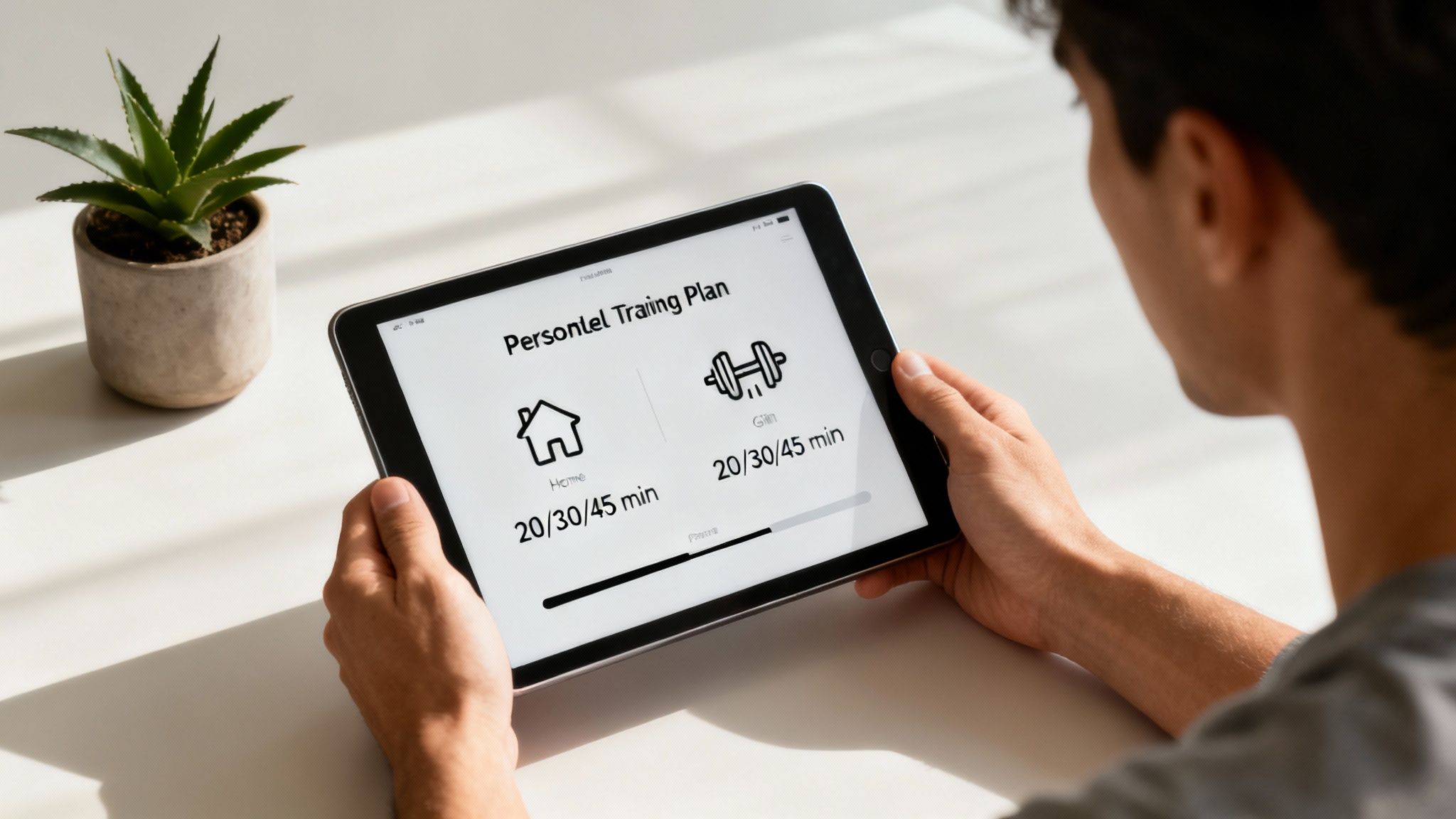
This approach eliminates the guesswork and intimidation that often derails fitness journeys. By aligning with your current fitness level and adapting as you get stronger, a personalized plan builds momentum and confidence. You stay engaged because the program feels like it was designed just for you, which fosters a sense of ownership and makes it easier to build a sustainable habit.
How to Implement This Strategy
To get the most out of personalization, provide as much accurate data as possible upfront and offer feedback as you progress. This allows the system or coach to fine-tune your plan for optimal results.
- Be Honest in Your Assessment: When starting with an app or coach, provide accurate information about your experience, available time, and any physical limitations. This ensures your initial plan is a perfect fit.
- Establish a Clear Baseline: Complete any initial fitness tests or assessments. This provides a data-driven starting point for the algorithm to build upon, making its adaptations much more precise.
- Provide Consistent Feedback: If a workout feels too easy or impossibly hard, use in-app feedback tools or communicate with your coach. This feedback loop is crucial for accelerating the customization process and keeping you in the optimal training zone.
For instance, Zing Coach begins with a detailed quiz and a Fitness Test to create your baseline. The AI then designs a program that adapts not just week to week, but also based on your fatigue levels and performance during each workout, ensuring you are always challenged appropriately to maintain motivation and drive progress.
3. Real-Time Form Feedback, Visual Demonstrations and Avatar Trainer Guidance
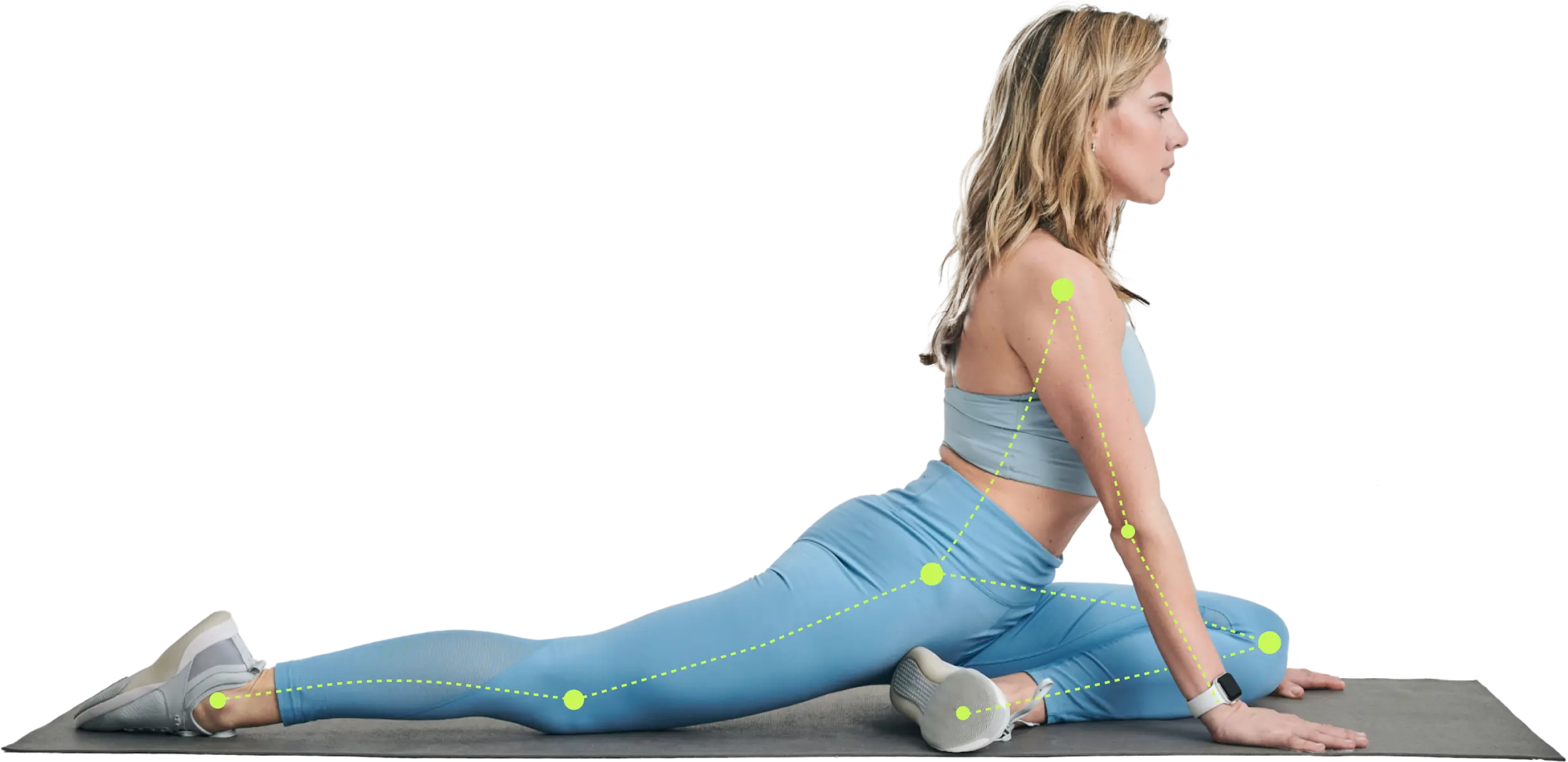
Nothing drains motivation faster than uncertainty or injury. When you're unsure if you're performing an exercise correctly, it's easy to lose confidence and skip workouts altogether. Real-time guidance using technology like computer vision provides instant, personalized coaching that removes the guesswork, ensuring every repetition is safe and effective.
This approach transforms your device into a smart personal trainer. It analyzes your movements, offers corrective cues on the spot, and counts your reps, allowing you to focus purely on your effort. This is a powerful workout motivation tip because it builds competence and confidence simultaneously. Feeling that you're mastering movements correctly creates a positive feedback loop that makes you eager for the next session.
How to Implement This Strategy
To leverage this technology, treat each workout as a skill-building session. Use the feedback not just to complete a set, but to perfect your technique and prevent injuries before they happen.
- Set Up for Success: Position your phone at waist height and about 6-8 feet away to give the computer vision a clear view. Ensure your workout space is well-lit for accurate tracking.
- Study and Execute: Before starting a new exercise, watch the animated avatar trainer demonstrate the correct form. Pay attention to details like joint alignment and range of motion.
- Act on Feedback Immediately: If the system flags a form issue, such as a rounded back during a deadlift, stop the set. Reset your position and focus on the specific cue. Early correction is key to building good habits.
For example, when using Zing Coach, the app's computer vision might detect partial range of motion in your squats. It will provide an immediate visual and audio cue to "Go lower," helping you correct the mistake mid-set. This instant guidance ensures you get the full benefit of the exercise while building a strong foundation for future progress.
4. Gamification and Streak-Based Motivation
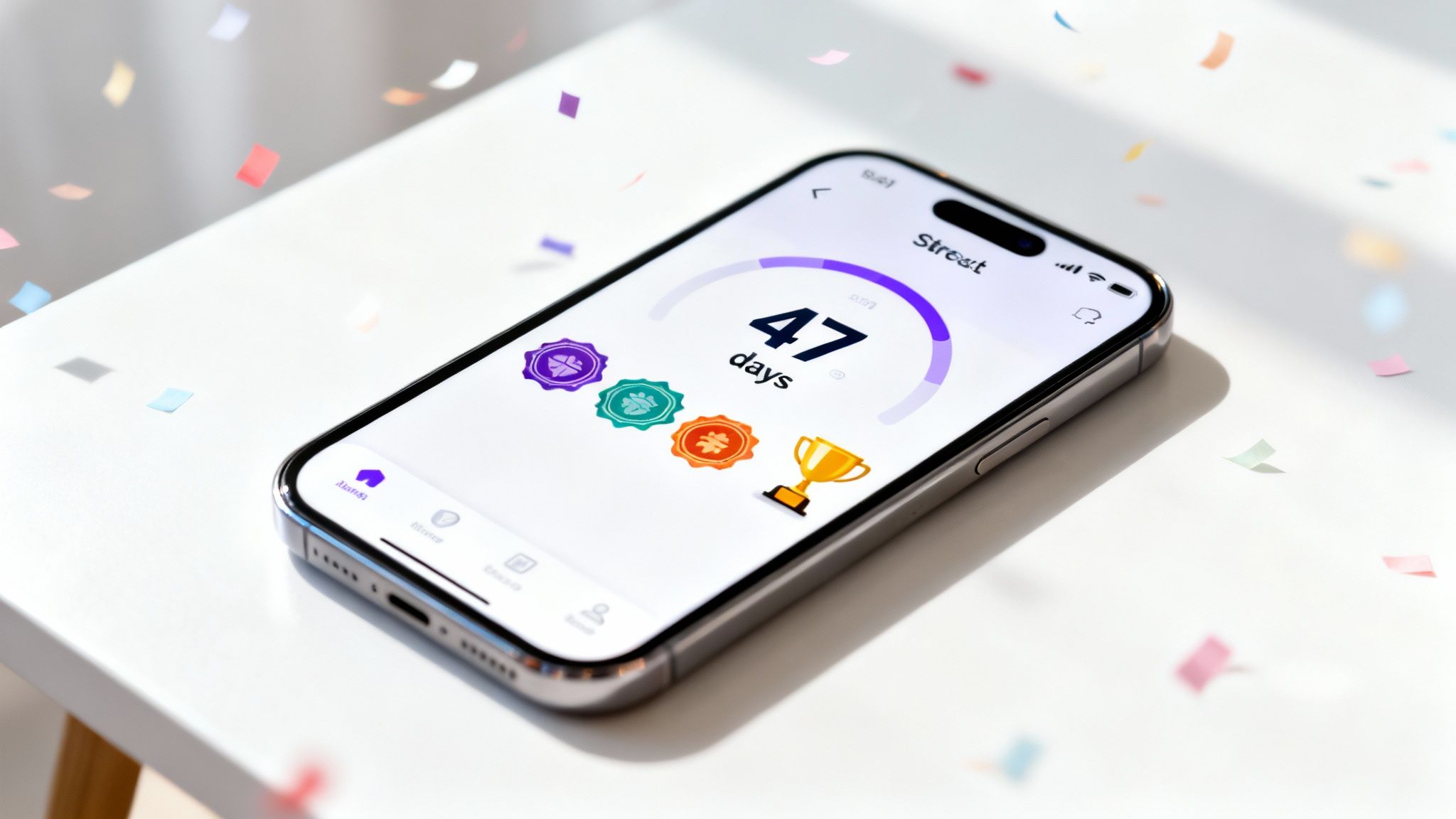
Turning fitness into a game taps into our brain's natural reward system, making exercise feel less like a chore and more like a challenge to be conquered. Gamification uses elements like streaks, badges, and progress bars to provide instant feedback and a sense of accomplishment. This method is particularly powerful for building consistency, as the desire to maintain a streak can be the push needed to show up on days when motivation is low.
This is one of the most effective workout motivation tips because it creates a compelling behavior loop: you complete a workout, you see your streak extend, and your brain receives a small dopamine hit, reinforcing the action. This transforms the abstract goal of “being consistent” into a tangible, daily victory, which is crucial during the early stages of habit formation.
How to Implement This Strategy
To use gamification effectively, focus on building momentum without creating unnecessary pressure. The goal is to make fitness fun and rewarding, not another source of stress.
- Don't Break the Chain: Focus on hitting a minimum frequency, like three workouts per week, to build a streak. The visual reminder of an unbroken chain is a powerful motivator.
- Set Realistic Streak Goals: Instead of aiming for a daily workout streak immediately, start with a more manageable target like completing all your scheduled sessions for two consecutive weeks.
- Celebrate Milestones: Acknowledge your progress when you hit a 30-day or 50-workout milestone. This reinforces how far you've come and refuels your drive to continue. If you miss a day, restart immediately without self-judgment.
For instance, Zing Coach uses a visual streak counter to show your consecutive workout days, sending celebratory notifications after you complete a tough session. The app also features challenges and achievements, such as unlocking a special badge for a 30-day streak, which adds an extra layer of motivation to keep you engaged and on track.
5. Nutrition Guidance Integrated with Training Goals
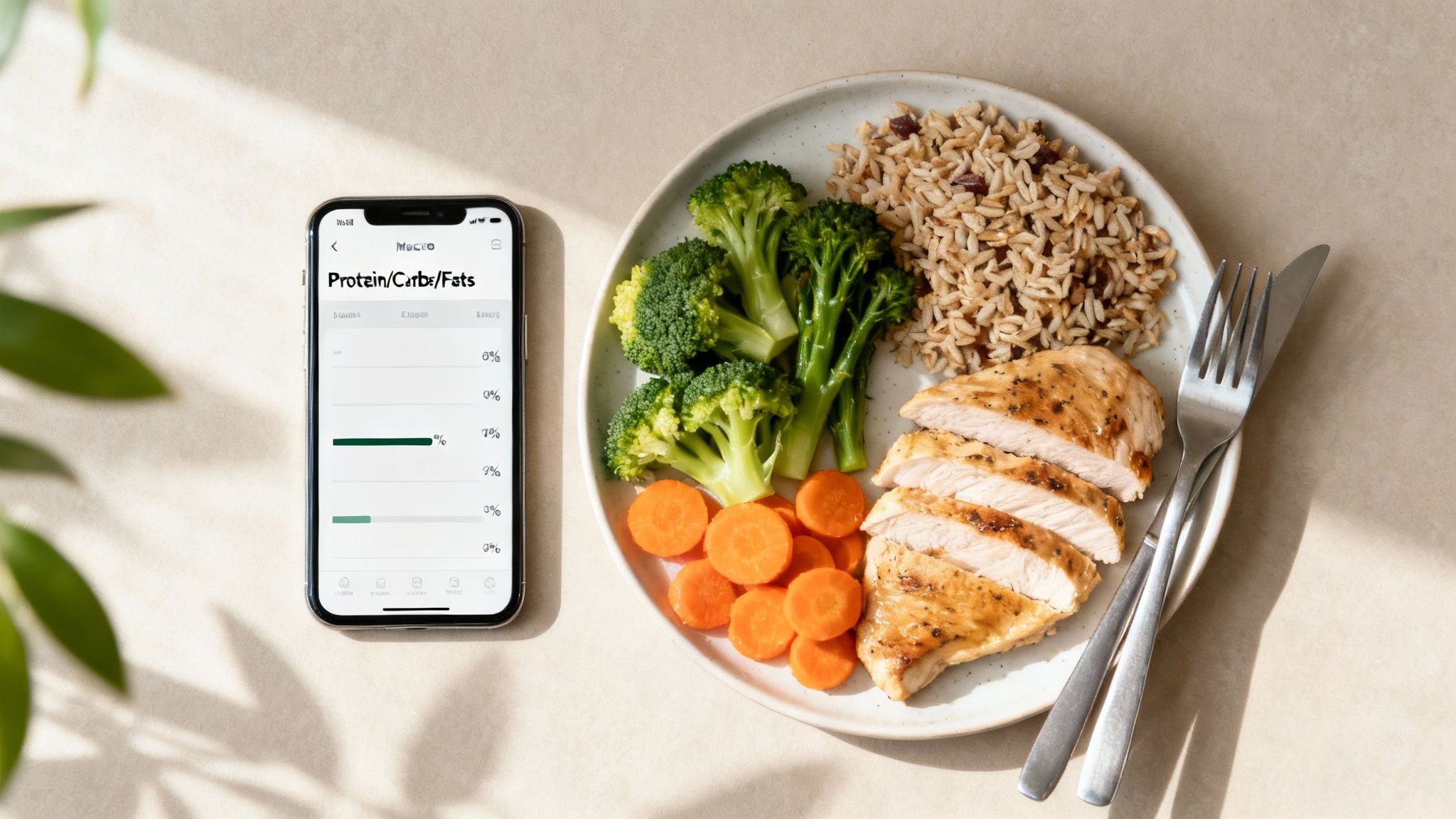
Exercise is only one part of the body composition equation; what you eat can either accelerate or sabotage your hard work in the gym. Integrating nutrition guidance with your training goals removes the guesswork, ensuring your diet directly supports your efforts. This creates a powerful synergy where your food intake fuels performance, optimizes recovery, and drives visible results like fat loss or muscle gain.
Aligning your eating habits with your fitness plan is one of the most impactful workout motivation tips because it creates a direct link between your daily choices and your progress. When you see your body fat percentage dropping or strength numbers increasing precisely because you hit your macro targets, it provides undeniable proof that your entire lifestyle is working in your favor. This positive feedback loop makes it easier to stay committed to both training and nutrition.
How to Implement This Strategy
To make this work, you must treat nutrition with the same level of planning and consistency as your workouts. The goal is to create a sustainable eating plan that fuels your specific objective.
- Establish Personalized Targets: Instead of following a generic diet, calculate your specific calorie and macronutrient needs. For fat loss, a 300-500 calorie deficit is a good starting point; for muscle gain, a 200-300 calorie surplus is effective.
- Prioritize Protein: Make protein the foundation of your plan. Aim for 0.7-1.0 grams per pound of body weight to preserve muscle during a fat-loss phase or support growth during a building phase.
- Log and Review: Use a food tracking app to monitor your intake and compare it against your targets. A weekly review will help you identify patterns and make necessary adjustments if your progress stalls.
For example, Zing Coach’s integrated nutrition guidance automatically sets your calorie and macro goals based on your fitness objective and Body Composition Scan data. As you train and your body changes, the app intelligently adapts these targets, ensuring your nutrition plan never becomes outdated and continues to drive results.
6. Adaptive Recovery and Fatigue Management
Pushing through fatigue can lead to burnout, injury, and a complete collapse of motivation. True long-term consistency isn't about training hard every single day; it’s about training smart. Adaptive recovery involves adjusting your workout intensity based on real-time feedback from your body, such as sleep quality, stress levels, and accumulated training fatigue, ensuring you make progress without overdoing it.
This intelligent approach prevents the cycle of overtraining and forced rest that derails so many fitness journeys. By listening to your body's readiness signals, you train optimally, pushing hard when you're recovered and easing off when you're not. This is one of the most powerful workout motivation tips for long-term adherence because it makes your training sustainable, reducing the risk of burnout and injury that often forces people to quit.
How to Implement This Strategy
To effectively manage fatigue, you need to integrate objective data with subjective feelings. This allows your training plan to be a dynamic guide rather than a rigid set of rules you must follow regardless of how you feel.
- Integrate Health Data: Connect your fitness app to a health tracker. For example, enable Apple Health integration so Zing Coach can automatically monitor your sleep, activity, and heart rate variability to assess your recovery status.
- Listen to Your Body (and Your App): If your tracker shows poor recovery after a sleepless night, trust the process when your app suggests a lighter session. Zing Coach might reduce the planned intensity by 20% to preserve progress without risking injury.
- Prioritize Nutrition: Effective recovery is impossible without the right fuel. For sustained workout motivation, effective recovery is key. Ensure your body gets the right nutrients after exercise by exploring the 8 best post-workout recovery foods.
For instance, after three consecutive hard training days, Zing Coach’s algorithm might detect accumulated central nervous system fatigue and automatically schedule a lighter, volume-focused session. This proactive adjustment enhances recovery, prevents performance dips, and keeps you feeling energized and ready for your next big workout.
7. Community Support and Accountability Partnerships
Going it alone can be tough, especially on days when your internal drive is low. Leveraging the power of social connection through an accountability partner or a supportive community transforms fitness from a solitary pursuit into a shared, engaging experience. This creates a powerful external motivator, making you less likely to skip a workout because you know others are counting on you or cheering you on.
This social layer provides encouragement, friendly competition, and a sense of belonging that internal motivation alone often can't match. This is one of the most resilient workout motivation tips because it builds a support system that holds you up during inevitable slumps. Knowing someone else is on the same journey provides validation and reinforcement, making the process feel less isolating and more rewarding.
How to Implement This Strategy
To make this method work, you must be intentional about finding the right people and setting clear expectations for mutual support. This turns a simple friendship into a powerful motivational tool.
- Find an Accountability Partner: Team up with a friend, coworker, or family member who has similar fitness goals. Agree to check in daily or weekly via text, sharing your completed workouts or challenges you're facing.
- Join a Community Challenge: Participate in group activities, whether it's a 30-day challenge or a team goal to reach a certain number of combined workouts. This fosters a sense of collective achievement.
- Share Your Progress and Wins: Don't be shy about posting your successes, like hitting a new personal record or completing a tough session. Celebrating with others reinforces positive behavior and can inspire them, too.
For example, you and a friend can join a Leaderboard challenge in the Zing Coach app to compete for the longest weekly workout streak. The friendly competition and shared goal provide an extra layer of motivation to stay consistent, ensuring neither of you wants to be the one to break the chain.
8. Efficient Time-Based Workouts That Fit Busy Schedules
The "I don't have time" excuse is one of the most common barriers to fitness consistency. The solution is to reframe workouts not by what you do, but by the time you have. Designing efficient, time-boxed sessions eliminates this obstacle by fitting exercise into your existing schedule, ensuring that even on the busiest days, you can make meaningful progress toward your goals.
This strategy shifts the focus from duration to density and intensity, proving that a well-structured 30-minute workout can be more effective than an unfocused hour. This is one of the most powerful workout motivation tips because it removes a key point of friction. Knowing you only need a small, defined time block makes starting the workout feel infinitely more manageable, leading to higher adherence and better long-term results.
How to Implement This Strategy
To make this method work, you must prioritize efficiency in both exercise selection and scheduling. The goal is to maximize every minute you have available.
- Choose a Realistic Duration: Be honest about your schedule. A 30-minute session completed four times a week is far superior to a 60-minute session you only manage once.
- Prioritize Compound Movements: In a short workout, focus on exercises that work multiple muscle groups at once, like squats, deadlifts, and overhead presses. These deliver the most bang for your buck.
- Schedule It Like a Meeting: Block out your workout time in your calendar and treat it as a non-negotiable appointment. This protects your time from other demands.
- Reduce Rest and Travel: Minimize rest periods between sets to maintain intensity and consider home workouts to eliminate travel time completely.
For instance, Zing Coach allows you to set your workout duration from 15 to 60 minutes. A busy professional can select a 30-minute session, and the app will generate a high-intensity, full-body routine that fits perfectly into a lunch break or before the workday begins, ensuring no time is wasted.
9. Data-Driven Progress Metrics and Body Composition Tracking
Relying solely on the number on the scale is a common motivation trap, as it fails to capture the full picture of your progress. A data-driven approach using body composition scans and performance metrics provides a more accurate and motivating view of your success. This method shifts your focus from simple weight loss to meaningful physical changes like gaining muscle and losing fat, which often occur without the scale budging.
Seeing objective proof that your body is changing for the better, even when your total weight is stable, provides powerful reinforcement. A user might weigh the same as eight weeks ago but see a scan showing they've lost eight pounds of fat and gained eight pounds of muscle. This is one of the most powerful workout motivation tips because it validates your hard work with concrete evidence, preventing discouragement from misleading scale fluctuations.
How to Implement This Strategy
To use data effectively, establish a baseline and focus on trends over time rather than daily noise. This ensures you're measuring what truly matters for your fitness goals.
- Establish Your Baseline: Before starting a new program, get a baseline body composition scan. This provides a crucial starting point to measure against later.
- Track Key Lifts: Monitor your performance in 2-4 primary exercises, such as squats or bench presses. A 20-pound increase in your squat is a clear sign of progress, regardless of what the scale says.
- Measure Monthly, Not Daily: Body composition and weight can fluctuate daily. To see real trends, measure monthly. This gives you a clear signal of your progress while filtering out insignificant daily changes.
- Look Beyond the Numbers: Remember that non-scale victories are just as important. How do your clothes fit? Do you have more energy? These are all valid indicators of success.
For example, you can use the integrated Body Composition Scan in the Zing Coach app to get your baseline. After a few weeks of consistent training, a new scan can reveal a decrease in body fat percentage, providing clear, visual proof that your efforts are creating real change and keeping your motivation strong.
10. Safe Exercise Modifications for Injuries and Limitations
Nothing kills motivation faster than an injury or the fear of aggravating a chronic limitation. Instead of seeing these as stop signs, view them as detours that require a smarter route. Injury-aware programming provides adaptive variations and alternative exercises, allowing you to train safely and consistently even when you can't perform certain movements. This keeps momentum high and prevents the all-or-nothing mindset that derails progress.
By proactively addressing limitations, you transform a potential obstacle into an opportunity to build resilience and intelligence in your training. This is one of the most empowering workout motivation tips because it removes the excuse of "I can't" and replaces it with "how can I?" Seeing that you can still make progress despite physical constraints reinforces your commitment and proves that consistency is always possible.
How to Implement This Strategy
The key is to work around your limitation, not through it. This involves substituting problematic exercises with effective, pain-free alternatives that still target the intended muscle groups.
- Be Honest About Limitations: During an initial assessment, like the one in Zing Coach, clearly communicate all past injuries, chronic pain points, or movement restrictions. This allows the system to generate a safe and appropriate plan from day one.
- Seek Smart Substitutions: If an exercise causes pain, don't just skip it. Use a feature that suggests modifications. For example, if overhead presses aggravate a shoulder, the app might suggest a landmine press or a machine-based alternative.
- Distinguish Between Pain and Discomfort: Learn the difference between sharp, stabbing pain (a clear signal to stop) and the mild discomfort or muscle fatigue associated with rehabilitation or safe movement.
- Progress Gradually: Start with conservative modifications, such as reduced range of motion or lighter loads. As your tolerance improves, you can progressively challenge yourself, ensuring a safe return to more advanced movements.
For instance, if you flag knee pain, Zing Coach can automatically adjust your leg day. It might reduce the depth of your squats, substitute lunges with glute bridges, and add supplementary work to strengthen the supporting muscles, keeping you on track without causing a flare-up.
10-Point Workout Motivation Comparison
| Strategy | Implementation complexity | Resource requirements | Expected outcomes | Ideal use cases | Key advantages |
|---|---|---|---|---|---|
| Set Specific, Measurable Goals with Progress Tracking | Low–Medium | Goal framework, tracking app, periodic scans or measurements | Clear direction, measurable progress, higher motivation | Users who need structure and accountability | Objective measurement, motivation, course correction |
| Personalized Training Plans That Match Your Fitness Level | Medium | Assessment quiz, AI algorithm, user data (schedule, equipment) | Higher adherence, faster progress, lower injury risk | Beginners to advanced users needing tailored plans | Reduces guesswork, scalable personalization |
| Real-Time Form Feedback, Visual Demonstrations and Avatar Trainer Guidance | High | Camera/computer vision, demonstration media, real-time processing | Safer technique, better exercise effectiveness, rep accuracy | Learners needing form coaching without a trainer | Injury prevention, instant correction, consistent form |
| Gamification and Streak-Based Motivation | Low | App UX for badges, streaks, notifications, leaderboards | Improved short-term consistency, habit formation | Users motivated by rewards, early habit builders | Boosts engagement, reinforces daily behavior |
| Nutrition Guidance Integrated with Training Goals | Medium | Nutrition calculator, macro database, logging/sync tools | Faster body-composition changes, aligned fueling | Users pursuing fat loss, muscle gain, or recomposition | Removes calorie guesswork, aligns nutrition with training |
| Adaptive Recovery and Fatigue Management | Medium–High | Sleep/activity integration (e.g., Apple Health), recovery algorithms | Reduced overtraining, optimized performance, sustained progress | Athletes and busy users with variable recovery | Prevents burnout, smarter intensity scheduling |
| Community Support and Accountability Partnerships | Low–Medium | Social features, groups, leaderboards, messaging | Increased long-term adherence, social motivation | Users who benefit from peer support and competition | External accountability, shared knowledge, belonging |
| Efficient Time-Based Workouts That Fit Busy Schedules | Low–Medium | Short session programs, minimal-equipment options, scheduling | Consistent training despite time limits, maintainable results | Busy professionals, parents, time-constrained users | Solves "no time" barrier, high adherence with short sessions |
| Data-Driven Progress Metrics and Body Composition Tracking | Medium–High | Body composition scans, strength metrics, dashboards | Objective trend visibility, better-informed adjustments | Metric-focused users and those tracking recomposition | Comprehensive evidence of progress beyond scale weight |
| Safe Exercise Modifications for Injuries and Limitations | Medium | Injury flags, alternative exercises, rehab protocols, expert input | Continued training with reduced risk, progressive return | Users with past injuries, chronic pain, or limitations | Enables safe participation, preserves momentum and confidence |
Build a Motivation System, Not a Moment of Inspiration
The journey to consistent fitness is often framed as a battle against a lack of motivation. We wait for a surge of inspiration to strike, hoping it will be enough to get us off the couch and into our workout gear. However, as we've explored through these ten evidence-backed strategies, relying on fleeting feelings is a recipe for inconsistency. The most effective workout motivation tips aren't about finding a magical spark; they're about building a robust, intelligent system that makes showing up the easiest choice.
True, sustainable motivation is an output, not an input. It’s the natural result of a well-designed ecosystem that removes friction, provides constant positive feedback, and adapts to your unique circumstances. This is a fundamental shift in perspective: instead of chasing motivation, you architect it.
From Inspiration to Implementation
Think of the key pillars we discussed. You're no longer just "trying to get in shape." Instead, you are:
- Setting specific, measurable goals and using data-driven progress metrics to see tangible proof of your efforts.
- Following a personalized training plan that meets you exactly where you are, eliminating the guesswork and intimidation that often leads to quitting.
- Leveraging real-time form feedback to build confidence and competence, ensuring every movement is safe and effective.
- Harnessing the power of gamification and streaks to create compelling reasons to stay consistent, even on days you don't feel like it.
- Integrating smart nutrition and recovery management into your routine, acknowledging that progress happens both inside and outside the gym.
Each of these strategies is a gear in a larger machine. When they work together, they create a powerful flywheel effect. Seeing your strength numbers increase (data-driven progress) fuels your desire to stick with your personalized plan. Hitting a new workout streak (gamification) makes you more likely to prioritize that session, even with a busy schedule. This is how you build an unbreakable chain of positive reinforcement.
Your Action Plan for Lasting Motivation
The ultimate takeaway is to stop waiting and start building. Your system won't be perfect overnight, but you can begin laying the foundation today. Pick one or two strategies from this list that resonate most. Is it finding an accountability partner? Or is it finally committing to a plan that adapts to your old knee injury?
The goal is to create a fitness environment where the path of least resistance leads directly to your workout. By combining smart goal-setting, adaptive technology, and a clear understanding of what truly drives you, you transform exercise from a chore you have to force yourself to do into a rewarding part of your identity. You are no longer someone who is trying to work out; you are someone who has a system that makes it happen.
Ready to stop chasing motivation and start building your own personalized fitness system? Let Zing Coach be your architect. With adaptive plans, real-time feedback, and progress tracking, it automates the hard parts so you can focus on building unstoppable momentum. Start building your system with Zing Coach today!
Share this article


Authors