Feeling stuck? why am i not getting stronger? Learn practical, actionable steps to push past plateaus and build lasting strength.

So, you're hitting the gym consistently, but you're still asking yourself, "Why am I not getting stronger?" It's a frustrating spot to be in. The answer usually comes down to one simple word: adaptation. Your body has gotten used to your current routine and now it needs a new challenge to keep growing.
This is a totally normal part of training called a strength plateau. Think of it as a good sign—it means you've mastered the current level and you're ready to graduate. It's just a signal that your programming, nutrition, or recovery needs a smart little tune-up.
The Plateau Problem: Why Your Strength Gains Vanished

It’s one of the most demotivating moments in any lifter's journey. You show up. You put in the work. You follow the plan to a T, but the numbers on the bar just refuse to budge. What worked like a charm for weeks or even months suddenly hits a dead end.
Trust me, you're not alone. This experience is incredibly common. It’s like playing a video game where you've figured out all the enemies' moves on the current level. To advance, you need to learn new skills or find better gear. In the gym, your body is the exact same. It needs new, progressively harder challenges to keep adapting and getting stronger.
Your Body Is an Adaptation Machine
The human body is an absolute master at adapting to stress. When you lift weights, you create tiny micro-tears in your muscle fibers. In response, your body doesn't just repair them; it rebuilds them bigger and stronger to handle that same stress more easily next time. This is the core principle of how we build strength.
But here's the catch: after repeating the same workout for a while, your body gets too good at it. The routine no longer provides enough of a challenge to trigger more adaptation. And just like that, progress grinds to a halt. Research confirms this is a nearly universal experience for anyone who lifts seriously.
Studies show that up to 80% of regular gym-goers hit a training plateau within their first 6-12 months of consistent lifting. Why? Because after just 4-6 weeks on the same routine, the rate of muscle protein synthesis can plummet by as much as 50%. This effectively stalls your strength gains unless you introduce a new stimulus.
This means hitting a plateau isn't a sign you're failing. It’s a predictable—and necessary—part of the process. It's your body's way of telling you it's time to shake things up. For a deeper dive, check out our guide with tips to prevent plateaus.
5 Common Reasons Your Strength Has Stalled
When you're stuck wondering why you aren't getting stronger, the culprit almost always falls into one of five key areas. Pinpointing which one applies to you is the first step to busting through that plateau and getting back on track.
Take a quick look at this table to see the most common reasons lifters get stuck.
| Problem Area | What It Looks Like | Quick Fix |
|---|---|---|
| Flawed Programming | Doing the same reps/sets for weeks; no planned increases in weight or intensity. | Introduce progressive overload: gradually add weight, reps, or sets. |
| Poor Recovery | Feeling constantly tired, sore, or weak; not getting at least 7-8 hours of sleep. | Prioritize sleep and schedule rest days or deload weeks into your plan. |
| Inadequate Nutrition | Not tracking calories or protein; losing weight when trying to build muscle. | Calculate your TDEE and eat in a slight caloric surplus with enough protein. |
| Incorrect Technique | Lifts feel unstable; you fail reps at weights that should be manageable. | Film your lifts or work with a coach to refine your form and improve efficiency. |
| Stress & Injury | High life stress, nagging aches, or old injuries flaring up. | Manage stress through mindfulness or other habits; address injuries with a pro. |
These five areas are the usual suspects behind every frustrating strength plateau.
Throughout this guide, we'll break down each of these issues. We'll help you figure out exactly what’s holding you back and give you clear, actionable strategies to reignite your progress and start hitting new PRs again.
Is Your Workout Plan Sabotaging Your Progress?
If you're asking yourself, "Why am I not getting stronger?" the first place you should look is your workout program. You can put in all the effort in the world, but it won't matter if the plan you're following isn't built for continuous improvement. The entire foundation of getting stronger rests on one, single concept: progressive overload.
It’s simple, really. Think about climbing a ladder. You can't reach the top by stepping on the bottom rung over and over again. To go higher, you have to reach for the next one, and then the one after that. Progressive overload is just like that, but for your muscles—you have to systematically increase the challenge over time. If you don't, you’re just treading water, expecting to move forward.
Your body is an amazing adaptation machine. It gets stronger in response to stress. But once it adapts, it needs a new, bigger stressor to keep changing. That workout that felt brutal six weeks ago? It probably feels pretty manageable now. That feeling of comfort is the enemy of progress.
The Problem of a Stale Routine
One of the most common mistakes I see is people sticking to the exact same exercises, sets, reps, and weights for way too long. Your muscles become incredibly efficient at those familiar movements, which means the very thing that once triggered growth no longer works. This is where so many lifters hit a wall.
A good plan has to evolve with you. How can you tell if your routine has gone stale? Grab your training log and look at the last 4-6 weeks. Do you see any of these red flags?
- Identical Numbers: Are you lifting the same weight for the same reps on your big lifts, week after week?
- No Variation: Do you always do the same exercises in the same order? For example, is every chest day started with a flat barbell bench press?
- It Feels Easy: Are the workouts no longer challenging? Are you rarely pushing close to muscular failure on your last few reps?
If your training log looks more like a copy-paste job than a story of your progress, your program is almost certainly the culprit. To get a deeper understanding of the science here, you can learn more about what progressive resistance training is and why it's so critical.
Finding Your Goldilocks Training Volume
Another classic mistake is getting your training volume wrong—either doing way too much or far too little. Volume is the total work you do, usually calculated as sets x reps x weight. It’s a delicate balancing act.
- Too Little Volume: If your workouts are too short or not intense enough, you're not sending a strong enough signal to your body to adapt and grow. It's like whispering at your muscles when you need to shout.
- Too Much Volume: On the flip side, burying yourself in volume can lead to overtraining, gnawing fatigue, and burnout. This actually makes you weaker, not stronger, because your body simply can't keep up with the recovery demands.
Your "just right" or Goldilocks volume depends on everything from your fitness level and recovery capacity to your nutrition and sleep. Trying to find that perfect amount without a way to measure these factors is just blind guesswork. You might be working hard, but if the volume is off, you’ll eventually stall out.
Progressive Overload in Practice: Remember, you don't always have to add more weight to the bar. You can also progress by adding another rep with the same weight, doing an extra set, cutting your rest time between sets, or improving your lifting tempo (like slowing down the eccentric or "negative" part of a lift). The goal is simply to make the work harder than it was last time.
How Smart Technology Ends the Guesswork
Manually tweaking all these variables—intensity, volume, exercise selection, rest periods—is a massive headache. It's complicated, it's time-consuming, and it's easy to get wrong. This is where an intelligent system can be a game-changer. You need a plan that adapts with you, not one that remains frozen in time.
The Zing Coach app was built to solve this exact problem. It removes the guesswork from progressive overload by using AI to create and continuously fine-tune your workout plan.
- Performance-Based Adjustments: The app tracks how you perform in every single session. When you successfully hit your target reps, it intelligently increases the weight or reps for your next workout, ensuring you're always being challenged.
- Fatigue Integration: By syncing with Apple Health, Zing keeps an eye on your fatigue levels and daily activity. Had a terrible night's sleep or a super stressful day? The app can dial back the workout's intensity to prevent overtraining and prioritize recovery.
- Automated Progression: Based on your initial fitness tests and your ongoing performance, Zing automatically applies the principles of progressive overload. It keeps your program tough enough to drive results without pushing you over the cliff into burnout.
With this kind of system, your workout plan stops being a static document and becomes a dynamic, responsive partner in your fitness journey. It ensures you’re always reaching for that next rung on the ladder, turning the frustration of a plateau into a history of consistent, measurable gains.
Are You Eating Enough To Fuel Your Strength

You can have the most dialed-in workout program on the planet, but if your nutrition is off, you're trying to build a brick house without any bricks. Your training sessions are just the stimulus. The real magic of getting stronger happens when your body uses nutrients to repair and rebuild muscle tissue.
Think of your body as a high-performance engine and food as its fuel. Without enough of the right kind of fuel, that engine is going to stall out.
So many people asking "why am I not getting stronger?" are unknowingly sabotaging themselves in the kitchen. This is especially true if you're also trying to lose weight. A large calorie deficit is fantastic for shedding pounds, but it creates an environment where your body just doesn't have the resources to build new, stronger muscle. Building strength is an energy-intensive process, and under-eating brings it to a screeching halt.
Calories: The Energy Currency For Strength
Before we even get into specific foods, we have to talk about calories. A calorie is simply a unit of energy. To build strength, you need to give your body enough energy to not only get through your day and your workout but also to have some left over for muscle repair and growth.
For most people looking to gain strength, this means eating in a slight calorie surplus—consuming a few more calories than your body burns each day. This gives your body the raw materials it needs to get stronger. Trying to build significant strength in a large deficit is like trying to drive from New York to Los Angeles on a quarter tank of gas. You’ll run out of fuel long before you reach your destination.
A modest surplus of just 250–500 calories above your daily maintenance level is often the sweet spot. This provides enough energy to fuel muscle growth without promoting excessive fat gain, allowing you to get stronger efficiently.
If you aren't tracking your food intake, you're flying blind. You might think you're eating a lot, but you could still be falling way short of the energy your body needs to adapt to your training.
Macros: The Building Blocks Of Muscle
Once your calorie intake is set, the next piece of the puzzle is your macronutrients—protein, carbohydrates, and fats. Each one plays a critical role in your strength journey.
- Protein: This is the undisputed MVP for building muscle. The amino acids in protein are the literal building blocks your body uses to repair the micro-tears in your muscles caused by lifting.
- Carbohydrates: These are your body’s primary energy source. Carbs fuel your workouts so you can lift with high intensity, and they help replenish your muscle glycogen stores after you’re done.
- Fats: Healthy fats are essential for hormone production, including hormones like testosterone that are vital for muscle growth and strength.
Under-fueling on any of these can be a major reason you're not getting stronger. However, study after study shows that protein is where most people fall short. One recent study even highlighted that around 70% of trainees don't get enough protein to maximize their results.
A Simple Plan For Fueling Strength
So, how do you figure out your specific needs? Here are two simple formulas to get you started on the right track:
- Estimate Your Calorie Needs: Start by calculating your maintenance calories. You can use an online calculator or follow our in-depth guide on how to calculate your daily calorie needs. Once you have that number, add 250-500 calories to create your target surplus.
- Calculate Your Protein Target: Aim for 1.6 to 2.2 grams of protein per kilogram of your body weight (that’s about 0.7-1.0 grams per pound). For anyone serious about getting stronger, hitting this target is non-negotiable.
This data-driven approach is far more effective than just "eating healthy." But we get it—constantly tracking numbers can be tedious and complicated, especially when you're busy.
This is where a tool like Zing Coach becomes your nutritional co-pilot. The app's nutrition guidance takes all the complexity out of the equation. Based on your goals, body metrics, and activity level, it generates personalized daily targets for both calories and macros. It makes sure you’re consistently feeding your muscles what they need for optimal repair and growth, so you can focus on lifting while the app handles the numbers.
2. You’re Not Taking Recovery Seriously

It’s easy to think that you get stronger in the gym. But that’s a huge misconception. The hard truth is that strength isn’t built while you’re grinding out reps; it’s built while you’re resting afterward.
Your workout is the demolition phase—it sends a signal to your body by creating tiny micro-tears in your muscle fibers. Recovery is the construction phase, where your body gets to work repairing those fibers, building them back bigger and stronger than before.
If you skip out on this crucial construction phase, you're just doing demolition work with no rebuilding. That’s a surefire way to hit a plateau. Feeling constantly tired, sore, and weak? Your body is waving a giant red flag, telling you it desperately needs more time and resources to recover. Asking "why am I not getting stronger?" when you’re barely sleeping is like wondering why a construction site isn't finished when the crew never shows up.
The two pillars holding up this entire process are high-quality sleep and strategic rest days. Get these right, and you’ll unlock consistent gains. Get them wrong, and you might as well board up the gym door.
Sleep: The Ultimate Performance Enhancer
Sleep isn't just passive downtime; it's the single most powerful recovery tool you have. While you’re out, your body is in overdrive, releasing key anabolic hormones like human growth hormone (HGH) and testosterone. Think of these hormones as the foremen of your body's construction crew, directing the repair and growth of your muscle tissue.
When you consistently get less than the recommended 7-9 hours of sleep, you’re robbing your body of this critical hormonal surge. Your cortisol levels—the stress hormone that breaks down muscle—stay sky-high, while your muscle-building hormones take a nosedive. This creates a catabolic environment where you’re more likely to lose muscle than build it.
Getting enough quality rest is non-negotiable for muscle repair and hormone regulation. If this is a weak point for you, learning how to improve sleep quality is one of the best things you can do for your gains.
The Power of the Deload Week
Sometimes, the smartest move to get stronger is to actually train less. This is the whole idea behind a deload week—a planned period where you dial back your training intensity and volume. It’s not a week off, but a strategic step back that lets your body and central nervous system fully recover from all the fatigue you've built up.
Picture your progress like a slingshot. A deload week is when you pull the rubber back. You’re temporarily easing the tension so that when you let go, you launch forward with way more power than before.
This short period of active recovery helps:
- Repair Connective Tissues: Your joints, tendons, and ligaments recover much more slowly than your muscles. A deload gives them a much-needed break.
- Reduce Mental Burnout: Grinding at high intensity week after week is mentally draining. A deload is the perfect way to refresh your motivation.
- Enable Supercompensation: This is the rebound effect where your body adapts to a level beyond its previous state, setting you up for new strength gains.
Ignoring scheduled rest can lead to chronic fatigue and elevated stress hormones. According to a 2026 HFA Global Report, a shocking 65% of lifters battle chronic fatigue from poor rest. This can slash your force production by 10–15% weekly, and getting less than 7 hours of sleep can cut growth hormone by 30%—effectively slamming the brakes on your progress.
Zing Coach's Intelligent Recovery System: Manually guessing when you need a deload is tricky. This is where Zing Coach comes in, analyzing your health data to automate recovery. By syncing with your device's health metrics, it tracks fatigue signals and can automatically adjust your program's volume and intensity. This data-driven approach helps you recover smarter, stopping overtraining before it starts and helping you smash through plateaus safely. For a deeper dive, check out our guide on the importance of rest days.
How Poor Lifting Form Is Holding You Back
Perfecting your workout program and dialing in your nutrition are huge steps, but if your progress has still stalled, the problem might be how you move. Lifting with improper form is like trying to fire a cannon from a canoe—it’s unstable, inefficient, and you're not directing force where it needs to go. This is a classic reason you're not getting stronger.
When your form breaks down, two major things happen. First, your risk of injury skyrockets. More importantly for your plateau, the wrong muscles end up doing the work. This means the target muscles you’re trying to strengthen don't get the right stimulus for growth, and your progress grinds to a halt.
The Squat: A Case Study in Flawed Form
Let's use the squat as a clear example. You load the bar, ready to hit a new personal record. As you descend, your chest collapses forward, your lower back rounds, and your knees cave inward. You struggle to push back up and either grind out a shaky rep or fail completely.
Sound familiar? This isn't just a "bad rep." It's a sign that your technique is the weak link holding back your strength.
- Collapsing Chest: When your torso pitches forward, the load shifts from your powerful legs and glutes onto your lower back. Your back isn't designed to be the primary mover in a squat, so it quickly becomes the point of failure.
- Knee Valgus (Knees Caving In): This common issue often signals weak glute medius muscles. It puts immense stress on your knee joints and robs you of power, preventing you from using your strongest leg muscles to drive the weight up.
In this scenario, you're not failing because your legs aren't strong enough. You're failing because your form is preventing you from using their full power. You’re asking smaller, weaker support muscles to do a job they weren't built for, which is a recipe for stalled gains.
Your Virtual Spotter for Perfect Technique
Fixing your form can feel overwhelming, especially when you train alone. It’s hard to know what you’re doing wrong when you can’t see yourself. Filming your lifts helps, but what if you had a spotter who could give you feedback on every single rep? This is where technology offers a powerful solution.
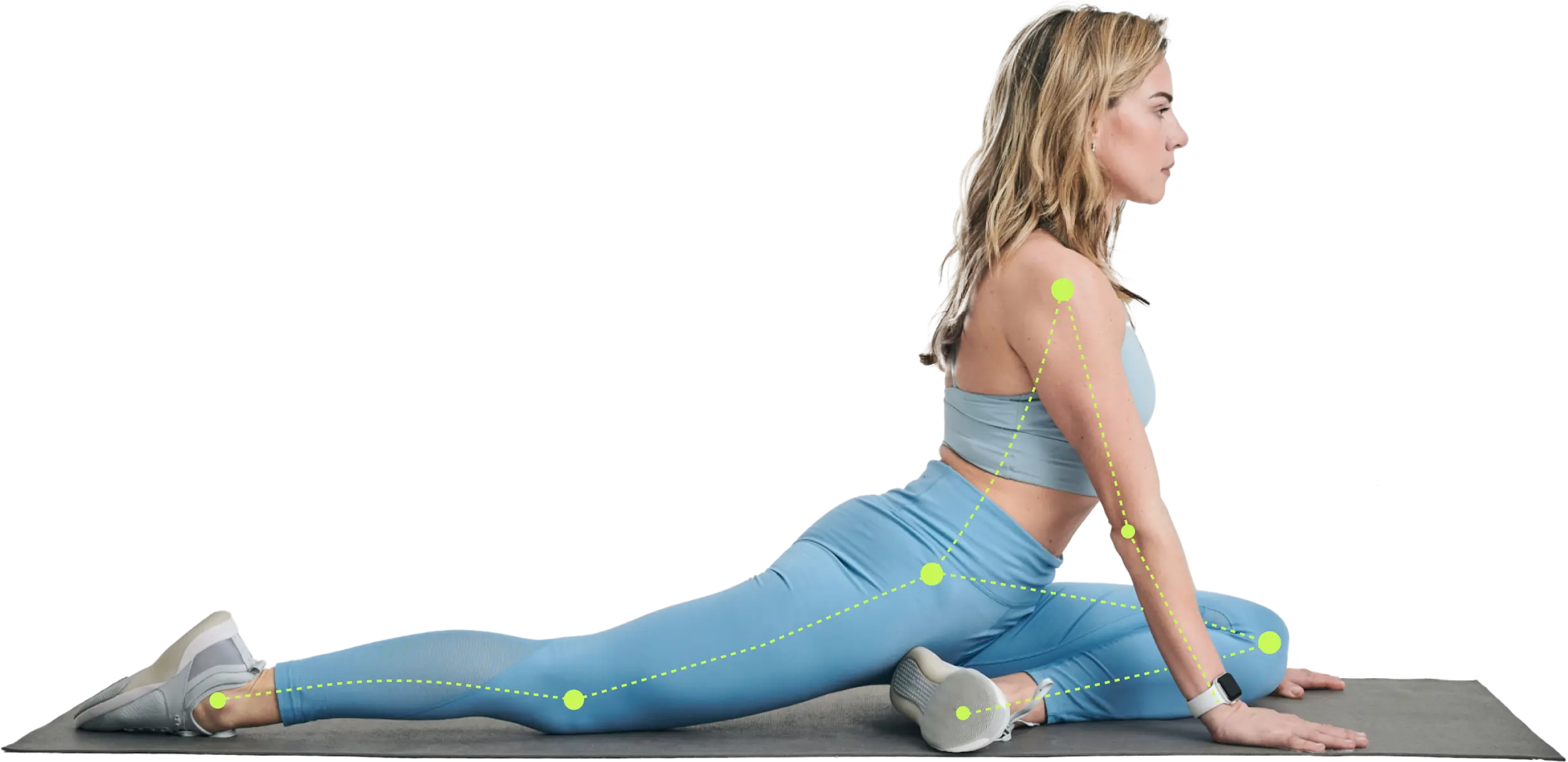
The Zing Coach app acts as your personal technique expert, using your phone’s camera and AI to analyze your movements in real time. It's built to ensure every rep you perform is safe, effective, and actually contributes to your goal of getting stronger.
Proper form isn't just about safety; it's about efficiency. A clean, mechanically sound lift allows you to recruit the maximum number of muscle fibers and channel all your energy directly into moving the weight. This neuromuscular efficiency is the secret ingredient to unlocking new levels of strength.
How AI-Powered Form Correction Works
Zing Coach's computer vision technology turns your phone into a smart spotter that guides you toward better, safer movement patterns. It focuses on precision to make sure your hard work translates into real results.
Here’s how it helps you break through a form-related plateau:
- Real-Time Movement Tracking: The app uses your camera to map key points on your body, tracking your joint angles and movement paths during each exercise.
- Instant Feedback and Cues: If your form deviates—like your chest collapsing in a squat or your hips rising too fast in a deadlift—the app can provide on-screen alerts to help you correct it mid-set.
- Accurate Rep Counting: It counts only the reps that meet the proper range of motion criteria. This holds you accountable and ensures you're not cheating yourself with half-reps.
For beginners, this feature builds the confidence to train correctly from day one. For experienced lifters, it offers the kind of detailed feedback needed to refine technique and squeeze out every last bit of potential. By ensuring every rep counts, Zing Coach helps you stop wasting effort on sloppy form and start translating that effort into measurable strength.
Your Action Plan To Start Getting Stronger Now
Knowing why you’re not getting stronger is one thing. Actually doing something about it is another. Now it's time to turn that knowledge into a straightforward plan to finally break your plateau and get those numbers moving in the right direction again.
This isn't about guesswork; it's about making specific, targeted changes. We're going to audit your current approach, dial in your weak points, and start building momentum today.
Your Plateau-Busting Checklist
Use this simple checklist to systematically figure out what’s holding you back. The key is to not try and fix everything at once. Find your single biggest weak point and pour your energy there first. That’s how you’ll see the most significant impact.
- Audit Your Program: Grab your training log and look at the last 4-6 weeks. Are you consistently applying progressive overload—adding a little weight, another rep, or an extra set? Or have your workouts gone stale? If it looks repetitive, it’s time for a change.
- Verify Your Nutrition: Track everything you eat for three full days. Be honest. Are you actually hitting your calorie and protein targets? For growth, you should aim for a modest surplus of 250-500 calories and between 1.6-2.2 grams of protein per kilogram of body weight.
- Prioritize Recovery: Are you getting at least 7-8 hours of quality sleep every single night? If the answer is no, this is your number one priority. Full stop. You might also want to schedule a deload week to give your body and nervous system a much-needed break.
- Refine Your Technique: This one is easy. Film your main lifts from the side and front. Does your form hold up when the weight gets heavy, or does it start to break down?
Breaking through a plateau requires a holistic approach that covers your training, recovery, and nutrition. You can learn how to improve athletic performance with proven strategies that address all these critical areas.
This decision tree shows just how critical lifting form is. Good technique leads to progress, while bad form is a dead end.

As you can see, your technique is a fundamental fork in the road. It determines whether all your hard work actually translates into real strength.
Let Technology Do the Heavy Lifting
Trying to execute this plan perfectly can feel like a full-time job. You’re juggling adaptive programming, calculating nutrition targets, and monitoring recovery—all complex, moving parts. This is where the Zing Coach app can be your secret weapon for finally breaking through.
Think of Zing Coach as the project manager for your strength goals. It handles the complicated logistics of your training plan so you can focus purely on execution—lifting the weights and recovering effectively.
The app automatically adjusts your workouts based on your performance, making sure you’re always pushing forward. It gives you personalized nutrition targets and uses your health data to gauge fatigue, helping you train smarter, not just harder.
If you're just starting out and need a solid foundation, check out our beginner strength training program to see how a structured plan should work. With its progress-tracking features, you’ll get tangible proof that you're finally getting stronger, giving you the motivation you need to stay consistent.
Frequently Asked Questions
Even with a solid plan, a few questions always seem to pop up. To give you some extra clarity, let’s go over some of the most common things people ask when they’re wondering, "why am I not getting stronger?"
How Long Does It Take To Break A Strength Plateau?
Breaking a plateau usually takes anywhere from 2 to 6 weeks, but honestly, it all comes down to the root cause. If it’s something small, like you just didn't eat enough for a couple of days, you could see a change almost as soon as you fix it.
But for bigger issues, like chronic overtraining or a program that’s gone completely stale, the timeline will be longer. You might need a full deload week to let your body recover, followed by several weeks on a fresh, optimized routine before you start hitting new personal records.
Can I Build Strength And Lose Weight At The Same Time?
Yes, you absolutely can. This process is often called "body recomposition." It’s most common in beginners, but it's a tough balancing act because building muscle (anabolism) and losing fat (catabolism) are fundamentally opposing goals.
To pull it off, you need a few key things to be perfectly aligned:
- A very high protein intake of around 1.8-2.2 grams per kilogram of body weight.
- A small, controlled calorie deficit—think just 200-300 calories below your maintenance level.
- A heavy, consistent resistance training program.
Just know that progress will be slower than if you were chasing only one goal at a time. Patience is your best friend here.
Should I Change My Entire Workout To Break A Plateau?
Not necessarily. In fact, making small, strategic tweaks is often much more effective than a complete overhaul. Tearing everything down can mess with your momentum and make it impossible to figure out what’s actually working.
Instead of scrapping your whole routine, just make one smart adjustment. More often than not, a single change is all it takes to give your body the new stimulus it needs to start adapting again.
Try one of these simple moves:
- Switch up your rep scheme (e.g., go from 3x10 to 5x5).
- Swap a primary lift for a similar variation (e.g., barbell bench press for dumbbell press).
- Slightly shorten your rest times between sets.
Stop guessing and start progressing. Zing Coach uses AI to automatically adjust your workouts, nutrition, and recovery based on your real-time data, ensuring you're always on the fastest path to getting stronger. Take the guesswork out of your training by downloading the app.
Share this article


Authors