Discover what is progressive resistance training and learn proven strategies for building muscle and strength. Start your fitness journey with expert tips.
At its core, progressive resistance training is the simple, powerful idea of consistently making your workouts more challenging over time. Think of it as the secret sauce behind almost every effective fitness plan. To keep getting stronger, building muscle, or boosting your endurance, you have to gradually increase the demands you place on your body.
Decoding Progressive Resistance Training
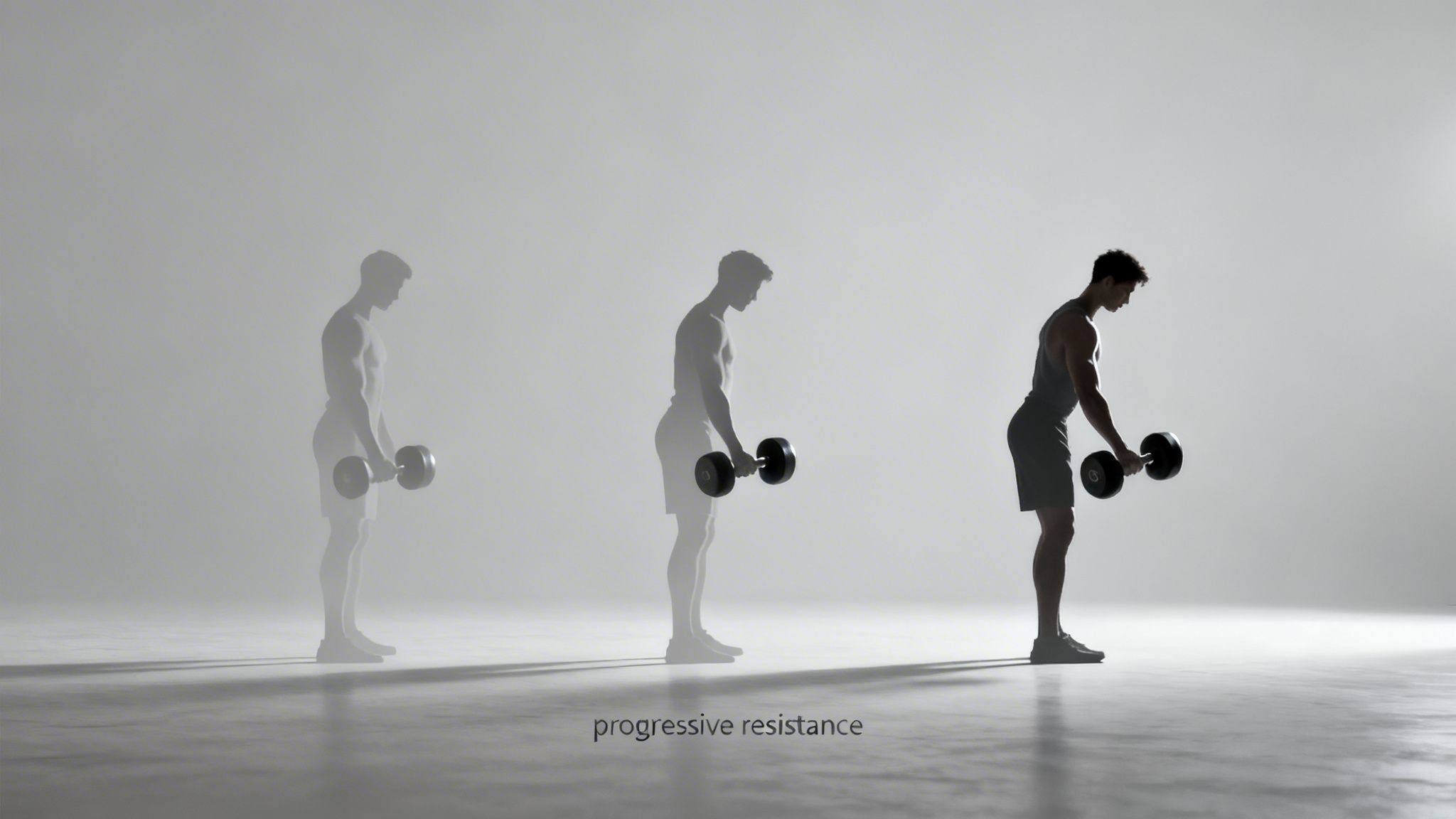
Imagine you're building a wall. If you keep using the same small bricks over and over, you'll eventually hit a point where the wall just doesn't get any taller. Your muscles operate on a similar principle.
If you show up to the gym and lift the same weight for the same number of reps, week in and week out, your body quickly adapts. It gets comfortable. Once that happens, it has absolutely no reason to change. Progressive resistance training (PRT) is the structured process of adding "bigger bricks" to your workout—forcing your body to adapt, rebuild, and come back stronger.
But this isn't about mindlessly piling more weight onto the bar. Real progression is a strategic game. It's about tweaking different parts of your workout to present a fresh challenge that pushes you just beyond your comfort zone.
The Foundation of Modern Fitness
While it might feel like a new-age gym concept, the idea of getting stronger by lifting heavier things is ancient. Its journey into a structured training system, however, has a fascinating history. PRT as we know it began to take shape when weightlifting first appeared at the 1896 Olympic Games, signaling a move from basic feats of strength to more organized programs.
Fast forward to the 1960s and 70s, and PRT exploded in popularity, thanks to fitness icons and the golden age of bodybuilding. It went from an obscure practice for elite athletes to a fundamental principle for anyone looking to get healthier. For a deeper dive, check out this in-depth analysis of strength training's evolution.
The central pillar of PRT is the principle of adaptation. Your body is an incredibly efficient machine designed to handle the stresses it regularly encounters. To trigger change, you must introduce a stressor it isn't used to.
This core concept is what we call progressive overload—it's the engine that drives all physical improvement. You can learn more about applying this key principle in our guide on progressive overload training. By systematically upping the challenge, you create a cycle of continuous improvement where your body never gets a chance to plateau.
To make this clearer, let's break down the key ideas that make PRT work so well.
The Core Principles of Progressive Resistance Training
| Principle | What It Means | Why It Matters |
|---|---|---|
| Progressive Overload | Gradually increasing the stress on your muscles over time. | This is the fundamental trigger for adaptation. Without it, your muscles have no reason to grow stronger or bigger. |
| Specificity | Training in a way that directly targets your specific fitness goals. | Your body adapts specifically to the demands you place on it. To get better at squatting, you need to squat. |
| Variation | Changing up exercises, intensity, or volume to avoid plateaus. | Variation keeps your body guessing and stimulates different muscle fibers, preventing boredom and overuse injuries. |
| Recovery | Allowing your body enough time to repair and rebuild between workouts. | Muscle growth and strength gains happen during rest, not during the workout itself. Without proper recovery, you risk overtraining. |
These principles aren't just abstract theories; they are the practical building blocks of any successful and sustainable training plan. Getting them right is the key to unlocking consistent results.
The Science of How Your Muscles Get Stronger
Ever wonder what’s actually happening under the hood when you lift a dumbbell or grind out a squat? It’s not magic—it's a fascinating biological process that systematically turns effort into raw strength. The engine driving all of this is a principle called progressive overload.
Think of your muscle fibers like a team of construction workers. When you challenge them with resistance that's heavier or more demanding than what they’re used to, you create tiny, harmless tears in the muscle tissue. This isn't a bad thing; in fact, it's the exact signal your body needs to kickstart the adaptation process.
This signal sends your internal construction crew into overdrive. During your recovery period—when you're resting, not when you're lifting—your body gets to work repairing these micro-tears. But it doesn't just patch them up to their original state. Instead, it rebuilds them bigger and stronger, reinforcing them to better handle that same stress next time. This powerful muscle-building process is called hypertrophy.
The Three Dials of Progression
To keep this cycle of breakdown and repair chugging along, you have to keep introducing new challenges. Just lifting heavier weight is only one part of the puzzle. You actually have three main "dials" you can turn to make sure you keep getting stronger:
- Intensity: This is the most obvious one—it’s simply how much weight you're lifting. Gradually increasing the load is a direct way to tell your body it needs to build more strength.
- Volume: This is the total amount of work you do, calculated by multiplying your sets and reps. You can dial up the volume by adding another set or squeezing out a few more reps with the same weight.
- Frequency: This dial controls how often you train a specific muscle group. Training legs once a week will get you results, but bumping that to twice a week can seriously speed up the process, as long as you’re getting enough recovery time.
Making small, strategic tweaks to these dials is what keeps your body from hitting a plateau. You don't have to crank all three at once. Often, a slight adjustment to just one is enough to trigger a new wave of growth.
The real takeaway here is that your muscles don't grow during your workout—they grow during your recovery. The training session is just the stimulus. The magic happens when you rest, refuel, and give your body the resources it needs to rebuild.
This process works wonders for people of all ages. A groundbreaking large-scale review found that high-intensity PRT performed two to three times per week significantly improved physical function in older adults, making daily tasks like getting out of a chair much easier. The study also showed that for coronary patients, PRT was just as good as aerobics for fitness improvements but delivered far greater gains in both upper and lower-body strength.
Knowing how to track these changes is crucial for long-term success. You can dive deeper into that with our guide on how to measure muscle gain. And since you can't out-train a bad diet, understanding how nutrition fuels muscle repair is just as important; a well-structured plant-based diet for athletes can provide all the building blocks your body needs.
The Real-World Benefits of Getting Stronger
Progressive resistance training does way more than just build bigger muscles. The benefits ripple through every part of your daily life, making you more resilient, energetic, and capable. Think of it less as just "working out" and more as an investment in your long-term health and functional independence.
When you consistently challenge your muscles, you build lean muscle mass. This is a huge deal because muscle is metabolically active tissue. The more muscle you have, the higher your resting metabolic rate becomes, which means your body burns more calories all day long—even when you're just sitting at your desk. It’s like upgrading your body’s engine for powerful, long-term fat loss and weight management.
From the Gym to Daily Life
The strength you build in the gym doesn't stay there. It shows up in countless ways, making everyday tasks feel practically effortless.
- Improved Functional Strength: Suddenly, carrying heavy groceries, hoisting a suitcase into an overhead bin, or playing with your kids becomes easier and a lot safer.
- Enhanced Posture and Reduced Pain: Building a stronger core and back gives your spine the support it needs. For many people, this leads to significant improvements in posture and can even reduce chronic lower back pain.
- Increased Bone Density: Resistance training puts just the right amount of stress on your bones, signaling your body to deposit more minerals and thicken up. This is one of the single most effective ways to fight age-related bone loss and lower your risk of osteoporosis.
This simple graphic shows you exactly how your muscles adapt and grow stronger through this whole process.
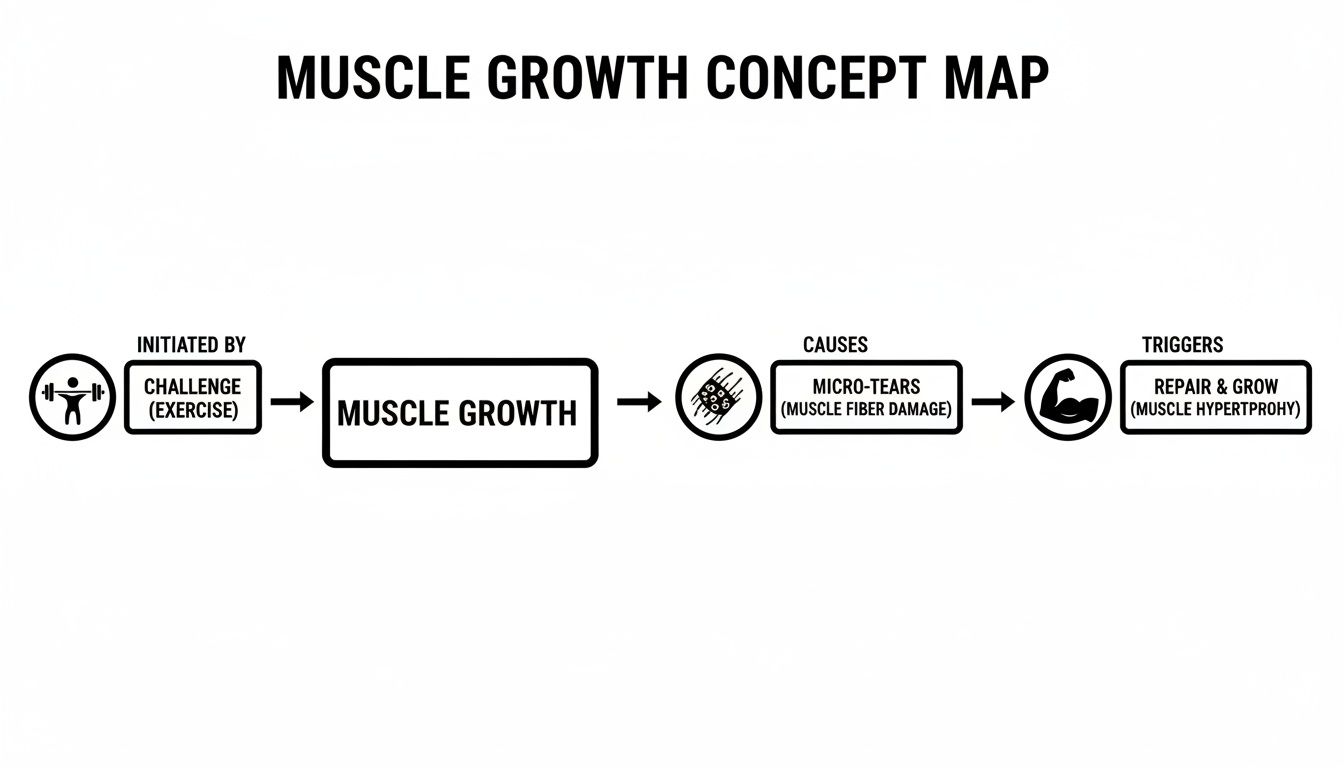
This cycle of challenge, micro-damage, and repair is the fundamental engine that builds a stronger, more resilient you.
Mental and Emotional Gains
The payoff from progressive resistance training goes way beyond the physical. The mental rewards are just as profound, creating a positive feedback loop that builds confidence and a real sense of well-being. Hitting a new personal record or just mastering a tough exercise gives you a tangible win that spills over into other areas of your life.
Plus, a great workout is a powerful stress buster, helping to regulate your mood and sharpen your mental clarity. The benefits are so noticeable they can even make a difference at work. For instance, one workplace study found that participants who did just 20-minute PRT sessions three times a week reported huge drops in perceived fatigue—slashing muscular fatigue by 10-14%. You can read more about the study’s findings on muscular strength.
The process of getting stronger teaches you resilience, discipline, and the power of consistency. These are not just gym skills; they are life skills that empower you to tackle any challenge with greater confidence.
At the end of the day, progressive resistance training is a cornerstone of holistic health. It equips your body and your mind to handle whatever life throws your way.
How to Start Progressive Resistance Training Safely
Jumping into progressive resistance training is an exciting step, but long-term success hinges on starting smart. The real goal isn't just to lift heavy right out of the gate—it's to master the fundamental movements and build a rock-solid foundation that keeps you injury-free and ensures consistent progress.
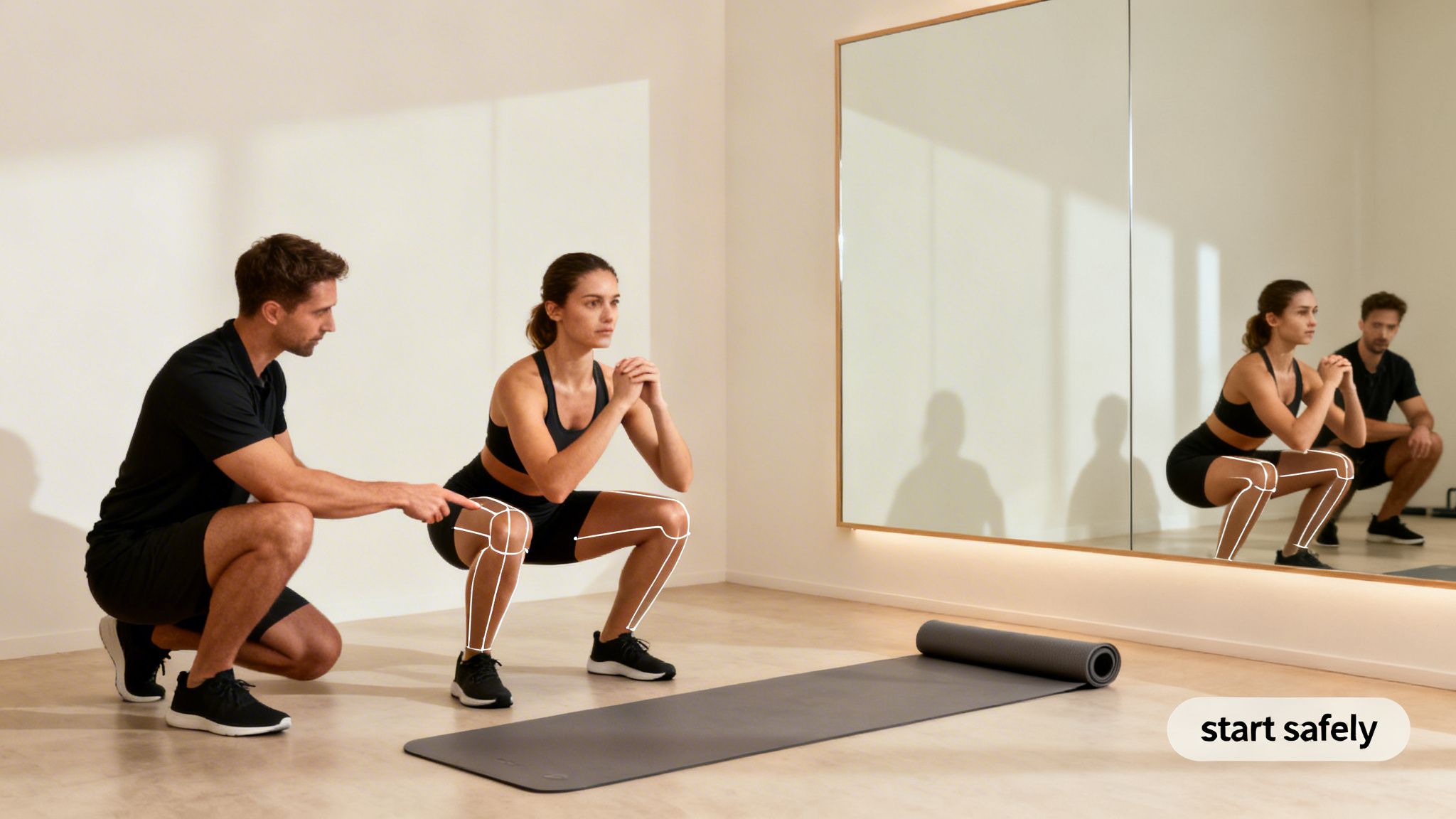
The first rule of the game is always form over weight. Good technique is non-negotiable. It makes sure you're actually working the muscles you intend to work and protects your joints from unnecessary strain. Before you even think about adding another plate to the bar, your entire focus should be on executing each exercise with precision and control.
Think of your first few weeks as a practice period where you're teaching your body the correct way to move. A great place to start is our beginner strength training program, designed to build your competence and confidence from the ground up.
Smart Progression for Beginners
If you're new to this, the simplest and safest way to progress is by first increasing your repetitions, or reps. Find a weight that lets you complete 8-12 reps with solid form, where the last couple feel tough but not impossible.
Once you can comfortably nail 12 reps for all your sets, that's your green light to bump up the weight just a little. This method, often called double progression, is fantastic because it guarantees you've built enough muscular endurance to handle the next level of intensity.
Your goal is not to hit total muscle failure on every set. Instead, you want to finish feeling like you could have squeezed out one or two more reps if you absolutely had to. This "reps in reserve" approach is a much safer and more sustainable way to trigger growth without burning yourself out.
To really dial this in, it helps to understand tools like the Rate of Perceived Exertion (RPE) scale. It’s a simple way to listen to your body and adjust your effort based on how you feel on any given day, which is crucial for safe and effective progress.
More Than Just Adding Weight
While adding more weight is a classic way to progress, it’s not the only trick up your sleeve. There are several other powerful ways to apply progressive overload, especially if you have limited equipment or just want to mix things up.
- Increase Sets: Currently doing three sets of squats? Try adding a fourth set with the same weight and reps. You’ve just increased your total workout volume—a key driver for growth.
- Decrease Rest Time: Cutting your rest periods between sets forces your body to work harder and challenges your muscular endurance in a new way. For example, try trimming your rest from 90 seconds down to 75.
- Improve Form and Range of Motion: Sometimes, the best way forward is to simply get better at what you're already doing. Sinking deeper into your squats or really feeling that mind-muscle connection is a huge form of progress.
Here’s a quick look at how these different methods can be applied, whether you're a total newbie or a seasoned gym-goer.
Progression Methods for Different Fitness Levels
| Progression Method | Best For | How It Works Example |
|---|---|---|
| Increase Reps | Beginners | You're doing bodyweight squats. Once you can easily do 15 reps with perfect form, you're ready to hold some light dumbbells. |
| Increase Weight | Intermediates | You're curling 20 lbs for 10 reps. When that feels comfortable, it's time to grab the 25s and aim for 8 reps. |
| Decrease Rest | Advanced | To make your bench press more intense, cut your rest time between sets from 2 minutes down to 90 seconds. |
No matter how you choose to progress, always remember to include a proper warm-up to get your muscles ready and a cool-down to help with recovery. And most importantly, listen to your body. Rest days are when the magic happens—it's when your muscles repair and grow stronger. Stick to these practices, and you'll build a routine that delivers results for years to come.
How Zing Coach Automates Your Progress
Knowing you need to apply progressive resistance training is one thing. Actually managing all the moving parts—when to add weight, how many reps to aim for, what to change next week—can quickly turn into a full-time job. It’s a lot to juggle, and it’s exactly where smart technology steps in to do the heavy lifting for you. Think of the Zing Coach app as your personal trainer in your pocket, automating the entire progression cycle so you can just focus on your workout.
It all starts with a quick, AI-powered quiz. This isn't just for show; it gathers the essential details about your goals, current fitness level, and what equipment you have on hand. Based on your answers, Zing maps out a starting point that’s perfectly matched to you, ensuring your first workout is challenging but totally doable. Getting this initial setup right is the foundation for training safely and effectively from day one.
Intelligent Progression Tailored to You
Here’s where Zing really shines: its ability to adapt on the fly. You don’t just get a static, one-size-fits-all plan. Instead, the app analyzes your performance and fatigue feedback after every single session.
If you crush a set and mark it as "easy," the algorithm knows it's time to bump up the challenge. If a workout felt like a real grind, it adjusts to give your body the recovery it needs. This constant feedback loop ensures you're always training in that sweet spot for growth.
Zing takes care of the big decisions, automatically telling you when to:
- Add more weight to dial up the intensity.
- Increase your reps or sets to build more volume.
- Adjust your rest times to improve your endurance.
By handling the number-crunching, Zing removes the mental load of planning your own progression. This data-driven approach is the secret to consistently applying progressive overload without getting stuck on frustrating plateaus.
Virtual Coaching for Perfect Form
Let’s be honest, one of the biggest hurdles for anyone training on their own is maintaining good form, especially when you start pushing your limits. Bad technique doesn't just make an exercise less effective; it dramatically increases your risk of getting hurt. This is a huge concern for anyone asking, what is progressive resistance training and how can I do it without injuring myself?
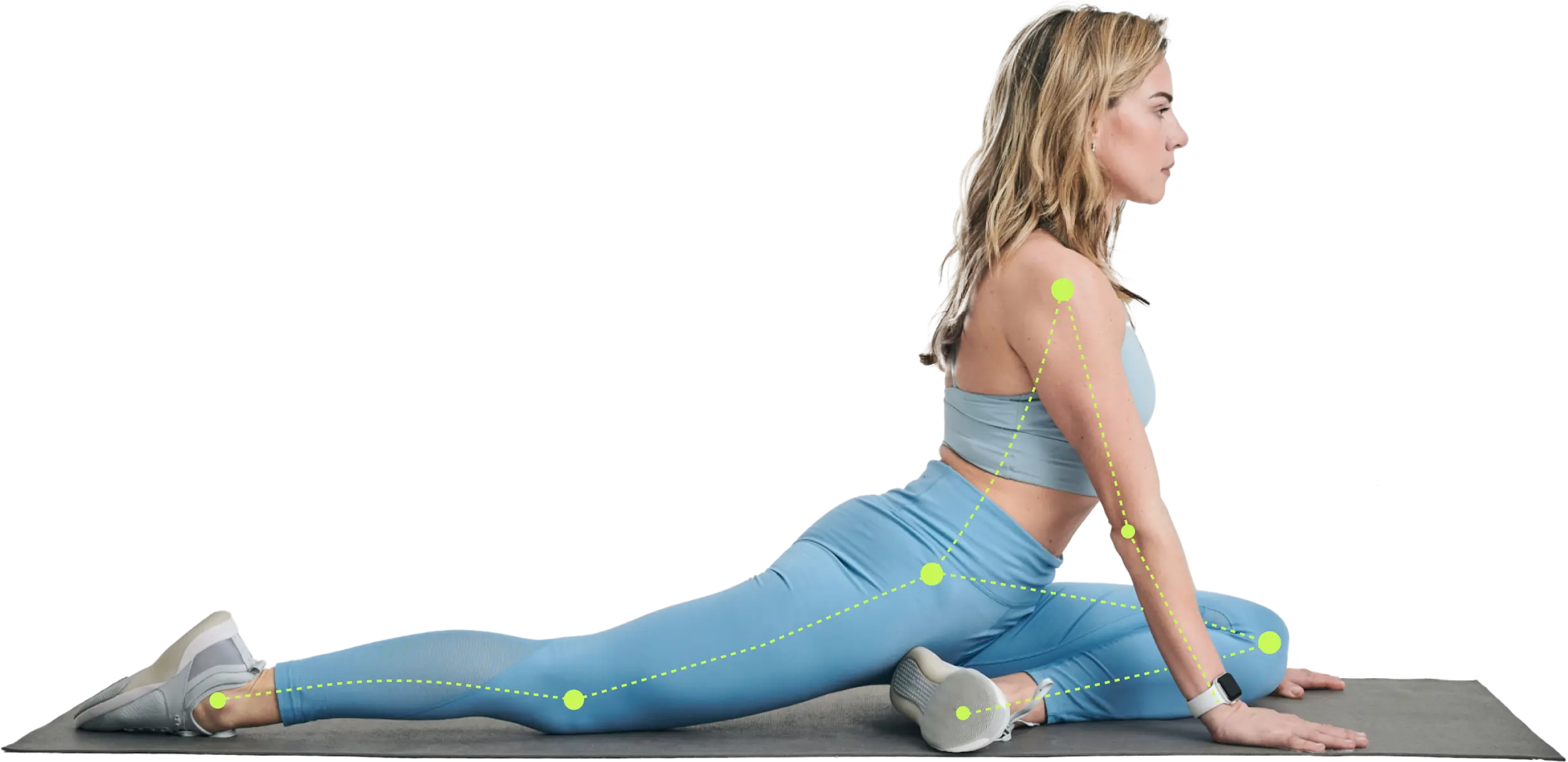
Zing tackles this problem head-on with a unique computer vision feature. Using your phone's camera, it analyzes your movements in real time, acting like a virtual coach watching over your shoulder. It counts your reps and gives you immediate feedback on your technique, making sure you’re performing each exercise correctly and safely.
A Holistic Approach to Growth
At the end of the day, progress isn't just made in the gym—it’s built in the kitchen. Zing connects the dots by weaving nutrition guidance right into your training plan. The app calculates your daily calorie and macronutrient targets based on how you train, helping you fuel your body for optimal muscle repair and growth.
This all-in-one approach makes sure every piece of the puzzle, from your workout programming and form correction to your nutrition, is working together seamlessly. For a deeper dive into the science powering these features, check out the Zing Coach methodology. By automating the tricky parts of progression, Zing makes building strength more accessible, safer, and way more effective.
Common Training Mistakes and How to Fix Them
Starting a progressive resistance training plan is exciting, but a few common missteps can easily slow you down or even lead to injury. Knowing what these pitfalls are ahead of time is your best defense, helping you train smarter and build a habit that actually lasts.
One of the biggest culprits is ego lifting. This is when you sacrifice good form just to move a heavier weight. It might feel cool in the moment, but sloppy technique makes the exercise way less effective and sends your risk of injury through the roof. The fix is simple but non-negotiable: master the movement with a lighter weight first. Get a feel for the control and full range of motion before you even think about adding another plate.
Progressing Too Fast or Not at All
Another classic mistake is messing up your progression. Some people get a little too eager and try to add weight every single week, which is a fast track to burnout or injury. Pushing too hard, too soon, doesn't give your body the time it needs to adapt. If you think you might be overdoing it, our guide can help you know if you're overtraining.
On the other hand, plenty of lifters get comfortable. They stick with the same weights and reps for months on end, eventually hitting a plateau where nothing seems to change.
The Fix: Find that sweet spot in the middle. Aim for small, consistent improvements. A fantastic strategy is the "double progression" method: first, focus on adding more reps with perfect form. Once you can hit the top of your target rep range (say, 12 reps), then you've earned the right to bump up the weight slightly. This ensures you've built a real foundation of strength before you pile on more load.
Finally, don't forget that what happens outside the gym is just as important. Neglecting proper nutrition and sleep is like trying to build a house without any bricks. Your muscles repair and grow while you rest, so make 7-9 hours of quality sleep a priority and give your body the protein it needs to get the job done.
Got Questions? We’ve Got Answers.
Let's tackle some of the most common questions people have when they're getting into progressive resistance training. Think of this as your quick-start guide to clear up any confusion so you can feel confident from day one.
A solid starting point for most people is training 2-3 days per week, making sure to hit all the major muscle groups. This schedule gives your body the downtime it needs to recover and actually build the muscle you're working so hard for. Remember, growth happens during rest, not just in the gym.
Can I Do Progressive Resistance Training at Home?
You absolutely can. Forget the idea that you need a commercial gym membership to see incredible results. The whole point is to make your workouts more challenging over time, and you can definitely do that with little to no equipment.
- Bodyweight Exercises: You can progress by simply adding more reps, slowing down the movement to increase time under tension, or switching to a tougher variation (like moving from a standard push-up to a decline push-up).
- Resistance Bands: These are game-changers for home workouts. They're perfect for adding a challenge to squats, lunges, and rows. When it gets too easy, just grab a band with more resistance.
- Dumbbells: Even a single pair of adjustable dumbbells opens up a world of exercises. They make it incredibly simple to increase the weight in small, manageable increments as you get stronger.
The real secret is consistency and a bit of creativity. The principles of progression are exactly the same whether you're lifting a heavy barbell or your own body.
How Do I Know If I'm Pushing Myself Enough?
This is a fantastic question, and getting it right is key to training safely and effectively. The goal isn't to grind yourself into dust on every single set. Instead, you want to finish a set feeling like you could have squeezed out 1-2 more reps with good form if you really, really had to.
This concept is what trainers call "Reps in Reserve," or RIR. It's the sweet spot. You're signaling to your muscles that they need to adapt and grow, but you aren't pushing so hard that your form breaks down or you risk injury. As you get stronger, what used to feel heavy will start to feel lighter, and you'll find you can do more reps. That's your cue to level up the challenge.
Ready to stop guessing and start progressing? The Zing Coach app takes all the guesswork out of your progressive resistance training. It tracks your performance and tells you exactly when it's time to add more weight, reps, or sets. You just focus on the workout; we'll handle the numbers. Start your personalized plan at https://zing.coach today.
Share this article


Authors