Discover how to measure muscle gain accurately with simple methods - photos, measurements, strength logs, and body composition scans.
If you want to get a real handle on your muscle-building progress, you need to look beyond the number on the scale. A truly accurate picture comes from combining a few key methods: circumference measurements, progress photos, and tracking your strength gains. This approach gives you the full story, cutting through the noise of things like water weight that make the scale so misleading.
Why The Scale Lies About Your Muscle Gain
It’s a classic fitness frustration. You’re hitting your workouts hard, dialing in your protein, and getting enough sleep, but the scale just won’t cooperate. Maybe it hasn’t moved an ounce. Or worse, it’s crept up a pound or two. It’s enough to make you want to throw in the towel.
But here’s the thing: your bathroom scale is only telling you a tiny, often confusing, part of the story. It’s a blunt instrument. Body weight lumps everything together—fat, bone, organs, water, and yes, muscle. It has no way of telling the difference between losing a pound of fat and gaining a pound of dense, hard-earned muscle.
Daily Fluctuations Hide What’s Really Happening
Your weight can easily swing by several pounds in a single day, and it almost never has to do with actual fat or muscle change. These shifts are just your body doing its thing:
- Water Retention: Had a salty meal? Hormonal shifts? Your body might hold onto a bit of extra water, making you temporarily heavier.
- Glycogen Stores: When you eat carbs, your body stores them as glycogen in your muscles, and every gram of glycogen brings about 3-4 grams of water along for the ride.
- Food Volume: The simple physical weight of the food and water sitting in your digestive system adds to the number on the scale.
Because of all this daily "noise," relying only on your weight can completely mask the slow and steady progress of building muscle. You could be in the middle of a successful body recomposition—building muscle while losing fat—and the scale might not show that positive change for weeks.
The scale measures mass, not composition. Real progress is about changing the ratio of muscle to fat, and a single number can never capture that.
A Smarter Way to Track Your Gains
Instead of fixating on one unreliable number, the smart move is to gather a few different data points. This guide will walk you through a complete toolkit of reliable methods for measuring muscle gain. Before you dive in, it helps to understand the fundamentals, which is why we have a detailed article explaining why body composition is important and what it is.
We'll cover everything from simple at-home techniques to more advanced technologies:
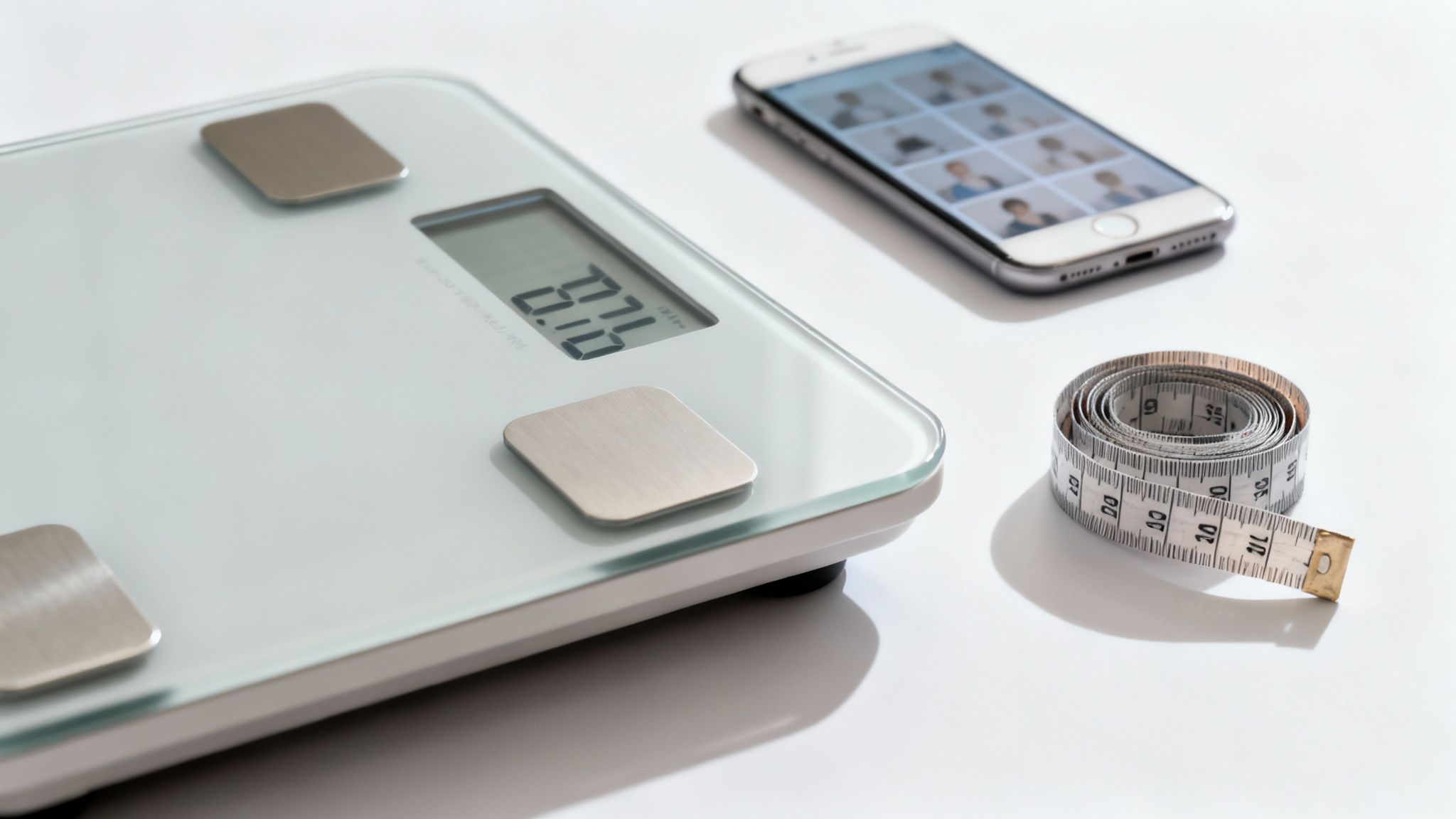
- Foundational Tools: A simple tape measure and your phone's camera can reveal powerful changes in your physique.
- Performance Metrics: Getting stronger in the gym is one of the most direct signs that your muscles are adapting and growing.
- Advanced Scans: Technologies like DEXA and BIA offer a detailed breakdown of your lean mass, fat mass, and more.
By combining these methods, you build a clear, accurate, and motivating picture of your hard work. You'll learn to trust the process, celebrate those non-scale victories, and make smarter adjustments to your training and nutrition along the way.
Foundational Tracking Methods You Can Use Today

You don't need access to a high-tech lab to get a solid read on your muscle-building journey. In fact, some of the most reliable and motivating tools are probably already lying around your house. These foundational methods give you tangible, real-world data that a simple bathroom scale could never provide, showing you the true results of your hard work.
The smartest approach is to combine a few of these simple techniques. When you track changes in your body's size, appearance, and performance, you get a complete, multi-layered picture of your progress. There's just no room for doubt.
Master the Tape Measure
A simple, flexible tape measure is one of the most powerful tools you have for tracking localized muscle growth. While the scale spits out a single number for your entire body, circumference measurements tell you exactly where you’re building muscle—and maybe even losing a bit of fat.
For your numbers to mean anything, you have to be consistent. Always measure under the same conditions: same time of day (morning before eating is best), same side of the body, and with the same snugness on the tape. Don't pull it so tight it digs in, but make sure there's no slack.
Here are the key spots to keep an eye on:
- Biceps: Measure at the widest point of your upper arm while flexing.
- Chest: Run the tape across your nipples, keeping it level all the way around your back.
- Waist: Find the narrowest point, which is usually just above your belly button.
- Hips: Wrap the tape around the widest part of your glutes.
- Thighs: Measure the fullest part of your upper leg, about halfway between your hip and knee.
Log these numbers every two to four weeks. Seeing your bicep measurement creep up by half an inch while your waist stays the same is a crystal-clear sign of successful body recomposition.
Tell Your Story with Progress Photos
Progress photos are your secret weapon against the mind games the scale can play. They offer undeniable visual proof of your transformation, capturing subtle changes in muscle definition and overall shape that numbers alone might miss. The whole game with progress photos is consistency.
To build a reliable visual timeline, stick to these rules:
- Same Time, Same Place: Take your photos in the same spot with the same lighting every time. Natural morning light usually works wonders.
- Same Poses: Stand relaxed from the front, side, and back. It's also a good idea to throw in a few flexed poses to really highlight new muscle growth.
- Same Outfit: Wear the same form-fitting clothes (like shorts or a sports bra) to make side-by-side comparisons a breeze.
Snap your photos every four weeks. When you line them up, you'll be blown away by the changes you see over time—fuller shoulders, a more defined back, or a better sweep to your quads. These visual wins are incredibly motivating.
Track Your Strength and Performance
Maybe the most direct and satisfying way to measure muscle gain is to watch your numbers go up in the gym. It's a simple equation: stronger muscles are almost always bigger muscles. If you're consistently lifting more weight or squeezing out more reps, you're creating the progressive overload that forces your muscles to grow.
This method only works if you're diligent about logging your workouts. Whether you use an old-school notebook or an app like Zing Coach, you need to record the details.
Your training log is a data-driven story of your progress. It proves that your muscles are adapting and growing stronger, which is the entire point of resistance training.
Focus on tracking the key performance indicators for your big compound lifts (squats, deadlifts, bench presses) and your main isolation exercises. Make sure you note the weight, sets, and reps for each. An increase in any of those numbers over time is a huge sign of muscle gain.
It's also crucial to have realistic expectations. Research shows that typical hypertrophy rates are often less than 1% per week, which means you need to be patient to see measurable changes. For instance, a re-analysis of multiple studies found that trainees added muscle size at a rate of roughly 0.3% to 0.4% per week. Over a 12-week program, that could add up to a 3.6% to 5.2% increase in size. You can explore the research on muscle growth from Stronger by Science to get a deeper dive into how training frequency impacts these rates.
Combining these three foundational methods—tape measurements, progress photos, and performance tracking—gives you a bulletproof system. It takes you way beyond the limits of the scale and helps you appreciate the full spectrum of your progress. This multifaceted approach is key for building momentum and setting targets that make sense. To learn how to use this data to propel your journey, check out our guide on how to set good fitness goals.
Advanced Scans: A Deeper Look at Your Body Composition
When the tape measure and mirror selfies aren't cutting it anymore, it's time to bring in the heavy hitters. Advanced tools like BIA and DEXA scans go beyond surface-level changes, giving you a direct look at what’s happening inside your body.
These technologies quantify your lean mass, fat mass, and sometimes even bone density. It's the most precise way to confirm that the number on the scale is going up for all the right reasons.
Your First Step: Bioelectrical Impedance Analysis (BIA)
For most people venturing into body composition analysis, Bioelectrical Impedance Analysis (BIA) is the gateway. The technology has become incredibly common, showing up in everything from affordable smart scales to the high-end machines you see at boutique gyms.
The idea behind BIA is pretty clever. The device sends a completely harmless, tiny electrical current through your body. Muscle, fat, and water all conduct electricity differently, and the machine uses the speed of that signal—its "impedance"—to estimate your body composition.
Think of it this way: muscle is packed with water, so the current zips right through it. Fat contains very little water, so it acts like a roadblock, slowing the current down. The device’s software then crunches these numbers to spit out metrics like your body fat percentage and muscle mass.
But here's the catch: not all BIA devices are created equal.
- Home Smart Scales: These are the most basic version. They typically send the current up one leg and down the other. This means they're really only "reading" your lower body and then making an educated guess about your top half.
- Professional Machines (like InBody): These are a whole different beast. You stand on a platform while holding onto handles, which lets the machine send multiple currents through your arms, legs, and torso independently. This segmental analysis gives you a much more accurate and complete picture.
The biggest knock on BIA is its extreme sensitivity to your hydration levels. Because the whole process relies on water, your results can swing dramatically depending on when you last drank water, worked out, or even had a big meal.
To get any real value from BIA, your testing protocol has to be ridiculously consistent. Always measure at the same time of day—ideally, first thing in the morning after using the bathroom but before you eat or drink anything.
This strict routine helps you filter out the daily fluctuations and see the real trend over time. While BIA gives you a solid estimate of your body fat, you can get a more detailed breakdown by learning how to measure your body fat percentage with other methods.
The Gold Standard: DEXA Scans
If you want the most accurate data you can get outside of a university research lab, you’re looking for a Dual-energy X-ray Absorptiometry (DEXA or DXA) scan. This is the same medical-grade technology used to check for osteoporosis, but it's also the undisputed champ at telling the difference between your fat, muscle, and bone.
Getting a DEXA scan is easy. You just lie still on a table for about 10 to 15 minutes while a machine arm passes over you. It uses two low-dose X-ray beams to build an incredibly detailed map of your body.
The report you get back is a data nerd's dream. It breaks down:
- Total body fat percentage.
- Total lean muscle mass (down to the pound or kilogram).
- Segmental analysis showing you exactly how much muscle and fat is in each arm, each leg, and your torso.
- Bone mineral density.
This isn't just cool—it's incredibly insightful. A DEXA scan can reveal muscle imbalances, like one arm being more developed than the other, or confirm that your new leg day routine is actually adding mass where you want it. It's so precise that it’s often used as the benchmark against which other methods are judged in clinical studies.
But even the gold standard has its quirks. Research shows that different body composition methods can give you different absolute numbers. The real lesson here for anyone tracking progress is consistency. Always use the same DEXA lab, the same BIA machine, or the same tape measure protocol. Switching methods can create a bigger change in your data than the actual muscle you’ve built.
BIA vs. DEXA: Which One Is for You?
Choosing between BIA and DEXA really comes down to a trade-off between accuracy, cost, and convenience. One isn't necessarily "better"; they just serve different needs.
| Feature | Bioelectrical Impedance Analysis (BIA) | Dual-energy X-ray Absorptiometry (DEXA) |
|---|---|---|
| Accuracy | Good, but very sensitive to hydration and device quality. | Excellent; widely considered the practical gold standard. |
| Cost | Low to moderate ($30 scale to $50–$100 scan). | Moderate to high (usually $100–$200+ per scan). |
| Accessibility | Very high; found in smart scales and most modern gyms. | Lower; requires a trip to a specialized clinic or facility. |
| Best For | Frequent, convenient check-ins to monitor general trends. | Infrequent, highly accurate snapshots of progress (e.g., every 6–12 months). |
For most people, a professional-grade BIA scan every few months offers plenty of data to know they're moving in the right direction. But if you're a competitive athlete or someone serious about a major body transformation, investing in an annual DEXA scan provides unparalleled insight and motivation.
How To Build Your Personal Muscle Tracking Protocol
Knowing how to use the various measurement tools is one thing. But weaving them into a smart, cohesive strategy? That’s where the magic really happens. A truly effective protocol isn't about finding one "best" method. It's about building a system that combines several data points to paint a clear, undeniable picture of your progress.
The goal is to move beyond staring at isolated numbers and start seeing the real trends. This takes consistency, a smart schedule, and knowing how to connect the dots between what the scale, tape measure, and your training log are telling you.
Establishing Your Measurement Cadence
To get a clear signal from all the noise, you need a consistent tracking schedule. Bombarding yourself with data every single day is a recipe for disaster—it just makes you obsess over meaningless fluctuations. A strategic, tiered approach works far better.
Here’s a sample schedule you can steal and adapt:
- Weekly Check-in: This is for your circumference measurements. It's a low-effort way to get frequent feedback on localized size changes.
- Monthly Review: Time for progress photos and a performance check. Dig into your training log and confirm your strength is climbing on key lifts.
- Quarterly or Bi-Annual Scans: If you’re using them, schedule a professional BIA or DEXA scan every 3-6 months. This gives you a high-level, objective look at the big shifts in your overall body composition.
This layered schedule delivers the right data at the right time. Weekly measurements keep you locked in and motivated, while the less frequent, high-impact data confirms long-term trends without causing unnecessary stress.
The Power of Standardization
The biggest enemy of accurate tracking is "noise." These are all the little variables that have nothing to do with actual muscle gain but can throw your numbers off. To get a clean signal, you have to standardize your measurement process. Every. Single. Time.
This just means controlling the conditions whenever you collect your data.
Think of yourself as a scientist running an experiment on your own body. The more variables you control, the more you can trust your results. Your protocol is your lab procedure.
Follow these simple rules for every measurement you take:
- Time of Day: Always measure first thing in the morning.
- Pre-Measurement State: Do it right after you use the bathroom, but before you eat or drink anything.
- Pre-Workout: Never, ever take measurements right after a workout when your muscles are temporarily pumped up.
Sticking to this routine eliminates the wild swings from hydration, food intake, and that post-workout pump, ensuring you’re always comparing apples to apples.
Triangulating Your Data for Confidence
The most powerful concept in all of this is triangulation. It’s a fancy way of saying you should use multiple, different types of data to confirm a single trend. Since every measurement method has its own quirks and margin of error, seeing the same story from different angles builds incredible confidence.
For example, let's say your tape measure shows your arms are a half-inch bigger. At the same time, your progress photos are showing more bicep definition, and your logbook proves you're curling 10 pounds more than last month. You don't have to second-guess it. You can be certain you've built new muscle.
The flow chart below shows how you might move from basic tools to more advanced ones as you get more serious.
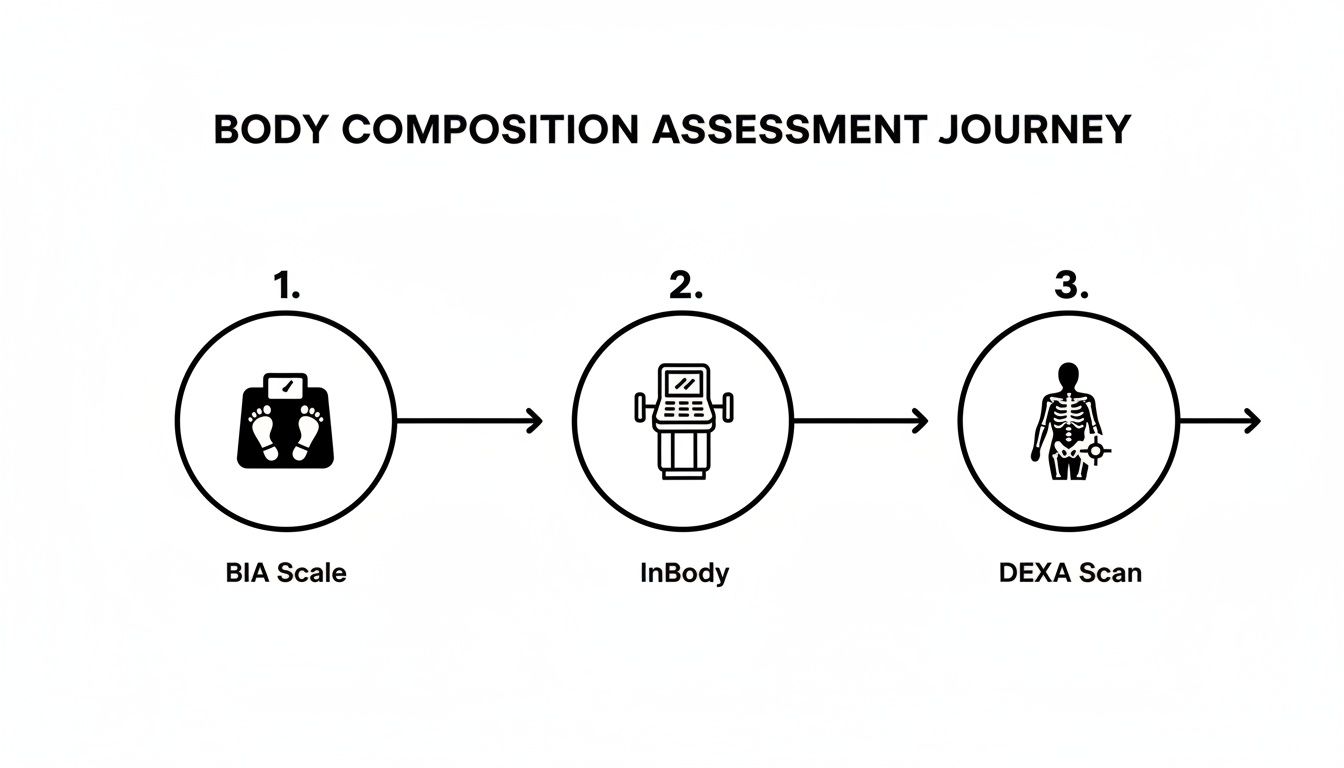
This visual lays out a clear path, starting with accessible BIA scales, moving to professional InBody machines, and peaking with the clinical precision of DEXA. Each step offers a deeper layer of data for your triangulation efforts.
Research backs this multi-metric approach. Relying on a single method can be misleading; BIA, for example, can have a prediction error of around ±9% when compared to an MRI. But when you combine a body composition scan with performance metrics (like a 5-10% strength increase) and simple circumference measurements, you build a much more reliable picture of what’s really going on.
Your Sample Tracking Journal
Staying organized is non-negotiable. A simple journal or spreadsheet is all you need to log everything in one place. Your specific training program will dictate which exercises you track; you can learn more by checking out our guide on how many exercises per muscle group is optimal.
And don't forget, what you eat is just as important as what you lift. To make sure your nutrition is actually supporting your training, you need to monitor your calories. A tool like a Recipe Calorie Calculator can make that a whole lot easier.
Here’s a simple layout to get you started:
| Date | Weight (lbs) | Bicep (R/L) | Chest | Waist | Thigh (R/L) | Notes/Performance Wins |
|---|---|---|---|---|---|---|
| Oct 1 | 185.2 | 15.5" / 15.4" | 41.0" | 33.5" | 24.1" / 24.0" | First day of new program. |
| Oct 8 | 185.5 | 15.5" / 15.5" | 41.0" | 33.5" | 24.1" / 24.1" | Bench press +5 lbs for reps. |
| Oct 15 | 186.0 | 15.6" / 15.5" | 41.2" | 33.4" | 24.2" / 24.1" | Feeling stronger on squats. |
This systematic approach transforms tracking from a chore into a powerful, motivating tool. It validates your hard work and gives you the clear feedback you need to decide your next move.
How To Interpret Your Results And Troubleshoot Plateaus
Collecting a mountain of data is a great start, but it's pretty much useless until you learn to read the story it’s telling you. This is where you turn raw numbers into smart decisions that keep you moving forward. Without this skill, it’s all too easy to get discouraged by what looks like a lack of progress.
A classic scenario I see all the time is someone getting way stronger in the gym, but their BIA scale stubbornly insists their lean mass hasn't budged. This is a perfect example of different metrics moving at different speeds. Strength gains, driven by your nervous system getting more efficient, almost always show up first. Measurable muscle growth tends to trail just a little bit behind.
Set Realistic Expectations for Muscle Gain
Before you can decide if your progress is any good, you need to know what "good" actually looks like. The truth is, the rate you can build muscle slows down dramatically the more experienced you get. Internalizing these timelines helps you set achievable goals and saves you a ton of frustration.
- Beginners (First 6-12 months): Welcome to the "newbie gains" phase. Your body is incredibly responsive to training, making it possible to gain 1-1.5% of your body weight in muscle per month.
- Intermediates (1-3 years of consistent training): Things start to slow down. A solid, realistic goal is to gain 0.5-1% of your body weight in muscle per month.
- Advanced Lifters (3+ years): At this point, gains are hard-won and incremental. Gaining even 0.25-0.5% of your body weight in muscle monthly is fantastic progress.
These numbers really drive home why patience is a non-negotiable part of the process. For an advanced lifter, a two-pound muscle gain over an entire year is a huge victory, not a sign that something's wrong.
A Framework for Troubleshooting Stalled Progress
So, what do you do when the numbers actually do stop moving? First, don't panic. A plateau isn't a dead end; it's a signal that your body has adapted and is ready for a new challenge. The trick is to analyze your approach systematically instead of just throwing random changes at the wall and hoping something sticks.
Work your way through the three core pillars of muscle growth to find the weak link in the chain.
A plateau is simply feedback. Your body is telling you it’s time to change the question you’re asking it through your training, nutrition, or recovery.
First up, your training log. Are you consistently applying progressive overload? This is the bedrock of getting stronger, and it just means methodically increasing the weight, reps, or sets over time. If your workouts have looked exactly the same for the past six weeks, you’ve probably found your problem.
Next, get brutally honest about your nutrition. You can't build muscle out of thin air. You absolutely need adequate protein—aim for around 1.6-2.2 grams per kilogram of body weight—and a small, consistent caloric surplus. If you aren't tracking your food, you're just guessing.
Finally, take a hard look at your recovery. This is easily the most overlooked variable of them all. Are you getting 7-9 hours of quality sleep every night? Chronic stress and bad sleep can jack up cortisol, a hormone that actively works against muscle growth. When you're trying to smash through a sticking point, optimizing your rest is critical. Checking out the best recovery tools for athletes can also open your eyes to new strategies for speeding up muscle repair.
By methodically working through these areas, you can make targeted adjustments that get the needle moving again. This structured approach puts you in the driver's seat. For an even deeper dive, our guide offers proven tips to prevent plateaus and keep the gains coming.
Common Questions About Measuring Muscle Gain
Even with a solid plan, a few questions always pop up when you start tracking muscle gain. It’s totally normal to get into the weeds with the details. Let's clear up some of the most common points of confusion so you can track your progress with confidence.
One of the first things people ask is how often they should be measuring. For things like tape measurements, pulling out the tape every two to four weeks is the sweet spot. This gives your body enough time to make real, measurable changes, so you're not getting discouraged by the tiny, meaningless fluctuations that happen day-to-day.
How Do I Know If I'm Gaining Muscle or Fat?
This is the big one, right? The key is to look at more than one piece of data at a time. If the number on the scale is slowly creeping up, but your waist measurement is holding steady—or even shrinking a bit—that's a fantastic sign you're adding quality lean mass.
Performance in the gym is your other major clue. Are you getting stronger? Being able to add a few more reps or a little more weight to your big lifts is a direct signal that your muscles are adapting and growing.
When the scale goes up, your jeans feel looser at the waist, and your deadlift is getting stronger, you've hit the muscle-building trifecta. That's how you know you're building functional muscle, not just adding fluff.
What’s the Single Best Method to Use?
If I had to pick just one, I’d say tracking your strength and performance is the most practical and motivating way to go. It doesn't give you a direct pound-for-pound measurement of muscle, but getting stronger is fundamentally linked to muscle hypertrophy. It's a real-world reflection of your body becoming more capable.
Progress photos are a very close second, though. They offer undeniable visual proof of changes in your physique—like better muscle shape and definition—that numbers alone just can’t capture.
Is Muscle Soreness a Good Sign of Growth?
We’ve all been there, feeling that deep muscle ache and thinking, "That was a good workout." While Delayed Onset Muscle Soreness (DOMS) can feel like a badge of honor, it's not actually a reliable sign of muscle growth.
Soreness just means you've hit your muscles with a new kind of stress they aren't used to. As you get more consistent with your training, you'll probably feel less sore over time, even as you continue to build muscle. The real goal isn't to chase soreness; it's to chase progressive overload by getting stronger week after week.
Ready to stop guessing and start seeing real, measurable results? The Zing Coach AI builds a personalized training plan that adapts to your progress, helping you build muscle efficiently. With integrated body composition scanning and detailed performance tracking, you'll always know exactly how your hard work is paying off.
Start your personalized fitness journey with Zing Coach today!
Share this article


Authors