Find out exactly how many exercises per muscle group you need for hypertrophy and strength. Get expert-backed, level-based workout plans to build muscle now.
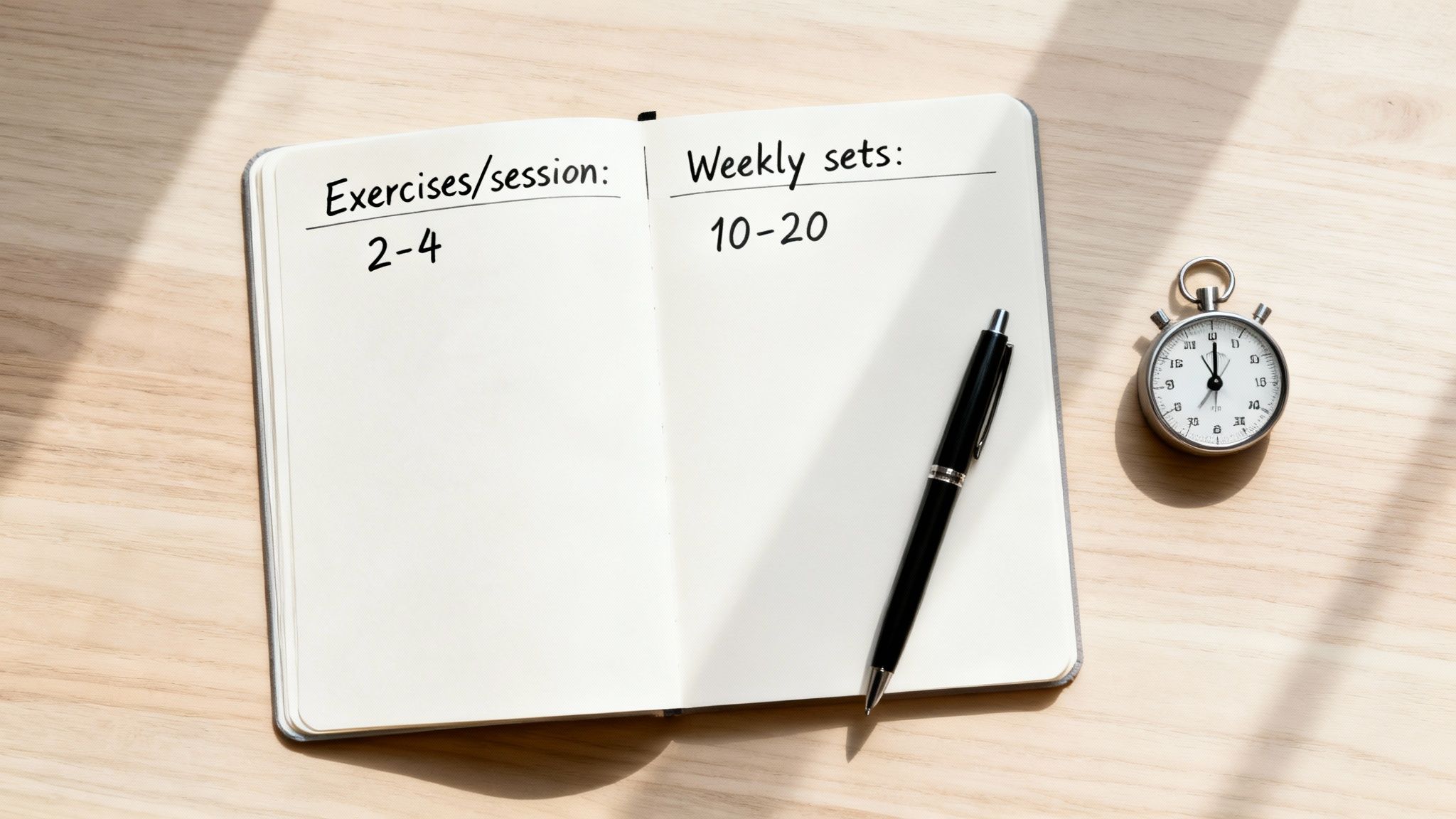
So, you're trying to figure out how many exercises you should be doing for each muscle group. Let's get right to it: the sweet spot is generally 2-4 exercises per muscle group in any given workout.
But here's the real secret, the number that actually drives growth: your total weekly volume. For most people, that means aiming for a grand total of 10-20 hard sets for each muscle, spread across the week. Think of it less like just checking off exercises and more like accumulating quality work over time.
Your Direct Answer to Workout Planning
Let’s cut through the noise. There isn't a single magic number here, but there is a smart, strategic range you can work with. The most effective way to build your workouts is to stop obsessing over the sheer number of different exercises and start focusing on hitting that optimal number of total weekly sets.
Think of it like cooking a great meal. The exercises are your ingredients, but the total volume—your sets and reps—is what really determines the final dish.
This approach gives you a solid, actionable starting point you can use right away. It’s especially powerful when you’re putting together an efficient routine, like a classic 3-day split workout plan, where every single set counts.
Quick Guide to Exercises and Sets Per Muscle Group
To make things even clearer, here’s a simple table to help you match your training plan to your goals. Use these numbers as your starting point, your reliable baseline. The rest of this guide will break down the "why" behind these recommendations so you can tweak them perfectly for your own body and goals.
The goal is to stimulate, not annihilate. Choosing the right number of exercises helps you find that perfect balance between triggering muscle growth and allowing for proper recovery—and that's where the real magic happens.
And before you even think about the main lifts, make sure you're properly prepped. Knowing how to warm up effectively before exercise is non-negotiable for getting the most out of every rep and staying injury-free.
| Experience Level | Primary Goal | Exercises Per Muscle Group (Per Session) | Total Weekly Sets Per Muscle Group |
|---|---|---|---|
| Beginner | General Fitness | 1-2 | 8-12 |
| Intermediate | Hypertrophy | 2-4 | 10-16 |
| Advanced | Strength/Specialization | 3-5 | 12-20+ |
Why Training Volume Trumps Exercise Count
It’s easy to fall down the rabbit hole of finding the "perfect" mix of exercises. But the real engine driving muscle growth isn't about how many different movements you do—it's all about training volume.
Think of it as the total amount of work you put in, calculated simply as sets x reps x weight.
Let’s use a house-building analogy. The number of different tools you use (your exercises) is far less important than the total number of bricks you lay (your volume). You can build a phenomenal chest by crushing 12 total weekly sets with just two powerhouse exercises, like a bench press and an incline dumbbell press. Or, you could spread those 12 sets across four different exercises. The end result is surprisingly similar because the total work is the same.
The goal is to find that sweet spot—enough productive work to trigger growth, but not so much that you can't recover from it.
The Problem with Junk Volume
This brings us to a crucial concept: "junk volume." These are the extra sets, reps, or even entire exercises you tack onto your workout. They feel productive, but they deliver little to no real benefit. In fact, they often do more harm than good.
Once you push past your optimal volume, you’re not stimulating more muscle. You're just digging a deeper recovery hole, piling on fatigue, and jacking up your risk of injury. This is where you get that nagging soreness that feels different from a good workout's ache. Knowing the difference between productive soreness and overtraining is key. You can learn more by understanding DOMS and how to manage it.
Finding Your Optimal Volume
So, what's the magic number? Research and real-world results from top coaches consistently point to a highly effective range for building muscle.
For most people, the optimal weekly training volume is between 10 to 20 hard sets per muscle group. Spreading this volume over two or three sessions a week is usually best for maximizing both recovery and performance.
Hitting this target is way more important than obsessing over how many exercises you're doing. A beginner might hit their 10 effective sets for their back using just pull-ups and rows. An advanced lifter, on the other hand, might need 18 sets spread across four different movements to get the same stimulus.
The focus should always be on the quality of the sets within that optimal range. This approach ensures every set is a high-quality "brick" contributing directly to your goals, not just wasted effort.
Matching Your Workouts to Your Experience Level
Your training plan shouldn't be a static document; it needs to evolve right alongside you. The question of how many exercises you need per muscle group has a different answer at each stage of your fitness journey. What works for a brand-new lifter is inefficient for an advanced athlete, and vice versa.
Think of your body like a new car engine. A fresh engine (that's you, the beginner) responds powerfully to basic, high-quality fuel. It doesn't need a bunch of complex additives to get going. In the same way, your body is primed for incredible growth from just a few simple, powerful movements.
Focusing on 1-2 core compound exercises per muscle group is your golden ticket. It's not about dazzling complexity; it’s about mastering perfect form and building a solid foundation. You're teaching your brain how to talk to your muscles effectively.
From Beginner to Intermediate Lifter
Once you've put in the time and graduate to an intermediate lifter, your body has adapted. It’s become more efficient, which means you need to give it a more sophisticated challenge to keep the gains coming. This is the point where you’ll want to add 1-2 more exercises per muscle group, often bringing in some isolation work.
This extra variety hits your muscles from new angles, waking up fibers that the big compound lifts might not fully hammer. It’s how you smash through frustrating plateaus and start carving out more detail and definition. The goal shifts from just building the foundation to strategically adding to it.
Your training level dictates the complexity of your approach. Beginners thrive on simplicity and mastery, while advanced lifters need strategic variety to continue making progress against a body that has already adapted significantly.
This decision tree illustrates the importance of focusing your total volume on quality sets that actually drive progress, no matter your experience level.
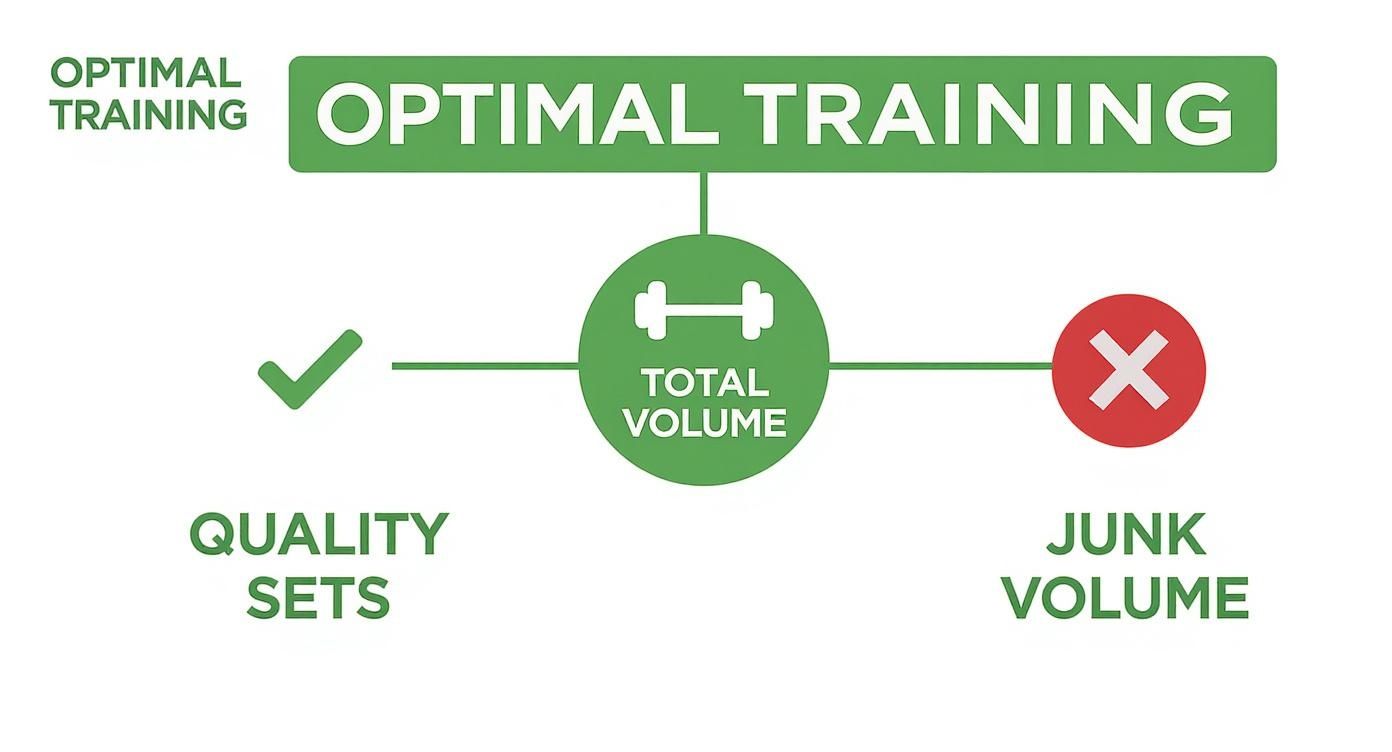
The key takeaway? Your total volume has to translate into high-quality, effective sets. Otherwise, you're just accumulating fatigue, not stimulating growth.
The Advanced Lifter's Toolkit
For the advanced lifter, the game changes completely. Your body is now highly resistant to change, and progress comes in much smaller, harder-fought increments. This is where a greater variety of exercises—often 3-5 per muscle group—becomes a strategic tool. You'll use different movements to target stubborn muscle fibers, manage the immense fatigue from heavy lifting, and bring up specific weak points that are holding back your main lifts.
At this level, you might even use bodyweight movements to manage joint stress while still hitting your volume targets. Weaving in a well-structured calisthenics routine can be a smart way to add volume without the heavy compressive load of barbells day in and day out.
Research backs up this progression, showing a clear dose-response relationship between training volume and muscle growth. While you can see results with as few as four hard sets per week, the sweet spot for most people falls between 5 and 10 weekly sets. Beyond 12-20 sets, the returns start to diminish significantly for most lifters.
This roadmap gives you the power to train smarter at every stage, making sure the effort you put in at the gym is always aligned with what your body actually needs to grow.
Selecting Exercises Based on Your Fitness Goals
The "best" number of exercises for a muscle group isn't some secret number etched in stone. It's a direct reflection of what you're trying to accomplish in the gym. Your specific fitness goal is the filter you should be using to decide not just which exercises to do, but how many it takes to get the job done right.
Think about it like packing for a trip. A quick weekend getaway means you only need a small bag with the essentials. A month-long expedition, on the other hand, demands a whole lot more gear. Your workout plan needs that same sense of purpose.
For Pure Muscle Growth
If your main goal is building muscle (what the pros call hypertrophy), your strategy needs to cover all the bases. You'll want to hit each muscle group with a variety of 2-4 exercises. Why? To make sure you're stimulating every single part of the muscle from different angles.
This mix of heavy compound lifts and more targeted isolation work is what creates the maximum stimulus for growth. A solid chest workout, for instance, might include a flat press, an incline press, and a cable fly to really target the upper, middle, and inner pec fibers.
Your goal dictates your tools. For muscle growth, you need a diverse toolkit. For raw strength, you need a few powerful, heavy-duty implements. For general fitness, you need versatile, all-purpose tools.
This approach is backed by science, which consistently points to total training volume as a key driver for muscle size. Research shows that somewhere between 12 to 20 weekly sets per muscle group is the sweet spot for hypertrophy. What's interesting is that some studies even suggest certain muscles, like the triceps, can handle—and even benefit from—more than 20 weekly sets. You can dive deeper into how volume impacts muscle growth if you're curious.
For Raw Strength and Power
When pure, unadulterated strength is the prize, your focus gets laser-sharp. It's no longer about hitting a muscle from every possible angle; it's about becoming a master of a few key movements.
Building your program around 1-2 heavy, foundational lifts per session is the name of the game. We're talking about the classics: squats, deadlifts, bench presses, and overhead presses. Perfecting your form on these core lifts allows you to move the most weight safely, and that's the number one thing that drives strength gains.
For General Fitness and Maintenance
For those of you focused on general fitness, staying healthy, or managing your weight, efficiency is everything. A balanced routine with 1-3 well-chosen exercises per muscle group will get you fantastic results without you having to live in the gym.
This is the perfect way to build a sustainable habit. Understanding the basics of strength training for weight loss can make these efficient workouts even more powerful. This goal-first approach makes sure every single exercise you do has a clear purpose, moving you straight toward the results you're after.
Sample Workout Plans You Can Use Today
Alright, let's put all this theory into practice. It's one thing to understand the concepts, but seeing how they actually come together in a real workout is where you’ll really start to feel confident.
These templates are built for an intermediate lifter who’s main goal is packing on muscle (hypertrophy). Pay attention to how they blend heavy compound movements with more targeted isolation work. That's the secret sauce for hitting your weekly volume goals without spending all day in the gym.
Intermediate Hypertrophy Workout Examples
To make this even clearer, here’s a table showing how you can structure workouts for different muscle groups. This isn't the only way, but it's a rock-solid approach that balances heavy lifting with targeted pump work to maximize growth.
| Muscle Group | Exercise 1 (Compound) | Exercise 2 (Compound/Accessory) | Exercise 3 (Isolation) | Total Sets |
|---|---|---|---|---|
| Chest | Barbell Bench Press (4x6-8) | Incline Dumbbell Press (3x8-12) | Cable Crossover (3x12-15) | 10 |
| Back | Pull-Ups / Lat Pulldowns (4 sets) | Bent-Over Barbell Row (4x6-10) | Seated Cable Row (3x10-12) | 11 |
| Legs | Barbell Squats (4x6-8) | Romanian Deadlifts (3x8-12) | Leg Press (3x10-15) | 10 (+Calves) |
As you can see, you can get a killer workout with just a few well-chosen exercises. It's all about being strategic with your selections to get the most bang for your buck.
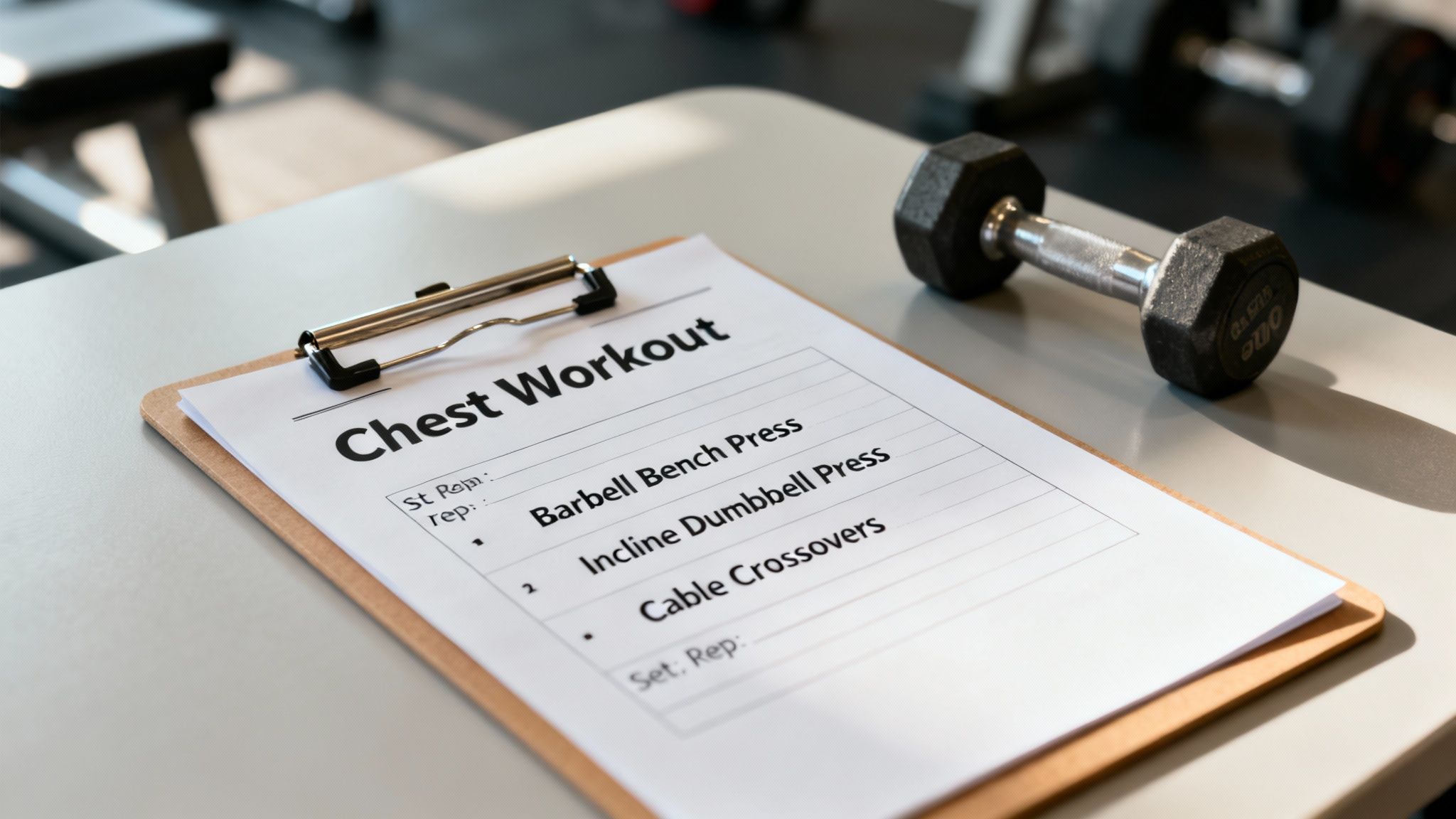
Chest Workout Example
This session is designed to hit your chest from multiple angles, ensuring you get balanced growth across the upper, middle, and lower pecs.
- Barbell Bench Press: 4 sets of 6-8 reps. This is your foundation for raw strength and size. Focus on adding weight to the bar over time.
- Incline Dumbbell Press: 3 sets of 8-12 reps. By changing the angle, we shift the focus to the upper chest—a spot many people miss.
- Cable Crossovers: 3 sets of 12-15 reps. This is our finisher. It gives a great stretch and an intense squeeze to pump the muscle full of blood.
- Total Sets for Chest: 10
Back Workout Example
The back is a huge, complex muscle group. To train it right, you need to pull from different directions—vertically and horizontally.
- Pull-Ups (or Lat Pulldowns): 4 sets to near-failure. This is your ticket to building that classic V-taper by widening your lats.
- Bent-Over Barbell Rows: 4 sets of 6-10 reps. Nothing builds a thick, dense back like a heavy row. This is a true powerhouse movement.
- Seated Cable Rows: 3 sets of 10-12 reps. This lets you really dial in on the mind-muscle connection and squeeze your mid-back.
- Total Sets for Back: 11
These examples prove you don't need a laundry list of exercises. Just three smart choices can deliver a potent training stimulus. Feel free to swap movements out from a library of effective exercises for muscle growth to find what works best for you.
Legs Workout Example
A proper leg day is brutal but simple. You just need to make sure you're hitting your quads, hamstrings, and glutes with enough intensity.
A well-structured workout is about synergy. Your first exercise sets the tone with heavy, compound work. The following exercises complement it, targeting muscle fibers from different angles and with different rep ranges to maximize the growth stimulus.
- Barbell Squats: 4 sets of 6-8 reps. The undisputed king for a reason. It builds overall leg mass and strength like nothing else.
- Romanian Deadlifts: 3 sets of 8-12 reps. This hones in on your hamstrings and glutes, building power in your posterior chain.
- Leg Press: 3 sets of 10-15 reps. A great tool for pushing your quads to their absolute limit in a safe, controlled way.
- Calf Raises: 4 sets of 15-20 reps. Don't skip the calves! They tend to respond really well to higher reps and a deep stretch.
- Total Sets for Legs: 14
Use these templates as your starting block. They perfectly illustrate how to pick the right number of exercises to build focused, intense workouts that will actually get you results.
How to Evolve Your Plan for Continuous Gains
A great workout plan is never set in stone. The best ones are living, breathing documents that have to adapt as you get stronger, faster, and more capable than you were last month.
This whole process of adaptation is driven by a single, powerful principle: progressive overload. It’s the secret sauce of getting results, and it just means continually challenging your muscles to do a little more than they’re used to.
But don't mistake that for just blindly piling more weight onto the bar every week. That’s a surefire way to hit a plateau. Real, lasting progress comes from a smarter, more varied approach. You need to know when to push for an extra rep, when to add another set, or even when to tighten up your rest periods to crank up the intensity.
Smart Ways to Progress Your Training
If you want to keep making gains month after month, you have to learn how to manipulate different training variables. Sticking to just one method, like adding weight, is a dead end. Instead, think of it as having a full toolkit for progress:
- Increase Reps: Did you hit 3 sets of 8 on your bench press last week? The goal this week is simple: try for 3 sets of 9 with the exact same weight. That's progress.
- Add Sets: Once you can comfortably nail the top end of your rep range (say, 12 reps) for all your working sets, it might be time to add a fourth set. More volume, new growth.
- Decrease Rest: Shaving even 15 seconds off your rest time between sets can completely change the game. It dramatically increases the metabolic stress on the muscle, forcing it to adapt in a new way.
Progressive overload is the language your muscles understand. If you stop challenging them in new ways, they have no reason to continue growing. Stagnation is the enemy of progress.
Knowing When to Swap Exercises
Sooner or later, even with smart progression, you'll hit a wall. A particular lift just stalls out for weeks on end, and no amount of extra reps or sets seems to help.
This is a clear signal that it’s time for a change. If your barbell bench press progress has flatlined, don’t just keep banging your head against the wall. Switch it up. Move to a dumbbell press or a machine press for the next few weeks. The new angle and stabilization challenge will provide a fresh stimulus.
This doesn't mean you're abandoning the barbell bench forever. It's about using a different tool to achieve the same goal and break through that plateau. This strategic rotation keeps your body guessing and ensures you're always moving forward.
Of course, to truly support your body's ability to adapt and grow, you have to recover as hard as you train. Smart progression and excellent recovery are two sides of the same coin. Understanding and using essential workout recovery tools is non-negotiable for anyone serious about long-term gains.
Common Questions About Structuring Workouts
Once you start putting these principles into practice, a few questions always seem to pop up. Let's run through some of the most common ones I hear from lifters trying to dial in their routine.
Should Bigger Muscles Get More Exercises?
Absolutely. Larger, more complex muscle groups almost always need more exercises and more total volume to grow properly.
Take your back, for instance. It's not just one big muscle; it’s a whole network of lats, traps, rhomboids, and spinal erectors, all doing different jobs. To really develop it, you need to pull from different angles—think vertical pulls like pull-ups and horizontal pulls like barbell rows. The same goes for your legs. Squats are king, but they won't hit every part of your quads, hamstrings, glutes, and calves equally. That’s why a solid leg day usually has 3-4 exercises to make sure everything gets the work it needs for balanced development.
How Do I Know If I’m Using Too Many Exercises?
Your body is pretty good at telling you when you're overdoing it. The whole point of training is to stimulate growth, not just run yourself into the ground with endless fatigue. If you're piling on "junk volume," you'll start seeing some tell-tale signs:
- Nagging Fatigue: You’re not just workout-tired; you feel drained all the time.
- Stalled Progress: Your numbers on the bar have hit a wall or, even worse, are starting to drop.
- Persistent Soreness: That deep, achy soreness just won't go away between your workouts.
- Poor Performance: By the end of your session, your form gets sloppy, and the weights feel way heavier than they should.
If any of that sounds familiar, it’s a good sign that you need to pull back on the number of exercises or sets.
Overtraining isn't a badge of honor; it's a roadblock to progress. Listening to your body's recovery signals is just as important as pushing hard in the gym.
Is It Better to Hit a Muscle All in One Day?
This one really comes down to your training split, how well you recover, and what your schedule looks like. For a lot of people, spreading those 10-20 weekly sets across two sessions leads to much higher-quality work than one marathon session.
Think about it: doing 10 sets for your chest on Monday and another 10 sets on Thursday will likely feel more powerful than trying to cram all 20 sets into a single workout where your performance tanks by the end. This is exactly why full-body and upper/lower splits are so effective. You get to stimulate each muscle more often throughout the week, which can be a huge driver for growth. At the end of the day, find the approach that you can stick with consistently.
Ready to stop guessing and start building a truly personalized plan? The Zing Coach AI takes all these variables—your goals, experience, and even your daily fatigue levels—to create workouts that adapt with you. Let the AI handle the numbers so you can focus on lifting. Get your customized plan at https://zing.coach.
Share this article


Authors