Discover strength training for weight loss with practical workouts, nutrition tips, and proven fat-burning strategies to build muscle fast.
If you're serious about sustainable weight loss, strength training needs to be your cornerstone. While cardio is great for burning calories during your workout, lifting weights does something far more powerful: it builds lean muscle. That new muscle increases your metabolism, turning your body into a fat-burning furnace that runs 24/7.
This single difference is the secret to not just losing weight but actually keeping it off for good.
Why Strength Training Is Your Fat Loss Advantage
When people decide to lose weight, their first thought is usually to hit the treadmill for hours. Cardio definitely has its place—it’s fantastic for heart health—but it’s only one part of a much bigger picture. Strength training offers a multi-pronged attack that fundamentally changes your body’s entire energy management system.
It all comes down to building lean muscle. Unlike fat, muscle tissue is metabolically active, meaning it burns calories just to exist. The more muscle you pack on, the higher your Basal Metabolic Rate (BMR) climbs. Think of your BMR as the number of calories your body torches while you're completely at rest—sleeping, working at your desk, you name it.
By consistently lifting weights and increasing your muscle mass, you're essentially giving your body's engine a major upgrade. It starts burning more fuel around the clock, even on days you don't hit the gym. This creates a lasting calorie deficit that’s much easier to stick with long-term than trying to burn every calorie through cardio alone.
The Afterburn Effect Explained
There's another cool thing that happens when you lift weights, a phenomenon known as Excess Post-Exercise Oxygen Consumption, or EPOC. Most of us just call it the "afterburn effect."
Simply put, EPOC is the extra chunk of calories your body keeps burning long after you've finished your workout.
Intense strength training creates tiny micro-tears in your muscle fibers. Don't worry, that's a good thing! Your body then has to expend energy (read: calories) to repair and rebuild those fibers, making them stronger than before. This metabolic repair process can keep your calorie-burning rate elevated for up to 24-48 hours after you leave the gym. That tough 45-minute lifting session? Its benefits last way longer than the workout itself.
Let's look at how these two approaches stack up for long-term results.
Strength Training vs Cardio for Sustainable Fat Loss
Here's a head-to-head comparison showing how each approach impacts metabolism, body composition, and long-term weight management.
| Factor | Cardio-Only Approach | Strength Training Approach |
|---|---|---|
| Metabolism | Temporarily increases during exercise, but can lower BMR long-term if muscle is lost. | Increases BMR 24/7 by building metabolically active muscle tissue. |
| Afterburn (EPOC) | Minimal afterburn effect, mainly from high-intensity interval sessions. | Significant afterburn effect lasting up to 48 hours as the body repairs and builds muscle. |
| Body Composition | Can lead to "skinny fat" look, losing both fat and muscle. Weight loss on the scale doesn't always reflect fat loss. | Sculpts the body by reducing fat while preserving or building muscle, leading to a more toned and defined physique. |
| Long-Term Success | Often leads to plateaus, requiring more cardio or fewer calories to continue losing weight. | Creates a more efficient metabolism, making weight maintenance easier and more sustainable. |
As you can see, while cardio has its place, strength training is the engine for a true body transformation.
A Tale of Two Transformations
Imagine two friends, both wanting to lose 20 pounds.
Person A (Cardio-Only): They commit to running an hour four times a week. The scale drops quickly at first, which feels great! But some of that weight is muscle, and as their muscle mass decreases, so does their metabolism. They soon hit a frustrating plateau and find they have to run even longer or eat even less to see any more changes.
Person B (Strength & Cardio): They lift weights three times a week and add two shorter cardio sessions. Their weight loss on the scale is more gradual, but that number doesn't tell the full story. They're losing pure fat while building lean, toned muscle. Their clothes are looser, they look stronger, and their metabolism is getting faster, not slower. This is a transformation built to last.
The scale can be a liar. Focusing on building muscle while shedding fat completely changes your body composition—how you look and feel. That's a much healthier and more accurate measure of progress than a single number.
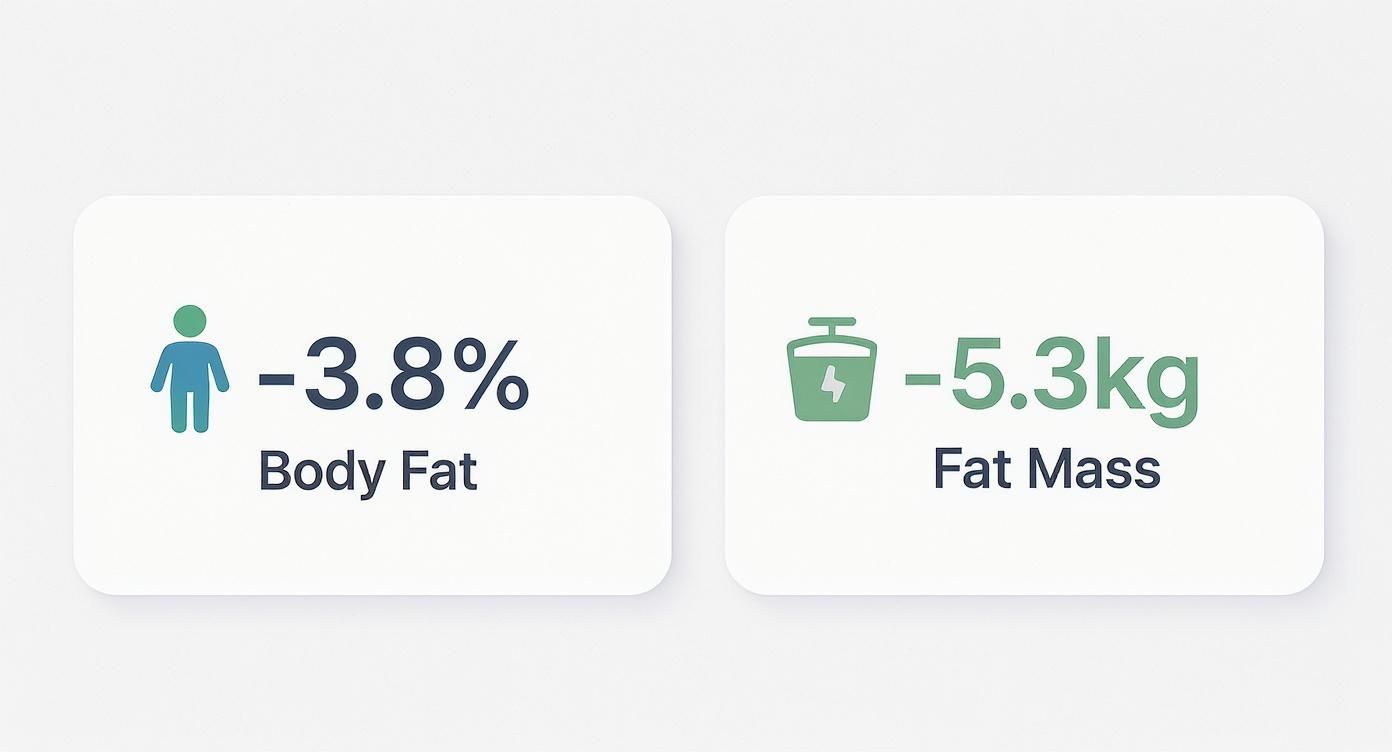
The results from strength training aren't just anecdotal; they're backed by science. Just look at these numbers.
This is why understanding what body composition is and why it's important is so critical. It’s about celebrating these non-scale victories.
In fact, a huge meta-analysis that looked at 114 different studies with over 4,000 participants found that combining resistance training with a calorie-managed diet was one of the most effective methods for weight loss. On average, people saw a 3.8% reduction in body fat and lost 5.3 kilograms of fat mass, outperforming other types of exercise. The data is clear: if you want to lose fat and keep it off, lifting weights is non-negotiable.
Building Your First Strength Training Program
Knowing that strength training is a powerful tool for weight loss is one thing; actually putting it into practice is a completely different ballgame. It's time to move from theory to action and design a plan that genuinely works for you.
The key? Start simple. Focus on consistency, not complexity. Forget about crafting the "perfect" program right out of the gate. Your only goal at the beginning is to build a habit.
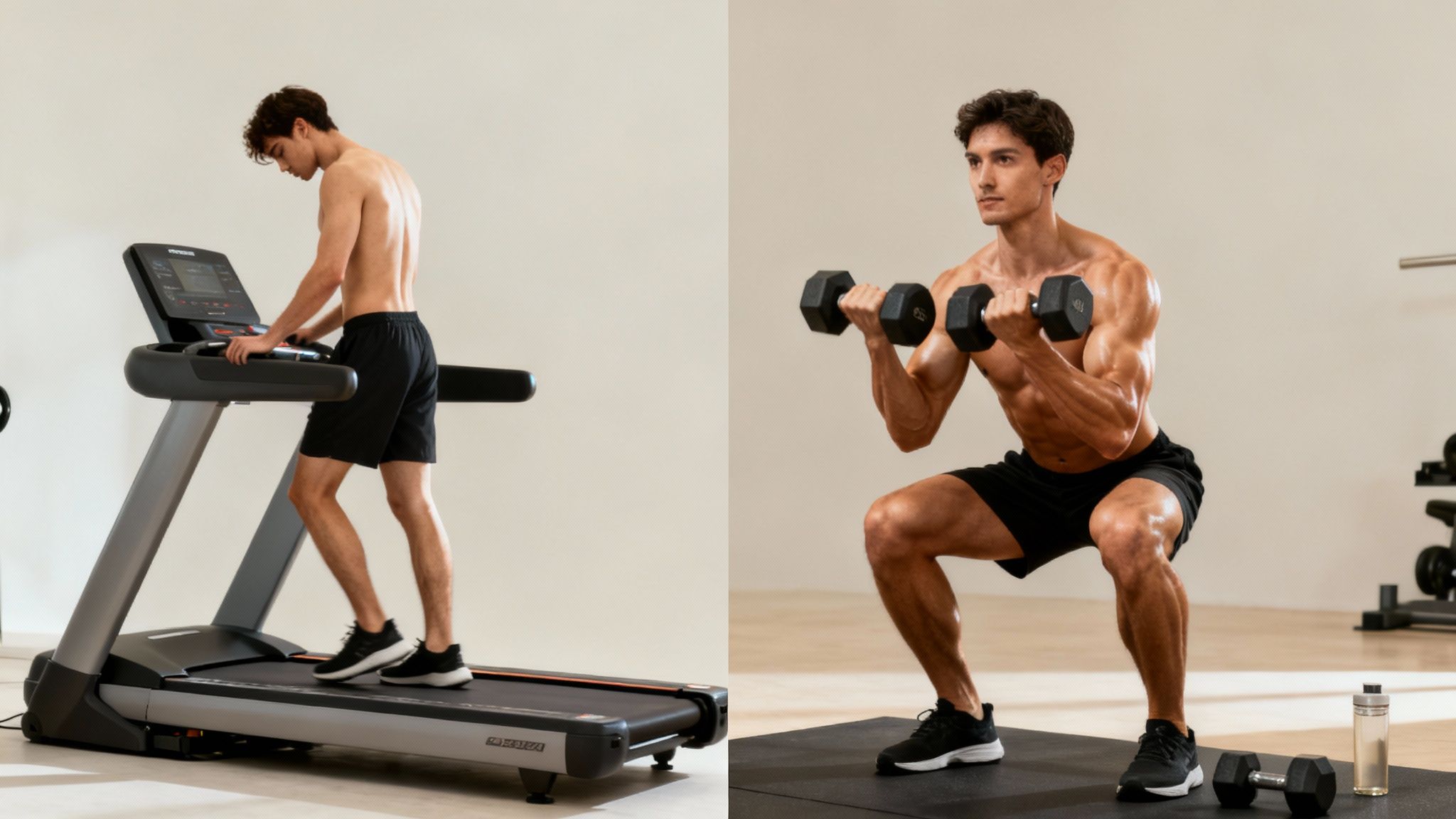
The best place to start is with full-body workouts. This approach hits all your major muscle groups in a single session, which is incredibly efficient when you're just starting out. It maximizes calorie burn and stimulates muscle growth across your entire body without you having to live in the gym five or six days a week.
How Often Should You Lift?
For anyone new to this and focused on fat loss, lifting on three non-consecutive days per week is the gold standard. A classic schedule would be Monday, Wednesday, and Friday, but Tuesday, Thursday, and Saturday works just as well.
This frequency strikes the perfect balance:
- Sufficient Stimulus: You're hitting your muscles often enough to signal them to grow stronger and become more metabolically active.
- Adequate Recovery: That day off between sessions is non-negotiable. This is when your muscles actually repair and rebuild, which is the whole point. Training without proper recovery is just a fast track to burnout and injury.
Remember, the real results from strength training for weight loss are built on your rest days, not just during your gym sessions. Prioritizing recovery is absolutely crucial for making progress.
This cycle of stress and recovery is a core principle of any effective training plan. To see how this concept is applied in more advanced programming, you can explore the science behind the Zing Coach methodology, which tailors workout frequency based on your personal fitness data.
Choosing Your Exercises and Reps
When you're starting, your best friends are compound movements. These are the multi-joint exercises that work several muscle groups at once, delivering the most bang for your buck. I'm talking about exercises like squats, deadlifts, push-ups, and rows.
Your main goal here is to build muscle, a process called hypertrophy. The sweet spot for this is typically in the 8-12 repetition range per set. This range is heavy enough to challenge your muscles to grow but not so heavy that your form starts to fall apart.
Aim for 3 sets of 8-12 reps for each exercise you do.
Let's use a real-world scenario: Say you're doing dumbbell goblet squats. You need to pick a weight where you can complete at least 8 solid reps, but you'd really struggle to get more than 12. That's your ideal weight for that set. If you can bang out 15 reps easily, the weight is too light. If you can barely manage 6, it's too heavy.
The Secret Sauce: Progressive Overload
If you take one thing away from this, let it be this principle. Progressive overload simply means you have to gradually increase the demand on your muscles over time. If you don't, your body adapts, and your progress will grind to a halt.
You don't need to make massive jumps. The goal is small, consistent improvements. Here are the easiest ways to apply this:
- Add Reps: If you did 3 sets of 8 reps last week, aim for 3 sets of 9 reps this week with the same weight.
- Add Weight: Once you can comfortably hit 3 sets of 12 reps with good form, it's time to bump up the weight slightly for your next workout and drop your reps back down to 8.
- Add Sets: If you're short on heavier weights, you can increase the challenge by simply adding a fourth set to an exercise.
This steady progression is what forces your body to keep adapting, building more muscle, and burning more fat. For anyone looking to start with a proven routine, programs like the Stronglifts 5x5 Full Body Strength Program are built entirely around this fundamental principle.
Your first program doesn't need to be intimidating. Start with a foundation of 3 full-body workouts per week, focus on that 8-12 rep range for muscle growth, and consistently challenge yourself with tiny improvements. This simple blueprint is the most effective and sustainable way to start using strength training for weight loss.
Your Go-To Exercises for Maximum Fat Burn
If you want to get the most bang for your buck with strength training for weight loss, you have to be smart about exercise selection. Efficiency is the name of the game. That means picking exercises that give you the biggest impact in the least amount of time.
The secret? Compound movements. These are the powerhouse exercises that hit multiple muscle groups and joints all at once. By recruiting so much muscle, you're not just building functional, real-world strength; you're also cranking your calorie burn into high gear. This is how you build lean muscle and torch fat effectively.
The Foundational Compound Lifts
A handful of key movements will be the bedrock of your entire program. There's a reason these are staples in almost every effective plan—they work, and you can tweak them for any fitness level.
The Squat
Often called the "king of all exercises," the squat is a true full-body movement. It hammers your quads, hamstrings, and glutes, but it also forces your core to work overtime to keep you stable.
How to Do It: Stand with your feet a little wider than your shoulders, toes pointing just slightly out. Keeping your chest proud and your core braced, push your hips back and down like you're aiming for a chair. Go until your thighs are parallel to the floor (or as low as your mobility allows), then power back up by driving through your heels.
Make It Easier: If a full squat feels like too much right now, start with box squats. Just place a sturdy box or bench behind you and squat down until you tap it, then stand back up. It’s a great way to build confidence and perfect your form.
The Deadlift
The deadlift is an absolute monster for building your posterior chain—that’s everything on the back side of your body, from your hamstrings and glutes all the way up your back. More importantly, it teaches you the fundamental pattern of how to lift heavy things off the floor safely.
How to Do It: Stand with your feet about hip-width apart, with a barbell or dumbbells right in front of you. Hinge at your hips first, keeping your back flat and chest up. Grab the weight, drive your feet into the floor, and lift by extending your hips and knees until you're standing tall. Lower it back down with the same control.
Make It Easier: A fantastic starting point is the dumbbell Romanian Deadlift (RDL). This version involves less knee bend, really isolates the hip hinge, and is much gentler on the lower back while you're learning the movement.
The Push-Up
This is the ultimate upper-body exercise you can do with just your body weight. The push-up blasts your chest, shoulders, and triceps, all while demanding serious core strength to keep your body rigid.
How to Do It: Get into a high plank, hands stacked directly under your shoulders. Your body should form a straight line from your head to your heels. Lower yourself by bending your elbows, keeping them tucked at roughly a 45-degree angle from your body. Press forcefully back to the start.
Make It Easier: Can't do one from your toes yet? No problem. Drop to your knees, or find an elevated surface like a bench or countertop and do incline push-ups.
The best exercise is always the one you can do with perfect form. Don't ever sacrifice your technique just to lift heavier or try a fancier version. Using modifications is a sign of smart training, not weakness.
The Overhead Press
Looking for strong, defined shoulders? This is your move. The overhead press also hits your triceps and upper chest. A solid press requires an iron-clad core to protect your spine as you push weight overhead.
How to Do It: Stand holding dumbbells at shoulder height with your palms facing forward. Squeeze your glutes and brace your core—don't let your lower back arch. Press the weights directly overhead until your arms are locked out. Lower them back down to your shoulders under full control.
Make It Easier: Try the seated dumbbell press. Sitting on a bench with back support takes some of the stability demand off your core, letting you really focus on the pressing motion itself.
To see how you can weave these moves into a solid routine, check out our library of full body exercises for more ideas and complete workouts.
As you can see in the Zing Coach app, a great plan is built around you—your goals, how much time you have, and what gear is available. The program should fit your life, not the other way around.
Sample Routines for Any Situation
Alright, let's put this into practice. Here are three different workouts you can use as a starting point, no matter what equipment you have access to.
The At-Home Bodyweight Blast (No Equipment)
- Bodyweight Squats: 3 sets of 12-15 reps
- Glute Bridges: 3 sets of 15 reps
- Incline Push-Ups: 3 sets to failure (as many good reps as you can)
- Plank: 3 sets, hold for 30-60 seconds
- Lunges: 3 sets of 10-12 reps per leg
The Dumbbell-Only Routine
- Goblet Squats: 3 sets of 10-12 reps
- Dumbbell Romanian Deadlifts: 3 sets of 12 reps
- Dumbbell Bench Press (or Floor Press): 3 sets of 10-12 reps
- Bent-Over Dumbbell Rows: 3 sets of 10-12 reps
- Seated Dumbbell Overhead Press: 3 sets of 12 reps
The Full Gym Workout
- Barbell Back Squats: 3 sets of 8-10 reps
- Conventional Deadlifts: 3 sets of 5-8 reps
- Bench Press: 3 sets of 8-10 reps
- Lat Pulldowns: 3 sets of 10-12 reps
- Overhead Press: 3 sets of 8-10 reps
To keep things interesting and continue challenging your muscles, you might want to explore some effective weight bench workouts to add more variety to your upper body days. Think of these sample routines as a launchpad for your own successful strength training plan.
How to Smartly Combine Cardio with Lifting
Think of strength training as the engine that drives your metabolism for long-term fat loss. Cardio? That's the accelerator. It’s a fantastic tool for burning extra calories, keeping your heart healthy, and speeding up your results—as long as it doesn't get in the way of your lifting. The key is being strategic, using cardio to complement your strength work, not compete with it.

Get it right, and you'll reap the cardiovascular benefits while creating a bigger calorie deficit, which is exactly what you need for weight loss. Get it wrong, and you can end up feeling drained, hurting your recovery, and even sabotaging your strength gains.
Choosing Your Cardio Wisely
Not all cardio is the same, and the best kind for you really comes down to your goals, how much time you have, and how your body is feeling. When you're pairing cardio with a lifting program, you’ll mainly be choosing between two types.
- Low-Intensity Steady-State (LISS): This is your classic cardio session—think a brisk walk on an incline treadmill, a relaxed jog, or a ride on a stationary bike. It’s low-impact, easy on the joints, and great for burning calories without piling on extra stress.
- High-Intensity Interval Training (HIIT): This is all about short, explosive bursts of effort followed by quick recovery periods. A perfect example is sprinting for 30 seconds and then walking for 60 seconds. HIIT is a huge time-saver and a metabolism-booster, but it's also incredibly demanding on your body.
For most people focused on losing fat while getting stronger, a combination of both works best. Use LISS for active recovery and consistent calorie burn, and maybe toss in one HIIT session a week for a serious metabolic kick.
The Golden Rule of Scheduling
The most important piece of the puzzle is when you do your cardio. Blasting through an intense cardio session right before you hit the weights can burn through the glycogen (stored energy) your muscles need to lift heavy. That means you won't be as strong, which directly compromises your ability to build muscle.
The Takeaway: Your strength training always comes first. If you absolutely have to do both on the same day, lift first, then do your cardio. This ensures all your energy and focus go toward the muscle-building part of your workout.
An even better approach is to put your cardio on separate days entirely. This gives your body plenty of time to recover between tough sessions. For a deeper dive into the science, check out our guide on whether to do cardio before or after weights.
The science is pretty clear on this. A massive review of over 100 trials found that adding 150 minutes of moderate to vigorous cardio per week leads to major reductions in body fat. The research even showed that for every extra 30 minutes you add, you can expect about another half-kilogram of weight loss. If you want to see the data for yourself, you can read the full research about these weight loss findings.
Sample Weekly Schedule
So, how does this look in practice? Here’s a sample week that balances three full-body strength days with two smart cardio sessions, giving you a powerful, sustainable routine.
- Monday: Full-Body Strength Training
- Tuesday: 30-45 minutes of LISS Cardio (brisk incline walk, cycling)
- Wednesday: Full-Body Strength Training
- Thursday: Rest or Active Recovery (stretching, light walk)
- Friday: Full-Body Strength Training
- Saturday: 20 minutes of HIIT Cardio (sprints, battle ropes)
- Sunday: Full Rest Day
This schedule lets you go into your lifting days with a full tank of energy, using cardio as a strategic tool to speed up fat loss without burning yourself out.
Fueling Your Body for Muscle Gain and Fat Loss
You can have the most dialed-in workout plan on the planet, but if your nutrition is off, your results are going to stall. It’s a hard truth. Think of it this way: your workouts create the demand for your body to change, but food provides the raw materials to actually rebuild itself leaner and stronger. Getting this right isn't just a suggestion; it's non-negotiable.
The goal isn't to starve yourself into submission. Far from it. This is about fueling your body intelligently to encourage fat loss while giving it everything it needs for muscle growth. It’s a balancing act, not an extreme sport.
The Calorie Deficit Sweet Spot
To lose fat, you have to be in a calorie deficit. Simple as that. You need to consume fewer calories than your body burns. But here's where people go wrong: a massive deficit is a recipe for disaster. It can force your body to break down precious muscle for energy and leave you too drained to even think about training hard.
Instead of slashing calories, aim for a moderate, sustainable deficit of around 300-500 calories per day. This is the sweet spot. It gently encourages your body to tap into fat stores for fuel without sacrificing your muscle mass or energy levels. You'll actually feel good during your workouts and avoid the ravenous hunger that tanks so many weight loss plans.
Prioritize Protein for Muscle and Satiety
When you're eating in a deficit, protein becomes your best friend. It serves two huge roles:
- Muscle Repair: Lifting weights creates tiny micro-tears in your muscles. Protein delivers the amino acids your body needs to patch them up, making your muscles stronger and more metabolically active.
- Satiety: Protein is hands-down the most filling macronutrient. A high-protein meal will keep you feeling full and satisfied way longer, which makes sticking to your calorie target a whole lot easier.
Aim for 1.6 to 2.2 grams of protein per kilogram of your body weight. For a 150-pound (68kg) person, that’s roughly 109-150 grams of protein a day. Spread this out over your meals, focusing on sources like chicken, fish, eggs, Greek yogurt, lentils, and tofu. If you find it tough to hit that number with food alone, you can learn more about how protein shakes and supplements can help fill in the gaps.
A high-protein diet is your secret weapon. It protects the muscle you're working so hard to build, which is the very tissue that keeps your metabolism elevated and helps you burn more fat at rest.
Strategic Carbs and Healthy Fats
Carbs are not the enemy. I repeat: carbs are not the enemy! They're your body's preferred fuel for high-intensity work like lifting weights. The key is timing them strategically. Having some complex carbs—think oatmeal or whole-wheat toast—about 1-2 hours before you train will top off your muscle glycogen stores, giving you the power to crush tough sets.
Healthy fats from foods like avocados, nuts, and olive oil are also crucial. They play a massive role in hormone production, including the ones that regulate your metabolism and help with muscle growth. Just be mindful of your portions, since fats are more calorie-dense than protein and carbs.
Recovery: The Overlooked Growth Factor
Real progress doesn't just happen in the gym and the kitchen. It’s solidified while you rest. Two of the most underrated (and free) tools for transformation are hydration and sleep.
Hydration is Key: Water is vital for just about everything—transporting nutrients, keeping your muscles working right, and maintaining your metabolism. Even slight dehydration can kill your performance and slow down recovery. Aim to drink enough water throughout the day so your urine is a pale yellow color.
Sleep is a Non-Negotiable: This is prime time for your body's repair crew. During deep sleep, your body releases growth hormone, which is absolutely critical for repairing muscle and metabolizing fat. Consistently getting 7-9 hours of quality sleep a night will have a dramatic impact on your results, energy, and even your ability to control hunger.
Measuring Progress When the Scale Doesn't Move

It’s probably the most frustrating moment in any weight loss journey. You're crushing your workouts, your nutrition is on point, but the number on the scale just won't cooperate. This is exactly where so many people get discouraged and quit, not realizing they're standing right on the edge of a breakthrough.
When you’re lifting weights and eating in a calorie deficit, your body is doing something amazing called recomposition. You’re burning off body fat while simultaneously building lean, metabolically active muscle. Here's the kicker: a pound of muscle is much denser and takes up way less space than a pound of fat. So, your weight might stall even as you're getting visibly leaner and stronger.
It's time to stop letting a single number have that much power over your motivation. The scale only tells you your total mass; it has no idea whether you've lost fat or gained muscle. To get the real story, you need to look at more meaningful signs of progress.
Look Beyond the Scale
The key to staying in the game for the long haul is to celebrate your non-scale victories. These are the tangible, real-world signs that all your hard work is paying off, and they paint a much more accurate and encouraging picture than any weigh-in ever could.
Here are the metrics that really matter:
- Body Measurements: This is one of the most powerful tools in your arsenal. Once a month, grab a flexible measuring tape and track the circumference of your waist, hips, chest, arms, and thighs. Losing inches, especially from your waist, is a dead giveaway that you're losing fat, regardless of what the scale says.
- How Your Clothes Fit: This one is undeniable. Are those jeans feeling a bit looser around the waist? Is that shirt fitting better across your shoulders? These are the daily wins that often show up long before the scale moves, confirming your body composition is changing for the better.
- Progress Photos: A picture is truly worth a thousand words. Every four weeks, snap photos from the front, side, and back. Try to use the same lighting and wear the same clothes. When you put them side-by-side, you'll be blown away by the visual changes you just don't notice looking in the mirror every day.
Your body is becoming denser and more compact. The number on the scale might not reflect the incredible trade-off you're making—swapping bulky fat for sleek, powerful muscle. Celebrate the inches lost and the way you feel, not just the pounds.
Celebrate Your Performance Wins
Another huge piece of the puzzle has nothing to do with how you look and everything to do with what your body can do. Strength training for weight loss isn't just about getting smaller; it's about becoming more capable, powerful, and resilient.
Keep a workout log to track these crucial performance metrics:
- Lifting Heavier: Did you go up in weight on your squats this week? That's a direct sign you're getting stronger.
- Completing More Reps: Were you able to squeeze out just one more rep than last time using the same weight? That’s progressive overload in action.
- Improved Form: Does an exercise that used to feel awkward now feel smooth and controlled? This is a massive win for your neuromuscular system.
- Increased Energy: Finding you have more gas in the tank for daily life? That's a clear sign your overall fitness is improving.
Acknowledging these performance gains creates a positive feedback loop that keeps you coming back for more. It beautifully shifts your focus from what you’re losing (weight) to everything you’re gaining: strength, confidence, and health.
Common Questions About Strength Training for Weight Loss
Whenever you start something new, questions are bound to pop up. It’s completely normal. So let's tackle some of the most common questions and myths about lifting for weight loss. My goal is to clear up any confusion so you can get started with confidence.
One of the biggest worries I hear, especially from women, is the fear of getting "bulky." Let me put that to rest right now. Building that kind of physique takes a very specific, high-volume training plan and, critically, a huge calorie surplus—the exact opposite of what you're doing to lose weight.
For most of us, lifting weights while dropping body fat creates a leaner, more toned, and athletic look. You're not just losing weight; you're shaping your body.
How Quickly Will I See Changes?
This is where you need to play the long game. You'll probably feel stronger and have more energy within the first 2-4 weeks. That initial surge is your nervous system getting smarter and more efficient at firing up your muscles.
As for visible changes—like your clothes fitting better or seeing some new muscle definition—that usually takes about 8-12 weeks of consistent work. Just remember, this isn't a race. Showing up week after week is what truly matters.
Progress isn't always a straight line, and it rarely happens overnight. Trust the process. The small, consistent efforts you make every day are what build a significant, lasting transformation.
Can I Lift Every Day for Faster Results?
This is a classic case of thinking more is better, but in reality, it can completely derail your progress. Your muscles don't get stronger while you're lifting; they grow and adapt during the recovery period between your workouts.
Training every single day puts you on a fast track to overtraining, which can lead to injury, burnout, and a frustrating plateau. A solid plan involves 2-4 strength sessions per week, with at least one full rest day between workouts that hit the same muscle groups.
Do I Need a Gym Membership?
Nope, not at all. A gym is great for variety, but you can get incredible results right in your living room. The core principle of getting stronger—progressive overload—can be applied anywhere.
Here are a few ways to effectively challenge your muscles at home:
- Bodyweight exercises are the foundation. Think push-ups, squats, and lunges. They are far more effective than people give them credit for.
- Resistance bands are a fantastic, low-cost tool for adding that extra challenge.
- A single pair of adjustable dumbbells can unlock hundreds of exercises, giving you everything you need for a killer full-body workout.
At the end of the day, it's not where you train that matters. It's how consistently you push your muscles to adapt and get stronger.
Ready to stop guessing and start seeing real results? The Zing Coach AI builds a strength training plan that adapts to your goals, equipment, and progress. Get a personalized program that evolves with you, ensuring you're always on the fastest path to your weight loss goals. Start your journey with Zing Coach today!
Tags
Share this article


Authors