Discover the most effective 3 day split workout for building muscle and strength. Get expert-designed routines, progression tips, and common mistakes to avoid.

A 3-day split is a simple, brutally effective way to schedule your training. You’ll hit the gym three times a week, dedicating each session to different muscle groups. This approach nails the balance between intense, focused work and the recovery time that’s absolutely essential for building real muscle and strength.
Why a 3-Day Split Is Your Smartest Training Choice
When you’re chasing gains, the first instinct is always to do more. More days, more exercises, more sets. But here’s a hard-earned piece of gym wisdom: the real magic doesn’t happen when you’re lifting, it happens when you’re resting.
This is where the 3-day split really comes into its own. It’s a framework built on quality over quantity. You give your muscles a powerful reason to grow, and then you give them the time they need to actually do it. It's not about saving time—it's about working with your body's natural process of getting stronger, not against it.
The Power of Focused Training and Recovery
A 3-day split workout routine is a classic for a reason. By dividing your workouts, you can hit specific muscle groups with more volume and intensity than you ever could in a single full-body session. This targeted approach is a huge driver for muscle growth.
This structure also has a built-in safety net against overtraining, which is one of the biggest progress killers out there. Burnout, injuries, and frustrating plateaus often stem from not giving your body a chance to catch up. By giving each muscle group a solid 48-72 hours to recover before you train it again, you make sure you’re always walking into the gym ready to perform at your best.
Maximizing Efficiency for a Busy Lifestyle
Let's be real—most of us can't build our lives around the gym. The beauty of a 3-day split is how well it fits into a normal, demanding schedule. It's both efficient and flexible.
- Time-Efficient: Three hard, focused sessions a week are manageable and much easier to stick with long-term.
- Reduces Burnout: A lower time commitment makes it far less likely that you'll get overwhelmed and quit.
- Flexible Scheduling: You can easily slot your workouts into your week (like a classic Mon/Wed/Fri) and move them around when life gets in the way.
This interplay between intensity and recovery is the absolute cornerstone of smart programming. You create the stimulus for change, then give your body the time and resources it needs to make that change happen. It's a simple concept, but it's profoundly effective.
If you dig into the science behind effective modern athletic strength training programs, you’ll find they all revolve around this same core principle: apply stress, then adapt. Here at Zing Coach, our entire AI-driven system is built on this very idea, which you can read more about in the Zing Coach methodology. The app intelligently plans your workouts and recovery periods to keep you progressing steadily without ever hitting that wall.
How To Choose The Right Split For Your Goals
Picking a 3 day split isn't about throwing a few random exercises together and hoping for the best. It's about strategy. Your training structure needs to be a direct reflection of what you're trying to achieve, whether that's building muscle, chasing raw strength, or boosting your athletic performance. The right split is your roadmap, making sure every ounce of effort pushes you in the right direction.
First things first, you have to know your "why." What's the primary objective? Someone training for a powerlifting meet has completely different programming needs than someone aiming to look good for a beach vacation. Before you even think about which exercises to do, get brutally honest about your main goal.
If you're still figuring that part out, our guide on how to set good fitness goals can help you find that clarity.
For a lot of people, the beauty of a 3 day split is its simplicity and how well it fits into a hectic life. If you're wondering if it's a good fit for your own schedule, this should help.
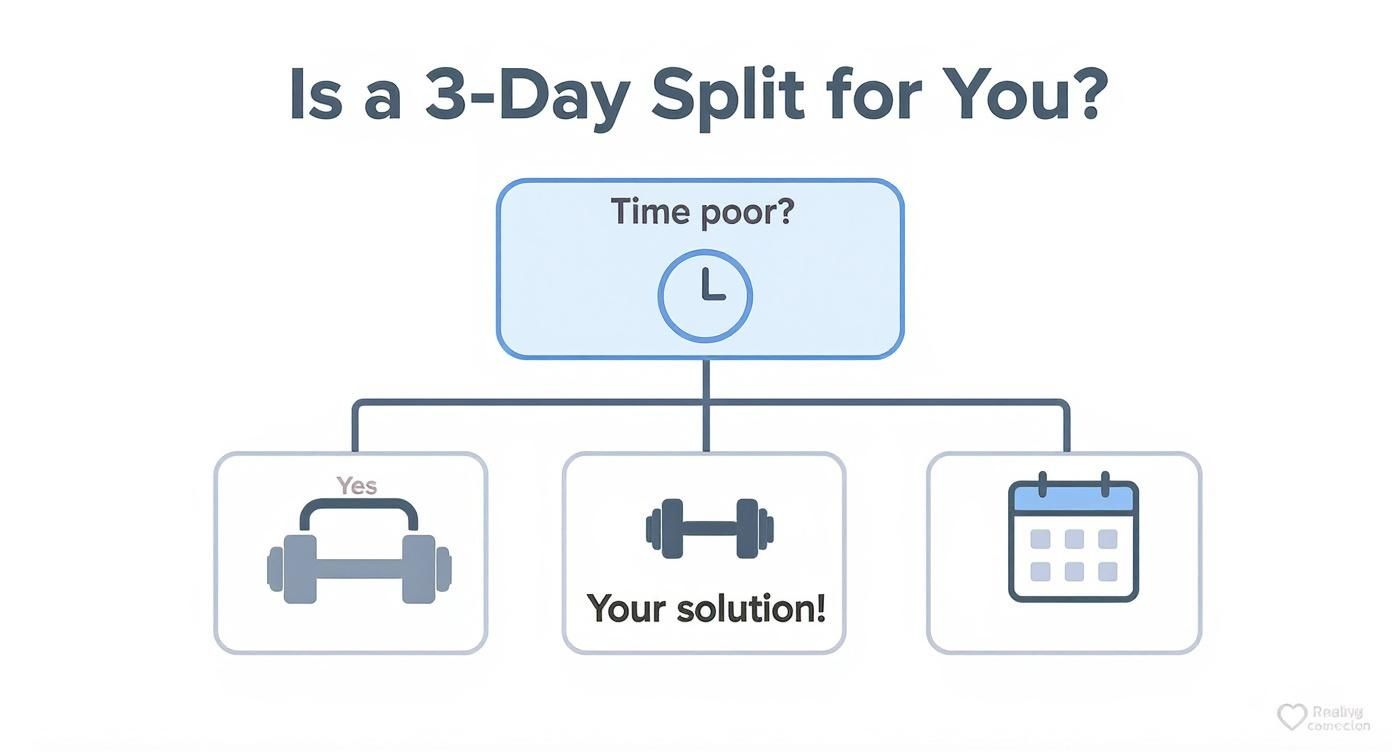
As you can see, for anyone juggling a packed calendar, the 3-day split offers a powerful and, more importantly, sustainable way to stay consistent with training.
Which 3 Day Split Fits Your Training Style
To help you cut through the noise, here's a quick comparison of the most popular 3-day splits. Use this table to see which one lines up best with your own fitness objectives and what you enjoy doing in the gym.
| Split Type | Primary Goal | Ideal For | Key Benefit | Potential Downside |
|---|---|---|---|---|
| Push/Pull/Legs | Muscle Growth (Hypertrophy) | Bodybuilders & aesthetics-focused lifters | High volume per muscle group, maximizing recovery between sessions. | Each muscle is only hit directly once per week. |
| Full Body | Raw Strength & Athleticism | Powerlifters, athletes, beginners | High-frequency training improves neural drive and technique. | Lower volume per session can limit muscle pump and size gains. |
| Upper/Lower Hybrid | Balanced Strength & Size | Intermediate lifters, those wanting more frequency | Hits muscles more than once a week; very versatile. | Can be complex to balance recovery and volume. |
Each of these splits has its own flavor and is built for a specific purpose. Let's dig a little deeper into what makes each one tick.
The Classic Push/Pull/Legs Split
The Push/Pull/Legs (PPL) split is probably the most popular 3 day split out there, and for good reason. It’s incredibly intuitive. You organize your week by movement patterns, which naturally prevents you from overtraining certain muscles while letting others recover.
Here’s how it breaks down:
- Push Day: You train all the upper-body muscles responsible for pushing. Think chest (bench press), shoulders (overhead press), and triceps (dips, pushdowns).
- Pull Day: This day hits all the upper-body muscles that pull. We're talking back (rows, pull-ups) and biceps (curls).
- Leg Day: Simple enough—it's dedicated entirely to your lower body. You'll cover quads, hamstrings, glutes, and calves with big moves like squats and deadlifts.
This setup is a rockstar for balanced muscle growth (hypertrophy). It lets you hammer each muscle group with a ton of volume once a week, making it a favorite for anyone trying to build a well-proportioned physique. The clean separation means you can go all out on your push day, knowing your back and biceps will be fresh and ready for their session.
The Full Body Strength Split
With a full-body split, you’re training all your major muscle groups in every single workout, three times a week. It sounds like a lot, but the trick is in managing your volume. You won’t be doing five different chest exercises in one session; instead, you’ll stick to one or two big, heavy compound lifts each day.
This approach is second to none for developing pure strength and is a staple for powerlifters and athletes. Hitting your muscles more often—three times a week versus just once—is like getting more practice. It improves your technique and neural drive much faster. In fact, a 2018 meta-analysis found that for strength gains, training a muscle group 2-3 times per week blows training it once out of the water.
By hammering compound movements like squats, deadlifts, and bench presses in every workout, you trigger a powerful hormonal response and build functional, real-world strength that carries over into everything you do.
The Upper/Lower Hybrid Split
For anyone who wants the best of both worlds—a mix of frequency and focused volume—the Upper/Lower hybrid is a fantastic middle ground. It cleverly blends elements from the other two splits into a flexible and brutally effective program.
A common setup might look like this:
- Day 1: Upper Body (hitting both pushing and pulling movements)
- Day 2: Lower Body (squats, deadlifts, and accessory work)
- Day 3: Full Body (often a lighter day or one focused on weak points)
This structure gives you the frequency needed for both strength and hypertrophy. That third, full-body day is your wild card. You can use it to add extra work for lagging body parts, focus on explosive athletic movements, or just get in some conditioning. It's an incredibly versatile 3 day split that can be tweaked for almost any goal, making it a go-to for intermediate lifters looking to smash through a plateau.
Actionable Workout Templates For Real Results
Theory is great, but results are built with iron, sweat, and action. This is where we stop planning and start doing. Below are three distinct, ready-to-go templates for a 3 day split, each built for a specific goal. Think of them as your starting blueprints—a clear roadmap you can follow today and tweak as you get stronger.
These aren't just random lists of exercises. They're structured plans based on proven principles of volume, intensity, and smart exercise selection. Whether you want to build noticeable muscle, forge raw strength, or get lean and conditioned, there's a path here for you.
The Muscle Growth Blueprint: Hypertrophy Focus
This plan is all about one thing: maximizing muscle growth, or hypertrophy. The goal is to create enough metabolic stress and muscular damage to signal your body to rebuild bigger and stronger. We'll get there with moderate weight, higher reps, and tight rest periods to keep the tension right where we want it.
We’re focusing on the classic 8-12 rep range. It's widely considered the sweet spot for hypertrophy, giving you the perfect blend of mechanical tension and time under tension.
Weekly Schedule Example: Monday / Wednesday / Friday
Day 1: Push (Chest, Shoulders, Triceps)
- Barbell Bench Press: 3 sets of 8-12 reps
- Incline Dumbbell Press: 3 sets of 10-12 reps
- Seated Dumbbell Shoulder Press: 3 sets of 10-12 reps
- Lateral Raises: 4 sets of 12-15 reps
- Triceps Pushdowns: 3 sets of 12-15 reps
- Overhead Triceps Extension: 3 sets of 12-15 reps
Day 2: Pull (Back, Biceps)
- Pull-Ups (or Lat Pulldowns): 3 sets to failure (or 8-12 reps)
- Barbell Rows: 3 sets of 8-12 reps
- Seated Cable Rows: 3 sets of 10-12 reps
- Face Pulls: 4 sets of 15-20 reps
- Barbell Curls: 3 sets of 10-12 reps
- Hammer Curls: 3 sets of 10-12 reps
Day 3: Legs (Quads, Hamstrings, Glutes, Calves)
- Barbell Back Squats: 3 sets of 8-12 reps
- Romanian Deadlifts: 3 sets of 10-12 reps
- Leg Press: 3 sets of 12-15 reps
- Leg Curls: 3 sets of 12-15 reps
- Leg Extensions: 3 sets of 15-20 reps
- Standing Calf Raises: 4 sets of 15-20 reps
Key Focus: For this hypertrophy plan, rest just 60-90 seconds between sets. This shorter rest period drives up metabolic stress, which is a key trigger for muscle growth. Concentrate on feeling the muscle work through its full range of motion.
The Pure Strength Blueprint: Max Power Focus
If your only goal is to move the heaviest weight possible, your training has to reflect that. This strength-focused 3 day split is built around heavy compound lifts, lower rep ranges, and longer rest periods. This gives you time to fully recover so you can produce maximum force on every single set.
Here, we'll be working primarily in the 3-6 rep range. This zone is perfect for developing neurological efficiency and raw power.
Weekly Schedule Example: Tuesday / Thursday / Saturday
Day 1: Heavy Upper Body
- Barbell Bench Press: 4 sets of 3-5 reps
- Weighted Pull-Ups: 4 sets of 5-6 reps
- Overhead Press: 3 sets of 5-6 reps
- Pendlay Rows: 3 sets of 5-6 reps
- Dips: 3 sets of 6-8 reps
Day 2: Heavy Lower Body
- Barbell Back Squats: 4 sets of 3-5 reps
- Conventional Deadlifts: 3 sets of 3-5 reps
- Leg Press: 3 sets of 6-8 reps
- Glute-Ham Raises: 3 sets to failure
Day 3: Full Body Power
- Incline Bench Press: 3 sets of 5-6 reps
- Front Squats: 3 sets of 5-6 reps
- Barbell Rows: 3 sets of 6-8 reps
- Seated Dumbbell Shoulder Press: 3 sets of 6-8 reps
- Barbell Curls: 3 sets of 8-10 reps
For a deep dive into proper form, the extensive Zing Coach exercise library has detailed video demonstrations to ensure you're lifting safely and getting the most out of every rep.
The Fat Loss and Conditioning Blueprint: Metabolic Focus
This template is engineered to maximize calorie burn and crank up your metabolic rate. The trick is to structure the workouts as circuits or supersets, keeping rest periods brutally short to keep your heart rate jacked up. It's intense, but it's an incredibly efficient way to train.
The exercises are a mix of compound strength moves and conditioning drills. This combo helps you hold onto hard-earned muscle while torching body fat.
Weekly Schedule Example: Any 3 non-consecutive days
Day 1: Full Body Circuit A
- Perform each exercise back-to-back with almost no rest. Rest 90-120 seconds after the full circuit. Repeat for 3-4 total rounds.
- Goblet Squats: 15 reps
- Push-Ups: 15 reps
- Dumbbell Rows: 15 reps (per side)
- Kettlebell Swings: 20 reps
- Plank: 60 seconds
Day 2: Full Body Circuit B
- Same circuit structure as Day 1. Knock out 3-4 rounds.
- Dumbbell Lunges: 12 reps (per side)
- Dumbbell Overhead Press: 12 reps
- Lat Pulldowns: 15 reps
- Burpees: 10 reps
- Leg Raises: 20 reps
Day 3: Full Body Circuit C
- You know the drill. Complete 3-4 rounds.
- Romanian Deadlifts: 15 reps
- Incline Dumbbell Press: 12 reps
- Seated Cable Rows: 15 reps
- Battle Ropes: 30 seconds
- Mountain Climbers: 45 seconds
These templates are a solid foundation, not a rigid prescription. Remember, the best program is the one you actually stick with. Listen to your body, track your progress, and don't be afraid to adjust these blueprints to fit your own needs and recovery.
The Art of Progression And Avoiding Plateaus
Even the most perfectly designed **3 day split** is useless if it never changes. Your body is an incredible adaptation machine; it gets stronger and more efficient in response to the stress you put on it. But once it adapts, it needs a *new* reason to keep growing.Without that new stimulus, you hit the dreaded plateau, where your progress grinds to a halt.
This is where the principle of progressive overload comes into play. It's the absolute cornerstone of all long-term gains, yet most people think it just means adding more weight to the bar. While that's a huge part of it, it's a pretty limited view. True progression is an art form, giving you a whole toolbox to keep the gains coming.
Smart Ways to Apply Progressive Overload
Staying ahead of your body's adaptation curve means you need to be creative. Instead of just fixating on the number on the dumbbell, think about all the other training variables you can tweak. This is how you keep your workouts challenging and productive.
Here are several practical ways to do it:
- Increase Reps: If you hit 8 reps on your bench press last week, fight for 9 or 10 this week with the exact same weight.
- Add Sets: Once you can comfortably nail your target reps for all your sets, tack on an extra set to bump up the total volume.
- Improve Form: Lifting the same weight with stricter, more controlled technique is a huge form of progression. It increases muscle tension and massively reduces injury risk.
- Decrease Rest Times: Shaving 15 seconds off your rest periods between sets makes the workout denser and more metabolically demanding.
Think of these as different levers you can pull. When one gets stuck—like you just can't add more weight to your squat this week—you can pull another, like adding a rep or an extra set.
The secret to avoiding plateaus isn't about making massive jumps every week. It's about consistently making small, measurable improvements over time. This patient, strategic approach is what separates fleeting progress from lasting transformation.
Listening to Your Body With Autoregulation
Some days you walk into the gym feeling like a superhero, ready to smash personal records. Other days, you feel completely run down from poor sleep or life stress. Autoregulation is the crucial skill of adjusting your workout on the fly based on how you feel that day.
Instead of blindly following the numbers on your spreadsheet, you listen to your body’s feedback. If your warm-up sets feel unusually heavy, it might be a day to dial back the weight and focus on higher reps and perfect form.
On the flip side, if everything feels light and snappy, that’s your green light to push a little harder. This is how you prevent overtraining and burnout while taking full advantage of your best days.
The frequency of a 3 day split is particularly well-suited for consistent strength gains, a fact backed by research. A study on resistance training found that individuals training three times per week saw their strength improve by 21.2% after 10 weeks, and 28.4% after 18 weeks—significantly more than those training less often. You can read the full research on training frequency and strength gains to dig into the details.
The Non-Negotiable Habit of Tracking
If you’re not tracking your workouts, you’re just guessing. You can’t apply progressive overload if you can’t remember what you lifted last week. It’s that simple. A simple notebook, a spreadsheet, or a dedicated app like Zing Coach is absolutely essential.
Tracking lets you see objective progress. It turns abstract feelings into hard data, showing you exactly when and how you’re getting stronger. This is also your early warning system for plateaus.
If your numbers haven't budged for three weeks straight, it’s time to change something up. For more detailed strategies on this, check out these excellent tips to prevent workout plateaus.
Fuel Your Gains With Smart Nutrition And Recovery
What you do in the gym is only half the battle. Your results from any 3 day split are truly forged in the hours you spend recovering and refueling. Without a smart approach to nutrition and recovery, you’re essentially training with one hand tied behind your back, leaving potential gains on the table.
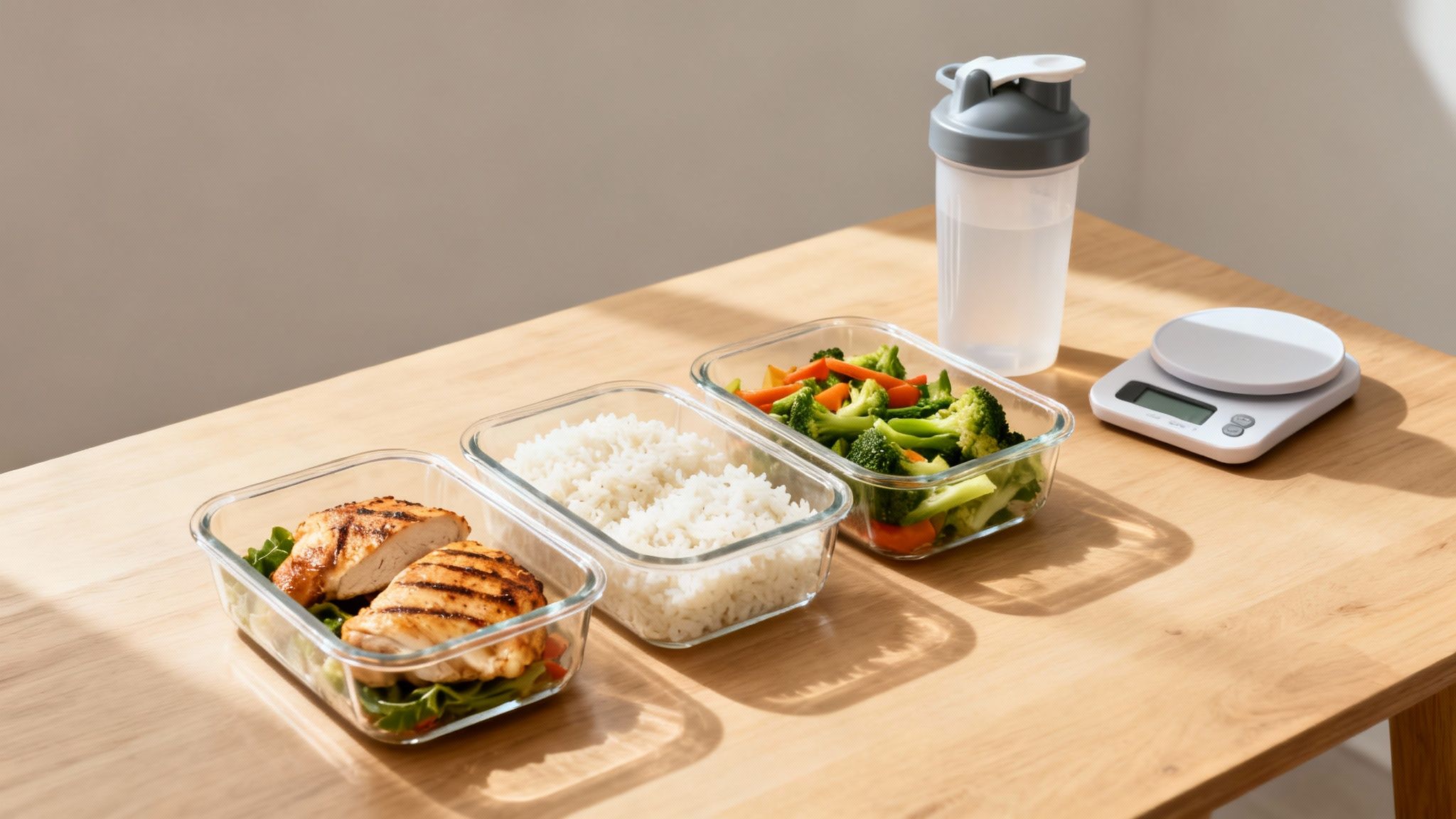
Think of your body like a high-performance engine. Your workouts are the throttle, but food is the premium fuel it needs to perform, repair, and come back stronger. Ignoring nutrition is like expecting a race car to win on low-grade gasoline—it simply won’t happen.
Dialing In Your Nutrition
Getting your nutrition right doesn't have to be complicated. It all boils down to two key pieces: calories and macronutrients (protein, carbs, and fats). How you tweak them depends entirely on what you're trying to achieve.
- For Muscle Gain (Hypertrophy): You need to be in a caloric surplus. A good starting point is eating 250–500 calories more than your body burns daily. This gives you the raw energy needed to build new muscle tissue.
- For Fat Loss: A caloric deficit is the name of the game. Aim to eat 250–500 calories below your maintenance level. This nudges your body to tap into stored fat for energy while your training helps you hang onto your hard-earned muscle.
When it comes to macros, protein is the non-negotiable king for recovery and muscle repair. A solid target for anyone lifting is 0.7–1.0 grams of protein per pound of body weight. The rest of your calories should come from quality carbs for energy and healthy fats to support hormone function.
Your pre- and post-workout meals are your biggest nutritional opportunities. Grabbing a mix of protein and easily digestible carbs 1–2 hours before training fuels your performance, while a similar meal right after kickstarts the recovery process immediately.
Many people find it easier to hit their protein targets with a little help. You can learn more about how protein shakes and supplements can fit into your recovery plan.
Beyond Just Sleeping More
Recovery is an active process that goes way beyond getting eight hours of sleep. Those four days you aren't lifting are prime opportunities to speed up muscle repair and get your body ready for the next session. This is where active recovery comes into play.
Instead of being a couch potato on your off days, doing some light, low-impact activity can make a huge difference. These practices boost blood flow to sore muscles, helping to flush out metabolic waste and deliver fresh, nutrient-rich blood to accelerate healing.
Smart Active Recovery Tactics
Try working these simple but powerful techniques into your rest days to keep your body feeling fresh and ready to go.
- Low-Intensity Cardio: A 20–30 minute walk, a casual bike ride, or a gentle swim can do wonders. The key is keeping your heart rate low enough that you could still hold a conversation.
- Foam Rolling & Myofascial Release: Spend 10–15 minutes with a foam roller or lacrosse ball on tight spots like your quads, hamstrings, back, and lats. This helps release muscle knots and can improve your flexibility.
- Dynamic Stretching: Focus on mobility with movements like leg swings, arm circles, and torso twists. This is great for joint health and range of motion without putting any real stress on your muscles.
How you bounce back is just as important as how you train, helping you make consistent progress and avoid overtraining. To build a truly resilient system, explore some science-backed strategies for faster workout recovery. Combining smart nutrition with active recovery ensures that every ounce of effort you put into your 3 day split translates into real, measurable progress.
Common 3-Day Split Mistakes And How To Fix Them
Even the best-laid 3-day split can fall flat if you stumble into a few common traps. These mistakes might seem small at first, but they're the kind of things that can completely derail your progress over time. Let’s walk through the biggest issues I see people run into and, more importantly, how to get back on the right track.
One of the most frequent offenders is "program hopping." You get excited about a PPL split, stick with it for two weeks, then get distracted by a shiny new full-body routine you saw on Instagram. This constant switching is the enemy of progressive overload. Your body simply never gets the chance to adapt and grow stronger.
The fix is straightforward but takes a bit of discipline: commit to one program for at least 8-12 weeks. That's enough time for the plan to actually work its magic and for you to see real, measurable improvements in your lifts.
Sacrificing Form For Weight
Another huge progress-killer is ego lifting. It's so tempting to pile more plates on the bar than you can realistically handle, but using sloppy, dangerous form just to move the weight is a one-way ticket to injury and zero results. You end up training your ego, not your muscles.
Instead, swallow your pride and master the movement first. Drop the weight, concentrate on a full range of motion, and really feel the target muscle doing the work. A perfectly controlled lift will always build more muscle than a jerky, partial rep with a heavier weight.
Remember, the goal isn't just to lift the weight; it's to stimulate the muscle. Your muscles don't know how much weight is on the bar, but they respond directly to tension and control.
Recent analyses show just how much workout frequency can influence results, which is why your exercise selection is so critical. For instance, full-body 3-day splits might boost strength gains by around 50% compared to hitting a muscle just once a week, though the benefit for muscle growth is a bit more modest. You can discover more insights on training frequency and results.
This brings up another classic mistake: filling your workouts with too many isolation exercises (like bicep curls) at the expense of big, compound lifts (like rows and pull-ups). Compound movements give you the most bang for your buck, building a solid foundation of strength and triggering more overall growth. Make sure at least 80% of your workout is built around these heavy hitters.
Common Questions About the 3 Day Split
Let's clear the air and tackle some of the most common questions that pop up when people start thinking about a 3 day split. Getting these answers straight can give you the confidence to jump in and stick with it.
First off, can you actually build muscle this way? Absolutely. The idea that you need to live in the gym five or six days a week to build serious muscle is a total myth. A well-designed 3 day split provides more than enough stimulus for growth, especially when you’re pushing for progressive overload and dialing in your nutrition.
The generous recovery time is a huge advantage here. Remember, muscle growth happens when you're resting, not when you're training.
How Should I Schedule My Training Days?
The classic—and most effective—schedule is to train on non-consecutive days. This gives your body a full day of recovery between each session, which is perfect for performance and muscle repair.
- Monday / Wednesday / Friday is a popular choice that works beautifully.
- Tuesday / Thursday / Saturday is another fantastic option.
This kind of setup lets your central nervous system and muscles fully recharge. While you can train on back-to-back days if your schedule is tight, it's not the best way to run a 3 day split for long-term progress.
The specific days you choose don't matter nearly as much as the recovery time you build in. A day of rest between workouts ensures you can bring maximum intensity to every single session.
How Long Should My Workouts Last?
Your workouts should be intense and focused. Aim for somewhere between 45 to 75 minutes. If you're consistently training for over 90 minutes, you might be packing in too much volume or taking way too long between sets.
The goal is quality over quantity. Get in, work hard, and get out.
And for anyone just starting out, is this a good approach? Definitely. A 3 day split is fantastic for beginners because it isn’t overwhelming. It gives newcomers a chance to learn proper form on the big lifts and build a solid foundation without risking the burnout that often torpedoes more demanding schedules.
Ready to stop guessing and start building a workout that truly works for you? Zing Coach uses AI to create a personalized 3 day split based on your goals, equipment, and fitness level, adapting automatically as you get stronger.
Tags
Share this article


Authors