Discover the ideal rate for healthy weight loss per week. Our guide explains the science behind sustainable fat loss for results that actually last.
Let's cut through the noise: what's a truly healthy amount of weight to lose each week? Most health experts agree that a steady pace of 1 to 2 pounds (about 0.5 to 1 kg) is the sweet spot for safe, sustainable results. This isn't a quick fix; it's a measured approach that sets you up for long-term success.
The Gold Standard for Weekly Weight Loss
Think of your weight loss journey like building a house, not setting off a firework. A firework is spectacular for a moment, but it vanishes quickly, leaving nothing behind. Building a house, on the other hand, requires a steady, consistent effort that creates something strong and lasting. This is the whole idea behind healthy weekly weight loss.
Imagine stepping on the scale and seeing a reliable drop of 1 to 2 pounds week after week. That's the gold standard recommended by top health authorities. This pace allows your body to shed fat while preserving precious muscle mass and avoiding the all-too-common pitfalls of crash diets.
Why This Pace Matters
Going slower has some serious advantages that go way beyond the number on the scale. It's about prioritizing your overall well-being and setting the stage for permanent change.
Here are the key benefits:
- You Keep Your Muscle: Rapid weight loss often burns through muscle, which is your metabolic engine. A slower pace helps ensure you're primarily losing fat, not the muscle you need to keep your metabolism humming.
- You Avoid Metabolic Slowdown: Slashing calories too drastically can signal your body to go into conservation mode, slowing your metabolism way down. This makes future weight loss even harder.
- You Build Habits That Actually Stick: Losing 1-2 pounds a week is the result of small, manageable tweaks to your diet and activity levels—the kinds of habits you can actually live with for the long haul.
The goal isn't just to drop weight; it's to build a healthier, more intuitive relationship with food and exercise that lasts a lifetime. This steady approach is what makes that possible.
The Science of the Deficit
This recommended range is all based on simple energy math. One pound of body fat holds roughly 3,500 calories of energy. So, to lose one pound in a week, you need to create a total deficit of 3,500 calories over seven days.
That breaks down to a daily deficit of about 500 calories. If you're aiming to lose 2 pounds a week, you’d double that to a daily deficit of 1,000 calories. This deficit is created through a smart combination of eating a bit less and moving a bit more. It's a reliable formula that favors consistency over intensity. You can learn more about how to lose weight safely in our detailed guide.
This science-backed approach is precisely what tools like Zing Coach are built on. The app analyzes your personal data to calculate the ideal calorie deficit for your body and goals, personalizing the journey to make sustainable progress feel natural.
Sustainable Weekly Weight Loss at a Glance
To make this simple, here’s a quick table summarizing the key metrics for a healthy weight loss journey.
| Metric | Recommended Range | Primary Benefit |
|---|---|---|
| Weekly Weight Loss | 1–2 pounds (0.5–1 kg) | Ensures fat loss while preserving muscle mass. |
| Daily Calorie Deficit | 500–1,000 calories | Creates steady progress without extreme restriction. |
| Focus | Habit Formation | Builds long-term behaviors for maintenance. |
This framework isn't about restriction; it's about creating a sustainable rhythm that your body can adapt to positively, leading to results that last.
Understanding the Science of a Calorie Deficit
To hit that sweet spot of healthy weekly weight loss, we need to pop the hood and look at how your body’s engine really works. The single most important concept to grasp is the calorie deficit.
Think of it like this: your body is a high-performance vehicle, and calories are its fuel. A calorie deficit is just you, the driver, burning a little more fuel each day than you put in the tank.
It’s not some magical formula or an excuse for extreme dieting. It’s simple energy accounting. When your body needs more energy than your food provides, it taps into its reserves—your body fat—to cover the difference. This steady, gentle withdrawal from your energy savings is what leads to real, lasting fat loss.
The whole game is governed by your Total Daily Energy Expenditure (TDEE), which is just a fancy term for all the calories you burn over a 24-hour period.
Breaking Down Your Personal Energy Equation
Your TDEE isn't just one number; it’s a sum of a few key parts that work together. Understanding these parts helps clear up why your calorie needs are completely unique to you.
- Basal Metabolic Rate (BMR): This is the biggest piece of the pie. Imagine you’re just chilling, completely at rest. Your BMR is the energy your body needs just to keep the lights on—breathing, circulating blood, repairing cells. It makes up a massive 60–75% of your daily burn.
- Thermic Effect of Food (TEF): Did you know you burn calories just by eating? That’s the TEF. Your body uses energy to digest and process food, and protein has the highest thermic effect of all. This is one of the not-so-secret reasons why high-protein diets are so effective for fat loss.
- Physical Activity: This covers everything from your planned gym session to taking the stairs or lugging in the groceries. It’s the most variable part of your energy equation and the one you have the most direct control over.
The real power comes when you realize you're in the driver's seat. By tweaking what you eat and how much you move, you create the small energy gap needed for consistent weight loss without ever feeling like you’re running on empty.
Calculating Your Target for Healthy Weekly Weight Loss
Once you get a handle on your TDEE, creating that deficit is pretty straightforward. It’s a widely accepted scientific fact that one pound of body fat stores roughly 3,500 calories.
So, let's do the math.
To lose 1 pound per week, you need to create a total deficit of 3,500 calories over seven days.
- 3,500 calories / 7 days = a 500-calorie deficit per day.
Want to aim for 2 pounds per week? You’d need to double that.
- 7,000 calories / 7 days = a 1,000-calorie deficit per day.
This 500–1,000 calorie deficit range is the science-backed foundation for that 1–2 pound weekly weight loss goal. It’s a big enough gap to get you results you can see, but not so big that it triggers the gnawing hunger and metabolic slowdown that come with crash dieting. For a deeper dive, check out our guide on how to calculate your daily calorie needs.
The infographic below really brings this idea to life, showing how small daily actions build into weekly progress and long-term success.
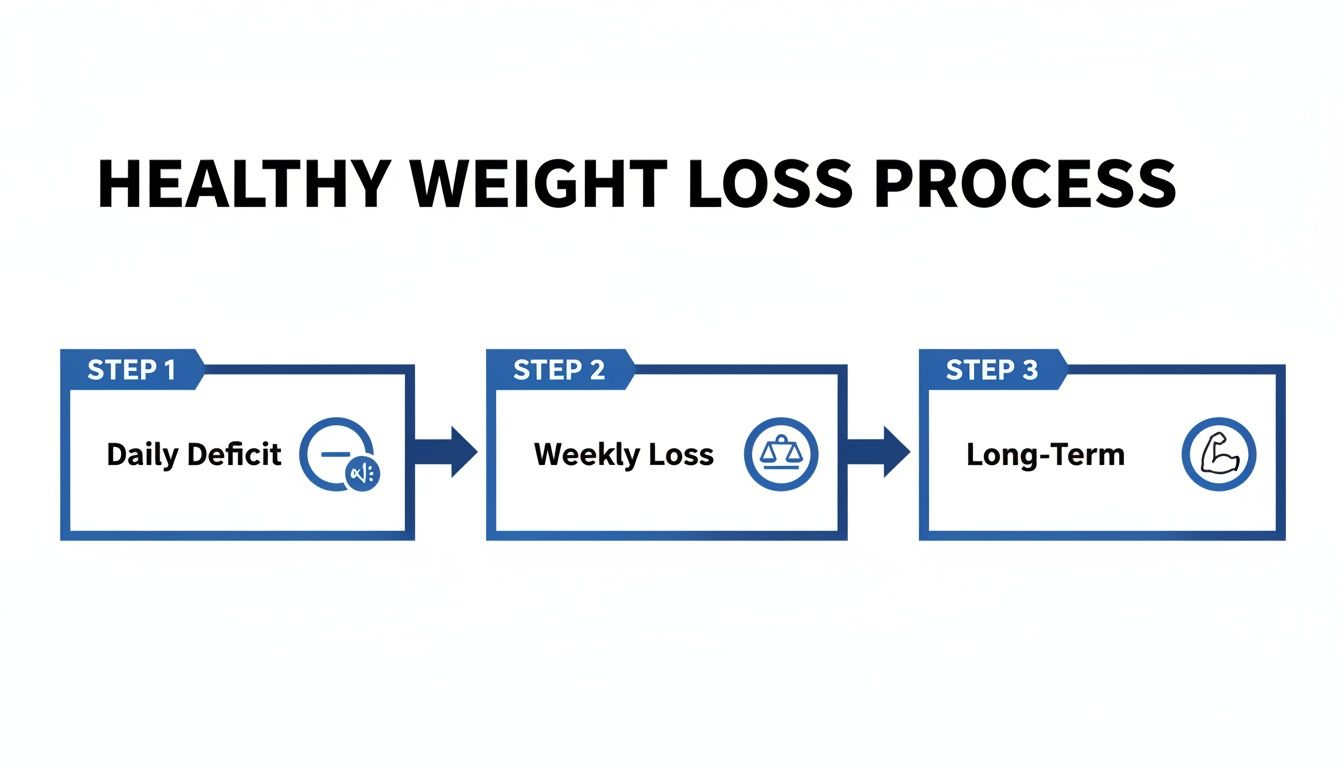
This visual makes it crystal clear: maintain a modest daily deficit, hit your weekly target, and you're well on your way to building a stronger, leaner body.
Why Your Weight Loss Journey Is Unlike Anyone Else’s
While the 1-2 pound a week guideline is a solid framework, it's important to see it for what it is: a map, not a turn-by-turn GPS route. There's no single "one-size-fits-all" formula for weight loss simply because no two bodies are exactly alike. The rate of weight loss that’s perfect for your friend might be too fast or too slow for you.
Your personal journey is shaped by a unique blend of your biology and your lifestyle. Think of it like this: your body is a car. Two cars might look similar on the outside, but one could have a V8 engine while the other has an efficient four-cylinder. They’ll burn fuel at completely different rates, even traveling the same road. The same is true for our metabolisms.
This is exactly why comparing your progress to someone else’s can be so misleading and discouraging. The real goal is to understand the factors that make your journey yours and yours alone.
Key Factors That Influence Your Results
Several key variables dictate how your body responds to a calorie deficit. Knowing what they are helps you set realistic expectations and appreciate the nuances of your own progress.
Let’s break down the main drivers:
- Age and Sex: Our metabolism naturally slows down as we age, largely because muscle mass tends to decrease over time. On top of that, men often lose weight more quickly than women, at least in the beginning. This is usually due to having more muscle mass and different hormonal profiles.
- Starting Weight: Someone with more weight to lose will often see faster results at the start. A larger body simply requires more energy (calories) to function, which means their baseline daily energy expenditure is higher, making it easier to create a significant calorie deficit.
- Body Composition: This one is huge. Two people can weigh the exact same, but if one has more muscle and the other has more fat, their metabolic rates will be worlds apart. Muscle is active tissue—it burns more calories at rest than fat does. If you're curious about this, you can check out our guide on how to measure your body composition at home.
These factors are just the start. Things like genetics and underlying health conditions can also play a major role in how your body sheds weight.
The Power of an Adaptive Plan
Given all this complexity, it’s clear why a static, generic plan is almost destined to fall short. Your body is constantly changing and adapting, so your fitness and nutrition strategy has to do the same. This is where modern tech can make a real difference.
An adaptive plan is like having a personal coach who checks in with you every single day. It notices when you're tired, when you're feeling strong, and adjusts your workout to match, ensuring you're always challenged but never overwhelmed.
This is the whole idea behind Zing Coach. The app’s AI doesn't just hand you a starting plan and wish you luck; it continuously evolves with you. By analyzing your progress, fitness level, and even your daily fatigue signals, it makes small adjustments to your workouts and calorie targets. This keeps your plan perfectly optimized for your body at every single stage of your journey.
And this isn't a niche concern—it’s a global effort. A 2022 Ipsos study found that 45% of people across 30 countries were actively trying to lose weight. Those numbers jump to over 50% in places like the USA and Spain. This worldwide push for better health shows a universal desire to combat rising obesity rates, which now affect 1 in 8 adults globally. You can find more stats on these health trends at pharmko.com.
Ultimately, your unique biology isn't a hurdle. It’s the blueprint that a truly smart, personalized plan should be built on.
Building Sustainable Nutrition and Exercise Habits
Knowing the science behind a calorie deficit is one thing, but putting it into practice day after day is where the real work—and the real transformation—begins. Dropping weight at a healthy pace isn't about miserable diets or workouts so intense you can only keep them up for a week. It's about building small, manageable habits that eventually become second nature.
Think of your nutrition and exercise as the two pillars holding up your long-term health goals. If one is shaky, the whole structure gets wobbly. A solid nutrition plan fuels your body and creates that all-important calorie deficit, while a smart exercise routine fires up your metabolism and helps sculpt your body.
Fueling Your Body for Fat Loss
Forget everything you think you know about restrictive dieting. The sustainable way to eat for weight loss is to focus on adding nutrient-dense foods that keep you full and energized, not just on cutting things out. This simple shift in mindset makes your calorie deficit feel less like a sacrifice and more like a smart upgrade.
Developing a structured approach is key, which is where effective meal planning can make a world of difference without adding stress to your week.
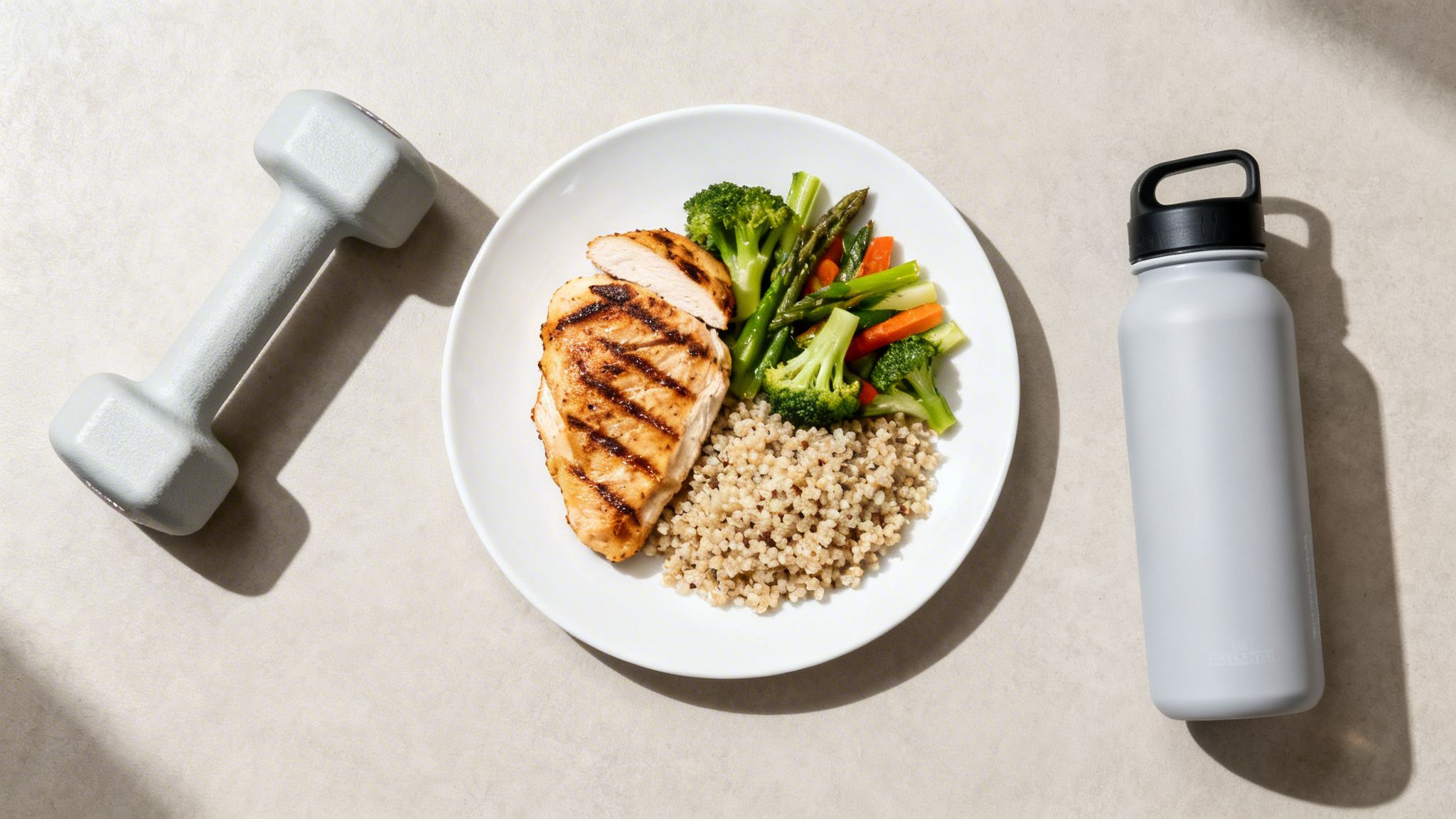
Your plate should really zero in on three key players:
- Protein for Satiety: Protein is your absolute best friend when you're trying to lose weight. It's more filling than carbs or fats, which is a huge help for managing hunger. Plus, it has a higher thermic effect, meaning your body actually burns more calories just digesting it. Make sure you're getting a source of lean protein like chicken, fish, tofu, or legumes with every meal.
- Fiber for Fullness: Foods packed with fiber—think vegetables, fruits, and whole grains—add serious bulk to your meals without piling on the calories. This helps you feel completely satisfied on less food, making it much easier to stick to your calorie target.
- Water for Everything: Staying hydrated is non-negotiable. It helps with digestion, keeps your metabolism humming, and can even stop you from reaching for a snack when your body is actually just thirsty.
When you prioritize these components, you start creating meals that are not only delicious but are actively working with your weight loss goals. For more hands-on ideas, check out our guide to simple meal prep for weight loss.
There’s a persistent myth that you have to lose weight at a snail's pace for it to stick. But some research actually suggests a moderately faster initial pace can be more motivating and just as effective, as long as the habits you're using are sustainable.
Interestingly, historical research from the TOURS study challenged this "slow and steady" mantra. It found that in structured lifestyle programs, participants who lost weight a bit faster—around 1 pound per week or more—actually had greater short-term success and better long-term results, without being more likely to regain it. You can dive into the full weight loss pace findings yourself.
Building a Stronger Metabolic Engine
Exercise is the other essential pillar. And while cardio is great for torching calories in the moment, strength training is what builds and protects your most valuable metabolic asset: lean muscle.
Here's a simple way to think about it:
- Strength Training: This is like upgrading your car's engine. Building muscle increases your Basal Metabolic Rate (BMR), which means your body burns more calories 24/7, even when you're just sitting on the couch. This makes it so much easier to maintain your weight loss down the road.
- Cardio (Cardiovascular Exercise): This is like taking your car for a long, efficient drive. Activities like running, cycling, or swimming are fantastic for burning a lot of calories in one go and are crucial for heart health.
The magic really happens when you combine them. A great, balanced routine might involve 2–3 days of strength training and 2–3 days of cardio each week. This synergy ensures you're burning calories effectively while simultaneously boosting your resting metabolism for the long haul.
This is exactly where a tool like Zing Coach shines. The app doesn't just throw random workouts at you; it crafts a balanced, personalized plan that strategically weaves together both strength and cardio. It guides you through every movement with an avatar trainer and even uses your phone's camera for real-time form feedback, making sure you're doing each exercise safely and effectively. By personalizing the plan, Zing helps you build a routine that supports healthy weekly weight loss and, more importantly, keeps you coming back for more.
How to Track Progress Beyond the Scale
Let’s be honest: the number on the bathroom scale can feel like the final verdict on our progress. But relying on it alone is like judging a movie by a single, blurry photo—you miss the whole story. Your weight can jump around daily thanks to water retention, hormones, or even what time you weigh in, which can be incredibly frustrating when you’re trying to stay consistent.
True progress is so much more than just a number going down. It’s about real, fundamental changes in your body composition, how much energy you have, and frankly, how you feel in your own skin. When you broaden your definition of a "win," you build a more motivating and realistic picture of your journey, helping you stick with it even when the scale is being stubborn.
Seeing the Real Changes in Your Body
One of the most powerful ways to see what’s really happening is to look at how your body shape is changing. As you start eating better and exercising—especially with strength training—you'll be building lean muscle while losing body fat. This is a massive victory, but it might not show up on the scale right away.
Here's the thing: muscle is denser than fat. That means it takes up less space for the same amount of weight. You could be losing inches and toning up while your weight stays put or even nudges up slightly. That’s phenomenal progress the scale will never give you credit for.
Here are a few better ways to see the changes:
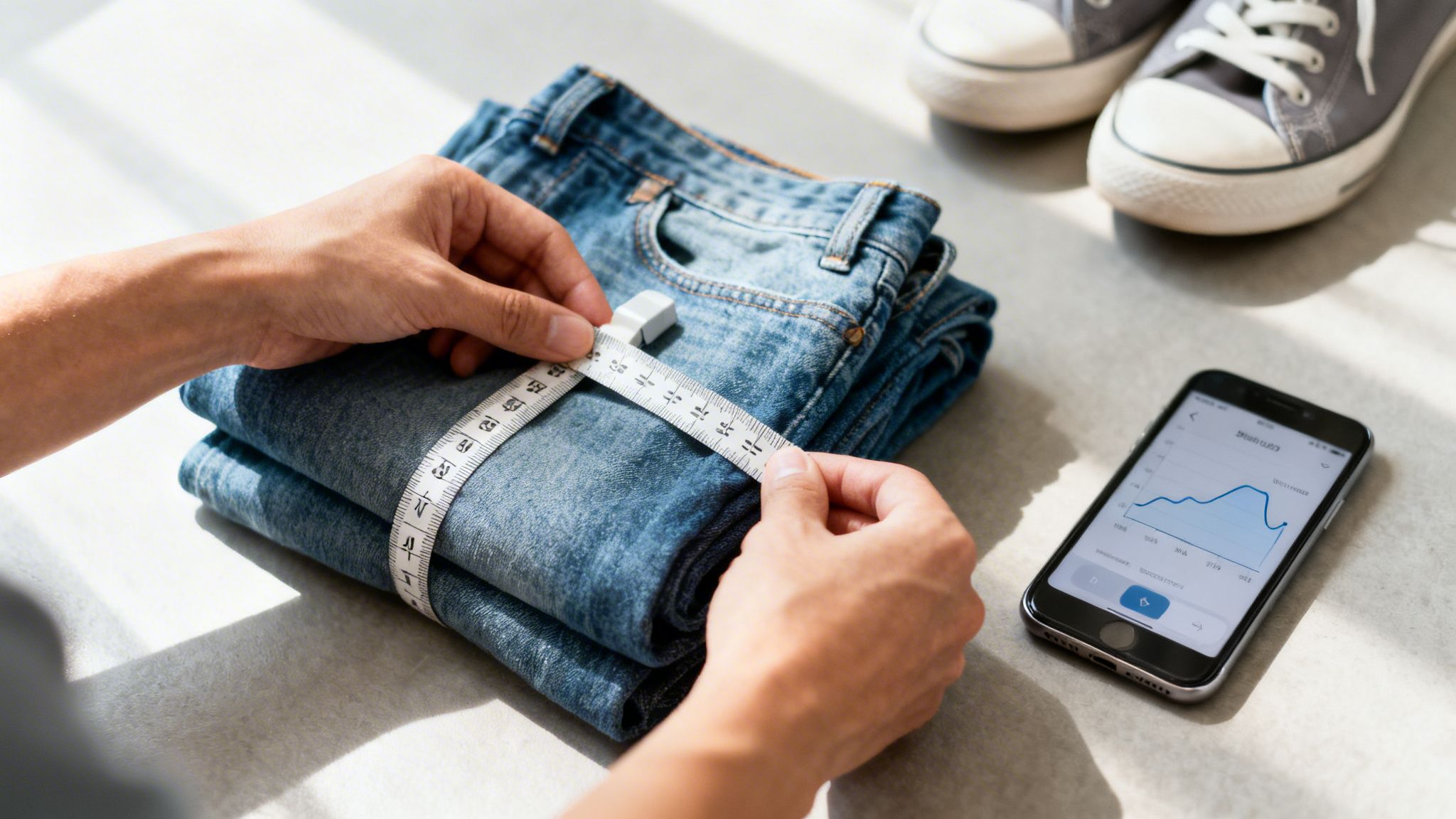
- Body Measurements: Grab a flexible measuring tape and track your waist, hips, chest, and arms every few weeks. A shrinking waistline, in particular, is a fantastic sign you're losing visceral fat—the unhealthy kind that surrounds your organs.
- How Your Clothes Fit: That pair of jeans that used to feel a little too tight is often a more honest progress report than any digital readout. When your clothes start fitting better, it's undeniable proof your body is changing for the better.
- Progress Photos: It might feel awkward at first, but taking photos from the front, side, and back every four weeks (in the same lighting and clothes) can reveal visual shifts your own eyes miss day-to-day.
Celebrating Your Non-Scale Victories
Your health journey isn’t just happening in the gym or the kitchen; it spills over into every part of your life. These "non-scale victories" (NSVs) are the real rewards of your hard work. They’re the moments that remind you why you started in the first place.
Non-scale victories are the milestones that remind you why you started. They are tangible proof that your efforts are transforming your health, strength, and confidence in ways a scale could never measure.
It’s a great idea to keep a journal to track these wins. Here are a few examples to look out for:
- Increased Energy: You’re not reaching for that 3 p.m. coffee anymore.
- Improved Strength: You can carry all the grocery bags in one trip or lift a heavier weight than you could last month.
- Better Sleep: You’re waking up feeling actually rested.
- Easier Movement: Taking the stairs doesn’t leave you winded, or you can keep up with your kids at the park.
If you want to get more organized with your tracking, it’s worth learning about the different ways for how to track fitness progress.
Using Technology for a Deeper Look
For an even clearer picture of what’s happening inside your body, technology can offer some incredible insights. Modern fitness apps have come a long way from just logging your weight; they can now give you a more complete view of your body composition. This data-driven approach takes the guesswork out of the equation.
Zing Coach, for example, has a Body Composition Scan feature built right into the app. It uses your phone's camera to estimate your body fat percentage and lean muscle mass. This is huge because it helps you see the most important metric of all: that you're losing fat while holding onto (or even building) muscle. This kind of holistic view keeps you motivated and gives you the info you need to make smart adjustments to your plan, especially when you hit an inevitable plateau.
Frequently Asked Questions
The world of weight loss is full of questions. Let's tackle some of the most common ones with clear, science-backed answers to help you move forward with confidence.
Is It Safe to Lose More Than 2 Pounds a Week?
It’s tempting to chase fast results, but consistently dropping more than 1-2 pounds a week is something you should only do under a doctor's supervision. When the scale drops too quickly, you're often losing a mix of water weight and, more importantly, hard-earned muscle.
Losing muscle actually slows down your metabolism, making it tougher to keep the weight off for good. Sticking to that 1-2 pound range ensures you're primarily burning fat while holding onto the muscle that's so crucial for your long-term health and metabolic fire.
What Should I Do When I Hit a Weight Loss Plateau?
First off, don't panic. Hitting a plateau is a completely normal—and expected—part of the journey. As you get leaner, your body adapts and simply doesn't need as many calories to function. That calorie deficit that worked like a charm in the beginning might not be enough anymore.
The first step is to take an honest look at your food and activity tracking. Are you still being as accurate as you were? If everything is on point, a small adjustment is usually all it takes to get things moving again. This could mean nudging your daily calorie target down slightly or adding a little more movement to your week. An adaptive tool like Zing Coach can automate these tweaks for you, adjusting your plan as your body changes to help you push right through that stall.
Why Is Strength Training So Important for Fat Loss?
Think of strength training as your secret weapon for sustainable fat loss. Its biggest advantage is building and preserving lean muscle, which is way more metabolically active than fat.
You can think of muscle as your body's own metabolic furnace—it's always on, burning calories 24/7, even when you're just relaxing on the couch. The more muscle you have, the hotter that furnace burns.
This ensures that the weight you're shedding is coming from fat, not muscle. The result is a stronger, healthier body composition that makes it so much easier to maintain your results for the long haul.
Ready to stop guessing and start seeing real, sustainable results? Zing Coach creates a truly personalized fitness and nutrition plan that adapts to your body, goals, and progress. Get your customized plan and start your journey today at https://zing.coach.
Share this article


Authors