Learn how to track fitness progress with actionable metrics, tools, and tips to stay motivated and reach your goals.

Knowing how to track your fitness progress starts with one simple rule: you have to know your starting point. Before you even think about chasing goals, you need a clear, honest snapshot of where you are right now, covering everything from body composition to how much you can actually lift or how far you can run.
This initial data is your "before" picture, and it gives context to every single win you'll have down the road.
Establishing Your Fitness Baseline
Jumping into a fitness journey without a baseline is like starting a road trip without checking your location on a map. Sure, you're moving, but you have no real way to know how far you've come or if you're even going in the right direction. Establishing a solid baseline turns vague goals into a measurable, motivating process.
It's about more than just a number on the scale. It's about creating a multi-dimensional starting point that captures the full picture of your health.
This initial dataset becomes your personal benchmark. It’s the concrete evidence you’ll look back on in a few weeks or months to see tangible proof that your hard work is paying off. When motivation inevitably dips, this baseline is a powerful reminder of where you started and why you can't stop.
Capturing Your Body Composition Metrics
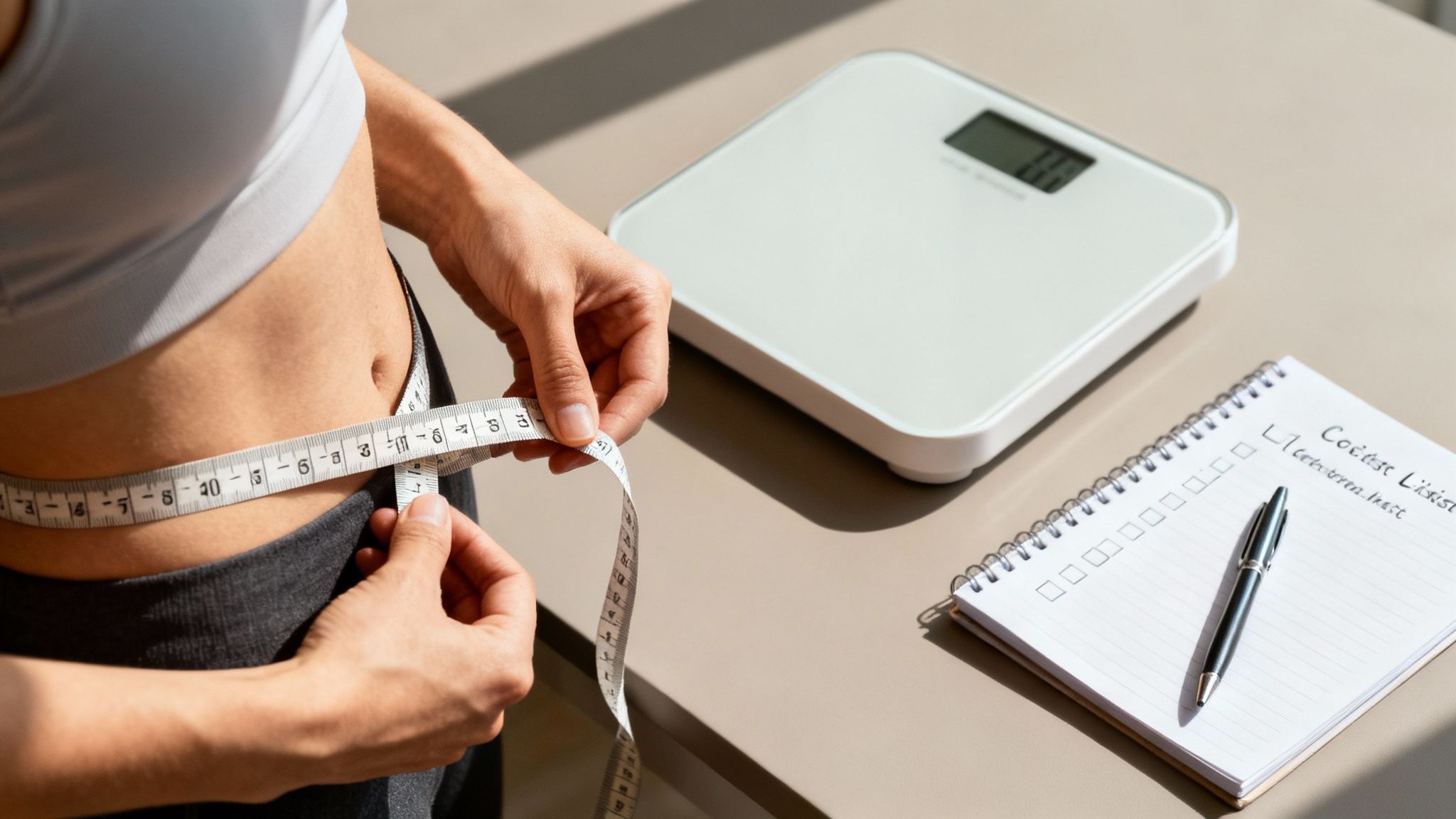
Your body composition—the ratio of fat to lean mass—tells a much more interesting story than your body weight alone. A scale can't tell the difference between a pound of fat and a pound of hard-earned muscle, which is exactly why you need to dig a little deeper.
Get started with these key measurements:
- Body Weight: Hop on the scale first thing in the morning, after you've used the restroom but before you eat or drink anything. For the most reliable numbers, always use the same scale on the same flat surface.
- Waist Circumference: Grab a flexible tape measure and wrap it around your waist, right at your belly button. You want it to be snug, but not digging in. This measurement is a surprisingly strong indicator of visceral fat.
- Body Fat Percentage: While a DEXA scan is the gold standard, it's not exactly practical for most of us. Thankfully, modern apps like Zing Coach have made this much easier. The app’s AI-powered body scan uses your phone's camera to estimate your body fat percentage and lean muscle mass, giving you a detailed starting point without any special equipment.
These three metrics give you a solid, quantifiable picture of your body's starting point, setting the stage for tracking meaningful changes down the line.
Conducting Initial Performance Tests
Beyond what you see in the mirror, your baseline needs to reflect what your body can do. Simple performance tests are perfect for this, giving you a real sense of your current strength and cardio fitness. They don't need to be complicated, but they absolutely must be repeatable.
Consider these straightforward assessments:
- Max Push-Ups Test: In a single go, do as many push-ups as you can with good form until you can't do another one. It’s a classic for a reason—it’s a great test of upper-body strength and endurance.
- Timed Mile Run/Walk: Find a flat, measured mile (a local track is perfect) and see how long it takes you to cover the distance at a steady, challenging pace. This is a fantastic benchmark for your cardiovascular fitness.
- Wall Sit Test: With your back flat against a wall and your knees bent at a 90-degree angle, hold that position for as long as you possibly can. This will tell you a lot about your lower-body muscular endurance.
Just remember, the goal here isn't to hit some magic number. It's simply to establish an honest benchmark. Your initial results are just data—no judgment attached. They're the starting line, not the finish line.
Try to knock these tests out during your first week of training. To make it even easier, you can use guided assessments right within a fitness app. For example, Zing Coach has a comprehensive Fitness Test feature that walks you through various exercises to lock in a precise performance baseline. The app's AI then uses that data to build your entire training plan, taking all the guesswork out of the equation.
Before you dive in, let's pull all that together. Here’s a quick checklist to make sure you capture a complete snapshot of where you're starting.
Your Initial Fitness Baseline Checklist
This table sums up the essential metrics to record before you start. Nailing this down from day one gives you a powerful tool for tracking every bit of progress.
| Metric Category | Specific Measurement | Why It Matters |
|---|---|---|
| Body Composition | Body Weight, Waist Circumference, Body Fat % | Provides a complete picture of your body's makeup, beyond just the scale. |
| Strength | Max Push-Ups Test, Wall Sit Test | Measures upper and lower body muscular strength and endurance. |
| Cardiovascular | Timed Mile Run/Walk | Gauges your current aerobic fitness level and heart health. |
| Subjective Feel | Energy Levels (1-10), Sleep Quality (1-10), General Mood | Tracks non-physical progress, which is just as important as the numbers. |
Once you have these numbers logged, you're officially ready to go. You've set your starting line, and now the real fun begins—seeing just how far you can go from here.
Choosing the Right Tracking Tools for You
Once you've got your baseline numbers, it's time to pick the tools that will make tracking feel less like a chore and more like a natural part of your routine. The best tool isn't the fanciest or most complicated one; it's the one you'll actually stick with day in and day out.
Some people thrive on the constant feedback from a smartwatch. Others find that the simple act of writing down their reps and sets is what keeps them honest and focused. Let’s break down the options to find what works for you.
Embracing Wearable Technology
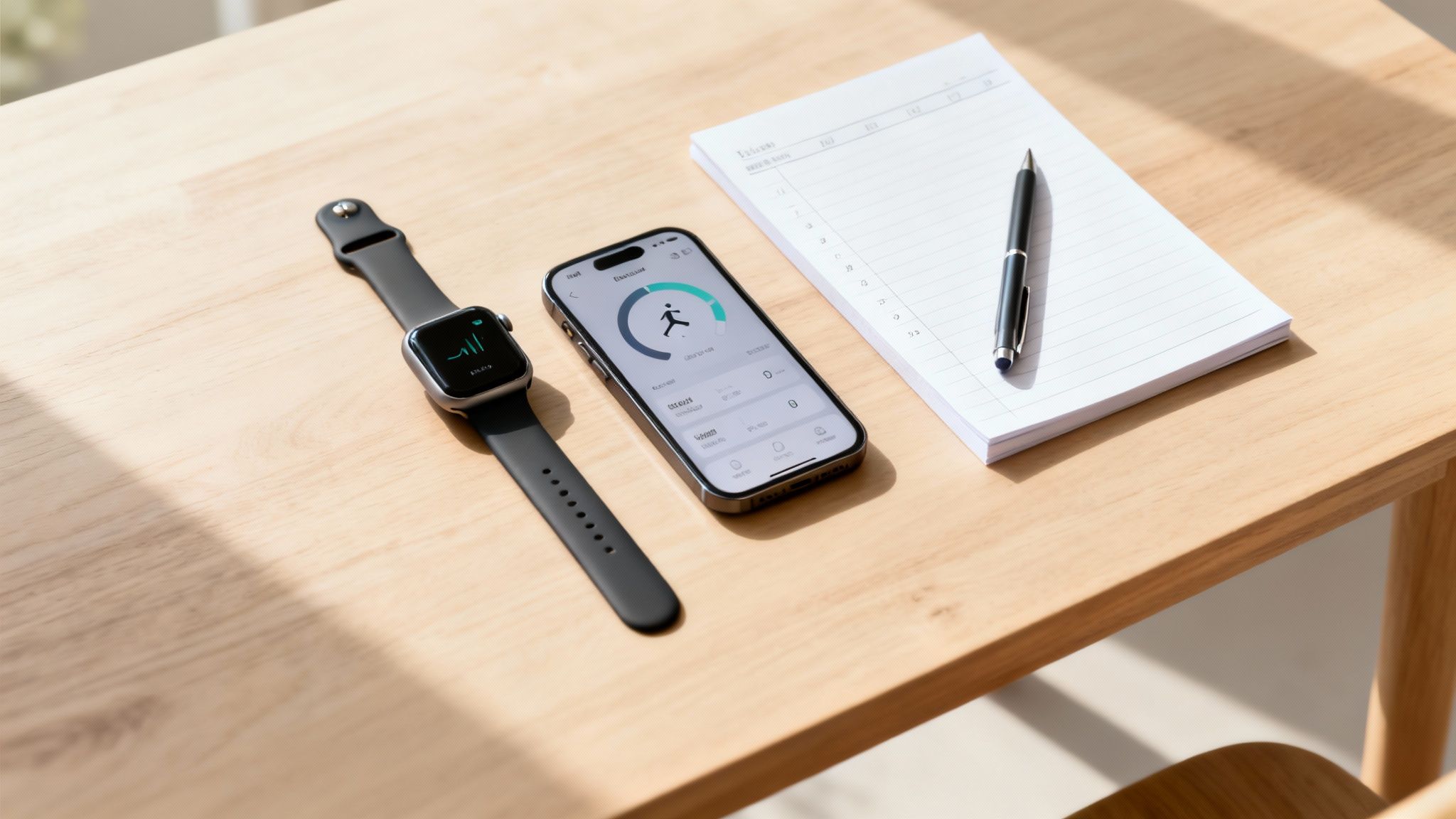
Wearable fitness trackers have become massively popular for a simple reason: they automate a huge chunk of data collection. Devices from Apple, Garmin, and Fitbit give you a constant stream of information about your body, not just during workouts but throughout your entire day. They’re brilliant at tracking the metrics that are otherwise nearly impossible to monitor.
These gadgets are great for capturing:
- Heart Rate Data: Watch your heart rate zones in real-time to dial in your workout intensity and see your cardiovascular fitness improve over weeks and months.
- Sleep Quality: Tracking your sleep stages gives you a real window into your recovery, which is a huge—and often ignored—piece of the fitness puzzle.
- Activity Levels: Get a full picture of your movement beyond planned workouts by tracking daily steps, active minutes, and how often you stand.
The global fitness tracker market has exploded from $11.6 billion to about $62 billion, which just shows how many people find them useful. With over 433.9 million units expected to ship by 2025, it’s clear that wearables make progress tangible, whether you're trying to up your daily step count or improve your sleep score.
The Power of a Simple Workout Journal
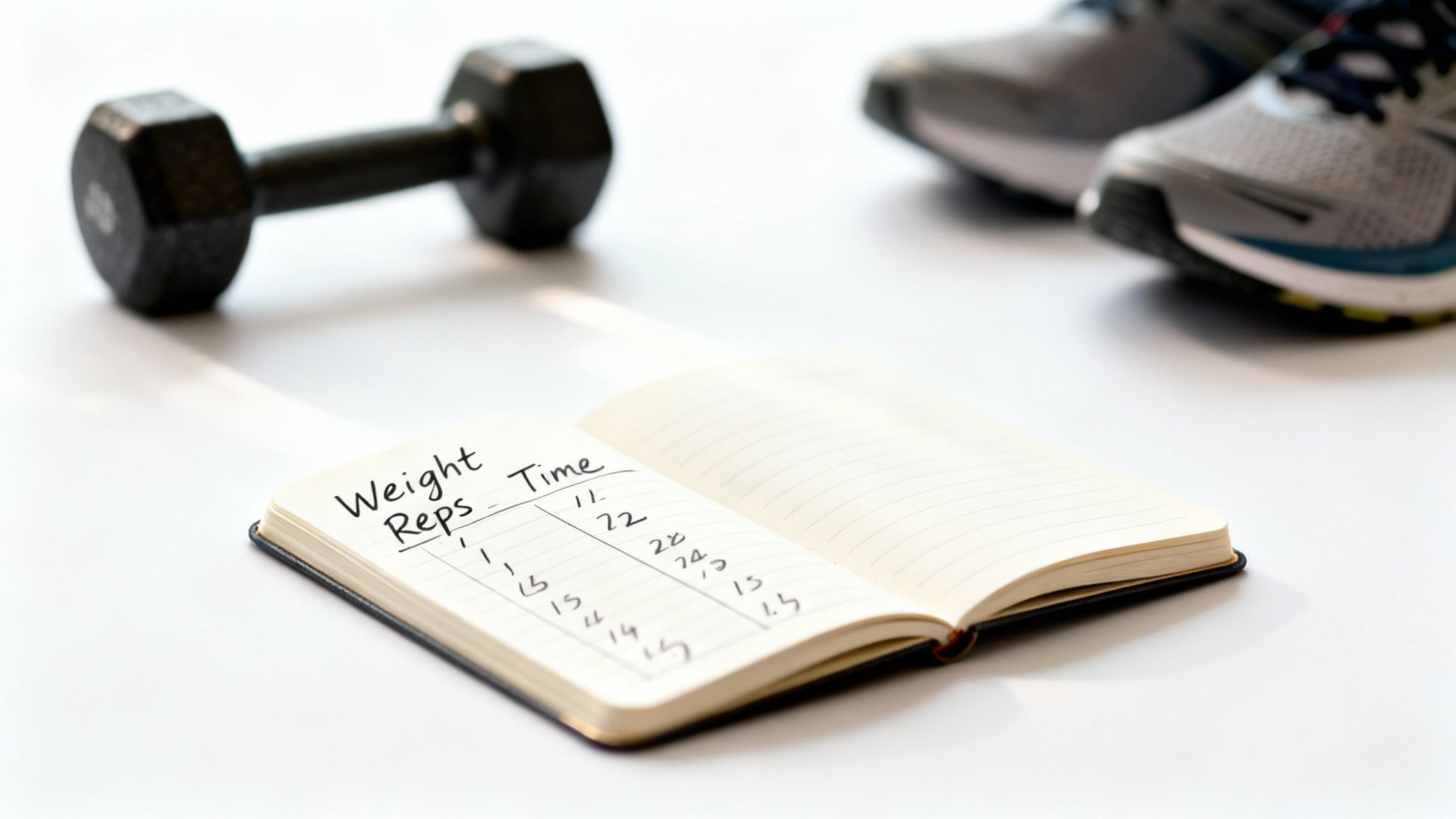
In an age of non-stop digital pings, the humble notebook is still a surprisingly potent tool. There's something powerful about the physical act of writing down your workout details—the exercises, the weight, the reps. It forces you to be present and mindful of the effort you're putting in.
A journal is also completely yours to customize. You aren't boxed in by an app's design. You can track whatever feels important to you, whether that’s how a specific lift felt, your energy levels that day, or notes for what you want to hit next week. It's totally distraction-free and never needs charging.
The best workout journal is one you can flip back through a month from now and see a clear story of your hard work and progress. It becomes a physical record of your effort, which can be incredibly motivating on days you feel stuck.
Leveraging Modern Fitness Apps
Fitness apps are where it all comes together, offering the best of both worlds. They can sync with your wearable to automatically pull in health data while giving you a structured place to log workouts, nutrition, and body measurements. The best apps don't just collect data; they turn it into genuinely useful insights.
Think of an app as your digital command center. Zing Coach, for example, integrates with Apple Health to get a complete picture of your daily movement. This allows its AI to make smarter tweaks to your training plan based on how active and recovered you actually are.
The more advanced apps also offer features that used to be out of reach for most people.
- AI Body Scans: Using just your phone’s camera, apps like Zing can estimate your body fat percentage and lean muscle mass. It's an incredibly convenient way to see your body composition change over time.
- Computer-Vision Form Tracking: Some apps can actually watch you perform an exercise, counting your reps and giving you real-time feedback on your form to make sure you're moving safely and effectively.
- Personalized Workout Adjustments: By analyzing your logged data, the app’s AI can progressively overload your workouts, making sure you’re always challenged just enough to keep making progress. You can find out more about how the Zing AI Coach adapts to your progress.
Beyond basic tracking, you might even look into tools like an AI Workout Generator to help build out a personalized plan. The key is finding something that doesn't just spit numbers at you but helps you understand what they mean and what to do next.
Focusing on Metrics That Truly Matter
With a world of data at your fingertips, it’s easy to drown in numbers that don’t actually move the needle on your goals. The secret to effective fitness tracking isn't logging everything; it's about knowing which numbers to watch and which ones to ignore. What matters for a marathon runner is worlds apart from what a powerlifter needs to track.
This is all about cutting through the noise to find your personal key performance indicators (KPIs). When you focus on the right data, you stop feeling overwhelmed and start seeing a clear path to your goals.
This very idea is what's fueling the explosion in digital health. The fitness app market is expected to reach a staggering $8.30 billion by 2025, while the broader fitness tracker market is projected to hit $65 billion. It's built on a simple truth: quantifying progress works. In fact, users who track consistently see 20-30% better results.
Tailoring Metrics to Your Goal
The most crucial step is to connect your tracking to your "why." Are you trying to get stronger, shed fat, or boost your athletic performance? Your answer determines exactly what you should be measuring.
Choosing the right metrics is essential. The table below breaks down which numbers are most important for common fitness goals, helping you focus your efforts where they'll have the biggest impact.
Matching Metrics to Your Fitness Goals
| Fitness Goal | Primary Metrics to Track | Secondary Metrics to Track |
|---|---|---|
| Fat Loss | Body Fat Percentage, Waist Circumference, Progress Photos | Body Weight, Calorie Intake, Step Count |
| Muscle Gain | Weight Lifted (Progressive Overload), Muscle Measurements, Total Volume (Sets x Reps x Weight) | Body Weight, Protein Intake, Sleep Quality |
| Endurance Improvement | Pace/Speed, Distance Covered, Time to Completion, Resting Heart Rate | Heart Rate Variability (HRV), VO2 Max, Cadence |
This table serves as a solid starting point. As you get more advanced, you might layer in other metrics, but nailing these basics first will keep you on the right track.
For the Strength Athlete
If strength training is your game, your North Star is progressive overload. You have to consistently challenge your muscles to do more than they’re used to.
Here’s what that looks like in your logbook:
- Weight Lifted: This is the most obvious one. Are you adding small amounts of weight to the bar over time?
- Total Volume: Think of this as the total work you did. Calculate it with (Weight x Reps x Sets). Even if the weight stays the same, adding another set or squeezing out a few more reps means you've increased your volume—that's progress.
- Reps at a Given Weight: Smashing more reps with a weight that felt impossible last month is a huge win and a clear sign you're getting stronger.
For the Endurance Enthusiast
When your focus is on endurance, the metrics shift from how much you can lift to how long and how efficiently you can go.
You’ll want to keep an eye on:
- Pace and Distance: Are you running your usual 5k a bit faster? Or maybe you can now run for 45 minutes instead of 30?
- Resting Heart Rate (RHR): This is a classic indicator of cardiovascular fitness. As your heart gets stronger, it doesn't have to work as hard at rest. Most wearables track this automatically while you sleep, and seeing it trend downward is a fantastic sign.
Remember, a single workout is just one data point. The real story is told over weeks and months. It's the trend that matters, not the individual day.
Looking Beyond the Numbers
Some of the most powerful signs of progress will never show up on a spreadsheet. We call these non-scale victories, and they are absolutely critical for staying motivated, especially when the numbers on the scale or in your app stall out.
These are the real-world wins that prove your hard work is paying off in your daily life.
You might start noticing things like:
- More Energy: You’re not hitting that 3 p.m. wall at work anymore. You actually have energy left over for your family or hobbies in the evening.
- Better Sleep: Falling asleep faster and waking up feeling genuinely refreshed is a game-changer for recovery and overall well-being.
- Clothes Fit Differently: The scale might be stuck, but your jeans are looser in the waist and your shirts fit better across your shoulders. This is a classic sign of body recomposition—losing fat while building muscle. You can get a better handle on this by learning how to measure body fat percentage.
- Improved Mood: It’s no secret that exercise is a huge mood booster. Feeling stronger in your body often translates directly to feeling more confident in every other area of your life.
Celebrating these victories is just as important as hitting a new PR in the gym. They’re the daily reminders that fitness is about so much more than just a few numbers—it’s about enhancing your entire life.
Building a Consistent Tracking Routine
Knowing what to track is only half the battle. Consistently logging those numbers is where the magic really happens. The whole point isn't to add another stressful chore to your to-do list, but to build a simple, empowering ritual that gives you a powerful feedback loop and keeps you motivated.
The trick is to weave tracking seamlessly into your existing life, not try to force some complicated new routine. This all comes down to finding the right rhythm for your measurements and standardizing how you take them, so every single data point is reliable.
Establishing Your Measurement Cadence
Timing is everything. If you measure too often, you'll drive yourself crazy obsessing over normal daily ups and downs. But if you measure too infrequently, you're just guessing. The key is to match your tracking frequency to how quickly you can realistically expect a metric to change.
Here’s a solid schedule to start with:
- Daily (Optional): Things like sleep quality, energy levels (just rate it 1-10), and your daily step count. These are great for spotting trends in your recovery and overall activity levels.
- Weekly: This is the sweet spot for body weight and waist circumference. Weigh yourself just once a week—same day, same time, like Friday morning before breakfast—to get past the daily water weight fluctuations.
- Monthly: Progress photos and key body measurements (think arms, thighs, chest). A month is enough time to see visible changes, which is way more motivating than squinting at tiny weekly differences.
- Every Workout: Log your performance metrics—weight lifted, sets, reps, duration—the moment you’re done. Don't wait.
This rhythm helps you see the big picture, focusing on the long-term trends instead of getting bogged down by discouraging daily noise.
The Power of Standardization
If you want to trust your data, you have to control the variables. Inconsistent measurements give you junk data, making it impossible to know if you're actually making progress. Think of standardization as your secret weapon.
Treat it like a science experiment where you are the test subject. To get clean results, you have to keep the conditions exactly the same every single time.
This means:
- Always measuring your waist at the exact same spot—usually right across your belly button.
- Running your time trials on the same flat route or the same treadmill setting to see if you're actually getting faster.
- Taking progress photos with the same lighting, from the same angles, and around the same time of day.
- Performing strength tests (like a max push-up test) when you're well-rested, not right after a killer workout.
By standardizing your process, you eliminate the guesswork. When you see a change in your numbers, you can be confident it reflects genuine progress, not just a fluke in your measurement technique.
Making Tracking an Effortless Habit
The easiest way to stay consistent is to make tracking so simple it feels automatic. This is where "habit stacking" is a game-changer. You're not relying on willpower; you're just linking your new tracking habit to one you already have.
For instance, try logging your session in an app like Zing Coach the second you finish your last set—right before you hit the shower. This makes tracking feel like the final, satisfying step of your workout ritual.
Or, you could keep your measuring tape right on top of your scale. That way, it's a natural prompt to grab your waist measurement right after your weekly weigh-in. The goal is to make it a natural conclusion to something you already do without thinking.
Building these small, consistent actions is what creates long-term success. If you're looking for more strategies, our guide on forming habits that stick has a ton of practical tips for turning good intentions into real, lasting change.
How to Analyze Your Data and Adapt Your Plan
Collecting data is just the first step. The real magic happens when you use those numbers to make smarter decisions about your training. Think of your data as direct feedback from your body, telling you exactly what’s working, what isn’t, and when it’s time to switch things up. This is how you stop just exercising and start training with purpose.
The whole point isn’t just to fill a spreadsheet but to create a powerful feedback loop. You test, you analyze, and then you adjust your plan based on what you find. This simple cycle is what keeps you from getting stuck and ensures you're always making real progress, not just spinning your wheels.
And let's be honest, technology makes this easier than ever. The global fitness tracker market is set to hit a massive $71.2 billion by 2025, with North America making up 47% of that. There's a clear reason for this boom: with 42% of US adults dealing with obesity, tools that help us move more are critical. Just logging 30 minutes of activity a day can slash the risk of diabetes by 58%, which shows that tracking this stuff has a huge impact on real-world health.
From Data Points to Clear Trends
Progress is never a straight line. You'll have good days and bad days, amazing weeks and weeks where you feel like you're going backward. That's precisely why the golden rule of data analysis is to look for trends, not daily fluctuations. A single weigh-in can be thrown off by anything from a salty meal to a bad night's sleep, but the average over four weeks tells the real story.
Instead of getting hung up on today's workout versus yesterday's, zoom out. Compare your average performance this week to last week. Is your total lifting volume inching up? Is your average mile time slowly ticking down? When you smooth out the daily noise, the real signal of your progress becomes crystal clear.
For strength training, one of the most useful things you can track is your total training volume. It’s a simple calculation: (Weight x Reps x Sets). Maybe you didn’t add more plates to the bar this week, but if you squeezed out an extra set, your volume increased. That's a win, and it's a perfect example of progressive overload in action.
Recognizing and Breaking Through Plateaus
Your data is your best friend when it comes to spotting a dreaded plateau. If you notice your key numbers—like your bench press max or your 5k time—haven't budged for three or four weeks straight, it's time to make a change. A plateau isn't failure; it's just your body's way of telling you it has adapted and needs a new challenge.
Here are a few common situations I see and how to handle them:
- Scenario 1: Weight is dropping, but so is your strength. This is a classic sign you're losing muscle along with fat. The culprit is usually a calorie deficit that's too steep or not enough protein.
- The Fix: Bump up your daily calories slightly and make sure you're hitting your protein target. Keep your lifting intensity high to signal to your body to hold onto that muscle.
- Scenario 2: Your endurance is improving, but your body isn't changing. You're definitely getting fitter, but your diet isn't quite aligned with your fat-loss goals.
- The Fix: Time for a nutrition audit. You probably need to create a small calorie deficit or tweak your macros to better support fat loss.
- Scenario 3: You feel wiped out and sore all the time. Check your tracking data—I'll bet you see performance and motivation taking a nosedive.
- The Fix: This is a textbook case of under-recovery. Schedule a deload week immediately by cutting your training volume by 40–50%. Get more sleep and double down on good nutrition.
A plateau is just your body asking for a new question. Instead of pushing harder with the same failed strategy, use your data to ask a different, smarter question. Change a variable—training frequency, exercise selection, or rep ranges—and see how your body responds.
This decision tree helps visualize how your main goal should shape how often you track certain metrics, so you can focus on what matters most.
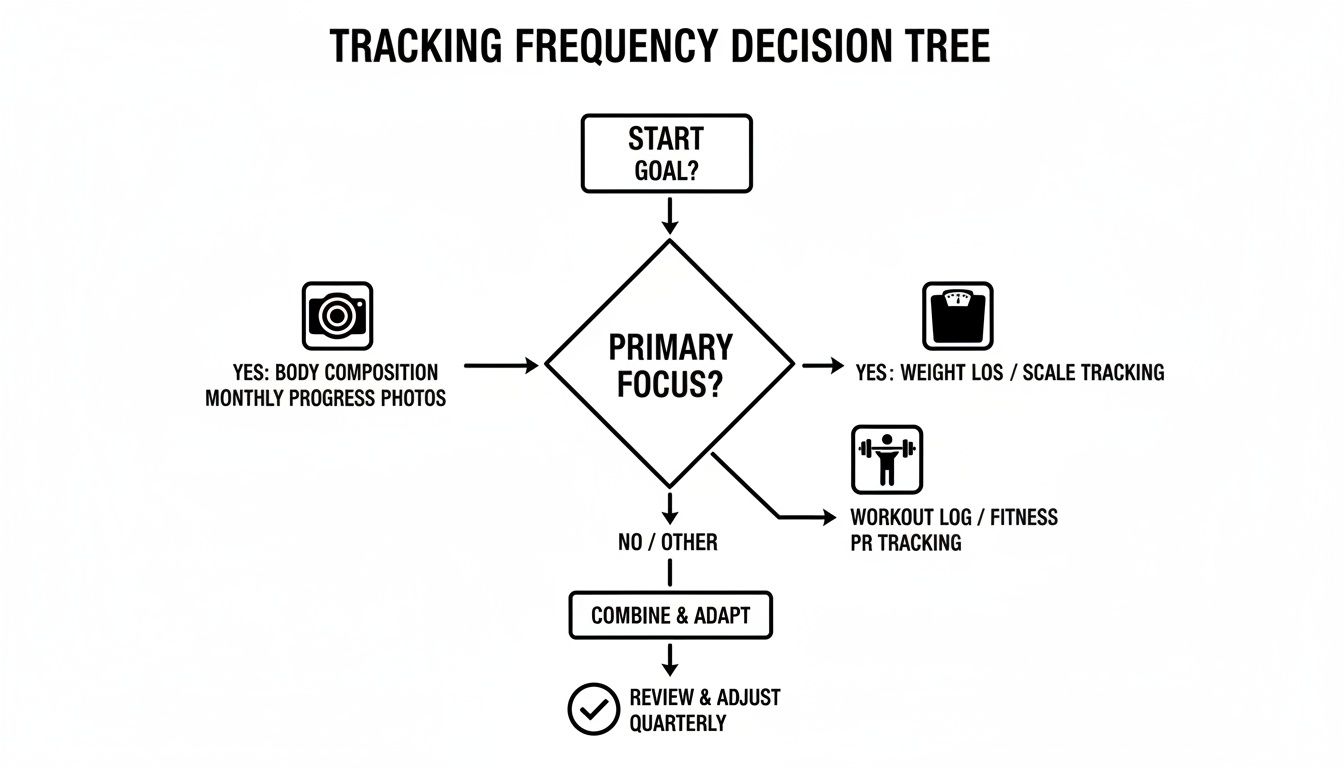
As you can see, things that change quickly like body weight are best tracked weekly. Slower-moving targets like strength gains or visible physique changes are better reviewed over longer stretches.
Using AI for Smarter Adjustments
Trying to make sense of all this data can feel overwhelming, but modern apps can handle the heavy lifting for you. Fitness coaches like Zing use AI to analyze your performance as you go. By syncing with Apple Health and logging your workout data, the app gets a clear picture of whether you're recovering well or feeling fatigued.
From there, it can automatically adjust the volume and intensity of your next workout. If you crushed your last session, it’ll dial up the challenge. If you struggled, it'll scale things back so you can recover properly. This puts that "analyze and adapt" loop on autopilot, making sure your plan is always perfectly suited to how you're feeling right now. You can learn more about how this works by checking out our guide on Zing's Strength Score.
Your Top Fitness Tracking Questions, Answered
Even with the best plan and the slickest tools, you're going to have questions. It’s just part of the process. Getting tripped up on the little details of tracking progress is common, but clearing up those sticking points is what keeps you in the game.
Let’s tackle some of the most frequent questions that pop up when people start logging their fitness journey. Think of this as your personal troubleshooting guide to keep you moving forward.
How Often Should I Take Progress Photos?
Progress photos are one of the most powerful tools you have, but snapping them too often will just drive you crazy. Trust me on this. The sweet spot for most people is every 4 to 6 weeks.
Why that long? Because it gives your body enough time for real, visible changes to happen. The side-by-side comparison becomes so much more satisfying and motivating when you can actually see the difference.
To make them count, you have to be consistent. It’s all about creating an honest visual record.
- Same Time of Day: First thing in the morning, before you eat or drink anything, is best. It cuts down on variables like bloating.
- Same Lighting: Find a spot with good natural light from a window. It’s consistent and flattering.
- Same Poses: Get a clear shot from the front, side, and back. Try to stand relaxed and don't "suck it in."
- Same Outfit: Wear the same shorts, sports bra, or swimsuit every time. It gives you a true apples-to-apples comparison.
Nail these simple rules, and your photo log will become undeniable proof of your hard work—capturing wins the scale doesn't know how to measure.
What Should I Do If I Hit a Weight Loss Plateau?
First off, hitting a plateau is totally normal. It doesn't mean you've failed; it actually means you've succeeded. Your body has adapted to the demands you've placed on it and has become more efficient. Now, it's asking for a new challenge.
Before you overhaul your entire plan, take a breath. Do a quick audit of your habits. Are you still tracking your food as carefully as you did in week one? Has that "splash of creamer" in your coffee gotten a little more generous? Often, it's the small, unconscious habits that creep back in and stall your progress.
If you’re sure your tracking is still on point, it’s time for a small, strategic shift. No need for anything drastic.
A plateau isn't a wall; it's a signal. Your body has solved the problem you gave it, and now it's ready for a new one.
Try one of these simple tweaks:
- Drop Calories (Slightly): Shave off just 100-200 calories from your daily target. It’s often enough to get things moving again without making you feel deprived.
- Add a Little More Movement: A 20-minute walk after dinner a few nights a week or an extra set on your main lifts can be enough to tip the energy balance back in your favor.
- Consider a 'Refeed' Day: For some people, a planned day of higher carbohydrate intake can help reset key hormones that regulate your metabolism and appetite, effectively breaking the stall.
Think of it this way: your body got comfortable. It's time to make it a little uncomfortable again.
How Accurate Are Fitness Trackers and Smartwatches?
Fitness trackers are brilliant motivators and great for spotting trends, but it's important to know their limits. Don’t treat every number they spit out as gospel.
For things like step counts and heart rate (especially during steady cardio), most modern wearables are pretty reliable. They give you a solid big-picture view of your daily activity levels and how hard you're working.
Where you need a healthy dose of skepticism is with metrics like calorie burn estimates and sleep stage tracking. These are calculated with algorithms making educated guesses based on your heart rate, movement, and personal data. They're helpful guides, but they aren't lab-accurate.
The real value of your tracker is in its consistency. So what if the calorie burn is off by 15%? It's probably consistently off by that much. That means you can still trust the trends. If your average daily step count is climbing or your resting heart rate is dropping over several weeks, that’s meaningful progress, no matter what the exact numbers are.
Ready to stop guessing and start seeing real, measurable results? Zing Coach uses AI to turn your fitness data into a personalized plan that adapts with you. From AI body scans to intelligent workout adjustments, we make tracking your progress simple and effective. Start your journey with Zing Coach today!
Share this article


Authors