Unsure about 'what should my macros be?' This guide demystifies calculating protein, carbs, and fat for your fitness goals. Get your numbers right.

A good place to start when figuring out your macros is with the Acceptable Macronutrient Distribution Ranges (AMDR). These are solid guidelines suggesting that adults get 10-35% of their calories from protein, 45-65% from carbs, and 20-35% from fats.
Think of these numbers as a balanced baseline. It's a scientifically-backed starting point you can use before fine-tuning everything for your personal goals, whether that's dropping a few pounds or packing on muscle.
Your Macro Starting Point Explained
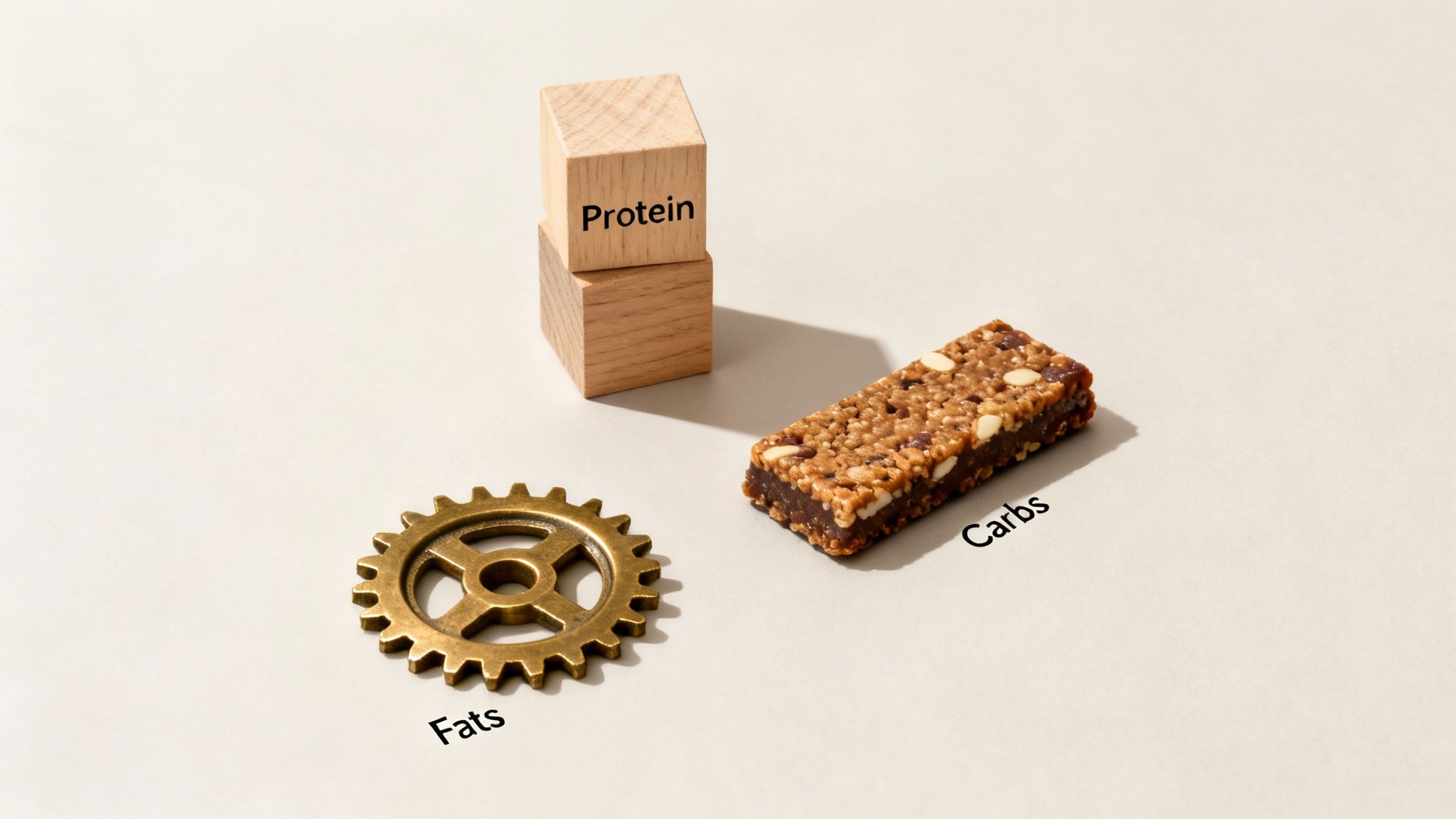
Before we start crunching numbers, let's get clear on what these three macronutrients—protein, carbohydrates, and fats—actually do. They're like the core team running your body, and each one has a specific, vital job. Getting the balance right is the real secret to hitting your health and fitness goals.
A simple analogy can make their roles crystal clear:
- Protein is the "building block." It’s essential for repairing tissues, building muscle, and keeping your immune system strong.
- Carbohydrates are the "quick fuel." They give your brain and muscles the immediate energy they need to function day-to-day and power through workouts.
- Fats are the "essential machinery." They play a huge role in producing hormones, absorbing vitamins, and protecting your organs.
Understanding the AMDR Baseline
The Acceptable Macronutrient Distribution Ranges (AMDR) aren’t rigid rules, but they are a fantastic, science-backed starting point. These ranges come from major health bodies like the Institute of Medicine and ensure you're getting enough of each nutrient without going overboard on any single one.
Here’s what those general starting points look like:
General Macronutrient Starting Points (AMDR)
This table shows the Acceptable Macronutrient Distribution Ranges (AMDR) for adults, providing a balanced starting point before customizing for specific goals.
| Macronutrient | Percentage of Daily Calories | Role in the Body |
|---|---|---|
| Protein | 10–35% | Builds and repairs tissues, enzymes, and hormones. |
| Carbohydrates | 45–65% | Provides the body's main source of energy. |
| Fats | 20–35% | Supports hormone production and vitamin absorption. |
To put this into perspective, for a 2,000-calorie diet—a common target for weight loss or muscle gain—this translates to roughly 50–175g of protein, 225–325g of carbs, and 44–78g of fats each day. This is the kind of baseline Zing Coach uses before creating your personalized plan.
Why This Is Just a Starting Point
While the AMDR gives you a great foundation, your perfect macro split is deeply personal. The numbers that work for you will ultimately depend on several unique factors that we're about to dive into.
The most effective nutrition plan is the one that aligns with your specific goals, body composition, and lifestyle. A marathon runner's needs will differ vastly from someone aiming to build muscle in the gym.
This initial framework gives you an immediate, actionable answer so you're not left guessing. It sets the stage for true personalization. As you keep reading, you'll learn exactly how to tweak these percentages based on your metabolism, activity level, and whether your main goal is fat loss, muscle gain, or athletic performance.
Getting to know your body is a key part of this process. To learn more, check out our guide on how to measure body composition at home.
First Calculate Your Daily Calorie Budget
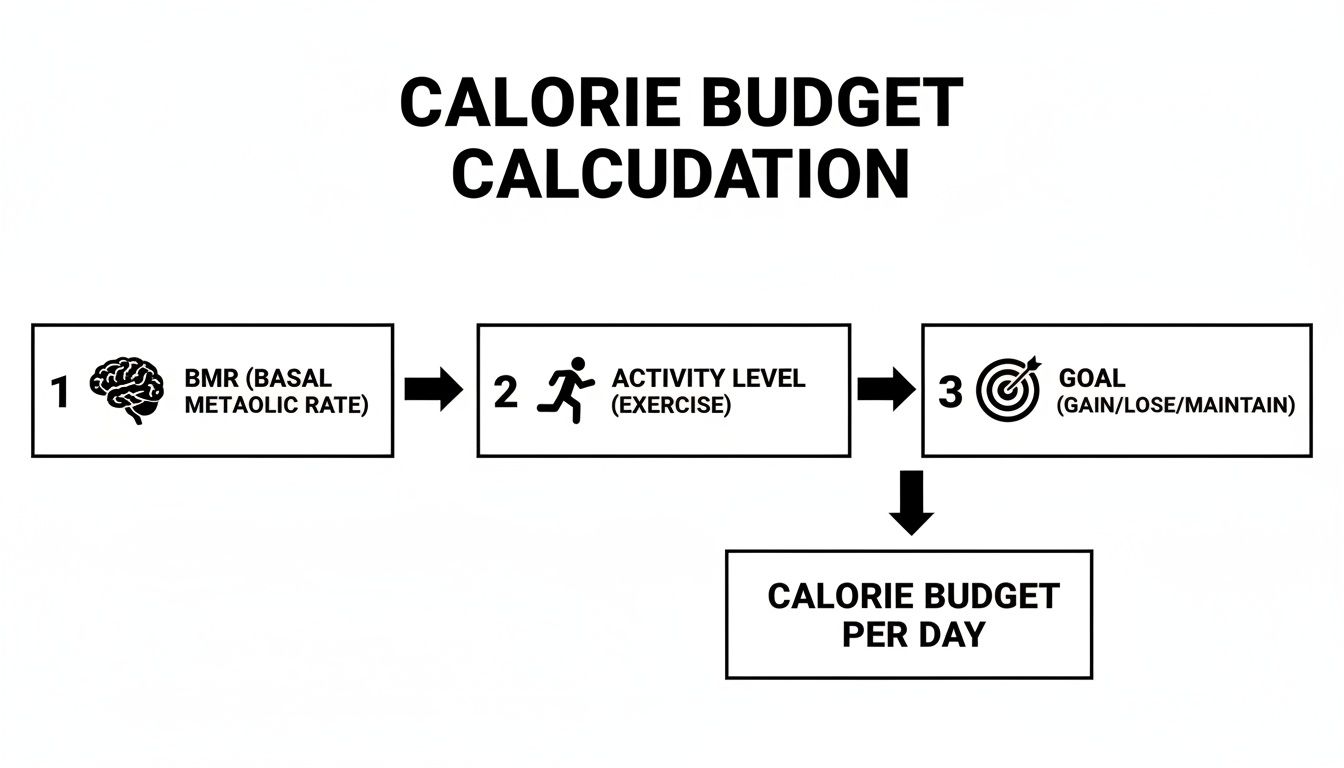
Before you can even think about macros, you need a starting point. Think of your daily calories like a financial budget. You can't decide how to divvy up your money if you don’t know how much you have to spend. In nutrition, that budget is your Total Daily Energy Expenditure (TDEE).
Your TDEE is essentially the total number of calories your body burns over a 24-hour period. It’s a mix of the energy you use just staying alive, digesting food, and moving around. Nailing this number down is the first—and most critical—step in building a macro plan that will actually get you results.
Breaking Down Your Energy Needs
Your TDEE isn't just one magic number; it's made up of a few key parts. The biggest piece of the pie is your Basal Metabolic Rate (BMR). This is the baseline energy your body needs just to keep the lights on—powering your brain, heart, and lungs while you're completely at rest.
The other major factor is your activity level. This isn't just your gym sessions. It’s everything from walking the dog to tapping your foot at your desk. Put it all together, and you get your "maintenance calories"—the amount you need to eat every day just to stay at your current weight. Our detailed guide on how to calculate daily calorie needs can walk you through finding yours.
Your maintenance calorie number is your neutral baseline. It’s the foundational figure you'll adjust up or down to create a plan tailored specifically for fat loss, muscle gain, or performance enhancement.
Once you’ve got this baseline, you can start making strategic adjustments to hit your main fitness goal. This is where a simple number transforms into a powerful tool for changing your body. If you’re making your own meals, getting an accurate calorie count can be tricky. Using a recipe nutrition calculator can make it much easier.
Adjusting Your Budget for Your Goal
With your maintenance calories figured out, the next step is pretty straightforward. You’ll create either a calorie deficit or a calorie surplus, depending on what you're trying to accomplish.
1. For Fat Loss Create a Calorie Deficit
To lose body fat, you have to eat fewer calories than your body burns. It's that simple. This encourages your body to start using its stored fat for energy. A smart, sustainable deficit is usually around 10–20% below your maintenance calories.
- Example: If your maintenance TDEE is 2,200 calories, a 15% deficit would put your new target at about 1,870 calories per day.
Taking this moderate approach helps you hold onto your hard-earned muscle and keeps your energy levels from tanking, which makes sticking with your plan for the long haul much more manageable.
2. For Muscle Gain Create a Calorie Surplus
On the flip side, building new muscle requires extra fuel. Your body needs more energy and raw materials than it uses just for maintenance. This means you need a calorie surplus. A modest surplus of 10–15% above your maintenance level is the sweet spot—it provides enough energy for growth without packing on a ton of unwanted body fat.
- Example: If your maintenance TDEE is 2,500 calories, a 10% surplus means you’d shoot for 2,750 calories per day.
Starting with a small surplus is the key here. It helps ensure that the weight you gain is mostly lean muscle. Once you have this new calorie target, you’re finally ready to start figuring out your daily macros.
Translating Calories Into Your Daily Macros
Once you’ve got your daily calorie budget, the real fun begins. It’s time to turn that single number into a practical, day-to-day eating plan. This is where we convert total calories into specific gram targets for protein, carbohydrates, and fats, finally answering the question, "what should my macros be?"
The math here is pretty straightforward. Each macronutrient has its own calorie value per gram:
- Protein: 4 calories per gram
- Carbohydrates: 4 calories per gram
- Fat: 9 calories per gram
Right away, you’ll notice fat packs more than double the caloric punch of protein and carbs. It's a super-dense energy source, which is why your gram target for fat will almost always be lower than the other two, even if the calorie percentage is similar.
This whole process follows a logical flow. You start with your baseline needs, factor in your activity, and then set your final target based on your goal.
Choosing Your Macro Split
Your specific health and fitness goal is the number one thing that dictates your macro split—that is, the percentage of total calories coming from each macro. Someone looking to pack on muscle needs a totally different setup than an endurance athlete or someone focused on fat loss.
Let's look at some common splits that just plain work.
A really popular and balanced starting point for fat loss is the 40/30/30 split. This means you get 40% of your calories from carbs, 30% from protein, and 30% from fat. This approach provides plenty of protein to hold onto muscle while you're in a deficit, enough carbs to keep your energy up, and the healthy fats you need for proper hormone function.
Putting It All Into Practice
Let's make this real with a quick example. We’ll use a 2,000-calorie diet and that 40/30/30 split we just talked about.
Step 1: Calculate Calories per Macro
- Carbohydrates: 2,000 calories x 0.40 = 800 calories
- Protein: 2,000 calories x 0.30 = 600 calories
- Fat: 2,000 calories x 0.30 = 600 calories
Step 2: Convert Calories to Grams
Now, we just divide those calorie amounts by the calories-per-gram value we covered earlier.
- Carbohydrates: 800 calories / 4 = 200 grams
- Protein: 600 calories / 4 = 150 grams
- Fat: 600 calories / 9 = approximately 67 grams
Boom. For a 2,000-calorie fat loss plan, your daily goals are 200g of carbs, 150g of protein, and 67g of fat. This is exactly the kind of math the Zing Coach app handles for you in seconds.
Don't get hung up on hitting these numbers perfectly. Think of them as targets, not rigid rules. The real magic happens when you get consistently close to them day after day.
How Different Goals Change Your Macros
But what if fat loss isn't your goal? Your macro split needs to shift to match your new objective.
For example, building muscle demands more protein to supply the building blocks for new tissue. An endurance athlete, on the flip side, needs a boatload more carbs to fuel long training sessions.
To see how much things can change, let's look at a few different goals, all still using a 2,000-calorie budget.
Sample Macro Splits for a 2000-Calorie Diet
This table shows just how much your targets can shift based on what you're trying to achieve.
| Goal | Protein (g) | Carbohydrates (g) | Fats (g) |
|---|---|---|---|
| General Health | 125g | 250g | 56g |
| Fat Loss | 150g | 200g | 67g |
| Muscle Gain | 160g | 220g | 60g |
| Endurance | 100g | 300g | 44g |
Notice how just switching from "Fat Loss" to "Muscle Gain" bumps the protein target up by 10 grams per day. That might not sound like much, but over weeks and months, those small, consistent adjustments are what drive huge changes in your body composition. This is why getting your goal straight from the start is so critical.
For a deeper look into the nuts and bolts of tracking, check out our complete guide on how to count macros for beginners.
How to Adjust Your Macros as You Progress
Your body is a dynamic, incredibly smart system. It's constantly adapting to your workouts and the food you eat. Because of this, the "perfect" macro targets you calculated at the start won't stay perfect forever. This is actually a good thing! Learning to listen to your body’s feedback and make small, strategic tweaks is what separates short-term results from long-term success. It's how you become your own nutrition coach.
This doesn't mean you need to tear up your plan every week. Far from it. It’s all about recognizing clear signals that your body is ready for a change and responding with minor adjustments, not massive swings. Think of it like steering a ship—you make tiny corrections to stay on course, not sharp, sudden turns that throw everything off balance.
Key Signals It’s Time for a Change
Your body will tell you when something needs adjusting. The trick is learning its language. Progress isn't always a straight line, but if you notice one or more of these signs sticking around for two to three weeks, it's probably time to make a small change to your macros.
Here are the most common signals:
- A Weight Loss Plateau: The scale hasn't moved for weeks, even though you’ve been hitting your workouts and sticking to your plan.
- Persistent Hunger: You feel constantly hungry or deprived. This makes sticking to any plan feel nearly impossible and is a recipe for burnout.
- Energy Crashes: Your energy levels are tanking, especially during workouts, and you feel sluggish all day long.
- Poor Recovery: You're excessively sore for days after training, and your performance in the gym is actually getting worse, not better.
Your progress data is your most valuable feedback loop. Your weight, body measurements, progress photos, and gym performance tell an objective story about what’s working and what isn’t.
Ignoring these signals is a fast track to frustration. Instead, see them for what they are: helpful data points guiding your next move. A stubborn weight loss plateau, for example, is a common hurdle, but it’s one you can definitely clear. For a deeper dive, check out our guide on how to break through a weight loss plateau.
A Simple Framework for Making Adjustments
Once you've confirmed it's time for a change, fight the urge to do something drastic like slashing your calories in half. The best approach is methodical and gradual. Start with the smallest effective change, then give your body a couple of weeks to respond before you even think about adjusting again.
Here’s a simple framework to follow, depending on your goal and the signals you're getting.
If Your Goal Is Fat Loss and You've Plateaued:
Your first move is a small reduction in total calories. The easiest way to get there is by slightly trimming either your carbohydrate or fat intake—never your protein.
- Reduce Calories by 100–150: This is just enough to kick-start progress again without cratering your energy levels.
- Adjust Carbs or Fats: Take out about 25–35 grams of carbs OR about 10–15 grams of fat from your daily target. Leave your protein alone; it's critical for holding on to muscle while you lose fat.
- Assess After Two Weeks: Give the new numbers time to work. Watch your weight, energy, and hunger levels closely before making another move.
If Your Goal Is Muscle Gain and Weight Gain Has Stalled:
Building muscle takes fuel, and if your weight isn't trending up, your body is telling you it needs a little more.
- Increase Calories by 100–150: Just a small bump in fuel is often all it takes to support new growth.
- Add Primarily Carbs: An extra 25–35 grams of carbs is perfect. It'll help fuel your workouts and kick-start recovery.
- Keep Protein High: Make sure your protein intake stays consistent, somewhere around 1.6–2.2 grams per kilogram of body weight, to give your muscles the building blocks they need.
The answer to "what should my macros be?" is never set in stone. It evolves right along with you. By paying attention to your body and making small, informed adjustments, you’ll create a sustainable nutrition plan that keeps working for you every step of the way.
Common Macro Tracking Mistakes to Avoid
Tracking macros is an incredibly powerful tool for dialing in your nutrition, but it's really easy to get sidetracked by a few common pitfalls. Learning to navigate these is the key to making this work for you long-term. Remember, the goal isn't perfection—it's consistency and awareness.
One of the biggest hurdles I see is the classic all-or-nothing mindset. You go over your carb target by lunch, and that little voice in your head says, "Well, today's ruined." So you give up tracking for the rest of the day. This is a fast track to burnout. Instead, aim for "good enough." Seriously, hitting your numbers within a reasonable range, say 5-10 grams, is a huge win.
Forgetting the Hidden Macros
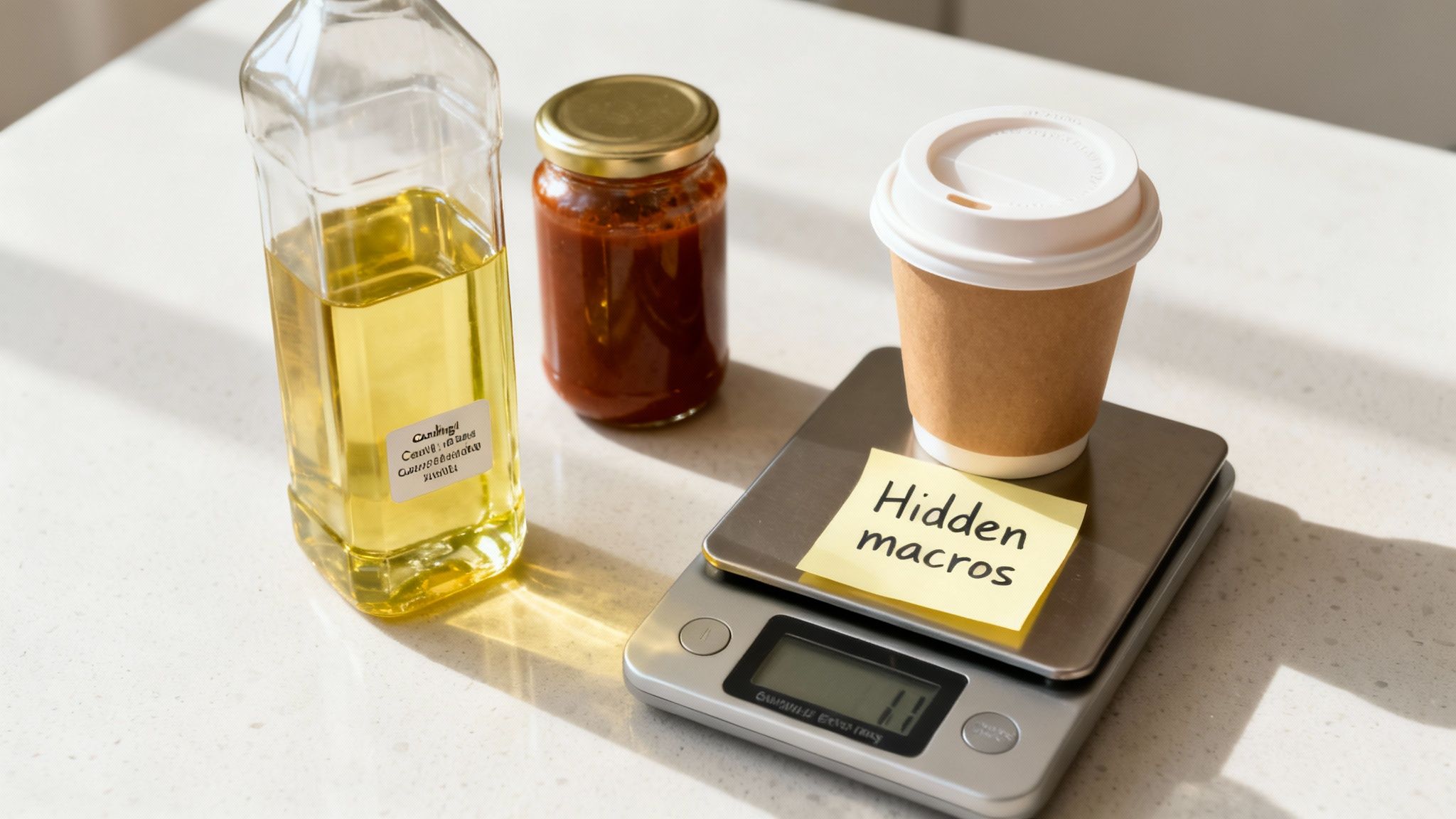
Another classic mistake is overlooking the "hidden" macros that sneak into your diet. These are the little additions that seem totally insignificant on their own but can easily add up to hundreds of calories, quietly sabotaging your progress.
You might be meticulously tracking your chicken breast and broccoli, but what about all the extras? Here are the usual suspects:
- Cooking Oils and Butters: Just one tablespoon of olive oil packs about 14 grams of fat. If you're using it to cook three separate meals, that's an extra 42 grams of fat you might be completely missing.
- Sauces and Dressings: Creamy salad dressings, marinades, and pasta sauces are often loaded with fats and sugars that can throw your numbers off in a hurry.
- Sugary Drinks: That morning latte or afternoon soda can pack a surprising punch of carbs and calories without offering much nutritional value in return.
Becoming a bit of a food detective and learning to account for these items is an absolute game-changer. It makes sure the numbers you’re logging actually reflect what you’re eating.
The Obsession with Perfection
It's way too easy to turn tracking into a stressful, obsessive chore. When you find yourself spending more time worrying about hitting your macros to the exact gram than actually enjoying your food, it stops being a helpful tool and becomes a burden. This is where you need to reframe your entire approach.
Think of macro tracking not as a restrictive set of rules, but as a tool for awareness. It's about learning what's in your food and how it makes your body feel, empowering you to make better choices over time.
This shift in perspective is what helps build sustainable habits. You start to learn how to estimate portion sizes, make smarter swaps at restaurants, and understand the nutritional give-and-take of your favorite meals. It's also critical to learn the fundamentals of how to track macros in a simple, sustainable way.
Avoiding Common Tracking Traps
To keep your journey smooth and successful, focus on building good habits rather than chasing flawless daily reports.
1. Don't "Guesstimate" Everything: While you don't need to weigh every single leaf of spinach, it’s a great idea to weigh and measure your calorie-dense foods—think oils, nuts, and grains—at least when you're starting out. This is how you build an intuitive sense of portion sizes.
2. Plan Ahead (Even a Little): You don't have to meal prep your entire week. Just having a rough idea of your next meal helps you make choices that fit with your remaining macros for the day.
3. Be Honest with Yourself: It's so tempting to "forget" to log that handful of chips or the extra cookie. But the only person this hurts is you. Log everything, learn from it, and move on. No judgment.
By sidestepping these common mistakes, you can transform macro tracking from a rigid chore into an enlightening guide that helps you finally nail your health and fitness goals.
Let Zing Coach Personalize Your Macros Instantly
Figuring out your macros, tracking them, and making adjustments takes real, consistent effort. While the whole process is incredibly powerful, it can feel like a lot to juggle, especially when you're just starting out.
But what if you could get a science-backed, personalized macro plan without crunching a single number yourself?
That's where Zing Coach comes in. The app essentially automates the entire process we've just walked through, turning all those complex calculations into a simple, actionable plan you get in seconds. It’s built for anyone who wants to take the guesswork out of their nutrition and get straight to the results.
How Zing Creates Your Personal Plan
It all kicks off with a quick, interactive quiz. Instead of you having to guess your TDEE and activity multipliers, the app gathers all the crucial details for you. It'll ask about your goals, current body stats, lifestyle, and just how active you really are throughout the day.
Based on your answers, Zing’s AI instantly fires back with your precise daily calorie and macro targets. This isn’t some cookie-cutter formula; it’s a starting point built just for you, giving you clear gram targets for protein, carbs, and fats that line up perfectly with what you're trying to achieve.
Think of Zing Coach as your dynamic nutrition partner. It transforms your personal data into a clear, actionable macro plan that evolves with you. It’s the difference between following a static map and having a live GPS guiding you.
And the personalization doesn't stop after day one. Zing becomes an active partner on your fitness journey, constantly refining your plan as you go. This adaptive approach is what really sets it apart from trying to track everything on your own.
A Plan That Adapts with You
One of its most powerful features is how it adjusts your plan based on real-world feedback. Zing Coach syncs up with Apple Health to get a clearer picture of your daily activity, and it uses your workout performance and even your fatigue levels to make smart recommendations.
- Workout Integration: Did you just crush a tough strength session? The app knows you'll need the right fuel to recover and get stronger.
- Fatigue Feedback: Feeling sluggish or wiped out? Zing can tweak your plan to boost your energy levels and support better recovery.
This constant feedback loop means your nutrition plan never goes stale. As we've covered, adjusting your macros is absolutely key for long-term progress. Zing handles those adjustments for you, keeping your plan perfectly dialed in to your body's changing needs. To see more on how this works, you can check out the details of the Zing AI Coach upgrades. It’s the smart way to answer "what should my macros be?" every single day.
Got Questions About Macros? Let's Talk.
Jumping into the world of macros is going to bring up some real-world questions. That's totally normal. Getting a handle on these practical details is what builds confidence and helps you stick with it for the long haul. Let's dig into some of the most common things people ask when they're just starting out.
What If I Go Over My Macro Targets for One Day?
First off, take a deep breath. One day of going over your targets won't sink your progress. It's the big picture—what you do consistently over weeks and months—that really moves the needle, not being perfect every single day.
The absolute worst thing you can do is fall into the "all-or-nothing" trap. Don't think the day is ruined and just throw in the towel. Acknowledge it, learn from it, and get right back on track with your next meal or the very next morning. Whatever you do, don't drastically slash your calories the next day to "punish" yourself. That just starts an unhealthy cycle of restriction and binging. Just get back to your normal plan.
Does the Timing of My Macros Matter?
For the vast majority of us, what you eat over the course of 24 hours is way more important than when you eat it. Hitting your daily targets for protein, carbs, and fats is the engine that will drive 95% of your results.
That said, for athletes or people with very specific performance goals, nutrient timing can give you a little extra edge.
- Pre-Workout: Having some carbs 1-2 hours before you train can top off your energy stores, giving you more fuel for your session.
- Post-Workout: A mix of protein and carbs within a few hours after training helps kick-start muscle repair and refill your energy tanks (glycogen stores).
Timing can be a great tool for fine-tuning, but it’s something to worry about after you've nailed the main goal: consistently hitting your daily calorie and macro numbers.
How Do I Handle Social Events and Eating Out?
Going out to eat shouldn't feel like a test you're doomed to fail. A little bit of planning is all it takes to enjoy yourself without getting thrown completely off course. The name of the game is making smart choices and getting decent at estimating your portions.
Your best move is to look up the menu online before you go. Most restaurant chains have nutritional info available, which takes all the guesswork out of it. If not, you can still make great choices.
Simple Strategies for Eating Out:
- Lead with Protein: Build your plate around a lean protein source like grilled chicken, fish, or a lean cut of steak.
- Control the Extras: Ask for sauces, dressings, and gravies on the side so you can control how much you use. Opt for steamed veggies or a side salad instead of the fries.
- Use Your Hand as a Guide: You don't need a food scale at the table. A portion of protein the size of your palm is about 3-4 ounces. A cupped hand is about one serving of carbs, and the tip of your thumb is roughly a tablespoon of fat.
- Enjoy the Moment: Seriously, remember that balance is the goal. Make the best choices you can, savor the food and the company, and don't obsess over hitting your numbers perfectly. One meal will not undo all your hard work.
Answering "what should my macros be" is just the starting line. Learning how to weave that knowledge into the fabric of your real, everyday life is how you create success that actually lasts.
Ready to stop guessing and get a plan that’s built just for you? Let Zing Coach do the work. Our AI instantly calculates your ideal calorie and macro targets based on your unique body and goals, creating a personalized nutrition plan that adapts as you progress. Start your journey with a plan that works at https://zing.coach.
Share this article


Authors