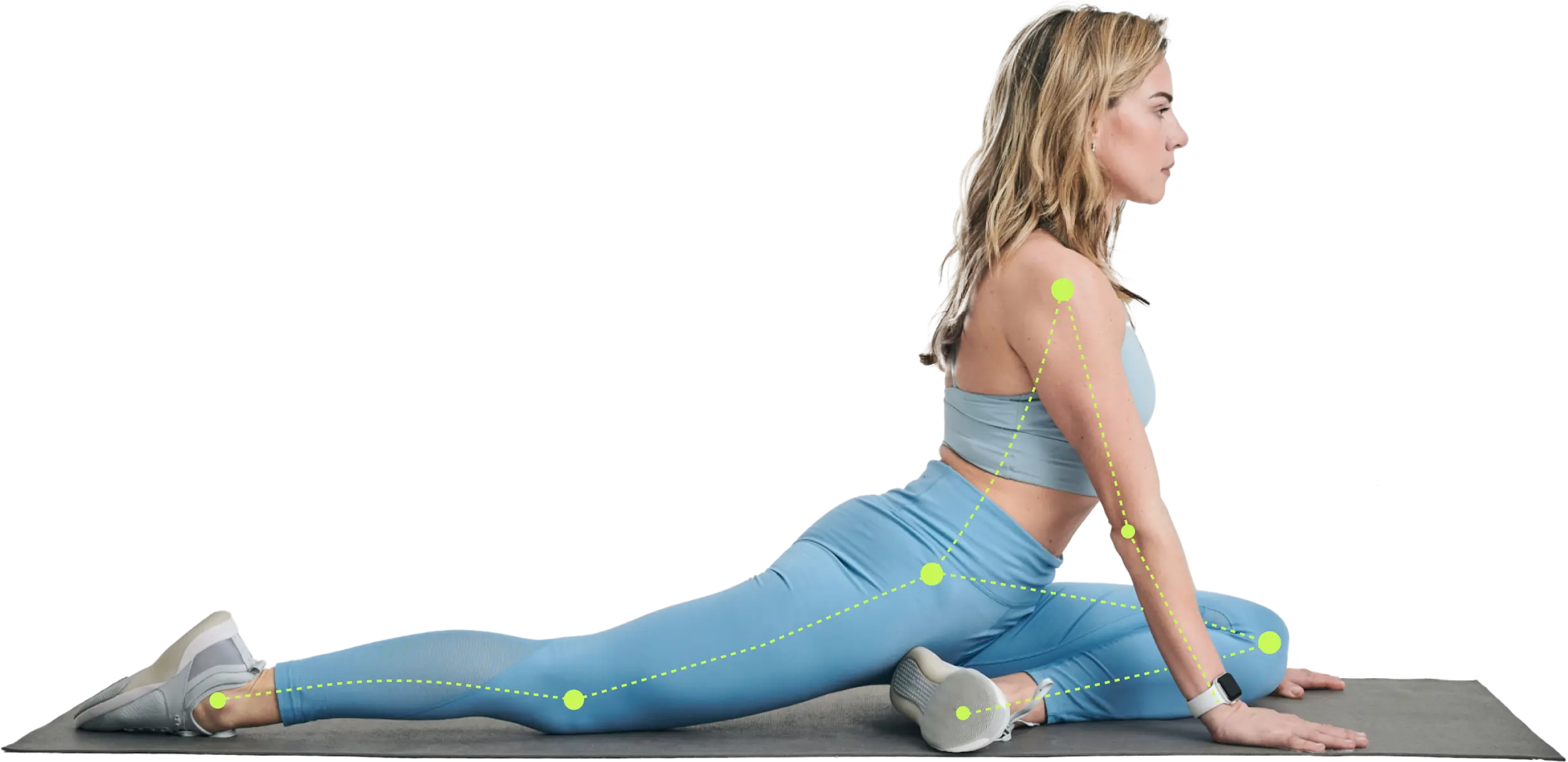
Learn how to measure body composition at home using simple methods. This guide covers smart scales, calipers, and tape measures to track your fitness progress.

To get a real handle on your body composition at home, you have to look beyond the number on the scale. Methods like skinfold calipers, tape measurements, or bioelectrical impedance (BIA) smart scales are your best friends here. These tools give you the inside scoop on your fat-to-lean-mass ratio, which is a far more useful indicator of health and fitness progress than your total weight could ever be.
Why You Need More Than Just a Scale
If you're only tracking your weight, you're missing most of the story. Seriously. Weight alone can be incredibly misleading because it lumps everything together—fat, muscle, bone, and water.
It's a classic scenario: you're crushing your workouts, building muscle, and shedding fat, but the number on the scale just won't budge. Talk about frustrating. This happens all the time, especially when you're starting a strength training program. As you lift, your muscles get denser and your body starts burning fat. Since muscle is more compact than fat, you might notice your clothes fitting better even if your weight stays the same. That's a huge win, but it's one the scale will never tell you about.
Understanding Key Body Composition Metrics
To track what actually matters, you need to get familiar with a few core concepts. Understanding why body composition is important is the first real step toward seeing meaningful progress.
Here are the key metrics you should know:
- Body Fat Percentage: This is the percentage of your total weight that's made up of fat. It gives you a much clearer picture of your health than BMI ever could.
- Lean Body Mass: This is everything else—your muscles, bones, organs, and water. Gaining lean mass is usually a top priority because it fires up your metabolism and makes you stronger.
- Visceral Fat: This is the sneaky fat stored deep in your abdomen, wrapped around your vital organs. High levels are linked to some serious health risks, so it's a critical number to watch.
When you shift your focus from "losing weight" to "improving body composition," you're finally aligning your efforts with what actually drives health and aesthetic changes. It's about changing the quality of your body mass, not just the quantity.
When you use a tool like the Zing Coach app, plugging in these metrics gives you powerful data that helps customize your workouts and nutrition. It turns your fitness journey from a guessing game into a clear, data-driven plan.
Choosing Your At-Home Measurement Method
So, which tool is right for tracking your body composition at home? The honest answer depends on your goals, your budget, and frankly, how much of a data geek you are. The best method isn't the most expensive or complicated one; it's the one you'll actually use consistently.
Tracking the trends over time gives you infinitely more insight than a single, supposedly perfect measurement ever could.
Let's break down the most common options you can use right in your own home. You've got Smart Scales, which use something called Bioelectrical Impedance Analysis (BIA) and are fantastic for seeing daily patterns. Then there are Skinfold Calipers, which offer a more hands-on, surprisingly accurate way to estimate body fat for just a few bucks. Of course, there's the trusty Tape Measure Method—low-tech, but an incredibly powerful way to see changes in your measurements. And never, ever underestimate the motivational power of Progress Photos.
Finding Your Best Fit
Think of each of these tools as telling a slightly different part of your fitness story. For example, your smart scale might show a small increase in lean mass, while the tape measure confirms your waist is shrinking. That's a classic sign of successful body recomposition that weight alone would completely miss.
If you want to get really granular on one of the most important metrics these tools estimate, we've got a complete guide on how to measure body fat percentage that digs into the details.
This simple decision tree can help you figure out if your goals demand more than just a standard bathroom scale.

The main point? Whether you're obsessed with the number on the scale or couldn't care less about it, tracking body composition paints a much richer, more accurate picture of what's happening with your body.
To help you choose, here’s a quick-glance table breaking down the pros and cons of each method.
Comparing At-Home Body Composition Methods
Here's a quick look at the most popular at-home methods to help you choose the right one for your goals.
| Method | What It Measures | Best For | Approximate Cost | Ease of Use |
|---|---|---|---|---|
| Smart Scale (BIA) | Estimates body fat %, lean mass, water, etc. | Tracking long-term trends with daily data. | $50 - $150 | Very Easy |
| Skinfold Calipers | Skinfold thickness to calculate body fat %. | Precise, budget-friendly fat percentage tracking. | $10 - $30 | Moderate |
| Tape Measure | Circumference of waist, hips, thighs, etc. | Monitoring changes in body shape and size. | $5 - $10 | Easy |
| Progress Photos | Visual changes in muscle definition and shape. | Seeing aesthetic progress numbers can't show. | Free | Very Easy |
Ultimately, these tools just provide data points. The real magic happens when you use that information to celebrate small wins, stay motivated when progress feels slow, and make smart tweaks to your training and nutrition plan—something Zing Coach is designed to help you with.
No matter what you choose, learning how to measure body composition accurately is key. Being consistent with how you measure is what will turn your chosen tool from a simple gadget into a reliable partner on your fitness journey.
Using Skinfold Calipers for Reliable Results
Skinfold calipers are a classic, trusted, and surprisingly affordable tool for anyone who's serious about tracking their body fat percentage at home. They might look a bit intimidating, but once you get the hang of it, they offer a level of precision that many other home methods just can't match.
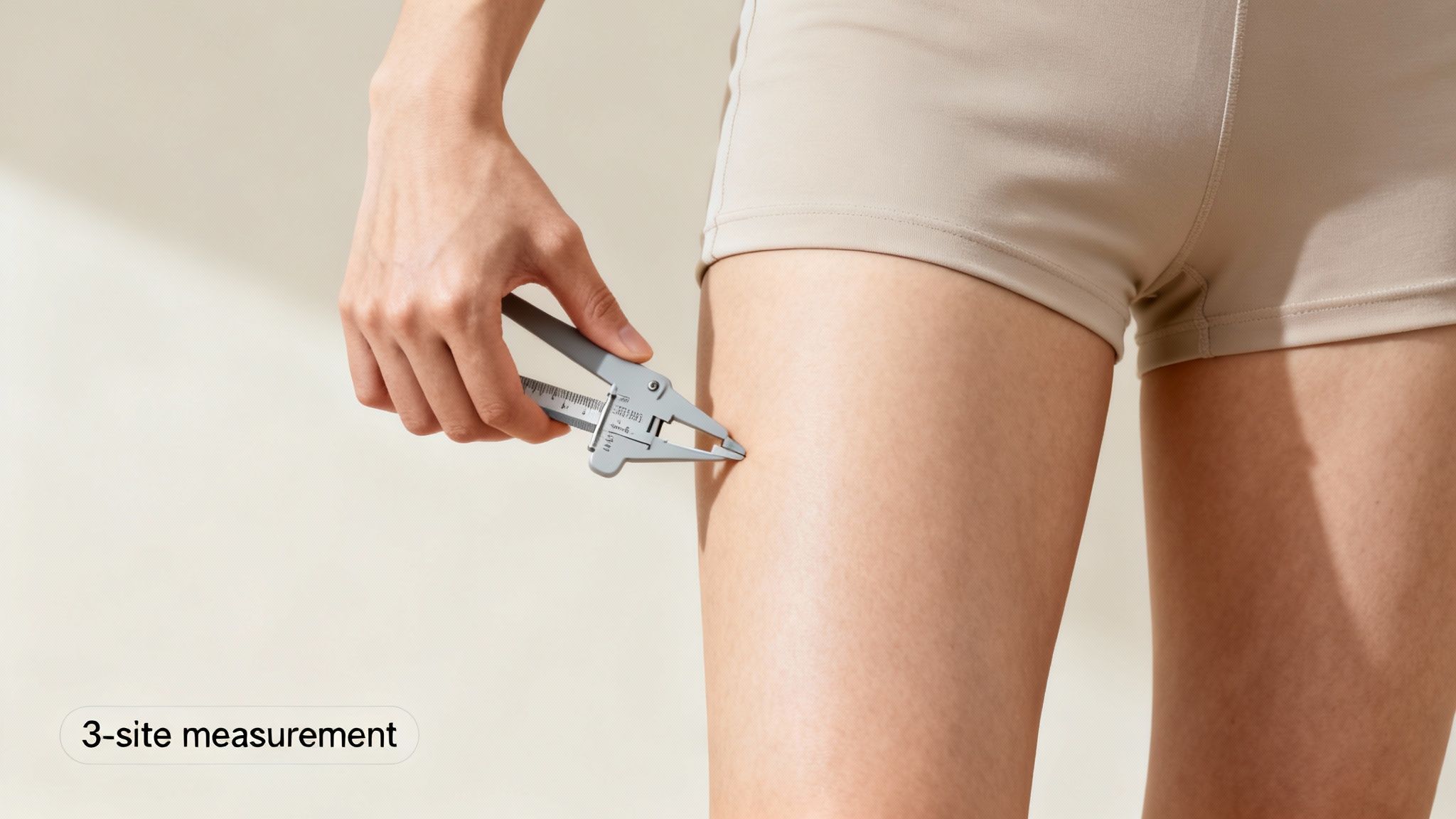
The idea behind them is pretty simple. You gently pinch a fold of skin and the subcutaneous fat right underneath it, then use the calipers to measure its thickness in millimeters. Those numbers then get plugged into a formula to estimate your overall body fat percentage. Don't worry, you won’t need to do any complex math yourself; there are countless online calculators and apps that handle that part for you.
When you use them correctly, the accuracy is pretty impressive. A meta-analysis of over 50 studies found that people who know what they're doing can get results within 3-5% of a DEXA scan—which is considered the clinical gold standard. For athletes, the common 3-site protocols can predict body fat with a 95% correlation to lab methods. That makes calipers a powerful tool for tracking real progress. You can dive deeper into the research on skinfold accuracy if you want to see the data for yourself.
Performing a 3-Site Measurement
The go-to method for most people at home is the Jackson-Pollock 3-site formula. The exact spots you measure depend on your sex, since body fat tends to be distributed differently.
- For Men: The three sites are the chest, abdomen, and thigh.
- For Women: The three sites are the triceps, suprailiac (that spot just above your hip bone), and thigh.
To get a measurement, you'll pinch a vertical fold of skin at each of these sites. Place the caliper jaws about 1 cm away from your fingers and then release the trigger to get your reading. For the best result, take each measurement three times and use the average of the three.
Tips for Consistent Readings
The real secret to using skinfold calipers effectively isn't about getting a flawless technique on your first try. It's all about consistency. Your goal is to create a process you can repeat perfectly every time, so you can accurately track the changes happening over weeks and months.
Key Takeaway: With calipers, consistency beats perfection. An imperfect measurement taken the exact same way every month is far more valuable for tracking progress than a perfect measurement taken once.
Here are a few practical tips to make sure your readings are reliable:
- Always measure on the same side of your body. Most protocols recommend using the right side.
- Pinch firmly but don't grab muscle. You’re trying to isolate just the skin and fat layer. If it feels hard or it hurts, you’re probably pinching too deep.
- Take your readings at the same time of day. First thing in the morning, before you eat or drink anything, is usually best to avoid fluctuations from hydration.
- Wait a second before you record the number. After you apply the caliper, give it a moment for the needle or digital display to settle before you write down the reading.
By following these simple guidelines, you can turn a ten-dollar tool into a powerhouse for understanding how to measure body composition at home and seeing the real results of all your hard work.
Making the Most of Your Smart Scale
Smart scales are super convenient, right? They use a technology called Bioelectrical Impedance Analysis (BIA) to give you a quick snapshot of everything from your body fat to your muscle mass. But if you’ve ever owned one, you know the numbers can jump all over the place day to day.
The thing is, a smart scale’s real power isn't in one perfect reading. It's in the story it tells over time.

Here’s how BIA works: the scale sends a tiny, harmless electrical signal up through your body. That signal travels quickly through water-heavy muscle but hits the brakes when it encounters fat. This is why your hydration level is the single biggest wild card that can throw your results off.
A 2021 study from the NIH backed this up. It found that while smart scales are great for tracking weight (99% accurate), their body fat estimates can be off by as much as 5-10% compared to lab-grade equipment. Even so, they're fantastic tools for watching trends. You can dig into the findings on smart scale accuracy yourself, but the takeaway is clear: consistency is everything.
Create a Measurement Ritual
To get data you can actually trust, you have to lock down your variables. That means creating a strict, repeatable routine you follow every single time you step on that scale.
Treat it like you're running a science experiment on yourself. The goal is to remove all the outside noise so the only changes you see are real shifts in your body. This is especially true if you’re syncing your data with an app like Zing Coach, which needs consistent numbers to properly adjust your workouts.
These are the non-negotiables for your weigh-in ritual:
- Same Time, Every Time: The sweet spot is right after you wake up, after you’ve used the bathroom, and before you eat or drink a single thing. This is when your hydration is at its most stable.
- Same Spot: Always put your scale on a hard, flat surface. Carpet, rugs, or wobbly tiles will mess with the sensors and give you a bogus reading.
- Same State: Never measure right after a brutal workout, a huge meal, or a night of drinking. All of these things massively swing your hydration and glycogen levels, making the numbers totally unreliable.
Look at the Trend, Not the Number
Once you’ve got your routine dialed in, it's time for a mindset shift. Stop obsessing over today's body fat percentage. It doesn’t matter. Instead, zoom out and look at your weekly and monthly averages.
A single reading is just a snapshot. It’s influenced by what you ate yesterday, how much water you drank, and a dozen other fleeting factors. The trend line over several months? That’s the real story of your progress. It smooths out the daily static and shows you where you're truly headed.
When you start analyzing your data this way, your smart scale becomes an incredibly insightful ally. You can start to see how your body is responding to different training blocks or changes in your nutrition. Understanding the Zing Coach methodology can help you connect those dots, turning what looks like random numbers into meaningful feedback you can act on.
How to Analyze and Act on Your Data
Collecting numbers is one thing, but using them to actually make smart decisions is where the real progress happens. Think of your body composition data as a direct feedback loop from your body—if you learn to listen.
The first rule is simple: focus on the long-term trend, not the daily noise.
It doesn't matter if you're using a simple spreadsheet, a dedicated journal, or logging it all in an app like Zing Coach. The goal is always to see the big picture over weeks and months. A single measurement can get thrown off by anything—hydration levels, a salty dinner the night before, or even a tough workout. The trend line, however, doesn't lie. It tells the real story of your body's transformation.
Turning Data Into Actionable Steps
So, you've spotted a pattern. Now what? This is the point where your measurements become your personal guide, telling you exactly how to tweak your training and nutrition for better results.
Let's walk through a few real-world scenarios:
- Scenario 1: Body Fat is Down, Lean Mass is Stable. This is the sweet spot. It means you're successfully torching fat while holding onto your hard-earned muscle. Whatever you're doing, keep doing it—your current mix of diet and exercise is clearly working.
- Scenario 2: Both Fat and Lean Mass Are Dropping. This is a classic sign that you might be in too aggressive of a calorie deficit or, just as likely, not getting enough protein. A tiny dip in lean mass can happen, but a steady decline is a definite red flag.
- Scenario 3: Weight is Stable, but Circumference Measurements Are Shrinking. This is it—the holy grail of body recomposition! You're building muscle and losing fat at the same time. The scale won't budge much here, which is exactly why progress photos become so incredibly motivating.
Making Smart Adjustments
If your data is telling you it's time for a change, don't panic. The adjustments don't need to be massive. In my experience, small, consistent tweaks are almost always more effective than a complete overhaul.
For instance, if you see your lean mass trending downward, it’s a clear signal to intervene. You could start by increasing your daily protein intake to give your muscles the fuel they need to repair and grow. It might also be a good time to take a hard look at your workouts; our guide to strength training for weight loss is a great resource for making sure your routine is set up to preserve muscle.
Your body composition metrics are not a final grade; they are a navigation tool. They provide the feedback you need to course-correct, celebrate your successes, and stay on the most efficient path toward your goals.
Getting a handle on your body composition is a huge first step. The next is putting that knowledge to work by creating a personalized nutrition plan that aligns with your fitness goals. This turns the simple act of measuring your body composition at home from a passive chore into an active strategy for success.
Common Body Composition Questions Answered
Diving into the world of body composition can bring up a lot of questions. Getting clear, straightforward answers helps you move forward with confidence and turn your data into real, actionable insights. Here are some of the most common queries that pop up when you start learning how to measure body composition at home.
How Often Should I Measure My Body Composition?
First things first: resist the urge to measure every single day. It's a classic mistake. Your body composition changes far more slowly than your weight, and daily shifts in hydration can make your results wildly misleading, especially if you're using a smart scale. All it does is create unnecessary stress and confusion.
For insights that actually reflect your progress, aim to measure once every two to four weeks. This timeframe is long enough to see real, meaningful changes in fat and muscle tissue, giving you a much truer picture of how your plan is working. For the best results, lock down your routine: always measure under the exact same conditions, like first thing on a Saturday morning before you've had anything to eat or drink.
Which At-Home Method Is the Most Accurate?
While no at-home tool can perfectly match the clinical precision of a DEXA scan, that's not really the point. When it comes to tracking your own progress, consistency matters far more than perfect accuracy. The best method is simply the one you'll use correctly and repeatedly over the long haul.
That said, here’s a quick rundown of what you can expect:
- Skinfold calipers, when you get the technique down, can be surprisingly on the money, often getting you within 3-5% of lab-grade results.
- Smart scales (BIA) aren't the best for a single, snapshot reading, but they are fantastic for revealing long-term trends—if you control all the variables.
- Tape measures are incredibly reliable for tracking changes in your body's dimensions. Sometimes, seeing your waist shrink is a more powerful motivator than any body fat percentage.
Why Do My Body Composition Results Fluctuate So Much?
If your readings are all over the place, it's almost always because of changing variables—especially with BIA smart scales. Your hydration level is the single biggest culprit. A big glass of water or a sweaty workout can throw off the result by changing how that tiny electrical current travels through your body.
Other common suspects include:
- Measuring after a large meal
- A recent, tough workout
- The time of day you take the reading
- Inconsistent technique with calipers or the tape measure
The solution? Create a strict pre-measurement ritual. Measure at the same time, under the same hydration and food conditions, and use the exact same technique every single time. This is how you filter out the noise and see the true signal of your progress.
The key is to focus on the weekly or monthly trend, not a single number. Fluctuations are normal; the direction of the trendline over time is what tells you if your hard work is paying off.
Is It a Good Idea to Combine Measurement Methods?
Absolutely. In fact, it’s one of the smartest things you can do. Combining methods provides a more complete, three-dimensional picture of your progress. Each tool highlights a different aspect of your body's transformation, and using them together helps validate your efforts and keep you fired up. Once you start seeing the full picture, you might be surprised to learn about common nutrition misinformation that could be holding you back.
For example, you could use a smart scale weekly to keep an eye on body fat trends, then pull out the tape measure monthly to track changes in your waist and hip circumference. Add in progress photos every 4-6 weeks, and you’ll have undeniable visual proof of your transformation that numbers alone simply can't capture.
Ready to turn those numbers into a personalized action plan? Zing Coach uses your body composition data to create intelligent, adaptive workouts that evolve with you. Stop guessing and start seeing results. Get your personalized plan today!
Share this article


Authors