Use our protein intake calculator for muscle growth to find your exact daily protein target. Learn how to adjust for real results and build muscle faster.
Forget the old-school advice to "just eat more protein." If you're serious about building muscle, you need to be precise. Using a protein intake calculator for muscle growth is the single best way to figure out your exact target, ensuring you give your body the raw materials it needs to repair and grow after a tough workout.
Why a Calculated Protein Target Is Your Secret Weapon
Simply winging your protein intake is like trying to build a house without a blueprint. You might end up with something, but it’s going to be inefficient and leave a lot to chance.
Here’s what’s happening in your body: when you lift weights, you create tiny micro-tears in your muscle fibers. The real magic happens during recovery, when your body uses amino acids—the building blocks of protein—to repair these fibers, making them bigger and stronger than before. This process is known as Muscle Protein Synthesis (MPS).
A generic approach just doesn't cut it because it ignores you as an individual—your weight, how active you are, and your body composition. A calculated target, on the other hand, gives you a clear, actionable number to hit every day. It turns nutrition from guesswork into a reliable system for growth.
The Science Driving Modern Protein Recommendations
For years, the advice on protein was shockingly low. Back in the day, many of us were told to aim for a measly 0.8 grams of protein per kilogram of body weight. We now know that's just the bare minimum to prevent deficiency in sedentary people—it's nowhere near enough for anyone actively trying to build muscle.
Thankfully, the science has caught up. A landmark 2018 meta-analysis completely changed the game, finding that intakes between 1.6 to 2.2 grams per kilogram are the sweet spot for maximizing muscle growth when combined with resistance training. In fact, some trainees in these studies gained 27% more lean mass over 12 weeks compared to those eating less protein.
This diagram shows the basic process of muscle protein synthesis. Think of your DNA as the blueprint for building muscle, and the amino acids from protein as the bricks and mortar.
When you supply enough protein, you're making sure the construction crew always has the materials they need to get the job done right.
Key Takeaway: Your protein target isn't just a random number. It's a direct signal to your body to kickstart muscle repair and growth. If you fall short, you're leaving gains on the table, no matter how hard you push yourself in the gym.
This level of precision is what separates those who break through plateaus from those who stay stuck. It’s the foundation you need to support your training and is crucial for learning how to measure muscle gain effectively.
Finding Your Personal Protein Number
Alright, let's get down to business. It's time to move past generic advice and figure out the exact daily protein target that will actually fuel your muscle growth. Your number needs to be specific to you.
We'll walk through two of the most reliable ways to calculate this: a simple method using your total body weight and a more precise approach using your lean body mass. You don't need a fancy app just yet—just some basic math.
This flowchart lays out the thought process perfectly. You can either stick with a generic guess or get calculated and targeted with your approach.
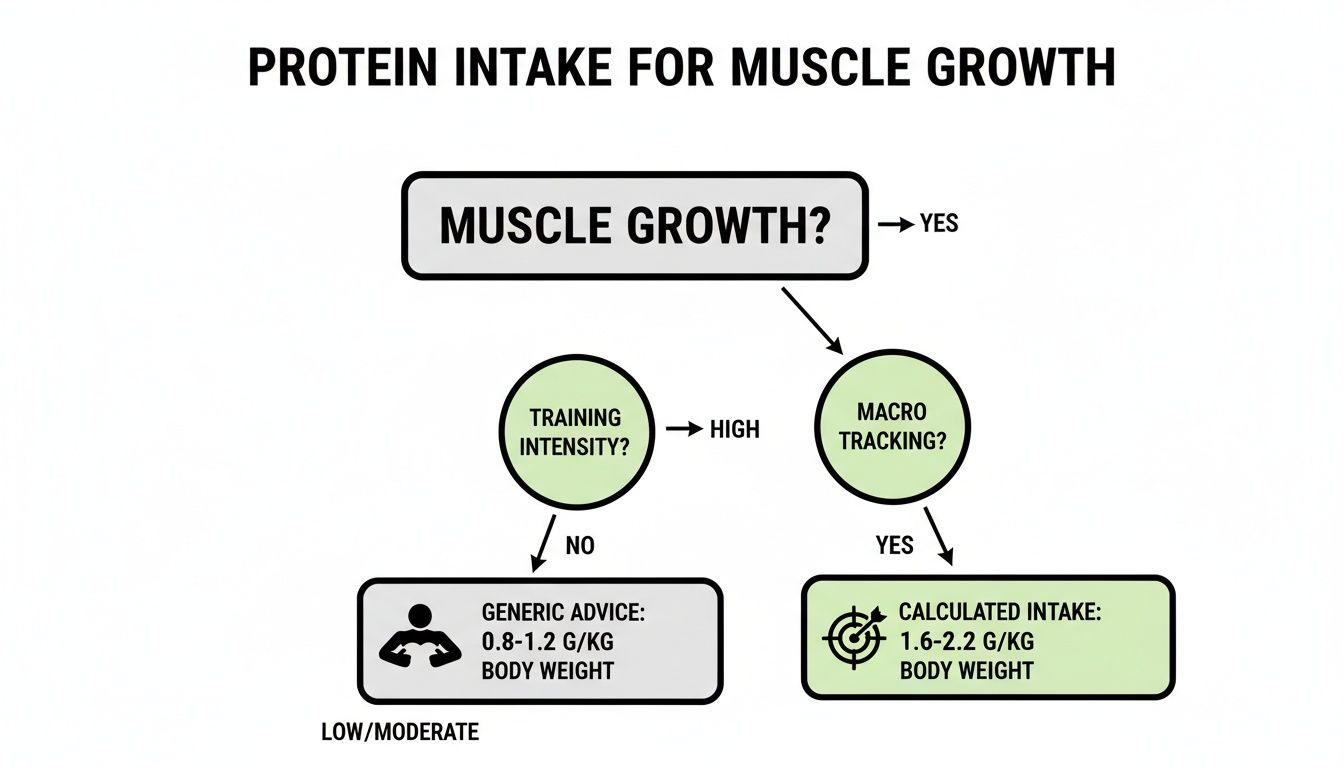
The takeaway is pretty clear: a calculated intake gives you a direct path to your goals. Generic advice? That often leads to guesswork and stalled progress.
To make it even clearer, let's compare the two primary calculation methods side-by-side.
Protein Calculation Methods at a Glance
| Calculation Method | Best For | Formula (per kg) | Formula (per lb) |
|---|---|---|---|
| Total Body Weight | Beginners, leaner individuals, or those looking for a quick and simple starting point. | Body Weight (kg) x 1.6 to 2.2 | Body Weight (lb) x 0.7 to 1.0 |
| Lean Body Mass | Anyone with a higher body fat percentage or those who want maximum precision. | Lean Body Mass (kg) x 2.0 to 3.0 | Lean Body Mass (lb) x 0.9 to 1.4 |
Each method has its place, but as you can see, the right one for you depends on how dialed-in you want to get.
Calculating Protein With Total Body Weight
This is the most straightforward method and a fantastic starting point for most people, especially if you're already fairly lean. The idea is to eat a certain amount of protein for every pound or kilogram you weigh.
The sweet spot for building muscle is generally between 1.6 and 2.2 grams of protein per kilogram of body weight. If you think in pounds, that works out to about 0.7 to 1.0 grams per pound.
Let's run the numbers for someone who weighs 180 lbs (around 82 kg). Using this method, their daily protein target would land somewhere between 126g and 180g. For many lifters, that's a perfectly solid baseline to work from.
The Gold Standard: Using Lean Body Mass
If you want a more accurate target, especially if you're carrying a bit more body fat, calculating your protein needs based on lean body mass (LBM) is the way to go. Your LBM is everything in your body that isn't fat—muscle, bones, water, and organs.
Why is this better? It ties your protein intake directly to your metabolically active tissue, not your total scale weight.
First, you'll need to figure out your LBM.
- Find Your Fat Mass: Total Body Weight x Body Fat Percentage
- Find Your Lean Body Mass: Total Body Weight - Fat Mass
Once you have your LBM, the formula is a little different.
Let's bring back our 180 lb person, but this time, let's say they have 20% body fat.
- Fat Mass: 180 lbs x 0.20 = 36 lbs
- Lean Body Mass: 180 lbs - 36 lbs = 144 lbs
- Protein Target: 144 lbs x (0.9 to 1.4) = 130g to 202g
See how that range is a bit more refined? This precision helps ensure you're not over- or under-eating protein based on non-muscle weight. Modern, science-backed approaches have moved past the old "1 gram per pound" rule because we now know that what really matters is feeding your lean tissue.
Of course, your personal protein number is just one piece of the puzzle. To get the full picture, you need to understand what your overall macros should be to support your training and recovery completely.
How to Adjust Your Protein Intake for Better Results
Sticking to a single, static protein number just doesn’t work long-term. Your body isn't static, so why should your nutrition be? Your protein needs are constantly shifting based on your training, your age, and whether you're in a cutting or bulking phase.
If you’re serious about making progress, you have to get comfortable fine-tuning your intake. That means knowing when to bump up the numbers and when to ease off.
When to Increase Your Intake
For some people, a higher protein intake is non-negotiable right from the start. Beginners and older adults, for example, often need an extra 0.4-0.6 g/kg of protein. This helps overcome what’s known as "anabolic resistance," jumpstarting the muscle-building process.
Another critical time to up your protein is during a calorie deficit. When you're cutting, your body is looking for energy, and you risk it breaking down hard-earned muscle. Pushing your protein intake toward the higher end of your recommended range helps protect that muscle mass.
So, if someone weighing 80 kg is cutting calories, they might aim for 2.2 g/kg daily to preserve their gains.
“Adjusting protein in a deficit keeps your gains solid even when calories drop.”
Adjustments Based on Training Status
Your experience level in the gym plays a huge role in how much protein you need. A one-size-fits-all approach just won't cut it.
- New Lifters: When you're just starting, your muscles are primed for growth. Adding an extra 0.2 g/kg to your baseline can help ignite that new muscle synthesis.
- Intermediate Lifters: Once you've been training for a while, you can usually settle in around 1.6 g/kg to maintain steady, consistent progress.
- Advanced Lifters: For the seasoned gym-goer, protein becomes more about recovery. Pushing intake up to 1.8–2.0 g/kg is a smart move, especially when your training volume gets intense.
To really dial this in, make sure your protein and calorie targets are working together. You can check out our guide on calculating daily calorie needs to get everything aligned.
A Look at the Calculator Logic
Here’s a simple way to think about how to adapt your numbers based on your current situation:
- First, get your base value using either your total bodyweight or, for more accuracy, your lean body mass.
- Next, multiply that number by your target rate (e.g., 1.6 g/kg or 0.7 g/lb).
- Finally, make adjustments. If you're in a cutting phase, for instance, add an extra 10–20% to that final number to protect muscle.
To make this process seamless, using the best app to track food for your health goals can be a game-changer for hitting your numbers consistently.
Backed by Research
This isn't just gym-talk; the science backs it up. A major 2017 review in the Journal of the International Society of Sports Nutrition, which analyzed 22 different trials, pinpointed 1.6 g/kg as the sweet spot for muscle growth for most people.
But it also confirmed that beginners and older adults benefit from more—up to 2.2 g/kg. That extra 0.4-0.6 g/kg is what helps them overcome anabolic resistance and spark growth. With 80 million adults hitting gyms in the US each year, it's no surprise that under-eating protein is a key reason why up to 40% of them see their progress stall.
Start with your calculated baseline and plan to check in with yourself every 4–6 weeks. Are you getting stronger? Is your weight changing how you want it to? Is your recovery solid?
When you decide to cut, a good rule of thumb is to bump your protein up by 0.2 g/kg above what you'd eat for maintenance. And if you're in a surplus? You can often dial it back toward the lower end of your range, freeing up calories for carbs and fats.
Fine-Tuning With Zing Coach
Manually tracking and adjusting all of this can feel like a full-time job. That's where an app like Zing Coach comes in. It automates these protein adjustments for you. By syncing with Apple Health or body composition scans, it constantly updates your lean mass and recalculates your targets.
The app essentially does the thinking for you, tweaking your macros weekly so your nutrition always matches your training effort.
- Weekly Recalibration: Your protein target shifts as your lean mass changes.
- Smart Alerts: You'll get notifications if you're having low-protein days, so you can course-correct.
- Seamless Integration: It all fits perfectly within your overall calorie and macro plan.
Adopting a dynamic approach like this ensures your nutrition is always precise, keeping you on track without the hassle. Stay consistent, and the results will follow.
Turning Your Protein Target Into Daily Meals
Alright, you've got your magic number from a protein calculator. That's a great start, but let's be real—the number itself doesn't build muscle. The real work begins when you turn that target into actual food on your plate, day in and day out.
This isn't about rigid, boring meal prep. It's about building a smart, flexible system that actually fits your life.
The secret isn’t just hitting your total protein goal; it’s how you spread it out. Think of it like a steady drip-feed for your muscles. By spreading your intake across three to five meals, you keep those muscle-building signals firing all day long instead of just dumping a ton of protein on your system at once.
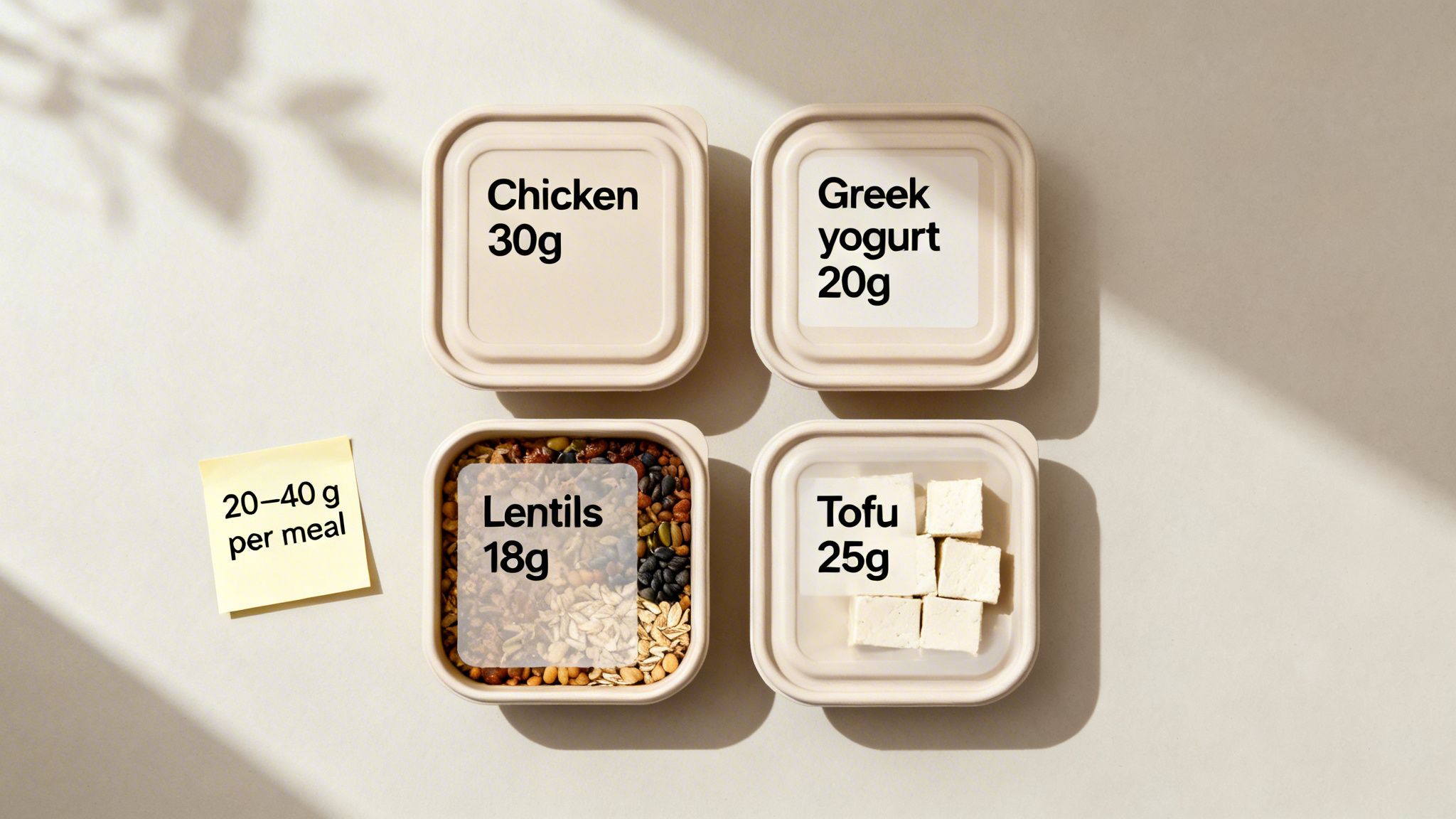
A solid, research-backed target to aim for is 20-40 grams of protein per meal. This seems to be the sweet spot for maxing out muscle protein synthesis—the process of repairing and building muscle—without just sending the excess… elsewhere. This way, your body gets the amino acids it needs, right when it needs them.
Structuring Your Protein Timing
While the old-school "anabolic window" isn't the tiny, 30-minute emergency we once thought it was, timing still matters. A consistent eating schedule helps you avoid that frantic, end-of-day scramble to cram in 80 grams of protein before bed.
Here’s what a 160g protein day could look like in the real world:
- Breakfast (8 AM): Greek yogurt with a scoop of protein powder and some nuts. (~40g protein)
- Lunch (12 PM): Big salad with a grilled chicken breast. (~45g protein)
- Post-Workout (4 PM): A quick protein shake. (~30g protein)
- Dinner (7 PM): A nice piece of salmon with quinoa. (~40g protein)
- Evening Snack (9 PM): Small bowl of cottage cheese. (~15g protein)
This is just a template, of course. The real goal is to find a rhythm that works for you, ideally with a protein-heavy meal every three to four hours. Knowing the ins and outs of protein shakes and supplements can be a game-changer here, making it way easier to hit your numbers, especially around your workouts.
Building Your High-Protein Arsenal
The key to consistency? Making it easy on yourself. Having a go-to list of reliable protein sources simplifies everything from grocery shopping to figuring out what to eat when you're tired and hungry. You don't need fancy, exotic foods—mastering the basics is what gets results.
Pro Tip: Always keep a few high-protein staples stocked. A pre-cooked chicken breast, a tub of Greek yogurt, or some canned tuna can be the difference between hitting your goals and ordering a pizza.
Here are some excellent choices to build your meals around, along with their typical protein content:
| Food Source | Serving Size | Average Protein |
|---|---|---|
| Chicken Breast | 100g (3.5 oz) | ~31g |
| Lean Beef | 100g (3.5 oz) | ~26g |
| Greek Yogurt (0%) | 1 cup (227g) | ~23g |
| Tofu (Firm) | 100g (3.5 oz) | ~15g |
| Lentils (Cooked) | 1 cup (200g) | ~18g |
| Eggs (Large) | 1 egg | ~6g |
Stock your kitchen with a mix of these animal and plant-based options, and you'll always have a solid foundation. This is how you take that number from the calculator and turn it into real, tangible, muscle-building results.
Let AI Handle the Math with Zing Coach
Doing all the calculations and tweaks yourself is a great way to learn, but let's be honest—it can get old fast. What if your protein and calorie targets could just... update themselves based on your actual progress, taking all the guesswork out of the equation?
That’s exactly what an AI-powered fitness app like Zing Coach is designed to do. It turns your nutrition plan from a static set of numbers into a living, breathing system that adapts right along with you.
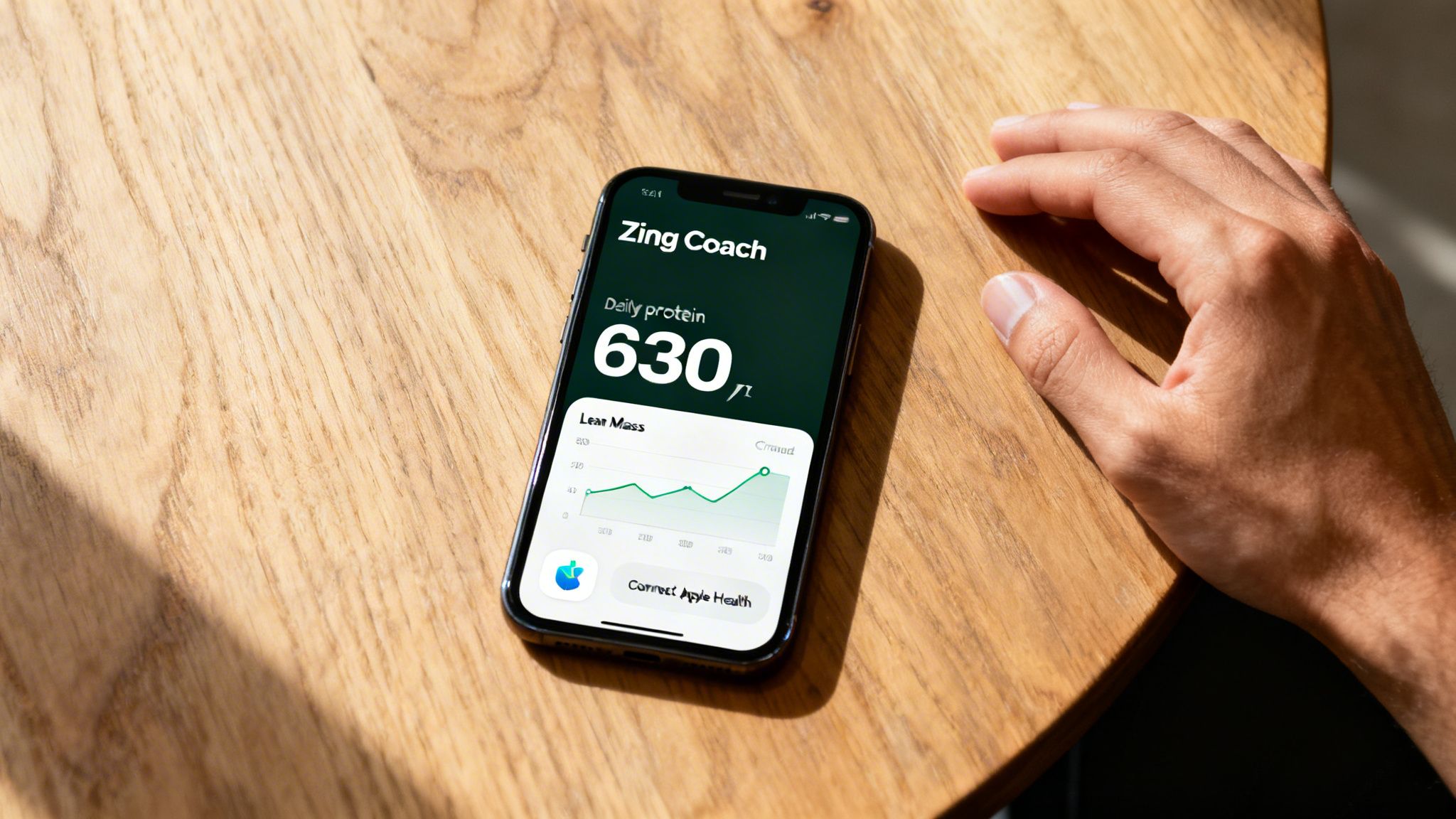
Sure, the app sets up your baseline macros when you start. But the real magic is what happens next. Your nutrition plan isn't just a document; it's a dynamic blueprint that evolves week by week.
Dynamic Adjustments Based on Real Data
The real power of Zing Coach comes from its integration with your health data. When you connect it to Apple Health and body composition tools, the app gets a clear, honest look at what’s actually happening with your body.
From there, your plan starts adjusting based on key metrics:
- Logged Workouts: Just smashed a heavy leg day? The AI knows your muscles will need more fuel to recover and can bump up your targets accordingly.
- Fatigue Levels: Feeling completely wiped out? The system can shift focus to recovery, ensuring your protein and calorie goals are set to help you bounce back.
- Changes in Lean Mass: As you successfully build new muscle, your protein requirements naturally go up. The app sees this change and automatically recalculates your targets to support that new growth.
This direct, visual link between what you eat every day and tangible results like gaining lean mass is incredibly motivating. It shows you that your effort is paying off in real-time.
Your Personal Nutritionist and Trainer in One
Think of it like having a personal nutritionist checking in on your progress every single day to fine-tune your plan. This takes the mental burden of constantly re-calculating off your plate, letting you pour all your energy into what matters: training hard and eating well.
This automated approach ensures your nutrition always matches your effort, preventing the plateaus that happen when your diet lags behind your training progress.
For anyone with a busy schedule, this is a massive time-saver. No more spending your Sunday nights hunched over a spreadsheet trying to figure out your macros for the week. For beginners, it offers the peace of mind that comes from a guided system, so you know you're on the right track from day one.
And if you're a data geek, you get to see exactly how your nutrition impacts the results you can track right in the app. This constant feedback loop—where your actions directly influence your plan—is a game-changer for staying consistent. To see how this tech works with your training, check out how an AI-powered workout app can dial in your entire fitness journey.
Ultimately, a smart tool like Zing Coach does more than just replace a manual protein intake calculator for muscle growth. It gives you a continuously optimized strategy, ensuring every gram of protein you eat is put to the best possible use for your body's changing needs.
Common Questions About Protein and Muscle Growth
Once you start nailing down your protein numbers for muscle growth, a lot of questions tend to come up. Frankly, there's a ton of outdated and just plain wrong advice floating around. Let's tackle some of the most common myths so you can stay on track with total confidence.
Does Eating Too Much Protein Damage Your Kidneys?
This is probably the most stubborn myth in fitness, and it’s time to put it to rest. For anyone with healthy, functioning kidneys, the science is crystal clear: a high-protein diet is safe.
The concern really only applies to people with pre-existing kidney conditions. If that's you, you should absolutely talk to your doctor before cranking up your protein. But if your kidneys are healthy, they are more than equipped to handle the demands of a muscle-building diet, even at levels of 2.2g per kg (1g/lb) or more.
Do I Need a Protein Shake Immediately After My Workout?
Ah, the "anabolic window." We used to think there was this magical 30-minute window after a workout where you had to slam a protein shake or all your gains would vanish. We now know it’s far more flexible than that.
While getting protein in after you train is a good idea, the urgency has been seriously overblown. What's far more important is your total daily protein intake.
The best approach is simply consistency. As long as you have a protein-rich meal a few hours before and a few hours after your workout, your muscles have everything they need to start repairing and growing.
Instead of stressing about the clock, just focus on spreading your protein intake evenly across three to five meals throughout the day. This provides a steady stream of amino acids for muscle protein synthesis.
Can I Build Muscle on a Plant-Based Diet?
You absolutely can. Building serious muscle on a plant-based diet is totally doable, it just requires a bit of smart planning. The main thing to know is that most individual plant proteins are "incomplete," which just means they don't contain all nine essential amino acids on their own.
But the fix is easy: eat a wide variety of plant protein sources. By mixing and matching foods like lentils, beans, rice, tofu, and quinoa, you can easily get the full spectrum of amino acids your body needs.
- Combine Your Sources: Think classic pairings like rice and beans, or lentils with a side of whole-wheat bread. Together, they create a complete protein profile.
- Aim a Little Higher: Some plant-based proteins aren't absorbed as efficiently as animal sources. A good strategy is to aim for the higher end of your calculated protein range to make sure you're covered.
With a well-thought-out diet, you can hit your muscle-building goals just as effectively.
Stop guessing and start growing. The Zing Coach AI takes your personal data and goals to create a dynamic nutrition plan that adjusts your protein targets automatically. Download Zing Coach and let AI handle the math for you.
Share this article


Authors