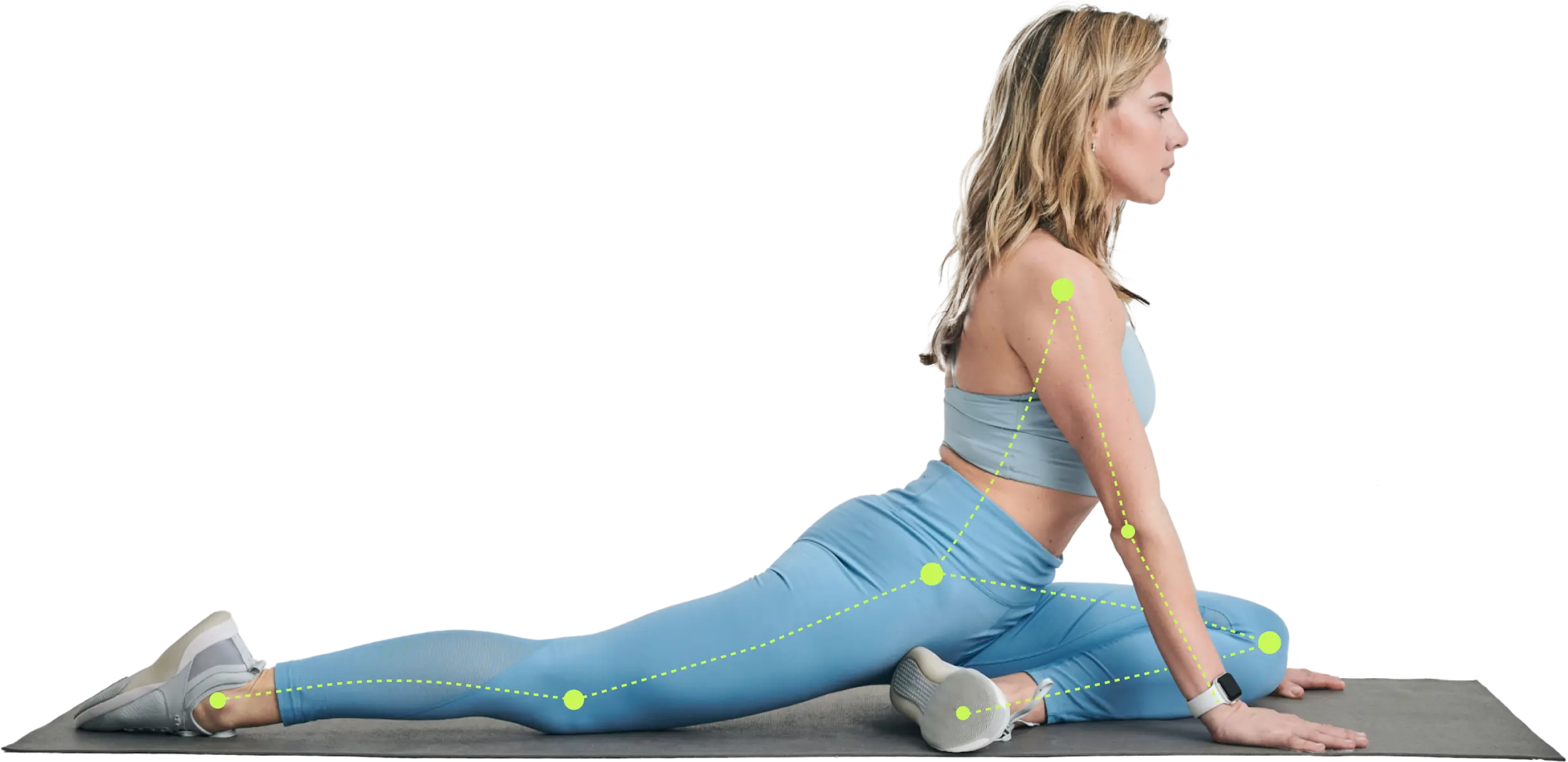
Discover the best calisthenics workout for your goals. Our 2026 guide ranks 10 routines for strength, skill, and weight loss, with sample plans.

Calisthenics is more than just push-ups and pull-ups; it's a discipline that builds functional strength, impressive skills, and elite body control using only your bodyweight. But with endless routines available online, finding the single best calisthenics workout can feel overwhelming. The truth is, the "best" workout is the one that aligns perfectly with your specific goals, whether that's mastering a handstand, building lean muscle, improving metabolic health, or simply getting stronger for everyday life.
This guide cuts through the noise. We've curated the top 10 calisthenics training methodologies, each one a detailed blueprint for a different objective and experience level. You won't find generic advice here. Instead, you'll get actionable, structured routines designed for real results.
Here’s what you will learn:
- Diverse Training Styles: From classic Push/Pull/Legs splits and skill-focused protocols like "Greasing the Groove" to metabolic conditioning with EMOM and HIIT circuits.
- Actionable Blueprints: We provide clear, easy-to-follow workout structures, sample sessions, and specific progression paths for each method.
- Goal-Oriented Selection: Discover which routine is ideally suited for building muscle, developing skills like the handstand, or improving cardiovascular fitness.
We will also explore how an AI-powered tool like Zing Coach can take these proven frameworks and create a truly personalized plan. By adapting to your fitness level, recovery needs, and specific goals, technology ensures every session is perfectly calibrated for safe, efficient, and measurable progress. This article is your definitive resource for choosing and implementing the right calisthenics workout to unlock your full potential.
1. Recommended Routine (Push/Pull/Legs Split)
The Push/Pull/Legs (PPL) split is a cornerstone of strength training, and its calisthenics adaptation is arguably the best calisthenics workout for building a balanced, functional physique. This routine organizes your training week into three distinct sessions based on fundamental movement patterns. Instead of isolating individual muscles, you focus on pushing, pulling, or lower-body movements, ensuring comprehensive muscle engagement and preventing imbalances.
Popularized by communities like Reddit’s r/bodyweightfitness, this split’s effectiveness lies in its simplicity and scalability. It provides an ideal balance of training frequency and recovery, typically hitting each movement pattern once or twice a week with at least 48 hours of rest in between. This structure is perfect for beginners building a solid foundation and intermediates aiming for consistent progress.
Why It Works So Well
The PPL split shines because it groups synergistic muscles. Your "Push Day" targets the chest, shoulders, and triceps with exercises like push-ups and dips. "Pull Day" focuses on the back and biceps through movements like pull-ups and rows. Finally, "Leg Day" strengthens your entire lower body with squats, lunges, and calf raises. This logical grouping allows you to apply maximum effort to related muscles in a single session.
Key Insight: This method emphasizes progressive overload through exercise variations. As you get stronger, you don’t just add reps; you advance to a more challenging version of the exercise, like moving from incline push-ups to pike push-ups.
How to Implement This Routine
For optimal results, follow a structured approach to your PPL split. Here are some actionable tips:
- Master the Basics: Start with foundational movements. Before you attempt a muscle-up, ensure you can comfortably perform 3 sets of 8 pull-ups and dips.
- Track Your Progress: Log every workout. Note the exercise variation, sets, and reps completed. The Zing Coach app automates this, helping you visualize when it’s time to progress to a harder variation.
- Prioritize Form: Use your phone to record your form or use an app with technique-analysis features. Proper execution is crucial for preventing injury and maximizing muscle activation.
- Rest Adequately: Aim for 60-90 seconds of rest between sets. This timeframe is ideal for replenishing energy for the next set without letting your heart rate drop too low.
This structured approach is highly effective for building strength and muscle mass with just your body weight. To explore a detailed program, you can find a comprehensive guide on implementing a 3-day split workout that fits this model.
2. Skill Work and Strength (Greasing the Groove)
The "Greasing the Groove" (GtG) method is a highly effective, yet unconventional, approach to mastering difficult calisthenics skills and building specific strength. Instead of exhausting a muscle group in a single session, GtG involves practicing a target exercise frequently throughout the day with low repetitions and perfect form, well short of failure. This technique focuses on training your nervous system, not just your muscles.
Popularized by former Soviet special forces instructor Pavel Tsatsouline, GtG treats strength as a skill. By performing an exercise like a pull-up or handstand multiple times daily, you teach your brain and central nervous system to become incredibly efficient at that specific movement pattern. This high-frequency, low-intensity approach allows for rapid skill acquisition without causing the fatigue that hinders recovery.
Why It Works So Well
The brilliance of Greasing the Groove lies in its neurological focus. Each perfect rep strengthens the neural pathways responsible for executing the movement, making it smoother and more powerful over time. It’s an ideal method for breaking through plateaus on challenging exercises like muscle-ups or one-arm push-ups, as it builds the requisite strength and coordination without the need for intense, muscle-damaging workouts. To truly leverage your potential, remember that a key component to speeding up metabolism and achieving your fitness goals is to actively engage in forms of training that help you build more muscle with strength training.
Key Insight: This method emphasizes neurological adaptation over muscular fatigue. The goal is to make a hard movement feel easy by practicing it so often that it becomes second nature to your body.
How to Implement This Routine
To apply GtG effectively, you need discipline and a clear focus. Here are some actionable tips:
- Pick One Skill: Focus on a single target exercise for a 4- to 6-week block. This could be pull-ups, pistol squats, or handstand holds.
- Practice Frequently: Perform several "micro-sessions" throughout your day. Aim for 3-5 sets spread out with at least an hour between each to allow for full nervous system recovery.
- Stay Fresh: Never go to failure. If your maximum is 5 pull-ups, your GtG sets should be just 2-3 reps. The movement should always feel crisp and easy.
- Use Reminders: Consistency is everything. Use an app like Zing Coach to set reminders for your micro-sessions, ensuring you hit your daily volume without having to think about it.
3. Ring Training (Progressive Strength Building)
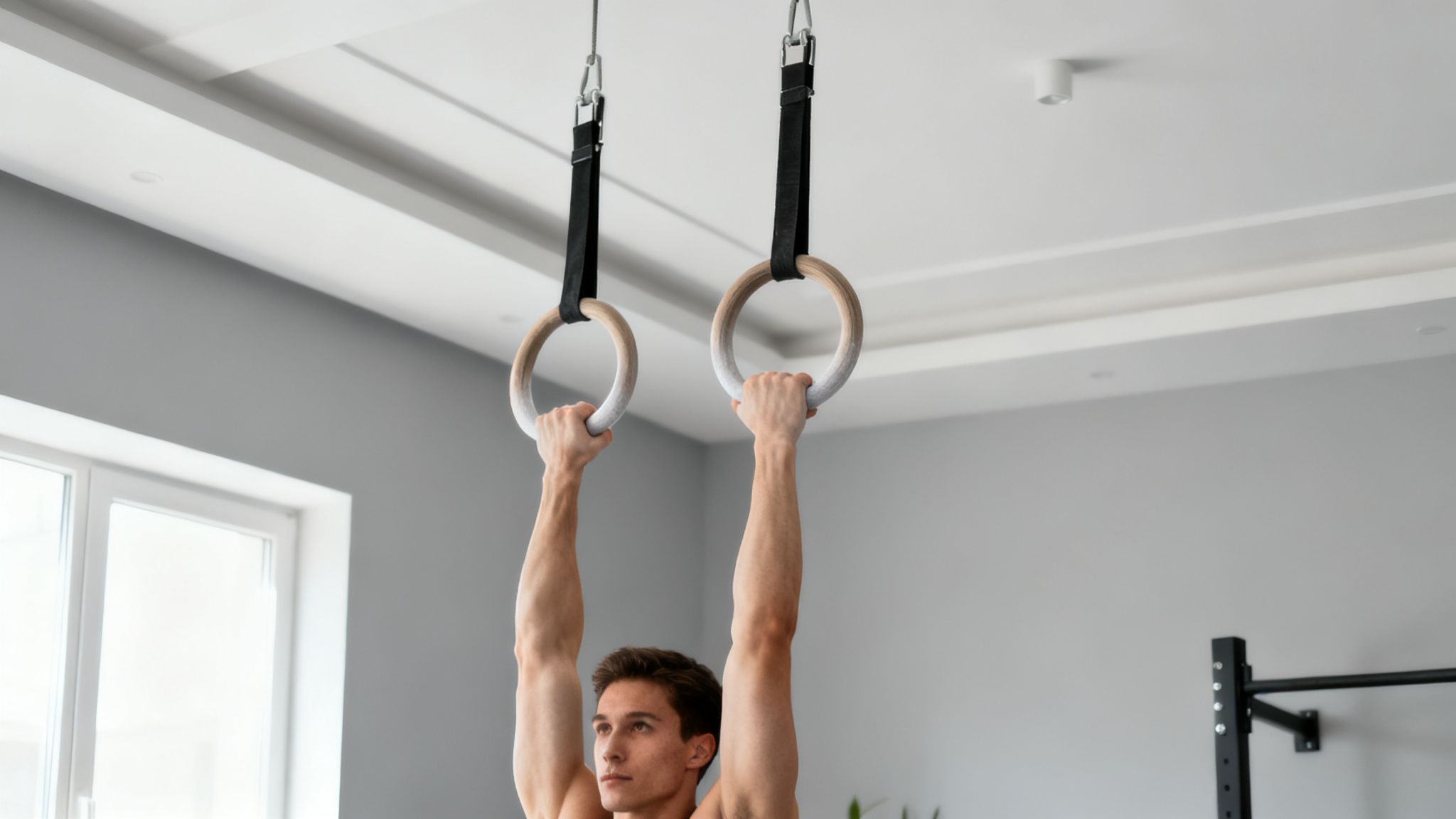
Gymnastics rings offer a level of challenge and versatility unmatched by most other calisthenics equipment, making ring training arguably the best calisthenics workout for developing superior upper-body and core strength. This method leverages instability to force your stabilizer muscles to work overtime, building functional power that translates directly into other athletic pursuits. Unlike fixed bars or the floor, rings move freely in multiple planes, requiring constant control and engagement.
This instability is the key to its effectiveness. Popularized by gymnasts and adopted by communities like CrossFit and fitness influencers such as FitnessFAQs, ring training provides a clear path for progression. The difficulty of any exercise can be instantly scaled by adjusting ring height or body angle, making it accessible for beginners while offering an infinite ceiling for advanced athletes chasing skills like the muscle-up or iron cross.
Why It Works So Well
Ring training excels because it demands total body tension and neuromuscular control. Every movement, from a simple support hold to a complex lever, forces your core, shoulders, and hips to work in unison. This integrated approach builds true, applicable strength rather than isolated muscle size. The dynamic nature of rings also promotes superior joint health by allowing your wrists, elbows, and shoulders to move through their natural range of motion.
Key Insight: The core principle of ring training is mastering instability. Your body must constantly make micro-adjustments to maintain balance, leading to a much deeper level of muscle activation than static exercises.
How to Implement This Routine
A structured approach is essential for safely progressing with rings. Here are some actionable tips to get started:
- Build a Static Foundation: Before attempting dynamic movements like dips or pull-ups, master static holds. Aim to achieve a solid 30-60 second top support hold and a dead hang to build foundational stability.
- Use Height to Your Advantage: Start with the rings set low to the ground for exercises like push-ups and rows. This reduces instability and allows you to focus on form.
- Prioritize Scapular Health: Incorporate scapular pull-ups and push-ups into your warm-ups. Strong, healthy shoulder blades are crucial for preventing injury in ring work.
- Maintain Your Grip: For advanced skills like the muscle-up or iron cross, grip strength can be a major limiting factor. To ensure a secure hold and enhance performance, many athletes use specialized tools like liquid chalk for gymnastics.
- Track Your Progress: Log your holds, sets, and reps for each exercise. The Zing Coach app can help you monitor your performance and will suggest when it’s time to move to a more challenging variation, such as transitioning from ring rows to archer rows.
4. EMOM (Every Minute on the Minute) Metabolic Conditioning
EMOM, which stands for "Every Minute on the Minute," is a high-intensity training protocol that transforms a simple list of exercises into a powerful metabolic conditioning workout. At the start of each minute, you perform a prescribed number of reps of a specific exercise. The time remaining in that minute is your rest period before the next minute begins. This structure creates a thrilling race against the clock, pushing your work capacity and cardiovascular fitness simultaneously.
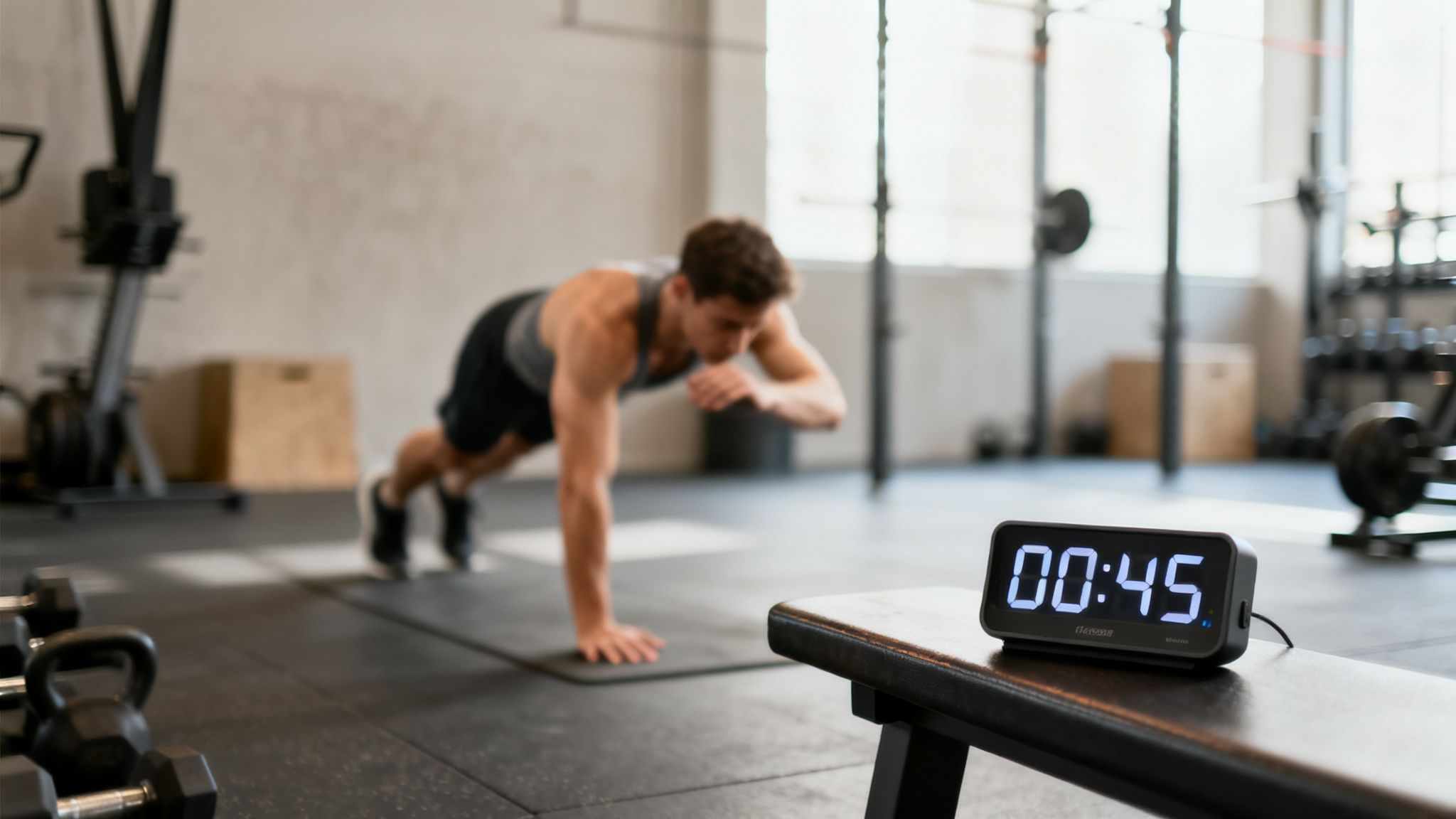
Popularized by the CrossFit community, EMOM is one of the most efficient calisthenics workout formats for busy individuals. It guarantees a high volume of work in a short, fixed period, making it perfect for anyone needing to maximize their training time. As your fitness improves, you complete the work faster, earning more rest and creating a natural form of progressive overload.
Why It Works So Well
The genius of the EMOM format lies in its ability to build both muscular endurance and aerobic capacity under controlled fatigue. Unlike traditional sets where rest is static, EMOM forces you to maintain intensity and form as your rest periods potentially shrink. This teaches your body to recover quickly and work efficiently, a crucial skill for both athletic performance and everyday functional fitness.
Key Insight: EMOM workouts gamify your training by making time management a core component. The challenge isn't just completing the reps; it's about earning your rest, which keeps you engaged and focused throughout the entire session.
How to Implement This Routine
To get the most out of an EMOM workout, strategic planning is essential. A poorly designed session can lead to premature burnout or insufficient stimulus. Here’s how to do it right:
- Start Conservatively: Choose a rep count you can complete in 30-40 seconds for the first few minutes. This ensures you have adequate rest and can maintain proper form as fatigue sets in.
- Select Complementary Movements: Pair exercises that work different muscle groups, like burpees and pull-ups, to avoid localized fatigue and keep your heart rate elevated.
- Use a Timer: A dedicated timer is non-negotiable. The Zing Coach app has a built-in interval timer perfect for EMOMs, alerting you at the start of each minute so you can focus on the movement.
- Track Your Recovery: Monitor how long it takes to complete your reps each minute. If your work time consistently increases and rest time disappears, it’s a sign to reduce the reps or scale the exercise.
This method is an excellent way to structure a time-efficient and effective calisthenics workout, delivering significant results in 15-20 minutes.
5. Isometric Hold Training (Static Strength Development)
Isometric Hold Training is a powerful method that builds immense strength and body control by holding challenging positions without movement. This technique involves creating tension in the muscles without changing their length, a process known as an isometric contraction. It’s an incredibly effective way to build raw strength, improve joint stability, and enhance mind-muscle connection with minimal equipment and reduced stress on your joints.
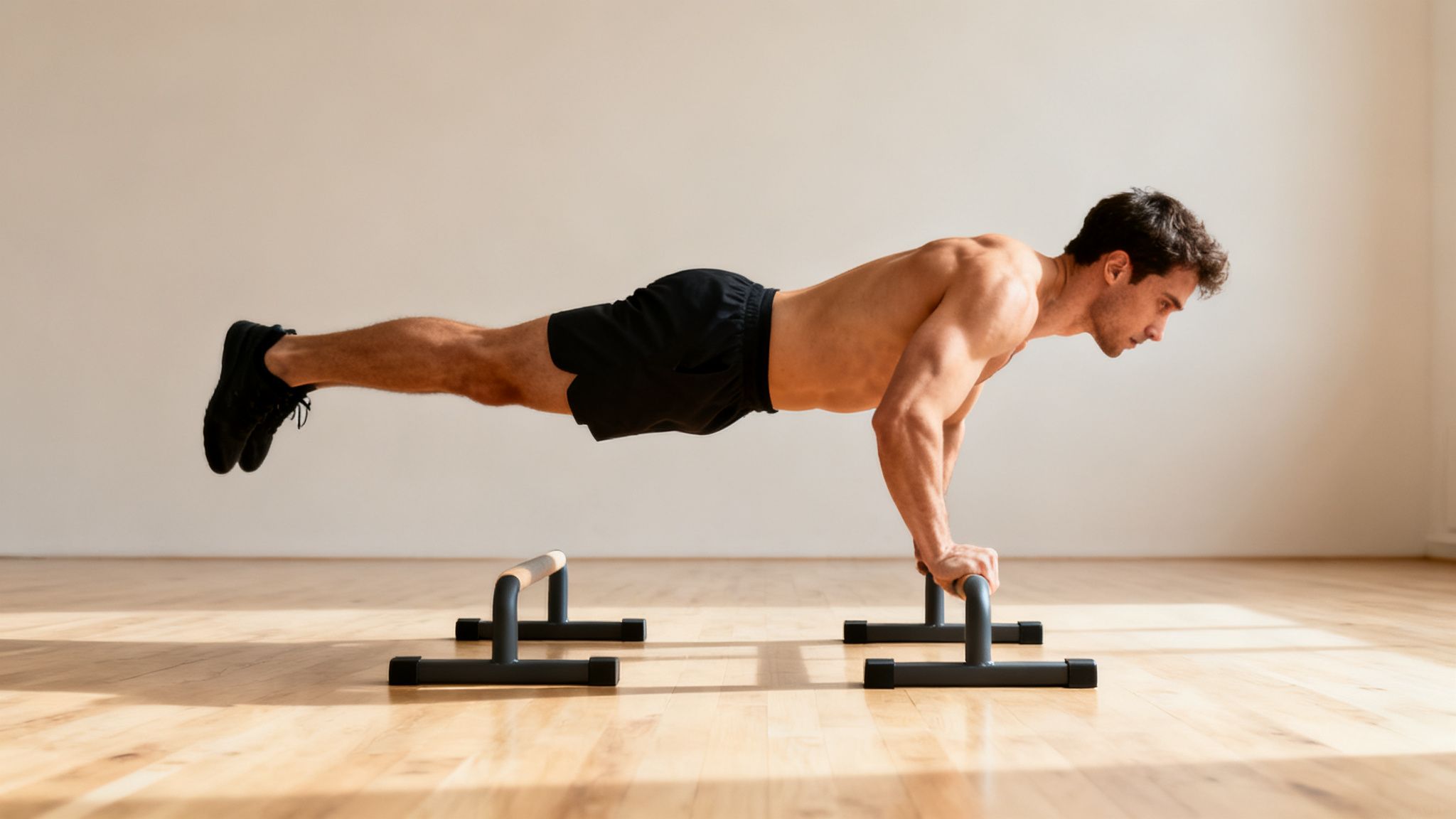
Popularized through gymnastics and physical therapy, isometric training is a key component of the best calisthenics workout programs. It allows you to target muscle fibers that might be missed during dynamic movements, making it perfect for breaking through strength plateaus or rehabilitating injuries safely. From basic wall sits to advanced planche leans, isometrics build a foundation of static strength essential for high-level skills.
Why It Works So Well
The magic of isometrics lies in sustained tension. By holding a position like a plank or a handstand, you force your muscles to work continuously, recruiting a high number of motor units to maintain stability. This sustained effort builds strength at specific joint angles and significantly enhances your endurance, body awareness, and control.
Key Insight: This method builds time under tension in its purest form. Rather than moving through a range of motion, you are mastering a single, challenging point, which directly translates to greater stability and power in dynamic exercises.
How to Implement This Routine
To integrate isometric training effectively, focus on proper form and gradual progression. Here are some actionable tips to get started:
- Start with Holds: Begin with holds lasting 20-45 seconds, focusing on maintaining perfect form. Your goal is quality, not just duration.
- Controlled Breathing: Maintain steady, controlled breathing throughout each hold. Holding your breath can spike blood pressure and reduce performance.
- Track Your Time: Use the Zing Coach app's timer to accurately track your hold durations. Aim to gradually increase the time each week to ensure progressive overload.
- Combine with Dynamic Moves: For a well-rounded routine, perform isometric holds at the beginning of your strength workout to activate muscles, or pair them with dynamic exercises for a balanced training stimulus.
This approach is fantastic for building foundational strength safely. To master one of the most fundamental isometric exercises, you can find a detailed guide on perfecting your plank form.
6. Hybrid Training (Bodyweight + Minimal Equipment Blending)
Hybrid training merges the raw functionality of calisthenics with the targeted benefits of minimal equipment, creating a versatile and highly effective workout philosophy. This approach enhances traditional bodyweight training by incorporating simple tools like resistance bands, parallettes, or light dumbbells. It’s the perfect solution for overcoming common calisthenics plateaus and addressing "blind spots" that pure bodyweight training can sometimes miss, such as horizontal pulling or hamstring isolation.
This blend maintains the accessibility of calisthenics while unlocking a wider range of exercises and progression pathways. It's particularly powerful for those training at home who may lack access to a full gym but want to ensure well-rounded muscular development. By adding simple tools, you can add resistance, assist difficult movements, and introduce new stimuli without a significant investment.
Why It Works So Well
Hybrid training excels by offering the best of both worlds. Calisthenics builds incredible relative strength and core stability, while minimal equipment allows for targeted muscle isolation and more linear progressive overload. For instance, while you work on your pull-up strength, you can use resistance bands to add volume with band-assisted pull-ups or target stabilizing muscles with band pull-aparts for better shoulder health.
Key Insight: This method provides infinite scalability. You can progress a bodyweight exercise by adding a weighted vest, or you can make a dumbbell exercise more functional by pairing it with an explosive calisthenics movement.
How to Implement This Routine
Integrating equipment into your calisthenics workout is simple and can be tailored to your specific goals. Here are some actionable tips:
- Start with Bands: High-quality resistance bands are the most versatile starting point. Use them for assisted pull-ups, added resistance on push-ups, or isolation work like bicep curls and hamstring curls.
- Invest in Parallettes: Parallettes increase the range of motion for push-ups, allow for L-sits and handstand practice, and are essential for developing straight-bar dip strength.
- Use Light Dumbbells Strategically: Light weights are perfect for accessory movements. Incorporate dumbbell rows to build back thickness that supports your pull-ups, or use them for overhead presses to strengthen shoulders for handstands.
- Balance Your Sessions: A great approach is to program 2-3 pure bodyweight sessions per week and 1-2 hybrid sessions that incorporate your equipment for targeted weak points. The Zing Coach app can help you track both bodyweight progressions and load increases in one place.
7. Periodized Progressive Overload (Structured Strength Cycles)
For those serious about long-term gains, Periodized Progressive Overload is not just a workout but a strategic framework. This advanced programming method organizes your training into planned phases or cycles, each with a specific focus. Instead of randomly increasing difficulty, you systematically target different physical adaptations like muscle growth (hypertrophy), raw strength, and explosive power, making it the best calisthenics workout for breaking through plateaus.
This approach, rooted in modern strength and conditioning science, prevents overtraining by varying intensity and volume over time. A typical plan might involve a 12-week cycle broken into smaller blocks: a hypertrophy phase with higher reps, a strength phase with more difficult variations for lower reps, and finally, a skill or deload phase. It’s a structured, confidence-building path perfect for anyone who wants a clear roadmap to achieving advanced skills.
Why It Works So Well
Periodization is effective because it forces targeted adaptation while allowing for recovery. By dedicating specific blocks to hypertrophy (e.g., 8-12 reps) or strength (e.g., 3-6 reps), you give your body a clear signal to adapt in a certain way. This structured variation keeps training from becoming stale and helps you manage fatigue, reducing the risk of burnout and injury.
Key Insight: The magic of periodization is its proactive approach. Instead of reacting to a plateau, you have a long-term plan designed to prevent it from ever happening by systematically changing the training stimulus.
How to Implement This Routine
Implementing a periodized plan requires foresight and tracking. Here are some actionable tips to get started:
- Plan Your Cycles: Design an 8-12 week training block. For example, Weeks 1-4 could focus on hypertrophy (3 sets of 8-12 reps per exercise), followed by Weeks 5-8 for strength (4 sets of 4-6 reps of a harder variation).
- Include Deloads: Schedule a deload week every 4-6 weeks where you reduce training volume by about 40-50%. This is crucial for recovery and allows your body to super-compensate, coming back stronger.
- Track Everything: Use an app like Zing Coach to log your exercise variations, sets, reps, and even how you feel. These metrics are essential for knowing when to adjust your plan and progress to the next phase.
- Stay Consistent: Adherence to the plan is key. Trust the process, even during higher-rep phases that may not feel as intense as heavy strength work. Each phase builds upon the last.
This scientific approach ensures continuous improvement. By understanding how to apply it, you can master the principles of progressive overload training and achieve consistent results.
8. Handstand Progression Training (Skill-Based Strength Development)
Handstand training is the quintessential example of skill-based strength development in calisthenics. Rather than focusing solely on reps and sets, this approach prioritizes mastering a complex movement through a structured progression. This is the best calisthenics workout for building exceptional shoulder stability, core strength, and proprioception (your sense of body position), which translates into greater control across all other exercises.
This training path breaks down the freestanding handstand into manageable steps, starting from wall-supported holds and gradually removing assistance. It transforms a seemingly impossible feat into an achievable goal through consistent, quality practice. This method, popularized by gymnastics communities and YouTube experts like Emkfit and FitnessFAQs, emphasizes that strength is a skill that must be practiced with intention.
Why It Works So Well
Handstand training builds a unique type of strength that combines stability, balance, and power. Holding your body weight upside down forces your shoulders, traps, and upper back to work isometrically, creating incredible joint integrity. Your core must remain braced to maintain a straight line, developing deep abdominal strength that protects your spine and improves posture.
Key Insight: The handstand is a full-body exercise disguised as an upper-body skill. Success requires a coordinated effort from your fingertips to your toes, building total body tension and control.
How to Implement This Routine
A dedicated, frequent practice is key to mastering the handstand. Instead of one long session, aim for several shorter ones each week.
- Practice Frequently: Dedicate 15-20 minutes, 4-5 times a week, to skill work. Consistency is more important than duration.
- Build a Strong Foundation: Master wall-supported holds before attempting to balance. Start with chest-to-wall holds to learn proper alignment, aiming for 3 sets of 30-60 seconds.
- Strengthen Your Wrists: Your wrists are your foundation. Incorporate specific wrist mobility and strengthening exercises into your warm-ups to prevent injury.
- Film Yourself: Use your phone to record your attempts. Visual feedback is invaluable for spotting and correcting alignment issues, like an arched back or bent arms. Apps like Zing Coach can help with form analysis to pinpoint balance problems.
9. HIIT (High-Intensity Interval Training) Calisthenics
High-Intensity Interval Training (HIIT) pairs explosive, all-out work periods with short, timed rest intervals. When combined with calisthenics, it becomes a powerful, time-efficient engine for cardiovascular conditioning and fat loss. This approach transforms standard bodyweight movements like burpees and jump squats into a potent metabolic challenge, making it one of the best calisthenics workout options for those short on time.
The core principle is to push your heart rate near its maximum for brief bursts, followed by minimal recovery. This cycle, repeated over a 10-20 minute session, elevates your metabolism significantly. The result is an "afterburn" effect, or Excess Post-exercise Oxygen Consumption (EPOC), where your body continues to burn calories at a higher rate for hours after the workout is over, making it ideal for busy professionals aiming for efficient results.
Why It Works So Well
HIIT calisthenics is brutally effective because it taxes both your aerobic and anaerobic energy systems simultaneously. The short, intense work periods build explosive power and muscle endurance, while the minimal rest trains your cardiovascular system to recover quickly. This dual benefit makes it a superior choice for improving overall fitness without needing any equipment.
Key Insight: The goal is maximum intensity, not duration. A 15-minute HIIT session can provide greater cardiorespiratory benefits than a 45-minute steady-state cardio workout if the effort level is truly pushed to its limit during the work intervals.
How to Implement This Routine
To get the most from HIIT without risking burnout or injury, a structured approach is essential. Here are some actionable tips:
- Stick to a Schedule: Due to its intensity, limit HIIT sessions to 2-3 times per week on non-consecutive days to allow for adequate recovery.
- Choose Appropriate Exercises: Select movements you can perform with good form even when fatigued, like mountain climbers, high knees, or burpees.
- Use a Timer: Structure is key. Follow a specific protocol, like Tabata (20 seconds work, 10 seconds rest for 8 rounds) or an EMOM (Every Minute On the Minute) format.
- Prioritize Form Over Speed: As you get tired, your form may suffer. It’s better to slow down and maintain proper technique than to risk injury by chasing reps.
This method is perfect for shredding fat and boosting endurance. For more ideas on effective movements, you can explore the best exercises for fat loss at home that fit perfectly into a HIIT structure.
10. Movement-Based Training (Full-Body Functional Patterns) + Calisthenics Strength Ladders
This hybrid approach merges the philosophy of training fundamental human movements with a simple yet powerful progression method known as strength ladders. Instead of focusing on muscles, this workout organizes exercises around six core patterns: horizontal push/pull, vertical push/pull, squat, hinge, carry, and locomotion. This ensures a balanced, functional development that translates directly to real-world strength and athletic ability.
The addition of calisthenics ladders provides a clear, structured way to achieve progressive overload within a single session. A ladder involves performing sets with ascending or descending reps, such as 1, 2, 3, 4, 5 reps of pull-ups, with a short rest between each "rung." This combination delivers one of the best calisthenics workout frameworks for building practical strength and preventing the muscular imbalances common in traditional isolation training.
Why It Works So Well
This method’s genius lies in its dual focus on movement quality and measurable progress. By training patterns, you guarantee that your body learns to work as an integrated system. Your push-ups (horizontal push), pull-ups (vertical pull), and pistol squats (squat) all contribute to a more capable and resilient physique.
Ladders make progression simple and motivating. Instead of grinding out the same sets and reps each week, you have a clear goal: add another rung to the ladder or complete another round. This systematic approach builds volume and strength without pushing you to muscular failure on every set, which aids in recovery and skill acquisition.
Key Insight: This method builds strength as a skill. By performing frequent, high-quality reps in a ladder format, you are teaching your nervous system to become more efficient at executing key movements like the pull-up or handstand push-up.
How to Implement This Routine
To effectively use this system, distribute the six movement patterns across your training week and apply ladder schemes to your primary strength exercises.
- Structure Your Week: Aim for 3-4 full-body sessions per week, ensuring each of the six movement patterns is trained at least once. For example, a session could pair pull-ups (vertical pull) with push-ups (horizontal push) and squats.
- Build Your Ladders: Start with a conservative ladder, such as 1-2-3 reps. Perform 1 rep, rest, 2 reps, rest, and then 3 reps. Rest for 90-120 seconds, and repeat for 2-3 rounds. Progress by adding a rung (1-2-3-4) or another round.
- Prioritize Movement Quality: Never sacrifice form to complete a rep. The goal of ladders is to accumulate high-quality volume, not to train to failure.
- Track All Patterns: Use an app like Zing Coach to log your performance across all six patterns. This helps identify weak links and ensures your training remains balanced.
This approach is highly adaptable for all fitness levels. To better understand how these patterns build real-world capability, explore this guide on what functional fitness training is and its benefits.
Top 10 Calisthenics Workouts Comparison
| Training Option | Implementation complexity | Resource requirements | Expected outcomes | Ideal use cases | Key advantages |
|---|---|---|---|---|---|
| Recommended Routine (Push/Pull/Legs Split) | Low–Moderate; structured 3-day plan | Minimal; pull-up bar optional | Balanced strength & muscle gains; steady progression | Beginners → intermediate; home routines | Simple, adaptable, efficient compound focus |
| Skill Work and Strength (Greasing the Groove) | Low; high discipline and scheduling | Minimal; specific apparatus as needed (bar, wall) | Neuromuscular adaptation; rapid skill mastery | Learning pull-ups, handstands, muscle-ups; busy schedules | Low fatigue, high frequency, sustainable skill gain |
| Ring Training (Progressive Strength Building) | Moderate–High; technical progressions | Requires rings and secure mounting space | Upper‑body & core strength; stabilizer development | Gymnastics/calisthenics athletes; advanced progressions | Highly scalable difficulty; superior stability challenge |
| EMOM (Every Minute on the Minute) Metabolic Conditioning | Low–Moderate; time‑paced programming | Minimal; timer or app | Improved conditioning, calorie burn, strength endurance | Time‑efficient conditioning for busy professionals | Self‑regulating intensity; very time efficient |
| Isometric Hold Training (Static Strength Development) | Low–Moderate; requires precise positioning | Minimal; often no equipment (parallettes optional) | Exceptional static strength; joint‑friendly gains | Rehabilitation, injury‑managed training, low‑impact goals | Low joint stress; rapid strength improvements |
| Hybrid Training (Bodyweight + Minimal Equipment) | Moderate; integrates equipment and progressions | Minimal equipment (bands, dumbbells, parallettes) | Broader muscle development; easier progression options | Home gyms lacking heavy kit; balanced development goals | Versatile stimulus; addresses calisthenics blind spots |
| Periodized Progressive Overload (Structured Strength Cycles) | High; requires planning and tracking | Varies; tracking tools recommended | Long‑term strength, hypertrophy, reduced plateaus | Goal‑oriented trainees and long‑term programs | Scientifically driven; prevents plateaus, optimizes progress |
| Handstand Progression Training (Skill‑Based) | High; long learning curve and practice volume | Minimal; wall/spotter recommended, wrist tools helpful | Shoulder stability, core strength, balance proficiency | Skill seekers and advanced calisthenics practitioners | High transfer to other skills; motivating visible progress |
| HIIT Calisthenics (High‑Intensity Interval Training) | Moderate; demanding pacing and intensity | Minimal; clear space and monitoring (HR/timer) | Maximal calorie burn, rapid conditioning, fat loss | Time‑crunched users targeting weight loss/cardio | Extremely time‑efficient; high metabolic afterburn |
| Movement‑Based Training + Calisthenics Ladders | Moderate; requires movement knowledge | Minimal; bodyweight movements (optional light kit) | Balanced functional strength; reduced imbalances | General fitness, functional training, all levels | Comprehensive movement coverage; simple measurable progress |
From Plan to Progress: Making Your Calisthenics Workout Work for You
We've explored a comprehensive array of the best calisthenics workout methodologies available, from the structured intensity of Push/Pull/Legs splits and Periodized Progressive Overload to the skill-focused dedication of Handstand Training and the metabolic challenge of HIIT. Each approach offers a unique pathway to building functional strength, enhancing body control, and achieving a lean, powerful physique using little more than your own body weight. The journey from selecting a plan to seeing tangible results, however, is paved with consistency, smart adaptation, and a commitment to progressive challenge.
The ultimate "best calisthenics workout" isn't a one-size-fits-all template; it's the one that aligns with your specific goals, fits seamlessly into your lifestyle, and evolves as you get stronger. It’s the routine you can stick with week after week, making incremental adjustments that fuel long-term growth.
Synthesizing Your Calisthenics Strategy
The true power of this guide lies not in picking just one workout, but in understanding the principles behind each. You can now see that building a well-rounded physique involves more than just endless push-ups. It requires a blend of strength, skill, and conditioning.
- For pure strength and muscle gain, foundational routines like the Push/Pull/Legs split or a Periodized plan provide the necessary structure and volume.
- To master advanced skills, integrating "Greasing the Groove" or dedicated Handstand Progression sessions is non-negotiable.
- For metabolic conditioning and fat loss, EMOMs and HIIT Calisthenics deliver unparalleled efficiency, torching calories while preserving muscle.
- To build foundational stability and overcome plateaus, Isometric Hold Training offers a potent, often-overlooked tool for developing static strength.
Think of these workout styles as tools in your fitness toolbox. A successful long-term plan often involves combining them. For instance, you might follow a primary strength routine three days a week and incorporate one HIIT session and two short "Greasing the Groove" skill practices on your other days. This hybrid approach ensures you are developing multiple physical qualities simultaneously, leading to more holistic and athletic development.
The Critical Role of Intelligent Progression and Tracking
The single most important factor separating a great calisthenics plan from a mediocre one is intelligent progression. Simply repeating the same workout will lead to stagnation. The goal is to consistently provide your body with a stimulus that forces it to adapt and grow stronger. This doesn't always mean adding more reps; it can also mean:
- Decreasing Rest Times: Making your workouts more dense and metabolically demanding.
- Improving Form: Performing each repetition with greater control and a fuller range of motion.
- Advancing the Variation: Moving from knee push-ups to standard push-ups, or from standard pull-ups to L-sit pull-ups.
- Increasing Time Under Tension: Slowing down the eccentric (lowering) phase of an exercise.
This is where meticulous tracking becomes invaluable. A training journal or an advanced fitness app is not just for logging sets and reps; it's your data hub for making informed decisions. By tracking your performance, you can objectively see when it's time to push harder and when it might be time for a deload week to allow for recovery and supercompensation.
Key Takeaway: Progress isn't accidental. It is the direct result of a planned, measured, and consistent application of stress, followed by adequate recovery. Without tracking, you are merely guessing.
Choosing your ideal calisthenics workout is the starting line. The real race is won through consistent effort, smart adjustments, and a dedication to the process. Embrace the journey of mastering your own body, celebrate the small victories, and let each new skill unlocked and each strength PR achieved be the fuel that drives you forward.
Tired of the guesswork? Let technology build the best calisthenics workout for you. The Zing Coach AI takes your goals, fitness level, and available equipment to generate a truly personalized training plan that adapts with every session, ensuring you progress safely and efficiently. Get your custom-built calisthenics plan from Zing Coach today and start turning your effort into measurable results.
Share this article


Authors