Discover how to bench press without a bench. This guide covers the floor press, advanced push-ups, and band exercises to build a powerful chest at home.
Think a powerful chest is only built on a gym bench? Think again.
The truth is, you can hammer your chest and build serious upper-body strength with nothing more than a bit of floor space. Effective, accessible movements like the floor press and advanced push-up variations build raw strength and muscle mass without needing a bench at all.
Why A Bench-Free Chest Workout Works
Let's challenge the old-school idea that a gym bench is non-negotiable for chest development. For many people, training without one isn’t just a backup plan; it’s a smarter, more functional way to build strength. While many lifters still swear by traditional weight bench workouts, this guide is all about effective alternatives that sidestep the bench entirely.
The reality is, elite-level bench press numbers are incredibly rare. Globally, a tiny 0.075% of the population can bench 225 pounds, and only about 3% of regular gym-goers ever hit that number. This really puts things into perspective and shows why accessible, equipment-free versions are exploding in popularity—especially when so many people don't have daily gym access.
This isn't about compromise. It's about strategic training that offers its own unique advantages.
The Core Benefits Of No-Bench Pressing
By taking the bench out of the equation, you unlock several key benefits that can actually speed up your progress and improve your overall fitness.
- Better Shoulder Health: Exercises like the floor press naturally limit your range of motion. This stops the shoulder joint from moving into a vulnerable, over-extended position, making it an incredibly safe option, especially if you have cranky shoulders.
- Serious Core Engagement: Without a bench to stabilize you, your core muscles have to work overtime to keep your torso rigid during movements like push-ups and single-arm presses. This translates directly to a stronger, more stable midsection.
- Unbeatable Convenience: This is the most obvious perk. Your living room, a hotel room, or the local park instantly becomes your gym. This flexibility removes one of the biggest barriers to consistency, letting you build a powerful chest anywhere, anytime.
The goal isn't just to find a substitute for the bench press; it's to embrace a method that builds real-world, functional strength safely and effectively. Your body doesn't know if you're on a fancy bench or the floor—it only knows resistance and tension.
Bench-Free Pressing Options at a Glance
To make sense of the options available, it helps to see them laid out. Each exercise offers a unique stimulus for building strength and muscle without a bench.
| Exercise | Primary Benefit | Ideal For |
|---|---|---|
| Floor Press | Shoulder safety & heavy lifting | Building raw strength, lifters with shoulder issues |
| Push-Up Progressions | Functional strength & muscle endurance | All fitness levels, building a strong core |
| Single-Arm Variations | Core stability & correcting imbalances | Intermediate to advanced lifters, athletic training |
| Band & Improvised Setups | Constant tension & versatility | Home workouts, adding variety and resistance |
This table gives you a quick snapshot, but the real magic happens when you understand how to apply each movement to your specific goals. Let's dig into the technique for each one.
Master the Floor Press for Raw Pressing Power
When you need to build serious pressing power without a bench, the floor press is your undisputed champion. This isn't just a workaround; it's a staple exercise for elite powerlifters who use it to develop explosive strength and keep their shoulders healthy. It’s hands down the best way to get a heavy bench press without a bench.
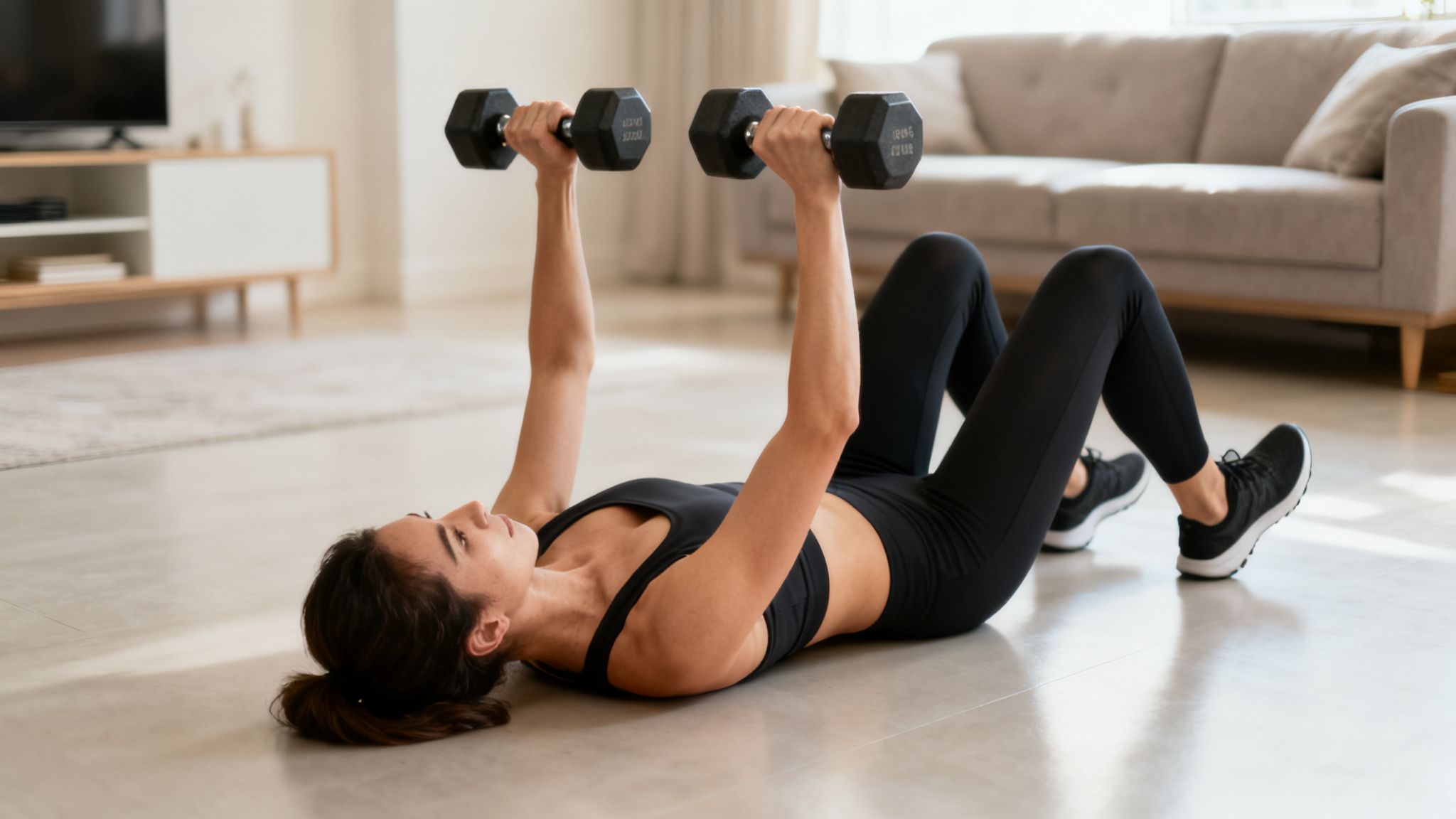
The ground acts as a natural safety net, physically stopping your elbows from dropping into a vulnerable position. This limited range of motion is precisely what makes the floor press so effective and safe, particularly if you've got sensitive shoulders. It forces you to generate raw power without any help from momentum.
Perfecting Your Floor Press Technique
Whether you're using a barbell or a pair of dumbbells, the core principles of the floor press are all about creating a stable and powerful base to press from.
Get started by lying on your back with your knees bent and feet flat on the floor, about hip-width apart. This setup is key because it lets you generate leg drive—an often-overlooked secret to a stronger press. Before you even think about moving the weight, the goal is to create tension from head to toe.
Your setup checklist should look like this:
- A solid base: Squeeze your glutes and dig your feet into the floor. As you press the weight up, imagine trying to push your heels straight through the ground.
- Shoulder blade position: Actively retract your shoulder blades by pulling them together and down, like you’re trying to tuck them into your back pockets. This creates a solid platform for your upper back and protects your shoulder joints.
- Correct elbow angle: The most common mistake is flaring the elbows out to a 90-degree angle. Instead, tuck them in so they form a 45-degree angle with your torso. This simple adjustment engages your lats and puts the focus squarely on your chest and triceps, not your shoulder ligaments. You can see a perfect example of this in our guide to the dumbbell floor press.
The floor press isn't just an upper-body move; it’s a full-body lift. Driving through your heels and bracing your core connects your lower body to the movement, allowing you to handle significantly more weight safely.
Why It's a Smarter Choice for Many
The traditional bench press is a fantastic exercise, but it isn't the right fit for everyone. Biomechanical studies have actually shown that floor press variations can cut down on shoulder strain by 20-30% compared to a standard bench press, making it a brilliant alternative for a huge range of people.
This movement is also a beast for building lockout strength. Because you're pressing from a dead stop with your triceps resting on the floor, you have to generate massive force just to get the weight moving. That ability translates directly to a much stronger and more powerful top-end on all your pressing exercises.
Use Push-Up Progressions to Build Strength
Don't make the mistake of dismissing the push-up as just a warm-up exercise. When you use them right, push-ups are an incredibly powerful and adaptable tool for building serious chest strength and muscle. They are easily one of the best ways to get that bench press stimulus without a bench.
The secret is all in the progression. This system allows anyone, no matter their starting point, to build strength by constantly challenging their muscles just enough to grow. It’s a core principle called progressive overload, and it’s all about meeting yourself where you are and building from there.
Starting with Incline Push-Ups
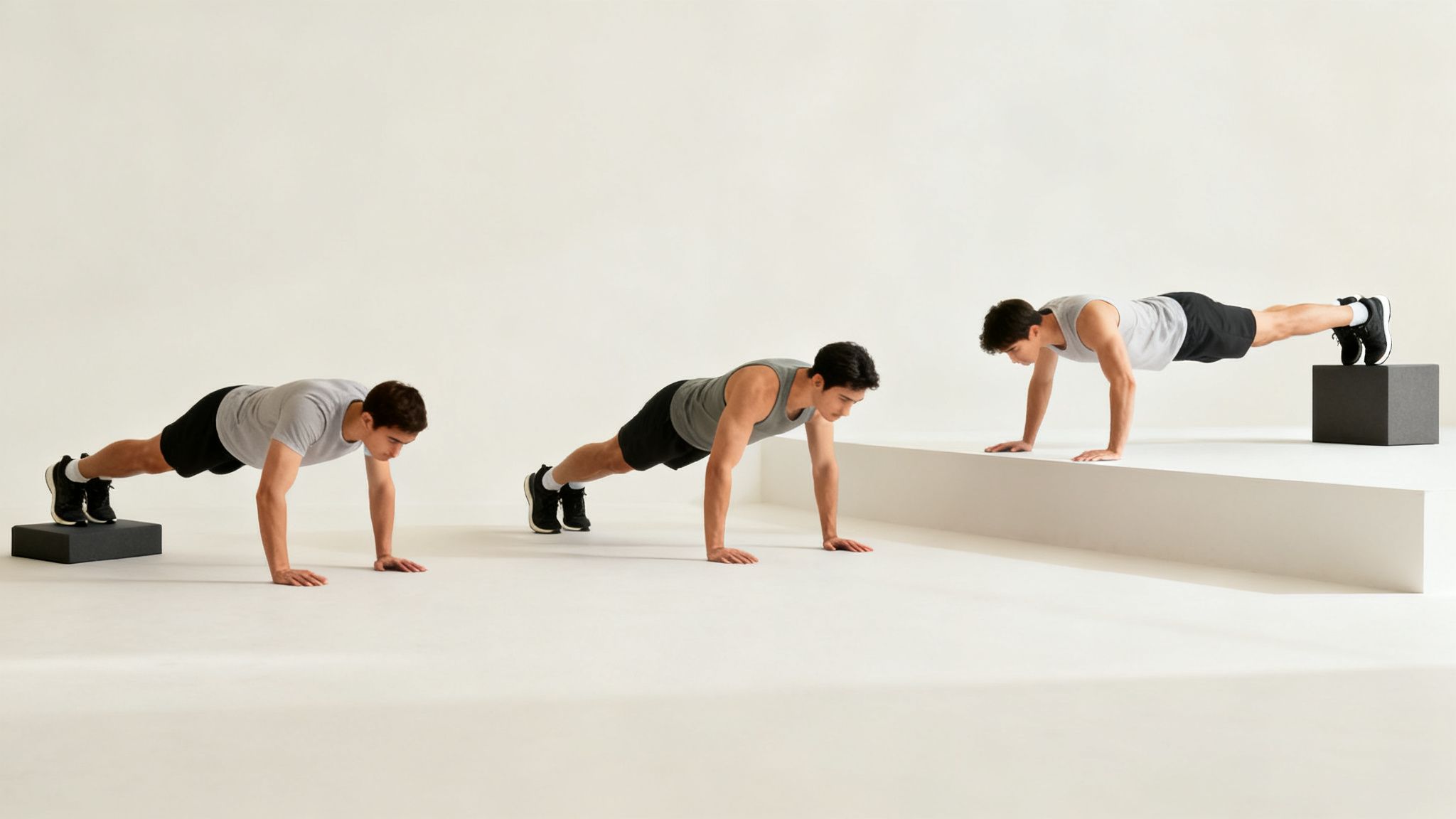
If you can't quite nail a full push-up from the floor yet, the incline variation is your perfect entry point. Just place your hands on an elevated surface—a sturdy table, the kitchen counter, even the arm of a sofa works. This simple tweak reduces the amount of body weight you have to lift.
The higher the surface, the easier it gets. This lets you build that foundational strength in your chest, shoulders, and triceps while focusing on perfect form. Concentrate on keeping a dead-straight line from your head to your heels; no sagging hips or arched back.
Mastering the Standard Push-Up
Once you can comfortably knock out a few sets of incline push-ups, it's time to take it to the floor. The standard push-up is the gold standard for upper-body strength for a reason. It fires up your pecs, deltoids, triceps, and core all at once.
Here's how to execute it perfectly:
- Place your hands just slightly wider than your shoulders.
- Keep your body rigid like a plank by squeezing your glutes and abs.
- Lower your chest toward the floor, keeping your elbows tucked in at a 45-degree angle. Don't let them flare out to the sides.
- Press back up powerfully to the start.
Getting this movement down is a huge milestone. For a full mechanical breakdown, check out our comprehensive guide on how to perform push-ups correctly.
Don't just drop to the floor. Control the entire movement, especially the lowering (eccentric) phase. A slow, controlled descent lasting two to three seconds builds significantly more muscle and strength than rushing through your reps.
Advancing to More Demanding Variations
When you can confidently perform 15-20 standard push-ups with flawless technique, you're ready to up the ante. It’s time to increase the challenge and start targeting different parts of your chest and arms.
- Decline Push-Ups: Elevate your feet on a step or a box. This shifts the focus to your upper chest and the front of your shoulders, which is a fantastic way to build that "upper shelf" look. The higher your feet go, the tougher it gets.
- Diamond Push-Ups: Bring your hands close together, forming a diamond shape with your thumbs and index fingers. This variation absolutely torches your triceps. It's brutal, but it's one of the most effective ways to build powerful arms and strengthen your lockout.
Each of these progressions introduces a new stimulus. This ensures your body never gets too comfortable, and your progress never stalls out. They offer a clear, equipment-free path to building a powerful and well-developed chest.
Get Creative with Bands and Household Items
Real-world strength training isn't always about having the perfect setup; it’s about being resourceful. When you don't have a bench and heavy weights, you can still put together a killer chest workout by thinking outside the box. This is where resistance bands and even some common household items become your new best friends.
The star of the show here is the resistance band chest press. By looping a long band around your upper back, you can mimic the strength curve of a cable machine. This creates constant tension throughout the entire movement, which is something free weights can't do. As you press forward, the band stretches and the resistance ramps up, forcing your chest to work hardest right at the peak of the contraction.
How to Use Bands for Pressing
You’ve got a couple of great options for using bands, and each one offers a slightly different feel.
- Banded Floor Press: Set up just like you would for a dumbbell floor press, but this time, wrap a resistance band across your shoulder blades and hold the ends in your hands. This adds what’s called accommodating resistance to a classic movement. For a deep dive into the technique, check out our guide on the band floor press.
- Standing Banded Press: Find something solid to anchor the band to behind you—a door anchor or a sturdy pole works great. Step forward until you feel tension, then punch forward into a standing chest press. You'll immediately notice how much this variation lights up your core to keep you from falling forward.
When you're looking to get creative, knowing the best options for your resistance band exercises can completely change the game.
Improvised Weights for a Serious Challenge
Don't stop at bands. Your home is probably full of stuff you can lift. You'd be surprised at the kind of chest strength you can build by getting clever with everyday items.
A backpack or a tough duffel bag can easily be loaded with books, water bottles, or sandbags to create a surprisingly heavy—and unstable—weight. This is perfect for single-arm floor presses, sometimes called a suitcase press. Lying on your back, you press the loaded bag up with one arm. Your core and stabilizer muscles have to fire like crazy to stop your body from twisting. It's a fantastic challenge.
Here's another pro-level tip: try doing your presses on a stability ball instead of the floor. Performing any press on an unstable surface like a ball forces your core and all those smaller stabilizer muscles to work overtime. You're building functional strength that carries over into just about everything else you do.
This all just goes to show that a great workout to replace the bench press without a bench is only limited by your imagination, not by what's in your gym bag.
Design Your Bench-Free Chest Workouts
Knowing the right exercises is only half the battle. The real magic happens when you arrange them into a smart plan that drives results. Structuring your workouts based on your specific goals—whether that’s building raw strength, packing on muscle, or boosting endurance—is how you turn effort into actual progress when you bench press without a bench.
A workout designed to build brute strength, for instance, is going to look completely different from one focused on muscle growth. It’s all about tweaking the variables like sets, reps, and rest periods to give your body the right signal to adapt and grow.
Programming for Your Primary Goal
Let's get practical. How you build your workout depends entirely on what you want to achieve. Your main goal dictates everything, from the exercise you lead with to how long you catch your breath between sets.
- For Raw Strength: The name of the game is lifting heavy for low reps. Your go-to movement should be a challenging floor press variation. A great starting point is 4 sets of 5-8 reps. Give yourself a full 2-3 minutes of rest between sets so you're recovered enough to give maximum effort each time.
- For Muscle Growth (Hypertrophy): Building size is all about volume and keeping the muscles under tension. This is where higher-rep push-up progressions shine. Aim for 3 sets of 10-15 reps, but keep the rest periods shorter—around 60-90 seconds—to create that metabolic stress that triggers growth.
- For Muscular Endurance: Here, we're training your muscles to keep firing for extended periods. Resistance bands are fantastic for this. You could do 2-3 sets of continuous reps to failure, with very little rest (30-45 seconds) to really push your limits.
And what if you're limited on equipment? No problem. This little decision tree shows how simple it can be to pick your tools.
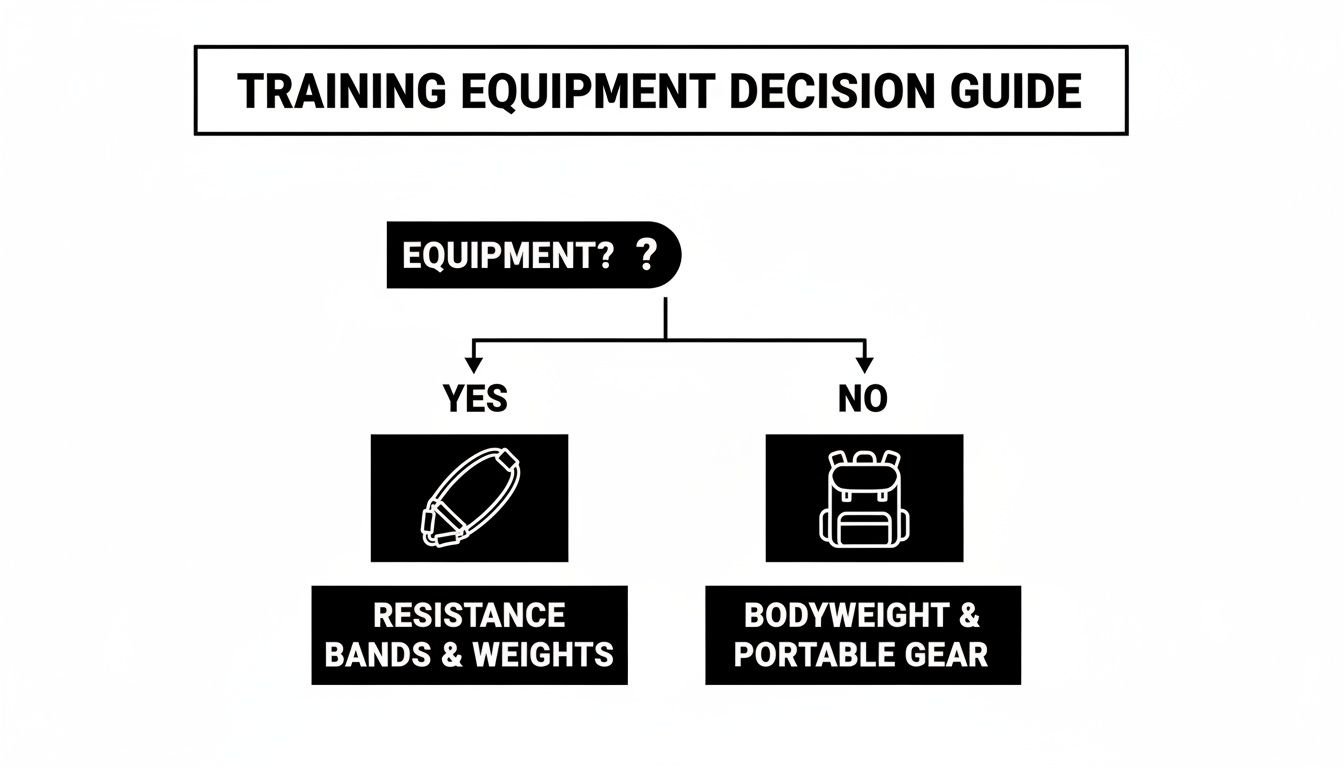
As you can see, you can get a killer workout whether you've got a full set of bands or just your own body weight and a loaded backpack.
To make this crystal clear, here’s a quick-glance table showing how to structure your workouts based on your goal.
Sample Workout Plans by Goal
| Goal | Primary Exercise | Sets x Reps | Rest Period |
|---|---|---|---|
| Strength | Heavy Floor Press (Dumbbell/Barbell) | 4 x 5-8 | 2-3 minutes |
| Muscle Size | Weighted or Decline Push-Ups | 3 x 10-15 | 60-90 seconds |
| Endurance | Resistance Band Chest Press | 2-3 x To Failure | 30-45 seconds |
Just match your approach to your ambition. Pick a lane and stay consistent.
The Key to Long-Term Progress
If there's one non-negotiable principle in any training program, it's progressive overload. All this means is that you have to consistently make your workouts more challenging over time. Without it, your body adapts, gets comfortable, and your progress grinds to a halt.
And no, you don't always have to just add more weight. You can apply progressive overload in a bunch of different ways:
- Add Reps: If you hit 8 reps last week, go for 9 or 10 this week with the same weight.
- Add Sets: Once you nail all your target reps for every set, add one more set to the exercise.
- Increase Difficulty: Mastered the standard push-up? It's time to elevate your feet for a decline push-up.
- Decrease Rest Time: Shave 15 seconds off your rest periods. This increases the density of your workout and forces your muscles to work harder.
Your body is an adaptation machine. It will only grow stronger if you give it a reason to. Consistently and gradually increasing the demand is the only way to ensure you never plateau.
This simple concept is the engine that drives all successful training. If you're looking for more ways to slot these movements into a routine, check out our guide on the best bench press alternative workouts.
Sample Weekly Workout Splits
To get the best results, you need to fit your chest day into a balanced weekly schedule. This prevents overtraining and helps you build a well-rounded physique. Here are a couple of popular and effective ways to organize your week.
Upper/Lower Split (4 Days/Week):
- Monday: Upper Body (Floor Press, Rows, Overhead Press)
- Tuesday: Lower Body (Squats, Lunges, Calf Raises)
- Wednesday: Rest
- Thursday: Upper Body (Weighted Push-Ups, Pull-Ups, Bicep Curls)
- Friday: Lower Body (Deadlifts, Leg Press, Hamstring Curls)
Push/Pull/Legs Split (3 Days/Week):
- Monday: Push (Push-Ups, Dips, Shoulder Press)
- Wednesday: Pull (Pull-Ups, Rows, Face Pulls)
- Friday: Legs (Squats, Deadlifts, Leg Curls)
The "best" split is the one you can actually stick with. Pick a plan that fits your life and allows for enough recovery. Consistency is what separates those who get results from those who don't.
Avoid These Common Training Mistakes
Proper form isn’t just a suggestion when you’re doing these bench press alternatives—it’s non-negotiable. It's the critical difference between getting incredible results and sidelining yourself with a preventable injury. When you nail the technique, you can be sure every ounce of effort is going straight into building strength and muscle, not just straining your joints.

Let's walk through some of the most frequent errors that can sabotage your progress. Once you understand not just what to do, but why you're doing it, you become your own best coach.
Flaring Your Elbows Too Wide
This is easily the biggest and most dangerous mistake I see, especially during floor presses. When your elbows flare out to a 90-degree angle from your body (making a "T" shape), you’re putting a ton of stress on your delicate rotator cuff and shoulder capsule.
The fix is to consciously tuck your elbows, aiming for a 45-degree angle. As you lower the weight, think about pointing your elbows more toward your feet. This simple tweak immediately shifts the load from your shoulder joints onto your chest and triceps, which is exactly where you want it. It's not just safer—it's stronger.
Key Takeaway: Think of your body forming an arrow shape, not a "T". Your elbows should track at a 45-degree angle to your torso to maximize chest activation and minimize shoulder strain.
Letting Your Hips Sag
During any push-up variation, your body needs to be a straight, rigid line from your head down to your heels. The second your hips drop toward the floor, your core has checked out. This makes the exercise way less effective for your chest and puts a lot of unnecessary stress on your lower back.
The correction here is simple but powerful: squeeze your glutes and brace your abs like you’re about to take a punch. This instantly locks your pelvis into a stable, neutral position. You’ll feel the difference immediately, turning the push-up into the full-body strength builder it’s meant to be. Of course, a good workout always starts with a good warm-up; you can find excellent guidance on how to warm up before strength training to get your body ready.
Rushing Through Your Reps
So much of the magic happens during the lowering (or eccentric) part of the lift. This is where you build a massive amount of muscle and strength. If you just drop down and bounce back up, you’re leaving more than half the benefits on the table.
Slow it down. For every single rep—floor press or push-up—aim for a deliberate 2-3 second count on the way down. Feel the tension. Then, explode powerfully back to the start. This intentional control keeps your muscles working for longer, and that leads to much better results over time.
Got Questions? I've Got Answers.
When you first hear about bench pressing without a bench, it's natural to have a few questions. I get it. It sounds a little unconventional, but trust me, these methods are built on solid, time-tested training principles. Let's clear up some of the most common questions I hear so you can get started with confidence.
The big secret? Your muscles respond to tension and progressive overload, not a specific piece of fancy equipment.
Can I Really Build a Big Chest Without a Bench Press?
Absolutely, and I’ve seen it happen time and time again. Muscle growth boils down to three key triggers: mechanical tension, muscle damage, and metabolic stress. The good news is that floor presses, weighted push-ups, and band work deliver on all three.
Your chest muscles can't tell if you're lying on a plush leather bench or your living room floor. All they know is the challenge you're putting them through.
The trick is to consistently apply progressive overload. That just means you have to keep making things a little bit harder over time—whether that’s adding a few more reps, grabbing a heavier dumbbell, or switching to a tougher exercise. Many elite powerlifters even use the floor press as a core accessory lift to build raw pressing power, which tells you everything you need to know about its effectiveness for both strength and size.
Your body is an incredible adaptation machine. By consistently challenging your muscles in new ways, you give them the stimulus they need to grow bigger and stronger, no bench required.
Is the Floor Press Safe for My Shoulders?
For a lot of lifters, the floor press is actually safer for the shoulders than the traditional bench press. Think of the ground as your built-in safety spotter. It physically stops your elbows from dropping too low.
This natural stopping point prevents your shoulder joint from moving into an extreme, and often vulnerable, range of motion under a heavy load. This can drastically cut down the risk of common nagging issues like shoulder impingement. It makes the floor press a fantastic choice if you have sensitive shoulders or just want to build serious strength with less joint stress.
How Do I Know When to Try a Harder Push-Up?
Great question. You don't want to jump to a harder variation too soon and sacrifice your form. A solid rule of thumb is to move on once you can comfortably knock out 3-4 sets of 15-20 reps of your current push-up variation with perfect technique.
When you hit that milestone, your body is basically telling you, "Okay, I've mastered this. What's next?"
That next step could be:
- Moving from standard push-ups to decline push-ups to hit the upper chest.
- Adding a weight vest or a resistance band over your back to increase the load.
- Trying a more technical version like diamond push-ups to blast your triceps.
Share this article


Authors