Tired of the bench? Discover the top 10 bench press alternative exercises to build chest strength safely. Perfect for home workouts and injury prevention.

The barbell bench press is often seen as the undisputed king of chest exercises, a benchmark for upper body strength in gyms worldwide. But what if it's not the right fit for your body, your goals, or your available equipment? Whether you're dealing with a nagging shoulder injury, working out from home with limited gear, or simply looking to break through a strength plateau, incorporating a bench press alternative is a game-changer.
Sticking to a single movement pattern, especially a demanding one like the barbell press, can lead to overuse injuries and muscular imbalances. The fixed position of the barbell can place significant stress on the shoulder joints, which may not be suitable for everyone. By diversifying your pressing exercises, you not only protect your joints but also stimulate new muscle growth by hitting your chest, shoulders, and triceps from different angles and with varied resistance profiles. This variation is key for developing well-rounded, functional strength and a more resilient physique.
This guide moves beyond the traditional bench to provide a comprehensive toolkit for building a powerful upper body. We will break down 10 of the most effective alternatives, including dumbbell, machine, bodyweight, and band exercises. For each movement, you'll find detailed step-by-step instructions, specific programming recommendations (sets and reps), and expert tips for maximizing results while minimizing risk. This is your definitive resource for building a stronger, more balanced chest, with or without a barbell.
1. Dumbbell Floor Press
The Dumbbell Floor Press is a powerful and accessible bench press alternative that shifts the focus to raw pressing strength while minimizing shoulder strain. By performing the movement on the floor, you naturally shorten the range of motion. The ground stops your elbows from dipping too low, creating a safer bottom position that protects the delicate shoulder joint.
This variation is particularly beneficial for lifters with pre-existing shoulder pain, limited mobility, or those returning from an injury. The floor provides constant stability for your back and shoulders, allowing you to focus purely on driving the weight up with your chest, triceps, and deltoids. It's also an excellent choice for building lockout strength, which can translate to a stronger conventional bench press.
How to Perform the Dumbbell Floor Press
- Setup: Lie on your back with your knees bent and feet flat on the floor to stabilize your lower body. Hold a dumbbell in each hand, resting them on your thighs.
- Get into Position: Carefully kick the dumbbells up one at a time to the starting position, with your arms extended over your chest and palms facing each other (neutral grip) or forward (pronated grip).
- The Descent: Slowly lower the dumbbells, keeping your elbows tucked at a 45-degree angle to your torso. Continue until the backs of your upper arms (triceps) make full contact with the floor.
- The Press: Pause for a moment on the floor, then forcefully press the dumbbells back up to the starting position by contracting your chest and triceps. Do not bounce your elbows off the ground.
Key Insight: The floor contact acts as a built-in safety mechanism, making this a fantastic option for training heavy at home without a spotter. If you fail a rep, you can safely lower the dumbbells to your sides.
Programming Recommendations
- For Strength: 3-4 sets of 5-8 reps.
- For Hypertrophy: 3-4 sets of 8-12 reps.
- Tempo: Focus on a controlled descent (2-3 seconds), a brief pause on the floor, and an explosive press up.
This movement is a foundational pressing exercise with a strong safety profile. To see how it compares to the standard bench variation, you can explore the dumbbell bench press in more detail.
2. Push-Ups (Elevated, Standard, and Decline Variations)
The Push-Up is the ultimate bodyweight bench press alternative, building impressive pressing strength, shoulder stability, and core endurance with zero equipment. By manipulating leverage through different body angles, the push-up can be scaled for any fitness level, from complete beginners to advanced athletes. It’s not just a chest exercise; it’s a full-body movement that teaches tension and control.
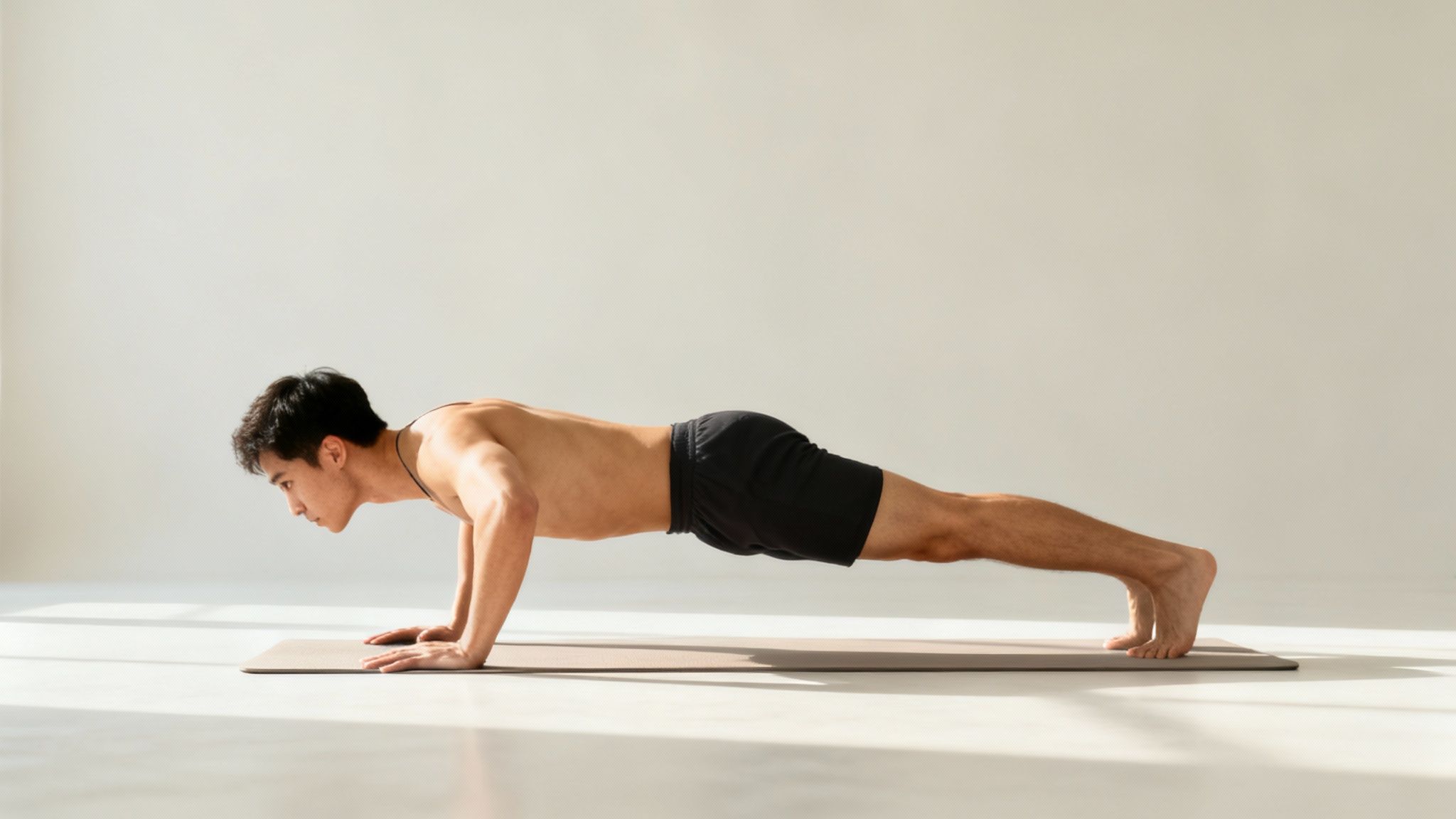
This exercise is incredibly versatile, making it ideal for home workouts, travel, or as an accessory movement in the gym. The three primary variations allow for seamless progression. Elevated push-ups (hands on a bench or wall) reduce the load, making them accessible to beginners. Standard push-ups provide a solid baseline challenge, while decline push-ups (feet elevated) increase the resistance and emphasize the upper chest and shoulders.
How to Perform a Standard Push-Up
- Setup: Start in a high plank position with your hands placed slightly wider than your shoulders, directly beneath them. Your body should form a straight line from your head to your heels.
- Engage Your Core: Brace your abdominals and glutes to prevent your hips from sagging. Keep your neck in a neutral position by looking at the floor just ahead of your hands.
- The Descent: Lower your body by bending your elbows, keeping them tucked at about a 45-degree angle to your torso. Continue down until your chest is just a few inches from the floor.
- The Press: Powerfully press through your palms to push your body back up to the starting plank position, fully extending your arms without locking the elbows.
Key Insight: Think of the push-up as a moving plank. Maintaining a rigid, straight line from head to heels is crucial for engaging the core and protecting your lower back, turning it into a true full-body exercise.
Programming Recommendations
- For Strength: 3-4 sets of 6-10 reps (choose a variation that is challenging in this range).
- For Hypertrophy/Endurance: 3-4 sets of as many reps as possible (AMRAP), stopping 1-2 reps shy of failure.
- Tempo: Control the descent (2 seconds), briefly pause at the bottom, and press up explosively.
The push-up is a cornerstone of bodyweight training. To dive deeper into this and other powerful movements, explore the world of calisthenics training.
3. Cable Machine Chest Press
The Cable Machine Chest Press is a versatile and joint-friendly bench press alternative that offers the unique benefit of constant tension throughout the entire movement. Unlike free weights where resistance can fluctuate, the cable pulley system ensures your chest muscles are engaged from the initial stretch to the final squeeze. This continuous resistance makes it an exceptional tool for muscle hypertrophy and metabolic stress.
This variation is ideal for lifters of all levels, from beginners learning the pressing motion to advanced athletes seeking a high-volume finisher. The guided path of motion provides stability, reducing the risk of form breakdown and allowing you to focus purely on muscle contraction. Because the cables are independent, you can easily adjust the angle of the press (incline, flat, or decline) simply by changing the pulley height and your body position, offering more customization than a fixed barbell.
How to Perform the Cable Machine Chest Press
- Setup: Adjust the pulleys on a cable crossover station to chest height. Grab a handle in each hand with a firm, overhand grip. Take a step forward into a staggered stance to create a stable base.
- Get into Position: Lean slightly forward from your hips, keeping your spine straight and chest up. Your arms should be extended back with a slight bend in your elbows, feeling a stretch across your chest.
- The Press: Powerfully press the handles forward and together, squeezing your chest muscles as they meet in front of your body. Focus on driving your biceps towards each other to maximize pectoral activation.
- The Return: Slowly and controllably reverse the motion, allowing the handles to return to the starting position. Maintain tension throughout the entire negative portion of the rep, feeling the stretch in your chest again.
Key Insight: The constant tension from the cables is unparalleled for creating a powerful mind-muscle connection. It forces you to control both the concentric (pressing) and eccentric (returning) phases, which is a major catalyst for muscle growth.
Programming Recommendations
- For Strength: 3-4 sets of 6-10 reps (true 1-rep max strength is better built with free weights).
- For Hypertrophy: 3-5 sets of 10-15 reps.
- Tempo: Focus on an explosive press, a 1-second squeeze at peak contraction, and a slow, 3-second negative.
This exercise is a staple for building a well-defined chest safely and effectively. For a similar movement with added back support, you can learn more about the seated chest press machine.
4. Machine Chest Press
The Machine Chest Press is a highly stable and accessible bench press alternative that guides the movement along a fixed path. By using a machine, you remove the need for stabilizer muscles to control the weight, which allows you to isolate the chest muscles (pectorals) with maximum safety and control. The guided trajectory reduces the complexity of the lift, making it one of the most beginner-friendly pressing variations available.
This exercise is an outstanding choice for individuals new to strength training, those recovering from an injury, or anyone looking to build a foundational level of strength before moving to free weights. The machine's design provides constant back support and a predictable range of motion, significantly lowering the risk of improper form. It allows you to focus entirely on contracting the target muscles and learning the feel of a proper chest press.
How to Perform the Machine Chest Press
- Setup: Adjust the seat height so that the handles are aligned with the middle of your chest when you are seated. Select an appropriate weight on the stack.
- Get into Position: Sit upright with your back pressed firmly against the backrest and your feet flat on the floor. Grasp the handles with a full grip, keeping your wrists straight and in line with your forearms.
- The Press: Exhale and press the handles forward until your arms are fully extended but not locked out. Squeeze your chest muscles at the peak of the movement. Keep your shoulders down and back, avoiding any shrugging.
- The Return: Inhale and slowly reverse the motion, bringing the handles back toward your chest in a controlled manner. Do not let the weight stack slam down; maintain tension throughout the entire repetition.
Key Insight: The fixed path of motion makes this exercise perfect for safely training to muscular failure. Since you don't have to worry about balancing the weight, you can push your final reps without the risk associated with dropping a barbell or dumbbells.
Programming Recommendations
- For Strength: 3-4 sets of 8-12 reps.
- For Hypertrophy: 3-4 sets of 10-15 reps, focusing on the mind-muscle connection.
- Tempo: Focus on a controlled return (2-3 seconds) and a powerful but smooth press (1-2 seconds).
This machine is a fantastic tool for building confidence and muscle mass with minimal risk. For a detailed look at how machine exercises fit into a well-rounded routine, you can learn more about the benefits of machine training.
5. Resistance Band Chest Press
The Resistance Band Chest Press is a uniquely portable and joint-friendly bench press alternative that leverages accommodating resistance. Unlike free weights, where the load is constant, a band’s resistance increases as you press and stretch it. This mirrors your body's natural strength curve, challenging your muscles most when they are in their strongest position (near lockout) and easing off at the weakest point (at the start of the press).
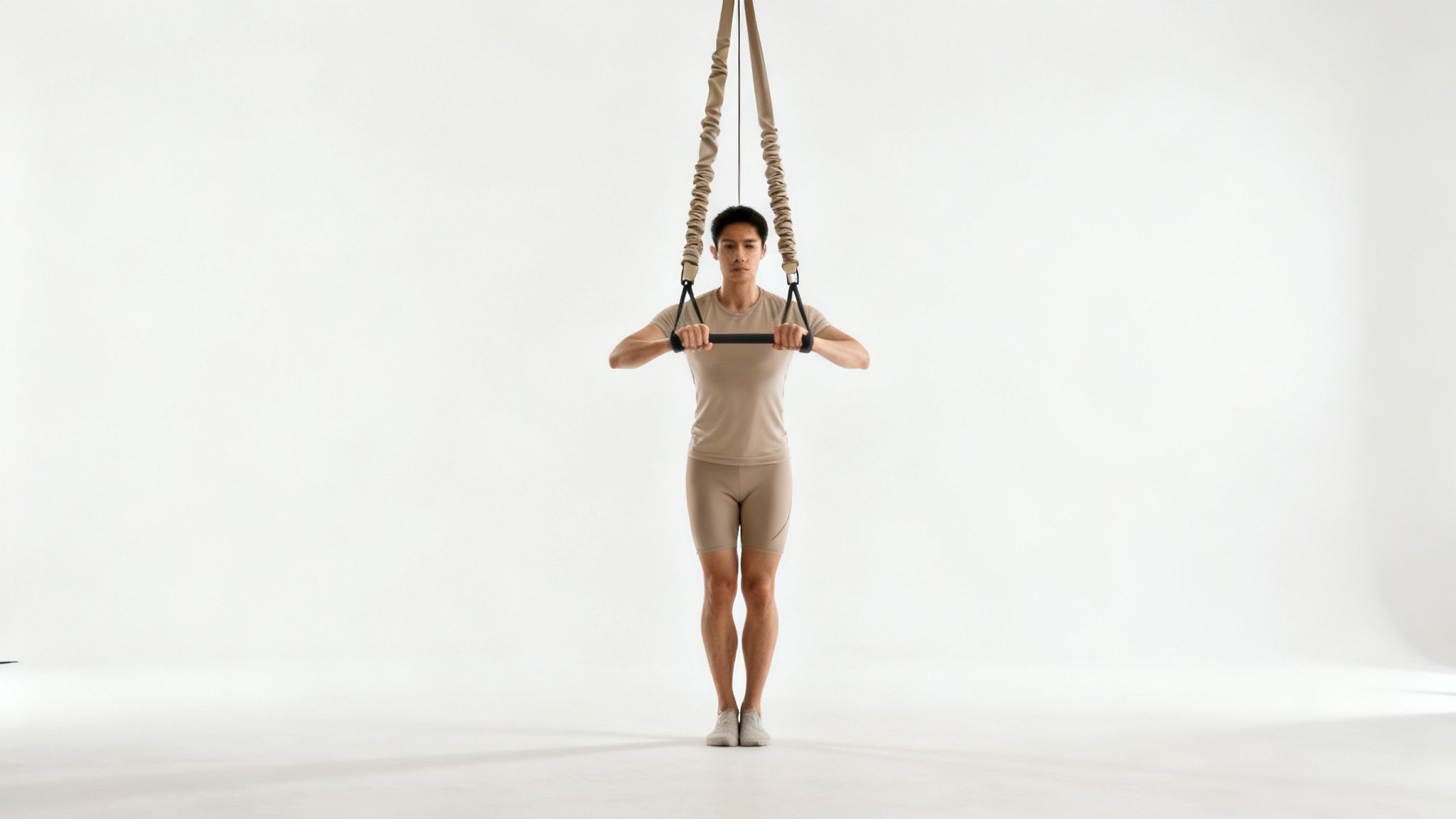
This dynamic tension keeps your chest, shoulders, and triceps engaged throughout the entire movement, promoting muscle growth and stability. Because the setup requires nothing more than a band, it's an exceptional choice for home workouts, travel, or as an accessory movement to complement heavier lifting days. It provides a constant, muscle-building stimulus without the significant joint stress associated with heavy barbells.
How to Perform the Resistance Band Chest Press
- Setup: Stand with your feet shoulder-width apart. Loop a resistance band behind your back, holding one end in each hand. The band should sit flat across your upper back, just below your shoulder blades.
- Get into Position: Bring your hands up to chest height with your palms facing down or each other, creating tension in the band. Engage your core and maintain a slight bend in your knees for stability.
- The Press: Forcefully press your hands forward and together, extending your arms fully until your hands meet in front of your chest. Squeeze your pecs at the peak of the contraction.
- The Return: Slowly and with control, return your hands to the starting position. Fight the band’s pull to maximize the eccentric (negative) portion of the rep, which is crucial for muscle growth.
Key Insight: The accommodating resistance forces you to accelerate through the entire press and control the return, building both explosive power and muscular endurance. This makes it a great tool for improving pressing speed and lockout strength.
Programming Recommendations
- For Hypertrophy: 3-4 sets of 15-25 reps.
- For Muscular Endurance: 2-3 sets of 25+ reps.
- Tempo: Focus on an explosive press (1 second), a brief pause and squeeze, and a slow, controlled return (3-4 seconds).
This exercise is incredibly versatile and can be modified easily. For a different angle and added stability, you can explore the band floor press variation.
6. Smith Machine Bench Press
The Smith Machine Bench Press is a fixed-path bench press alternative that offers maximum stability and safety. By guiding the barbell along vertical rails, the machine removes the need to balance the weight, allowing you to focus entirely on pushing heavy loads with your chest, shoulders, and triceps. This makes it an excellent tool for building confidence and overloading the muscles without a spotter.
This variation is particularly useful for lifters who want to isolate the pectoral muscles or work around stability issues. The fixed bar path ensures a consistent movement pattern on every rep, which can help in developing a strong mind-muscle connection. The machine’s adjustable safety catches also provide a built-in fail-safe, allowing you to train to failure with a reduced risk of injury, making it a reliable choice for solo training sessions.
How to Perform the Smith Machine Bench Press
- Setup: Position a flat bench in the center of the Smith machine. Set the safety catches just below your chest height when lying down. Lie on the bench so the bar is directly above your mid-chest.
- Get into Position: Grip the bar with your hands slightly wider than shoulder-width apart. Un-rack the bar by lifting it and rotating your wrists. Keep your feet firmly planted on the floor, your glutes on the bench, and maintain a slight, natural arch in your lower back.
- The Descent: Slowly lower the bar toward your sternum, keeping your elbows tucked at a 45-degree angle to your torso, not flared out to 90 degrees.
- The Press: Once the bar lightly touches your chest (or is just above it), forcefully press it back up to the starting position, extending your arms fully without locking out your elbows.
Key Insight: The fixed path of the Smith machine allows you to safely experiment with heavier weights than you might be comfortable with using free weights. This controlled overload is a powerful stimulus for muscle growth and strength development.
Programming Recommendations
- For Strength: 3-4 sets of 6-10 reps.
- For Hypertrophy: 3-4 sets of 8-12 reps.
- Tempo: Emphasize a controlled 2-second descent, a brief pause, and an explosive press to maximize muscle activation.
While the Smith machine provides excellent stability, it’s beneficial to complement it with free-weight exercises to develop stabilizer muscles for a more well-rounded physique. For another machine-based option, you can learn more about the Chest Press Machine.
7. Landmine Press
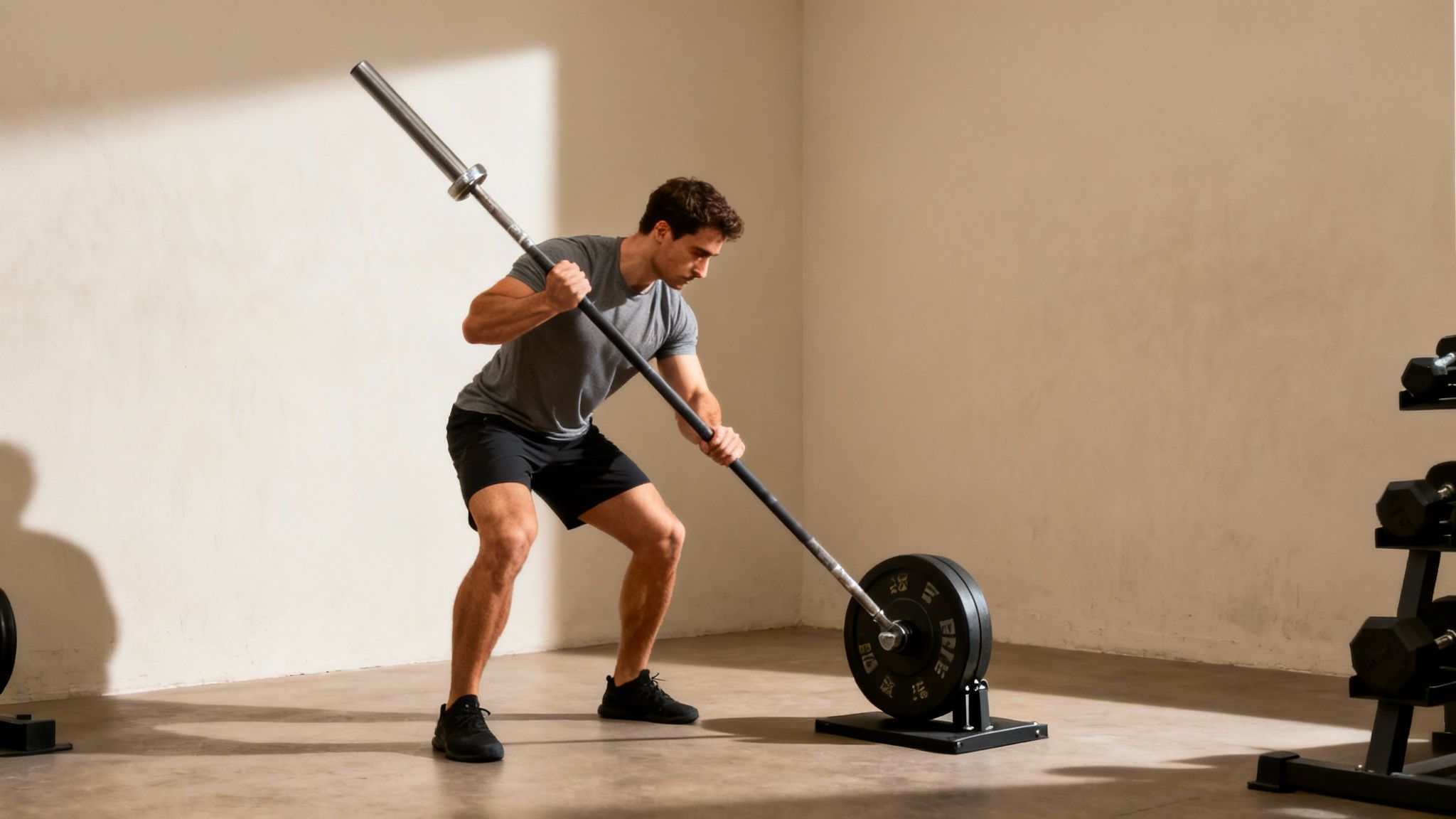
The Landmine Press is a unique and highly effective bench press alternative that uses a barbell anchored at one end to create an upward, arcing press. This movement pattern is incredibly joint-friendly, as it allows your shoulder blade to move freely and naturally, significantly reducing the strain often associated with flat or incline pressing. It effectively targets the upper chest, deltoids, and triceps from a functional angle.
This variation is ideal for anyone with shoulder impingement issues or those looking to build powerful, real-world pushing strength. The arc of the press mimics athletic movements like throwing a punch or pushing an opponent, making it a functional and powerful addition to any routine. Because you can perform it standing or kneeling, it also heavily engages your core to maintain stability.
How to Perform the Landmine Press
- Setup: Secure one end of a barbell into a landmine attachment or wedge it safely into a corner of the room. Load the other end with the desired weight.
- Get into Position: Stand facing the weighted end of the barbell. You can use a staggered stance for stability or a half-kneeling position. Pick up the end of the barbell with one hand and hold it at shoulder height.
- The Press: Brace your core and glutes. Press the barbell upward and forward, extending your arm fully. Follow the natural arc of the movement, allowing your shoulder blade to protract at the top.
- The Descent: Slowly and with control, lower the barbell back to the starting position at your shoulder. Complete all reps on one side before switching to the other.
Key Insight: The upward angle of the press is a game-changer for shoulder health. It promotes scapular upward rotation, a key movement for preventing impingement, making it a safer way to train the upper chest and deltoids.
Programming Recommendations
- For Strength: 3-4 sets of 6-10 reps per arm.
- For Hypertrophy: 3-4 sets of 8-15 reps per arm.
- Tempo: Focus on an explosive press up and a controlled 2-second descent to maximize muscle engagement.
The landmine is a versatile tool for building a powerful and resilient upper body. To discover more ways to use it, you can explore other landmine exercises.
8. Isometric Wall Press / Plank Variations
The Isometric Wall Press is a unique bench press alternative that builds static strength and stability by generating force without any movement. By pressing against an immovable object like a wall, you force your chest, shoulders, and triceps to maintain maximum tension. This type of training is exceptionally low-impact and can be performed virtually anywhere.
This variation is highly beneficial for injury rehabilitation, building foundational stability, and improving mind-muscle connection. Because there is no eccentric (lowering) or concentric (lifting) phase, it places minimal stress on joints while still activating the target muscles intensely. It's an ideal choice for lifters working around shoulder pain or anyone needing a no-equipment pressing option to build a solid base of strength.
How to Perform the Isometric Wall Press
- Setup: Stand facing a sturdy wall, about arm's length away. Place your feet shoulder-width apart for a stable base.
- Get into Position: Place your hands on the wall slightly wider than shoulder-width, at chest height. Lean your body forward to a 45-degree angle, keeping your body in a straight line from head to heels.
- The Press: Actively drive your hands into the wall as if you are trying to push it over. Engage your chest, shoulders, and triceps, creating and holding as much tension as possible.
- The Hold: Maintain this peak contraction for a predetermined time (e.g., 30 seconds). Breathe steadily throughout the hold; do not hold your breath.
Key Insight: To maximize muscle activation, perform holds at different joint angles. You can set up with your elbows bent at 90 degrees, 60 degrees, and near full extension to build strength throughout the entire range of motion of a press.
Programming Recommendations
- For Strength Endurance: 3-4 sets of 30-60 second holds.
- For Peak Contraction: 4-5 sets of 10-15 second holds with maximum effort.
- Progression: Increase difficulty by using a resistance band anchored behind you or by performing the press from a high plank position on the floor for greater core engagement.
9. Medicine Ball Chest Pass / Plyometric Press
The Medicine Ball Chest Pass is a dynamic and explosive bench press alternative that focuses on developing power and rate of force development rather than pure maximal strength. This movement translates raw strength into athletic speed by forcing you to accelerate a weight through a full range of motion and release it. It's a fundamental exercise for athletes in sports like football, basketball, and martial arts.
Unlike traditional pressing, which involves controlling a weight on both the eccentric (lowering) and concentric (lifting) phases, this plyometric variation is all about concentric power. By throwing the ball, you train your nervous system to recruit muscle fibers quickly and forcefully. This builds functional power that is crucial for any activity requiring a rapid push, from throwing a punch to shoving an opponent.
How to Perform the Medicine Ball Chest Pass
- Setup: Stand facing a sturdy wall, about 3-5 feet away, or face a partner. Hold a medicine ball with both hands at chest level, keeping your elbows tucked in.
- Get into Position: Assume an athletic stance with your feet shoulder-width apart and a slight bend in your knees. Engage your core to create a stable base.
- The Throw: Explosively extend your arms and throw the ball directly forward at the wall or to your partner. The power should originate from your hips and core, transferring through your torso and into your arms.
- The Catch: As the ball rebounds from the wall or is returned by your partner, catch it with soft hands and absorb the impact by bringing the ball back to your chest, immediately preparing for the next repetition.
Key Insight: This exercise is less about the weight of the ball and more about the speed of the throw. Choose a lighter ball (4-10 lbs) that allows for maximal velocity without compromising form.
Programming Recommendations
- For Power: 3-5 sets of 5-8 explosive reps.
- For Conditioning: Perform for time (e.g., 30 seconds on, 30 seconds off) as part of a circuit.
- Rest: Allow for full recovery between power sets (60-90 seconds) to ensure each rep is performed with maximum intent.
This movement is a fantastic tool for bridging the gap between strength and speed. To learn more about building a complete and balanced upper body workout, you can discover the best chest exercises for muscle growth.
10. Suspension Trainer (TRX) Chest Press
The Suspension Trainer Chest Press is a uniquely challenging bench press alternative that leverages your body weight and gravity for resistance. By using adjustable straps like a TRX, you create an unstable environment that forces your core and smaller stabilizer muscles in your shoulders and chest to work overtime to control the movement. This makes it a highly functional exercise that builds raw strength and enhances joint stability.
This variation is exceptionally scalable and portable, making it perfect for home workouts or when traveling. The difficulty is easily adjusted by changing your body angle relative to the anchor point; the more horizontal you are, the greater the challenge. This constant tension and need for stabilization provide a different stimulus than fixed-weight exercises, promoting well-rounded muscle development and coordination.
How to Perform the Suspension Trainer (TRX) Chest Press
- Setup: Adjust the suspension trainer straps to about mid-chest height. Grab the handles and step back until there is tension in the straps, facing away from the anchor point.
- Get into Position: Extend your arms straight out in front of your chest and lean forward into a strong plank position. Your body should form a straight line from your head to your heels. The farther you walk your feet back, the more challenging the exercise will be.
- The Descent: Keeping your core tight and body rigid, slowly lower your chest toward your hands by bending your elbows. Aim to keep your elbows at a 45-degree angle to your body, similar to a push-up.
- The Press: Once your hands are roughly in line with your chest, forcefully press back to the starting position, squeezing your pecs. Maintain the rigid plank position throughout and avoid letting your hips sag.
Key Insight: Unlike free weights, the instability of the straps requires constant muscle engagement from your entire body. This turns the chest press into a full-body exercise that significantly strengthens your core.
Programming Recommendations
- For Strength: 3-4 sets of 6-10 reps (adjust angle to make this range challenging).
- For Hypertrophy: 3-4 sets of 10-15 reps.
- Tempo: Focus on a slow, controlled descent (3 seconds) and a powerful, explosive press.
Here is a video demonstration to ensure proper form:
Top 10 Bench Press Alternatives Comparison
| Exercise | Implementation complexity | Resource requirements | Expected outcomes | Ideal use cases | Key advantages |
|---|---|---|---|---|---|
| Dumbbell Floor Press | Low — simple pattern, easy to learn | Dumbbells, mat | Foundational pressing strength; reduced ROM; shoulder-friendly | Home workouts, shoulder rehab, beginners | Protects shoulders; unilateral option; minimal setup |
| Push-Ups (Elevated/Standard/Decline) | Low → Moderate (progressions) | None to minimal (bench/mat) | Upper-body strength, core stability, endurance; scalable | Travel/home, progressive calisthenics, beginners→intermediate | Zero equipment; high core engagement; easy progression |
| Cable Machine Chest Press | Low — machine-assisted | Cable station, handles | Hypertrophy with constant tension; precise loading | Gym-based rehab, controlled hypertrophy, data-driven programs | Smooth, adjustable resistance; micro-loading; safe |
| Machine Chest Press | Very low — guided movement | Chest press machine | Introductory chest strength; low stabilization demand | Absolute beginners, post-injury rehab, quick gym sessions | Very safe; minimal learning curve; easy tracking |
| Resistance Band Chest Press | Low — simple setup | Bands and anchor (optional) | Activation, endurance, accommodating resistance | Travel/home training, warm-ups, mobility work | Extremely portable; inexpensive; matches strength curve |
| Smith Machine Bench Press | Low — guided bar path | Smith machine | Heavy strength development with safety stops; reduced stabilizers | Solo heavy training, structured strength progression in gym | Allows heavy loads safely; easy progression; solo-friendly |
| Landmine Press | Moderate — positioning and angle learning | Barbell + landmine or corner anchor | Functional diagonal pressing, unilateral strength, core rotation | Injury-prevention, asymmetry correction, functional training | Natural pressing angle; core demand; heavy loading option |
| Isometric Wall Press / Plank Variations | Very low — static holds | None to minimal (wall, band) | Joint stability, strength at specific angles, rehab | Short home sessions, prehabilitation, beginners | Extremely safe; accessible anywhere; builds stability |
| Medicine Ball Chest Pass / Plyometric Press | Moderate → High — explosive technique | Medicine ball, wall or partner, space | Power, rate-of-force development, conditioning | Athletes, metabolic conditioning, advanced users | Develops explosive power; engaging; cardio and power benefits |
| Suspension Trainer (TRX) Chest Press | Moderate — body-angle scaling | Suspension trainer and anchor | High stabilizer and core strength; functional pressing | Travel/home functional training, stability work, unilateral progress | Portable; adjustable difficulty; strong core engagement |
Building Your Perfect Pressing Plan
The journey to a powerful, well-developed chest doesn't begin and end with the traditional barbell bench press. As we've explored, the world of horizontal pressing is rich with effective, safe, and highly adaptable movements. From the raw stability of the Dumbbell Floor Press to the functional tension of the Suspension Trainer Chest Press, each exercise offers a unique set of benefits. The goal is not to find a single replacement for the bench press, but to build a versatile and intelligent pressing strategy tailored to your individual needs.
Choosing the right bench press alternative is a process of self-assessment. It requires you to consider your primary training objective, your current environment, and your body's specific feedback. Are you chasing maximal strength? The Smith Machine or a heavy Machine Chest Press can provide the stability needed to push your limits safely. Are you focused on athletic performance and core engagement? The Landmine Press and plyometric Medicine Ball Chest Pass are your go-to tools for developing explosive, functional power.
Synthesizing Your Options: From Theory to Action
The true power of this list lies not in any single exercise, but in how you combine them. A well-rounded chest program rarely relies on one movement alone. Instead, it strategically blends different stimuli to promote comprehensive muscle growth, strength, and joint health. Think of these exercises as ingredients in a recipe for success.
Here’s how you can start building your personalized plan:
- For the Home Gym Enthusiast: Your toolkit is likely built around portability and efficiency. A fantastic combination would be starting with Push-Up variations as your primary strength builder, focusing on progressive overload by changing the angle or adding a weight vest. Supplement this with the Resistance Band Chest Press for metabolic stress and to work on mind-muscle connection.
- For the Commercial Gym Goer: You have a wealth of options. You could structure a routine that starts with the Cable Machine Chest Press to warm up the shoulder joints and establish a strong contraction. Follow this with the Machine Chest Press as your primary heavy compound lift, and finish with the Landmine Press to target the upper chest and work on unilateral stability.
- For Those Managing Shoulder Sensitivity: Your priority is pain-free progress. The Dumbbell Floor Press is an excellent starting point, as its limited range of motion protects the shoulder capsule. The Isometric Wall Press can also be a powerful tool for activating the pectoral muscles without any joint movement, helping re-establish the neural connection to the chest.
Key Takeaways for Long-Term Pressing Success
Regardless of which bench press alternative you choose, a few core principles remain constant. Progressive overload is non-negotiable; you must consistently challenge your muscles by adding weight, reps, or sets, or by improving your form. Master the eccentric (lowering) phase of each lift, as this is where significant muscle damage and growth occur.
Most importantly, listen to your body. The reason many seek out these alternatives is due to the discomfort or injury risk associated with the barbell bench press. Don't fall into the same trap by forcing an exercise that doesn't feel right. The variety presented here ensures you always have another option that can help you move closer to your goals without compromising your health.
Ultimately, mastering these alternatives empowers you. It frees you from the notion that one specific lift holds the key to your success. It gives you the autonomy to build strength in any environment, adapt to your body’s needs, and construct a chest training plan that is not only effective but also sustainable and enjoyable for years to come.
Ready to take the guesswork out of building your perfect pressing plan? The Zing Coach AI can design a personalized workout program using the bench press alternatives that are best for your goals, available equipment, and fitness level. Get started on a smarter, safer path to a stronger chest by downloading the app from Zing Coach today.
Share this article


Authors