Find the best fitness tracker for weight loss with our in-depth comparison. We analyze top models to help you use data and achieve your fitness goals.

A fitness tracker is so much more than a glorified pedometer; think of it as your secret weapon on a weight loss journey. It takes all the hard work you're putting in—your daily activity, sleep, and workouts—and turns it into data you can actually use. This makes the best fitness tracker for weight loss an invaluable partner, giving you the real-time feedback you need to build healthier habits and finally nail that consistent calorie deficit.
How Fitness Trackers Drive Real Weight Loss Results
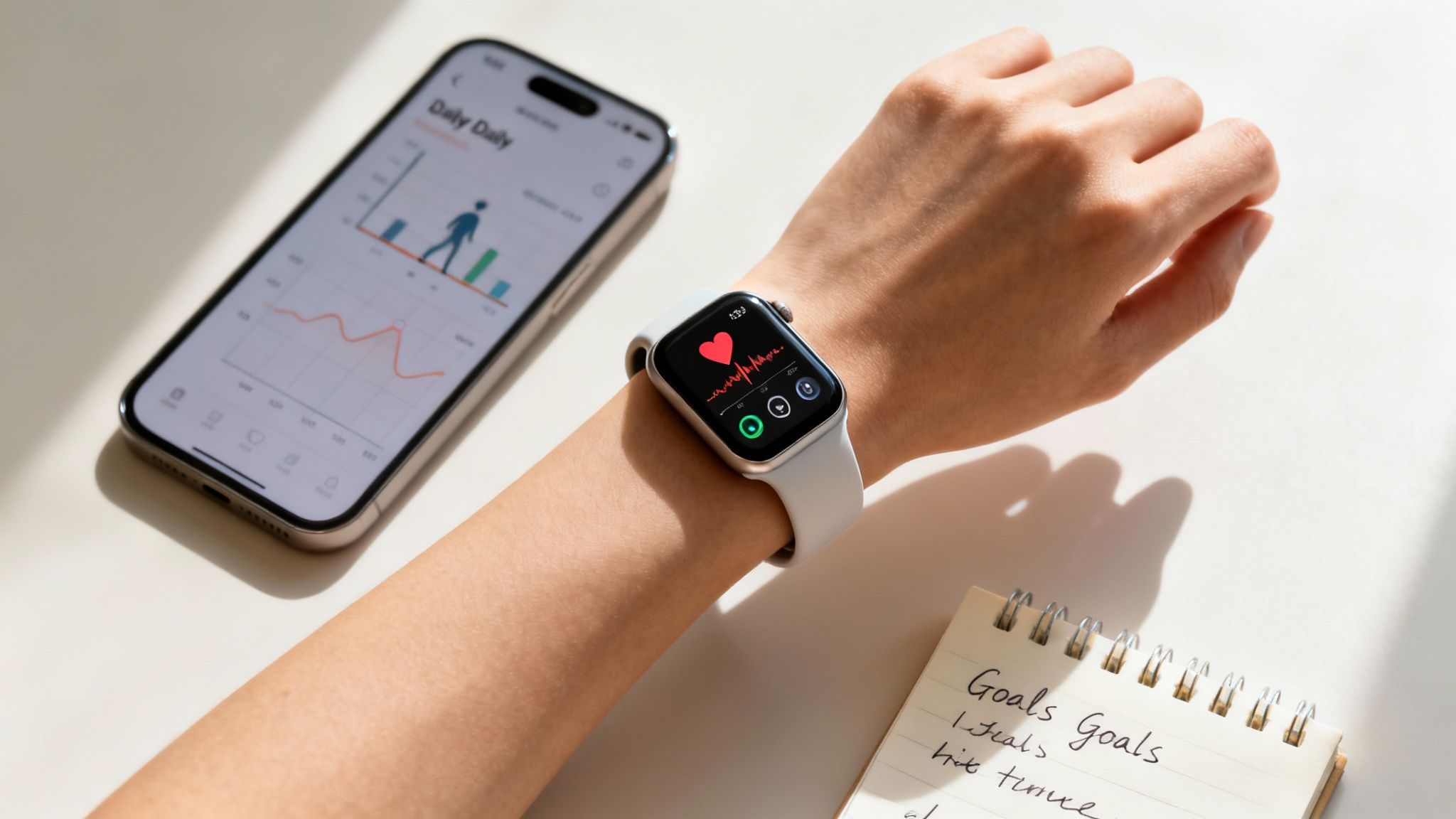
At its heart, weight loss comes down to one core principle: burning more calories than you eat. This is what's known as creating a calorie deficit. A fitness tracker is hands-down the best tool for measuring the "calories out" side of that equation, transforming vague effort into hard numbers.
This constant stream of information makes you acutely aware of your daily habits. Seeing how a brisk walk adds to your calorie burn or how a rough night’s sleep tanks your energy can be exactly the nudge you need to make better choices. But tracking alone isn't enough. A deeper understanding weight loss principles is key, because just hitting the gym won't guarantee progress.
Fostering Motivation and Accountability
Today's fitness trackers are master motivators. Features like closing activity rings, hitting step goals, and earning achievement badges turn your fitness journey into a game. This isn't just a gimmick; it’s a smart way to tap into basic behavioral science to build habits that actually stick.
There’s a reason the global fitness tracker market is exploding—it's projected to jump from USD 60.94 billion in 2024 to USD 323.47 billion by 2034. These devices just work. Studies have shown that people who consistently track their activity tend to lose 5-10% more body weight than those who don’t, simply because the data helps them make smarter decisions.
By making your progress visible, a fitness tracker provides undeniable proof that your efforts are paying off. This validation is a powerful tool for staying committed, especially on days when motivation is low.
Ultimately, these devices arm you with personalized data. When you connect that information with a system like Zing Coach, it becomes even more powerful. Zing’s AI uses your tracker’s data to build and adjust a personalized fitness plan, making sure your workouts are always perfectly synced with your real-time activity levels. This helps you hit your goals faster, and you can get started with our beginner's guide to losing weight for the foundational basics.
Decoding the Data: What a Fitness Tracker Actually Tells You
To pick the right fitness tracker for weight loss, you first need to understand which numbers actually move the needle. Think of a tracker as more than a step counter; it’s a data-gathering machine. Your success hinges on knowing how to read that data to make smarter, healthier choices every day.
Let's break down the essential metrics that turn raw numbers into real-world insights, so you can see which features are truly non-negotiable for your goals.
Heart Rate Monitoring: The Core of Calorie Burn
At the heart of any good weight loss tracker is its heart rate monitor. This little sensor is the key to one of the most important calculations you need: your total daily energy expenditure (TDEE). Without solid heart rate data, any "calories burned" number is just a sophisticated guess based on movement alone.
A quality optical heart rate sensor keeps a running tab on your beats per minute—whether you're asleep, walking to work, or pushing through a tough workout. This is what allows the device to tell the difference between a casual stroll and a sprint for the bus, adjusting your calorie burn estimates to reflect your actual effort.
For example, tracking your heart rate zones during a workout—like the "fat burn" or "cardio" zones—helps you see if your effort is lining up with your goals. It’s a simple way to optimize your intensity for maximum results.
Calorie Tracking: More Than Just a Number
Your tracker estimates two main types of calorie burn: your Basal Metabolic Rate (BMR) and your active calories. BMR is the energy your body burns just to stay alive, while active calories are the ones you torch through any kind of movement.
Add them together, and you get a clear picture of your total energy output. This number becomes your North Star for creating a sustainable calorie deficit—the absolute foundation of any effective weight loss plan. A good tracker makes this entire process transparent and easy to manage.
The real trick is to treat these calorie estimates as a trend line, not an exact science. Your goal is to understand your personal energy patterns over days and weeks, which then empowers you to make smarter decisions about what you eat.
The fitness tracker market is exploding, projected to hit USD 362.96 billion by 2034, precisely because these devices deliver such vital insights. Research shows that people who consistently use trackers achieve 64% higher activity levels, which can lead to a 7-10% body weight loss in six months compared to those who don't. You can dive deeper into the market trends in this detailed research report.
To help you cut through the noise, here’s a quick rundown of the features that truly matter for weight loss.
Essential Fitness Tracker Features for Weight Loss
| Feature | Why It Matters for Weight Loss | What to Look For |
|---|---|---|
| Continuous Heart Rate | This is the engine for accurate calorie burn estimates. Without it, your tracker is just guessing based on steps. | An optical sensor that tracks 24/7, especially during exercise and sleep. |
| Activity Tracking | Monitors steps, distance, and active minutes, motivating you to move more and create a consistent calorie deficit. | Reliable step counting and automatic workout detection for activities you do most often. |
| Calorie Expenditure | Provides a daily estimate of total calories burned (BMR + active), helping you manage your energy balance. | Look for trackers that combine HR data, activity levels, and personal stats (age, weight) for better accuracy. |
| Sleep Monitoring | Poor sleep messes with hunger hormones, leading to cravings. Tracking sleep helps you improve rest for better recovery and appetite control. | Devices that break down sleep into stages (Light, Deep, REM) and provide a sleep score. |
| GPS (Built-in or Connected) | Essential for accurately tracking distance and pace for outdoor activities like running or cycling, which improves calorie estimates. | Built-in GPS is more convenient, but connected GPS (using your phone) works well and saves battery. |
These core features provide the essential data loop: track your activity, understand its impact, and make adjustments to stay on course.
Sleep Tracking: The Unsung Hero of Weight Loss
Sleep is easily the most underrated part of losing weight. Skimp on quality sleep, and you throw your hunger hormones out of whack. Specifically, ghrelin (the "I'm hungry" hormone) spikes, while leptin (the "I'm full" hormone) drops. The result? Intense cravings and a much higher chance of overeating.
Modern trackers are fantastic at monitoring your sleep, giving you a detailed look at your time in different sleep stages:
- Light Sleep: The entry point where your body starts to relax.
- Deep Sleep: Absolutely critical for physical recovery, muscle repair, and a healthy immune system.
- REM Sleep: Essential for your brain—it helps with memory, learning, and keeping your mood stable.
By seeing how much time you spend in each stage, you can spot problems. For example, if you're consistently short on deep sleep, you'll likely wake up feeling drained, making it tough to find the energy for a workout. This data gives you the power to fix your sleep habits, which directly supports your entire weight management effort.
Advanced Sensors for the Full Picture
While not strictly essential for weight loss, some advanced sensors on higher-end devices can add valuable context to your health journey. Metrics like SpO2 (blood oxygen saturation) and body composition estimates paint a more complete picture of your progress.
Understanding your body composition is particularly important, because the scale doesn't always tell the whole story. You might be losing fat while building muscle, and a good tracker can help you see that shift. To learn more, check out our guide on how to measure your body fat percentage.
Comparing The Top Fitness Trackers For Different Goals
Picking the right fitness tracker for weight loss isn't a one-size-fits-all deal. The perfect device for a marathon runner poring over performance stats is miles apart from what a busy professional needs to stay mindful of their daily activity. So, instead of a generic rundown, we're going to look at the top contenders through the lens of four very different people. This should help you find the perfect match for your own lifestyle.
The trick is to line up a tracker's strengths with your personal goals and daily grind. This decision tree lays out the core metrics—heart rate, calories, and sleep—that are really the foundation of any weight loss journey.
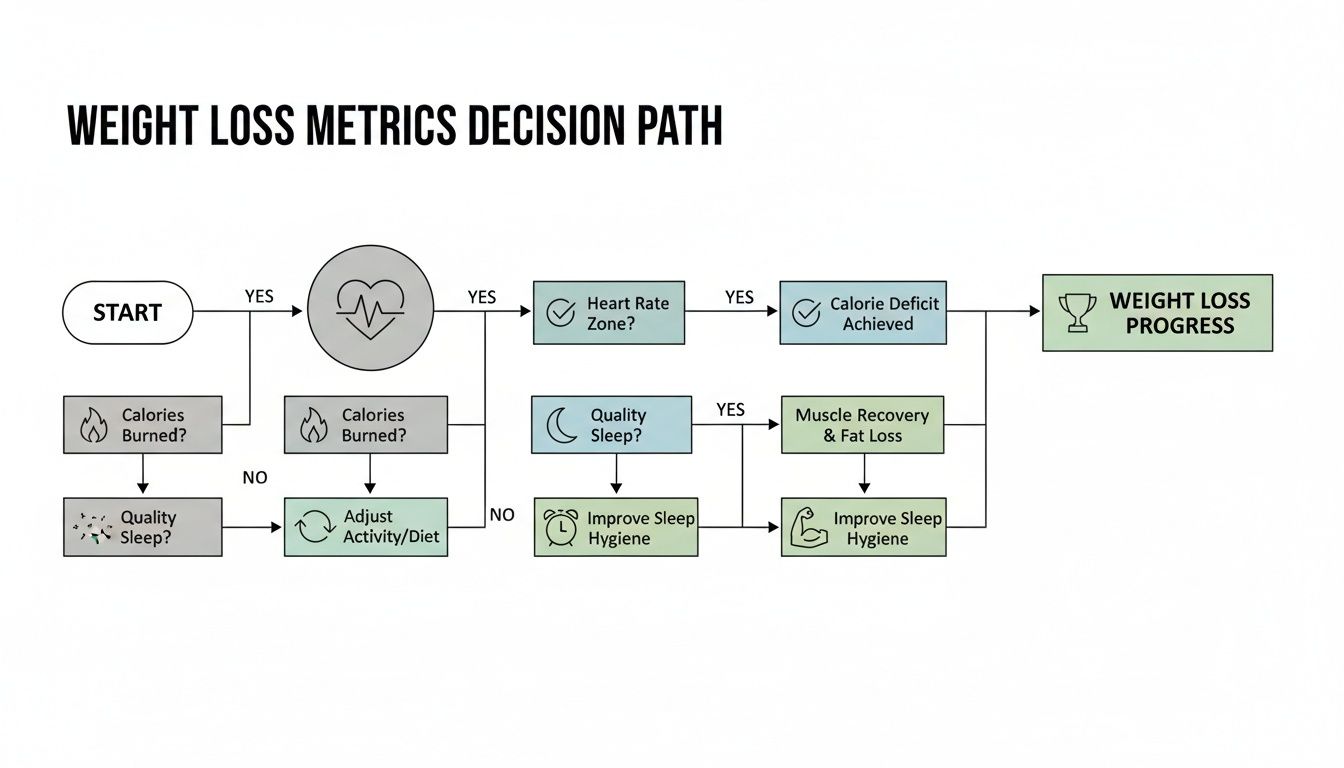
It really shows how tangled these elements are. You can't just focus on one; a holistic approach is what gets you sustainable results.
For The Beginner Focused On Simplicity
If you're just starting out, the main goal is to build consistent habits without drowning in data. You need something that's encouraging, dead simple to use, and gives you clear, actionable feedback. The Fitbit Charge 6 has always been a standout here.
Its interface is famously friendly, showing you core stats like steps, active zone minutes, and calories burned in a way that just makes sense. Fitbit's little motivational nudges, like celebratory animations and reminders to move, give you that positive reinforcement you need to keep going. It gently pushes you toward small, achievable goals—and that's the secret sauce for long-term change.
You could compare it to something like the Garmin Vivosmart 5. While it's a solid tracker, its app can feel a bit more clinical and data-heavy, almost assuming you already know your way around fitness stats. For a true beginner, the Fitbit ecosystem feels less like a spreadsheet and more like a supportive coach on your wrist.
For The Data-Driven Enthusiast
For those of you who love digging into the numbers, weight loss is a science. You want granular data on your performance, recovery, and stress levels to fine-tune every part of your training. This is exactly where WHOOP 4.0 shines.
WHOOP is different. It doesn't even have a screen. Its entire purpose is to collect high-quality data 24/7 and run it through its sophisticated app. Everything revolves around three pillars: Strain, Recovery, and Sleep. The daily Recovery score, which is based on metrics like Heart Rate Variability (HRV) and resting heart rate, tells you exactly how ready your body is to handle stress that day.
The real game-changer with WHOOP is that it's prescriptive. It doesn't just show you data; it tells you what to do with it. It will literally recommend an optimal "strain" target for your workout based on your recovery, helping you avoid overtraining and get the most out of every session.
This is a world away from a Fitbit, which is more descriptive—it tells you what you did, but offers less guidance on what you should do next. A data-driven person thrives on this level of detail. It helps them dial in everything from workout intensity to their sleep schedule, all in the name of peak performance. Knowing how to balance cardio and strength training becomes much easier when you have data telling you how your body is responding.
For The Busy Professional Needing Discretion
When your days are jammed with meetings and deadlines, you need a tracker that just blends in, not one that screams "fitness gadget." The Oura Ring Gen3 is the undisputed champ of discreet tracking. It manages to pack incredibly powerful sensors into a sleek, minimalist ring that just looks like a piece of jewelry.
The Oura Ring is brilliant at passive data collection, especially for sleep and recovery. Its temperature sensors and advanced sleep stage analysis deliver some of the most accurate sleep insights you can get from a wearable, which is vital for managing stress and energy. Every morning, it gives you a simple "Readiness Score"—a quick snapshot of where you're at, physically and mentally.
This focus on subtlety and holistic health is why smart rings are taking off. With U.S. retail sales for fitness trackers soaring by 88% in 2025, it’s clear they’ve become indispensable tools. Smart rings alone have pulled in $217 million this year, with sales jumping 195% because their discreet nature is perfect for busy people trying to manage their weight without broadcasting it.
For The Outdoor Adventurer
If your weight loss plan involves hitting the trails, climbing mountains, or swimming in open water, you need a device that's built for the elements. It needs to have rock-solid GPS and serious mapping features. A Garmin Fenix 7 or one of the Forerunner series watches is the obvious choice for this kind of person.
Garmin's strength is its best-in-class GPS accuracy, incredible battery life, and specialized profiles for just about any activity you can think of, from hiking and trail running to skiing. Features like topographic maps, elevation data, and performance metrics like VO2 max are non-negotiable for serious outdoor athletes. This level of detail also means the calorie burn estimates for those long, varied-terrain activities are far more accurate.
A device like an Oura Ring or a Fitbit would be completely out of its depth here. They just don't have the built-in GPS or the rugged build needed for real adventures. Garmin designs its watches to be tools for exploration, making them the best option for weight loss when your gym doesn't have walls.
Fitness Tracker Showdown: Which One Is Right For You?
With so many options, picking the right one comes down to your personal style and goals. This table breaks down our top picks for each type of user, highlighting what makes them stand out for weight loss.
| Tracker Model | Best For (User Profile) | Key Weight Loss Feature | Battery Life | Price Point |
|---|---|---|---|---|
| Fitbit Charge 6 | The Beginner | Active Zone Minutes and motivational feedback to build consistency. | Up to 7 days | $$ |
| WHOOP 4.0 | The Data-Driven Enthusiast | Daily Recovery Score to optimize workout intensity and prevent burnout. | Up to 5 days | Subscription |
| Oura Ring Gen3 | The Busy Professional | In-depth Sleep & Readiness scores for managing stress and energy. | Up to 7 days | $$$ |
| Garmin Fenix 7 | The Outdoor Adventurer | Best-in-class GPS and performance metrics for accurate outdoor tracking. | Up to 18 days | $$$$ |
Ultimately, the best tracker is the one you'll actually wear and use every day. Whether you need a simple motivator, a high-tech performance analyst, a discreet wellness monitor, or a rugged adventure partner, there's a device out there that fits perfectly into your weight loss plan.
Turning Tracker Data Into Action With Zing Coach
Collecting data with your fitness tracker is a great first step, but let's be honest—the numbers themselves don't make you lose weight. The real change happens when you turn those passive metrics into an active, guided plan. This is exactly where pairing your device with an intelligent app like Zing Coach gives you a serious edge.
Your tracker gathers the "what"—your steps, heart rate, and how long you slept. Zing Coach figures out the "so what?" and tells you "what's next." It takes all that raw information and builds a fitness experience that actually understands and reacts to your body's daily signals.
Creating a Truly Personalized Fitness Experience
It all starts with getting your data in one place. Most of the top fitness trackers, no matter the brand, can sync their data to a central health hub like Apple Health on your phone. Zing Coach then pulls this info—your activity levels, calories burned, and even your workout history—right from the source.
This steady stream of data is the bedrock of your personalized plan. It lets Zing's AI see the complete picture of your daily energy use, not just the 30 minutes you spend on a structured workout.
For instance, if your tracker shows you had a super active day walking all over the city, the app is smart enough to adjust the intensity of your next workout to keep you from overdoing it. On the flip side, if you've had a day stuck at your desk, it might nudge you with a more challenging session to help you stay on track with your goals.
Beyond Steps and Calories: Holistic Progress Tracking
Weight loss is about so much more than the number on the scale. Real progress involves changes in your body composition, like shedding fat and building lean muscle, which is something your tracker can't see on its own. Zing Coach closes this loop with built-in tools that work hand-in-hand with your device's data.
Body Composition Scan: Using just your phone's camera, this feature gives you an estimate of your body fat percentage. When you look at this alongside your tracker’s activity data, you get a much clearer picture of your progress. You might see the scale hasn't budged, but the Body Composition Scan can show you that you're successfully building muscle while losing fat.
Fitness Test: The app will periodically ask you to complete a fitness assessment. This is designed to measure how your strength and endurance are improving over time. It recalibrates the AI, ensuring your workouts are always tough enough to get results but never so hard that you feel defeated.
This blend of tracker data and in-app assessments creates a detailed feedback loop. It guarantees your plan evolves right along with your fitness level, keeping you on the fastest and safest route to your goals.
Your fitness tracker tells you how you performed yesterday. Zing Coach uses that information to tell you exactly what you need to do today to achieve your goals for tomorrow.
Adaptive Workouts Based on Real-Time Signals
Maybe the most powerful feature is how the AI adapts on the fly. Before every session, Zing Coach looks at your tracked activity levels and asks you how you're feeling. This simple check-in, informed by your fitness tracker's data, makes a huge difference in your consistency and long-term success.
Imagine you had a terrible night's sleep, and your tracker dutifully logged it. When you open the app, Zing's AI can recognize these fatigue signals and swap your planned high-intensity workout for a lower-impact recovery session. This kind of smart adaptation helps prevent burnout and injury—two of the biggest reasons people fall off the wagon with their weight loss plans.
By pairing your device with a smart system, you're no longer just looking at your metrics. You are actively using them to make better training decisions, every single day. The data from your fitness tracker becomes the fuel for an intelligent engine designed to guide you. See for yourself how Zing can transform your data into a clear plan by exploring the Zing Coach AI-powered fitness app.
Your First 30 Days: A Practical Weight Loss Plan
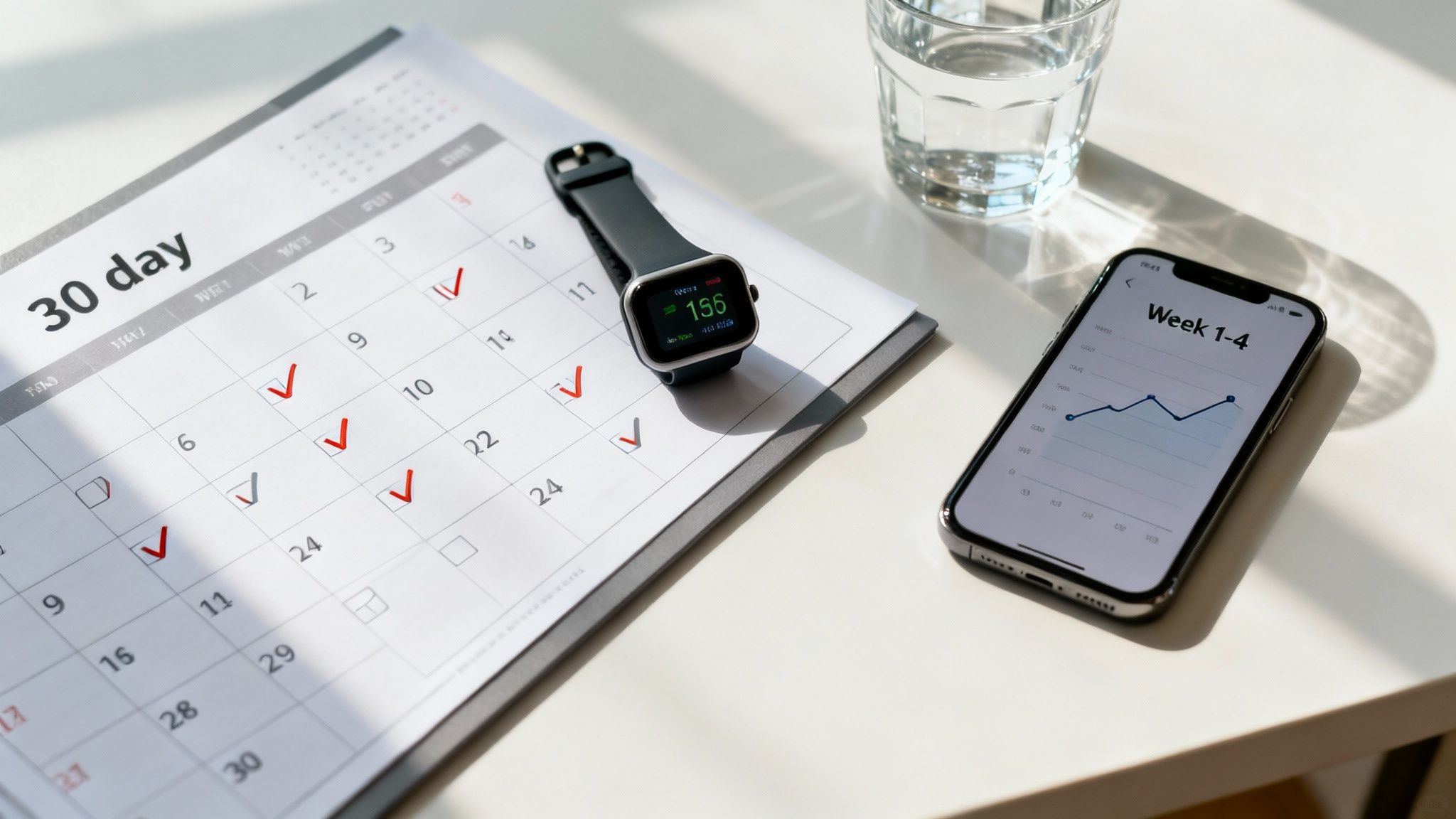
Alright, you’ve got your new device and you're fired up to get started. So, what’s next? The first month isn't about diving headfirst into punishing workouts; it's about building a solid foundation. This practical plan is all about creating habits that actually stick, one week at a time.
This structured approach keeps you from getting buried under a mountain of new data. You’ll learn to tune into your body’s natural rhythms, set goals that make sense, and ease into structured exercise. This is how the best fitness tracker for weight loss becomes a genuine partner in your journey, not just a gadget you ditch after a few weeks.
Week 1: Establish Your Baseline
Your only goal this week is to wear your tracker. That's it. Don't change a thing about your routine, don't try to cram in extra steps, and please, don't obsess over the numbers. The whole point here is to gather some honest data on your current lifestyle.
This baseline period is crucial. By the end of the week, you'll have a clear, judgment-free picture of what your typical day looks like. You’ll know your:
- Average Daily Steps: Get a real sense of your natural activity level, no extra effort required.
- Sleep Patterns: See how much shut-eye you’re actually getting and what the quality of that rest looks like.
- Active Minutes: Find out how much of your day is spent moving versus sitting still.
Think of it as a recon mission. You can't chart a course to your destination until you know exactly where you're starting from.
Week 2: Set Smart Goals
Okay, now you have a week of data to work with. It's time to set your first realistic goals. Look at your averages from Week 1 and aim for small, totally achievable improvements. One of the biggest reasons people give up is setting the bar way too high, way too soon.
For example, if you averaged 4,500 steps a day, don't immediately shoot for 10,000. Instead, aim for 5,500. That small bump is manageable, and hitting it will build your confidence. Likewise, if you averaged six hours of sleep, try for six hours and fifteen minutes.
This methodical approach prevents the "all-or-nothing" mindset that derails so many weight loss journeys. Consistency with small improvements will always outperform short bursts of extreme effort.
This is the week you start to gently push yourself. The goal isn’t perfection; it’s about making steady, incremental progress and learning to use your tracker as a guide for these small wins.
Week 3: Integrate Structured Workouts
With your new activity habits starting to feel normal, you're ready to bring in some structured exercise. This is the perfect time to sync your tracker with an app like Zing Coach. The app can use your baseline data to create a personalized workout plan that’s right for your current fitness level.
Your focus this week is on showing up consistently and starting to understand your effort level. Pay close attention to your heart rate zones during your workouts. This data is gold—it tells you if you’re pushing hard enough to burn fat and boost your cardiovascular health without overdoing it.
As you build your routine, you can check out our guide to a great workout routine for weight loss for more ideas. Of course, a practical weight loss plan also needs to address diet. You might even look into things like the role of protein shakes as a weight loss aid.
Week 4: Review and Refine
At the end of the month, take a moment to look back at your progress. Dive into the weekly reports in your tracker's app. Did you hit your new step and sleep goals? How many workouts did you manage to get in?
This isn't about judging your performance—it’s about learning what works for you. Celebrate your wins, no matter how small they seem. If you consistently fell short of a goal, don't look at it as a failure. Instead, get curious and ask why. Was your step target just too high for your current schedule?
Use these insights to refine your goals for the next month. Maybe you want to add another 1,000 steps to your daily goal, squeeze in one more workout per week, or focus on improving your deep sleep score. This cycle of doing, reviewing, and refining is the secret sauce for creating lasting change and crushing your weight loss goals.
Common Questions About Fitness Trackers and Weight Loss
When you're diving into a weight loss journey, you're bound to have questions about the tools of the trade. Fitness trackers spit out a ton of data, but knowing what to do with it all is what really counts. Let's clear up some of the most common questions people have when using a fitness tracker to lose weight.
Getting these answers straight will help you separate the useful insights from the noise and get the most out of your device.
How Accurate Are Calorie Burn Estimates?
This is the big one. Everyone wants to know if they can trust the calorie number on their wrist. While today’s trackers are impressively advanced, it’s best to treat their calorie burn estimates as a consistent benchmark, not a perfect scientific measurement. They use a pretty sophisticated algorithm that pulls in your heart rate, movement, age, and weight to estimate your energy expenditure.
For steady-state cardio like a jog or a bike ride, these numbers are generally in the right ballpark. Where they can get a little fuzzy is with activities like strength training or HIIT, where your heart rate is all over the place.
The smartest way to use this data is to watch the trends over time. Forget about the exact number for a single workout. Instead, look at your weekly and monthly averages to get a solid picture of your energy output. This gives you a reliable baseline for managing your calorie deficit.
Should I Wear My Fitness Tracker All Day?
For the best results? Absolutely. Wearing your fitness tracker 24/7 gives you the most complete and actionable data for weight loss. If you want an accurate read on your Total Daily Energy Expenditure (TDEE)—which includes calories burned while sleeping and just moving around—you need that constant data stream.
If you only strap on your device for workouts, you're missing a massive piece of the puzzle. The data it collects while you're resting, walking to the office, or sleeping is what creates a full picture of your lifestyle and energy needs. This holistic view is what you need to make smart calls on your diet and activity levels.
Can a Tracker Help Me Lose Weight Without Dieting?
A fitness tracker can definitely give you the nudge you need to move more, and that alone might help you drop a few pounds. But for significant, lasting weight loss, you almost always need to pair exercise with a solid nutrition plan. It's the classic "you can't out-train a bad diet" scenario.
Your tracker is a fantastic tool for managing the "calories out" side of the equation. The thing is, it's surprisingly easy to eat more calories than you burn, even on your most active days. The winning strategy is to use your tracker’s data to guide your activity while following a smart nutrition plan to manage what you eat.
What Is the Most Important Metric Besides Calories?
Beyond counting calories, sleep quality might just be the most critical—and most overlooked—metric for successful weight loss. When your sleep is consistently bad, it can throw the hormones that control your appetite completely out of whack. Ghrelin (the "I'm hungry" hormone) goes up, while leptin (the "I'm full" hormone) goes down.
This hormonal mess leads to intense cravings and can leave you feeling drained, making it way harder to stick to your workout plan. A good tracker will give you detailed sleep data, including how much time you spend in Deep, REM, and Light sleep. By working to improve both how long and how well you rest, you can have a massive impact on your ability to manage hunger and stay on track with your fitness goals.
Turning data into results is what separates a successful weight loss journey from a frustrating plateau. The Zing Coach app syncs with your fitness tracker, transforming your daily metrics into a personalized workout and nutrition plan that adapts as you progress. Stop guessing and start seeing real change. Get your personalized plan today.
Share this article


Authors