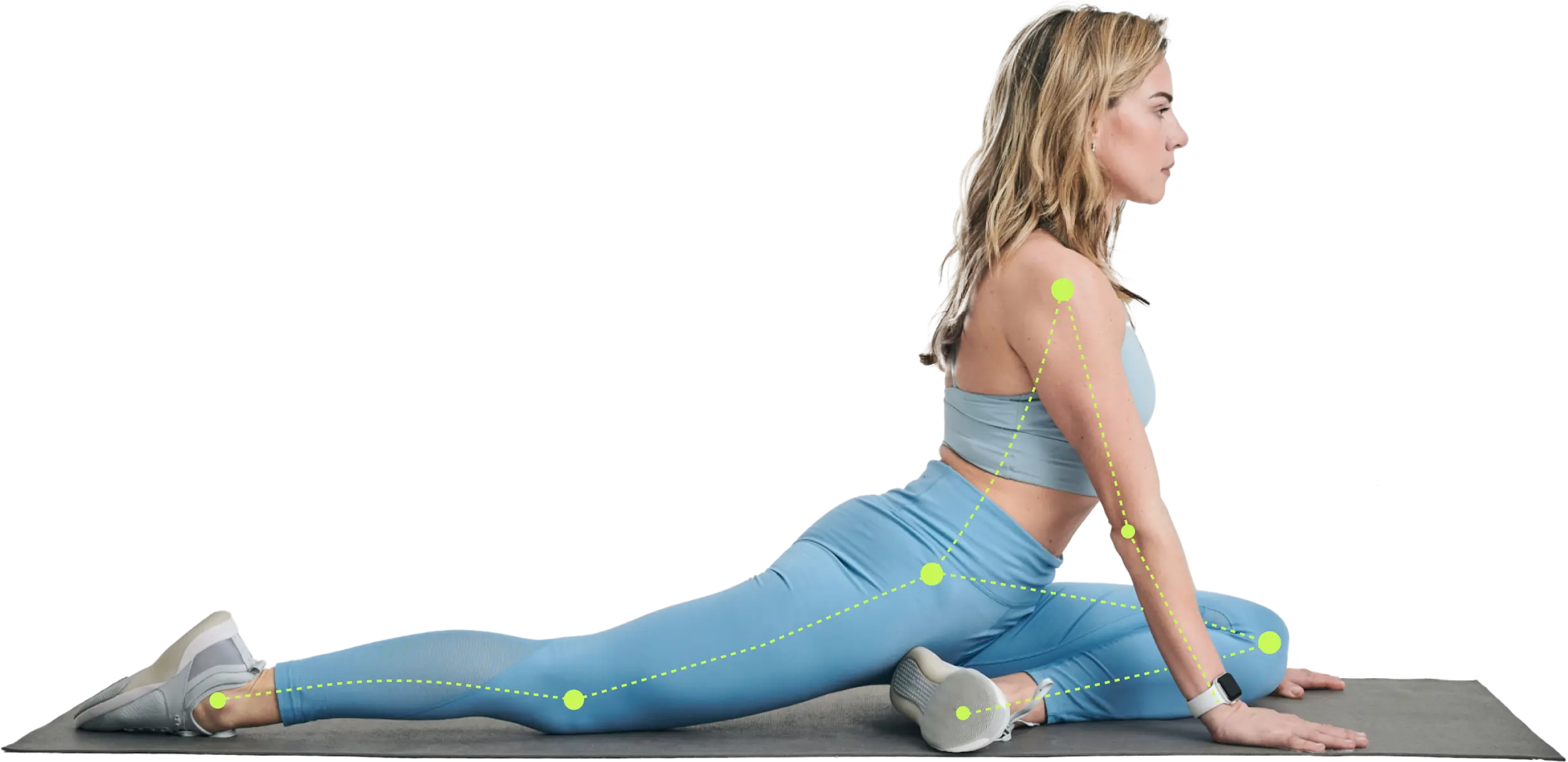
Discover a quick morning workout routine that boosts energy and fits your schedule. Get 5, 10, and 20-minute plans for lasting fitness results at home.
A quick morning workout is your secret weapon for a more productive, energized day. We're talking about just 15-20 minutes of movement to kickstart your metabolism and sharpen your mental focus. It sets a positive tone that can ripple through every choice you make, from breakfast to bedtime.
Why a Morning Workout Is Your Secret Weapon
Imagine starting your day feeling accomplished before you even glance at your email. That's the power of moving your body first thing. Instead of wrestling with the snooze button, you’re making a direct investment in yourself, building a wave of momentum that carries you through whatever the day throws at you.
This isn’t just about torching a few calories; it’s about creating a powerful chain reaction. When you finish a workout, you've already knocked a major personal goal off your list. That sense of achievement can sharpen your focus for complex tasks at work and give you the mental clarity you need to navigate a packed schedule.
Set the Tone for a Healthier Day
A quick morning sweat session does more than just jolt you awake. It can fundamentally alter the course of your day by nudging you toward healthier follow-up decisions. Think about it: after you’ve put in the effort to move, are you more likely to grab a sugary pastry or blend up a protein-rich smoothie? Exactly.
This isn't just a feeling; the data backs it up. For instance, a 2023 study showed that people who exercised between 7 and 9 a.m. not only had lower BMIs but also naturally gravitated toward healthier eating habits all day long. That one decision to work out first can cascade into better nutrition, more water, and more mindful choices in general. You can dig into the full findings on these morning exercise habits.
To give you a clearer picture, here's a quick rundown of the benefits you can expect.
Morning Workout Benefits at a Glance
| Benefit Category | Specific Advantage | Real-World Impact |
|---|---|---|
| Metabolic Boost | Increased Calorie Burn | You'll burn more calories throughout the day, even at rest. |
| Mental Clarity | Enhanced Focus & Cognitive Function | Tackle complex work projects or stay present with your family. |
| Mood Enhancement | Endorphin Release | Start your day feeling positive and more resilient to stress. |
| Healthier Habits | "The Domino Effect" | You’re more likely to make better food choices all day. |
| Improved Sleep | Regulated Circadian Rhythms | Better sleep at night leads to more energy the next morning. |
As you can see, the payoff from just a few minutes of morning movement extends far beyond the workout itself.
The Science Behind the Morning Boost
So, what’s actually happening inside your body? A morning workout fires up your metabolism, leading to a higher calorie burn that lasts for hours—a phenomenon often called the "afterburn effect." It also improves your insulin sensitivity, which is a game-changer for managing your energy levels and maintaining a healthy weight.
On top of that, physical activity is a potent mood elevator. It triggers a rush of endorphins—your brain’s natural feel-good chemicals—that help combat stress and foster a more positive outlook. This is a massive advantage for busy parents or professionals who need to walk into their day feeling resilient and clear-headed.
A morning workout isn't just a physical task; it's a mental one. By overcoming the initial inertia, you're training your discipline and proving to yourself that you can tackle challenges head-on, setting a powerful precedent for the hours to come.
The 5-Minute Warm-Up You Should Never Skip
I get it. When you’re short on time, jumping straight out of bed and into a set of push-ups sounds efficient. But trust me, it’s a fast track to injury and a lackluster workout. A proper warm-up isn't just a suggestion; it’s the single most important part of any effective and safe quick morning workout routine.
Think of it as gently waking up your body. Your core temperature is naturally lower first thing in the morning, and your joints feel a lot stiffer. A good dynamic warm-up gets your blood flowing, lubricates your joints, and switches on the exact muscles you’re about to ask to do some work. The result? You’ll move better, feel stronger, and drastically reduce your risk of pulling something.
Prime Your Body for Movement
Forget about old-school static stretching where you just hold a pose for 30 seconds. Before a workout, your body craves movement-based prep, often called dynamic stretching. This is what really primes your nervous system and unlocks your range of motion for the exercises coming up.
A great morning starts by energizing your body, which in turn leads to better focus and a real sense of accomplishment for the rest of the day.
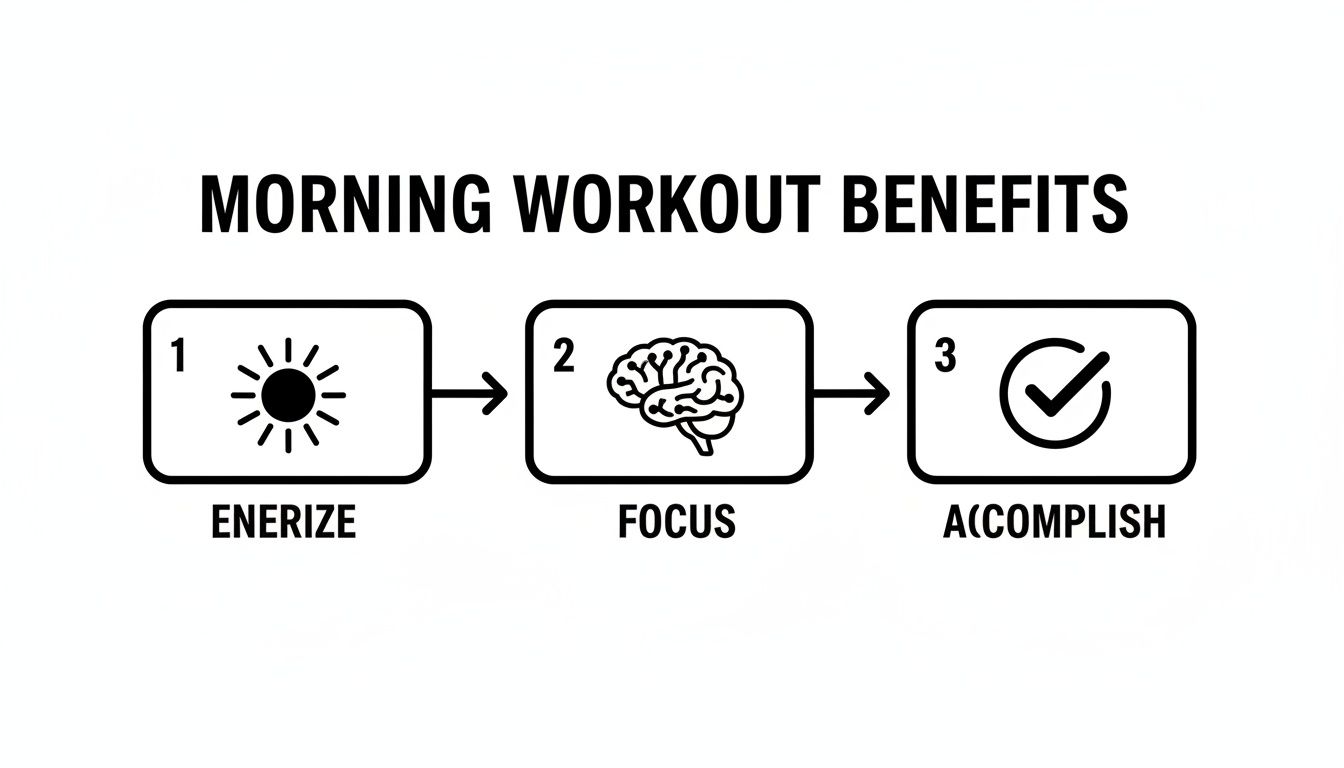
The key takeaway is simple: getting your body moving is the catalyst for a successful day.
Here's a simple and effective sequence I use to get going:
- Leg Swings (30 seconds per leg): Stand tall and hold onto a wall or chair for a bit of balance. Swing one leg forward and back, then side to side. This is fantastic for opening up your tight hip flexors and hamstrings.
- Torso Twists (60 seconds): With your feet about shoulder-width apart, gently rotate your upper body from side to side. This wakes up your core and gets your spine moving.
- Walking Lunges (60 seconds): Take a step forward into a lunge, making sure your front knee stays lined up with your ankle. Push off and alternate legs as you move across the room. This fires up your glutes, quads, and hamstrings all at once.
- Arm Circles (30 seconds forward, 30 seconds backward): Make big, controlled circles with your arms to get those shoulder joints warmed up and ready.
This five-minute investment is non-negotiable. It ensures your body is actually ready to perform, making your workout safer and way more effective. For a deeper dive, check out our complete guide on how to warm up before strength training.
Your Time-Based Workout Blueprints
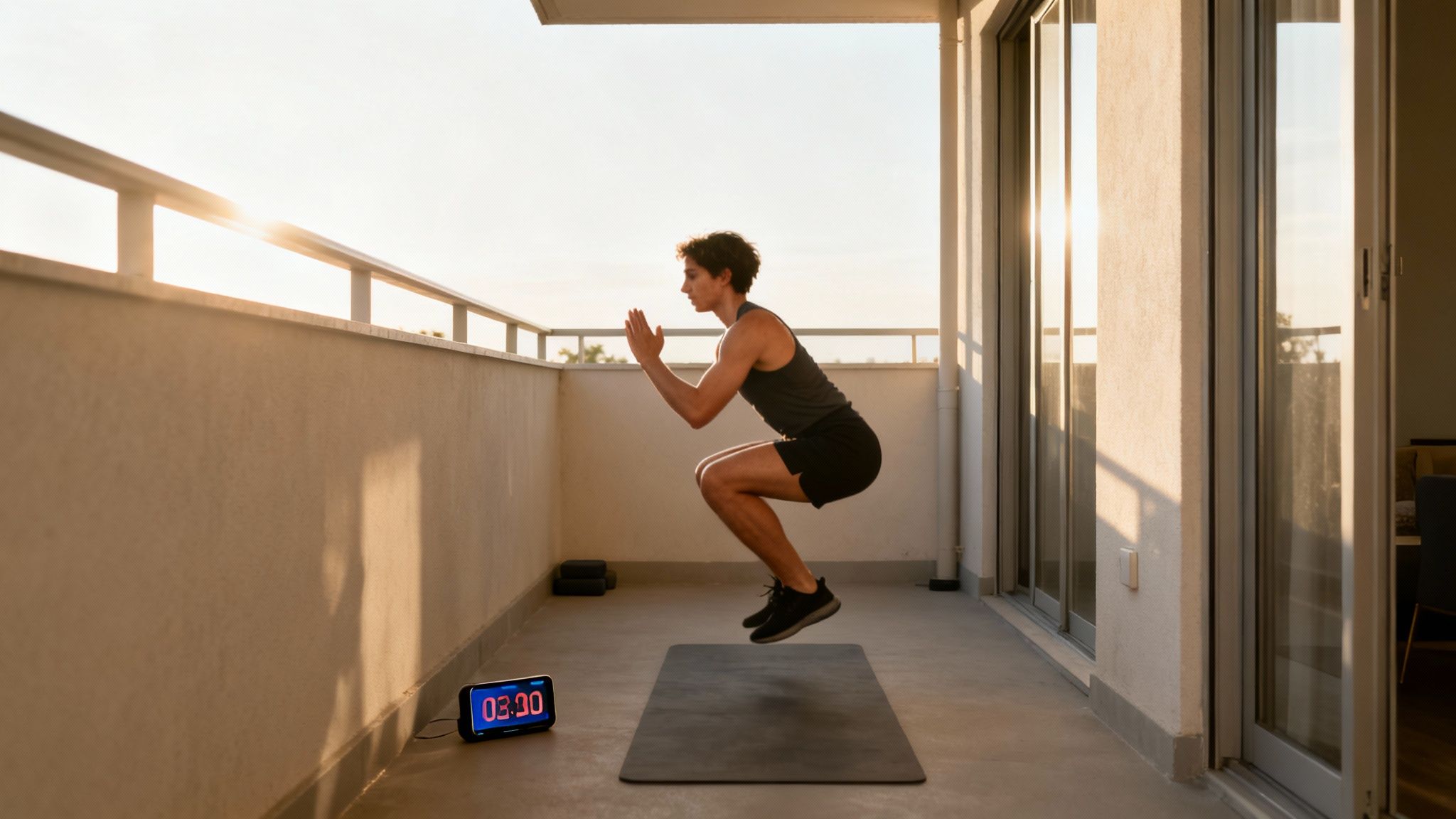
Let’s be honest: time is the biggest hurdle for most of us. The ambition to start a fitness routine often crashes against the reality of a busy schedule. This is where a quick morning workout routine becomes your secret weapon.
You don’t need an hour at the gym. Real, sustainable progress comes from matching your workout to the minutes you actually have.
Below are four different blueprints, each built for a specific timeframe. They all use powerful bodyweight movements you can do anywhere, from your living room to a hotel room, making them ridiculously convenient.
Choose Your Quick Morning Workout
Not sure which routine is right for you today? This table breaks down each option to help you pick the perfect workout based on how much time you've got and what you want to achieve.
| Workout Duration | Primary Focus | Example Exercises | Best For |
|---|---|---|---|
| 5 Minutes | Energy & Mobilization | Jumping Jacks, Cat-Cow Stretch | Waking up your body and shaking off grogginess |
| 10 Minutes | Metabolic Boost (HIIT) | Squat Jumps, Mountain Climbers | Maximum calorie burn in minimum time |
| 15 Minutes | Functional Strength | Push-Ups, Lunges, Glute Bridges | Building a strong, resilient foundation |
| 20 Minutes | Cardio & Core Endurance | Burpees, Planks, Bicycle Crunches | A comprehensive session to feel accomplished |
Find the one that fits your morning, and let's get moving.
The 5-Minute Energy Booster
Think of this as a healthier alternative to hitting the snooze button again. This isn't about crushing a workout; it's about gently waking up your body and mind with continuous movement. The goal is to get your blood flowing and prepare you for the day ahead.
Just perform each exercise for 60 seconds, flowing from one to the next with almost no rest.
- Jumping Jacks: The ultimate classic for a reason. It gets your heart rate up and warms up everything at once.
- High Knees: Really focus on driving your knees toward your chest. This fires up your core and hip flexors.
- Butt Kicks: A great dynamic stretch for your quads that also keeps the heart rate elevated.
- Bodyweight Squats: Time to wake up the biggest muscles in your body—your glutes and legs.
- Cat-Cow Stretch: Finish by mobilizing your spine to release any stiffness from a night's sleep.
The 10-Minute Full-Body Blast
Got 10 minutes? High-Intensity Interval Training (HIIT) is your best friend. This method is all about short, sharp bursts of maximum effort followed by a quick breather. It’s unbelievably effective for torching calories and boosting your metabolism.
Run through this circuit two times:
- Push-Ups: 40 seconds of work, 20 seconds of rest.
- Squat Jumps: 40 seconds of work, 20 seconds of rest.
- Plank: 40 seconds of work, 20 seconds of rest.
- Mountain Climbers: 40 seconds of work, 20 seconds of rest.
- Rest: Take a full 60 seconds between the two rounds.
Why HIIT Works: Pushing yourself that hard for short periods creates a metabolic ripple effect. Your body has to work overtime to recover, burning extra calories for hours after you've finished. It's often called the "afterburn effect," and it's a huge win for efficiency.
The 15-Minute Strength Circuit
Building real-world, functional strength is one of the smartest things you can do for your body. It makes everything easier, from hauling groceries to playing with your kids, and it’s a key factor in preventing injuries. This circuit hits multiple muscle groups at once for maximum impact.
There's a reason strength training is booming in popularity. Garmin's 2023 review saw a 20% global jump in strength workouts logged, and it's now ranked as the #2 fitness trend worldwide. People are realizing that this kind of foundational work is what delivers lasting results.
Complete three full rounds, resting 45-60 seconds between each one.
- 12 Bodyweight Squats
- 10 Push-Ups (on your knees or toes, whatever challenges you)
- 12 Alternating Lunges (that's 12 on each leg)
- 10 Glute Bridges
- 30-Second Plank Hold
The 20-Minute Cardio and Core Session
On days when you can carve out a bit more time, this 20-minute session is perfect. It blends heart-pumping cardio with focused core work to leave you feeling strong, stable, and ready for anything. Remember, a solid core is the foundation for almost every move you make.
This routine is broken into two distinct parts.
Part 1: Cardio Circuit (Complete 2 Rounds)
- Burpees: 45 seconds on, 15 seconds rest.
- Jumping Jacks: 45 seconds on, 15 seconds rest.
- High Knees: 45 seconds on, 15 seconds rest.
- Rest for a full 60 seconds after the round.
Part 2: Core Finisher (Complete 2 Rounds)
- Plank: Hold for 60 seconds.
- Leg Raises: 60 seconds of controlled movement.
- Bicycle Crunches: 60 seconds.
- Rest for 30 seconds after the round.
If you start enjoying these longer sessions and feel ready to level up, our 30-minute workout plan is the perfect next step to keep the momentum going.
How to Adapt and Advance Your Routine
A great workout plan isn't set in stone; it should grow and change right along with you. Let’s be real, the whole "one-size-fits-all" approach to fitness is a complete myth. To get real, lasting results, you have to know how to tailor your morning routine to your body and where you're at today.
It all starts with listening to your body. Some mornings you’ll feel like you can take on the world, and on others, you might need to dial it back a bit. The key is making smart adjustments, not excuses. That’s how you stay consistent without burning out or getting hurt.
Making Every Exercise Work for You
Every single exercise can be tweaked. Don't think of these modifications as "easier" versions—think of them as strategic moves. They help you build foundational strength and nail down the proper form you need to tackle more advanced stuff safely down the road.
Take push-ups, for example. If a full push-up feels like a pipe dream right now, don't just skip it.
- Start with Wall Push-Ups: Stand a couple of feet from a wall and press against it. This is a fantastic starting point for building shoulder and chest strength without the pressure.
- Progress to Incline Push-Ups: Once you're comfortable, use a sturdy table or the back of a couch. The higher the surface, the less body weight you're lifting.
- Move to Knee Push-Ups: When you feel stronger, bring it down to the floor. Your main job here is to keep a perfectly straight line from your head to your knees.
The same idea applies to squats. If your knees are a bit sensitive, just adjust your form. Don't go quite as deep, and really focus on pushing your hips back like you’re about to sit in a chair. This small change protects your joints while still firing up your glutes and quads.
Introducing New Challenges Safely
So, you can breeze through your routine without breaking much of a sweat? It's time to level up. You don't need a full home gym to add a new layer of challenge, either. A few simple tools can make a world of difference.
Resistance bands are incredibly versatile. You can loop a band around your thighs during glute bridges to really ignite your hips, or use one for bicep curls and shoulder presses. This introduces a new stimulus that tells your muscles, "Hey, time to adapt and get stronger!"
The goal is to find your "sweet spot"—a level of difficulty that feels challenging but still allows you to maintain good form. It’s always better to do eight perfect reps with a modification than 15 sloppy ones.
The Power of Progressive Overload
If you want to avoid hitting that dreaded fitness plateau where your progress grinds to a halt, you need to embrace a core principle of training: progressive overload. It sounds technical, but it’s simple: you have to gradually increase the demands on your body over time. Your muscles won't get stronger unless you ask them to do a little more than they're used to.
Putting this into practice isn't complicated at all.
- Increase Reps or Sets: If you did 10 squats last week, aim for 12 this week. Easy.
- Decrease Rest Time: Try shaving 10-15 seconds off your rest periods between exercises.
- Add Resistance: This is where those resistance bands or a pair of light dumbbells come in.
- Try a Harder Variation: Ready to move on? Progress from a regular plank to a plank with shoulder taps.
Figuring out how to balance these different elements is crucial for long-term success. For a deeper dive, check out our guide on how to balance cardio and strength training to build a truly well-rounded plan.
Building a Workout Habit That Actually Lasts

Let's be real for a second. The best quick morning workout routine isn’t the one with the most complicated moves or the one you see influencers doing. It's the one you actually do. Consistently.
Knowing what exercises to perform is just one piece of the puzzle. The real magic happens when you turn that knowledge into a habit so ingrained it feels automatic.
And the secret isn't about mustering up more willpower, especially before you've had your coffee. It’s about building a simple system that makes showing up for yourself the easiest decision you'll make all day.
Master the Art of Habit Stacking
One of the most effective tricks in the book is habit stacking. The idea is simple: you link the new habit you want to form (your workout) to an old, automatic one you already do without thinking.
For most of us, that first cup of coffee is non-negotiable. So, let's use it. Try this on for size: "After I turn on the coffee maker, I will immediately change into my workout clothes." Just like that, you've removed the internal debate that can kill a workout before it even starts.
A few other ways to rig the game in your favor:
- Prep the Night Before: Lay out your workout clothes, shoes, and water bottle somewhere you can’t possibly miss them. Next to the coffee maker? Perfect. On top of your phone? Even better. Make it impossible to ignore.
- Create a Cue: Your alarm can be more than just a jarring noise. Set it to an upbeat song that actually gets you pumped and signals to your brain that it's go-time.
- Start Ridiculously Small: If a 15-minute workout feels like climbing a mountain, just commit to putting on your workout clothes and doing the 5-minute warm-up. Seriously. Getting started is always the hardest part.
This isn't just feel-good advice; it's backed by data. A 2023 study in the journal Obesity found that people who exercised between 7 a.m. and 9 a.m. tended to have lower BMIs and make healthier food choices all day long. This lines up with the massive 67.4% participation rate in fitness activities across the U.S., showing just how many people are carving out time for their health.
Redefine What Success Looks Like
If the only metric you're tracking is the number on the scale, you're setting yourself up for a world of frustration. Real, sustainable progress is about so much more than weight. To stay fired up for the long haul, you need to track the wins that prove you're getting stronger and more capable.
Shift your focus to performance goals like these:
- Holding a plank for 10 seconds longer than last week.
- Nailing one more rep of push-ups with solid form.
- Feeling less winded during your cardio intervals.
Celebrate every single one of these small victories. They are tangible proof that your hard work is paying off. This simple mindset shift can transform your workout from a chore you dread into a practice you genuinely look forward to.
If you're looking for more general tips on building a solid morning schedule, check out these strategies on how to create a morning routine that actually sticks. And for a deeper dive into making fitness a permanent part of your life, our guide on how to stay consistent with exercise has you covered.
Your Common Morning Workout Questions Answered
Starting any new habit, especially a fitness one, always brings up a few questions. Let's clear up some of the common things that might be on your mind so you can move forward with your quick morning workout routine confidently.
One of the biggest questions I get is about food. Should you eat something first, or is it better to work out on an empty stomach? Honestly, it really comes down to how you feel and how hard you're planning to go.
Should I Eat Before a Quick Morning Workout?
For most of these quick workouts—anything under 30 minutes—you probably don't need a full meal. A glass of water is non-negotiable, though. You need to rehydrate after a full night's sleep.
If you're feeling a little sluggish or low on energy, a small, easy-to-digest carb can make a world of difference. Think half a banana or a few dates about 20 minutes before you start. It'll give you just the right energy boost without sitting heavy in your stomach.
The golden rule here is to listen to your body. If you feel faint or weak, a small snack is definitely the smart move. For a much deeper dive, we've got a full guide on whether to eat before or after working out. There are also some great resources out there that list the best foods to eat before your morning workout.
How Do I Handle Muscle Soreness?
Ah, the dreaded muscle soreness. That ache you feel a day or two after a workout is called Delayed Onset Muscle Soreness (DOMS), and it's completely normal. In fact, it's a good sign—it means your muscles are adapting and getting stronger.
To manage it, don't just sit on the couch. Light activity like walking can actually help. Also, make sure you're staying hydrated, getting enough protein to help with muscle repair, and prioritizing a solid night's sleep. Whatever you do, avoid another intense workout on those same sore muscles for a day or two.
Remember: Consistency will always beat intensity. On days when your motivation is at rock bottom, just commit to the 5-minute warm-up. More often than not, just starting is the hardest part. Even a short session is a huge win for your long-term goals.
Can I Get Real Results with Just 15 Minutes a Day?
Absolutely. It's easy to think you need an hour-long gym session to see progress, but that's just not true. The power of consistency is so much more impactful than the length of any single workout.
A daily 15-minute session, especially one focused on high-intensity movements or compound exercises, can do wonders. We're talking improved heart health, stronger functional muscles, and a nice boost to your metabolism.
The key is making every minute count. Focus on quality movement and don't waste time between exercises. Over weeks and months, these brief but consistent sessions really add up, creating significant fitness gains you can actually see and feel.
Ready to stop guessing and start training with a plan that adapts to you? The Zing Coach app uses AI to create workouts tailored to your goals, time, and fitness level. Get your personalized plan today at https://zing.coach.
Share this article


Authors