Unlock your potential with this science-backed 5 day lifting program. Get a complete, actionable workout plan designed for serious muscle and strength gains.

Thinking about stepping up your training? If you've ever wondered if hitting the gym more often could be the key to unlocking new gains, you're onto something. A 5-day lifting program is a seriously effective way to build muscle and strength, mainly because it nails two of the most important training variables: frequency and volume.
This kind of split lets you hit your major muscle groups multiple times a week while still giving them enough time to recover. It's a strategic move away from the old-school, one-muscle-per-day routine.
Why a 5-Day Lifting Program Can Fast-Track Your Gains
The real magic of a 5-day lifting program is its ability to keep your body in a nearly constant state of growth. Instead of absolutely destroying a muscle group once a week and then waiting a full seven days to train it again, this approach keeps muscle protein synthesis (MPS) humming along.
If you're not familiar, MPS is the biological process your body uses to repair and build new muscle after you work out. The catch? It only stays elevated for about 24-48 hours. By training muscles more often, you kickstart that growth process multiple times a week. This isn't about overtraining; it’s about training smarter. Each session delivers just enough of a stimulus to get the ball rolling without causing so much damage that you need a week to recover.
The Science Backs It Up
Modern research has pretty much confirmed that when it comes to training frequency, more is often more. Major studies comparing different training splits have consistently found that hitting a muscle group twice a week is far better for growth than the old-school "bro split."
For instance, a landmark 2016 meta-analysis showed that when total weekly volume was the same, training muscles twice per week resulted in significantly more muscle growth. This approach lets you get in a better stimulus without piling on "junk volume"—those extra, exhausting sets that give you less and less in return. A 5-day lifting program is the perfect way to put this science into practice, spreading the work out for the best results.
A 5-day split lets you pack in higher quality volume. Instead of grinding through 20 sets for chest in one brutal session, you can do 10 high-quality sets on two different days. You'll be able to lift heavier and with better form each time.
Who Is This Split Really For?
A 5-day program definitely requires commitment, but the payoff is huge. It's an especially great fit for a few types of lifters:
- Intermediate to Advanced Lifters: If you've been training for a while and your progress has started to stall, bumping up your frequency is often the exact thing you need to break through a plateau.
- Anyone Focused on Building Muscle: If hypertrophy is your main goal, the increased frequency and volume you get from this split is a direct line to faster gains.
- People Who Thrive on Structure: This split gives you a clear, effective plan for the week. It takes the guesswork out of your training and ensures you're hitting every muscle with the right intensity.
Ultimately, this structure gives you a strategic edge over splits that have you in the gym less often. If you're looking for another solid option but can't commit to five days, our guide on the 4-day split breaks down another highly effective routine for building strength and muscle.
The Complete 5-Day Lifting Program and Daily Schedule
Alright, let's get down to business. Theory is great, but a plan you can take to the gym floor today is better. This is your complete, actionable five-day workout schedule, designed to build both raw strength and serious muscle size.
Each day has a laser-sharp focus, stripping away the guesswork so you can pour all your energy into execution and growth. No more wandering around the gym wondering what to do next.
The "Why" Behind This Split
This program is built on a proven "Upper/Lower/Push/Pull/Legs" split. It's not just a random collection of exercises; it's a strategic approach that lets you hit your major muscle groups twice a week with different levels of intensity and volume.
We kick off the week with two foundational strength days, focusing on heavy, lower-rep compound lifts. From there, we shift gears into hypertrophy for the next three days, using higher rep ranges and more targeted work to maximize muscle growth. It’s the best of both worlds—you build the strength and the physique.
This high-frequency approach is a game-changer. Don't just take my word for it; a landmark study, famously known as the Norwegian Frequency Project, put this to the test. Over 15 weeks, they compared a high-frequency group (training 6 days a week) to a lower-frequency group (3 days a week), with both groups doing the same total weekly volume. The results? The high-frequency lifters packed on nearly twice the muscle and strength, boosting their lifts by an average of 10% compared to just 5% for the other group.
Frequency is a powerful catalyst for growth, and this program is designed to leverage it.
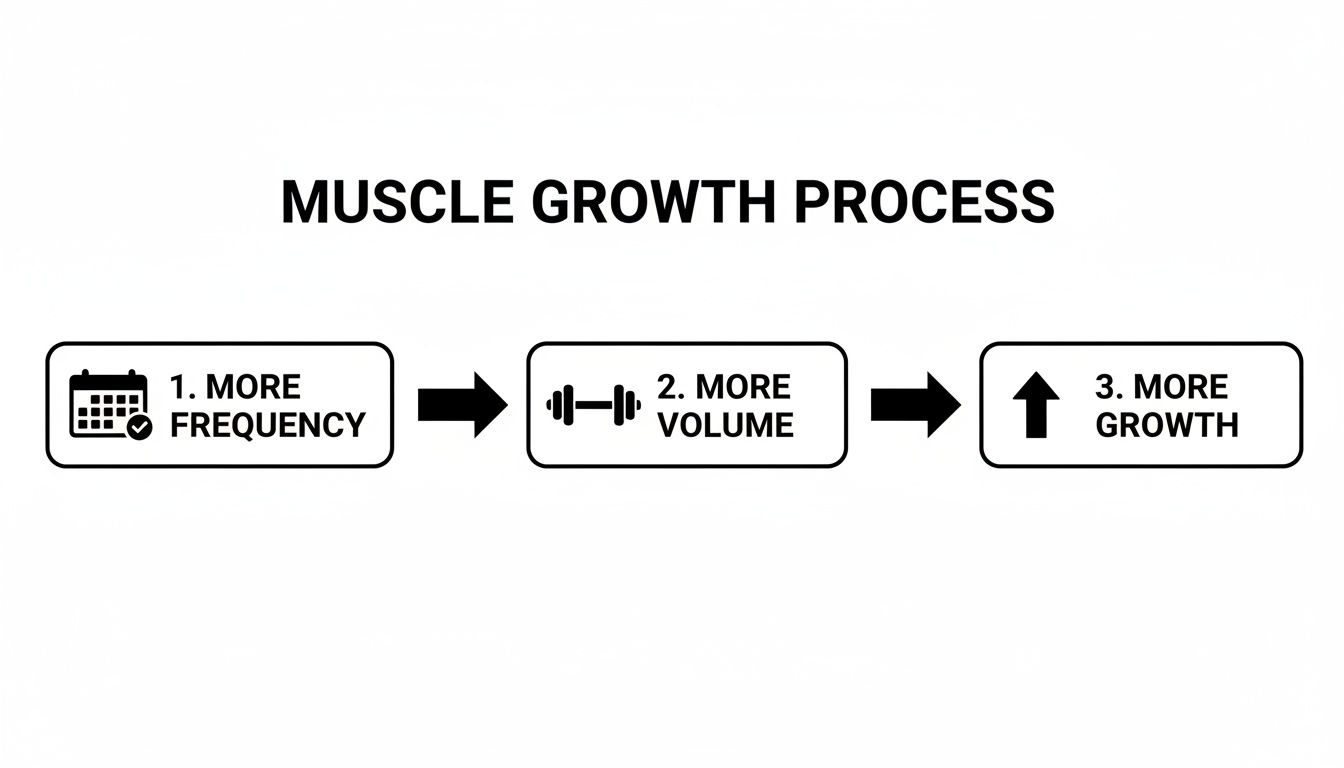
This simple flowchart nails it: more training days allow for more total volume, and volume is the primary driver of muscle growth over the long haul.
Your Weekly 5-Day Lifting Blueprint
Here’s a bird’s-eye view of your training week. This table lays out the focus for each day and gives you a clear picture of what you’ll be tackling. Remember to prioritize clean form over ego lifting, especially on your main compound movements.
| Day | Workout Focus | Primary Compound Lift | Secondary Compound Lift | Example Accessory Movements |
|---|---|---|---|---|
| 1 | Upper Body Strength | Barbell Bench Press | Barbell Row | Seated Dumbbell Press, Lat Pulldowns |
| 2 | Lower Body Strength | Barbell Back Squat | Romanian Deadlift | Leg Press, Leg Curls |
| 3 | Push Hypertrophy | Incline Dumbbell Press | Seated Arnold Press | Cable Crossovers, Triceps Pushdowns |
| 4 | Pull Hypertrophy | Weighted Pull-Ups | T-Bar Row | Face Pulls, Dumbbell Bicep Curls |
| 5 | Legs Hypertrophy | Goblet Squats | Walking Lunges | Leg Extensions, Seated Calf Raises |
| 6 | Active Recovery | Light cardio, mobility work, stretching | ||
| 7 | Full Rest | Complete rest and nutrition focus |
This blueprint gives you a solid structure to follow. Now, let’s dive into the nitty-gritty of each workout.
Day 1: Upper Body Strength
This is all about building a powerful upper body. We're moving heavy weight with perfect technique to force your chest, back, and shoulders to get stronger.
- Barbell Bench Press: 4 sets of 5-8 reps. Rest 90-120 seconds.
- Pro Tip: Pin your shoulder blades back and down on the bench. Drive your feet hard into the floor to create stability and power.
- Barbell Row: 4 sets of 5-8 reps. Rest 90-120 seconds.
- Pro Tip: Start the pull with your back muscles, not by yanking with your biceps. Think about pulling your elbows up towards the ceiling.
- Seated Dumbbell Shoulder Press: 3 sets of 8-10 reps. Rest 60-90 seconds.
- Lat Pulldowns: 3 sets of 8-12 reps. Rest 60-90 seconds.
- Dumbbell Skull Crushers: 3 sets of 10-12 reps. Rest 60 seconds.
Day 2: Lower Body Strength
Today, we build the foundation. Heavy squats and hinges are non-negotiable for lower body strength and will improve everything from your athletic performance to how you move in daily life.
- Barbell Back Squat: 4 sets of 5-8 reps. Rest 90-120 seconds.
- Pro Tip: Keep your chest proud and brace your core like you're about to take a punch. Drive up through the middle of your foot.
- Romanian Deadlifts (RDLs): 3 sets of 8-10 reps. Rest 90 seconds.
- Pro Tip: This is a hip hinge, not a bend. Push your hips straight back and feel that deep stretch in your hamstrings.
- Leg Press: 3 sets of 10-12 reps. Rest 60-90 seconds.
- Lying Leg Curls: 3 sets of 12-15 reps. Rest 60 seconds.
- Standing Calf Raises: 4 sets of 15-20 reps. Rest 45-60 seconds.
Day 3: Push Hypertrophy
The mission here is pure muscle growth for your chest, shoulders, and triceps. We're bumping up the reps and chasing a nasty pump.
- Incline Dumbbell Press: 4 sets of 8-12 reps. Rest 60-90 seconds.
- Pro Tip: Control the negative (the lowering phase) for a slow 3-second count. This maximizes time under tension and sparks growth.
- Seated Arnold Press: 3 sets of 10-12 reps. Rest 60-90 seconds.
- Pro Tip: Focus on a smooth, continuous rotation of the dumbbells. Don't rush it.
- Cable Crossovers: 3 sets of 12-15 reps. Rest 60 seconds.
- Dumbbell Lateral Raises: 3 sets of 15-20 reps. Rest 45-60 seconds.
- Rope Triceps Pushdowns: 4 sets of 12-15 reps. Rest 60 seconds.
Day 4: Pull Hypertrophy
Time to build a thick back and sleeve-splitting biceps. This workout is all about volume and squeezing every rep to recruit as many muscle fibers as possible.
- Weighted Pull-Ups (or Assisted/Lat Pulldowns): 4 sets of 6-10 reps. Rest 90 seconds.
- Pro Tip: Drive your elbows down and back, imagining you're pulling your chest to the bar.
- T-Bar Row: 3 sets of 8-12 reps. Rest 60-90 seconds.
- Pro Tip: Squeeze your shoulder blades hard at the top of the movement for a solid peak contraction.
- Face Pulls: 3 sets of 15-20 reps. Rest 60 seconds.
- Incline Dumbbell Curls: 3 sets of 10-12 reps. Rest 60 seconds.
- Hammer Curls: 3 sets of 12-15 reps. Rest 60 seconds.
If you need a form check on any of these movements, dive into our huge library of weightlifting exercises for video demos and coaching cues.
Day 5: Legs Hypertrophy
We finish the week strong by absolutely hammering the legs with volume. The focus here is on muscle fatigue and control, not just moving heavy weight.
- Goblet Squats: 4 sets of 10-15 reps. Rest 60-90 seconds.
- Pro Tip: Hug the dumbbell close to your chest. This will help you keep your torso upright and sink deeper into the squat.
- Walking Lunges: 3 sets of 12-15 reps per leg. Rest 60-90 seconds.
- Pro Tip: Take deliberate, controlled steps. Let your back knee gently "kiss" the floor before pushing off your front foot.
- Leg Extensions: 3 sets of 15-20 reps. Rest 60 seconds.
- Seated Leg Curls: 3 sets of 15-20 reps. Rest 60 seconds.
- Seated Calf Raises: 4 sets of 20-25 reps. Rest 45 seconds.
This structured 5 day lifting program is the perfect recipe of intensity, frequency, and volume to keep you making consistent progress. And if you're looking for a plan that adapts with you, the Zing Coach app can tailor this structure based on your performance, equipment, and goals, making every single workout optimal for you.
How to Use Progressive Overload to Keep Growing
A great workout plan can't be static; it has to evolve as you get stronger. The engine driving all your long-term muscle and strength gains is a principle called progressive overload. It's a simple but powerful idea: you have to consistently challenge your muscles beyond what they're used to, forcing them to adapt and grow.
But here’s where a lot of people go wrong. They think progressive overload just means piling more weight onto the bar every single week. While adding load is a fantastic way to progress, it's just one tool in the toolbox. Relying only on adding weight is a fast track to hitting a frustrating plateau.
This section is all about giving you practical, real-world strategies to make sure your progress never stalls. We'll dig into the different ways you can keep getting stronger and bigger within your 5-day lifting program.
Smart Ways to Apply Progressive Overload
Instead of just chasing heavier lifts, think about progression from multiple angles. The goal is to make your workouts harder over time, and there are several clever ways to do that.
Here are the most effective methods to weave into your routine:
- Increase Repetitions: This is often the most logical first step. If your program calls for 8-12 reps and you managed 8 reps last week, your goal for this week is to hit 9 or 10 reps with the same weight and perfect form.
- Increase Sets: Adding another quality set to an exercise is a direct way to increase your total training volume—a key driver of muscle growth. For example, moving from 3 sets of bench press to 4 sets significantly bumps up the workload on your chest.
- Increase Weight: The classic method. Once you can comfortably hit the top end of your target rep range (like 12 reps), it's time to add a small amount of weight—maybe just 5 pounds—and work your way back up through the rep range again.
- Decrease Rest Periods: Cutting down your rest time between sets forces your muscles to work harder with less recovery. If you normally rest for 90 seconds, try trimming it to 75 seconds to increase the metabolic stress and make your workout denser.
Let's make it real: Say your program has you doing Incline Dumbbell Press for 3 sets of 8-12 reps. Last week, you nailed 12 reps on all three sets. This week, you could add 5 pounds to each dumbbell and aim for 8 clean reps. That's progressive overload in action.
The Art of The Deload Week
Pushing your limits week after week is crucial, but you can't redline the engine forever. Your body's ability to recover isn't infinite. That's where a strategic deload week comes in. It's a planned period of reduced training intensity and volume.
A deload isn't a week off from the gym. It’s a strategic reset that lets your central nervous system, joints, and muscles fully recover and repair. This process, known as supercompensation, is what allows you to bounce back even stronger. If you skip deloads, you risk overtraining, burnout, and a much higher chance of getting injured.
Think of it this way: consistent hard training digs a small recovery "hole." A deload week fills that hole back in and builds a small mound on top, leaving you at a higher baseline than before.
When and How to Implement a Deload
There's no single, perfect schedule, but a good rule of thumb is to plan a deload every 4 to 8 weeks of consistent, hard training. More importantly, listen to your body. If your lifts have stalled for more than a week, you feel constantly sore, or your motivation has tanked, it’s probably time for a deload.
Here's a simple way to structure it:
- Reduce Volume: Cut your total number of sets in half. If you normally do 4 sets of squats, just do 2 sets during your deload week.
- Reduce Intensity: Drop the weight you're lifting to about 50-60% of what you normally use. The weights should feel light and snappy, not like you're grinding out reps.
- Maintain Frequency: Stick to your normal 5-day lifting schedule. This consistency helps you stay in the habit while giving your body the break it desperately needs.
This active recovery phase is absolutely crucial. And if you're ever unsure about how to structure your training volume, understanding how many exercises per muscle group is a great starting point for building a sustainable plan that naturally incorporates these periods of higher and lower stress.
Fueling Your Lifts With Smart Nutrition and Recovery
What you do in the gym is only half the battle. The real magic—the growth, the strength gains, the progress—happens when you’re not lifting. A demanding 5 day lifting program requires a smart, consistent approach to nutrition and recovery. Without nailing these, you’re just spinning your wheels.
This isn’t about some crazy, restrictive diet. It’s about giving your body what it needs to perform and repair itself. Think of it like this: your workouts are the work, but food and sleep are the premium fuel and maintenance that keep your engine running at its peak.
Dialing in Your Nutrition for Muscle Growth
Let’s cut through the noise. Building muscle comes down to two main things: being in a slight calorie surplus and getting enough protein. It’s really that simple. A solid starting point for protein is 0.7–1.0 grams per pound of your target body weight. So, if you weigh 180 pounds, that’s about 126–180 grams of protein a day.
Timing your meals around your training can also give you a serious edge in energy and recovery.
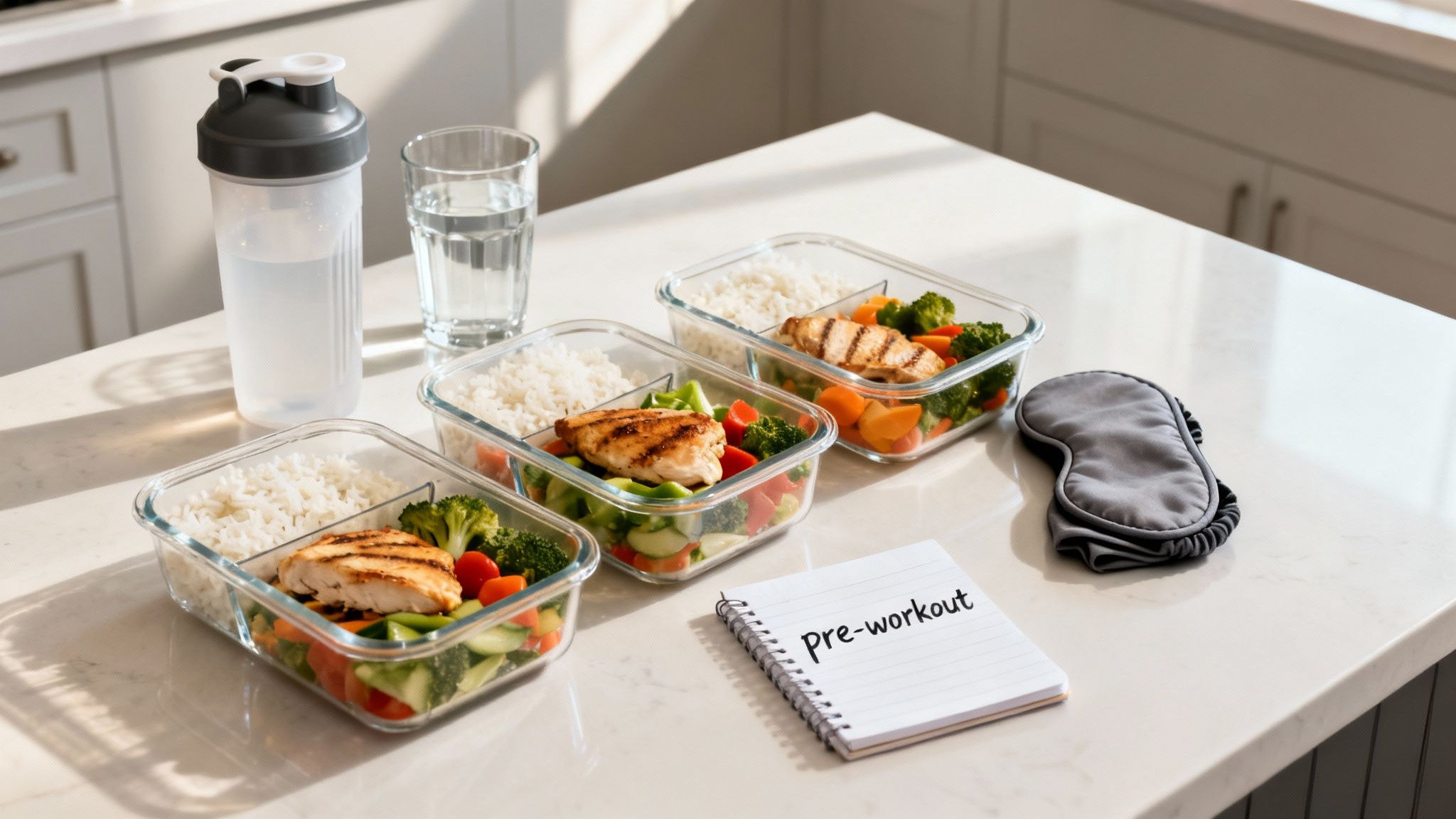
- Pre-Workout (1-2 hours before): You need fuel that’s easy to digest. Think carbs with a little protein. A banana and a scoop of whey or a bowl of oatmeal with berries are perfect examples. This tops off your energy stores so you can hit the weights hard.
- Post-Workout (Within 2 hours after): This is your prime recovery window. Get in a meal with plenty of protein and carbs to replenish your energy and kickstart the muscle repair process. Something like grilled chicken with sweet potatoes or a lean beef and rice bowl is ideal.
If you’re trying to gain muscle while keeping things lean, finding the right snacks can be a game-changer. There are plenty of great ideas for healthy snacks for weight loss that won’t throw you off track.
The Non-Negotiables of Recovery
Recovery isn't just about taking days off; it's an active process. The two things that will absolutely make or break your results are sleep and what you do on your rest days. Honestly, they’re just as critical as any set you perform.
Sleep is when your body does most of its repair work, producing growth hormone to rebuild muscle. Hitting 7-9 hours of quality sleep every night isn’t a luxury—it’s a necessity if you're serious about your goals. Skimp on sleep, and you can kiss your gains goodbye.
Your rest days are for repair, not for sitting on the couch all day. Light activity gets the blood flowing to sore muscles, helping to clear out metabolic waste and speed up the whole recovery process.
Your two rest days in this program are opportunities to get ahead. Instead of being completely sedentary, work in some active recovery.
Simple Active Recovery Strategies:
- Low-Intensity Cardio: Go for a 20-30 minute walk, a light bike ride, or a gentle swim. The goal is just to move and get the blood pumping, not to have another tough workout.
- Mobility Work: Spend 15-20 minutes with a foam roller or doing some dynamic stretches. Focus on tight spots like your hips, hamstrings, and upper back. It’ll do wonders for soreness and flexibility.
- Hydration and Fueling: Don't slack off on your nutrition just because it's a rest day. Your body is in full-on repair mode and needs those nutrients. Keep chugging water and hitting your protein goals.
Mastering your recovery is what separates good results from great ones. To dive deeper, check out these powerful workout recovery tips and build a system that works for you 24/7.
Making the 5 Day Program Work for You
Let's be real—no workout plan is one-size-fits-all. The real magic of a 5 day lifting program is how you can tweak it to fit your body, your schedule, and your specific goals. Think of this as your guide to making those smart, effective adjustments.
The program I've laid out is a solid template, but you have to make it your own. For instance, if your main goal is shedding fat, you'll want to add some cardio. The trick is to do it strategically. Squeeze it in on your two rest days, or tack it on right after your lifting sessions. This way, you're not burning up the fuel you need for those heavy compound lifts.
Smart Substitutions for Pain-Free Progress
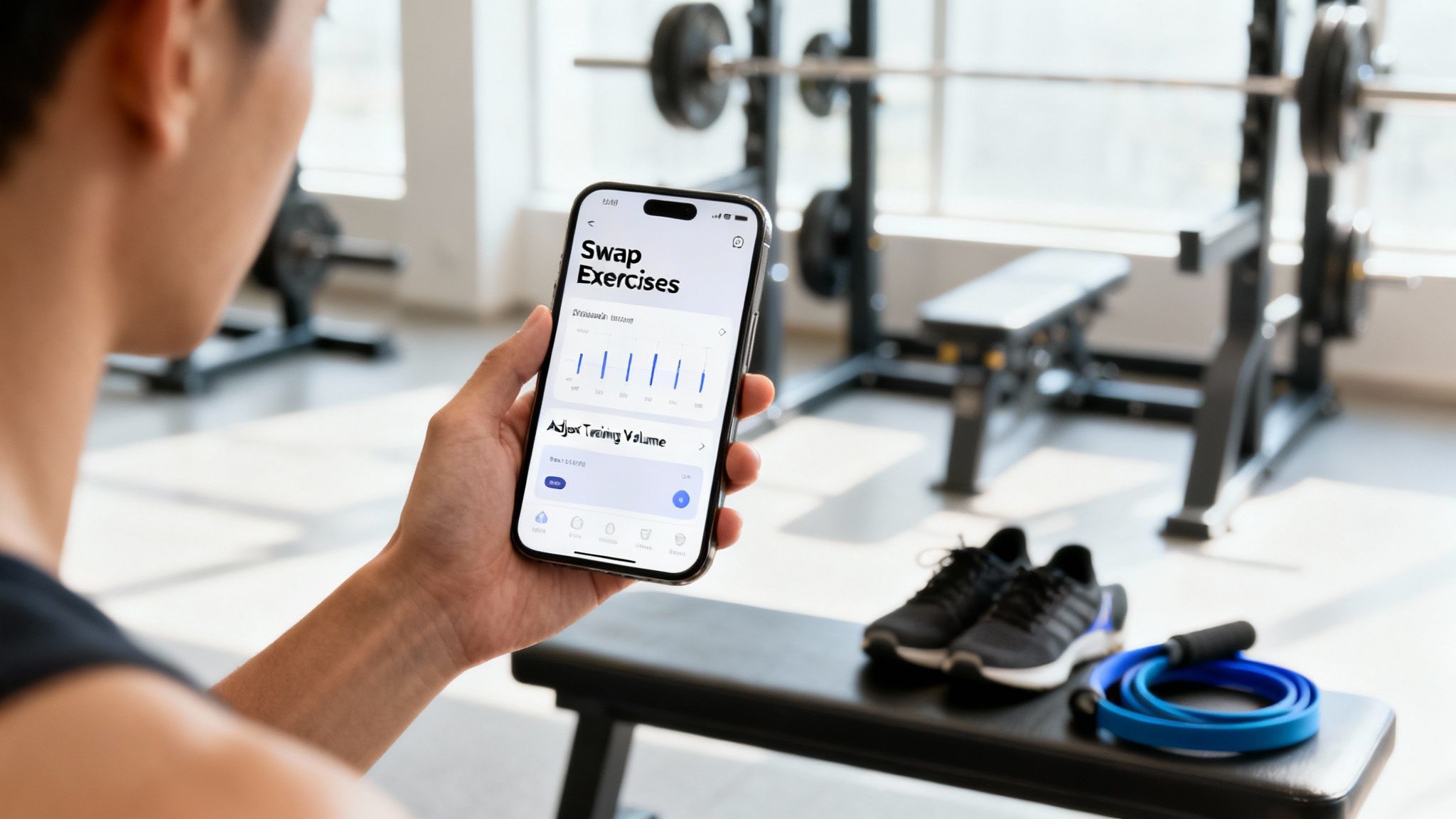
A nagging injury or limited mobility shouldn't sideline your training. The goal is to work around the problem, not push through the pain. This means making intelligent exercise swaps that still hit the right muscles without aggravating anything.
I've seen it all in the gym. Here are a few common scenarios and the go-to solutions:
- Nagging Shoulder Pain? Ditch the Barbell Overhead Press for a Landmine Press. This puts your shoulder in a much more natural, less stressful position while still building serious pressing power.
- Lower Back Discomfort? Swap heavy Barbell Back Squats for Goblet Squats or a Leg Press. You'll reduce the direct load on your spine but still hammer your quads effectively.
- Wrist Issues? Substitute traditional Barbell Rows with a Chest-Supported Machine Row. This takes stabilization out of the equation and lets you focus 100% on pulling with your back.
Of course, to stick with any program, the practical stuff matters, too—like nailing your form, getting enough rest, and selecting appropriate gym apparel that lets you move freely.
Leveraging Technology for True Personalization
This is where things get really interesting. Modern fitness tech can be a total game-changer, taking all the guesswork out of personalization and creating a program that actually grows with you.
A huge meta-analysis showed that training muscles more frequently is superior for upper body strength. A 5-day split, by its nature, hits muscles more often and delivered 20-50% more upper body strength over 8-12 weeks compared to old-school "bro splits."
An AI-powered tool like the Zing Coach app is designed for this. When you start, it puts you through a quick fitness assessment. It uses that info—plus your goals and the equipment you have—to fine-tune the volume, intensity, and even the specific exercises in your 5 day lifting program.
The best part? It keeps learning. Based on your performance and feedback, it automatically adjusts future workouts so you're always being challenged just enough to keep progressing. This data-driven approach is the future of building effective plans. If you're starting from square one, our guide on how to create a workout plan for beginners covers the foundational principles that this kind of technology can then build upon.
Common Questions About 5 Day Lifting Programs
Jumping into a five-day training schedule can bring up a lot of questions. It’s a big commitment, and you want to be sure you're setting yourself up for success, not burnout. Let's clear up some of the most common concerns so you can start with total confidence.
This section tackles the questions that pop up most often when people consider a 5 day lifting program.
Is a 5 Day Lifting Program Too Much for a Beginner?
This is a huge one, and the short answer is no—as long as the program is built correctly. A five-day routine can actually be fantastic for beginners because it quickly builds the habit of consistency. It also gives you frequent chances to practice and master your form on the big lifts without totally frying your body in a single session.
The key is managing the intensity and total volume. A beginner's five-day plan shouldn't look anything like an advanced lifter's. You'll start with lighter weights, fewer total sets, and a laser focus on perfect technique over ego lifting.
How Long Should My Workouts Be?
Because you’re training more frequently, each session gets to be shorter and more focused. You should be aiming for workouts that last between 45 and 60 minutes. Forget the idea that you need marathon two-hour sessions to see incredible results with this kind of split.
Your goal here is efficiency. Get in, warm up properly, hit your main compound lifts with intensity, finish your accessory work, and get out. Keeping your rest periods tight—generally 60 to 90 seconds for most exercises—is what keeps the workout moving and helps you finish inside that one-hour window. This is what makes the program so sustainable, even if you have a hectic schedule.
Forget the "more is always better" mindset. A well-executed 45-minute session is far more productive than a sloppy, two-hour workout. Quality over quantity is the name of the game.
What Should I Do If I Miss a Day?
Life happens. Don’t panic and definitely don't try to cram two workouts into a single day. That’s just a fast track to fatigue and potential injury. The best thing to do is simply pick up right where you left off.
For example, if you miss Wednesday's Push Day, just do that workout on Thursday and push the rest of your week back by a day. Your training week might bleed into the weekend, but that’s perfectly fine. Remember, long-term consistency will always trump short-term perfection. One missed day is just a tiny blip on the radar.
How Should I Add Cardio to This Program?
Adding cardio is a great way to support your heart health and any fat loss goals you might have. The smartest way to do it is to make sure it doesn’t get in the way of your lifting performance or recovery.
Here are the best ways to fit it in:
- On Rest Days: This is the ideal scenario. Schedule 2-3 cardio sessions on your two non-lifting days. This ensures 100% of your energy is dedicated to lifting on your training days.
- After Lifting: If you'd rather do cardio on lifting days, always do it after your weight training. This saves your strength for the heavy lifting that actually builds muscle.
- Keep It Moderate: Stick to low-to-moderate intensity stuff like incline walking, cycling, or the elliptical for 20-30 minutes. Trying to pair high-intensity interval training (HIIT) with a demanding 5 day lifting program can be too taxing on your recovery.
Ready to stop guessing and start a lifting program that’s built for you? Zing Coach uses AI to create a truly personalized 5-day plan that adapts to your goals, equipment, and performance. Get your customized workout and start seeing real results at https://zing.coach.
Share this article


Authors