No bench? No problem. Learn bench press no bench alternatives like the floor press, push-ups, and dips to build a powerful chest anywhere, anytime.
Let's be real: the flat bench press is hailed as the king of chest day. But what happens when you don't have one? A bench press no bench workout isn't a compromise; it's a smart strategy. By swapping in powerful alternatives like the floor press and clever push-up progressions, you can build serious strength and muscle mass.
These methods do more than just work around equipment limits. They actually offer unique benefits, like improving shoulder health and core stability, that a standard bench press might not.
Why You Can Absolutely Build a Great Chest Without a Bench
It's a common gym myth that a bench is non-negotiable for a powerful chest. The truth? Your pecs don't know if you're lying on a fancy bench or the floor. They only respond to tension, resistance, and progressive overload. Effective training is all about how you challenge the muscle, not the specific piece of furniture you're using.
This is where no-bench alternatives really shine. Take the floor press, for example. It gives you a rock-solid base and a slightly shorter range of motion, which can be a game-changer for anyone with cranky shoulders, all while letting you still push heavy weight. Then you have push-up variations, which create constant tension and metabolic stress—both proven drivers of muscle growth.
Your Top No-Bench Press Alternatives At A Glance
To help you get started, here's a quick look at the best bench-free exercises. This table breaks down what each movement targets, the gear you'll need (if any), and who it's best suited for.
| Exercise | Primary Muscle Groups | Equipment Needed | Best For |
|---|---|---|---|
| Floor Press | Chest, Triceps, Shoulders | Barbell or Dumbbells | Building raw strength and protecting shoulders |
| Push-Up Variations | Chest, Triceps, Core | Bodyweight (optional bands) | Muscular endurance and hypertrophy |
| Dumbbell Squeeze Press | Inner Chest, Triceps | Dumbbells | Isolating the inner pecs for a fuller look |
| Resistance Band Press | Chest, Shoulders, Triceps | Resistance Bands | Consistent tension and portable workouts |
Think of these as your new toolkit for chest day. Each one offers a different stimulus, helping you build a well-rounded and powerful upper body without ever needing to wait for a bench to free up.
Adapting to What You’ve Got
The fitness world is leaning more and more into adaptable, minimalist training. Even though the bench press rack market hit USD 1.2 billion in 2024, it's telling that adjustable benches without integrated racks make up 62% of sales. This shows a huge demand for more compact, versatile solutions.
For busy people and beginners—like many of our users at Zing Coach—no-bench options are perfect. In fact, studies show floor presses can effectively mimic the bench press at 70-80% of your max load, building comparable chest muscle without all the bulky equipment.
This flowchart breaks down exactly where to start based on what you have on hand.
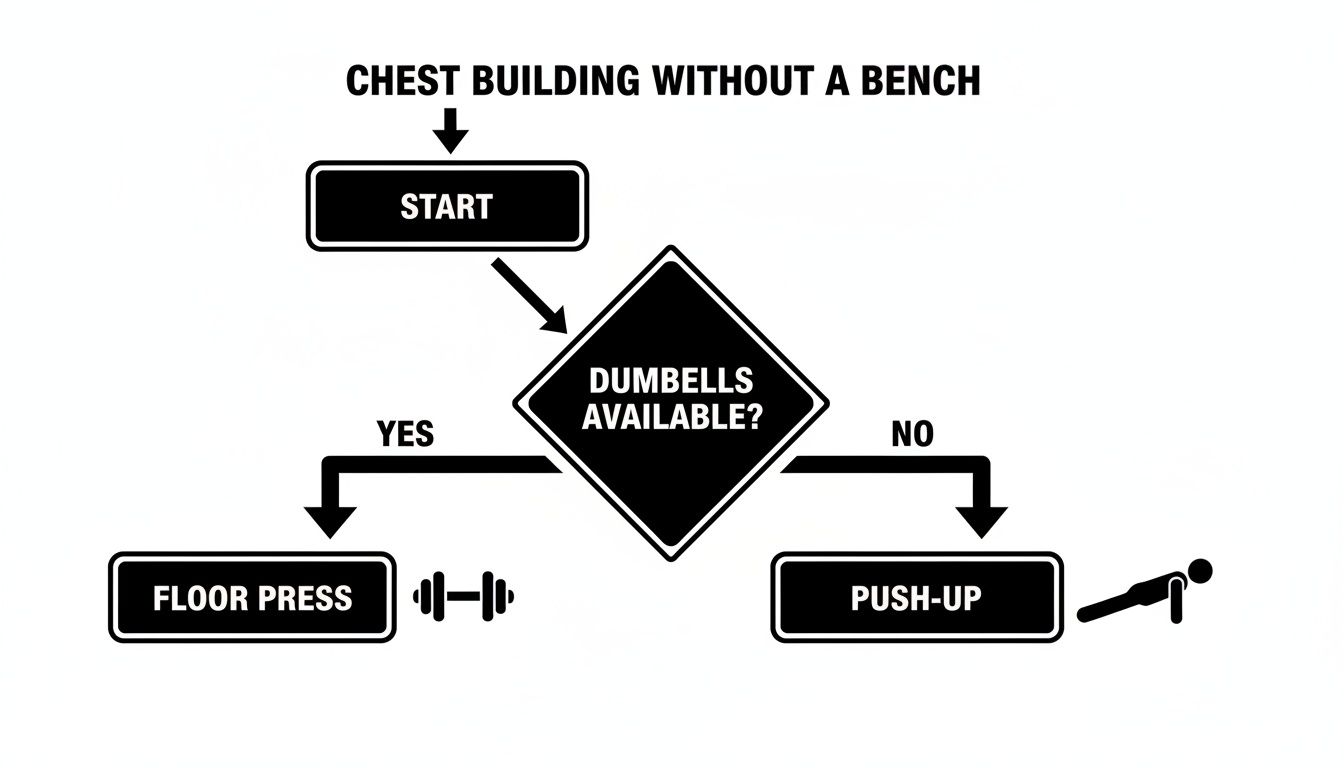
As you can see, there's always an effective path forward. Whether you're working with a set of dumbbells or just your own bodyweight, you have everything you need to start building a stronger chest today.
Key Takeaway: Real, consistent progress comes from smart adaptation, not from owning every piece of equipment in the gym. If you focus on solid movement patterns and progressive overload, you'll get impressive results, bench or no bench.
To see just how many options you have, check out our comprehensive guide on chest exercises that you can mix and match in your routine. This proves that a bench is just a tool, not a requirement for building a powerful physique.
Mastering The Floor Press For Raw Strength
The floor press is the undisputed champion of heavy, bench-free pressing. It’s way more than just a substitute for the bench press; it's a powerful tool for building raw strength and smashing through plateaus, especially when it comes to lockout power.
By taking leg drive out of the equation and shortening the range of motion, the floor press puts an intense focus on your chest, shoulders, and particularly your triceps. This is your go-to for developing pure upper-body pressing strength.
Because the floor stops your elbows, you get a consistent and safe endpoint for every single rep. This makes it a fantastic choice for lifters of all levels, even those with sensitive shoulders. It forces you to control the weight without relying on momentum.
Nailing The Technique
Proper execution is everything if you want to get the most out of this lift. Whether you're using a barbell or dumbbells, the core principles are the same, but the setup is a bit different for each.
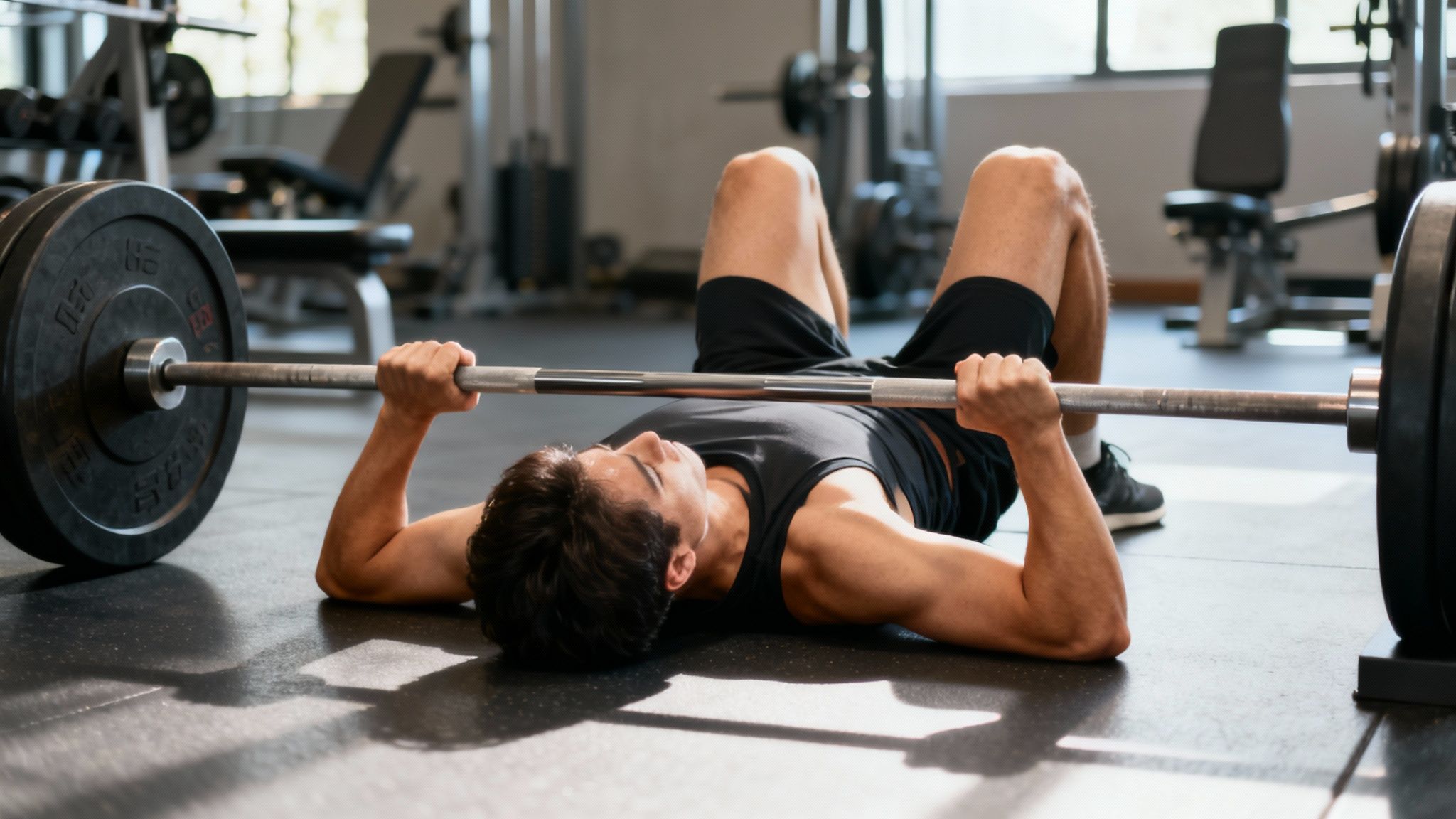
For a barbell floor press, you need a way to get the bar over your chest. If you've got a squat rack, you can set the safety pins low enough to roll the bar out. No rack? No problem. You can deadlift the bar to your thighs, sit down, and then carefully roll it over your hips and into position. It's sometimes called the "roll of shame," but it's an effective setup that just takes a little practice.
With dumbbells, the setup is much simpler. Just sit on the floor with the dumbbells resting on your thighs. From there, lie back while kicking the weights up into the starting position at the same time. If you need a visual, our guide on the dumbbell floor press breaks this down perfectly.
A critical mistake I see all the time is flaring the elbows out to 90 degrees. You need to tuck them to a 45–75 degree angle from your torso. This protects your shoulder joints and gives you a much stronger, more stable press.
Key Performance Cues
Once you're in position, lock in on these details to maximize muscle activation and keep yourself safe:
- Scapular Retraction: Squeeze your shoulder blades together and pull them down, almost like you’re trying to tuck them into your back pockets. This creates a solid shelf to press from.
- Foot Placement: Plant your feet flat on the floor with your knees bent. This gives you a solid base and helps you brace your core.
- Controlled Descent: Lower the weight under control until your triceps gently touch the floor. Don’t just drop and bounce the weight; pause for a split second to kill all momentum.
- Explosive Drive: Press the weight up powerfully. Think about driving through your chest and triceps until your arms are fully locked out at the top.
One of the biggest advantages here is efficiency. Some research shows that floor presses can activate 92% of the pectoral muscle recruitment you get from a standard bench press, all while slashing setup time by as much as 80%. This is a huge win for Zing Coach users who need effective workouts that fit into a packed schedule, and this data really proves its value. You can learn more about global trends in weight training equipment if you're curious.
Master these cues, and you can turn the simple floor press into a cornerstone of your chest training, building serious strength with minimal gear.
How To Unlock Chest Growth With Push-Up Variations
Often brushed off as a simple warm-up, the humble push-up is secretly one of the most powerful and versatile tools you have for building a bigger chest. When you’re figuring out how to do a bench press no bench workout, mastering push-up progressions is an absolute must.
This classic bodyweight exercise forces your pecs, triceps, and shoulders to fire in unison, all while your core works overtime to keep you stable. The real magic, though, is how easily you can scale it. By tweaking your body angle, hand placement, or even the speed of your reps, you can target different areas of your chest and crank up the difficulty. This is how you achieve progressive overload—the key to muscle growth—without ever needing to pick up a weight.
Starting with a Solid Foundation
If you find standard push-ups a bit too tough right now, no problem. Your starting point is the incline push-up.
By placing your hands on a sturdy chair, a countertop, or even a set of stairs, you reduce how much of your own bodyweight you have to lift. This is perfect for building that initial strength and really nailing your form from day one.
As you get stronger, just find a lower surface. The closer you get to the floor, the harder the exercise becomes, creating a smooth path toward doing a full push-up. For a deep dive into the mechanics, check out our guide on the correct form for push-ups.
Progressing to Advanced Variations
Once you can knock out multiple sets of standard push-ups with good form, it's time to up the ante to trigger new growth. You don't need a dumbbell rack for this—just gravity and a bit of creativity.
- Decline Push-Ups: Elevate your feet on a box or chair. This simple change shifts more weight onto your upper body, hitting the upper chest and front delts much like an incline press would.
- Weighted Push-Ups: Got a weight plate or a sturdy backpack? You've got a weighted push-up. Place a plate on your upper back or load a pack with books to instantly make every rep more challenging.
- Plyometric Push-Ups: If you want to build explosive power, plyo push-ups are your friend. Explode upward with enough force that your hands briefly lift off the ground. This high-intensity move recruits the fast-twitch muscle fibers that are critical for strength gains.
The secret to real progress isn't just about chasing more reps. It's about consistency and smart variation. Slow down the lowering phase of the lift, pause at the bottom, or move to a tougher version. That’s what keeps your muscles guessing—and growing.
Fine-Tuning for Maximum Impact
Beyond the main progressions, small adjustments can make a huge difference.
Bringing your hands closer together for a close-grip push-up will absolutely torch your triceps and inner chest. On the flip side, taking your hands slightly wider can put a greater stretch and more tension on your outer pecs.
Play around with these variations. When you start treating the push-up as a primary strength builder instead of just an afterthought, you unlock one of the best tools for building serious mass and strength. No bench required.
Creative Equipment Solutions For Benchless Pressing

No bench? No problem. Having just a few key pieces of equipment can unlock a whole new world of pressing movements. Your living room can quickly become a functional space for building serious chest strength with a little creativity.
Resistance bands, for instance, are game-changers. Unlike free weights where the tension is heaviest at the bottom, bands give you what's called accommodating resistance. This just means the tension ramps up the higher you press, forcing your muscles to work harder all the way through the movement, especially at the lockout where your triceps really have to fire.
This dynamic tension is fantastic for building explosive power and muscle endurance. If you're just starting out, learning how to use versatile gear like this is key. A good guide on home gym equipment for beginners can be a huge help here.
Harnessing Dynamic Tension With Bands
For a resistance band chest press, you can lie on the floor and loop the band behind your back, or you could anchor it to something sturdy for a standing press. As you push, focus on a smooth, controlled motion and feel that resistance build. It’s a unique stimulus that dumbbells and barbells just can't replicate.
You can dig into the specifics of this exercise in our detailed guide to the band floor press. It’s a simple but surprisingly effective way to add some variety and challenge to your routine.
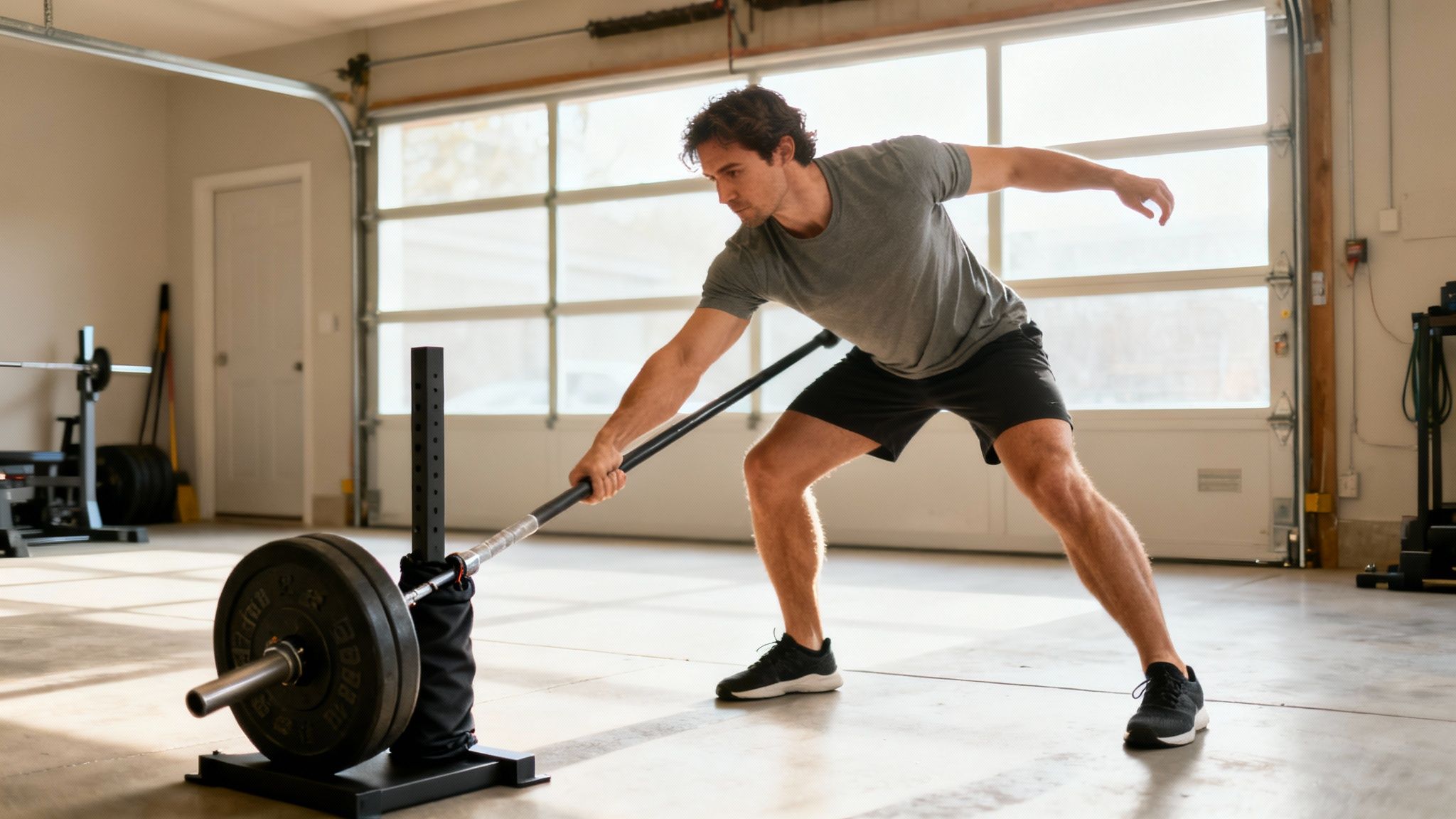
Building Unilateral Strength With Landmine Presses
If you've got a barbell and a corner, you have everything you need for a landmine press. This movement involves pressing the end of a barbell up and away from your body, either from a kneeling or standing position.
The arcing motion is incredibly shoulder-friendly and makes each side of your body work on its own. This kind of unilateral work is fantastic for evening out strength imbalances. Plus, your core has to fire like crazy to keep your torso from twisting, which turns this chest exercise into a full-body stability challenge.
Using Your Bodyweight With Dips
And let's not forget about bodyweight dips. With two sturdy chairs or a set of parallel bars, you can hit your lower chest and triceps with one of the most effective exercises out there. Lean your torso forward a bit, and you'll shift even more of the focus onto your pecs.
For beginners or those managing injuries, bodyweight dips are a standout choice. Recent biomechanics studies found they match 65% of the bench press load for chest and triceps activation but with a 20% lower risk of shoulder strain.
This fits right in with what we're seeing in fitness trends. Since the pandemic, home gym growth has shot up by 30%, with about half of users choosing versatile gear over traditional benches. These creative solutions really prove you can build an impressive chest without ever needing a dedicated bench.
How To Program Your No-Bench Chest Workouts
Knowing the best bench press no bench exercises is one thing, but the real magic happens when you string them together into a smart workout plan. This is what separates random exercises from a program that actually builds muscle and strength over time.
The way you structure your workout really boils down to your primary goal. Are you chasing pure strength, trying to move the heaviest weight possible? Or is your focus on hypertrophy—building bigger chest muscles? They sound similar, but the approach for each is a bit different.
For instance, a strength-focused routine means lifting heavier for fewer reps. This requires longer rest periods to let your central nervous system recover for the next big lift. On the other hand, a hypertrophy plan uses more moderate weights for higher reps to create that muscle-building "pump" and time under tension.
Programming For Your Specific Goal
Let's break down how to structure your training based on what you want to achieve. The principles are simple but incredibly effective when you stick with them.
If you're training for raw strength, a solid plan might look like this:
- Sets: 4-5
- Reps: 3-6
- Rest: 2-3 minutes between sets
- Focus: Center your workout around heavy, compound movements like the floor press.
If your main goal is maximizing muscle size, the strategy shifts:
- Sets: 3-4
- Reps: 8-15
- Rest: 60-90 seconds between sets
- Focus: Use a mix of compound and isolation work, like different push-up variations and band presses.
This gives you a clear roadmap to follow. From here, you just need to apply these principles to the equipment you have. Getting these concepts down is a huge step if you're serious about your training, and you can dive deeper in our guide on how to build muscle at home.
The best program is the one you can stick with consistently. Whether you have a full set of dumbbells or just your bodyweight, the key is showing up and applying progressive overload over time.
Sample No-Bench Chest Workout Routines
To make it even easier, here are two sample routines you can start using right away. The first one is pure bodyweight, while the second incorporates dumbbells and resistance bands. Each is designed with a specific focus—hypertrophy for the bodyweight plan and a blend of strength and size for the equipment-based one.
Think of these as templates. If a rep range feels too easy, find a way to make it harder. You could slow down your tempo, add a pause, or move to a more challenging exercise variation.
| Workout Type | Exercise | Sets x Reps | Rest Period |
|---|---|---|---|
| Bodyweight (Hypertrophy) | Decline Push-Ups | 3 x 8-12 | 60 seconds |
| Close-Grip Push-Ups | 3 x As Many Reps As Possible | 60 seconds | |
| Bodyweight Dips (using chairs) | 3 x 10-15 | 90 seconds | |
| Dumbbells/Bands (Strength & Hypertrophy) | Dumbbell Floor Press | 4 x 6-8 | 2 minutes |
| Dumbbell Squeeze Press | 3 x 10-12 | 90 seconds | |
| Banded Push-Ups | 3 x As Many Reps As Possible | 60 seconds |
Plug one of these workouts into your weekly split and concentrate on beating your last performance every single session. Whether it's adding just one more rep or moving to a tougher variation, that small, consistent effort is what builds a powerful chest without ever needing a bench.
Common Questions About Bench-Free Training
When you're used to seeing the bench press as the gold standard for chest day, the idea of training without one can raise a few eyebrows. It's only natural to have questions. Getting the right answers is key to making sure you're training smart, not just hard.
Let's clear the air and tackle some of the most common things lifters wonder about when they ditch the bench. This should give you the confidence you need to get the most out of your bench press no bench workouts.
Can I Really Build a Big Chest Without a Bench
Absolutely. Your chest muscles couldn't care less whether you're lying on a fancy bench or the floor. What they do care about is progressive overload—the simple principle of making your workouts more challenging over time.
By consistently getting stronger at heavy floor presses and mastering tough push-up variations, you're creating all the mechanical tension needed to spark serious muscle growth. Just focus on adding weight, doing more reps, or perfecting your form, and your chest will get the message.
Is The Floor Press Safer For Your Shoulders
For a lot of folks, it's a game-changer. The floor is your built-in spotter, physically stopping your elbows from dipping too far down. This simple mechanical stop prevents your shoulders from moving into that deep, hyper-extended position that often causes issues with traditional benching.
Because it has that built-in safety stop, the floor press is a fantastic option for anyone with a history of cranky shoulders. It lets you press heavy and build serious strength in your chest and triceps with a much lower risk of injury.
How Do I Choose The Right Exercise
The "best" exercise really comes down to two things: what equipment you have on hand and what you're trying to accomplish.
- For pure strength: The floor press is king. It's the best way to load up heavy with a barbell or dumbbells.
- For muscle size without equipment: Your go-to is mastering push-up progressions. Don't underestimate them.
- For variety and athletic development: Resistance band presses and dips are brilliant for hitting your chest from different angles and building more functional, real-world strength.
Start with what you've got access to and make consistent improvement your main goal.
How Can I Make Bodyweight Moves Harder
You don't always need more weight to make an exercise harder. Manipulating your technique is one of the most effective ways to trigger new growth with just your body weight.
Next time you do push-ups, try one of these tweaks to ramp up the intensity:
- Slow down the eccentric: Take a full 3-4 seconds to lower your chest toward the floor. The burn is real.
- Add a pause: Once you're at the bottom, hold that position for a one or two-second count before pushing back up.
- Elevate your feet: Doing decline push-ups shifts more of your body weight onto your chest and shoulders, making every single rep noticeably tougher.
Ready to stop guessing and start building a chest workout that’s perfectly suited to you? Zing Coach uses AI to create personalized training plans based on your goals, equipment, and fitness level, complete with real-time form correction to keep you safe. Start your journey with Zing Coach today!
Share this article


Authors