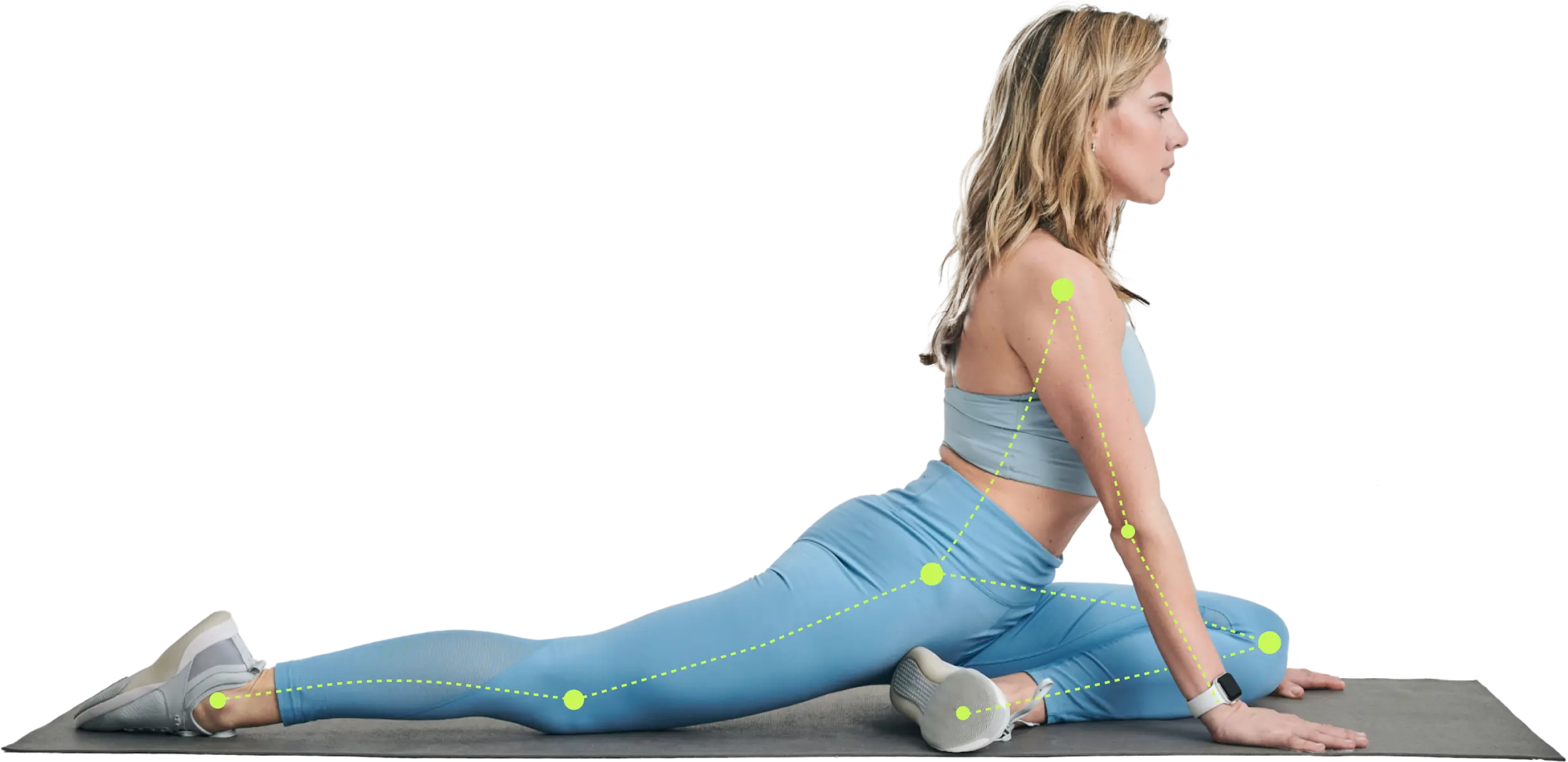
Learn how to build muscle at home with this science-backed guide. Discover effective workouts, nutrition plans, and smart strategies for real gains.

Forget the gym commute. Building serious muscle at home isn't just a backup plan anymore—it's about applying proven principles like progressive overload and smart nutrition consistently, right in your living room.
You can achieve significant strength and muscle growth with a solid plan that uses bodyweight exercises and minimal equipment.
The Rise of the Home-Built Physique

The idea of building a powerful physique without ever stepping into a commercial gym used to feel like a compromise. Today, it’s a strategic choice for millions. This isn't just some passing trend; it's a fundamental shift in how we approach fitness, driven by undeniable convenience and smarter training methods that flat-out deliver.
Imagine ditching the traffic and still packing on muscle. This reality is backed by a huge shift in how people train. Back in 2019, only 24% of exercisers in the US worked out at home. By 2023, that number exploded, with a whopping 51% preferring at-home sessions for their comfort and ease.
Even better, home exercisers are often more consistent—and consistency is the real secret to long-term progress. You can find more insights about these home fitness industry statistics online.
This guide goes way beyond generic advice. We're giving you a science-backed blueprint designed to make building muscle at home not just possible, but highly effective for anyone, no matter where you're starting from.
Why Home Workouts Are No Longer a Compromise
A workout's effectiveness isn't determined by its location, but by the principles you apply. Home fitness has evolved from random online videos to structured, intelligent programming. The old barriers to entry have vanished, making it easier than ever to start and, more importantly, stay on track.
Here’s why the home-built physique is becoming the new standard:
- Unmatched Consistency: When you remove travel time and gym fees, you eliminate the most common excuses. A 30-minute session is always within reach, making it far easier to stick to your routine.
- Laser-Focused Training: Without the distractions of a crowded gym, you can concentrate entirely on your form, tempo, and that all-important mind-muscle connection. This focus leads to higher-quality reps and better results.
- Cost-Effective and Accessible: You don't need a room full of expensive machines. A few key pieces of equipment, like resistance bands or adjustable dumbbells, can unlock hundreds of killer exercises.
At its core, muscle growth responds to tension, not location. Your muscles can't tell if you're lifting a custom-machined dumbbell in a high-end gym or a backpack filled with books. They only understand one thing: challenge and the need to adapt.
This guide will show you exactly how to create that challenge systematically. We'll get into the specific methods to stimulate hypertrophy, fuel your body for growth, and track your progress so you never hit a plateau. Welcome to your new gym—it’s always open.
Your Foundational Home Workout Blueprint
Forget complicated plans and rooms full of expensive equipment. To build real muscle at home, you just need a smart blueprint—one built on efficiency and consistency.
The absolute cornerstone of this plan is compound movements. These are the big exercises that recruit multiple muscle groups at the same time.
Think about it this way: a bicep curl is an "isolation" exercise. It only works that one small muscle. But a compound move like a pull-up? That single exercise hammers your back, biceps, shoulders, and core all at once. You get way more bang for your buck, stimulating more muscle fibers in less time and sparking a much better hormonal response for growth.
Structuring Your Week for Optimal Growth
If you're just starting out, a full-body routine is by far the most effective way to go. Forget those "bro splits" where you dedicate entire days to single body parts. Training your whole body in each session gives you a higher frequency of stimulus, which is perfect for learning proper form and maximizing muscle protein synthesis—the actual biological process of building new muscle.
Aim for 2-3 full-body workouts per week, making sure to take at least one full day of rest in between. A classic Monday-Wednesday-Friday split is popular for a reason. It strikes the perfect balance between stimulation and recovery, and recovery is when your muscles actually get bigger and stronger.
Choosing Your Essential Home Gym Tools
While you can get incredible results with just your bodyweight, investing in a few key pieces of gear can open up a whole new world of exercises and make progressive overload much, much easier.
Here are the essentials I'd recommend for any home setup:
- Resistance Bands: These things are unbelievably versatile. Use them for assisted pull-ups, add extra resistance to your squats and push-ups, or do targeted work like band pull-aparts to bulletproof your shoulders.
- Adjustable Dumbbells: They're a bigger investment up front, but a single pair of adjustable dumbbells can replace an entire rack of weights. This makes it simple to add weight to rows, presses, and lunges as you get stronger.
- A Pull-Up Bar: A simple doorway pull-up bar is one of the best investments you can make for building a powerful back and biceps. Can't do a pull-up yet? No problem. Use your resistance bands to give you a boost.
With just these simple tools, you have everything you need for a seriously challenging program. If you need some more ideas, you can check out these 8 at-home exercises to stay fit without the gym to keep things fresh.
Your First Full-Body Workout Plan
This routine is your starting line. The number one priority is mastering the form for each exercise. Don't even think about adding weight or chasing more reps until your technique is solid. Quality over quantity, always.
Plan to hit this workout 2-3 times per week on non-consecutive days. And don't skip your warm-up! Spend 5-10 minutes doing some light jogging in place, jumping jacks, and dynamic stretches like arm circles and leg swings to get your body ready.
The most important part of any workout plan is sticking to it. A "perfect" plan you only follow for a week is worthless. A "good enough" plan you stick with for months will completely transform your body.
Here is a simple, effective plan to get you started.
Sample Beginner Full-Body Home Workout
This table lays out your first routine. I highly recommend keeping a simple log of your performance—just jot down the reps you hit for each set. The next time you do the workout, your goal is simple: do just one more rep, or use slightly better form than last time. That's it. This is how you build muscle at home, one small victory at a time.
| Exercise | Target Muscles | Sets | Reps | Rest |
|---|---|---|---|---|
| Bodyweight Squats | Quads, Glutes, Hamstrings | 3 | 10-15 | 60 sec |
| Push-Ups | Chest, Shoulders, Triceps | 3 | As Many As Possible | 60 sec |
| Dumbbell Rows | Back, Biceps | 3 | 8-12 (per arm) | 60 sec |
| Glute Bridges | Glutes, Hamstrings | 3 | 12-15 | 45 sec |
| Plank | Core | 3 | Hold 30-60 sec | 45 sec |
| Jumping Jacks | Full Body (Cardio) | 2 | 30 seconds | 30 sec |
After you've completed all the sets for the main exercises, finish strong with the jumping jacks to get your heart rate up and improve your overall conditioning. Then, make sure to cool down with some light stretching. You've earned it.
Mastering Progressive Overload Without a Weight Rack
The secret to building muscle isn't having the fanciest gym membership; it’s about one non-negotiable principle: progressive overload. All this means is that you have to consistently make your workouts more challenging over time. Your muscles only grow when they’re forced to adapt to a demand greater than what they're used to.
If you don't keep challenging them, your body simply has no reason to change. The good news? You don’t need a heavy barbell to make this happen. You just need to get creative.
Adding another rep or two to your push-ups is a good start, but that's just scratching the surface. To really master building muscle at home, you need to understand all the different ways you can crank up the intensity of any exercise.
This flowchart breaks down the simple, three-part process for getting your home fitness routine structured and effective.
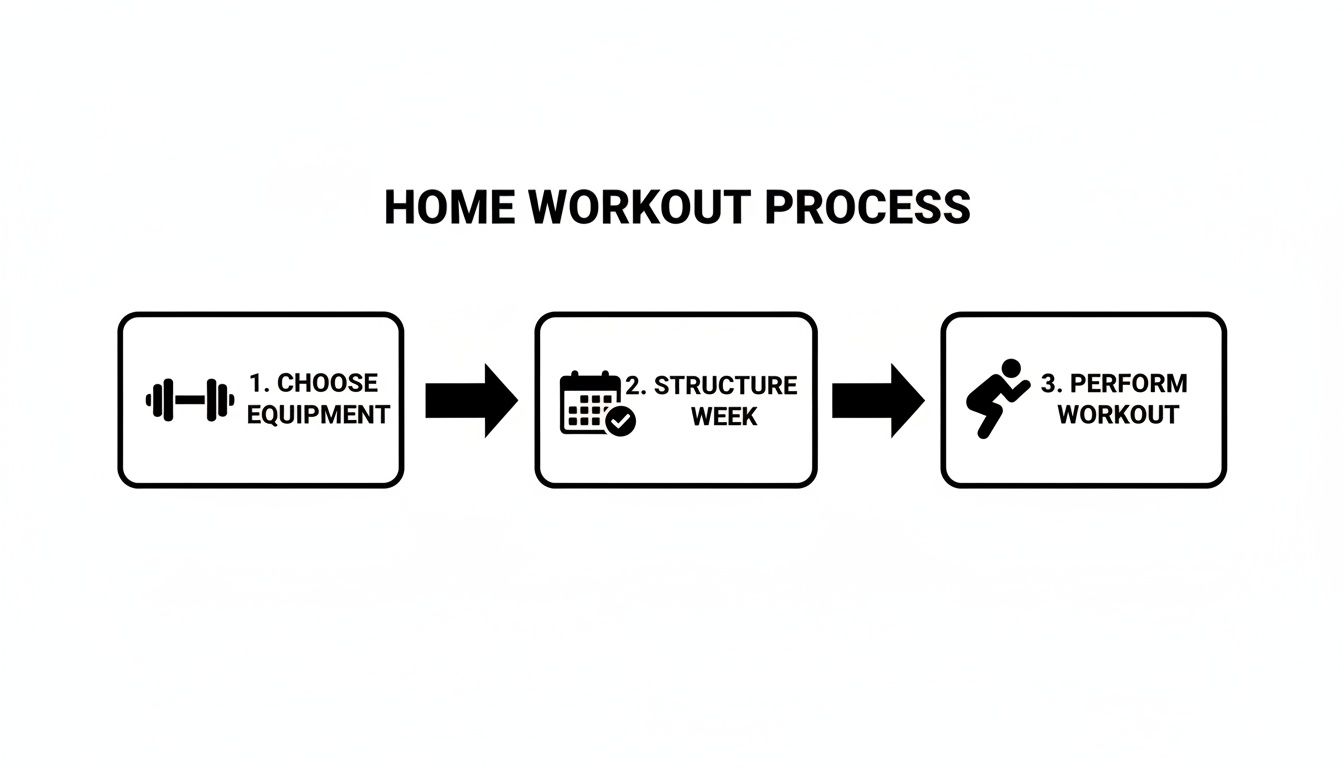
As you can see, success starts with picking your tools, planning your week, and then hitting your workouts with focus.
Go Beyond More Reps
Just adding more reps is the most common way people try to progress, but it has its limits. Eventually, you’ll find yourself doing 50 bodyweight squats in a single set, which is fantastic for endurance but not so great for building pure muscle size. To trigger real hypertrophy (the scientific term for muscle growth), you need to pull other levers.
Here are some smarter, more effective ways to progress your workouts from your living room:
- Increase Resistance: This is the most straightforward method. Grab a heavier dumbbell, switch to a thicker resistance band, or load up a backpack with books for your squats and push-ups. Even small jumps in weight force your muscles to adapt.
- Decrease Rest Time: What happens when you slice your rest time between sets from 60 seconds to 45? Your muscles have less time to recover, which ramps up the metabolic stress—a key driver of muscle growth.
- Improve Your Form: Perfecting your technique is about more than just safety. Actively squeezing your chest at the top of a push-up or controlling every inch of a row creates more tension on the target muscle. This makes every single rep more effective.
The goal isn't just to move weight; it's to make the target muscle do all the work. A sloppy, fast rep is a wasted opportunity. A slow, controlled rep with perfect form is how you build serious muscle at home.
Advanced Techniques for Bodyweight Training
When you can’t just slide another plate onto the bar, you have to make the movement itself harder. This is where bodyweight training really shines, offering endless variations that can challenge even the most advanced athletes.
Think of it like leveling up an exercise. Once you master the basic version, you unlock a more difficult one. This approach guarantees you're always pushing your limits and giving your muscles a fresh reason to grow.
Take the classic push-up, for example. Here’s a typical progression path:
- Wall Push-Ups: The perfect starting point if you're a complete beginner.
- Knee Push-Ups: The next level up, reducing the amount of bodyweight you have to press.
- Standard Push-Ups: The gold standard of bodyweight pressing.
- Decline Push-Ups: Put your feet on a chair to shift more weight onto your chest and shoulders.
- Archer Push-Ups: A seriously advanced variation that puts almost all the load on one arm at a time.
Each step up the ladder dramatically increases the difficulty, forcing your muscles to get stronger and adapt.
Manipulating Tempo for Maximum Tension
One of the most powerful—and most overlooked—tools in your arsenal is tempo, which is just the speed of your repetitions. By intentionally slowing down a movement, you increase the time under tension (TUT), or how long your muscle is actively working during a set.
Instead of just blasting through reps, try this on your next set of squats:
- Lower yourself down over four full seconds.
- Pause for one second at the very bottom.
- Explode back up to the starting position in one second.
That 4-1-1 tempo completely transforms the exercise. A set of 10 reps that used to take 20 seconds now takes a full minute to complete. This extended tension creates way more microscopic damage to the muscle fibers, which is the exact signal your body needs to rebuild them bigger and stronger. You can use resistance bands to make this even more effective; check out these loop band exercises to see how you can apply this principle right away.
The Science of Working Smarter, Not Harder
Let's bust a huge fitness myth right now: longer, more grueling workouts don't automatically lead to better results. The old-school idea that you have to spend hours in the gym to build muscle is completely outdated. Modern science actually shows that brief, intensely focused sessions can trigger significant muscle growth, which is great news for anyone trying to build muscle at home.
The real key is knowing the difference between productive effort and just spinning your wheels. Too many people fall into the trap of doing endless sets and reps, thinking more is always better. This leads to what trainers call "junk volume"—that point where any extra work stops helping and starts actively hurting your recovery and progress.
Why does this happen? Simple. Your body has a limited capacity to recover and adapt. Once you've stimulated your muscles enough to signal growth, any additional work just digs you into a deeper recovery hole without adding more muscle. This is exactly why a high-quality, 30-minute workout is far more effective than a random, hour-long session.
Finding Your Sweet Spot for Volume
So, what’s the magic number of sets? While it’s slightly different for everyone, research gives us a surprisingly clear target. It’s not about grinding out endless reps, but about hitting that sweet spot of just enough stimulus to kickstart growth.
A groundbreaking 2024 study crunched the data from dozens of trials and found something fascinating: muscle growth tends to plateau after about 11 hard, focused sets per session. The benefits drop off sharply beyond that point, meaning those extra sets are pretty much wasted effort. You can discover more insights about these strength training findings and see for yourself how less can truly be more.
This is fantastic news for anyone building muscle at home. It confirms you don't need marathon workouts. In fact, even just one or two intense sets per muscle group, spread across the week, can spark meaningful hypertrophy and strength gains. This approach is perfect for squeezing in a powerful 20-30 minute session on a busy day.
Quality Over Quantity in Every Single Rep
Knowing your optimal volume is only half the battle. The other half is making sure every single set counts for something. Instead of just going through the motions, you need to focus on generating maximum tension in the target muscle. This is where training with a bit of intelligence really pays off.
To get the most out of each set, focus on these key principles:
- Mind-Muscle Connection: Actively think about the muscle you're trying to work. When you're doing a push-up, consciously squeeze your chest muscles. This simple mental cue can dramatically increase muscle activation.
- Controlled Tempo: Like we talked about earlier, slowing down the negative (lowering) part of a lift increases time under tension, a critical factor for growth. Aim for a slow, 3-4 second negative on most exercises.
- Full Range of Motion: Using a complete range of motion ensures you're working the muscle through its entire length, which leads to better overall development and even improves flexibility.
A workout's effectiveness is measured by the quality of the stimulus, not the time on the clock. Ten perfectly executed, challenging reps will always build more muscle than thirty sloppy ones.
By combining the right amount of volume with high-quality execution, you create the perfect recipe for efficient muscle growth. If you’re trying to figure out how to structure your routine, you might be wondering how many different exercises you need. Our guide on how many exercises per muscle group gives you some clear, actionable advice. This whole approach respects your body's limits and ensures that every minute you spend training is a direct investment in real, sustainable progress.
Fueling Your Gains: The Home Muscle-Building Diet
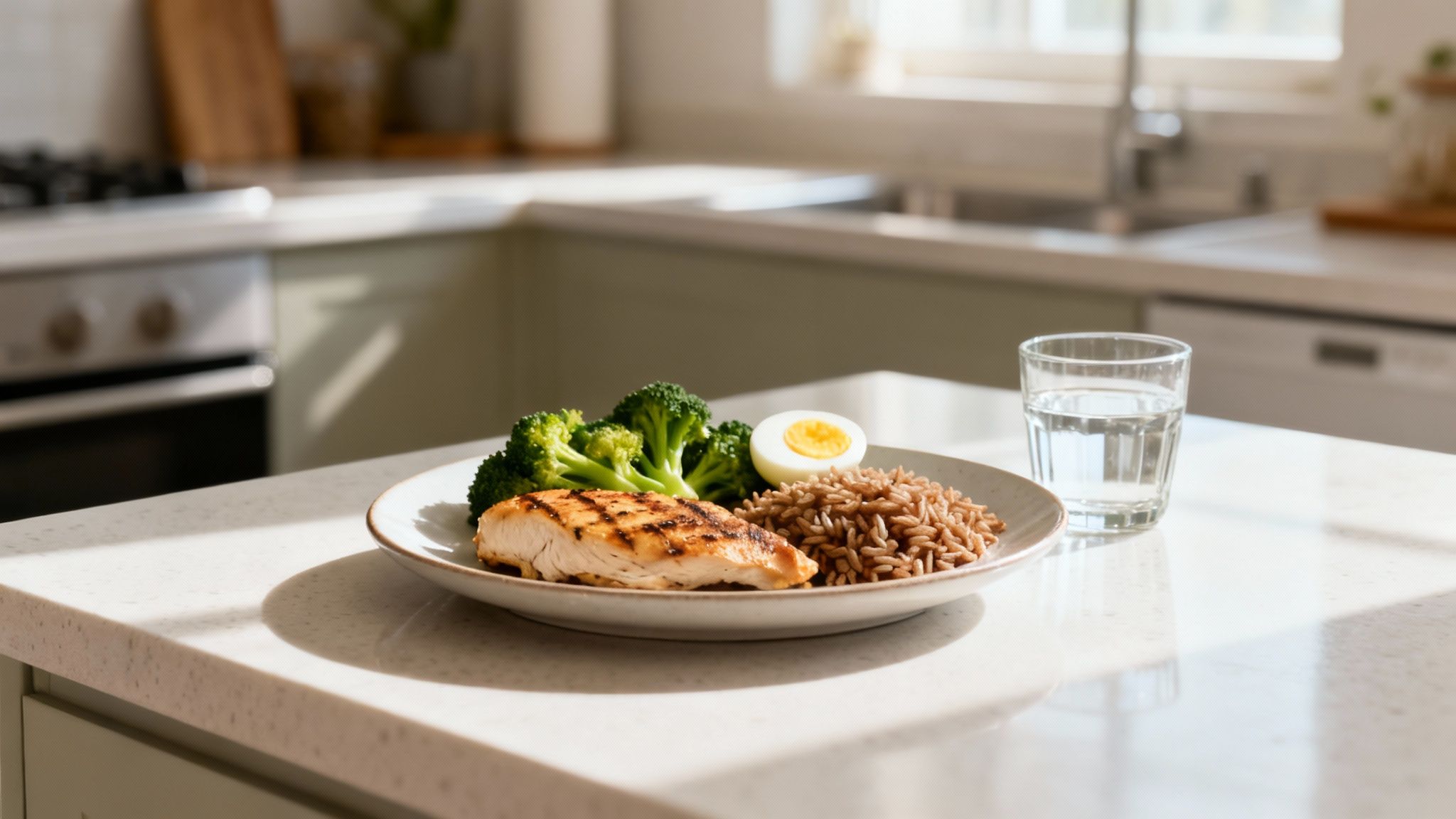
All those tough home workouts are the spark, but the real muscle growth happens in the kitchen. You can have the smartest training plan in the world, but it will fall completely flat without the right fuel.
Think of it this way: your workouts are like placing an order for new muscle. Your diet is the delivery of the building blocks needed to construct it. If the delivery never shows up, that order goes unfulfilled.
The good news? You don't need a nutrition degree to eat for muscle growth. The principles are surprisingly simple and easy to apply, even if you're juggling a busy schedule and a tight budget. It really all boils down to understanding your "macros."
Calculating Your Muscle-Building Macros
Macronutrients, or "macros," are just the three main nutrient categories you get from food: protein, carbohydrates, and fats. Each one has a critical job to do in helping you build muscle, and getting the right balance is what turns all your hard work into visible results.
Here’s a quick look at what each macro does for you:
- Protein: The Builder. This is non-negotiable. The amino acids in protein are the literal bricks your body uses to patch up and rebuild muscle tissue after you've broken it down during a workout.
- Carbohydrates: The Fuel. Carbs are your body’s go-to energy source. They give you the power to actually push through those tough sets and also help shuttle nutrients like protein into your muscle cells for better recovery.
- Fats: The Regulator. Don't skip the healthy fats. They’re absolutely vital for hormone production, including hormones like testosterone that are essential for muscle growth. They also keep your joints happy and support your overall health.
Eating for muscle gain isn’t about restrictive dieting; it’s about strategic fueling. You need to give your body a surplus of high-quality calories and the right building blocks to support all the effort you're putting in.
So, how much do you really need? When building muscle is the goal, the single most important number to get right is your protein intake. Aim for 1.6 to 2.2 grams of protein per kilogram of your body weight every day.
For a 180 lb (82 kg) person, that’s about 131-180 grams of protein daily.
Stocking Your Kitchen for Success
Knowing your protein target is one thing, but hitting it day after day is what counts. The trick is to keep your kitchen stocked with affordable, protein-heavy staples that make meal prep a no-brainer. You don't need fancy, expensive ingredients to fuel serious growth.
Zero in on these budget-friendly powerhouses:
- Chicken Breast (and thighs for more flavor and healthy fats)
- Ground Turkey or Lean Ground Beef
- Eggs (a perfect and cheap protein source)
- Canned Tuna or Salmon
- Greek Yogurt and Cottage Cheese
- Legumes like Lentils, Chickpeas, and Black Beans
- Tofu and Edamame for great plant-based options
For your carbs, lean on complex sources like oats, brown rice, quinoa, and sweet potatoes. For healthy fats, bring in some avocados, nuts, seeds, and olive oil. If you're consistently struggling to hit your protein goals with whole foods, it might be worth learning more about the strategic use of protein shakes and supplements to help fill the gaps.
A Sample Meal Plan That Delivers
Putting this all together can feel a little overwhelming at first, but it doesn't have to be complicated. Here’s a quick snapshot of what a simple, muscle-building day of eating can look like. The key takeaway here is how protein is included in every single meal, keeping your muscles in a constant state of repair.
Sample Daily Meal Plan
| Meal | Example | Protein Focus |
|---|---|---|
| Breakfast | Scrambled eggs with a side of oatmeal and berries. | Eggs |
| Lunch | Grilled chicken breast with quinoa and steamed broccoli. | Chicken |
| Snack | Greek yogurt with a handful of almonds. | Greek Yogurt |
| Dinner | Lean ground turkey with brown rice and mixed vegetables. | Ground Turkey |
| Evening | A bowl of cottage cheese or a casein protein shake. | Cottage Cheese |
This basic structure ensures you’re consistently giving your body the fuel it needs to recover, adapt, and get stronger from all your hard work at home.
Tracking Progress and Staying Motivated for the Long Haul
Nailing your workouts and nutrition is what builds the muscle, but your mindset is the glue that holds it all together. Real, lasting success comes from consistency. And the secret to staying consistent? Seeing tangible proof that your hard work is actually paying off.This is where smart progress tracking becomes your most powerful tool.
First things first: forget obsessing over the number on the bathroom scale. Your body weight can jump around daily thanks to water retention and a dozen other factors. It’s a notoriously poor indicator of real progress. We need to focus on metrics that truly reflect changes in your body composition and strength.
How to Track Progress Accurately
To get the full picture of your journey, you need to look at more than just one number. A few different data points will tell the whole story, not just a single, potentially misleading snapshot.
Here are the most effective ways to track your gains right at home:
- Progress Photos: Snap photos from the front, side, and back every 4-6 weeks. The key is consistency—use the same lighting, same spot, and same time of day to create a reliable visual log of your transformation.
- Body Measurements: Once a month, grab a simple measuring tape and track key areas like your chest, waist, hips, biceps, and thighs. Even a small increase in your arm measurement or a decrease around your waist is a huge win.
- Workout Log: This one is non-negotiable. Whether it's a simple notebook or an app, record your exercises, sets, reps, and the resistance you used for every single workout. Seeing your push-up count go from 8 to 15 is undeniable proof that you're getting stronger.
If you want to get even more granular with your tracking, our guide on how to measure body fat percentage breaks down several practical methods you can use without leaving the house.
The Psychology of Staying Consistent
Building muscle is a marathon, not a sprint. Your motivation will absolutely have its peaks and valleys. The trick is to build habits and systems that carry you through the days when you just don't feel like training.
Celebrating the small wins is crucial here. Did you add one more rep to your squats this week? Acknowledge it. That’s progress, plain and simple.
Motivation is what gets you started. Habit is what keeps you going. Focus on building the habit of showing up, even for a short workout, and the motivation will follow.
In the long run, mental discipline is just as critical as the physical work. Digging into the principles of sport psychology can give you some powerful strategies for building mental resilience on your fitness journey.
Set realistic, short-term goals, like finally mastering a new exercise variation. This approach turns the huge, long-term goal of building muscle at home into a series of smaller, achievable, and much more rewarding steps.
Common Questions About Building Muscle at Home
So, you've got the roadmap for building muscle right in your living room. But I'll bet a few questions are still bouncing around in your head. Let's tackle the most common ones so you can get started with confidence.
How Long Until I See Results?
This is the big one, right? The honest answer is: it depends, but patience and consistency are your best friends here.
Most beginners start to feel a difference—stronger, more capable—within 4 to 6 weeks. As for seeing those changes in the mirror? Give it about 8 to 12 weeks for noticeable muscle definition to appear. This all assumes you're hitting your workouts consistently and eating enough protein and calories to actually build new tissue. My advice? Snap some progress photos every month. It's the best way to see the subtle changes your eyes miss day-to-day.
Can I Really Build Muscle with Just Bodyweight Exercises?
Absolutely. You can build a seriously impressive physique without ever picking up a dumbbell. The magic isn't in the equipment; it's in the principle of progressive overload.
Think of it this way: your muscles don't know if you're lifting an iron plate or your own body. They only understand one thing: an increasing challenge. That’s the signal that forces them to get bigger and stronger.
Once you can bang out 15 standard push-ups without breaking a sweat, that movement is no longer a challenge. It's just maintenance. To keep growing, you have to make it harder. Try putting your feet on a chair for decline push-ups, or bring your hands closer for diamond push-ups. This constant "leveling up" is the secret to building muscle with nothing but your own body.
How Important Is Recovery for Muscle Growth?
Recovery isn’t just important—it’s where all the growth happens. Your workouts are just the signal you send to your body. The actual repair and muscle-building happens when you rest.
Skipping out on recovery is the fastest way to hit a wall. Aim for 7-9 hours of quality sleep every night. That’s prime time for your body to release growth hormone and get to work rebuilding. Also, give your muscles a break. Don't train the same body parts on back-to-back days. They need that time to heal up so they can come back stronger for the next session.
Ready to stop guessing and start building a physique you're proud of, right from home? Zing Coach creates a personalized training and nutrition plan that adapts to your progress, ensuring you're always challenged enough to grow.
Start your AI-powered home fitness journey at https://zing.coach
Share this article


Authors