Learn how to measure body fat percentage with our guide to simple at-home methods and advanced scans. Find the best option to track your fitness progress.
Figuring out how to measure your body fat percentage gives you a much clearer picture of your health than just stepping on a scale. Using tools like calipers, tape measures, or specialized scales, you can find out the ratio of fat mass to your total body mass. This one number offers a much deeper look into your fitness progress and overall well-being.
Why Body Fat Matters More Than Your Weight
The number on the scale only tells you your total weight—a mashup of bone, muscle, water, organs, and fat. That number can be pretty misleading. Two people can weigh the exact same but have wildly different health profiles simply based on their body composition, which is the breakdown of fat versus lean mass.
Think about two people who both weigh 180 pounds. One is a serious weightlifter with tons of dense muscle and a low body fat percentage. The other lives a mostly sedentary life and has a much higher percentage of body fat. Even though their weight is identical, their health risks and what they're physically capable of are worlds apart.
The Limits of Traditional Metrics
For decades, Body Mass Index (BMI) has been the standard for classifying weight. But it's a flawed tool because it can't tell the difference between muscle and fat. An athlete packed with muscle could easily get slapped with an "overweight" or even "obese" label by BMI standards, which is obviously not the case.
On the flip side, someone can have a "normal" BMI but carry around excess body fat—a condition sometimes called "skinny fat." This puts them at a higher risk for health problems they might not even know about, including:
- Metabolic Syndrome: A nasty group of conditions that jacks up your risk for heart disease, stroke, and type 2 diabetes.
- Cardiovascular Issues: High levels of visceral fat (the dangerous stuff around your organs) are tightly linked to heart problems.
- Insulin Resistance: Too much body fat can mess with your body's ability to use insulin properly, leading to high blood sugar.
Shifting Focus to a Better Goal
This is exactly why body composition is important and why understanding it is crucial for any real fitness journey. The goal shouldn't just be "weight loss." It should be "fat loss" while you hold onto—or even build—lean muscle. Muscle is metabolically active, which just means it torches more calories even when you're resting. This helps keep your metabolism humming and makes it easier to maintain a healthy weight for the long haul.
Tracking your body fat percentage completely changes your perspective. Instead of just chasing a number on the scale, you start focusing on what really matters: building a stronger, healthier, and more resilient body.
The focus on accurate body composition has become a huge deal from a public health perspective, too. The scary rise in obesity rates has put a spotlight on the need for better ways to measure health. Back in the early 1960s, about 13% of Americans were considered obese. By 2023, that number had shot up to nearly 40%. You can dig into more data on this trend in this in-depth USAFacts.org article. This dramatic shift really drives home why moving beyond a simple scale weight is critical for everyone's health.
A Practical Guide to Body Fat Measurement Methods
Choosing how to measure your body fat can feel a bit overwhelming. You've got everything from simple household tools to high-tech medical equipment. The trick is to figure out what you actually need. The best method for you really boils down to your goals, your budget, and how precise you need the numbers to be.
Are you tracking for general health, trying to hit peak athletic performance, or aiming for a specific physique? Your "why" will point you to the right "how."
Before you get bogged down in the details of each method, it helps to get clear on your primary objective.
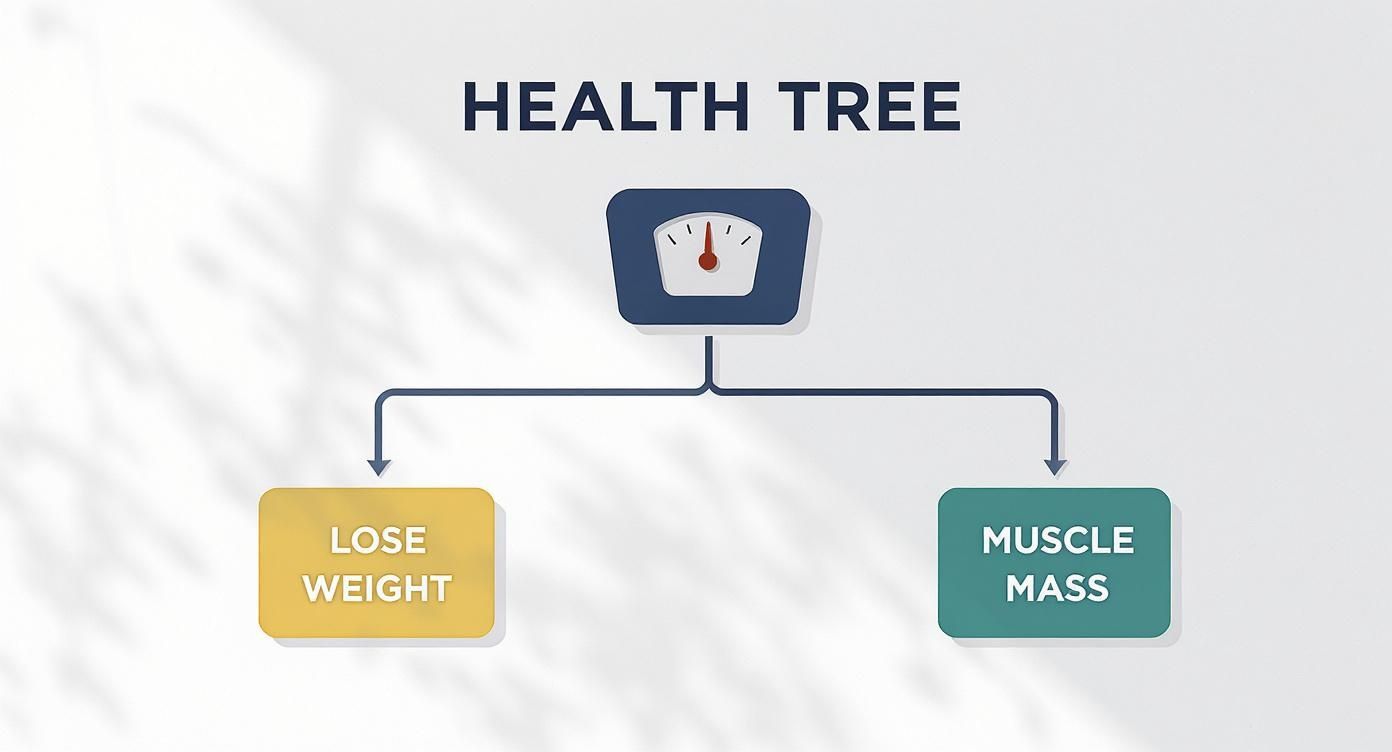
As you can see, if you're focused on improving your body's ratio of muscle to fat—not just dropping pounds—you’ll need a way to track those changes that goes beyond what a standard scale can tell you.
Accessible At-Home Methods
For most of us just starting out, consistency beats pinpoint accuracy every time. At-home methods are perfect for this. They let you track trends over time without costing a fortune.
Tape Measure (U.S. Navy Method): This is as low-tech as it gets. You just need a simple tape measure and a calculator to plug your circumference measurements into a formula. It's affordable, easy, and you can do it anywhere. While a single measurement might not be spot-on, its real value is in showing you the overall direction your body is heading week after week.
Skinfold Calipers: This classic tool measures the thickness of the fat just under your skin (subcutaneous fat) at several key spots. When done right, calipers can be surprisingly accurate. The big challenge here is technique. It takes some practice to get a consistent pinch and reliable reading every single time.
Here's the most important takeaway for at-home methods: focus on the trend, not the individual number. A downward pattern over several weeks is way more meaningful than any single reading.
These methods empower you to gather data regularly, which is a huge part of the Zing Coach methodology. It's all about making informed, sustainable progress.
Technology-Driven and Clinical Options
When you need a more precise number, that's where technology-based and clinical options come in. These can give you a much deeper look into your body composition, ranging from smart scales you can use at home to the gold-standard assessments done in a lab.
Comparing Popular Body Fat Measurement Methods
With so many options, it helps to see them side-by-side. This table breaks down the most common methods to help you decide which one aligns with your needs.
| Method | Accessibility | Estimated Cost | Accuracy Level | Best For |
|---|---|---|---|---|
| Tape Measure | High | $5–$15 | Low to Moderate | Tracking progress and trends at home on a budget. |
| Skinfold Calipers | High | $15–$50 | Moderate | Consistent at-home tracking for those willing to learn the technique. |
| BIA Scale | High | $30–$150+ | Moderate | Convenient, daily check-ins and trend monitoring. |
| DEXA Scan | Low | $100–$250 per scan | Very High | Establishing a highly accurate baseline or for detailed periodic check-ins. |
| Hydrostatic Weighing | Very Low | $150–$300 per session | Very High | Clinical research or athletes needing the highest level of accuracy. |
As you can see, there's a clear trade-off between convenience, cost, and accuracy. What's best for a research scientist isn't necessarily what's best for someone tracking their fitness journey from home.
A Closer Look at High-Tech Methods
Bioelectrical Impedance Analysis (BIA)
You've probably seen BIA technology in modern bathroom scales or handheld devices. It works by sending a tiny, completely harmless electrical current through your body.
Fat, muscle, and water all conduct electricity differently. The scale measures the resistance (or impedance) to this current to estimate your body composition. The catch? BIA readings can be easily thrown off by things like your hydration level, whether you've eaten recently, or if you just worked out.
Dual-Energy X-ray Absorptiometry (DEXA) Scan
This is often called the "gold standard" for a reason. A DEXA scan uses very low-dose X-rays to give you an incredibly detailed picture of your bone mass, fat mass, and lean muscle mass. It can even tell you how fat is distributed across different parts of your body.
The downside? DEXA scans are pricey and you have to go to a specialized clinic to get one done. This makes them impractical for regular tracking, but they are fantastic for setting an ultra-accurate baseline or for an occasional, in-depth check-up.
Hydrostatic Weighing (Underwater Weighing)
This one has a pretty cool history. Back in 1942, a researcher named Albert Behnke introduced underwater weighing, and it became the benchmark for body fat measurement for decades. It calculates your body density by comparing your weight on land to your weight while fully submerged in a tank of water.
Since fat is less dense than muscle and bone, the difference between these two weights can be used to calculate your body fat percentage with a high degree of accuracy. It's a fascinating process, and if you're a science nerd, you can dive into the history and the science behind body density models in this detailed study.
Like a DEXA scan, hydrostatic weighing is very accurate but also inconvenient and expensive, requiring a specialized lab. It’s more common in research settings than as a tool for the average person's fitness journey. Ultimately, picking the right tool is all about balancing how accurate you need to be with what’s practical and affordable for you.
Getting an Accurate Reading with Skinfold Calipers
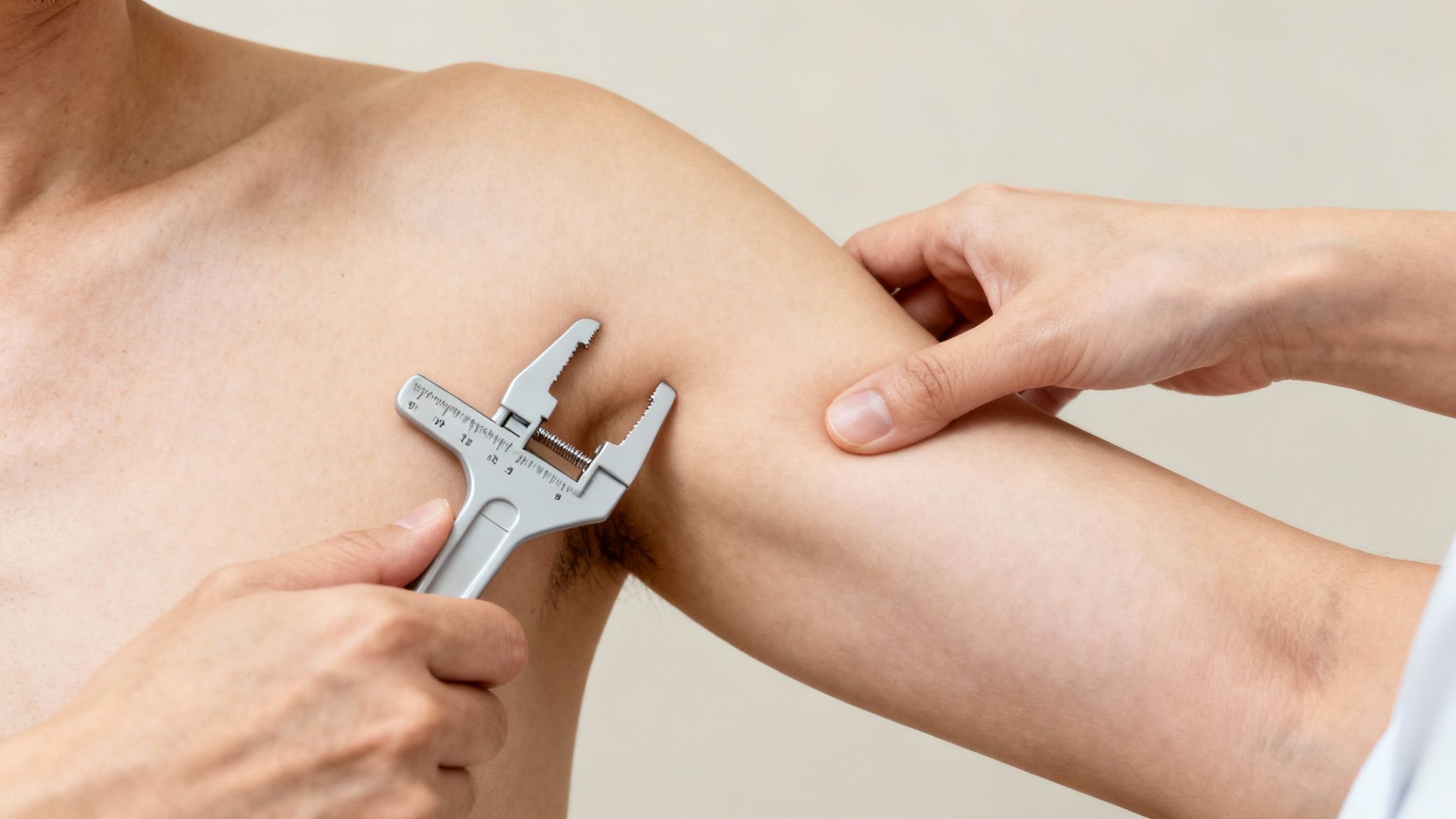
Skinfold calipers are a classic, affordable way to get a handle on your body fat, but there's a catch: their accuracy is all about your technique. This isn't like a smart scale you just step on; using calipers is a skill you have to learn. The good news? Once you get the hang of it, you can get surprisingly consistent results right from home.
The idea behind calipers is pretty simple. They measure the thickness of your subcutaneous fat—that's the layer just under your skin—at a few specific spots. You then plug those numbers into a formula to get an estimate of your total body fat percentage.
Locating the Measurement Sites Correctly
The most popular formula out there is the Jackson/Pollock 3-site method. It cleverly uses different spots for men and women to account for how we tend to store fat differently. Finding these exact locations every single time is non-negotiable if you want a reliable reading.
For Men, the 3 sites are:
- Chest: A diagonal pinch taken halfway between the nipple and the front of your armpit crease.
- Abdomen: A vertical pinch about one inch to the side of your navel.
- Thigh: A vertical pinch on the front of the thigh, midway between the hip crease and the top of your kneecap.
For Women, the 3 sites are:
- Triceps: A vertical pinch on the back of your upper arm, halfway between the shoulder and elbow.
- Suprailiac: A diagonal pinch taken just above the crest of your hip bone (that bony part at the top of your hip).
- Thigh: Same as for men—a vertical pinch on the front of the thigh.
Mastering the pinch is key. Use your thumb and index finger to grab a fold of skin and the fat beneath it. You want to gently pull this fold away from the muscle underneath. If it hurts, you're probably grabbing too hard or pinching muscle.
Executing the Measurement with Precision
Once you have a firm pinch, place the caliper's jaws about one centimeter away from your fingers, perpendicular to the skinfold. Let go of the caliper's trigger so the jaws apply full pressure, but keep holding the skinfold with your fingers.
Wait a second or two before reading the measurement on the dial. Jot down that number to the nearest half-millimeter. For the best accuracy, it's a good idea to measure each spot two or three times. Just wait about 15 seconds between attempts so the skin can settle back to normal. Average those readings for each site before you move on to the next.
Once you have your average measurement in millimeters for all three sites, add them up. This total, along with your age, gets plugged into a specific formula or an online calculator to give you your final body fat percentage. While the math can look a little intimidating, plenty of free online calculators are set up for the Jackson/Pollock method.
The data you get provides an excellent baseline to track over time. It's just one piece of the puzzle, but when tracked alongside other metrics, it paints a much clearer picture of your progress. You can learn more about how Zing Coach integrates a Fitness Test and Body Composition Scan to create a complete view of your fitness journey.
Using the Tape Measure Method for Consistent Tracking
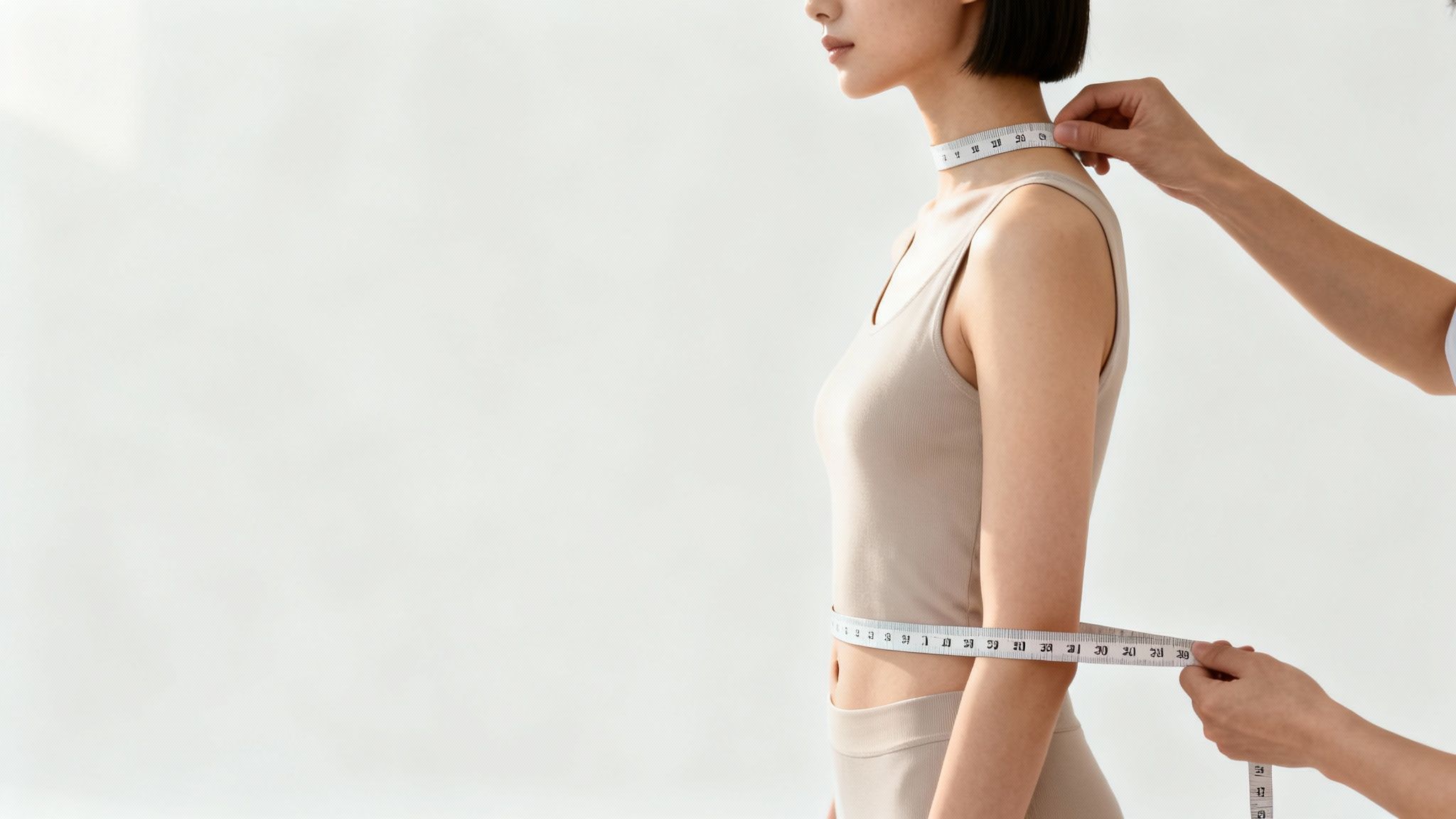
You don't need access to a high-tech lab to keep a close eye on your body composition. The U.S. Navy tape measure method is a straightforward, accessible, and surprisingly reliable way to track your progress over time.
While a single reading won’t ever be as precise as a DEXA scan, its real strength is in consistency. Week after week, it helps you see the trend, and that’s what really matters. All you need is a flexible measuring tape and a couple of minutes.
How to Take Your Measurements Accurately
The specific spots you measure are different for men and women, which accounts for typical fat distribution patterns. For the best results, grab a non-stretchable tape measure. You want it to be snug against the skin but not so tight that it’s digging in and compressing the area.
Measurement Sites for Men:
- Neck: Measure around your neck, just below your Adam's apple (larynx). Keep the tape level all the way around.
- Abdomen: Wrap the tape horizontally around your abdomen, right at the level of your belly button. Make sure you’re relaxed—no sucking in your stomach!
Measurement Sites for Women:
- Neck: Same as for men—measure just below the larynx.
- Waist: Find the narrowest point of your torso, which is usually just above your belly button, and measure there.
- Hips: Stand with your feet together and measure around the widest part of your hips or buttocks.
Turning Numbers into Actionable Data
Once you’ve got your measurements (in inches or centimeters) and your height, you can pop them into an online U.S. Navy body fat calculator. These calculators do the math for you and give you an estimated body fat percentage almost instantly.
The secret here is to stop obsessing over a single number and start focusing on the long-term trend. Even a slow-and-steady downward trend of 0.5% per month is a huge win and shows you're making real progress.
Consistency is everything with this method. To make your readings comparable, always measure under the same conditions. A good routine is to do it first thing in the morning, right after you use the restroom and before you eat or drink anything.
This data is incredibly powerful for tweaking your plan. For instance, seeing your waist measurement go down while your neck measurement stays the same is a fantastic sign that you're losing fat, not muscle. This kind of direct feedback is crucial for learning how to set good goals that are actually tied to meaningful changes, not just the number on the scale.
Making Sense of Your Body Fat Percentage
Getting a number back from your chosen measurement method is just step one. The real work—and the real payoff—comes from understanding what that number actually means for your health and your fitness goals. Think of your body fat percentage not as a static grade on a test, but as a dynamic metric that gives you incredible insight into your body composition.
Context is absolutely everything here. A body fat percentage that’s considered athletic for a 45-year-old is going to look different than it does for a 25-year-old. The key is to compare your number against established health ranges, not some arbitrary ideal you saw online.
What Is a Healthy Body Fat Percentage?
General guidelines are a great place to start when you're trying to figure out where you stand. These ranges are helpful because they account for the natural differences between sexes and general fitness levels.
For Men:
- Athletes: 6–13%
- Fitness: 14–17%
- Acceptable: 18–24%
- Obesity: 25% or higher
For Women:
- Athletes: 14–20%
- Fitness: 21–24%
- Acceptable: 25–31%
- Obesity: 32% or higher
It’s important to remember these are just benchmarks. Everyone needs a certain amount of essential fat for basic physical and physiological health. For men, that’s around 2–5%, and for women, it's about 10–13%. Dropping below these levels can be seriously dangerous.
Your result is a snapshot in time, not your final destination. Daily fluctuations due to hydration, meals, or even the time of day are completely normal. Focus on the trend over weeks and months, not a single reading.
Putting Your Data into Action
Once you have a solid grasp of your body fat percentage, this information becomes a powerful tool to guide your fitness plan. For instance, you could use your number to explore further insights into cutting phases and map out a strategic approach to lowering your body fat.
If your numbers are trending up, it might be a clear signal to take a hard look at your nutrition or dial up the intensity of your workouts.
On the flip side, if you see your body fat percentage steadily dropping, that’s your proof that the plan is working. This kind of data can be incredibly motivating, especially on days when the scale doesn't budge. And if you feel like you're hitting a wall, it might be the perfect time to check out our guide on tips to prevent plateaus to shake things up.
For the most reliable data, aim to measure every 2–4 weeks under the same conditions. This consistency is what allows you to make smart, informed adjustments to your plan.
Common Questions About Measuring Body Fat
Diving into the world of body composition can definitely bring up a lot of questions. Getting clear, straightforward answers is key to tracking your fitness with confidence and avoiding some common frustrations along the way.
How Often Should I Measure My Body Fat Percentage?
For tracking progress in a meaningful way, measuring every 2 to 4 weeks is the sweet spot.
Honestly, checking daily or even weekly can drive you crazy. It’s misleading because of normal, everyday fluctuations in your body's hydration and what you've recently eaten. A consistent monthly or bi-weekly check-in, done under the same conditions—like first thing in the morning, before you eat or drink—paints a much clearer picture of your actual long-term trend.
Which Body Fat Measurement Method Is Most Accurate?
This is the big one. While medical-grade methods like DEXA scans are the gold standard for accuracy, they just aren't practical for most of us to use regularly. They're expensive and hard to access.
For at-home tracking, skinfold calipers can be surprisingly accurate, but only if they're used by someone who really knows what they're doing. The key here, as with any method, is consistency. When you start looking into different tools, it's natural to wonder about the accuracy of body fat scales. The best method is simply the one you can stick with over time to see how your personal trend is moving.
The most important factor isn't finding the single "most accurate" tool. It's about choosing one method and using it consistently. Focusing on the trend over time will give you the most valuable insights into your progress.
Why Does My Body Fat Reading Change So Much?
If you see a big swing in your reading from one day to the next, don't panic. It's almost always caused by changes in body water, not actual fat.
For example, being dehydrated can make your body fat reading seem higher on a BIA scale, while being well-hydrated can make it seem lower. This is exactly why focusing on the trend over several weeks is far more important than getting hung up on any single measurement.
Ready to stop guessing and start seeing what's really happening with your body? The Zing Coach app uses a quick Body Composition Scan to give you a clear baseline. It then helps you track your body fat and lean mass over time, so you can see exactly how your hard work is paying off. Download the app and start your personalized fitness journey today at https://zing.coach.
Tags
Share this article


Authors