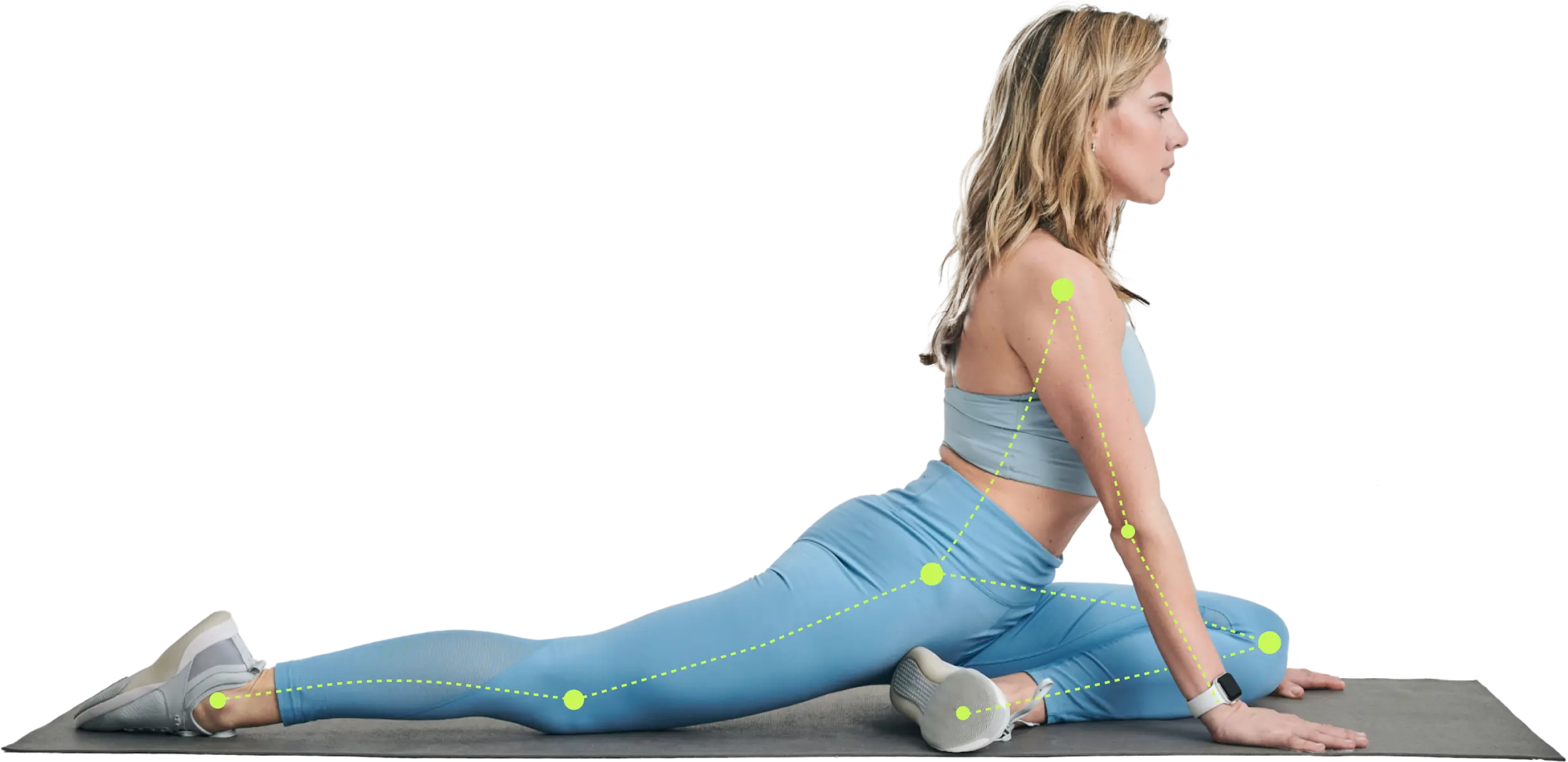
Discover the top hamstring exercises for beginners! This guide provides step-by-step instructions and sample routines to build strength and prevent injury.
The hamstrings, a group of three powerful muscles running down the back of your thigh, are the unsung heroes of your lower body. They power your sprints, stabilize your knees, and support your lower back in everything from lifting groceries to getting out of a chair. Yet for many beginners, they remain an afterthought, which can lead to muscle imbalances, poor posture, and an increased risk of injury.
This guide demystifies hamstring training, offering eight of the most effective and safest hamstring exercises for beginners. We'll break down each movement with precise, actionable steps, common mistakes to avoid, and progressions to ensure you build a strong, resilient posterior chain from day one. These exercises are the first step in creating a balanced physique and are foundational for anyone learning how to start strength training safely and effectively.
Whether you work out at home or in a gym, this is your foundational roadmap to unlocking balanced lower body strength. By mastering these core movements, you will build the confidence and stability needed to progress in your fitness journey. Let's dive into the exercises that will strengthen this crucial muscle group.
1. Glute Bridges: The Safest Starting Point for Posterior Power
The glute bridge is a foundational bodyweight exercise that serves as an ideal entry point for anyone starting their fitness journey. It’s performed by lying on your back with your knees bent, feet flat on the floor, and then raising your hips toward the ceiling. This movement primarily targets the glutes but is also one of the best hamstring exercises for beginners because it activates the entire posterior chain in a safe, controlled manner.
Its low-impact nature makes it perfect for individuals returning from injury or those who experience lower back discomfort. By strengthening the muscles that oppose tight hip flexors, the glute bridge also helps correct postural imbalances like anterior pelvic tilt, a common issue stemming from prolonged sitting.
How to Perform the Glute Bridge
- Starting Position: Lie on your back with your knees bent and feet flat on the floor, positioned about hip-width apart and roughly 6 inches from your glutes. Your arms should rest at your sides with palms down.
- Execution: Brace your core and press through your heels to lift your hips off the floor. Squeeze your glutes and hamstrings until your body forms a straight line from your shoulders to your knees.
- The Hold: Pause at the top for 2-3 seconds, focusing on maximal contraction in your glutes and hamstrings.
- Return: Slowly lower your hips back to the starting position with control.
Tips for Success
- Avoid Overarching: Focus on lifting your hips by squeezing your glutes, not by arching your lower back. Your core should remain engaged throughout the movement.
- Mind-Muscle Connection: Consciously think about your hamstrings working as you lift. This mental cue enhances muscle activation.
- Progressive Overload: Once you can comfortably perform 3 sets of 15 reps, consider adding a resistance band above your knees or placing a light dumbbell across your hips.
2. Lying Hamstring Curls: The Ultimate Isolation for Targeted Strength
The lying hamstring curl is a classic machine-based exercise that allows you to directly isolate and strengthen your hamstrings. Performed by lying face-down on a leg curl machine and curling your legs up against resistance, this movement removes the need for complex stabilization. This makes it one of the most effective hamstring exercises for beginners looking to build foundational strength with minimal risk of improper form.
Because the machine guides the movement path, it allows you to focus purely on contracting the hamstring muscles without loading the spine or engaging other muscle groups. This makes it an excellent choice for individuals with lower back sensitivity or those who want to add targeted training volume to their routine safely.
How to Perform the Lying Hamstring Curl
- Starting Position: Adjust the machine so the pad rests comfortably on your lower leg, just above your ankles, when your legs are straight. Lie face-down on the bench, gripping the handles in front of you for stability.
- Execution: Exhale and slowly curl your legs up as far as possible by flexing your hamstrings. Keep your hips pressed firmly into the pad throughout the entire movement.
- The Hold: Pause at the top of the movement for 1-2 seconds, squeezing your hamstrings to maximize muscle activation.
- Return: Inhale and slowly lower the weight back to the starting position with control, typically over a 2-3 second count. Do not let the weight stack slam.
Tips for Success
- Keep Hips Down: Avoid lifting your hips off the pad as you curl the weight. This is a common mistake that shifts the focus to your lower back instead of your hamstrings.
- Control the Negative: The lowering (eccentric) phase of the lift is crucial for muscle growth. Resist the weight on the way down instead of letting it drop.
- Mind-Muscle Connection: Focus entirely on feeling the back of your legs do the work. If you feel it more in your lower back or calves, the weight is likely too heavy. For a bodyweight alternative, consider trying Swiss ball hamstring curls, which also demand strong muscle control.
3. Romanian Deadlifts (RDLs): Mastering the Hip Hinge
The Romanian Deadlift, or RDL, is a fundamental compound exercise that teaches one of the most important movement patterns for overall strength: the hip hinge. It involves hinging at your hips while keeping your legs relatively straight, which places a direct emphasis on the hamstrings. This makes it one of the most effective hamstring exercises for beginners looking to build strength, improve flexibility, and prepare for more complex lifts.
Unlike other movements, the RDL focuses on eccentric loading, which is the lengthening of the hamstring muscles under tension. This is crucial for building resilient muscle tissue and preventing common injuries. Because it strengthens the entire posterior chain in a functional way, it's perfect for anyone wanting to counteract the effects of a sedentary lifestyle or build a solid foundation for more advanced training.
How to Perform the Romanian Deadlift
- Starting Position: Stand with your feet hip-width apart, holding a light dumbbell in each hand in front of your thighs. Maintain a soft bend in your knees (not locked) and a proud, upright chest.
- Execution: Initiate the movement by pushing your hips straight back, as if trying to touch a wall behind you with your glutes. Keep the dumbbells close to your legs as you lower your torso.
- The Stretch: Continue hinging until you feel a deep stretch in your hamstrings, typically when your torso is nearly parallel to the floor. Your back must remain flat throughout this phase.
- Return: Drive your hips forward and squeeze your glutes to return to the starting position, standing tall.
Tips for Success
- Hinge, Don't Squat: The movement comes from your hips moving backward, not from bending your knees. Keep your shins nearly vertical.
- Maintain a Neutral Spine: Avoid rounding your lower back at all costs. Imagine a straight line from your head to your tailbone and keep it throughout the exercise.
- Master Bodyweight First: Before adding weight, practice the hip hinge pattern with your hands on your hips to ensure you feel the stretch in your hamstrings.
- Progress Smartly: Once you’ve mastered the form, you can advance to heavier weights or a barbell. For a detailed guide on the conventional barbell version, you can learn more about deadlifts and their variations.
4. Nordic Hamstring Curls: The Ultimate Eccentric Strengthener
The Nordic hamstring curl is a highly effective, albeit challenging, bodyweight movement renowned for its ability to build exceptional hamstring strength and prevent injuries. It works by focusing on the eccentric phase of muscle contraction, which is the controlled lengthening of the muscle under tension. While often seen in elite athletic training, modified versions make this powerful exercise one of the best hamstring exercises for beginners looking to build serious posterior chain resilience without equipment.
This movement is particularly effective because the intense eccentric load stimulates significant muscle adaptation and strength gains. Research has shown that incorporating Nordic curls into a routine is a powerful strategy to build hamstring and knee stability, which can significantly help to prevent ACL injuries and other common lower-body strains.
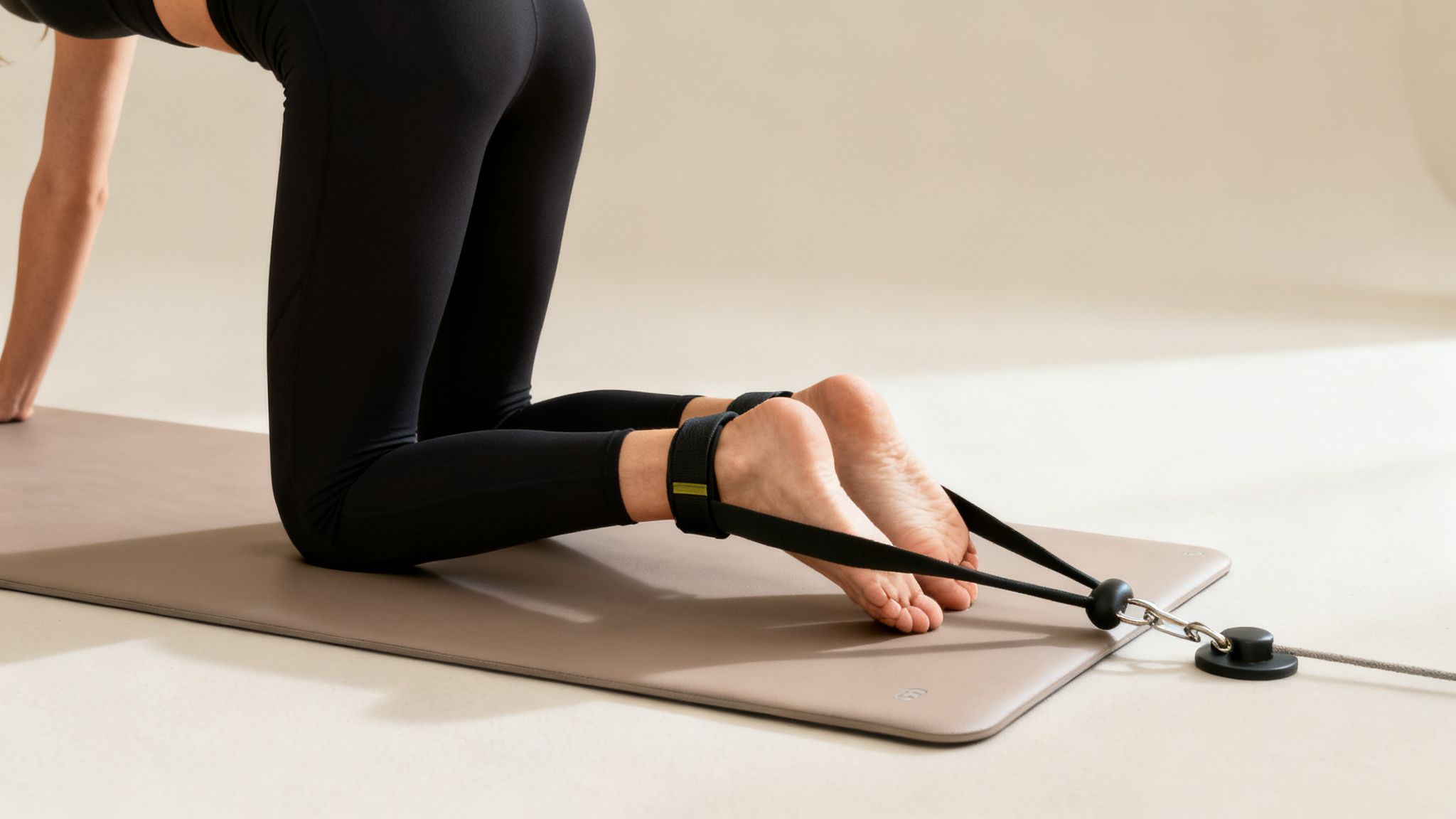
How to Perform the Nordic Hamstring Curl
- Starting Position: Kneel on a padded surface with your ankles secured by a partner or anchored under a sturdy object like a loaded barbell or heavy sofa. Keep your torso upright and your core braced.
- Execution: Maintaining a straight line from your head to your knees, slowly lower your upper body toward the floor. Control the descent for as long as possible using only your hamstrings.
- The Catch: Once you can no longer control the descent, allow yourself to fall forward and catch your body with your hands in a push-up position.
- Return: Lightly push off the floor with your hands to help initiate the return to the starting position, pulling with your hamstrings to complete the movement.
Tips for Success
- Start with Assistance: As a beginner, use a thick resistance band anchored high in front of you and looped around your chest. This will help control the descent and make the exercise manageable.
- Slow and Controlled: The magic of this exercise is in the slow, controlled lowering phase. Aim for a 3-5 second descent on every repetition.
- Low Volume is Key: This is an extremely demanding exercise. Start with just 2-3 sets of 2-5 reps, focusing on perfect form. Quality is far more important than quantity.
- Prioritize Recovery: Due to the intense eccentric stress, allow at least 3-5 days of recovery between sessions to avoid overtraining your hamstrings.
5. Lying Leg Raises (Hamstring Focus)
While often considered a core exercise, the lying leg raise is a surprisingly effective movement for engaging the lower hamstrings when performed with intentional focus. This bodyweight exercise involves lying on your back and lifting your straight legs toward the ceiling, activating the hamstrings as they work to control the movement and stabilize the pelvis alongside your abdominal muscles.
This dual-benefit movement is one of the best hamstring exercises for beginners because it simultaneously builds foundational core strength, which is crucial for protecting the lower back during more advanced hamstring exercises like deadlifts. For desk workers, it helps improve the muscular balance between the front and back of the legs, counteracting the effects of prolonged sitting.
How to Perform the Lying Leg Raise
- Starting Position: Lie flat on your back with your legs extended straight out. You can place your hands under your lower back for support or keep them at your sides with palms down.
- Execution: Engage your core by pressing your lower back firmly into the floor. Keeping your legs as straight as possible, slowly raise them toward the ceiling until they are perpendicular to the floor (or as high as you can comfortably go).
- The Peak: Pause briefly at the top of the movement, focusing on the tension in both your hamstrings and your lower abs.
- Return: Slowly lower your legs back down with control over a 3-4 second count. Stop just before they touch the floor to maintain tension, and then begin the next repetition.
Tips for Success
- Protect Your Back: The most important cue is to keep your lower back pressed into the floor. If you feel it arching, you have lowered your legs too far.
- Modify as Needed: If keeping your legs straight is too challenging, perform the exercise with your knees slightly bent. This reduces the lever length and makes the movement more accessible.
- Mind-Muscle Connection: Consciously think about your hamstrings working to control the descent. This mental focus is key to shifting the emphasis from your abs to your posterior chain.
- Progressive Overload: Begin with 3 sets of 8-10 reps. As you get stronger, progress by adding more reps or introducing a slow, controlled "flutter" motion at the bottom of the movement. For an advanced challenge, consider adding light ankle weights.
6. Good Mornings: Mastering the Hip Hinge for Stronger Hamstrings
The Good Morning is a classic hip hinge exercise that builds incredible strength and awareness throughout the entire posterior chain. It involves holding a weight across your upper back and bending forward at the hips, keeping your legs relatively straight. This movement heavily targets the hamstrings and glutes, making it one of the most effective hamstring exercises for beginners when performed correctly with light weight.
Its primary benefit lies in teaching the crucial hip hinge pattern, which is fundamental to more advanced lifts like deadlifts and squats. For beginners, starting with an unloaded barbell or even a PVC pipe is an excellent way to build hip mobility, develop posterior chain awareness, and learn to maintain a safe, neutral spine under load.
How to Perform the Good Morning
- Starting Position: Stand with your feet shoulder-width apart, with a slight bend in your knees. Place an unloaded barbell or PVC pipe across your upper back, resting on your traps, not your neck. Keep your chest up and core braced.
- Execution: Initiate the movement by pushing your hips straight back, as if trying to touch a wall behind you. Allow your torso to hinge forward while maintaining a flat back.
- The Stretch: Lower your torso until it's nearly parallel to the floor, or until you feel a significant stretch in your hamstrings. Your shins should remain vertical.
- Return: Drive your hips forward and squeeze your glutes and hamstrings to return to the upright starting position with control.
Tips for Success
- Master the Hinge First: Before adding any weight, practice the hip hinge pattern with just your bodyweight or a PVC pipe. Focus on the sensation of pushing your hips back.
- Keep a Neutral Spine: The most critical cue is to avoid rounding your back. Keep your core tight and your chest proud throughout the entire movement.
- Slight Knee Bend: Maintain a soft, consistent bend in your knees (about 10-15 degrees) to protect them and keep the focus on the hamstrings.
- Control the Weight: Start light. Once you can comfortably perform 3 sets of 8-10 reps with perfect form, you can consider adding a small amount of weight.
7. Single-Leg Deadlifts: Building Unilateral Strength and Stability
The single-leg deadlift, often called a single-leg Romanian deadlift, is a powerful unilateral exercise that challenges your balance, stability, and hamstring strength on one side at a time. It involves standing on one leg and hinging forward at the hips, extending the other leg behind you for counterbalance. This movement is one of the most functional hamstring exercises for beginners as it mimics real-life movements and helps identify and correct strength imbalances between your legs.
For those new to strength training, starting with your bodyweight is key to mastering the hip hinge pattern on a single leg. This exercise builds foundational control, improves proprioception (your sense of body position), and strengthens the smaller stabilizing muscles around your hips and ankles, which are crucial for injury prevention and overall athletic performance.
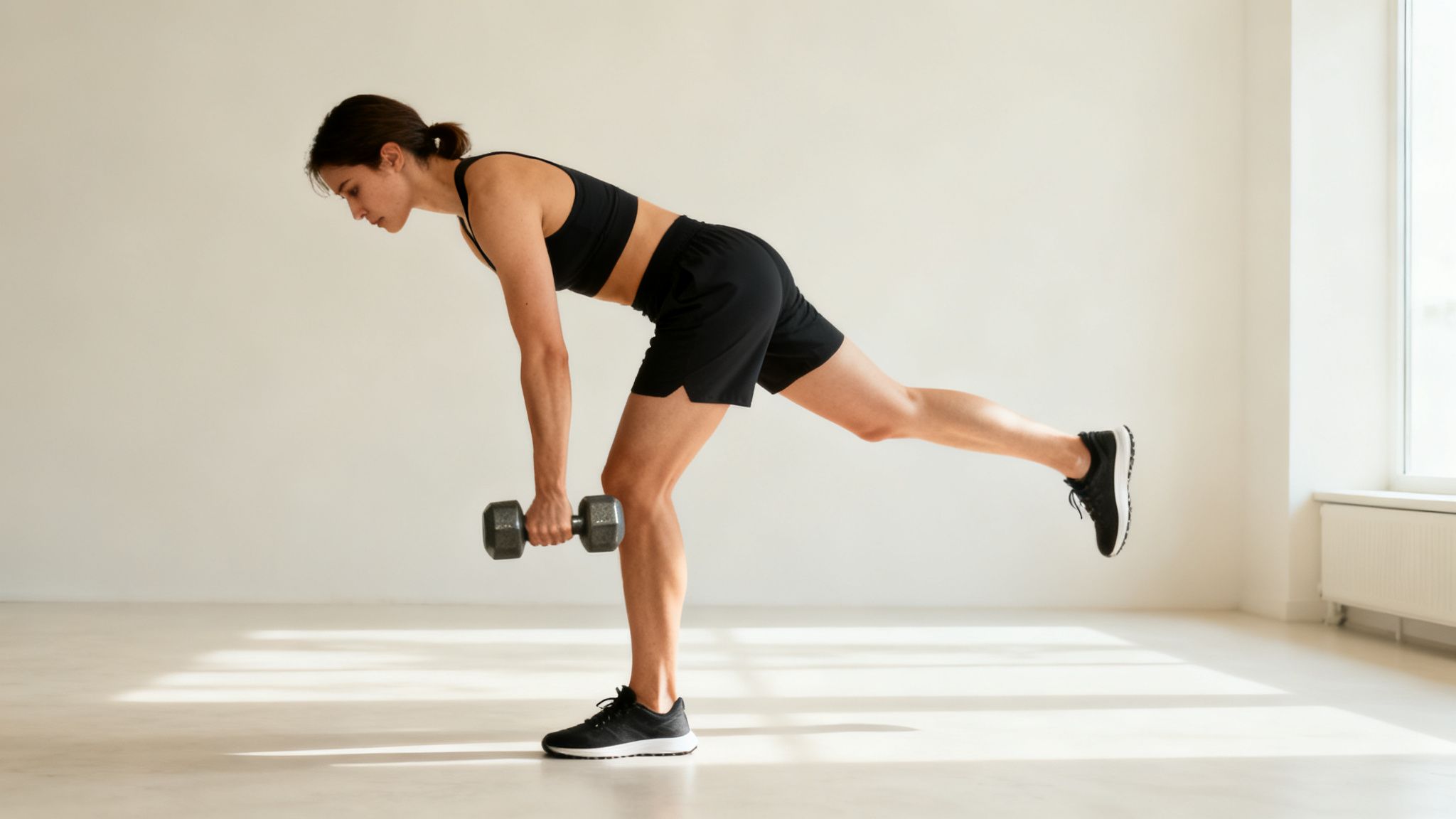
How to Perform the Single-Leg Deadlift
- Starting Position: Stand with your feet together. Shift your weight onto one leg, which will be your working leg. Maintain a slight bend (5-10 degrees) in the knee of your working leg.
- Execution: Keeping your spine neutral, hinge forward at your hips. As your torso lowers, extend your non-working leg straight behind you for balance. Your arms can hang down toward the floor.
- The Hold: Lower yourself until your torso is nearly parallel to the floor, or as far as you can while maintaining balance and a flat back. Feel the stretch in your working hamstring.
- Return: Drive through the heel of your standing foot and squeeze your glute and hamstring to return to the starting position with control.
Tips for Success
- Balance is Key: Initially, hold onto a wall, chair, or TRX strap for support. This allows you to focus on the hip hinge mechanic without struggling with balance.
- Hinge, Don't Squat: The movement should come from your hips, not by bending your waist or squatting down. Keep your back straight from your head to your tailbone.
- Control Over Depth: Prioritize slow, controlled movements over how far you can lower your torso. As your stability improves, you can increase the range of motion.
- Start with Bodyweight: Master the form without any weight first. Once you can comfortably perform 3 sets of 6-8 reps per leg, consider holding a light dumbbell or kettlebell.
8. Seated Hamstring Stretches (Active Stretching): A Foundation for Flexibility
Flexibility is just as important as strength, and the active seated hamstring stretch is a perfect way to improve mobility without any equipment. This stretch involves sitting on the floor, extending one leg, and hinging forward from your hips. It’s a cornerstone among hamstring exercises for beginners because it teaches proper hinging mechanics while safely lengthening the muscles.
Unlike passive stretching where you simply hold a position, active stretching involves engaging the opposing muscles (like your quadriceps) to deepen the stretch through a process called reciprocal inhibition. This method not only improves flexibility but also enhances control over your range of motion, which is crucial for preventing injuries and supporting your strength training exercises.
How to Perform the Seated Hamstring Stretch
- Starting Position: Sit on the floor with one leg extended straight in front of you. Bend the other leg and place the sole of that foot against your inner thigh. Sit tall, with your back straight and your chest up.
- Execution: Inhale and engage your core. As you exhale, slowly hinge forward from your hips, keeping your back straight. Reach toward the toes of your extended leg.
- The Hold: Stop when you feel a gentle to moderate stretch in your hamstring. Actively contract the quadriceps of your extended leg. Hold this position for 30-60 seconds while breathing deeply.
- Return: Gently release the stretch and slowly return to the upright starting position. Switch legs and repeat.
Tips for Success
- Hinge, Don't Round: The movement must come from your hips, not from rounding your lower back. Imagine bringing your chest toward your thigh.
- Warm Up First: Never stretch cold muscles. Perform this stretch after your workout or after a 5-10 minute warm-up of light cardio.
- Be Patient: Flexibility improves over time. Don't force the stretch; just go to the point of light tension and breathe into it. Combining this with other recovery methods, such as foam rolling your hamstrings, can further enhance muscle recovery and flexibility.
Beginner Hamstring Exercises: 8-Point Comparison
| Exercise | Implementation complexity | Resource requirements | Expected outcomes | Ideal use cases | Key advantages |
|---|---|---|---|---|---|
| Glute Bridges | Very low — simple, low-impact pattern | None (optional bands/dumbbell) | Posterior chain activation, hip stability | Warm-up, beginners, at-home rehab | Accessible, low injury risk, easy to progress |
| Lying Hamstring Curls | Low — machine-guided, minimal technique | Leg curl machine | Isolated hamstring hypertrophy, controlled overload | Gym isolation work, rehab with spinal sensitivity | Safe isolation, adjustable resistance, simple progression |
| Romanian Deadlifts (RDLs) | Moderate — requires hip-hinge skill and coaching | Dumbbells/barbell (or light alternatives) | Functional posterior-chain strength, eccentric loading, hip mobility | Teaching hinge, compound strength training | High transfer to daily tasks, scalable, strong eccentric stimulus |
| Nordic Hamstring Curls | High — advanced eccentric control and technique | None (recommended partner or band anchor) | Exceptional eccentric strength and injury prevention | Athlete conditioning, hamstring injury-prevention programs | Proven injury risk reduction, time-efficient stimulus |
| Lying Leg Raises (Hamstring Focus) | Low — basic bodyweight movement | None (optional ankle weights) | Lower-hamstring engagement, core stability, hip flexor balance | Home core/hamstring routines, beginners | No equipment, improves core-hamstring balance, easy progressions |
| Good Mornings | Moderate — hinge with external load; technical under bar | Barbell/PVC or light load | Loaded posterior-chain strength, spinal stability, hip mobility | Teaching hinge under load, loaded mobility work | Reinforces neutral spine, effective posterior-chain loading |
| Single-Leg Deadlifts | Moderate — unilateral hinge with balance demand | None to light dumbbells or TRX for support | Unilateral hamstring strength, balance, proprioception | Correcting imbalances, functional single-leg training | Addresses asymmetries, builds balance and stabilizers |
| Seated Hamstring Stretches (Active) | Very low — simple active stretching technique | None | Improved hamstring flexibility and active control | Mobility routines, post-workout recovery, injury prevention | Low risk, builds flexibility with active muscle engagement |
Putting It All Together: Your Path to Stronger Hamstrings
You have now explored a comprehensive collection of the best hamstring exercises for beginners. From the foundational Glute Bridge to the more challenging Single-Leg Deadlift, each movement offers a unique way to build strength, improve flexibility, and enhance the overall function of your posterior chain. This isn't just about aesthetics; it's about creating a powerful, resilient lower body that can support you through daily activities and more demanding athletic pursuits.
Remember, the goal is not to perform every single exercise at once. The key to sustainable progress, especially as a beginner, is to start small and master the fundamentals. Choose two or three exercises from this list that feel most comfortable and accessible for your current fitness level. Focus intensely on form and control before you even think about adding weight or increasing complexity.
Key Takeaways for Your Hamstring Journey
As you integrate these exercises into your routine, keep these core principles at the forefront of your training philosophy:
- Form Over Everything: Perfecting your technique is non-negotiable. A well-executed bodyweight Romanian Deadlift is infinitely more effective and safer than a sloppy, heavily-weighted one. Film yourself or use a mirror to check your form against the cues provided.
- Listen to Your Body: Differentiating between the muscle fatigue of a good workout and the sharp signal of pain is a critical skill. Never push through pain. Instead, regress the exercise or choose an alternative movement.
- Consistency Trumps Intensity: Two well-planned hamstring workouts per week, performed consistently for months, will yield far better results than sporadic, high-intensity sessions that lead to burnout or injury. Create a schedule you can realistically stick to.
- Progressive Overload is the Goal: Once you can comfortably complete your target sets and reps with perfect form, it's time to make the exercise more challenging. This could mean adding a small amount of weight, increasing your repetitions, or moving to a more advanced variation. This gradual increase in demand is what stimulates muscle growth and strength gains.
Your Actionable Next Steps
Building a stronger posterior chain starts today. Begin by selecting one exercise that focuses on hip extension (like the Glute Bridge or RDL) and one that focuses on knee flexion (like Lying Hamstring Curls). Add them to your leg day routine, following the recommended sets and reps outlined in the article.
Commit to performing these hamstring exercises for beginners twice a week for the next four weeks. Pay close attention to how your body feels. You should notice improved stability, less lower back tightness, and an increased mind-muscle connection with your hamstrings. This initial phase is all about building a solid foundation and creating a lasting habit. As you build confidence and strength, you can then begin to incorporate other exercises from the list, creating a more varied and comprehensive hamstring workout. The path to a stronger, more functional lower body is a marathon, not a sprint. Embrace the process, stay patient, and celebrate the small victories along the way.
Ready to take the guesswork out of your training and ensure perfect form on every rep? The Zing Coach AI-powered app creates a personalized workout plan tailored to your specific goals and abilities, providing real-time feedback to help you master these hamstring exercises for beginners safely and effectively. Start your journey with a plan that grows with you at Zing Coach.
Share this article


Authors