Is working out twice a day right for you? Discover the real benefits, risks, and sample schedules to safely boost your fitness and achieve your goals.
Training twice a day is a pretty advanced strategy, but if you plan it right, it can seriously speed up your results. This isn't just about cramming a second session into your day. It’s about being smart and splitting your efforts to boost performance without burning out or getting injured. For anyone with some solid experience under their belt, this can be a killer way to bust through plateaus and hit specific goals faster.
The Reality of Two-a-Day Workouts
Jumping into twice-daily training is a huge commitment. It takes more than just extra time—it demands smart planning and a massive respect for recovery. And while the idea of making faster progress is tempting, this isn't a shortcut. Think of it as an amplifier for your current training; it cranks up both the potential rewards and the risks.
Success with two-a-days comes down to making it work for you. What a pro athlete does to prep for a competition is going to look completely different from what a seasoned gym-goer needs to break a strength stall. The real key is structuring your sessions so they work together, not against each other.
A Quick Look at Two-a-Day Workouts
Before you dive in, it helps to see the big picture. Here's a quick summary to help you decide if this intense training style is a good fit for your goals and lifestyle.
| Potential Benefits | Potential Risks |
|---|---|
| Faster progress toward specific goals | Higher risk of overtraining and burnout |
| Increased total training volume | Greater chance of injury from fatigue |
| Breaks through stubborn plateaus | Requires more time for recovery and nutrition |
| Enhances sport-specific conditioning | Can disrupt sleep and increase stress |
| Improves recovery between sessions | May lead to mental and physical fatigue |
Ultimately, two-a-days amplify everything. If you can handle the demands, the payoff is huge. But if you neglect recovery, you'll likely run into problems.
Balancing Benefits with Potential Risks
The main upside here is the ability to pack in more total training volume and frequency—two of the biggest drivers for muscle growth and strength. In fact, one study showed that resistance-trained men who split their workouts into two daily sessions saw much bigger strength gains. Some guys increased their back squat by up to 16.1% compared to those training just once a day. You can dig into the specifics in the Journal of Sports Medicine and Physical Fitness.
But, and this is a big but, cranking up the frequency like this also ramps up your risk of overtraining if you aren't careful. Without enough rest and the right fuel, you can quickly find yourself dealing with:
- Feeling tired and drained all the time
- Nagging muscle soreness that just won't quit
- Watching your performance or strength go backward
- Weird sleep patterns and mood swings
Here's the golden rule for two-a-days: Your second workout should never mess up the quality of your main session the next day. If you're too wiped to perform, you're doing too much.
Is This Advanced Method Right for You?
At the end of the day, deciding to train twice a day boils down to your experience, your goals, and what your lifestyle can handle. It’s really a strategy for people who already have a strong fitness base and are ready to get serious about their recovery. You have to be honest with yourself about whether you can handle the extra physical stress.
If you start noticing signs of being overly tired, you absolutely have to scale back. Knowing those warning signals is your best defense against burnout. To get a better handle on this, check out our guide on how to know if you're overtraining, which can help you spot problems before they get serious. With a technique this advanced, listening to your body is more important than anything else.
Who Should Actually Consider Two-a-Days
Let's be clear: working out twice a day is an advanced training strategy. It's not for the faint of heart, and it's definitely not for everyone. Before you even entertain the idea of doubling up your gym time, you need a rock-solid foundation of consistent training, proper form, and a deep understanding of your own body's limits.
For the right person, this intense schedule can put results into overdrive. But for the wrong person, it's a fast track to burnout, injury, and frustration. The key is being brutally honest with yourself about your current fitness level, lifestyle, and—most importantly—your ability to recover. Without those pieces locked in, you're just setting yourself up for a fall.
The Seasoned Athlete
If you’re training for something specific—a marathon, a triathlon, or a powerlifting meet—two-a-days can be a total game-changer. This approach lets you break up different parts of your training so you can give each one the laser focus it deserves.
Think about it: a runner might hammer out a high-intensity interval session in the morning to build speed, then come back in the evening for a slower, steady-state run to boost endurance. By splitting them up, the fatigue from one session doesn't tank the quality of the other. It's a smart way to get in a higher total training volume without cramming it all into one soul-crushing workout.
The Dedicated Lifter at a Plateau
Been staring at the same weight on your bench press for months? If you're an experienced lifter, hitting the gym twice a day can be the sledgehammer you need to smash through a stubborn strength plateau. The increased training frequency can trigger muscle protein synthesis more often, which can lead to better gains in strength and size over time.
A pretty common split is to tackle your heavy, compound lifts in the morning when you're fresh. We're talking squats, deadlifts, and overhead presses. Then, your evening session can be all about lighter, accessory work targeting muscle growth, improving mobility, or shoring up any weak points. This way, your primary lifts get 100% of your effort, but you still add valuable volume later in the day.
The Busy but Committed Individual
This one might sound a little backward, but two-a-days can sometimes be a lifesaver for people with packed schedules. Carving out a single 75-minute block in a day can feel impossible. But finding two separate 30-40 minute slots? That might actually be doable.
This approach gives you two short, highly focused workouts. You could crush a quick strength circuit at home before work, then get in a brisk walk or a yoga session on your lunch break. It keeps you moving throughout the day and can feel a lot less intimidating than one long, grueling session.
This quick flowchart can help you visualize whether this path is right for you, based on where you're at in your fitness journey.
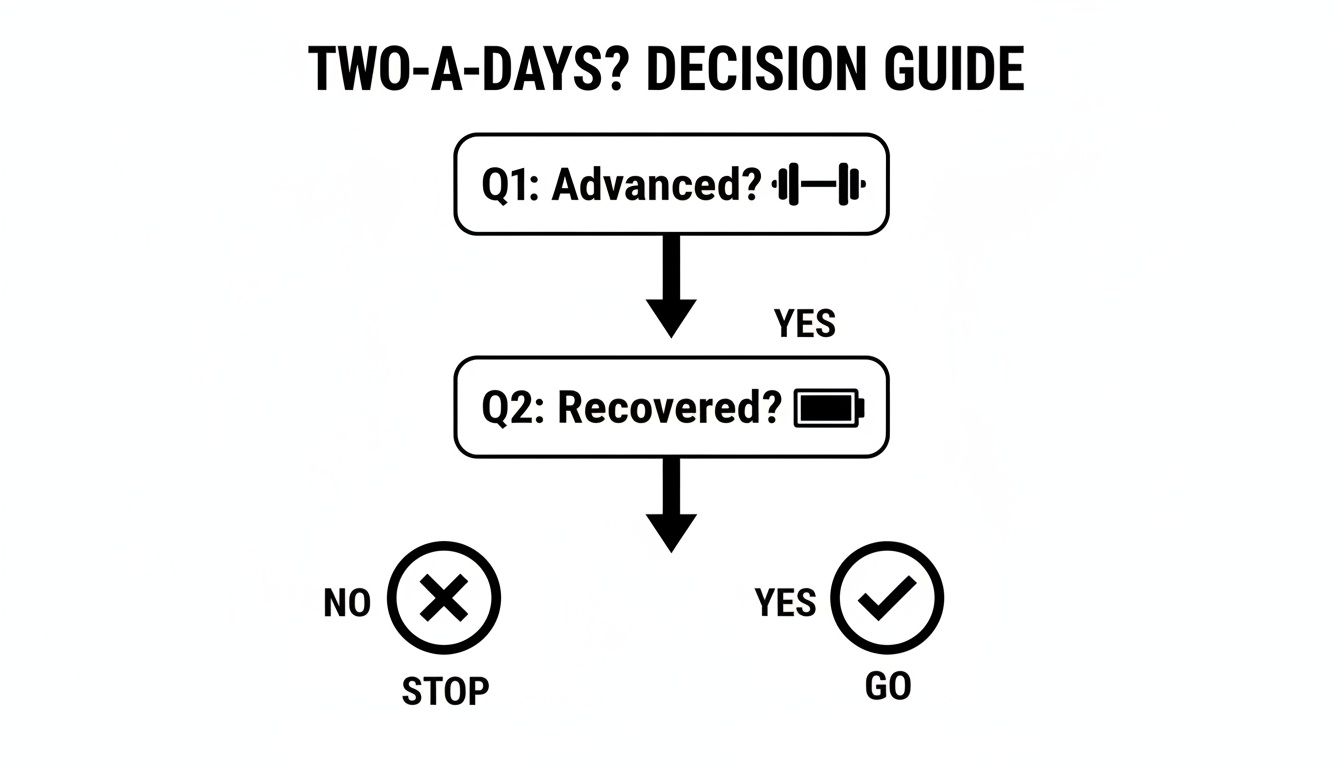
As you can see, being an advanced trainee with your recovery dialed in isn't just a suggestion—it's a non-negotiable prerequisite for this style of training.
Who Should Absolutely Avoid Two-a-Days
Just as crucial as knowing who should try this is knowing who shouldn't. This is not a one-size-fits-all strategy, and trying to force it can cause a lot more harm than good.
Give this a hard pass if you fall into any of these camps:
- Beginners: If you're new to fitness, your body is still just trying to adapt to a regular workout schedule. Piling on a second session is a surefire recipe for injury and overwhelming soreness. Focus on consistency first. A well-designed beginner strength training program is the perfect place to build that foundation.
- Those Under High Stress: Your body doesn't know the difference between the physical stress from a workout and the mental stress from your job or personal life. If your tank is already running on empty, adding more training will just dig you into a deeper hole of fatigue.
- Anyone with Poor Sleep or Nutrition: Recovery is everything. If you aren't consistently getting 7-9 hours of sleep a night and fueling your body with enough quality food, you simply won't be able to bounce back from the demands of training twice a day. Period.
Remember, the point of training is to get stronger and healthier. If adding a second workout wrecks your recovery, tanks your performance, and makes you feel miserable, it's not the right move for you.
How to Structure Your Two-a-Day Workout Plan

Pulling off two-a-days successfully isn’t about brute force—it’s about intelligent design. A poorly planned schedule will leave you exhausted and sore, but a smart one can amplify your results without wrecking your body. The whole game hinges on managing intensity and giving yourself enough time to recover between sessions.
There's one golden rule: never train the same muscles with high intensity twice in the same day. Your two workouts need to complement each other, not compete. Think of them as two halves of a whole, each with its own purpose that feeds into your bigger goal.
This means you need a clear strategy for splitting your workouts. The most effective approaches separate sessions by muscle group, training style, or intensity. What you choose really comes down to what you're trying to achieve, whether that's building raw strength, boosting your endurance, or chasing peak athletic performance.
Pairing Strength and Cardio Sessions
One of the most popular—and for good reason—ways to structure two-a-days is dedicating one session to strength and the other to cardio. This split is fantastic because it lets you give your all to lifting heavy without being gassed from a long run, and vice versa.
As a general rule, tackle your highest-priority workout first. If your main goal is building muscle and strength, hit the weights in the morning when your energy and focus are at their peak. Your central nervous system will be fresh, letting you move maximum weight safely.
Your second session, ideally 6-8 hours later, can then be your cardio. The intensity here should match your goals and how well you’re recovering. A high-intensity interval training (HIIT) session can torch fat, while low-intensity steady-state (LISS) cardio, like a light jog or cycling, is perfect for active recovery and building your aerobic base.
- Morning Session (AM): Focus on heavy compound lifts like squats, bench presses, and deadlifts.
- Evening Session (PM): Aim for 20-30 minutes of moderate-intensity cardio on an elliptical or stationary bike.
This setup works just as well in reverse if cardio is your priority. A marathoner, for example, might do their key speed work in the morning and follow it up with a lighter, full-body strength session in the evening to support their running. Learning how to balance cardio and strength training is the secret to making this work long-term.
Splitting by Muscle Groups or Body Parts
Another tried-and-true method is the classic body part split, like an upper/lower routine. This approach is killer for cranking up the total training volume for specific muscles without overtaxing them in a single day. You can stimulate a muscle group, let it rest, and then hit a completely different one later on.
This allows for much more focused, higher-quality work in each session. Instead of slogging through a long, grueling full-body workout that leaves you drained, you're doing two shorter, more targeted sessions. That increased frequency can be a powerful stimulus for muscle growth.
The core principle of a two-a-day plan is to make the sum greater than its parts. Each workout should enhance, not detract from, your overall progress by managing fatigue and maximizing recovery windows.
For instance, a solid upper/lower split could look like this:
- AM Session: Upper Body Strength (e.g., bench press, pull-ups, overhead press).
- PM Session: Lower Body Hypertrophy (e.g., leg press, lunges, calf raises).
This method is surprisingly efficient. An exhaustive review of training frequency data found that upper-body strength can jump by 1.52% per week with just one or two sessions, holding its own against training three or more times. You can dive deeper into the science behind these findings over at Stronger by Science.
Contrasting High and Low Intensity
The high/low intensity split is a brilliant strategy for managing the overall stress on your body while still training often. This method pairs a demanding, high-intensity workout with a much lighter, restorative session later in the day. It's a fantastic way to accelerate recovery and improve mobility.
Your morning session could be a classic heavy lifting day or a tough metabolic conditioning circuit—the goal is to push your limits. Then, your evening session becomes a form of active recovery.
This second workout isn't supposed to be taxing. Its purpose is to increase blood flow to sore muscles, release tension, and improve your range of motion. All of this can seriously speed up your recovery for the next day's main event.
- AM Session: High-Intensity Interval Training (HIIT) with kettlebells and battle ropes.
- PM Session: A 30-minute session of yoga, light stretching, or foam rolling.
By separating the intensity, you get the perks of high-frequency training without the burnout. This approach also teaches you to listen to your body—pushing hard when it’s time to work and focusing on restoration when it’s time to recover. Ultimately, the best structure for you is the one that aligns with your goals and, most importantly, is sustainable for your lifestyle.
Sample Two-a-Day Schedules for Your Goals
Knowing the theory behind twice-a-day training is one thing. Seeing it laid out in a practical plan is where things really start to click.
The secret to making a two-a-day schedule work for you is to tailor it directly to your main goal. A routine for packing on muscle is going to look completely different from one designed to shed fat or boost athletic performance. Below are a few solid templates for these common goals—think of them as smart starting points, not rigid rules. Listen to your body, adjust based on your schedule, and find what works for you.
Schedule for Building Muscle and Strength
When muscle gain is the name of the game, your two-a-day plan needs to be all about maximizing training volume without running yourself into the ground. This usually means pairing a heavy, compound-focused session with a lighter, more targeted workout later in the day.
Splitting it up this way lets you attack your big lifts with everything you've got. It also gives you two distinct post-workout windows to refuel with protein and carbs, which is a huge advantage for muscle repair and growth. Just remember, rest days are where the magic actually happens. Don't skip them.
Here's a battle-tested weekly template to give you a clearer picture of how to structure your training for hypertrophy.
Weekly Two-a-Day Schedule for Muscle Gain
| Day | AM Session (Strength Focus) | PM Session (Accessory/Recovery) |
|---|---|---|
| Monday | Upper Body Strength: Heavy Bench Press, Weighted Pull-Ups, Overhead Press (low reps) | Arms & Core: Bicep Curls, Tricep Pushdowns, Planks, Leg Raises (high reps) |
| Tuesday | Lower Body Strength: Heavy Squats, Romanian Deadlifts, Leg Press (low reps) | Mobility: 30 minutes of Hip Mobility Drills, Foam Rolling, Light Stretching |
| Wednesday | REST | REST |
| Thursday | Upper Body Hypertrophy: Dumbbell Incline Press, Seated Rows, Lateral Raises (mid reps) | Light Cardio: 30-minute Incline Walk or Stationary Bike |
| Friday | Lower Body Hypertrophy: Leg Extensions, Hamstring Curls, Calf Raises (mid reps) | REST |
| Weekend | REST | REST |
This kind of setup is perfect for anyone trying to bust through a size or strength plateau. For more ideas on organizing your lifting days, our guide on building a powerful 4-day split has some great insights.
Schedule for Weight Loss and Fat Burning
For fat loss, the strategy shifts. We're now focused on torching calories and cranking up your metabolism. The best way to do this is by combining high-intensity metabolic work with low-impact, steady-state cardio. This one-two punch helps you burn a ton of calories without putting too much stress on your joints or nervous system.
Your morning session should be intense, creating a strong "afterburn" effect (EPOC) that keeps your metabolism humming for hours. The evening session is your active recovery—a lower-key workout to burn a few extra calories from fat stores without messing up your recovery for the next day.
The goal isn't just about the calories you burn during the workout. A smart two-a-day plan for weight loss keeps your metabolism elevated all day long, turning your body into a more efficient fat-burning machine.
Here's what that might look like in a typical week:
- Monday (AM): Full-Body HIIT Circuit (Kettlebell Swings, Burpees, Battle Ropes)
- Monday (PM): 45-minute Brisk Walk or Light Elliptical Session
- Tuesday: REST
- Wednesday (AM): Metabolic Resistance Training (Lighter weight, high reps, minimal rest)
- Wednesday (PM): 30-minute Yoga or Mobility Flow
- Thursday: REST
- Friday (AM): Sled Pushes & Sprints (15-20 minutes total)
- Friday (PM): 45-minute Steady-State Cycling
- Weekend: Active Recovery (e.g., long walk, light hike)
Schedule for Athletic Performance
Athletes have a different set of needs. For them, it's about separating skill development from general physical preparedness (GPP). Training twice a day is a game-changer here, as it lets you practice sport-specific skills when you're fresh, then build raw strength and conditioning in a separate session.
This split is critical. The fatigue from a brutal conditioning workout can wreak havoc on the fine motor skills needed for your sport. Imagine a basketball player trying to dial in their jump shot after a heavy squat session—it’s just not going to happen. By splitting them, both sides of your training get the focus they deserve.
The Skill-and-Strength Split
- Morning Session (Skill Work): This workout should happen when your nervous system is fresh, ensuring every movement is sharp and precise. Think practicing free throws, running specific routes for football, or drilling tennis serves. Quality over quantity.
- Evening Session (Strength & Conditioning): This is where you build the engine. The focus is on developing the physical tools of your trade—power, strength, and endurance. This session could include plyometrics, heavy lifting, or intense, sport-specific conditioning drills.
This two-pronged approach ensures that skill and strength improve together, helping you become a more dominant and resilient athlete.
Mastering Fuel and Recovery for Success
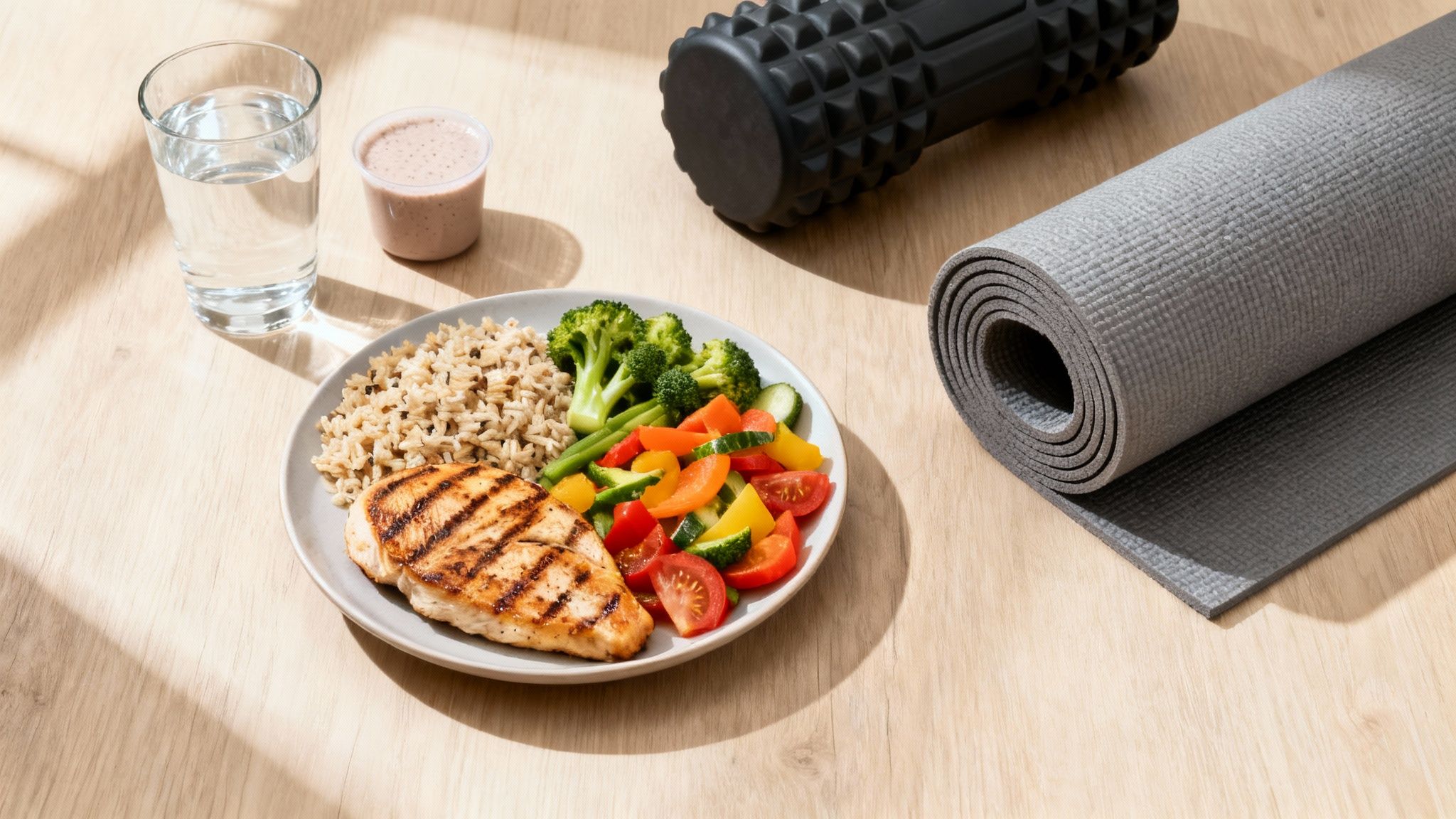
When you start working out twice a day, you can't cheat the system. This level of training puts a massive strain on your body, and without nailing your fuel and recovery, you're just setting yourself up for burnout, not progress. Think of nutrition and recovery as the foundation that makes this entire training style possible.
Dialing in Your Nutrition for Two-a-Days
Adding a second workout means you're burning through a serious amount of calories, and your body needs that energy back. This is definitely not the time to be running a steep calorie deficit. Your number one job is to eat enough high-quality food to fuel your performance, repair muscle, and keep fatigue at bay.
Suddenly, timing your meals and macros becomes incredibly important. You have to be strategic about placing carbohydrates and protein around your workouts to get the most out of them. Carbs give you that immediate energy for your sessions, while protein is the essential building block for muscle repair once you're done.
A simple but killer strategy looks like this:
- Pre-Workout: Grab some easily digestible carbs about 60-90 minutes before you start. A banana or a small bowl of oatmeal is perfect for sustained energy.
- Post-Workout: Within two hours of finishing, you need a meal with both protein and carbs to replenish your glycogen stores and kick-start muscle repair. You can't go wrong with a classic like grilled chicken and sweet potatoes.
For anyone taking on this demanding schedule, adding the best supplements for muscle recovery can be a game-changer in avoiding overtraining and keeping your progress on track.
Smart Recovery Beyond Just Sleep
Getting 7-9 hours of quality sleep is absolutely non-negotiable. But real recovery for a two-a-day athlete goes much deeper than that. You have to actively help your body bounce back, which is where active recovery techniques become your best friend. They're key to reducing soreness and getting you ready for the next session.
These aren't just "nice-to-haves"—they're essentials. Weaving mobility drills, foam rolling, and light stretching into your routine can make a huge difference in how you feel and perform. Just dedicate 10-15 minutes after your second workout or before bed to these activities.
It’s also worth noting that your total weekly workout volume is a massive factor in your health. A study looking at data from 93,000 UK adults found that even cramming your workouts into a couple of intense days could still lower the risk of early death by up to 32%. It just goes to show that total effort matters more than the schedule.
The goal of recovery isn't just to feel less sore. It's about restoring your body's ability to perform at a high level, session after session. Neglect it, and your performance will inevitably tank.
Recognizing the Early Signs of Overtraining
There's a fine line between pushing your limits and just plain overdoing it, especially with two-a-days. Learning to listen to your body’s signals is your single best defense against burnout. Overtraining isn't something that happens overnight; it’s a gradual slide caused by accumulated fatigue that you didn't address.
Keep a close eye out for these red flags:
- Persistent Fatigue: You feel completely drained, even after a full night's sleep.
- Performance Drops: You can't lift as heavy, run as fast, or your form just feels sloppy.
- Nagging Soreness: Your muscles are constantly aching, and the soreness hangs around way longer than usual.
- Irritability and Mood Swings: You feel on edge, unmotivated, or find yourself getting frustrated easily.
If you start ticking these boxes, it's a crystal-clear signal to pull back. Ignoring them will only dig you into a deeper recovery hole you'll have to climb out of later. This is why smart recovery is about being proactive, not just reactive. To get a better handle on this, check out our in-depth guide covering essential workout recovery tips.
Common Questions About Working Out Twice a Day
So you've got a plan, but jumping into a two-a-day routine can still feel a little weird. It's totally normal for a bunch of practical questions to pop up. Let's walk through some of the most common ones I hear so you can feel ready to tackle this thing.
How Much Time Should Be Between Workouts?
This is probably the most critical question, and for good reason. Rushing from one session to the next is a surefire way to kill your performance and, worse, get yourself injured. Your body needs a real chance to recover and refuel.
As a general rule, you'll want at least six hours between two moderate or high-intensity workouts. That gap gives your body enough time to start replenishing its glycogen stores—the main fuel source for your muscles—and lets your central nervous system chill out a bit.
Think of it like this: if you wrap up a heavy lifting session at 8 AM, your second workout, say a cardio session, shouldn't kick off before 2 PM. This separation ensures you aren't walking into round two already running on fumes.
Should I Eat a Full Meal Between Sessions?
Yes. 100%. Fueling up between workouts is completely non-negotiable.
Don't just think of it as a break; that meal is a crucial part of your recovery. It's your window to kick-start muscle repair and top off your energy tank for the next session.
Your between-session meal should have a solid mix of:
- Complex Carbohydrates: Think brown rice, quinoa, or sweet potatoes. These will restock the glycogen you burned and give you sustained energy for round two.
- Lean Protein: Chicken breast, fish, or plant-based options like tofu are vital for getting muscle protein synthesis going—that's the process of rebuilding your muscle fibers.
- Healthy Fats: A little bit of avocado or a handful of nuts can help with inflammation and overall recovery.
And don't forget to keep sipping water all day. Hydration is key for pretty much everything, from nutrient transport to keeping your body temperature in check.
The quality of your workout is directly tied to the quality of your fuel. Skipping the meal between sessions means you're asking your body to perform on an empty tank, which will inevitably lead to a subpar workout and slower progress.
What If I Only Have Time for Short Workouts?
That’s perfectly fine! In fact, it can be a massive advantage.
Working out twice a day doesn't mean you have to schedule two separate hour-long gym marathons. Two focused, high-quality 30-minute sessions can often be way more effective than one long, drawn-out workout where fatigue sets in and your form starts to get sloppy.
This approach is a lifesaver for busy people. A quick HIIT session in the morning followed by a 30-minute mobility and core workout in the evening is a fantastic way to boost your fitness without your schedule taking a hit. It's all about intensity and focus, not duration.
How Do I Know If I Am Doing Too Much?
Your body is actually pretty good at sending up flares when you're pushing too hard. The trick is learning to listen to those signals before they become full-blown screams. A little muscle soreness and fatigue are normal, but you should never feel constantly drained or beaten down.
Keep an eye out for these warning signs:
- Your sleep quality tanks, and you're waking up tired.
- Your motivation to train completely vanishes.
- You feel irritable or moody for no good reason.
- Your performance in the gym starts to dip for more than a day or two.
If you start ticking these boxes, it's a clear signal to pull back. Take an extra rest day, or swap your second session for something purely restorative, like a good stretch or a long walk. Remember, real progress comes from training smart and recovering even smarter, not from running yourself into the ground.
Ready to take the guesswork out of your training and recovery? Zing Coach builds a truly personalized fitness plan that adapts to your goals, schedule, and energy levels. Let our AI-powered technology design a smart, effective routine—including guidance on structuring two-a-day workouts safely—so you can focus on getting results without the risk of burnout. Start your journey with Zing Coach today!
Share this article


Authors