Feeling burnt out? Learn how to know if you're overtraining with our expert guide. We cover the physical and mental signs, plus a realistic recovery plan.
Knowing you're overtraining isn't about feeling sore after a tough workout. It's about recognizing a nagging pattern of unexplained underperformance, persistent fatigue, and mood swings that a few days off just can't seem to fix.
It’s that frustrating point where your body stops adapting and starts breaking down. More effort in the gym actually leads to less progress. This is the crucial difference between pushing your limits and completely burning out.
The Difference Between Pushing Limits and Burning Out

Hitting a wall in your fitness journey is a common, and maddening, experience. You’re showing up, you’re putting in the work, and you’re following your plan, yet the weights feel heavier and your endurance seems to be vanishing. This is that confusing gray area where the line between productive training stress and destructive overtraining gets blurry.
The whole point of getting stronger is progressive overload—you apply just enough stress to stimulate growth, then you recover, allowing your body to adapt and come back stronger. That's a healthy cycle. Overtraining is what happens when that simple equation gets thrown completely out of whack.
When Stress Outweighs Recovery
Here’s the thing: the problem isn't just about what you're doing in the gym. Modern life piles on its own layers of stress, and your body doesn’t really distinguish it from a heavy set of squats.
Think about all the other things demanding your energy:
- Work Deadlines: That high-stakes project at work? It elevates cortisol, the very same stress hormone that spikes during intense exercise.
- Poor Sleep: Skimping on rest cripples muscle repair, messes with your hormones, and fries your nervous system.
- Life Pressures: Financial worries, relationship issues, family drama—it all contributes to your body’s total "stress load."
When these outside stressors pile on top of an already intense training schedule, you’re creating the perfect storm for burnout. Your body's capacity to recover is finite. If the total stress you’re under exceeds that capacity, your performance is going to tank. You get stuck in a state of unexplained underperformance where pushing harder only digs you into a deeper hole.
This isn't just an issue for pro athletes, either. It’s a huge problem across the board.
Did you know that up to 60% of elite runners experience overtraining syndrome (OTS) at some point in their careers? Even casual runners aren't safe, with nearly one-third (33%) dealing with it. You can dig into the research on how training volume impacts athletes over at Physio-pedia.
Smart Training Versus Hard Training
This really highlights a critical distinction: training hard isn't always the same as training smart. A well-designed workout program intentionally builds in periods of rest and lower intensity to give your body a chance to adapt.
If your plan is just "go hard all the time," you’re risking that slide from productive stress into burnout. For a good look at what a sustainable routine involves, check out our guide on how to create a workout plan for beginners.
Learning to recognize when your body is sending signals to slow down—not just push harder—is the first, most important step toward making real, sustainable progress for the long haul.
Listening to Your Body's Physical Warning Signs

While the mental fog and motivation dips are a big deal, your body often sends the most direct and measurable distress signals. If you're serious about long-term fitness, learning to read these physical warnings is a non-negotiable skill. Ignoring them is like driving with the check engine light on—you might get a little further down the road, but a breakdown is inevitable.
These signals are much more than your typical post-workout ache. They're persistent, systemic signs that your body's recovery systems are overwhelmed and falling behind.
Let's break down the most critical physical red flags you need to watch for.
Your Heart Rate Is Telling a Story
One of the most objective clues you might be overtraining is a change in your resting heart rate (RHR). This is your pulse when you're completely at rest, ideally measured first thing in the morning before you even get out of bed. Think of it as a powerful indicator of your body's overall stress level.
A consistently high RHR is a classic sign that your sympathetic nervous system—your "fight or flight" response—is stuck in overdrive. Your body just isn't powering down and recovering like it should, even when you're sleeping.
A consistent increase of just 5-10 beats per minute (bpm) in your morning RHR is a significant red flag. This subtle shift means your body is working much harder than usual just to maintain its baseline functions, signaling a major recovery deficit.
This elevated heart rate is a common symptom seen in 30-60% of athletes experiencing overtraining. It often shows up alongside other issues like muscle weakness and getting sick more often, painting a clear picture of a body under way too much strain.
You don't need any fancy equipment to track your RHR; most fitness trackers and smartwatches handle it automatically. The real key is consistency. Measure it at the same time every day to establish a solid baseline. When you see that number creeping up and staying high for several days in a row, it's a clear signal to back off.
When Muscle Soreness Never Ends
We all know the feeling. Muscle soreness is a normal part of training, especially when you try a new exercise or crank up the intensity. This familiar ache is known as Delayed Onset Muscle Soreness (DOMS), which typically peaks 24-48 hours after a workout and then fades. It's a good sign—it means your muscles are adapting and getting stronger.
Overtraining, however, turns this temporary ache into a chronic condition. It’s that deep, persistent soreness that never seems to fully go away, even on your rest days. Your legs feel heavy and leaden during every run, or your arms ache before you even pick up a weight.
This isn't the satisfying ache of progress; it's a sign of excessive muscle breakdown without enough time for repair. Your body is trapped in a catabolic state, breaking down tissue faster than it can rebuild it. For a deeper dive into what separates productive soreness from a warning sign, check out our guide on understanding DOMS.
If you’re constantly feeling beat up, that’s a huge indicator that your training is outstripping your ability to recover.
The Nagging Injuries That Keep Coming Back
Another tell-tale physical sign of overtraining is the sudden appearance of small, nagging injuries. I'm not talking about major tears or breaks, but rather those persistent issues that just won't seem to heal.
Does any of this sound familiar?
- Tendonitis: A nagging ache in your Achilles tendon that flares up on every single run.
- Joint Pain: A constant twinge in your shoulder or knee that wasn't there before.
- Shin Splints: That familiar, frustrating pain along your shins that returns with any impact.
- Strains and Sprains: You find yourself pulling minor muscles with movements that used to be completely effortless.
When your body is chronically fatigued, your form starts to break down. Your neuromuscular coordination falters, and your muscles are too tired to properly support your joints and absorb impact. This creates the perfect storm for these overuse injuries to take hold. It’s your body's way of forcing you to stop because it simply can't handle the load you’re placing on it anymore.
Your Immune System Is Waving a White Flag
Do you feel like you're catching every cold that makes the rounds at work? Overtraining can put a serious damper on your immune system, leaving you vulnerable to frequent illnesses.
Intense exercise temporarily lowers your immunity, but with proper recovery, your system bounces back even stronger. When you’re overtrained, you never get that bounce-back. High levels of stress hormones like cortisol can interfere with how well your immune cells function.
This leaves you in a state of compromised immunity. A minor bug that you'd normally fight off in a day might knock you out for a week. If you find yourself constantly battling sniffles, sore throats, or other infections, it’s time to take a hard look at your training log and recovery habits. Your immune health is a direct reflection of your body's overall resilience.
Recognizing the Mental and Emotional Toll of Overtraining
We often look for the physical signs first—a high resting heart rate, nagging soreness—but the mental and emotional fallout from overtraining can be just as damaging. Sometimes, it's even worse, because it’s so easy to mistake for something else. This isn't just about feeling a bit tired; it's a deep psychological shift that can ripple through every part of your life.
This mental drain is a direct result of the physiological storm brewing inside your body. When you're overtrained, your hormonal system is in chaos. Levels of stress hormones like cortisol stay stubbornly high, while mood-regulating neurotransmitters like serotonin can plummet. It’s this chemical imbalance that fuels the irritability, brain fog, and general apathy that so many athletes experience.
From Passion to Chore: The Loss of Motivation
One of the biggest red flags is when your relationship with your workouts turns sour. The training you used to look forward to all day now feels like a heavy obligation. Instead of excitement, the thought of hitting the gym fills you with dread.
This isn’t just an "off day." It's a bone-deep loss of motivation, sometimes called exercise apathy. You might catch yourself making excuses to skip sessions, phoning it in, or just going through the motions with zero joy. That's your brain's self-preservation instinct kicking in, screaming for a real break from the constant physical stress.
When that inner fire for training fizzles out, it’s a clear sign the balance has tipped too far. Keeping that drive alive is crucial, and if it's gone, looking into how to stay consistent with exercise can help you find ways to rebuild that positive connection once you've recovered.
Heightened Irritability and Mood Swings
Find yourself snapping at your partner or friends over nothing? Overtraining can give you an incredibly short fuse, leaving you feeling irritable, anxious, or even down in the dumps.
This isn't a character flaw—it's a physiological reaction. The hormonal mess caused by excessive training stress messes with the parts of your brain that handle emotional control. You might start noticing:
- Sudden mood swings that seem to appear out of nowhere.
- A constant feeling of anxiety or restlessness, even when you’re supposed to be relaxing.
- Trouble concentrating or a persistent feeling of "brain fog."
- Feeling completely overwhelmed by simple, everyday tasks.
These symptoms often look a lot like emotional burnout. In fact, checking out these 10 key signs of emotional burnout can offer some powerful insights into what you might be going through. Recognizing these changes is so important because they're a clear signal that your nervous system is overloaded and needs a serious break.
Mental State Self-Assessment Checklist
Take a second and be honest with yourself. If you're nodding along to several of these, it’s a pretty good indicator that your training is taking a mental toll.
- Do I dread workouts that I used to enjoy?
- Have I lost my motivation or drive to train?
- Am I more irritable or short-tempered than usual?
- Do I feel anxious or on edge for no clear reason?
- Is my ability to focus at work or home declining?
- Am I having trouble falling asleep or staying asleep, even when I'm exhausted?
- Do I feel a sense of hopelessness or apathy about my fitness goals?
This isn't a formal diagnosis, of course, but it’s an incredibly useful tool for self-awareness. It helps you connect the dots between how you're training and how you're feeling. Paying attention to these psychological red flags is the first step toward pulling back and giving your mind the same recovery you’d give your muscles. Your mental well-being isn't separate from your physical performance—it’s the foundation of it.
When Your Performance Suddenly Drops Off
After wading through the physical aches and mental fog, the most undeniable proof of overtraining is often staring you right in the face: your performance numbers. It's one thing to have a single bad workout. We all get those. It's another thing entirely when that "off day" bleeds into an "off week," and then an "off month."
This sustained dip in what you can actually do in the gym or on the track is the clearest sign that your body isn't adapting anymore—it's regressing.
We're not talking about small, day-to-day fluctuations. This is a genuine, frustrating downward trend. It’s when you load up the squat rack with a weight you handled easily last month, only to grind out a few painful reps. It’s when your usual 10-minute mile pace slows to 11 minutes, and it feels twice as hard.
This drop-off can be incredibly discouraging because it feels like all your hard work is being erased. You're putting in the same—or even more—effort, but your results are moving in the wrong direction.
More Than Just a Bad Day
So, how do you separate a temporary slump from a serious problem? The key is the duration and consistency of the underperformance. An occasional tough session is just part of the process. But when your strength, speed, or endurance stays in the gutter for weeks, that’s a major red flag.
Here’s what this looks like in the real world:
- For the Lifter: You can no longer complete the same number of reps with a weight that was a staple in your routine. Your one-rep max might even start to slide backward.
- For the Runner: Your times for familiar distances are consistently slower, and your perceived effort for those runs is through the roof.
- For the HIIT Enthusiast: You find yourself needing longer breaks between intervals or just can't hit the same intensity levels you could before.
These performance drops are so critical because they are the most agreed-upon marker of overtraining. Across numerous studies on resistance exercise, a sustained decrease in performance is the one constant, undeniable symptom. This is where tracking your workouts becomes invaluable; the data doesn't lie. For more on this, check out our detailed guide on how to track fitness progress.
The Overtraining Spectrum Explained
It helps to think of overtraining not as an on/off switch, but as a spectrum. You don't just wake up one day with full-blown Overtraining Syndrome (OTS). You slide along a continuum, moving from beneficial training stress to a state of serious dysfunction. Knowing where you fall on this spectrum is crucial for figuring out how urgently you need to act.
This table breaks down the stages so you can better identify where you might be.
| Stage | Description | Performance Impact | Recovery Timeframe |
|---|---|---|---|
| Functional Overreaching | A planned, short-term increase in training load to stimulate adaptation. | Temporary dip followed by a "supercompensation" boost. | Days to a week |
| Non-Functional Overreaching | Excessive training stress without enough recovery, leading to stagnation. | Stagnant or decreased performance that does not improve with short rest. | Weeks to months |
| Overtraining Syndrome (OTS) | A severe maladaptation from chronic stress and inadequate recovery. | Significant, long-term performance decrease with other systemic symptoms. | Months to years |
Recognizing which stage you're in helps put the situation in perspective. A performance dip that lasts a week might just require a deload. But a drop that lasts for a month demands immediate and significant changes to your entire approach. At that point, ignoring it is no longer an option.
The progression usually starts with something positive. Functional overreaching is a deliberate, short-term push in your training designed to shock your system into adapting. You feel tired and your performance dips for a few days, but after a short recovery period, you bounce back stronger than ever. This is a planned strategy in many advanced training programs.
The trouble starts when you push past that productive phase into non-functional overreaching. This is the first real danger zone. Your performance drops and stays down for weeks. You feel constantly fatigued, and no amount of "pushing through it" helps. You're basically digging a hole that a couple of extra rest days can no longer fill.
If you ignore the signs of non-functional overreaching and keep grinding, you risk sliding into full-blown Overtraining Syndrome (OTS). This is a serious clinical state where performance is suppressed for months, or in some cases, even longer. It brings a whole host of other nasty symptoms, including hormonal disruption, mood disturbances, and chronic fatigue.
Overtraining Syndrome isn't something that resolves in a week. While functional overreaching can lead to performance gains after a few days of rest, non-functional overreaching can suppress performance for over three weeks. Full-blown OTS can lock you into underperformance for two months or more, sometimes with lasting effects.
Your Action Plan for Recovery and Prevention
So, you’ve spotted the signs of overtraining. That’s a massive first step. But what you do next is what really counts. This isn't about admitting defeat; it’s about shifting to a smarter, more sustainable training strategy. Acting now stops the slide into full-blown burnout and helps you build a more resilient foundation for the long haul.
The first move is always the toughest because it feels completely backward: you have to stop training. Immediately. Taking 3-5 days of complete rest is non-negotiable. This isn't just about skipping the gym; it's a full system reset. You're giving your hormonal and nervous systems a chance to start finding their way back to normal.
Prioritize Deep Recovery and Fueling
During this initial rest period, your focus needs to pivot entirely from training to recovery. And your most powerful tool here is sleep. It’s when your body gets down to the critical business of repairing tissue, regulating hormones like cortisol, and cementing all that hard-earned motor learning. Aiming for 7-9 hours of solid, high-quality sleep isn't a luxury—it’s the cornerstone of your comeback.
Getting enough rest is absolutely essential for both physical and mental restoration. For a deeper dive, check out this guide on understanding and enhancing sleep quality. Simply focusing on this one thing can dramatically speed up the healing process.
At the same time, you've got to get your nutrition sorted. Overtraining often digs you into a caloric and nutritional hole that your body just can't climb out of. Get back to basics and focus on:
- Sufficient Calories: Forget about cutting. Your body needs enough fuel to run its basic systems and handle repairs. Make sure you're eating enough.
- Protein Intake: Give your muscles the raw materials they need to rebuild. Aim to include a quality source of lean protein with every meal.
- Hydration: Water is involved in pretty much every metabolic process, especially muscle recovery. Keep a water bottle handy and sip consistently all day.
This flowchart is a great visual for understanding how a simple performance dip can spiral into Overtraining Syndrome, and it highlights just how critical early intervention is.
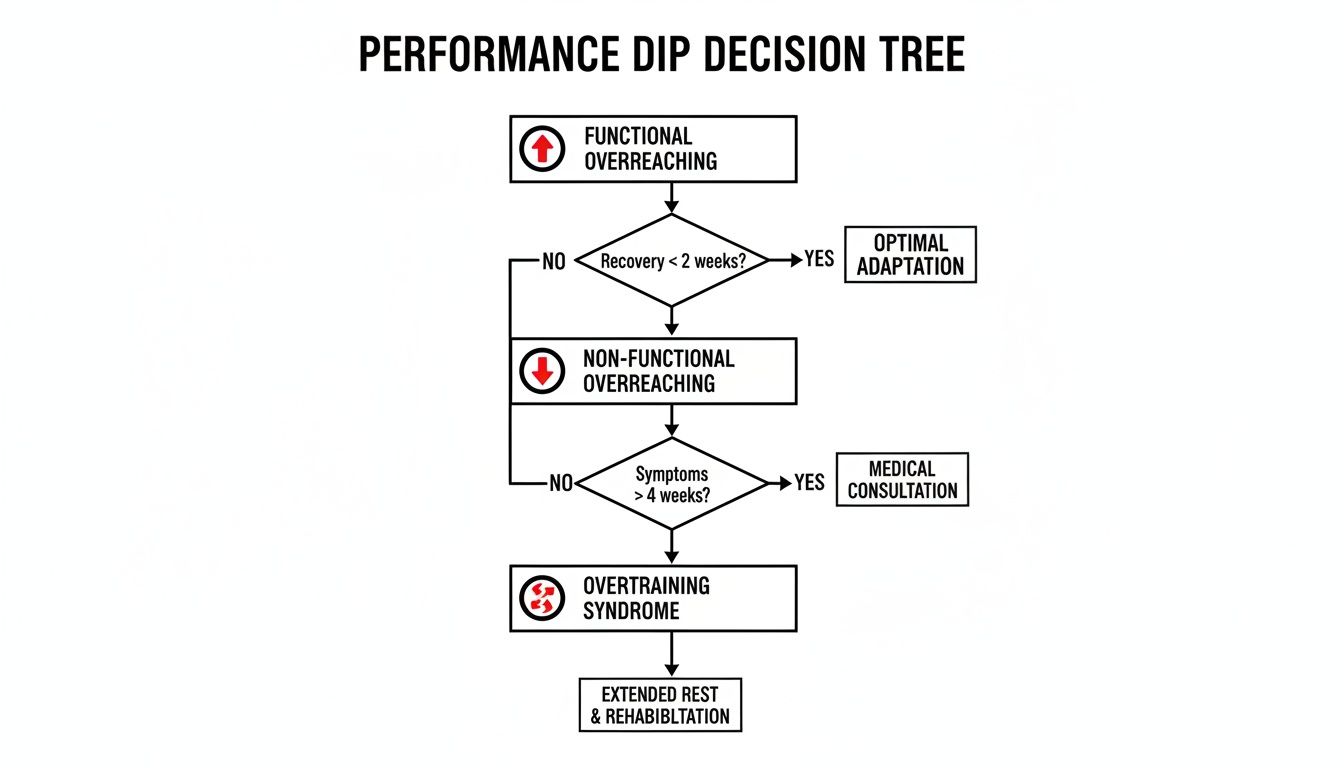
As you can see, the longer you ignore the warning signs, the deeper the hole gets and the longer it takes to climb out.
Reintroducing Movement Intelligently
After your initial 3-5 day break, you can start to bring movement back into your routine—slowly. The keyword here is active recovery. The goal is to promote blood flow and healing without adding more stress to your system.
Some great options include:
- Gentle walks, preferably outside
- Light cycling or an easy swim
- Restorative yoga or some dedicated stretching
- Foam rolling and mobility drills
Pay close attention to how you feel. If a light activity leaves you feeling energized, that’s a fantastic sign. If it leaves you feeling wiped out, your body is telling you it needs more time. For more great ideas on this phase, take a look at our comprehensive guide on workout recovery tips.
Building a Smarter Long-Term Training Plan
To keep from falling back into the overtraining trap, you need to fundamentally change your approach. It's time to ditch the "more is always better" mentality and embrace a strategy built on consistency and smart programming. Real, lasting progress comes from a cycle of stress and adaptation—and recovery is where all the good stuff (adaptation) actually happens.
To bulletproof your training plan against overtraining, you absolutely must schedule deload weeks. A deload is a planned week of reduced training volume and intensity. Slotting one in every 4-8 weeks gives your body a proactive chance to fully recover, repair nagging micro-injuries, and hit the hormonal reset button.
This isn't a sign of weakness; it's what smart, experienced athletes do. By building these breaks into your plan, you ensure you never push yourself so far into a recovery deficit that you need weeks or even months of forced time off. This proactive approach is the real secret to breaking the burnout cycle for good.
Common Questions About Overtraining
Even when you know the signs, a few specific questions always seem to come up when you start to suspect you're in the red zone. Getting straight answers can help you make the right call for your training and recovery, right now.
How Long Does It Take to Recover from Overtraining
This is the big one, and the honest answer is: it depends entirely on how far down the rabbit hole you've gone. If you've just dipped your toes into what we call non-functional overreaching, a few weeks of seriously backing off and prioritizing rest might be all you need to feel like yourself again.
But if you're dealing with true overtraining syndrome (OTS), that's a different beast altogether. Full recovery can take months, and in really severe cases, even years. The most important thing to remember is to act the moment you spot the symptoms. A strategic deload week now is a thousand times better than being forced to take months off later. Don't try to rush the process.
The single biggest mistake I see athletes make is trying to "train through" the fatigue. Listen when your body whispers—that way, it won't have to scream at you later in the form of injury or total burnout.
Can I Still Do Light Exercise If I Am Overtrained
Great question, and the answer isn't black and white. For severe cases, where you're battling deep fatigue and a pile-up of symptoms, complete rest is often the only prescription. Your body needs a full stop from all physical stress to even begin healing.
However, for those milder situations, a bit of active recovery can work wonders. This is all about swapping your grueling, high-intensity workouts for low-impact activities that feel good and restorative, not draining.
Think about adding in things like:
- Gentle walks: Just getting outside and moving increases blood flow, which helps the recovery process without adding more stress.
- Restorative yoga: This is fantastic for calming your nervous system and working on mobility without taxing your muscles.
- Light swimming or cycling: Both are great for moving your body without the pounding stress of running or jumping.
The golden rule is simple: whatever you choose should leave you feeling better and more energized, not more wiped out.
Is Under Recovering the Same as Overtraining
Yes, absolutely. They are two sides of the very same coin, and this is a critical concept to get your head around. Overtraining isn't just about doing too many reps or running too many miles. It's the result of an imbalance between the total stress you're under and your body's capacity to recover from it.
You could be following a "perfect" training plan, but if your life outside the gym is draining your batteries, you can still end up overtrained. Things like poor sleep, not eating enough, high-pressure work deadlines, or emotional stress all contribute to your body's cumulative stress load. This is exactly why a holistic approach—one that puts sleep, nutrition, and stress management on the same level as your workouts—is the ultimate defense against overtraining.
Ready to train smarter, not just harder? Zing Coach uses AI to build a personalized plan that adapts to your body's signals, ensuring you get the right balance of stress and recovery. Stop guessing and start progressing safely. Get your custom plan today at https://zing.coach.
Share this article


Authors