Tired of falling off the fitness wagon? Learn how to stay consistent with exercise using practical strategies for motivation, habit-building, and real life.
Let's be real. The secret to finally sticking with an exercise routine isn't about white-knuckling your way through with pure motivation. It’s about building a smarter system around your life—not the other way around. Real, lasting success comes from creating a flexible plan that can bend without breaking, shifting your mindset from an "all-or-nothing" approach to an "always something" philosophy.
The Real Reason Your Workout Routine Fails

We’ve all been there: starting a new fitness plan with a ton of energy, only to watch it fizzle out a few weeks later. It's an incredibly common cycle. But the problem isn't a lack of willpower. It's trying to cram a rigid, one-size-fits-all workout plan into a busy, unpredictable life.
This guide is different. We're moving beyond the usual advice to give you a practical framework that actually works. We’ll get into the core pillars of a fitness routine that you can actually stick with for the long haul.
Shifting from Willpower to Systems
Relying on motivation is a recipe for failure. Motivation is fickle; it comes and goes. A well-designed system, on the other hand, gives you structure on the days you'd rather do anything but move. The idea is to focus on what you can control, like your schedule and prep, instead of waiting for inspiration to strike.
The end goal? To make exercise as automatic as brushing your teeth. It all comes down to a few key things:
- Setting realistic goals: So many people quit because they aim way too high right out of the gate. Forget the daily hour-long gym session for now. Start with something you can't say no to, like a 15-minute walk. Our guide on how to set good goals breaks down exactly how to do this.
- Understanding habit psychology: We'll dig into how to use simple cues and rewards to make your fitness routine feel less like a chore and more like a natural, even enjoyable, part of your day.
- Leveraging smart technology: Modern tools, like the Zing Coach app, provide the personalized feedback and accountability needed to keep you on track, adapting to your progress and your ever-changing schedule.
The Consistency Paradox
Here’s a wild trend that perfectly illustrates the problem. In 2023, the U.S. hit a record-breaking 23.7% of its population holding gym memberships. And yet, global physical inactivity climbed to 31% of adults worldwide.
This tells us one thing loud and clear: access isn't the problem—consistency is.
Busy professionals consistently cite time constraints (27%) and low energy as their biggest hurdles. That’s precisely why a personalized, flexible approach is the game-changer that turns sporadic gym visits into a lifelong habit.
The most effective workout plan is the one you can stick to, even on your worst day. It's about progress, not perfection.
This guide will show you how to build that plan. We’ll start by breaking down the most common reasons people fall off the wagon and introduce the smart, actionable solutions to overcome them.
Common Consistency Killers vs Smart Solutions
To build a routine that lasts, you first need to understand what's been stopping you. Most of us run into the same roadblocks. Here's a quick look at the biggest consistency killers and the smart solutions we'll be diving into throughout this guide.
| Consistency Killer | The Smart Solution |
|---|---|
| The "All-or-Nothing" Mindset: Skipping a workout because you're short on time. | Time-Boxed Routines: Creating 15, 30, and 45-minute workout options so you always have a plan. |
| Unrealistic Goals: Aiming for six gym sessions a week from day one. | Micro-Goals & Progressive Overload: Starting small and gradually increasing intensity as you get stronger. |
| Lack of a Clear Plan: Showing up at the gym and wondering what to do. | Structured, Personalized Plans: Using tools like Zing Coach to get a clear, day-by-day workout schedule. |
| Treating Exercise as a Chore: Forcing yourself to do workouts you hate. | Habit Stacking & Reward Systems: Pairing exercise with activities you enjoy to make it feel effortless. |
| Ignoring Your Body's Signals: Pushing through pain and getting sidelined by injury. | Strategic Recovery & Injury Management: Prioritizing rest, mobility, and proper form to stay in the game. |
| No Way to See Progress: Feeling like you're spinning your wheels with no results. | Consistent Tracking & Accountability: Using data to celebrate small wins and stay motivated for the long run. |
By tackling these common issues head-on with a smarter, more flexible strategy, you can finally build a fitness habit that supports your life instead of competing with it.
Create a Workout Plan You Genuinely Enjoy
Let’s be honest: the world's "best" workout plan is useless if you hate doing it. The most effective routine isn't one you saw on Instagram or one that promises miracles in six weeks. It's the one you actually stick with.
Consistency comes from enjoyment. That’s the secret. The goal is to build a plan that feels less like a chore and more like a rewarding part of your day, something you genuinely look forward to. This shift starts by figuring out what truly drives you.
What's Your "Why"?
Before you even think about picking exercises, ask yourself why you want to get moving. And I mean really ask. Dig deeper than surface-level goals like "lose weight" or "get in shape." What do those things actually mean for your life?
Maybe you want...
- More energy to chase your kids around the park without getting winded.
- The confidence and strength to handle daily tasks with ease.
- A healthy outlet to manage stress and clear your head after a long day.
This is your intrinsic motivation. It’s the personal, powerful reason that will pull you off the couch on days when your willpower is running low.
Turn Your "Why" Into a Smart Plan
Once you’ve got your "why," it's time to make it real. The SMART goal framework is a fantastic tool for turning a vague wish into an actual, actionable plan.
A SMART goal is:
- Specific: What, exactly, do you want to achieve?
- Measurable: How will you know when you’ve achieved it?
- Achievable: Is this realistic for you right now?
- Relevant: Does it connect back to your big "why"?
- Time-bound: What’s the deadline?
For example, a fuzzy goal like "I want to get stronger" is hard to act on. A SMART goal, on the other hand, gives you a clear roadmap: "I will complete three 30-minute strength workouts a week for the next six weeks so I can finally carry all the groceries inside in one trip." Now that's a plan.
Find Your Fitness Flavor
This is the fun part. If you force yourself to do workouts you can't stand, you're setting yourself up to quit. The world of fitness is huge, so give yourself permission to explore until you find what clicks.
Don't feel pressured to stick to a traditional gym setting. Your perfect workout could be anything from:
- Dancing around your living room to your favorite playlist.
- Hiking a scenic trail every weekend.
- Joining a local rec league for volleyball or soccer.
- Trying out a bouldering gym.
- Following a guided workout right from your phone.
The key is to find movement that energizes you instead of drains you. When you actually enjoy the activity, showing up consistently becomes something you want to do, not just another thing on your to-do list.
A mix of activities is often the best way to keep things fresh. You might love a couple of focused strength sessions during the week, balanced with a long, relaxing bike ride on Saturday. You never know what you might fall in love with.
Schedule It Like You Mean It
Got your goals and your favorite ways to move? Great. Now it’s time to make it happen by carving out dedicated time in your schedule. This is where "time-boxing" comes in—you treat your workouts like any other non-negotiable appointment.
For most of us, the biggest hurdle isn't a lack of desire; it's a lack of time. In fact, work demands are the top obstacle to consistent exercise for more than two-thirds of athletes worldwide. That’s why 27% of people say time constraints are their main fitness barrier. We saw this play out in 2022, when U.S. fitness participation jumped, driven largely by quick, accessible activities like walking. You can learn more about the rise in U.S. fitness participation on sfia.org.
This is precisely the problem an app like Zing Coach is designed to solve. It builds your plan around your life, fitting effective 20- to 45-minute sessions into your packed schedule. By using your quiz answers about preferences, goals, and equipment, it designs a plan you're far more likely to stick with from day one. For more inspiration, check out our guide on 8 at-home exercises to stay fit without the gym.
Build an Unbreakable Exercise Habit
Motivation is a great kick-starter, but it's a terrible long-term fuel source. Relying on it to keep you going is like trying to drive across the country on a single tank of gas—you're going to run out. The real secret to staying consistent isn't about finding more motivation; it's about building systems that make showing up feel automatic. You want to turn your workout from a daily decision into a simple reflex.
This is where a little behavioral science comes in handy. At the heart of any lasting habit is a simple, three-part loop your brain loves: cue, routine, reward. Get this loop right, and you can engineer a fitness habit that actually sticks.
The Cue-Routine-Reward Framework
Think about your morning coffee. The cue might be the alarm clock going off. The routine is the whole process of making and drinking it. The reward is that hit of caffeine and the comforting ritual. Your brain connects these three things so tightly that the cue alone triggers a craving for the reward, pushing you to do the routine without a second thought.
We can hijack this exact same process for exercise:
- The Cue: This is the trigger that kicks off your workout. It could be a specific time, putting on your gym shoes, or an alarm on your phone.
- The Routine: This is the workout itself—your run, your strength session, your yoga flow.
- The Reward: This is the positive feedback that tells your brain, "Hey, that was worth it. Let's do it again."
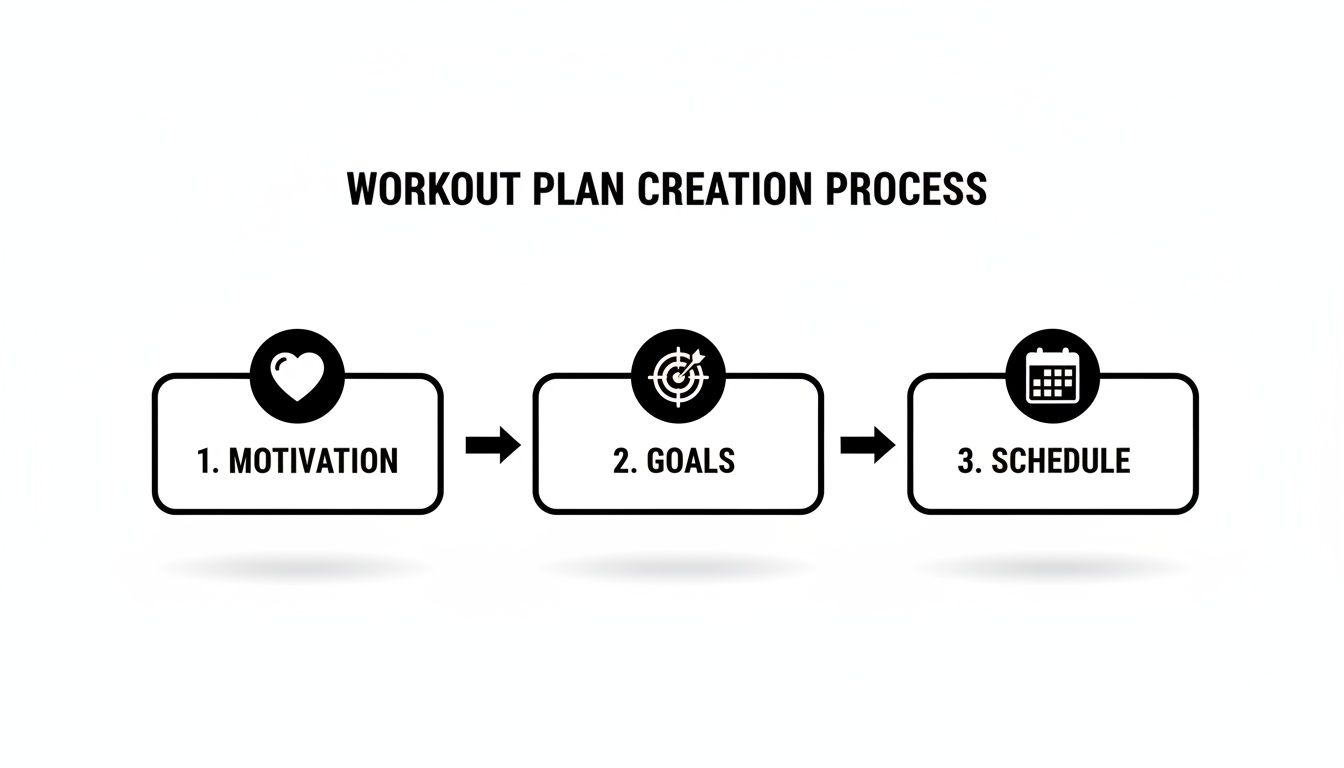
This process shows how your initial "why" (your motivation) shapes your goals, which then need to get locked into a real-world schedule. Let's dig into how to build the cues and rewards that make it all happen.
Master Habit Stacking
One of the slickest ways to create a powerful cue is a technique called habit stacking. Instead of trying to pull a new habit out of thin air, you just piggyback it onto something you already do automatically.
The formula is dead simple: "After [CURRENT HABIT], I will [NEW HABIT]."
- Example 1: "Right after I brush my teeth in the morning, I will put on my workout clothes."
- Example 2: "As soon as I shut my laptop for the day, I will start my 20-minute Zing Coach workout."
This trick uses the momentum of an existing habit to launch you into the new one. No need to find time or willpower; you're just flowing from one action to the next. For a deeper dive, our guide on forming habits that stick has even more strategies.
Start Absurdly Small
The biggest thing standing between you and a workout is just getting started. That initial inertia is a killer. The two-minute rule is your secret weapon for bulldozing through that resistance by making the first step laughably easy.
The idea is to shrink your new habit down to something you can do in two minutes.
- "Go for a run" becomes "Put on my running shoes and walk out the door."
- "Do a 30-minute workout" becomes "Do one set of push-ups."
The point isn't to get a full workout in two minutes. The point is to master the art of showing up. Once you've started, continuing is a hell of a lot easier.
Engineer Your Rewards
Rewards are the glue that holds the habit loop together. They don't have to be anything fancy. A good reward is anything that gives you immediate positive feedback, teaching your brain that the effort paid off. This could be a post-workout smoothie you love, 15 minutes of guilt-free scrolling, or just the simple satisfaction of checking off the workout in your app.
For some, a bigger commitment helps. Structuring your activity by signing up for something like a monthly membership to a pro football academy can provide a powerful, built-in reward system.
This is also where a tool like Zing Coach becomes your partner in crime. Many of its features are basically digital cues and rewards designed to reinforce your new habit.
- Push notifications and calendar integrations are powerful, hard-to-ignore cues.
- Progress streaks and achievement badges deliver that instant, satisfying reward.
- Watching your progress charts go up reinforces the long-term benefits, making you want to keep the streak alive.
When you blend these psychological tricks with smart tools, exercise stops feeling like a chore. It just becomes a natural, rewarding part of your day.
Use Technology for Motivation and Smart Progress
Not too long ago, tracking your fitness meant scribbling in a notebook and just hoping you were getting stronger. Things have changed. Modern fitness tech puts a personal coach, data analyst, and cheerleader right in your pocket. Used correctly, these tools are an incredible way to understand your body and keep that fire lit.
It's so easy to get hung up on the number on the scale, but real, lasting progress is so much more than that. The right tech helps you see the whole story, tracking the metrics that actually prove your hard work is paying off.
Look Beyond the Scale
True progress is about how you feel and what your body can do, day in and day out. Fitness apps and wearables open a window into those improvements, giving you the positive feedback you need to stay in the game.
Instead of obsessing over pounds, use your tech to watch these numbers:
- Improved Sleep Quality: Many trackers can show you how much deep sleep you're getting. Seeing that number climb is a concrete sign your body is recovering better from your workouts.
- Lower Resting Heart Rate: This is a classic indicator of a healthier, more efficient cardiovascular system. Watching it drop over a few weeks is incredibly rewarding.
- Heart Rate Variability (HRV): A higher HRV is often a signal that your body is rested and primed for a tough workout.
- Increased Strength and Endurance: Are you lifting more weight? Doing more reps? Lasting longer on your runs? Apps make it simple to see these performance gains stack up.
Seeing these metrics improve is powerful. It’s the proof you need that your consistency is making a real difference, even on days when you don’t necessarily "feel" it.
Create a Smart Feedback Loop
The best fitness tech doesn't just throw data at you—it uses that data to make your plan smarter. This is where AI-driven platforms like Zing Coach really shine for anyone trying to figure out how to stay consistent with exercise.
Zing Coach syncs up with data from sources like Apple Health to get a sense of your overall activity. It also uses its own Fitness Test to get a baseline for your strength and endurance. All this info feeds into a powerful feedback loop.
Your performance in one workout directly shapes the next one. The app automatically tweaks your plan based on real-time feedback, so you’re always being pushed just the right amount—never too much, never too little.
This whole process takes the guesswork out of the equation. If you absolutely smash a workout, the AI will dial things up next time. If you're feeling drained and struggle, it’ll scale back to help you recover. This kind of smart adaptation is key to avoiding burnout and plateaus, which are two of the biggest reasons people fall off the wagon. To see how this is becoming more widespread, you can check out how technology in gyms is transforming fitness and bringing similar intelligence into public spaces.
Gamify Your Progress for Daily Motivation
Let's be real—some days, the motivation just isn't there. This is where gamification comes in. Turning your routine into a bit of a game can give you that little nudge you need to get moving.
Fitness apps use a few clever tricks to keep you hooked:
- Activity Streaks: There's nothing like a streak to keep you going. Once you've hit a 30-day chain of workouts, you won't want to be the one to break it. You can learn more about the psychology behind staying healthy with activity streaks and why they're so effective.
- Achievement Badges: Unlocking a new badge for hitting a milestone, like completing 50 workouts, provides a little hit of dopamine and a satisfying sense of accomplishment.
- Visual Progress Charts: A simple graph showing your strength gains or workout frequency is a potent visual reminder that all your small efforts are adding up to something big.
These small, digital pats on the back provide the daily dose of motivation that's so crucial for building a habit that sticks.
Perfect Your Form with Real-Time Feedback
One of the biggest things that holds people back from working out alone is the fear of doing an exercise wrong and getting hurt. Well, technology is now solving that problem with surprising accuracy.
Zing Coach, for instance, can use your phone's camera to analyze your movements while you exercise. An AI avatar on your screen gives you immediate feedback, counting your reps and offering corrections as you go.
This is a complete game-changer for a couple of reasons:
- It builds confidence. You can tackle new exercises without worrying if you're doing them safely.
- It prevents injury. Catching and correcting bad form from the start is the best way to avoid the nagging injuries that can sideline you for weeks.
- It maximizes results. Proper form means you're actually working the muscles you're supposed to be working, which leads to better, faster results.
By combining smart tracking, adaptive planning, and real-time coaching, technology offers a powerful support system. It helps you work out smarter and safer, giving you the daily encouragement you need to build an exercise habit that truly lasts.
How to Navigate Setbacks and Bust Through Plateaus
Sooner or later, even the most perfect workout plan collides with real life. You'll have days where you feel tired, unmotivated, or just plain sore. The journey to consistent exercise is never a straight line; it's full of small detours. How you handle these moments is what truly determines your long-term success.
The trick is to have a playbook ready for these inevitable challenges. A missed workout or a dip in motivation isn't a failure—it's just a signal to adjust your strategy. With the right tactics, you can turn a potential setback into a minor blip and keep moving forward.
The Art of the "Backup" Workout
One of the biggest traps people fall into is the all-or-nothing mindset. You plan a 45-minute strength session, but a meeting runs late or you’re just wiped out after a long day. So, you do nothing. This is exactly where a "backup plan" can save your consistency streak.
Instead of scrapping your workout entirely, have a go-to, low-effort routine locked and loaded.
- A 10-minute mobility and stretching session.
- A 15-minute walk around the block.
- Two sets of your favorite core exercises.
The goal isn't to have an amazing workout; it's to maintain the habit of showing up. By choosing "something" over "nothing," you reinforce the identity of someone who stays active, no matter what. That’s what builds resilience for the long haul.
A bad workout is infinitely better than no workout at all. The act of simply starting, even for just ten minutes, keeps the momentum alive and makes it easier to get back to your full routine the next day.
Reframe Rest as a Strategic Tool
Our culture often glorifies pushing through pain, but anyone who’s trained consistently knows that rest is not a sign of weakness—it’s a critical part of the process. Your muscles don't get stronger during the workout; they get stronger when they repair and rebuild afterward.
Ignoring your body's need for rest can lead to burnout, fatigue, and injury, which are the ultimate consistency killers. Learning to listen to your body is a skill. Pay attention to signs that you might need a break, like unusual soreness, poor sleep, or a persistent lack of energy.
Embrace a strategic approach to recovery:
- Active Recovery: On days you feel sore but not exhausted, opt for light activity like walking or gentle yoga. This increases blood flow and can actually speed up recovery.
- Complete Rest: Don't be afraid to take a full day off. Seriously. This allows your central nervous system and muscles to fully repair.
- Smart Scheduling: Make sure your plan has built-in rest days from the start. An app like Zing Coach automatically factors recovery into your schedule, preventing you from accidentally overtraining.
Busting Through Fitness Plateaus
At some point, you'll hit a plateau. It's when your progress stalls, and the exercises that once felt challenging now feel kind of routine. This is a normal and even positive sign—it means your body has successfully adapted to the stress you've been putting on it.
The solution is a core fitness principle called progressive overload. This simply means you need to gradually increase the demand on your muscles to continue seeing results. Without it, your body has no reason to keep adapting.
There are a few ways to do this:
- Increase the Weight: Add a little more resistance to your strength exercises.
- Increase the Reps/Sets: Do more repetitions or add another set to your routine.
- Decrease Rest Time: Shorten the rest periods between your sets to crank up the intensity.
- Improve Your Form: Slow down and focus on perfect technique, which increases how hard your muscles have to work.
This is where AI-powered tools become incredibly helpful. The Zing Coach app manages progressive overload for you. Its algorithm analyzes your performance in each session, automatically adjusting the weights, reps, and exercises in your next workout to ensure you’re always being challenged just enough to keep making progress without getting overwhelmed. It takes the guesswork out of how to stay consistent when your results start to level off.
And if you've been away from the gym for a while, our guide on how to start working out again offers great tips for easing back in safely.
By anticipating setbacks and having a plan for plateaus, you build a resilient fitness routine. You learn to work with your body, not against it, turning obstacles into opportunities for smart, sustainable progress.
Your Questions on Exercise Consistency Answered
Even with the best plan in the world, questions are going to pop up. Sticking points are a totally normal part of building a fitness routine that lasts. It's how you navigate them that matters.
Let's clear up some of the most common hurdles people run into.
How Long Does It Really Take to Build a Habit?
You've probably heard the old 21-day myth. The truth is, it's different for everyone. Research shows the real number is anywhere from 18 to 254 days.
But honestly, the timeline isn't what you should focus on—the process is. Instead of getting hung up on a magic number, just concentrate on making your workout obvious, attractive, easy, and satisfying. Start so small it feels ridiculous not to do it, like five minutes of stretching right after you get out of bed.
The secret isn't hitting a certain number of days. It's about making it easier to show up than it is to skip, and then celebrating that small win, day after day. Eventually, it just becomes part of who you are.
What Is the Best Type of Exercise for Consistency?
The best exercise is the one you actually do. It really is that simple. There's no perfect program or magical workout split that will work if you dread every single second of it.
For some people, that's lifting weights at home with a clear plan. For others, it's dancing, hiking, swimming, or joining a local rec league. I find the routines that stick the longest usually mix a few different things to keep from getting stale. A solid blend of strength, cardio, and mobility is a pretty great formula for most people.
The key is picking things that you genuinely enjoy and that line up with what you want to achieve. That's how fitness becomes a part of your life, not a chore you have to get through.
How Do I Get Back on Track After Missing a Week?
First off, just breathe. Missing a week is not a catastrophe, and it definitely doesn't erase all your hard work. The biggest mistake you can make is falling into that "all-or-nothing" trap where one missed week makes you feel like a failure, so you just give up entirely.
Whatever you do, don't try to "make up" for lost time with some monster workout. That's just asking for an injury or burnout.
Instead, ease back in. Your first workout after a break should be a little shorter or a little less intense than the last one you did. This is where an adaptive app like Zing Coach really shines. The AI notices you've been inactive and automatically adjusts your next workout to be challenging but manageable, so you can get right back in the groove without overdoing it.
The most important step is always just the next one.
Ready to build a workout plan that adapts to your life, not the other way around? The Zing Coach AI designs your sessions based on your goals, energy levels, and schedule, making consistency feel effortless. Start your personalized fitness journey today at zing.coach.
Share this article


Authors