Learn how to start working out again with a practical plan to safely rebuild fitness, prevent burnout, and stay motivated.
If you’re trying to start working out again, the trick is to reframe your mindset first, run a quick self-check, and then start with a schedule that feels almost too easy. This simple, three-part strategy is the key to managing expectations, staying injury-free, and building momentum that actually lasts.
The Right Mindset for Your Fitness Comeback
Let's be honest, the real challenge isn't the first workout. It's the mental game you have to play just to get yourself to the starting line. Before you even think about lifting a weight or running a mile, your success hinges on laying a new mental foundation. If you're asking how to get back into it, this is where it all begins.

So many of us get stuck in an all-or-nothing mindset, thinking we have to jump right back to peak performance. That’s a fast track to frustration and quitting. The secret is to swap that perfectionism for compassionate consistency.
Shift Your Perspective From Past to Present
It’s so easy to feel guilty about the time you lost or get frustrated that you can’t lift what you used to. Trust me, that’s a mental block we all face. Instead of dwelling on what’s gone, shift your entire focus to what you can do right now, today.
Think of this as a brand new chapter, not a rocky continuation of an old one. It's okay to acknowledge where you were, but don't let your past fitness level dictate your current starting point. Making this mental switch is absolutely crucial for setting expectations you can actually meet and celebrating those small wins that keep you going.
Key Takeaway: You're not trying to reclaim your past fitness overnight. You're building a new, stronger foundation, one workout at a time. The first step is just showing up for yourself with a little patience.
Find Your Powerful “Why”
Motivation that’s tied to external goals, like looking good for an upcoming event, has a nasty habit of fading. For this comeback to really stick, you need a deep, personal reason to keep going long after the initial excitement wears off. This is your "why."
Ask yourself what you really want to get out of this.
- Is it having more energy to keep up with your kids or crush it at work?
- Maybe it’s about better mental health and finding an outlet for daily stress?
- Or is it about investing in your long-term health so you can stay active and independent for decades?
Whatever it is, write it down. Stick it on your mirror, your fridge—anywhere you'll see it every day. This is the anchor that will hold you steady when motivation dips. A successful restart is all about building a sustainable routine, and there are some great tips for building a lasting exercise habit out there. The structure you build around your "why" is just as important as the reason itself, so it’s worth learning more about forming habits that stick and applying those principles to your new routine.
Establishing Your New Fitness Baseline
Trying to jump right back into your old routine is probably the fastest way to get hurt or just burn out completely. So, before you even think about planning a single workout, you need to take an honest look at where you are right now. This isn’t about judging yourself; it’s about gathering some smart, useful data to help you move forward safely.
Your body has changed since you were last training consistently, and that’s perfectly okay. Acknowledging this is the most critical part of figuring out how to start working out again. Life happens. Maybe you had a baby, recovered from an illness, or your job shifted from active to sedentary. All these things reset your fitness baseline.
A Quick Reality Check
Start by asking yourself a few simple but really important questions. Think of it less as a test and more as taking stock of your current situation. This will help you build a plan that actually works for your body today.
- How has my daily activity level changed? If you went from a physically active job to sitting at a desk all day, it’s a safe bet your cardiovascular endurance has taken a hit.
- Have any new health issues or injuries popped up? Maybe you’re dealing with chronic back pain, a tricky knee, or you’re on new medication. All these things can influence the kind of exercise you should be doing.
- What does a "good" day feel like for me now? Get a sense of your current energy levels. Knowing when you feel your best helps you schedule workouts for times you’re most likely to actually do them.
Getting clear on these factors is the first piece of the puzzle. The next is to do a few simple physical tests to get a real, tangible measure of where you're starting from.
Your body doesn't remember your old personal bests. It only knows what it can do today. Respecting that is the secret to avoiding injury and building momentum that lasts.
Simple At-Home Fitness Self-Assessment
You don’t need any fancy equipment for this part. The goal here is just to get a snapshot of your current cardio, strength, and flexibility. This isn’t about comparing your numbers to anyone else’s—it’s about creating your personal starting line.
Take a few minutes to run through these simple tests. They’ll give you a concrete idea of your current fitness level and help you build a smarter, safer workout plan from day one.
| Fitness Component | Test Instructions | What to Record |
|---|---|---|
| Cardiovascular Endurance | See how far you can comfortably walk or jog on a flat surface in 12 minutes. Don't push to the point of exhaustion. | Record the total distance covered. |
| Muscular Strength | See how many bodyweight squats or modified push-ups (from your knees) you can complete with good form before you fatigue. | Record the number of reps for each. |
| Flexibility | Sit on the floor with your legs straight out. Reach toward your toes without bouncing. | Note how far you can comfortably reach. |
Remember, these are just your starting numbers. They're meant to give you a baseline so you can see your progress over time, which is incredibly motivating.
Once you have these numbers, they become invaluable for setting realistic goals and picking the right exercises for your comeback. For more structured guidance and a way to log your results, you can check out a fitness test feature spotlight that helps you track these metrics as you get stronger.
Your First Week Back: A Practical Workout Schedule
Alright, enough with the theory. It's time to get moving. This is where we take all that planning and self-assessment and turn it into sweat. I've designed a clear, straightforward template to get you through your first week safely and effectively.
Don't worry about complicated workout splits or anything high-intensity. The goal right now is simply to re-establish that mind-body connection with foundational movements. Think of it as waking your muscles up, not shocking them into submission.
The plan is simple: three workout days spread throughout the week, with recovery time in between. We'll be using full-body workouts because they're perfect for restarting. They hit all the major muscle groups just enough to stimulate them without completely wiping out any single one. It’s the best way to build a solid base.
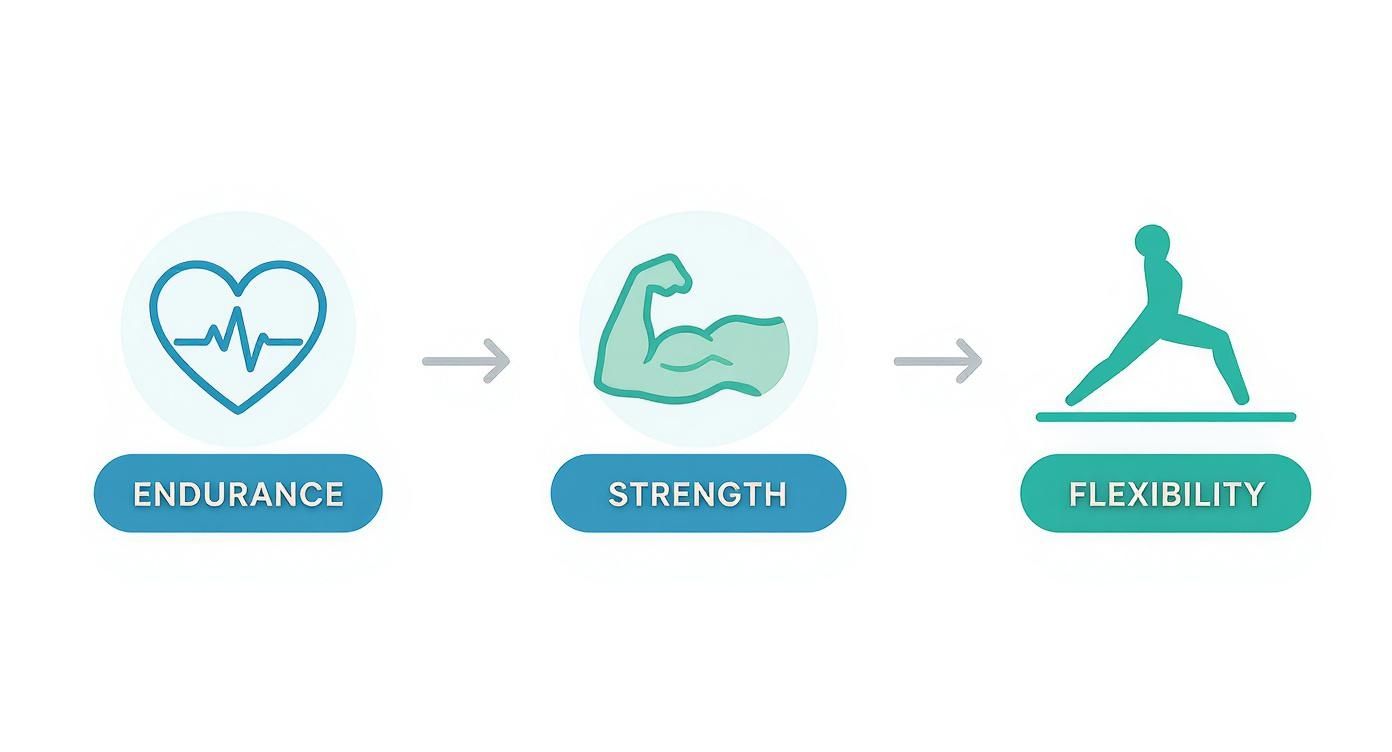
As you can see, real fitness isn't just about lifting heavy things. It's a blend of endurance, strength, and flexibility—all of which we'll touch on in this first week.
Your Sample Weekly Schedule
Treat this schedule as a guide, not a strict set of rules. Your body is the boss here, so listen to it. If Monday feels awful, start Tuesday. What really matters is the pattern: workout, rest, workout, rest, workout, then two days to fully recover.
- Day 1 (e.g., Monday): Full-Body Workout A
- Day 2 (e.g., Tuesday): Active Recovery (Gentle walk or stretching)
- Day 3 (e.g., Wednesday): Full-Body Workout B
- Day 4 (e.g., Thursday): Active Recovery or Full Rest
- Day 5 (e.g., Friday): Full-Body Workout C
- Day 6 & 7 (e.g., Weekend): Rest and Recover
This setup is designed to build consistency without burning you out. We all know the feeling of jumping back in with a ton of motivation—just like the 12% of all new gym memberships famously bought every January. But that initial fire can fizzle out fast without a smart plan. Before the pandemic, gym memberships in the U.S. had climbed to 64.2 million, and a structured approach like this is what helps people stick with it.
Pro Tip: Don't skip your "active recovery" days. They are just as crucial as your workouts. A 20-minute walk or a few gentle stretches gets the blood flowing, eases soreness, and keeps the daily movement habit alive without adding more stress to your body.
The Full-Body Workouts
Here’s how to approach each workout. Do the exercises as a circuit: complete one set of an exercise, take a short breather, and then move on to the next one on the list. Once you've gone through all the exercises, that’s one round. Rest for 60–90 seconds, then repeat the entire circuit for a total of 2–3 rounds.
The number one rule? Focus on clean, controlled form. Speed and weight can wait.
Workout A: Focus on Push & Squat
- Bodyweight Squats: 10–12 reps
- Modified Push-ups (on your knees): 8–10 reps
- Glute Bridges: 12–15 reps
- Plank: Hold for 20–30 seconds
Workout B: Focus on Pull & Hinge
- Dumbbell or Banded Rows: 10–12 reps per side
- Bodyweight Romanian Deadlifts (RDLs): 10–12 reps
- Bird-Dog: 8–10 reps per side
- Side Plank: Hold for 15–20 seconds per side
Workout C: Combined Movements
- Goblet Squats (holding one dumbbell or kettlebell): 8–10 reps
- Standing Overhead Press (with light dumbbells): 8–10 reps
- Lunges (alternating legs): 10–12 reps total
- Dead Bug: 10–12 reps total
These are all foundational movements that are both effective and safe for getting started. And if you don't have equipment, no problem. There are plenty of great at-home exercises to stay fit without the gym you can easily swap in.
Just remember the most important rule of all: if you feel any sharp pain, stop. Never, ever sacrifice good form just to squeeze out a few more reps.
How to Get Stronger Without Getting Injured
Just showing up is half the battle—it builds the habit. But what really keeps you coming back for more is seeing actual progress.
The secret to getting stronger, especially when you’re getting back into the swing of things, isn't about pushing yourself to failure every single time. It’s all about a smart concept called progressive overload.
Put simply, this just means you need to gently and consistently increase the challenge over time. This gives your body a reason to adapt, rebuild, and come back stronger. Without it, you’ll eventually hit a plateau, just going through the motions without seeing any real change.
The good news? It doesn't always mean you have to pile more weight onto the bar. There are a bunch of simple, effective ways to apply this principle.
Simple Ways to Create a Challenge
Progressing your workouts is all about making small, manageable tweaks from one week to the next. The goal is simple: make today’s workout just a little bit harder than the last one.
- Add More Reps or Sets: If you managed two sets of 10 bodyweight squats last week, try for two sets of 12 this week. Or maybe add a third set of 10.
- Increase the Weight: When you feel ready, adding even a small amount of weight—just five pounds—can make a huge difference.
- Reduce Your Rest Time: Shave 15 seconds off your rest period between sets. This ramps up the intensity without you having to change the exercise at all.
Let's see what this looks like in the real world. Imagine you started with basic bodyweight squats. Your progression over a month might look something like this:
- Week 1: 2 sets of 10 reps
- Week 2: 3 sets of 10 reps
- Week 3: 3 sets of 12 reps
- Week 4: 3 sets of 10 reps, but this time holding a light dumbbell (a goblet squat)
This slow and steady approach is how you build strength that lasts.
Recovery: The Secret Ingredient to Progress
Here's something a lot of people miss: your muscles don't get stronger during your workout. They get stronger while you rest and repair afterward.
Skipping out on proper recovery is one of the quickest ways to stall your progress and, even worse, get hurt. To make sure your fitness comeback is a long-term success, it's crucial to understand how to prevent sports injuries and stay in the game.
Focus on these three non-negotiables:
- Sleep: Aim for 7–9 hours of quality sleep a night. This is prime time for your body to release growth hormone, which is absolutely essential for muscle repair.
- Nutrition: You don’t need some ridiculously complicated diet. Just focus on getting enough protein to help rebuild muscle tissue and drink plenty of water throughout the day.
- Listen to Your Body: This is the golden rule. If you feel a sharp pain, stop immediately. If you're feeling unusually sore or just plain exhausted, take an extra rest day. It’s a sign of strength, not weakness.
Your body gives you constant feedback. Learning to tell the difference between normal muscle soreness and actual pain is a skill that will protect you from major setbacks down the road.
Good recovery also involves active measures, not just sitting on the couch. On your rest days, try incorporating some gentle movement. A library of stretching workouts can do wonders for improving flexibility and easing muscle tightness.
This balanced approach—challenging your body and then giving it what it needs to recover—is the key to showing up, feeling good, and getting stronger.
Using Modern Tech to Support Your Fitness Journey
You don’t have to figure out how to start working out again all on your own. Your smartphone and a simple wearable can act as a personal coach, data analyst, and accountability partner. This tech takes a lot of the guesswork out of the equation—something that used to derail people all the time.
Instead of tearing a generic plan out of a magazine, you can use an app that builds workouts based on your actual fitness level, your specific goals, and even the equipment you have on hand. It's a much smarter and safer way to build momentum.
Your Personal Coach and Tracker
Modern fitness apps do a lot more than just show you exercises. They actually learn from you. By tracking your performance, they can intelligently dial the difficulty up or down for your next workout, making sure you're always challenged but never completely overwhelmed. Think of it as having a great personal trainer right in your pocket.
Tools like the Zing Coach app use your feedback and data to progressively increase the challenge, which takes the mental load off your shoulders. You can learn more about how an AI coach upgrades your training to keep you moving forward. This kind of smart adaptation is what really drives long-term success.
Here’s a look at how a modern fitness app like Zing lays out your personalized workout plan, making it simple to see exactly what you need to do.
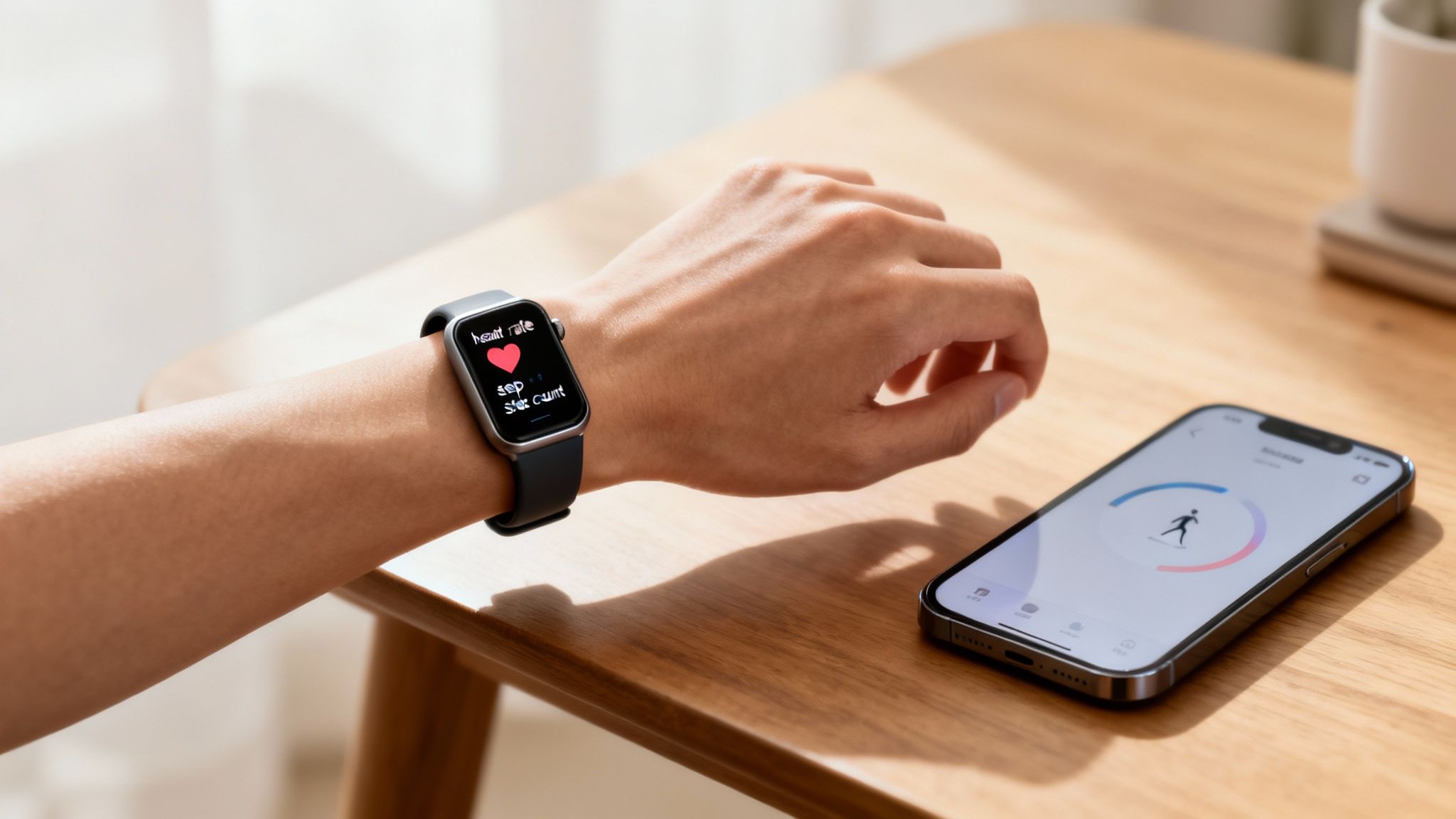
This screenshot shows just how valuable having a clear, actionable plan at your fingertips can be. No more guessing what to do next.
Making Sense of Your Data
Wearable devices, like smartwatches, give you a constant stream of valuable information about your body. They track metrics that go way beyond just steps and calories.
- Heart Rate: Keeping an eye on your heart rate during workouts helps you train at the right intensity—not too hard, not too easy. It's the sweet spot for making progress.
- Sleep Quality: Recovery is just as important as the workout itself. Tracking your sleep can show you patterns that directly impact your energy and performance in the gym.
- Activity Levels: Seeing your daily activity gives you the full picture of your movement, motivating you to stay active even on your "off" days.
This data isn't just for show; it's direct feedback that helps you make smarter decisions. If you see your sleep quality was poor, maybe you opt for a lighter workout. If your heart rate is lower during a familiar routine, that's a crystal-clear sign your fitness is improving.
The integration of these tools is a massive trend for a reason. The wearable fitness tech market is on track to hit $62.82 billion by 2025, pushed by people who want this kind of precise feedback to restart their routines with confidence. Using this tech wisely turns your fitness journey from a guessing game into a well-informed strategy.
Got Questions About Your Fitness Comeback?
Let’s be real: when you’re figuring out how to start working out again, your brain probably goes into overdrive. Overthinking can be the biggest hurdle, so let's clear the air and tackle some of the most common questions head-on. Getting these answers sorted can give you the confidence to just start without second-guessing everything.
One of the first things people wonder about is muscle soreness. Is it good? Bad? How much is too much? A little tenderness, which is technically called Delayed Onset Muscle Soreness (DOMS), is a totally normal part of your body adapting to new stress. It usually pops up 24 to 48 hours after you’ve worked out.
However, if you're so sore that simple daily activities feel like a mission, that's a red flag you've overdone it. The goal is to learn the difference between that satisfying ache of a muscle well-worked and sharp, can’t-move pain. For mild soreness, things like gentle stretching, drinking plenty of water, and some light activity like walking can really help.
Should I Work Out at Home or Join a Gym?
The classic debate: home workouts versus the gym. Both have their perks and pitfalls, and the right answer for you boils down to your personality, budget, and lifestyle. There's no one-size-fits-all solution here.
Working Out at Home:
- The Upside: It’s ridiculously convenient, completely private, and easy on the wallet. You can jump into a workout whenever you have a spare moment without worrying about travel time or who’s watching.
- The Downside: You might not have access to a wide variety of equipment, which can make it tougher to keep challenging yourself. It also takes a serious amount of self-discipline to stay on track without the buzz of a gym.
Joining a Gym:
- The Upside: Gyms are packed with equipment, which is fantastic for progressive overload. Plus, just being in a dedicated fitness space surrounded by other people can be a huge motivator.
- The Downside: Memberships can get pricey, and it can feel a bit intimidating when you're just getting back into the swing of things. Don't forget to factor in travel time, too.
Ultimately, the best place to work out is wherever you'll actually do it. The global fitness industry, set to be worth over $90 billion by 2025, is booming because people want options. This includes a huge surge in at-home fitness tech—fitness app downloads are expected to blow past 5 billion globally by 2025. It just goes to show how digital tools are filling the gap for those who prefer the home-turf advantage. Explore more about evolving global fitness trends.
What If I Lose Motivation?
Losing motivation isn't a possibility; it's a certainty. It happens to literally everyone. The secret isn't to try and stay motivated forever—it's to build habits and systems that carry you through when you're just not feeling it.
Motivation is what gets you started. Habit is what keeps you going. Don't wait until you "feel like it." Stick to your schedule, even if you just do a shorter, lighter version of what you planned.
When that initial spark fades, go back to your "why." Re-read the deep, personal reasons you wrote down at the beginning of this journey. Remind yourself that showing up on a day when you have zero motivation is a massive victory. It reinforces your habit way more than crushing a workout when you were already pumped to do it.
Ready to take the guesswork out of your fitness comeback? The Zing Coach app creates a truly personalized plan that adapts as you get stronger, keeping you challenged, motivated, and on track. Start your journey with a workout plan built just for you at https://zing.coach.
Share this article


Authors