Learn how to measure training effectiveness with practical KPIs and proven methods to track progress and boost outcomes.

That post-workout high is great, isn't it? It’s motivating, but it's not a reliable way to tell if you're actually getting fitter. To truly understand if your hard work is paying off, you need to look beyond just feeling good and start looking at the cold, hard data.
This means swapping guesswork for a clear-cut plan: defining exactly what you want to achieve, tracking the right numbers over time, and tweaking your approach based on what those numbers tell you.
Going Beyond the Feel of a Good Workout
Simply "working hard" doesn't guarantee results. Without a target to aim for, your effort can feel scattered and unproductive. This is where a systematic approach to tracking becomes your best friend, whether you're just starting out and need to see those early wins or you're a seasoned athlete dialing in your performance.
The process is pretty straightforward, but it’s the foundation of all real progress.
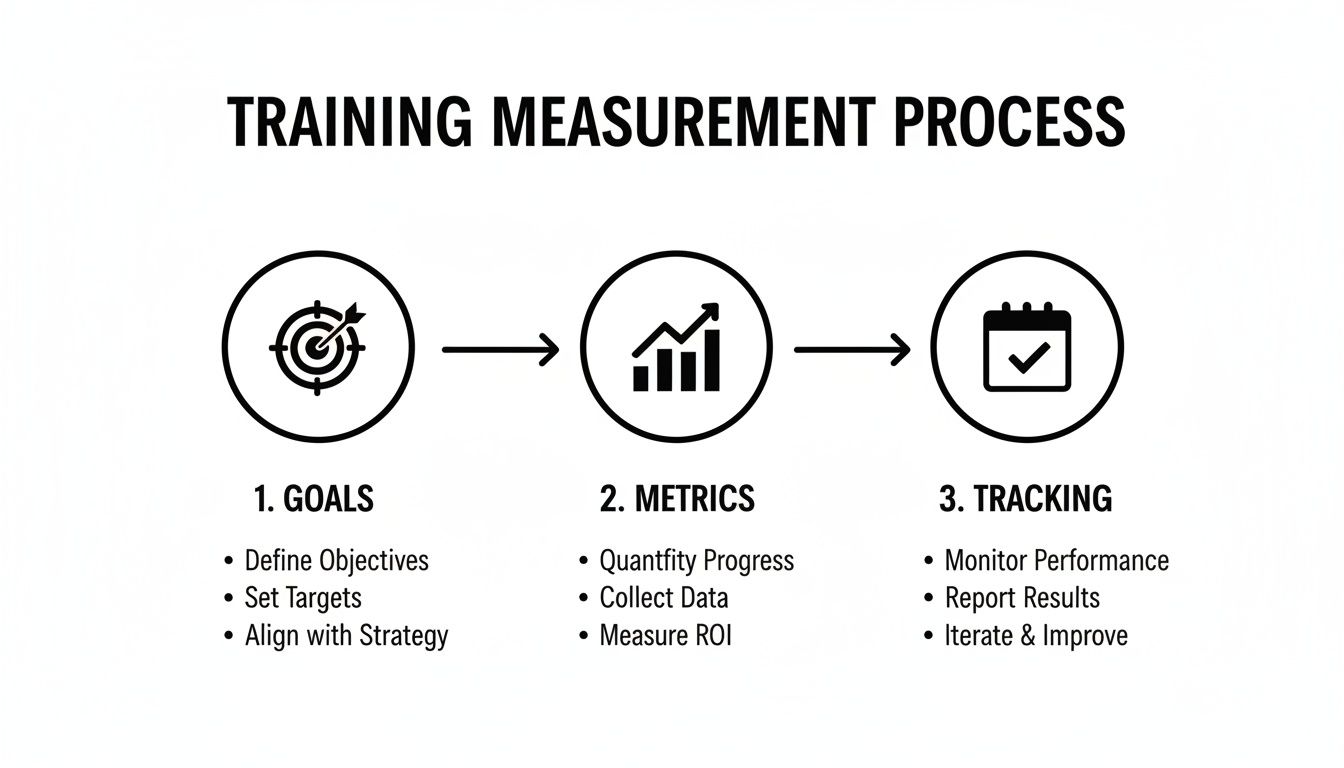
As you can see, it all starts with setting a clear goal. Without one, the metrics you track are just numbers without any real meaning or direction.
The Power of a Structured Framework
Adopting a structured plan takes the emotion out of your fitness journey. No more wondering if you’re getting stronger or leaner—you'll have concrete data to prove it. This clarity helps you see exactly what’s working and, just as importantly, what isn't.
A solid framework helps you in a few key ways:
- Stay Motivated: Nothing fuels consistency like seeing measurable progress, like adding another rep to your set or watching your body fat percentage drop.
- Spot Plateaus Early: Objective data makes it obvious when your progress stalls. This is your cue to switch things up before you get stuck.
- Train Smarter, Not Harder: The insights you gain from your data allow for intelligent adjustments. You can learn more about the specifics of how to track fitness progress in our detailed guide.
To get started, let's break down the essential components you'll need. Think of these as the building blocks for a successful and measurable training program.
Core Components for Measuring Training Success
A quick look at the fundamental elements needed to accurately track your fitness journey and confirm your plan is delivering results.
| Component | What It Means for You | Why It's Non-Negotiable |
|---|---|---|
| Clear Goals & KPIs | Defining exactly what success looks like for you (e.g., lose 10 lbs, add 20 lbs to squat). | Gives your training purpose and a clear finish line to work towards. |
| Valid Metrics | Choosing the right data points to track that align directly with your goals (e.g., body fat %, 1RM). | Ensures you're measuring what actually matters, not just collecting random numbers. |
| Baseline & Cadence | Establishing your starting point and deciding how often you'll test and measure progress. | Provides a benchmark to measure against and a consistent schedule for evaluation. |
| Data & Interpretation | Consistently collecting your data and analyzing it to understand trends and make informed decisions. | Turns raw data into actionable insights that guide your next steps. |
By building your plan around these core components, you create a powerful feedback loop that keeps you moving forward.
To truly measure training effectiveness, it's important to consider all factors influencing performance and recovery. This includes how dedicated care like sports massage can contribute to alleviating chronic pain and muscle tightness, ultimately supporting your ability to perform and recover.
Ultimately, a data-informed approach is what transforms all that sweat and effort into real, tangible achievements you can see and feel. Modern tools like the Zing Coach app are designed to streamline this entire process, turning your hard work into undeniable results.
Setting Goals That Actually Drive Progress
If you want to know if your training is actually working, you need a destination. "Getting in shape" is a wish, not a destination. Without a clear target, you're just wandering around the gym hoping for the best. This is where setting specific, measurable goals becomes your North Star, guiding every single workout and decision you make.
Progress is impossible to track without something to track it against. We need to ditch the vague aspirations and craft some meaningful Key Performance Indicators (KPIs). Don't let the corporate-speak scare you; a KPI is just a specific number that shows you how close you are to hitting your goal. It turns a fuzzy idea into something real you can measure.

From Vague Ideas to Actionable Targets
The best way I’ve found to nail down these targets is by using the SMART framework. It’s a classic for a reason. It forces you to make sure your goals are Specific, Measurable, Achievable, Relevant, and Time-bound. This simple structure is brilliant because it turns a day-dream into a concrete plan of attack.
Let’s take a common one: "I want to get stronger." Great sentiment, but you can't measure it. Let's run it through the SMART filter:
- Specific: I want to increase my deadlift strength.
- Measurable: I will increase my one-rep max by 15 lbs.
- Achievable: Based on my recent training, this is a challenging but realistic jump.
- Relevant: A stronger deadlift will directly improve my overall functional strength and power.
- Time-bound: I will hit this new PR in the next 8 weeks.
Just like that, "get stronger" becomes "Increase my deadlift by 15 lbs in 8 weeks." Now that's a target. You have a clear mission to work toward and a finish line to cross. If you want more inspiration, we've got a whole guide on how to set fitness goals that you’ll actually stick with.
Real-World Goal Examples
This approach works for absolutely everyone, no matter where you're starting. For a total beginner, the goal might have nothing to do with performance and everything to do with just showing up. Consistency is the game.
Their main KPI could be adherence: "Complete three 25-minute workouts per week for one full month." That's a perfect, measurable starting point that builds the foundation for everything else.
Or maybe you're getting back into it after a break. A great goal could be: "Improve my body composition by losing 2% body fat in 12 weeks." This focuses on a meaningful health marker that goes way beyond the number on the scale.
For coaches and serious trainees, quantitative KPIs are gold. Things like program completion rates and weekly engagement tell the real story of effectiveness. Modern platforms can automate this data collection, and the insights are powerful. For example, some Zing Coach users hit a 95% completion rate for their tailored sessions, often fueled by simple motivators like streaks and challenges.
This is exactly where technology can lend a hand. Smart tools like the Zing Coach app are built to help you define these targets right from the get-go, making your fitness journey intentional, focused, and—most importantly—measurable. It handles the tedious tracking so you can focus on putting in the work.
Choosing the Metrics That Truly Matter
Once you’ve locked in your goals, it's time to figure out how you'll actually track your progress. Let’s be real: just hopping on the scale every morning isn't going to cut it. That number is notoriously misleading and only ever tells a tiny fraction of the story.
To get a true picture of how effective your training is, you need to look at a balanced set of metrics. Think of it like a business dashboard. A CEO wouldn't judge the health of their company by a single number. They'd look at sales, customer satisfaction, and operational costs. Your body's no different—you need a holistic view to see what’s really changing.
We can break down the most insightful metrics into a few key areas that, when combined, give you a complete and actionable overview of your fitness journey.
Key Fitness Metrics to Monitor for Real Insights
This table breaks down the essential metrics that give you a holistic view of your training effectiveness, moving far beyond just the number on the scale.
| Metric Category | Examples | What This Data Reveals |
|---|---|---|
| Body Composition | Body Fat %, Lean Muscle Mass | The quality of your weight change (gaining muscle, losing fat). |
| Strength & Performance | Progressive Overload (weight, reps, sets), 1-Rep Max | Concrete proof that you're getting physically stronger and more capable. |
| Adherence & Consistency | Workout Frequency, Completion Rate, Streaks | How well you're sticking to the plan—the biggest predictor of long-term success. |
| Recovery & Well-being | Sleep Quality, Perceived Fatigue, Heart Rate Variability (HRV) | Whether your body is adapting to training stress or heading for burnout. |
By monitoring a mix of these metrics, you get a much smarter, more nuanced understanding of your progress, allowing you to make better decisions about your training and lifestyle.
Beyond the Bathroom Scale: Body Composition
This is where so many people get stuck, but it’s absolutely crucial for any goal related to fat loss or muscle gain. The scale can't tell the difference between a pound of fat and a pound of muscle, which is precisely why body composition metrics are so much better.
- Body Fat Percentage: This is the percentage of your total weight that is pure fat. A drop here, even if your total weight stays the same, is a massive win.
- Lean Muscle Mass: This is everything else—muscle, bone, water, and organs. An increase in lean mass is a crystal-clear sign your strength training is paying off.
If you really want to dive deep into this, we have a complete guide on how to measure muscle gain effectively.
Modern tools make tracking this easier than ever. For instance, the Zing Coach app includes a Body Composition Scan that uses your phone's camera to estimate these figures, giving you a much clearer picture of your progress than weight alone ever could.
Performance and Adherence: The Hard Proof
These metrics are your objective proof of getting stronger and more consistent. They are the most direct indicators of whether your training plan is working from a strength and habit-building perspective. Performance is about what you can do, while adherence is about what you actually do.
Consistency is the engine of all fitness results. You can have the perfect plan, but it’s worthless without adherence. Often, the simple act of tracking your workout frequency is the most powerful predictor of success.
Start tracking these to see real-world results:
- Progressive Overload: Are you lifting more weight, doing more reps, or completing more sets than you were a month ago? This is the fundamental principle of getting stronger.
- Workout Frequency: How many of your planned sessions did you actually complete this week? Hitting your target is a direct measure of your commitment.
- Streaks and Consistency: Tracking how many weeks in a row you’ve hit your workout goals builds powerful momentum that's hard to break.
The Overlooked Role of Recovery
You don’t build muscle in the gym; you build it when you recover. Ignoring recovery metrics is an incredibly common mistake that leads straight to burnout, plateaus, and frustration. Paying attention to these signals tells you if your body is adapting well to the training stress you're putting it under.
Simple but effective recovery metrics include sleep quality and perceived fatigue. Integrating data from sources like Apple Health can automate a lot of this, giving you insight into how your lifestyle supports (or sabotages) your training.
When you see your performance dip after a few nights of poor sleep, you start to understand just how critical rest is. It’s not a luxury; it’s part of the training.
Creating Your Starting Line and Check-In Rhythm
You can't really appreciate how far you've come if you don't know exactly where you started. This is why establishing a clear baseline is non-negotiable. It’s your concrete "Day Zero," the personal starting line you’ll use to benchmark all future progress.
This isn’t about just one number, either. To get the full picture, you need to create a holistic snapshot of your current fitness before you even lift a single weight on your new plan. Gathering a few key data points right at the outset gives you a rich, multi-faceted starting point to look back on.
Your Initial Assessment Checklist
Your first assessment should capture both how your body looks and how it performs. When you combine these two elements, you get a much more compelling story of your progress over time than any single metric could ever tell you.
- Progress Photos: Snap front, side, and back photos in good, consistent lighting. These visual records are amazing because they often reveal changes in your physique that the scale completely misses.
- Body Measurements: Grab a flexible tape measure and record the circumference of your chest, waist, hips, and thighs. These numbers are fantastic for tracking fat loss and muscle gain. For a deeper dive, check out our guide on how to measure body composition at home.
- Standardized Fitness Test: This is where you gauge your current strength, endurance, or mobility with a structured test. The Zing Coach app actually includes a Fitness Test for this very reason, creating a performance baseline that the AI then uses to build your personalized plan.
Once you have this data, you've officially drawn your starting line in the sand. Now comes the next crucial piece: deciding on a sustainable rhythm for your check-ins.
Finding Your Re-Testing Rhythm
The real magic happens when you’re consistent—not just with your training, but with your measuring, too. A smart check-in schedule keeps you honest and accountable without making you stress over tiny, meaningless daily fluctuations. The trick is to match your re-testing frequency to how quickly each metric is actually likely to change.
Here’s a practical schedule you can start with:
- Body Composition (Weight, Measurements, Photos): Re-evaluate every 4 weeks. This is the sweet spot. It's long enough to see real trends in fat loss or muscle gain, but not so long that you lose motivation. It also helps you ignore those frustrating daily shifts from water weight.
- Performance (Strength, Endurance): Re-test every 4-6 weeks. This timing lines up perfectly with most training blocks. It gives your body enough time to adapt and genuinely get stronger before you put it to the test again.
Here's a pro tip: Keep your testing conditions as consistent as possible. Always measure yourself at the same time of day (the morning, before you eat, is ideal) and under the same circumstances. This is the only way to ensure the data you collect is reliable and truly reflects your progress.
Turning Your Data Into Smart Training Decisions
Gathering data is just the starting line. The real magic happens when you know how to read it. Your numbers tell a story, and learning that language is how you turn raw data into smart, effective training decisions.
It’s easy to get obsessed with the daily ups and downs, like a slight jump on the scale or one less-than-stellar workout. But here’s the thing: progress is almost never a straight line. The trick is to look for trends over weeks, not days.
One off-workout doesn’t mean much. But four straight weeks of stalled strength gains? That’s your body sending you a clear signal that something needs to change.
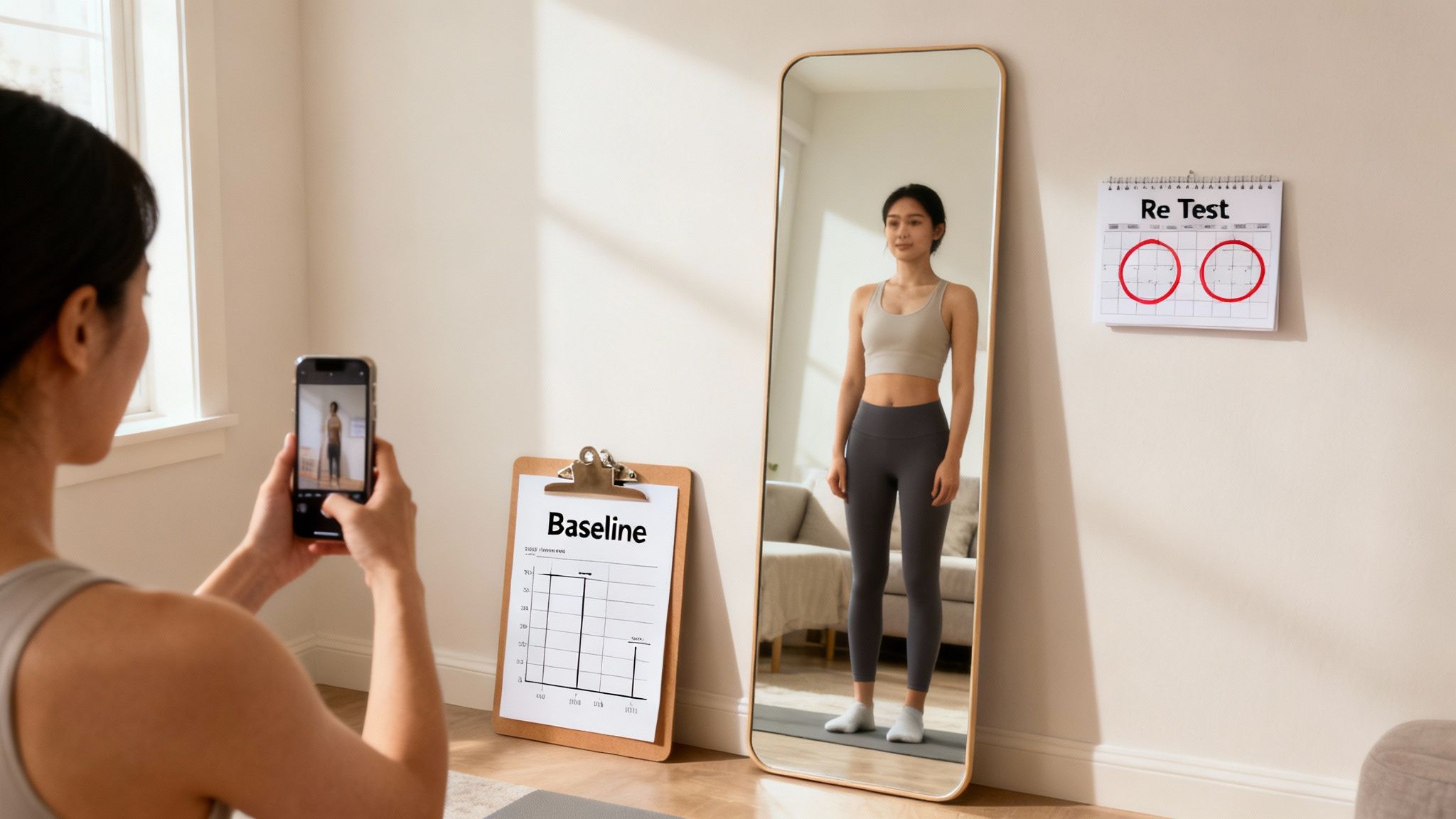
This process isn't about judging yourself; it's about becoming your own coach. By learning to interpret these signals, you empower yourself to make the small adjustments that lead to big, long-term results. If you want to dive deeper into the science of how this works, you can learn more about the Zing Coach methodology.
Interpreting Real-World Scenarios
So, what does this look like in practice? Let's walk through a few common situations and decode what your data might be trying to tell you.
Scenario 1: Your weight is the same, but your clothes fit better.
This is a massive win! It's a classic sign of body recomposition—you're losing fat while building muscle. The scale isn't budging because dense muscle is replacing the space once taken up by fat. Your progress photos and body measurements will tell the true story here.Scenario 2: Your strength numbers haven't moved in three weeks.
Welcome to the plateau. Your body has officially adapted to what you've been throwing at it, and it's time for a new challenge. Your next move could be to switch up your rep scheme, add more weight to the bar, or introduce a few new exercises to shake things up.Scenario 3: You’re constantly tired and your energy is in the tank.
Look at your performance data, and you'll likely see a dip there, too. This is a tell-tale sign of under-recovery. Your data is screaming at you to check in on your sleep, nutrition, and stress levels. Pushing harder isn't the answer—smarter recovery is.
Think of your training data as a feedback loop. It's not a report card grading your effort; it's a compass pointing you toward your next best move. Listen to it without emotion, and you'll always know what to do next.
Automating Your Adjustments with AI
Making these kinds of adjustments on the fly requires a lot of experience and constant attention. Honestly, it can be a huge headache. This is exactly where technology can step in and do the heavy lifting for you.
An AI-powered tool like Zing Coach doesn't just help you collect data; it actively interprets it for you.
The app's AI looks at your workout performance, considers your feedback on fatigue and effort, and automatically adjusts your next session. If you start blowing past your targets, it will progressively dial up the challenge. But if you report feeling sore or tired, it might scale back the intensity to prioritize recovery. This constant, data-driven adjustment cycle ensures your plan always fits where you are right now, taking all the guesswork out of the equation.
Putting It All Together: A Proven Framework for Tracking Your Progress
Alright, we've covered the nuts and bolts—setting goals, picking the right metrics, and getting your baseline. Now it’s time to build the actual system that ties everything together. A truly effective way to measure your training isn’t just about one or two numbers; it’s about looking at your journey from multiple angles.
To do this, we can actually borrow a powerful, multi-layered framework from the corporate world and adapt it for fitness: the Kirkpatrick Model. Don't worry, this isn't about spreadsheets and TPS reports. It's a holistic way of seeing your progress that accounts for your experience, skill development, habits, and of course, the final results.
The model breaks progress down into four distinct levels, each one building on the last. By checking in with each level, you get the full picture of your success, making sure none of your hard work goes unnoticed. This structure gives you clarity and helps keep the fire lit for the long haul.
A Four-Level View of Your Fitness Success
Let's translate this industry-standard model into something practical for your training. Think of it as a checklist to ensure your program is delivering on every single front, from how you feel right after a workout to the big-picture goals you hit months down the line.
The Kirkpatrick Model is one of the most reliable ways to measure training effectiveness, used by an estimated 71% of organizations to evaluate their programs. Applying it to your fitness gives you a structured path from immediate feedback to tangible, life-changing outcomes. For a deeper dive, you can check out some of the foundational research on measuring learning program effectiveness.
Here’s how the four levels apply directly to your fitness journey:
Level 1: Reaction. This is your immediate, gut-level response. How did that workout feel? Was it too hard, too easy, or just right? Zing Coach’s post-session feedback, where you rate the difficulty and your energy, is a perfect example of capturing this crucial Level 1 data.
Level 2: Learning. This level is all about skill acquisition. Are you getting better at the movements? Are you mastering new abilities or improving your technique? In a fitness context, this could be validated through tools like Zing Coach's Fitness Tests, which track performance improvements over time, or its computer vision feature that confirms you’re nailing your squat form.
Level 3: Behavior. This is where new skills become second nature. Are you consistently applying what you’ve learned and turning it into a real habit? This is all about adherence—hitting your weekly workout targets, making smarter food choices, and sticking to your plan even when motivation is low.
Level 4: Results. This is the bottom line—the "so what?" of your training. Are you actually achieving your big-picture goals? This is where your training connects directly to those measurable outcomes we talked about, like dropping 5-10% body fat over 12 weeks or finally adding 20 pounds to your bench press.
This tiered approach is a game-changer because it helps you see progress even when the big "results" feel slow to arrive. Nailing your form (Level 2) and staying consistent week after week (Level 3) are massive victories that directly lead to the long-term changes you’re chasing.
Common Questions About Tracking Fitness Progress
Navigating the world of fitness tracking always brings up a ton of questions. As you start digging into the data behind your training, it's totally normal to hit a few hurdles or wonder if you're even doing things right.
Let's clear up some of the most common points of confusion so you can stay on track with confidence.
How Often Should I Measure My Progress?
This is a big one, and the right answer depends entirely on what you're tracking. Not all metrics change at the same speed, and checking in too often can be a one-way ticket to frustration.
Here’s a practical schedule that works for most people:
- Performance Metrics: Things like sets, reps, and weight lifted should be logged every single workout. This daily data is what shows your immediate progress and tells you what to aim for next time.
- Adherence Metrics: A quick review of your weekly consistency and how many workouts you hit is perfect to do once a week. A Sunday evening check-in is a great way to wrap up the week.
- Body Composition Metrics: Changes like your scale weight, body measurements, and progress photos happen much more slowly. For these, you’ll want to check in every 2-4 weeks. This rhythm helps you see real trends without getting thrown off by normal day-to-day fluctuations.
What Should I Do If My Progress Has Stalled?
First off, don't panic. Hitting a plateau is a normal, even expected, part of any real fitness journey. All it means is that your body has successfully adapted to what you've been throwing at it, and now it's craving a new challenge.
This is where your data becomes your detective. Dig into your logs for clues. Are you still consistently applying progressive overload in your workouts? Is your nutrition really dialed in to support your goals? What about your sleep and stress levels lately? A stall is just a signal that it's time to strategically tweak one of these variables.
The most crucial metric for just about everyone is adherence—or, to put it simply, consistency. You can have the most perfectly designed plan in the world, but it means absolutely nothing if you don't actually follow it.
Focusing on just showing up builds the foundation for every other result you want, from strength gains to fat loss. When in doubt, make getting your workouts in the top priority. The other numbers will eventually start moving in the right direction again. Of course, an adaptive app can also help automate these adjustments for you.
Ready to stop guessing and start seeing real, measurable progress? Zing Coach uses AI to build a plan that adapts to your performance, feedback, and goals, taking all the guesswork out of your fitness journey. Get your personalized plan at https://zing.coach.
Share this article


Authors