Discover the most effective 5 day workout split to build serious muscle and strength. Get proven templates, sample routines, and expert nutrition tips.

So, what exactly is a 5-day workout split? It’s a training schedule that carves up your week, dedicating each of your five gym sessions to different muscle groups. Think "Chest Day," "Leg Day," and so on. This approach lets you hit specific muscles with intense focus and high volume, which is a fantastic recipe for growth and recovery.
Is a 5-Day Workout Split Right for You?
Choosing how often to train can feel like a huge decision, but the 5-day split has long been a go-to for anyone serious about building muscle and strength. And it's not just for elite bodybuilders anymore. This highly effective structure is more accessible than ever for everyday gym-goers looking to get the most out of their time.
The idea is pretty straightforward: by splitting your workouts, you give each muscle group a really intense, focused session. Then, you give it plenty of time off to recover and grow. This is a big departure from full-body routines, where you're working every muscle more often but with way less intensity in each workout.
The Power of Focused Training
When you have an entire session just for your back or shoulders, you can throw more exercises, sets, and overall volume at those muscles than you ever could otherwise. This targeted approach is a powerful trigger for hypertrophy (that's the science-y term for muscle growth).
Instead of trying to squeeze in a few sets of bench press after you've already done squats and rows, you can spend a solid 45-60 minutes just on pushing movements. You leave the gym knowing you’ve absolutely exhausted the target muscles for that day.
This kind of schedule works well for a lot of different people:
- Busy Professionals: The sessions are efficient. You can go all-out for under an hour and be confident you’ve done what you need to for that day's muscle group.
- Strength Seekers: It lets you hit your heavy compound lifts right at the start of the workout when you're fresh, then follow up with accessory work to build a rock-solid foundation.
- Returning Gym-Goers: A structured split gives you a clear, repeatable plan for the week, which is huge for building consistency and getting your confidence back.
The real magic of a 5-day split is how it balances intensity with recovery. You push a muscle to its absolute limit, then give it a full week to repair and come back stronger. This cycle is what drives long-term progress.
A Proven Method for Serious Gains
There’s a reason professional bodybuilders have sworn by this approach for decades. In fact, some estimates suggest that around 95% of professional bodybuilders use a 5-day split, often dedicating one full day to each major body part.
While their training volume might be on another planet, the principle is the same. For advanced lifters who have been training for years, a higher-frequency split provides the volume and intensity needed to smash through plateaus that other routines just can't touch. You can find endless debates about this on forums like T-Nation.
Of course, a 5-day split is just one of many ways to organize your training. Before jumping in, it's worth understanding the core benefits of strength training and why it's such a critical piece of any fitness plan. It's also smart to see how it stacks up against other popular options, like a 4-day workout split.
Comparing Popular Workout Splits
To give you a better idea of where the 5-day split sits, here's a quick look at how it compares to other common training frequencies.
| Split Type | Weekly Frequency Per Muscle | Best For | Potential Drawback |
|---|---|---|---|
| Full Body | 2-3 times per week | Beginners, general fitness, time-crunched | Less focus on individual muscle groups |
| Upper/Lower | 2 times per week | Intermediate lifters, strength & hypertrophy | Can lead to long workout sessions |
| Push/Pull/Legs | 1-2 times per week | Intermediate to advanced, flexible scheduling | Recovery can be tricky if run twice a week |
| 5-Day Split | Once per week | Advanced lifters, maximum hypertrophy | Requires a high time commitment (5 days/wk) |
This table makes it clear that different splits serve different purposes. The 5-day split is really designed for those who can hit the gym consistently and want to maximize muscle growth.
Ultimately, the best split is the one you can actually stick with week in and week out. Modern tools like the Zing Coach app can take a pro-level concept like the 5-day workout split and build a version that’s customized for your specific goals, schedule, and fitness level—turning it into a practical plan that delivers real-world results.
Proven 5-Day Split Templates That Deliver Results
Alright, enough theory. Let's get into the good stuff—the actual plans that get you where you want to go. Now that you know why a 5-day split works, it’s time to figure out how to make one work for you. Picking the right template is your first real step toward building a routine that actually matches your goals.
The way you structure your week is going to have a huge impact on your results. A split designed to pack on muscle is going to look a lot different than one built for raw strength, so getting clear on your main objective is key.
To make it easier, here’s a quick decision tree to guide you toward the best 5-day split for your primary goal.
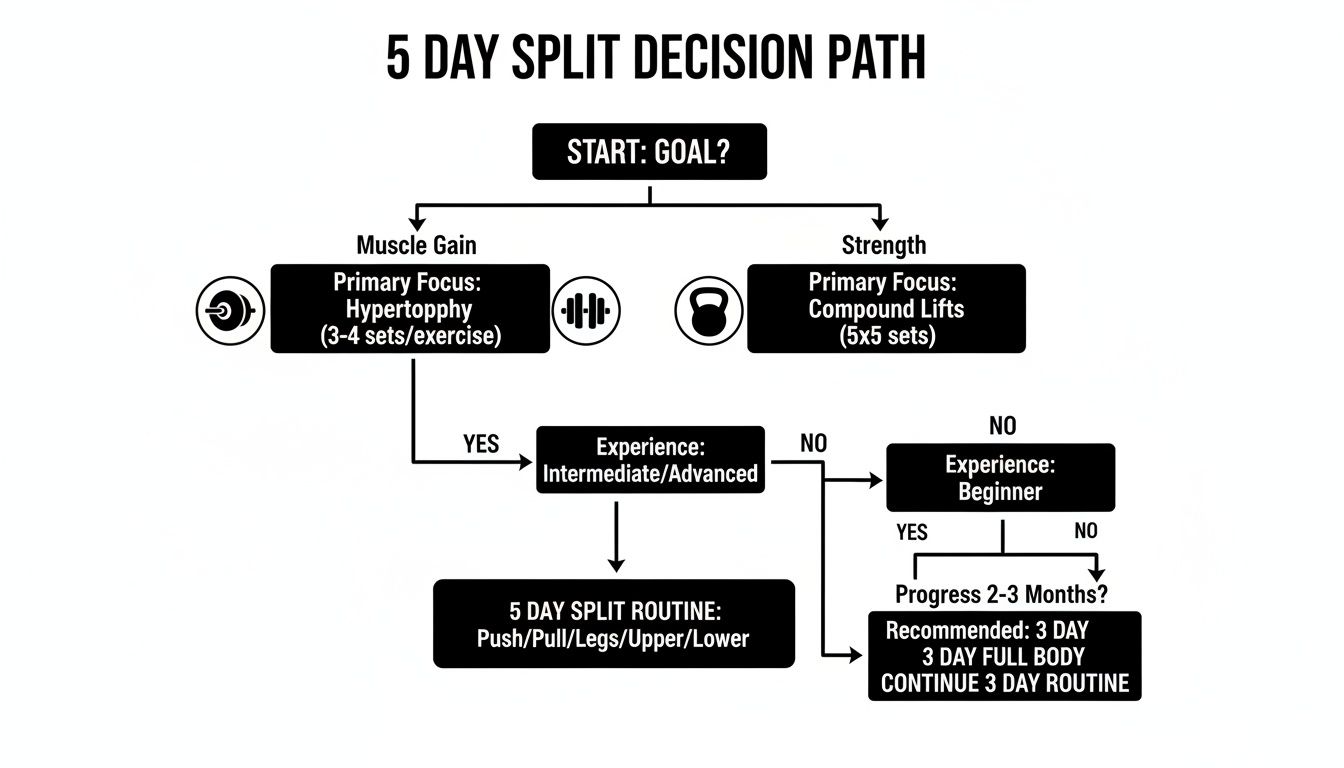
As you can see, your path splits depending on whether you're chasing muscle growth (hypertrophy) or functional strength. Both routes lead to killer results, but they get there in different ways.
The Classic Body Part "Bro" Split
You've definitely heard of this one. The "Bro Split" is probably the most famous 5-day split out there. The concept is simple: dedicate each workout to one major muscle group and absolutely hammer it with volume and intensity. It's a beast for hypertrophy.
A classic week looks something like this:
- Day 1: Chest
- Day 2: Back
- Day 3: Legs
- Day 4: Shoulders
- Day 5: Arms (Biceps & Triceps)
Since you only train each muscle directly once per week, you can go all-out in every session. There's no need to worry about being too fried for the next day's workout. This high-volume, high-intensity approach is a time-tested recipe for muscle growth. That full week of recovery for each muscle group is perfect for lifters who love pushing their sets close to failure.
Who is it for? This split is a fantastic choice for intermediate to advanced lifters whose number one goal is maximizing muscle size. It really lets you dial in that mind-muscle connection and hit each body part from every conceivable angle.
The Upper/Lower Push/Pull/Legs Hybrid
This one is a more modern take that blends a few different training styles. The Upper/Lower/Push/Pull/Legs (ULPPL) split ramps up the training frequency for some muscle groups, making it a stellar option for building well-rounded strength and size.
It's a bit more complex than the Bro Split, but its versatility is incredible. It combines specific body parts with broader movement patterns for a truly balanced attack.
Here’s one way a ULPPL week could shake out:
- Day 1: Upper Body (Strength Focus)
- Day 2: Lower Body (Strength Focus)
- Day 3: Rest
- Day 4: Push (Chest, Shoulders, Triceps)
- Day 5: Pull (Back, Biceps)
- Day 6: Legs (Hypertrophy Focus)
- Day 7: Rest
With a setup like this, you're hitting your upper body muscles twice over the five workouts—once with heavy, compound movements and again with more targeted "push" and "pull" days. That extra frequency can be just the ticket for busting through strength plateaus. If you're coming from a less intense schedule, our guide on moving on from a 3-day workout split might have some useful tips.
The Body Part Focus Split
What if you have that one stubborn muscle group that just refuses to grow? That’s where the Body Part Focus split comes in. It’s designed specifically to bring up a lagging area by dedicating two days a week to it, while the other body parts get hit once.
Let’s say your chest development is lagging. Your week could be structured like this:
- Day 1: Chest (Strength Focus)
- Day 2: Back
- Day 3: Legs
- Day 4: Chest (Hypertrophy Focus)
- Day 5: Shoulders & Arms
This strategy gives your priority muscle a double dose of stimulus. The first session could be all about heavy compound lifts like the bench press, while the second could use higher reps and more isolation work to pump the muscle full of blood and spark new growth.
A few things to keep in mind with this split:
- Recovery is everything. Hitting the same muscle group twice a week is no joke. You absolutely have to be on top of your sleep and nutrition.
- Rotate your focus. To ensure balanced development and avoid overuse injuries, it’s smart to switch your focus to a different body part after 8-12 weeks.
- Listen to your body. This is an advanced strategy. If you're feeling overly sore or run down, don't be a hero—take an extra rest day.
Building Your Routine with Sample Workouts
Theory is one thing, but seeing a plan on paper is where the real magic happens. So, let's get down to business. This is your go-to resource for a structured, effective 5 day workout split you can take to the gym today.
I've laid out two detailed, plug-and-play routines based on the splits we've talked about: the hypertrophy-focused "Bro Split" and the strength-building "ULPPL" hybrid.
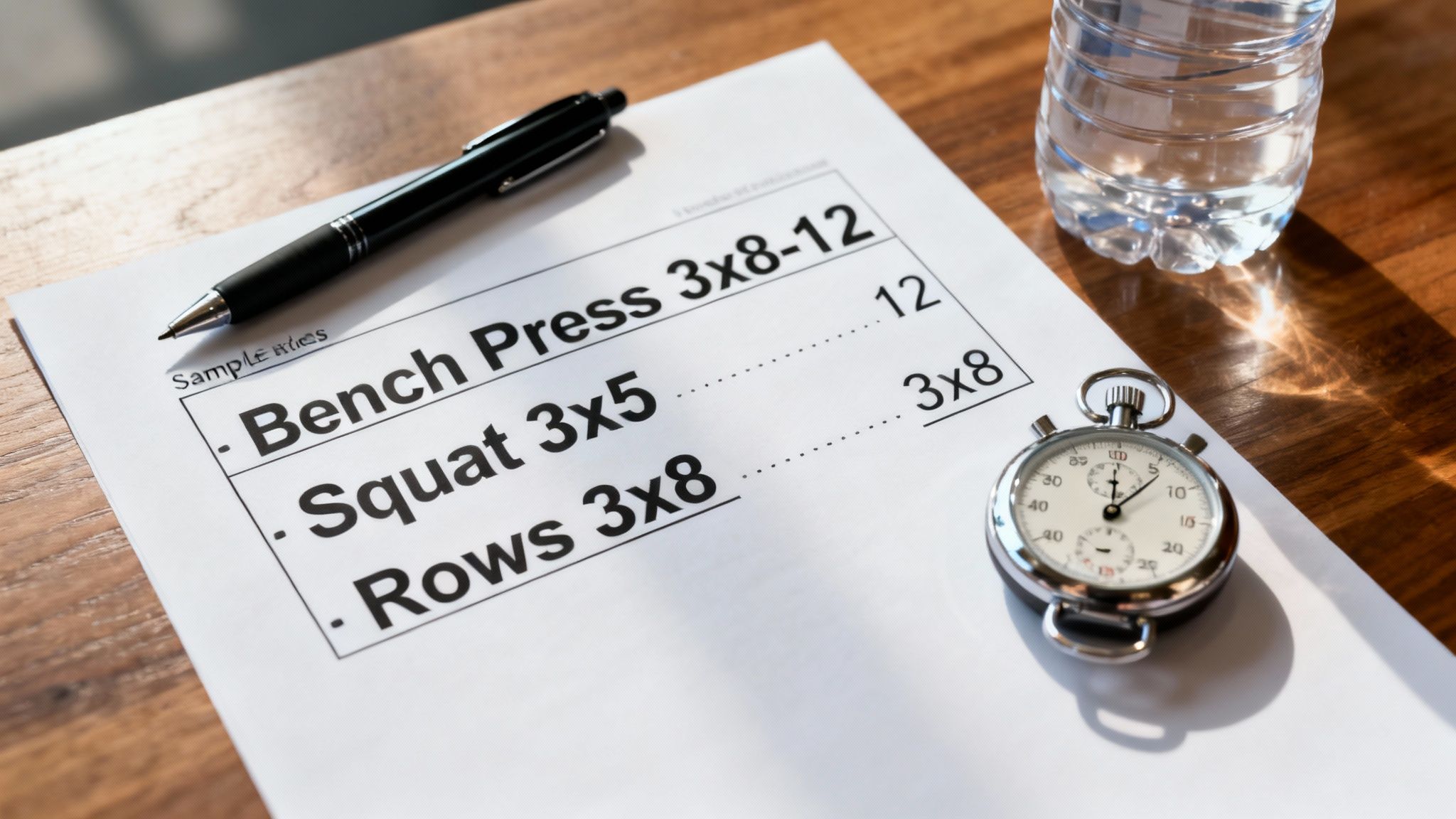
These aren't just random lists of exercises. I’ll break down the recommended sets, reps, and intensity targets to take the guesswork out of your training. Think of these as a solid foundation. As you get stronger and more comfortable, you can start swapping movements based on your preferences and the equipment you have.
The Hypertrophy "Bro Split" Workout
This classic split is designed with one primary goal in mind: maximizing muscle growth. By dedicating an entire session to a single major muscle group, you can hit it with enough volume and intensity to trigger some serious hypertrophy. Each workout should take you about 45–60 minutes.
The intensity here is absolutely key. You should be aiming for an RPE (Rate of Perceived Exertion) of 8–9 on your main sets. In plain English, that means you should feel like you only have 1-2 reps left in the tank at the end of each set. Pushing yourself this close to failure is what tells your muscle fibers it's time to grow.
Remember, the goal here is volume and muscular fatigue. Focus on a strong mind-muscle connection, controlling the weight through a full range of motion. The pump is your friend with this split.
Here’s what a typical week could look like:
Day 1: Chest
- Barbell Bench Press: 3 sets of 6-8 reps
- Incline Dumbbell Press: 3 sets of 8-12 reps
- Decline Machine Press: 3 sets of 10-15 reps
- Cable Crossover: 3 sets of 12-15 reps
- Push-ups: 2 sets to failure
Day 2: Back
- Pull-Ups (or Lat Pulldowns): 3 sets of 6-10 reps
- Bent-Over Barbell Row: 3 sets of 8-10 reps
- Seated Cable Row: 3 sets of 10-12 reps
- Single-Arm Dumbbell Row: 3 sets of 10-12 reps per arm
- Face Pulls: 3 sets of 15-20 reps
Day 3: Legs
- Barbell Squats: 4 sets of 6-8 reps
- Leg Press: 3 sets of 10-15 reps
- Romanian Deadlifts: 3 sets of 8-12 reps
- Leg Extensions: 3 sets of 12-15 reps
- Seated Leg Curls: 3 sets of 12-15 reps
- Standing Calf Raises: 4 sets of 15-20 reps
Day 4: Shoulders
- Overhead Press (Barbell or Dumbbell): 3 sets of 6-8 reps
- Dumbbell Lateral Raises: 4 sets of 12-15 reps
- Bent-Over Dumbbell Reverse Flys: 3 sets of 12-15 reps
- Barbell Shrugs: 3 sets of 8-10 reps
- Front Plate Raise: 2 sets of 10-12 reps
Day 5: Arms
- Barbell Bicep Curls: 3 sets of 8-10 reps
- Close-Grip Bench Press: 3 sets of 8-10 reps
- Dumbbell Hammer Curls: 3 sets of 10-12 reps
- Triceps Pushdowns: 3 sets of 12-15 reps
- Preacher Curls: 2 sets of 12-15 reps
- Overhead Triceps Extension: 2 sets of 12-15 reps
Hitting the gym five days a week like this provides a powerful stimulus for growth. This isn't just gym lore; a groundbreaking 2015 study showed that groups training with higher frequency saw significantly more muscle growth in their biceps and quads compared to those hitting muscles just once a week.
The ULPPL Strength and Size Hybrid
The Upper/Lower/Push/Pull/Legs (ULPPL) split is a fantastic blend of strength and hypertrophy training. It’s a smart way to increase the training frequency for your upper body muscles, hitting them twice a week, which is excellent for smashing through strength plateaus. If you're looking for a guided path to get started, our beginner strength training program offers a really solid, structured start.
This split is all about organizing your week around movement patterns and body regions. The first two days are your heavy, strength-focused sessions, while the last three days shift gears toward hypertrophy with higher rep ranges.
Here's one way you could schedule your ULPPL week.
Example ULPPL 5 Day Workout Split Schedule
| Day 1 (Upper) | Day 2 (Lower) | Day 3 (Push) | Day 4 (Pull) | Day 5 (Legs) |
|---|---|---|---|---|
| Focus: Heavy compound lifts for the upper body. Go for perfect form. Intensity: RPE 7-8. | Focus: Heavy compound lifts for the lower body. Prioritize technique over ego. Intensity: RPE 7-8. | Focus: Chest, shoulders, and triceps with moderate weight. Chase the pump. Intensity: RPE 8-9. | Focus: Back and biceps with moderate weight. Squeeze the target muscles. Intensity: RPE 8-9. | Focus: Quads, hamstrings, and glutes with moderate weight. Embrace the burn. Intensity: RPE 8-9. |
| Barbell Bench Press: 4x5-6 | Barbell Squats: 4x5-6 | Incline Dumbbell Press: 3x8-12 | Lat Pulldowns: 3x8-12 | Leg Press: 4x10-15 |
| Weighted Pull-Ups: 4x5-6 | Romanian Deadlifts: 3x6-8 | Seated Dumbbell Shoulder Press: 3x8-12 | Seated Cable Rows: 3x10-12 | Leg Extensions: 3x12-15 |
| Barbell Row: 3x6-8 | Glute Bridges: 3x8-10 | Cable Crossovers: 3x12-15 | Dumbbell Curls: 3x10-12 | Lying Leg Curls: 3x12-15 |
| Dumbbell Shoulder Press: 3x8 | Standing Calf Raises: 3x8-10 | Triceps Pushdowns: 3x10-12 | Face Pulls: 3x15-20 | Seated Calf Raises: 4x15-20 |
This table gives you a clear blueprint, but feel free to adjust exercises to fit what’s available at your gym and what feels right for your body.
How Technology Can Guide You
Let’s be honest—manually tracking every exercise, set, rep, and progression can feel like a part-time job. This is where smart fitness apps like Zing Coach can be a game-changer. An AI-powered coach essentially automates the entire process for you.
Instead of guessing what to do next, the app selects movements based on your goals and the equipment you have. It gives you clear video demonstrations and can even use computer vision to track your form, count your reps, and provide real-time feedback. It's about making sure you’re moving safely and effectively.
This turns a complex plan into a simple, guided experience, letting you focus all your energy on what matters: the workout itself.
How to Customize Your 5 Day Split
Think of the sample workouts I've laid out as a fantastic starting point, a road map to get you going. But here’s the thing: the absolute best 5 day workout split is the one that molds to your life, not the other way around.
A generic plan will only take you so far. Real, sustainable progress kicks in when you start tailoring your routine to fit your body, your schedule, and the equipment you actually have. This is where you go from just following a program to truly owning your training.
Adapting to Your Equipment
Look, not everyone has access to a fully-stocked commercial gym, and that’s perfectly okay. The core principles of a 5 day split—hitting specific muscle groups with focused volume—work just as well in a home gym or with just a few pieces of gear.
The secret is to understand the movement pattern, not just the specific exercise written on the page.
Let's break down some common swaps you might need to make:
- No Barbell for Squats? Easy. Goblet squats with a heavy dumbbell, Bulgarian split squats, or even weighted lunges are all incredible quad-dominant alternatives.
- Missing a Lat Pulldown Machine? If you have a pull-up bar, you’ve got one of the best back-builders on the planet. If not, resistance bands anchored high in a doorway can mimic the pulldown movement pretty well. You can also just double down on dumbbell rows.
- No Cable Crossover for Chest Flys? Dumbbell flys on a bench are a classic for a reason. No bench? Floor presses with a hard squeeze at the top do a fantastic job of isolating the chest, too.
The goal is always to match the primary muscle and the type of movement. If the plan calls for a horizontal press like a bench press, any dumbbell press, machine press, or push-up variation will create a similar stimulus for your chest, shoulders, and triceps.
Working Around Injuries and Limitations
Pushing through nagging pains or old injuries is the fastest way to derail your progress completely. Smart exercise substitution isn't about being lazy; it's a non-negotiable part of intelligent training. You're not trying to avoid work—you're finding a smarter way to challenge the muscle without aggravating the joint.
Think about the source of the discomfort. For instance, if barbell back squats bother your lower back, it's often the direct spinal loading that's the culprit. A leg press or a belt squat can absolutely hammer your quads and glutes with a similar stimulus, but without that direct pressure on your spine.
Key Takeaway: Never, ever push through sharp pain. If an exercise hurts, find a pain-free alternative that targets the same muscle group. The goal is to build your body up, not break it down.
Mastering Progressive Overload
If you want to get stronger or build muscle, there's one principle that rules them all: progressive overload. It’s a fancy term for a simple concept: you have to continually increase the demand you place on your muscles over time. If you lift the same weight for the same reps every single week, your body has no reason to change.
But progress isn't just about slapping more weight on the bar. There are several ways to apply progressive overload:
- Add More Reps: Last time you did 8 reps with that weight? This time, fight for 9.
- Add More Sets: Instead of 3 sets on your main lift, try adding a fourth.
- Add More Weight: Once you can comfortably hit the top of your target rep range (e.g., 12 reps), it's time to bump up the weight slightly.
- Improve Your Form: This is a big one. Slowing down the negative (eccentric) part of a lift can dramatically increase the intensity and muscle damage.
- Decrease Your Rest: Cut your rest periods between sets from 90 seconds to 75. This makes the workout more metabolically demanding.
You absolutely have to track your workouts. You can't progress what you don't measure.
Making Your Workouts More Time-Efficient
Let's be real—five days a week in the gym is a serious commitment. To make it stick, your workouts have to be efficient. Your best friend here is a technique like supersets. A superset is simply performing two exercises back-to-back with little to no rest in between.
For example, on an arm day, you could blast through a set of bicep curls and then immediately jump into a set of triceps pushdowns. This keeps your heart rate elevated and can slash your total workout time without sacrificing the amount of work you get done.
This is another spot where a bit of tech can make a huge difference. An AI-powered app like Zing Coach personalizes this entire process for you. It learns from your performance and automatically adjusts your plan, suggesting when it’s time to increase the weight, swap exercises based on your equipment, or tweak your routine to make sure you keep progressing safely and effectively.
Fueling Your Body for Growth and Recovery
Intense training is only half the battle. So many people pour everything they have into their workouts, only to neglect the two things that actually build muscle: food and rest. Your hard work in the gym tears down muscle fibers; the real growth happens when you’re recovering.
Following a demanding 5-day workout split without the right fuel is like trying to build a house without any bricks. You’ve got a solid plan, but no materials to actually get the job done. Think of your body as a high-performance engine. Food is the premium fuel, and sleep is the essential maintenance. Without them, you’ll just stall out.
Dialing in Your Nutrition
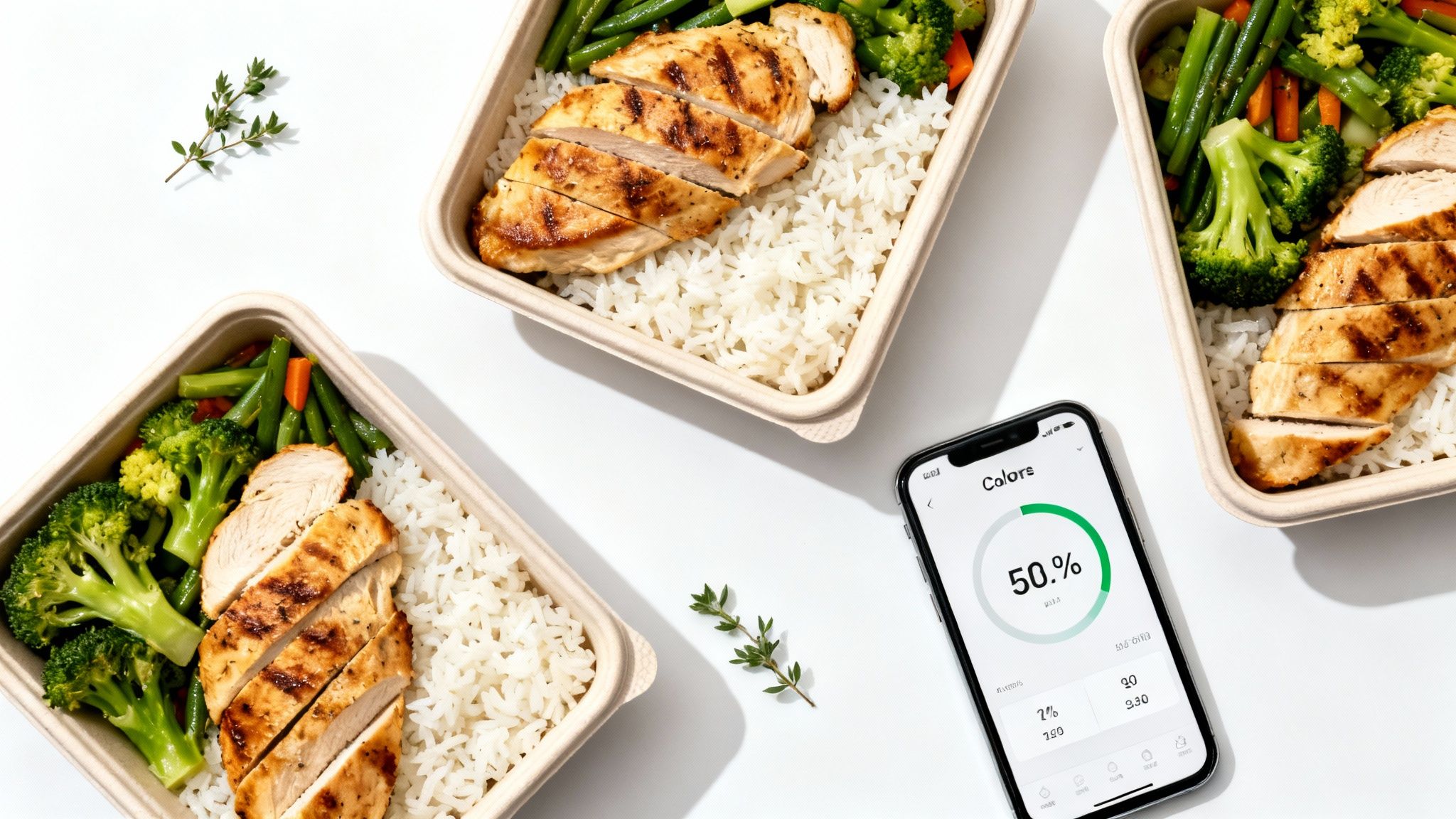
Nutrition doesn't have to be complicated, but it absolutely needs to be intentional. To support muscle repair and growth, your body needs enough energy (calories) and the right building blocks (macronutrients).
First things first: you need to be in a slight caloric surplus to build muscle effectively. This just means eating a little more than your body burns each day. A modest surplus of 250–500 calories above your maintenance level is a great starting point for lean gains without packing on unwanted fat.
From there, it's all about your macronutrients—protein, carbs, and fats.
- Protein: This is non-negotiable for muscle repair. Aim for around 0.7–1.0 grams of protein per pound of body weight. So, if you weigh 180 pounds, that’s about 126–180 grams every day.
- Carbohydrates: Carbs are your main energy source. They fuel your workouts and replenish the glycogen you burn through, which is critical for performance.
- Fats: Healthy fats are vital for hormone production, including testosterone—a key player in the muscle-growth game.
A simple way to build your plate is to fill one-third with a lean protein (chicken, fish, tofu), one-third with complex carbs (rice, potatoes, quinoa), and the final third with vegetables. Then just add a thumb-sized portion of healthy fats like avocado or a drizzle of olive oil.
Figuring out how to balance these macros can feel a bit overwhelming at first. To get a handle on it, it's worth learning how to count macros for beginners, which breaks the whole process down into simple, actionable steps.
The Pillars of Smart Recovery
Your two rest days in a 5-day workout split are just as important as your training days. Seriously. This is when your body actually adapts and gets stronger.
Prioritize Sleep
Sleep is the undisputed champion of recovery. While you're in deep sleep, your body releases growth hormone, which is absolutely essential for repairing damaged muscle tissue. Aiming for 7–9 hours of quality sleep a night isn't a luxury; it's a requirement if you’re serious about seeing results.
Embrace Active Recovery
Rest days don't always mean being glued to the couch. Light activity, or "active recovery," can be incredibly beneficial for getting you ready for the next session. This could be anything from:
- A brisk walk
- Light cycling
- Foam rolling or stretching
- A gentle yoga session
These activities get the blood flowing to your muscles, which helps flush out metabolic waste and can seriously cut down on soreness.
Ultimately, fueling your body correctly and prioritizing recovery will be the difference between spinning your wheels and making consistent, long-term progress. Smart fitness apps like Zing Coach can take the guesswork out of it by integrating nutrition guidance and calculating your daily calorie and macro targets, ensuring your diet directly supports all the hard work you're putting in.
Common Questions About 5 Day Splits
Jumping into a new training plan, especially a 5-day split, always brings up a few questions. It’s a real commitment, and you want to be sure you’re setting yourself up for success, not just spinning your wheels. We’ve been there.
Let’s tackle some of the most common things people ask so you can walk into the gym with confidence, knowing exactly what you’re doing and why. This is all about getting you from uncertain to unstoppable.
Can a Beginner Start with a 5 Day Split?
Absolutely, but you have to be smart about it. A classic beginner mistake is jumping headfirst into an advanced routine, trying to lift too heavy, too soon. That’s a fast track to burnout or injury, which will kill your momentum before you even get started.
If you’re new to the gym, your number one job is mastering proper form and just showing up consistently. A 5-day split is actually great for building that habit. The key is to start with lower volume—fewer sets and exercises—than a seasoned lifter. Focus on feeling the right muscles work and making every single rep count.
This is where having a plan makes all the difference. An AI-guided program can build you a plan that’s challenging but not overwhelming, giving you a structured way to build a solid fitness habit from day one.
How Long Should My Workouts Be?
One of the best things about a 5-day split is how efficient it is. Because you’re only hitting one or two muscle groups per session, you don’t need to live in the gym to get a killer workout. You can get all the work you need done with focused, high-quality effort.
For most people, 45 to 60 minutes per session is the sweet spot. That’s plenty of time to warm up, crush your main lifts with good rest in between, and hit a few accessory movements without feeling rushed. It makes the 5-day-a-week commitment feel way more manageable, even with a crazy schedule.
A focused, intense 60-minute session will always beat a sloppy two-hour workout with no real plan. It’s all about quality over quantity here.
What if I Miss a Day on My Split?
Look, life happens. Missing a gym day is going to happen sooner or later. The most important thing is this: don't let one missed day derail your entire week. Consistency over perfection, always.
When you miss a day, you’ve got a couple of simple options:
- Option 1: Shift Everything. Just do the workout you missed on your next available day. If you missed Wednesday's leg day, do it on Thursday and push the rest of the week’s workouts back by one day. Easy.
- Option 2: Skip and Resume. If rescheduling feels like too much of a headache, just skip the missed workout and pick right back up where you were supposed to be. The most important thing is getting back on track without the guilt trip.
Remember, one missed workout is a drop in the bucket. Real progress comes from what you do over months and years, not what you did or didn't do on one random Tuesday.
How Do I Know When to Change My Routine?
Your body is incredibly smart. It adapts to the stress you put on it. To keep seeing results, you have to switch things up every now and then. Grinding away at the same exact routine for too long is a recipe for plateaus, boredom, and even overuse injuries.
Keep an eye out for these tell-tale signs that it’s time for a change:
- You're Stuck: You haven’t been able to add weight or reps to your main lifts for a few weeks.
- You're Bored: You dread your workouts and feel like you're just going through the motions.
- You're Wiped Out: You feel constantly run down and sore. If you’re always feeling beat up, it might be helpful to learn more about understanding DOMS and what your body is trying to tell you.
As a rule of thumb, give any program a solid 8-12 weeks to see what it can do for you. After that, you can swap in new exercises, play with your set and rep schemes, or even try a completely different split to keep your body guessing and keep the gains coming.
Trying to figure all this out on your own can feel overwhelming, but you don't have to. The Zing Coach app takes all the guesswork out of it, creating a personalized 5-day workout split that grows and changes right along with you. It adapts to your progress, your equipment, and your feedback. Get expert-level guidance in your pocket and start building a routine that actually works. Find your perfect plan with Zing Coach today!
Share this article


Authors