Discover a proven beginner strength training program to build muscle, gain strength, and train confidently at home or in the gym.
A good beginner strength training program is the single most effective way to start building muscle, crank up your metabolism, and set yourself up for long-term health. The best plans stick to the basics: 2-3 full-body workouts a week, focusing on nailing the form for foundational movements like squats, push-ups, and rows.
Right now, consistency and quality are everything. Lifting heavy can wait.
Why Strength Training Is Your Secret Weapon For a Healthier Life
When you hear "strength training," it's easy to picture intimidating gyms filled with complicated machines. But the reality is so much simpler—and way more rewarding. Starting a solid routine is one of the best investments you can make for your physical and mental well-being, with benefits that go far beyond what you see in the mirror.

This isn't just about getting bigger muscles. Think of strength training as a metabolic upgrade. Every pound of muscle you build burns more calories even when you're just sitting on the couch, which makes managing your weight a whole lot easier. It's a huge reason why strength training for weight loss is so powerful; you’re changing how your body’s engine runs, not just tinkering with the fuel.
Beyond that, lifting weights is crucial for your structural health. It actually increases your bone mineral density, which is your best defense against osteoporosis later in life. It also strengthens all the connective tissues that support your joints, making you more stable and less prone to injury from everyday activities.
The Overlooked Mental and Practical Perks
The benefits aren't just physical, either. Regularly engaging in strength work is proven to sharpen cognitive function, ease anxiety symptoms, and give your mood a serious boost. There's a powerful sense of accomplishment that comes from lifting something you couldn't before, and that self-confidence tends to spill over into all other areas of your life.
Even with all these upsides, a lot of people never get started. It’s pretty surprising, but only about 30% of American adults get in their muscle-strengthening activities. One massive survey of almost 400,000 people found that just 24% hit the recommended guidelines for both cardio and strength work. That’s a huge gap, especially when research shows that beginners can see significant strength gains from just one weekly session with light weights.
Strength training isn’t about becoming a bodybuilder overnight. It's about empowering your body to handle everyday life with more ease and energy—carrying groceries, playing with your kids, or climbing stairs without getting winded.
This all creates a positive feedback loop. When you feel stronger and more capable, you're naturally more motivated to keep moving. Exercise stops feeling like a chore and starts becoming a rewarding practice that fuels a more vibrant life. That is the real "why" behind every single lift you’re about to do.
Laying Your Foundation Before You Lift A Single Weight
Jumping into a beginner strength training program without a plan is like trying to build a house without a blueprint. It's a classic rookie mistake. Before you even think about picking up a dumbbell, a few key steps will dramatically increase your chances of success, keep you safe, and make sure the work you put in actually pays off.
Too many beginners skip this part, get frustrated when they don't see results, and quit. Let's make sure that's not you.
Set Your Sights On Tangible Milestones
First things first: you need to define what "getting fit" actually means to you. Vague goals like "get stronger" are impossible to track and lose their motivational power fast. The trick is to set specific, performance-based goals that you can literally check off a list.
This simple shift in perspective changes everything. It gives you a clear target to aim for, making your workouts feel purposeful instead of just random.
Think in terms of concrete achievements, not fuzzy objectives. This creates a powerful feedback loop where you can see and feel your progress, which is the ultimate motivation.
Instead of: "I want to tone up."
Try: "I want to perform 10 consecutive push-ups from my toes in 8 weeks."
Instead of: "I want to get in shape."
Try: "I want to squat my bodyweight for 5 repetitions in 12 weeks."
See the difference? These goals are clear, time-bound, and give you something real to work toward. Do yourself a favor and write them down. It makes them feel more official.
Know Your Starting Point With A Simple Assessment
You wouldn't start a road trip without knowing where you are on the map, right? Same logic applies here. A quick baseline assessment helps you understand your current strength and mobility so you can choose the right exercises and, more importantly, track your improvement from day one.
You don't need a fancy lab for this. A simple at-home test can tell you a lot.
- Max Push-Ups: How many can you do in one go? Don't be a hero—do them from your knees if you need to. Just note the number.
- Max Bodyweight Squats: With good form (chest up, thighs parallel to the floor), how many can you crank out before you gas out?
- Plank Hold: How long can you hold a solid plank with a straight back? Time it.
These numbers aren't for judgment; they're your "Day 1" data. Honestly, seeing these metrics improve over the weeks is one of the most rewarding parts of the whole process. For a more scientific approach, you can dig into the personalized fitness assessments offered by AI coaching tools, which we cover in the Zing Coach methodology.
Choose Your Training Ground: Home vs. Gym
The final piece of your foundation is figuring out where you’ll actually do the work. There's no single "best" answer—only what's best for you, your schedule, and your personality. Both home and gym setups have their own pros and cons.
The most effective workout program is the one you can stick with consistently. Your environment plays a massive role in that consistency. Be honest about your lifestyle, personality, and budget.
Here’s a quick breakdown to help you decide:
| Factor | Home Workouts | Gym Workouts |
|---|---|---|
| Convenience | Unbeatable. No travel time, always open. | Requires travel and operates on a set schedule. |
| Cost | Minimal initial investment (bodyweight or dumbbells). | Monthly membership fees and potential sign-up costs. |
| Equipment | Limited, which can eventually slow progress. | Huge variety of weights and machines for progression. |
| Focus | Can be distracting (chores, family, TV). | Dedicated environment designed for exercise. |
If you're self-motivated and short on time, a home workout is a fantastic way to start. If you thrive on the energy of others and want access to a wider variety of equipment for long-term growth, the gym is a worthy investment. No matter where you train, learning foundational movements is key. For example, a detailed guide on proper bench press technique is invaluable whether you're using a barbell at the gym or dumbbells at home.
Your First Actionable Beginner Strength Training Program
Alright, it's time to put the theory into practice. You've set your goals, you know where you're starting from, and now it’s time to actually start moving some weight. A solid beginner strength training program is your roadmap from here on out—it kills the guesswork and lets you walk into your workout space knowing exactly what to do.
This is where the real fun (and the real results) begin. We've laid out two simple, effective 4-week plans to get you rolling: one designed for the gym and another you can tackle right in your living room.
Getting started isn't complicated. It's really just a three-step process: figure out your goal, see where you're at right now, and then make a plan that fits your life—whether that's at home or in a gym.
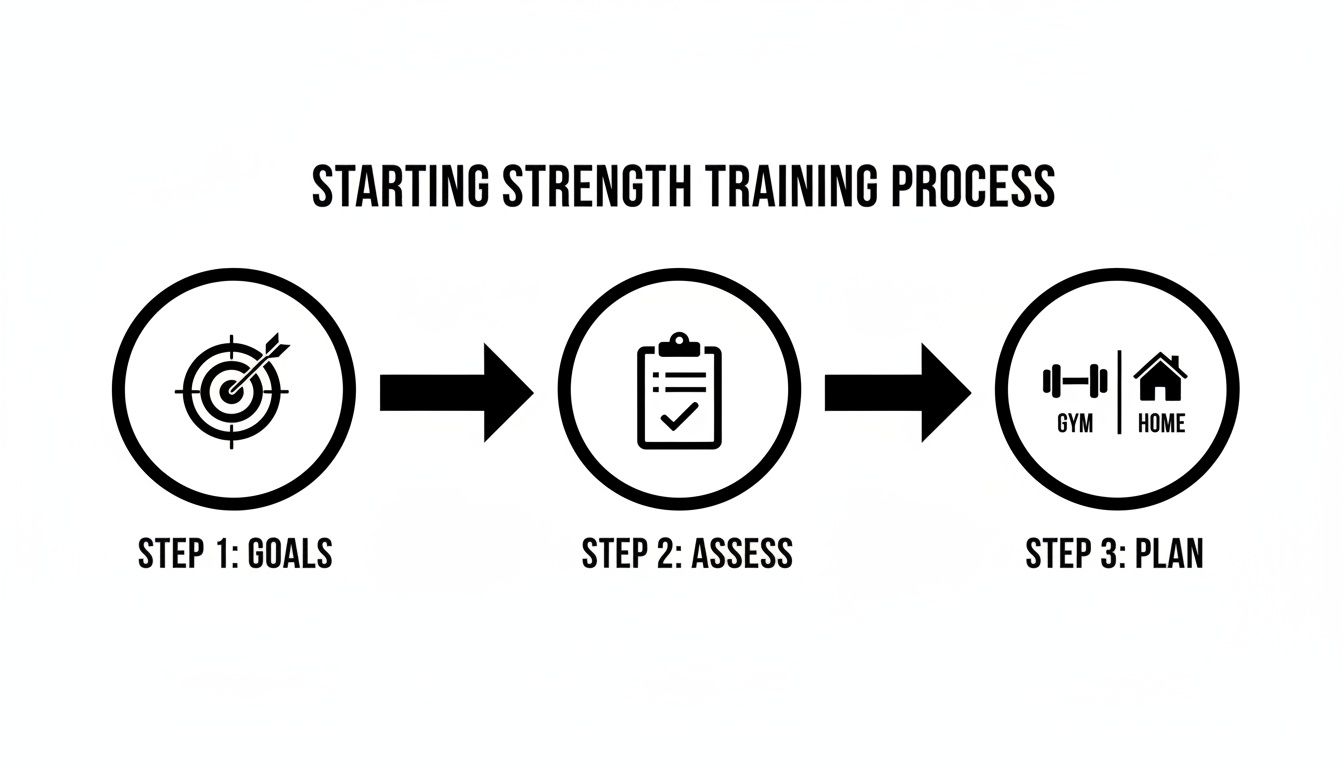
This simple flow shows that a successful start is just about making a few smart decisions upfront to create a routine you can actually stick with.
The Power of Compound Movements
Both of these programs are built on a foundation of compound exercises. Think of these as the multi-taskers of the fitness world. They work several muscle groups and joints all at once. We're talking about the classics: squats, push-ups, rows, and overhead presses.
Why focus on these? Simple. They're incredibly efficient. Instead of trying to isolate every tiny muscle one by one, you build functional, real-world strength that helps you do everything from carrying groceries to playing with your kids.
Your 4-Week Gym-Based Program
This plan uses the kind of basic equipment you'll find in almost any gym: dumbbells, a bench, and a few simple machines. You'll follow the same schedule of 2-3 workouts per week, giving your body plenty of time to recover and adapt.
For anyone new to the gym floor, checking out guides on foundational movements like Weight Bench Workouts can be a huge help in building confidence.
A great way to structure your week is by alternating between two different full-body workouts. This keeps things interesting and ensures you're hitting all your major muscle groups consistently.
Here’s a sample schedule to give you an idea of the flow:
Sample 4-Week Beginner Full-Body Workout Schedule
This table outlines a typical weekly structure for a beginner, alternating workout days with rest days to maximize recovery and growth.
| Day | Workout A (e.g., Monday) | Workout B (e.g., Wednesday) | Workout C (e.g., Friday) |
|---|---|---|---|
| Week 1 | Full Body A | Full Body B | Full Body A |
| Week 2 | Full Body B | Full Body A | Full Body B |
| Week 3 | Full Body A | Full Body B | Full Body A |
| Week 4 | Full Body B | Full Body A | Full Body B |
This A/B split is a classic for a reason—it works. It provides the perfect balance of stimulation and recovery needed for building that initial base of strength.
Here are the two workouts you'll be alternating:
Workout A:
- Goblet Squats: 3 sets of 8-12 reps
- Dumbbell Bench Press: 3 sets of 8-12 reps
- Seated Cable Rows: 3 sets of 10-15 reps
- Plank: 3 sets, hold for 30-60 seconds
Workout B:
- Romanian Deadlifts (with dumbbells): 3 sets of 10-15 reps
- Dumbbell Overhead Press (seated): 3 sets of 8-12 reps
- Lat Pulldowns: 3 sets of 10-15 reps
- Leg Press: 3 sets of 10-15 reps
Your 4-Week At-Home Bodyweight Program
Don't have a gym membership? No problem. This plan requires absolutely zero equipment, making it the perfect starting point for anyone working out at home. If you happen to have a pair of dumbbells, great! You can hold them during squats and lunges to up the intensity.
Aim to do this workout 2-3 times per week on non-consecutive days (like Monday, Wednesday, and Friday) to give your muscles time to repair.
The Workout (Complete 3 Rounds):
- Bodyweight Squats: 10-15 reps
- Push-Ups (from knees or toes): 8-12 reps
- Glute Bridges: 15-20 reps
- Plank: Hold for 20-45 seconds
- Reverse Lunges: 10-12 reps per leg
- Jumping Jacks: 30 seconds
Beginner Tip: Your main goal here is quality over quantity. Really focus on feeling the right muscles working through their full range of motion. Take a 60-90 second rest between each round.
How to Keep Progressing Without Adding Weight So, how do you get stronger if you aren't lifting heavier? You just have to get creative and manipulate other factors.
- Add Reps: Once you can easily hit the top of the rep range (e.g., 15 squats), try for 16 or 17 next time.
- Cut Rest Time: Shave 15 seconds off your rest periods between rounds.
- Add Another Round: When 3 rounds feel manageable, push yourself to complete 4.
- Slow Down: Try performing each rep more slowly. A 3-second descent on your squats will feel much harder than a 1-second one.
Making Exercises Fit You: Progressions and Regressions
Every exercise can be tweaked to be easier or harder. This is the secret to staying safe, avoiding injury, and making sure you're always being challenged just enough to keep making progress.
- Progression: This is how you make an exercise harder. It’s the core of progressive overload.
- Regression: This is how you make an exercise easier. It’s absolutely essential for learning proper form.
Let's take the push-up, for example. Here’s what a typical progression path looks like:
- Wall Push-Up: The easiest version. You're standing and pushing away from a wall.
- Incline Push-Up: More challenging. Place your hands on a sturdy bench or countertop.
- Knee Push-Up: Performing the push-up from your knees instead of your toes.
- Standard Push-Up: The classic! A straight line from your head to your heels.
There’s no prize for rushing to the hardest version. Building strength is a long game. Master the easier variations first to build the stability and control you need to tackle the next level safely. If you ever need more ideas or want to see how an exercise is done, our comprehensive library of exercises has detailed videos and instructions for hundreds of movements.
The last piece of this puzzle is just showing up. Pick the plan that fits your life, commit to it for four weeks, and keep a simple record of your workouts. Jot down the exercises, sets, and reps in a notebook or an app. Seeing those numbers go up over time is one of the most powerful motivators there is.
Mastering The Essentials Beyond The Exercises
The reps and sets you do in the gym are only half the story. A truly successful beginner strength training program is built just as much on what happens before, after, and between your workouts. These are the details that turn your effort into real, lasting results.
Think of your workout as the main event. Your warm-up is the rehearsal, your food is the fuel, and your recovery is the vital post-show maintenance. If you skip any of these, it's like trying to race a high-performance car with the wrong fuel and no oil changes—it just won't perform well for long.
Priming The Engine With A Smart Warm-Up
Jumping straight into heavy squats with cold muscles is a recipe for a bad workout and, potentially, an injury. A good warm-up does more than just get you warm; it preps your nervous system, lubricates your joints, and wakes up the specific muscles you're about to train.
An effective warm-up shouldn't take more than 5-10 minutes. It has two key parts:
General Warm-Up (2-3 minutes): The goal here is simple: raise your core body temperature and get blood pumping. Think light cardio that uses your whole body.
- Jumping Jacks (30-60 seconds)
- High Knees (30-60 seconds)
- Brisk Walking or Light Jogging (60 seconds)
Dynamic Stretching (3-5 minutes): This isn't about holding a stretch. It’s about actively moving your joints and muscles through their full range of motion to prime them for action.
- Leg Swings: 10 forward-and-back swings per leg.
- Arm Circles: 10 small circles forward, then 10 backward. Repeat with large circles.
- Cat-Cow: 10 reps to get your spine moving.
- Bodyweight Squats: 10-15 slow, controlled reps to fire up your glutes and quads.
The Art Of Cooling Down And Recovering
Just as you prepare your body for work, you need to help it transition back to rest. A simple cool-down helps bring your heart rate down gradually and kick-starts the recovery process. It's another quick 5-minute investment that pays off big time.
Start with a few minutes of walking, then move into some light static stretching. Hold each stretch for about 20-30 seconds, focusing on the big muscle groups you just worked—quads, hamstrings, chest, and back.
Recovery is where the magic happens. Your muscles don't get stronger during the workout; they rebuild and grow while you rest. The single best recovery tool you have is sleep.
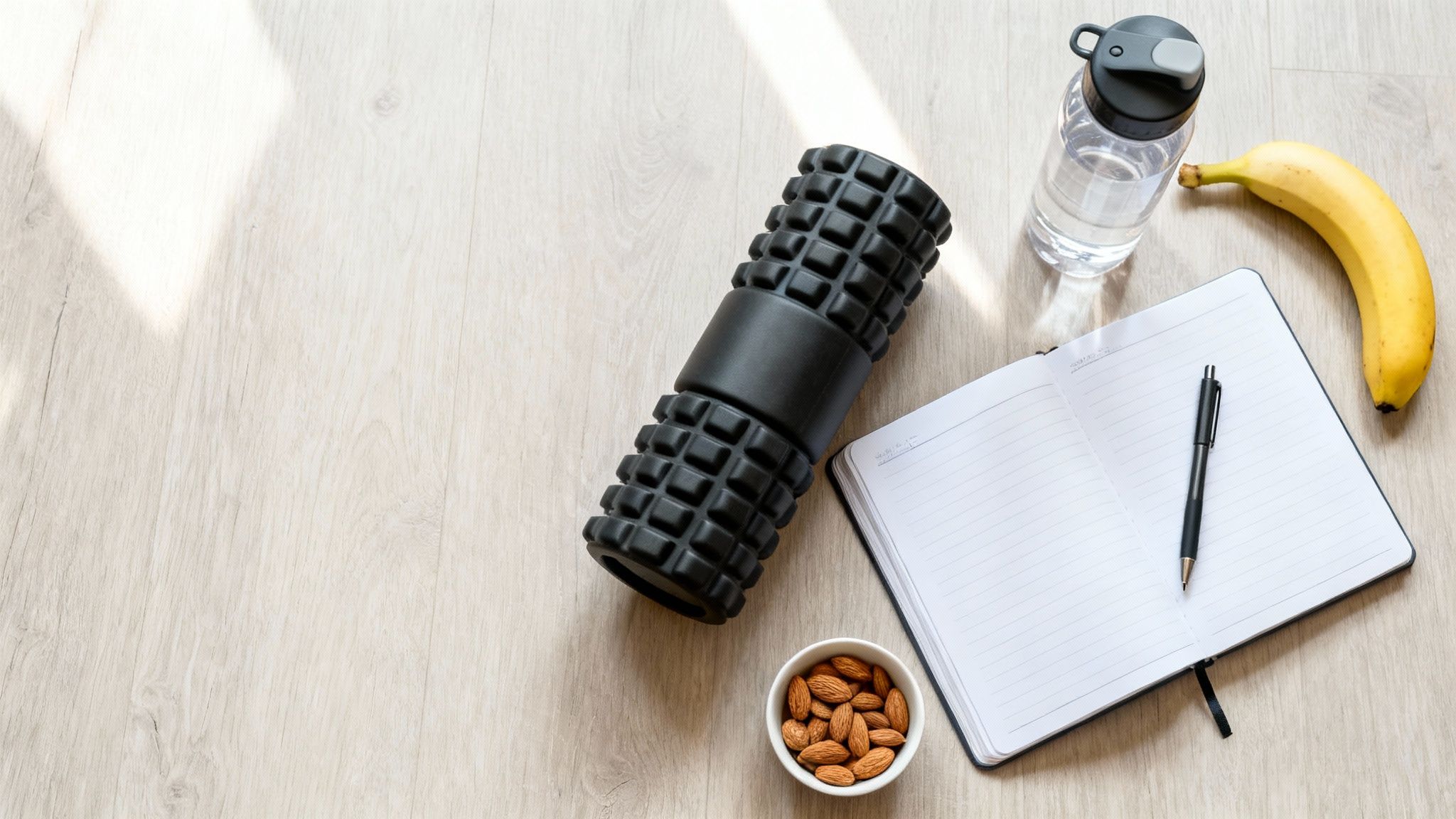
Aim for 7-9 hours of solid sleep a night. It's non-negotiable for muscle repair, hormone balance, and energy. On your "off" days, don't just sit on the couch. Try active recovery like a walk, some light yoga, or foam rolling. This gentle movement boosts blood flow to tired muscles and can help ease soreness.
Fueling Your Body Without The Complexity
Nutrition for beginners gets overcomplicated fast. You don't need a crazy restrictive diet or a cabinet full of supplements to see progress. Start with these simple, foundational habits to fuel your body, whether your goal is gaining muscle or losing fat.
- Prioritize Protein: This is literally what your muscles use to rebuild. Make sure you get a solid source—like chicken, fish, eggs, tofu, or Greek yogurt—with every meal.
- Embrace Whole Foods: Build your meals around stuff that doesn't come in a crinkly bag. Fruits, veggies, lean proteins, and whole grains give you the energy and nutrients your body craves.
- Stay Hydrated: Your muscles need water to function properly. Keep a bottle with you and sip on it all day long.
- Time Your Nutrients: Try to have a balanced meal with carbs and protein 1-3 hours before you train for energy. Afterward, have another one within a couple of hours to help with recovery.
While the number of exercises you do is important, knowing how to fuel those movements is the other side of the coin. For a deeper dive into workout structure, you can learn more about how many exercises per muscle group is ideal.
Tracking Your Progress To Stay Motivated
How do you know you're actually getting stronger? You track it. Monitoring your progress is one of the most powerful ways to stay motivated. Seeing cold, hard proof that your work is paying off makes it so much easier to keep showing up.
You don't need a complicated system. Just pick one of these and stick with it:
- A Simple Notebook: Old-school, but it works. Jot down the date, exercises, weight, sets, and reps. That's it.
- A Fitness App: An app like Zing Coach takes care of the logging for you. It tracks your workouts, visualizes your progress with charts, and can even adjust your next session based on how you did.
The goal is to see the numbers go up over time. It could be lifting 5 pounds more, doing one extra push-up, or holding a plank for 10 seconds longer. Every little improvement is a win. Celebrate it.
Navigating Plateaus And Common Beginner Challenges
Sooner or later, every fitness journey hits a speed bump. One week you're cruising, adding reps with ease, and the next, the same old weight feels like it’s bolted to the floor. This is a strength plateau, and it's a completely normal, even expected, part of the process.
It doesn’t mean you’ve done something wrong. Far from it. It actually means your body has successfully adapted to the challenges you've been throwing at it. Now, it needs a new reason to get stronger. When you notice your progress has stalled for a couple of weeks, it's time for a strategic change—not a complete overhaul, but a smart tweak to shock your system back into growth.
Breaking Through Your First Strength Plateau
The trick to busting through a plateau is to introduce something new without creating chaos in your routine. Your muscles are craving a fresh stimulus to keep adapting. A few simple adjustments are often all it takes to get the needle moving again.
Here are a few tried-and-true methods I've used with countless beginners:
- Change Your Rep Scheme: If you’ve been living in the 3 sets of 10 world, try switching to 5 sets of 5 with a slightly heavier weight. This simple shift from focusing on muscular endurance to pure strength can be the exact catalyst your body needs.
- Introduce a New Exercise: Been doing the dumbbell bench press forever? Swap it out for incline push-ups for a few weeks. A different angle or movement pattern will force your muscles to work in a way they aren't used to.
- Decrease Rest Time: Try shaving 15-30 seconds off your rest periods between sets. This ramps up the metabolic demand of your workout and forces your muscles to work harder under fatigue.
It’s all about being strategic. For a deeper dive, check out our guide with more tips to prevent plateaus and keep those gains coming.
Working Around Aches And Pains Safely
When you first start lifting, some muscle soreness is part of the territory. It's crucial, however, to learn the difference between typical delayed onset muscle soreness (DOMS)—that general achiness—and a sharp, specific, localized pain. Never, ever push through joint pain. Instead, get smart about modifying exercises to work around sensitive areas.
This approach keeps you in the game and training consistently while allowing minor issues to heal.
- Knee Discomfort: If squats are bothering your knees, shift your focus to strengthening the muscles that support them. Glute bridges and Romanian deadlifts are fantastic for your glutes and hamstrings. You could also try box squats, which control your depth and teach you the proper "sit back" mechanic.
- Shoulder Tweaks: For angry shoulders, swap out overhead presses for lateral raises with light dumbbells. Double-check your form on rows—you should be pulling with your back muscles, not yanking the weight up with your arms and shoulders.
- Lower Back Soreness: This is often a red flag for a weak core or improper lifting form. Sub out traditional deadlifts for a bit and build your core stability with planks and bird-dogs. And always, always brace your core before you lift anything.
Listening to your body isn't a sign of weakness; it's a sign of intelligence. The goal is long-term progress, and that requires staying healthy and injury-free.
The Mental Game: Staying Consistent When Motivation Dips
The physical grind is only half the battle. Honestly, your biggest opponent will often be your own brain. Some days, you just won't feel like working out. That’s normal. That’s human. The real secret to success is showing up anyway.
Consistency will always beat intensity. A "bad" workout where you just go through the motions is infinitely better than skipping it altogether. Building the habit of showing up is the most important "muscle" you can develop.
And remember to celebrate the small wins. Did you add just one more rep this week? Finally nail your squat form? Acknowledge it. This kind of positive reinforcement is what builds momentum and makes the journey enjoyable.
Keep your "why" in mind, and focus on how much stronger you feel. Even minimalist programs are incredibly effective. An 8-week study found that free weight training was superior for reducing body fat and increasing lean mass in beginners. Research even confirms that performing fewer than 5 weekly sets can still result in ~5% muscle growth for novices.
Got Questions About Strength Training? We’ve Got Answers.
Jumping into the world of lifting weights is exciting, but it almost always comes with a laundry list of questions. Getting good, straight answers is the first step to feeling confident on the gym floor (or in your living room) and actually sticking with it.
Let's clear up some of the most common things beginners wonder about.
How Many Days a Week Should I Be Lifting?
For anyone just starting out, 2 to 3 days per week is the magic number. This hits the sweet spot between stimulating your muscles to grow and giving them enough downtime to actually do it. Remember, the real magic happens on your rest days when your body is busy rebuilding itself stronger.
A full-body routine is your best friend here. Think Monday, Wednesday, and Friday. This approach lets you work all your major muscle groups multiple times a week without sending your body into overdrive. When you're new, quality and consistency beat frequency every single time.
Am I Going to Get Bulky from Lifting Weights?
This is easily one of the biggest myths in fitness, and it’s one I hear all the time, especially from women. The short answer? Absolutely not.
Putting on serious muscle mass—what most people think of as "bulk"—is incredibly difficult. It takes years of very specific, high-volume training and a diet to match, with a major focus on eating more calories than you burn. Trust me, it does not happen by accident.
For a beginner, a solid strength program will do the exact opposite. You'll build a foundation of lean muscle. Since muscle is much denser than fat, you’ll probably start to look leaner and more toned, even if the scale doesn’t budge much at first. You're building a stronger, more compact version of you.
The fear of getting "too bulky" from a beginner program is like worrying you'll accidentally qualify for the Tour de France just because you bought a new bike. The level of dedication and specific effort required is on a completely different planet.
How Do I Figure Out How Much Weight to Use?
This is all about finding a balance between challenging yourself and keeping your form perfect. The right weight is one that makes the last rep or two of a set feel tough, but not so tough that your form falls apart. It's the "challenging but doable" zone.
Here’s a simple way to gauge it:
- Too Light: You finish a set of 10 reps and feel like you could’ve easily cranked out 5 more.
- Too Heavy: You can't even hit your target rep count (say, 8 reps) without your form getting sloppy.
Always start on the lighter side. Nail down the movement first. Once you feel confident and your form is solid, then you can start inching the weight up. This idea of gradually adding more challenge over time is called progressive overload, and it's the single most important principle for getting stronger long-term. This isn't about ego; it's about smart, steady progress.
Ready to stop guessing and start training with a plan that adapts to you? The Zing Coach app uses AI to create a personalized beginner strength training program based on your goals, equipment, and fitness level. With features like real-time form feedback and automatic adjustments, you'll build strength safely and effectively. Get your custom plan at https://zing.coach.
Share this article


Authors