Discover progressive overload training to unlock muscle growth, break plateaus, and achieve real gains with practical, science-backed steps.
If you've ever felt stuck in a workout rut, doing the same exercises week after week without seeing any real change, you've hit the dreaded plateau. The secret to breaking through it is a concept called progressive overload. It’s the single most important principle for getting stronger, building muscle, and making sure your hard work actually pays off.
At its core, progressive overload is just a fancy way of saying you need to consistently make your workouts a little bit harder over time. Without that extra challenge, your body has no reason to adapt and improve.
Understanding Progressive Overload
Think of it like getting a tan. Spending five minutes in the sun on your first day might give you a hint of color. But if you stick to just five minutes every single day, you won't get any darker because your body adapts. To build a deeper tan, you have to gradually increase your sun exposure.
Your muscles work the exact same way. When you lift a challenging weight, you create tiny micro-tears in the muscle fibers. Your body’s natural repair process kicks in, rebuilding those fibers to be a little stronger and thicker so they can handle that same load more easily next time.
But here’s the catch: if the challenge never increases, the adaptation stops. To keep the gains coming, you have to keep giving your body a new, slightly tougher problem to solve. This is the engine that drives all successful strength and muscle-building programs, from elite powerlifting to foundational strength training for runners.
The Foundation of Consistent Gains
Progressive overload might sound simple, but it's what separates an effective training plan from just "going through the motions." It’s the reason you can’t just do three sets of ten with the same 20-pound dumbbells forever and expect to look like a superhero. Your body is too smart for that.
"If the goal is to continue to gain strength, and you do the same movement pattern with the same amount of weight consistently over a long duration of time, eventually your body will adapt and that weight will no longer be challenging."
The key is to be strategic, not reckless. The National Academy of Sports Medicine suggests a smart, sustainable increase of no more than 10% per week. This could mean adding a little weight, squeezing out an extra rep, or changing another variable. This measured approach is the sweet spot—enough to trigger growth, but not so much that you risk getting hurt. You can find out more about the science behind this at https://www.zing.coach/methodology.
To really nail this down, it helps to see the core ideas laid out clearly.
The Core Principles of Progressive Overload at a Glance
This table breaks down the fundamental pillars of a successful progressive overload strategy, making it easy to see how each piece fits into the bigger picture of getting stronger.
| Principle | What It Means | Why It's Important |
|---|---|---|
| Increase Demand | Systematically making workouts harder over time. | Forces the body to adapt and prevents performance plateaus. |
| Specificity | The adaptations are specific to the type of training. | Ensures your progress aligns directly with your fitness goals. |
| Consistency | Applying the principle regularly in your training. | Consistent stimulus is necessary for continuous adaptation and growth. |
| Variability | Changing the training variables (weight, reps, etc.). | Prevents burnout, reduces injury risk, and keeps the body guessing. |
| Recovery | Allowing adequate time for muscles to repair and grow. | Growth happens during rest, not during the workout itself. |
With these principles in mind, you can start applying them to your own workouts in very practical ways.
Key Components of Progressive Overload
So, how do you actually do it? Progressive overload isn't just about piling more plates on the barbell until you can't lift it. There are several clever ways to increase the difficulty and keep your body adapting.
Here are the most common methods you can use:
- Increasing Resistance: This is the classic method. If you squatted 100 lbs for 8 reps last week, try 105 lbs this week. It’s simple and incredibly effective.
- Increasing Reps: Can’t add more weight? No problem. Stick with the same 100 lbs, but aim for 9 or 10 reps instead of 8.
- Increasing Sets: If you normally do three sets of an exercise, try adding a fourth. This increases your total training volume, forcing your muscles to do more work.
- Improving Form: This one is subtle but powerful. Focus on perfecting your technique—like squatting deeper or pausing at the bottom of a push-up. A greater range of motion makes the same weight feel much harder.
- Decreasing Rest Time: Shave 15-30 seconds off your rest periods between sets. Your muscles will have less time to recover, which increases the metabolic stress and triggers new adaptations.
The Science of How Your Muscles Actually Get Stronger

To really get the most out of progressive overload training, it helps to pull back the curtain and see what’s happening inside your body. Getting stronger isn’t some fitness mystery; it’s a brilliant biological process that kicks in when you challenge yourself just enough.
When you lift a weight that makes your muscles work, you’re sending them a clear message: "Get stronger, or we won't be able to do this again." This controlled stress creates tiny, microscopic tears in your muscle fibers. But don't worry, this is a good thing.
Think of it like a road crew fixing a pothole. They don't just fill the hole; they rebuild that section of road to be tougher and more durable than before. Your body does the same thing. It doesn't just patch up the muscle fibers—it rebuilds them thicker and stronger. This whole process is called muscular hypertrophy, and it’s the physical proof of your hard work in the gym.
But bigger muscles are only half of the equation.
The Brain-Body Connection
Long before a single muscle fiber fires, your brain is calling the shots. It sends electrical signals down your central nervous system, telling your muscles exactly how much force to generate. The first time you try a new exercise, that signal path is like a faint, overgrown trail through the woods—it works, but it’s clumsy and inefficient.
As you repeat that exercise and gradually increase the challenge, that trail gets cleared, paved, and eventually turned into a superhighway. Your brain gets better at recruiting more muscle fibers and coordinating them to fire all at once, in a powerful, synchronized effort. This is what we call neuromuscular adaptation.
It’s the reason you can often lift more weight in the first few weeks of training, even before you see much actual muscle growth. Your nervous system is simply getting better at using the muscle you already have. Progressive overload doesn't just build your muscles; it fine-tunes the commands that control them.
Your Body's Three-Step Cycle of Growth
This entire adaptation process is perfectly captured by a classic concept in physiology known as the General Adaptation Syndrome (GAS). It breaks down how your body reacts to any new stress—including a tough workout—into three clear phases:
Alarm Stage: This is the workout itself. You introduce a challenging new stimulus, and your body goes into a state of temporary shock and fatigue. Performance dips, and you feel tired.
Resistance Stage: This is where the magic happens. During recovery (shout-out to rest days!), your body gets to work repairing the damage and adapting. It rebuilds muscle fibers stronger, reinforces neural pathways, and tops off energy stores, all to make sure it can handle that same stressor more easily next time.
Exhaustion Stage (The One to Avoid): If you push too hard, too fast, or skip out on recovery, your body can't keep up with the repairs. This is the fast track to burnout, overtraining, and injury. Smart progressive overload is all about staying in that sweet spot between alarm and resistance.
By intelligently managing this cycle, you ensure each workout builds on the last. You apply just enough stress to trigger a positive adaptation without ever pushing your body into a state of exhaustion it can't recover from.
This strategic stress has benefits that go way beyond your biceps. The mechanical load from progressive overload also tells your bones to get denser, strengthens your tendons, and improves nerve function. These widespread benefits contribute to a significant drop in all-cause mortality, with studies showing a 10-20% reduction in risk for those who get stronger.
The flip side is also true: without this stimulus, a sedentary person can lose up to ten pounds of muscle every decade.
Understanding this science helps you train smarter, not just harder. It’s not just about mindlessly lifting heavy weights; it’s about applying a precise, calculated dose of stress to set off a chain reaction of positive changes throughout your entire body. If you want to know how to apply these principles at home, check out our guide on how to build muscle at home.
How to Actually Use Progressive Overload in Your Workouts
Alright, so you get the theory behind progressive overload training. That’s the easy part. The real magic happens when you start putting that theory into practice in the gym. The good news? You’ve got a whole toolkit of methods to choose from. This isn’t a one-size-fits-all deal, which means you can always find a way to push yourself, no matter what equipment you have or how you're feeling on a given day.
Progressive overload is a principle, not a single technique. You can apply it by making all kinds of smart, strategic tweaks to your workouts. Let's dig into the five best ways to make your training just a little bit harder over time.
Increase the Weight or Resistance
This is the classic for a reason. It's the most straightforward path to getting stronger. If you hit your target reps and sets on an exercise with clean form, the next logical step is to nudge the weight up. This directly increases the mechanical tension on your muscle fibers, which is the loudest signal you can send your body to adapt and grow.
For example, say you squatted 135 pounds for 3 sets of 8 this week and it felt solid. Next week, you could aim for 140 pounds for those same 3 sets of 8. The trick is to make small, sustainable jumps. A five-pound increase on a big lift is a huge win.
Add More Repetitions
What happens when you can't just add more weight? Maybe you're working out at home with limited dumbbells, or you're just not feeling ready for a heavier load. Easy—just add more reps. Pushing for one or two more reps per set with the same weight is an incredibly effective way to overload. You’re increasing the total work your muscles are doing, a key driver of muscle growth (hypertrophy).
This is perfect for anyone stuck with the same pair of 20-pound dumbbells. If you managed 3 sets of 10 bicep curls last time, your new goal is to hit 3 sets of 11 or even 12.
And don't think this is a lesser option. Adding reps can be just as powerful as adding weight. An 8-week study showed that lifters who focused on adding reps at a fixed weight saw similar muscle and strength gains as those who just added weight. This proves that as long as you're pushing yourself hard, the total effort is what really counts. You can read more about the study's findings on repetition versus load progression here.
Increase the Number of Sets
Here’s another simple but potent way to crank up your total training volume: just add another set. This forces your muscles to do more total work during your session, which is a fantastic stimulus for adaptation.
If your routine has you doing 3 sets of 12 bodyweight squats and you're finishing them without your form falling apart, try for a fourth set next time. Just like that, you've gone from 36 total reps to 48. That's a 33% increase in work for that single exercise.
Key Takeaway: Increasing your total volume—either by adding reps or adding sets—is the bedrock of progressive overload. It guarantees your muscles are consistently challenged to do more over time, which is non-negotiable for building both strength and size.
Decrease Your Rest Time Between Sets
This method flips the script by playing with metabolic stress. When you shorten your rest periods, you're giving your muscles less time to recover between sets. This forces your body to get better and more efficient at clearing out metabolic waste and generating energy, sparking a whole new kind of adaptation.
Think about your lunges. If you normally rest for 90 seconds, try cutting it to 75 seconds next time. Then maybe 60 seconds the week after. You’ll feel a massive difference in difficulty, even though the weight and reps haven't changed. It’s a great tool for building muscular endurance and jacking up the intensity of your workout without having to touch heavier weights.
Improve Your Technique and Range of Motion
This is the most overlooked—and maybe the most important—form of progressive overload. Dialing in your form, increasing your range of motion, or slowing down the tempo forces your muscles to work harder through their entire length and increases their time under tension.
Here are a few ways to do it:
- Go Deeper: Instead of stopping your squats at parallel, focus on sinking just a little lower while keeping your spine straight.
- Slow It Down: Give your lifts a "tempo." On a push-up, try a 3-second descent, a 1-second pause at the bottom, and then explode back up.
- Use Pauses: Add a strategic pause at the hardest part of the lift, like at the bottom of a bench press or squat. This kills momentum and makes your muscles do all the work.
By chasing perfect execution, you make the same weight feel heavier and far more effective. Every single rep becomes a quality rep that builds you up for the long haul.
We've just covered the "what" and the "how," but knowing which method to use and when can make all the difference. Some techniques are better for beginners, while others are perfect for breaking through plateaus.
Let's compare these methods side-by-side to help you figure out which one is the right tool for your specific goal.
Comparing Progressive Overload Techniques
| Method | How It Works | Best For | Example |
|---|---|---|---|
| Increase Weight/Resistance | Adding more load (e.g., 5 lbs) to the bar or machine for the same number of reps and sets. | Building maximal strength and muscle mass. Ideal for intermediate to advanced lifters on compound exercises. | Squatting 135 lbs for 3x8 one week, then 140 lbs for 3x8 the next week. |
| Add More Reps | Performing more repetitions with the same weight. | Muscle hypertrophy and endurance. Great for beginners or when you have limited equipment. | Doing 3x10 bicep curls with 20 lbs, then aiming for 3x11 or 3x12 in the next session. |
| Increase Sets | Adding an extra set to an exercise while keeping the weight and reps the same. | Increasing total training volume to drive muscle growth and break through plateaus. | Moving from 3 sets of 12 bodyweight squats to 4 sets of 12. |
| Decrease Rest Time | Shortening the rest periods between sets. | Improving muscular endurance, metabolic conditioning, and workout density. | Reducing rest time between sets of lunges from 90 seconds down to 75 seconds. |
| Improve Technique/ROM | Performing the exercise with better form, a greater range of motion (ROM), or a slower tempo. | Anyone at any level. It makes the exercise safer and more effective without adding load. | Squatting deeper (ass-to-grass) or lowering the bar for 3 seconds on a bench press. |
Each of these methods is a valid path forward. The smartest approach is to use a mix of them over your training career. You might spend a few weeks focused on adding weight, then switch to adding reps when you hit a wall. It’s all about having options to keep the progress coming.
How to Build Your Own Progressive Overload Training Plan
Knowing the theory behind progressive overload is one thing. Actually turning that knowledge into a smart, effective training plan? That's where the real magic happens.
Designing your own progressive overload training plan puts you in the driver's seat of your fitness journey, making sure every single workout builds on the last. It’s the difference between just exercising and training with a purpose.
This guide will walk you through the essential steps, from figuring out your starting point to using proven rules for progression. You'll learn how to build a plan that keeps you moving forward without burning out, whether you're chasing muscle, strength, or endurance.
Step 1 Establish Your Baseline
Before you can progress, you have to know where you're starting from. Establishing a baseline isn't about ego-lifting the heaviest weight you can possibly manage. It's about finding a starting point that's challenging but allows you to maintain perfect form.
Think of it like setting the difficulty on a video game. If you jump straight into "Expert" mode, you're probably going to get frustrated and quit. You want to find that sweet spot that tests you without being impossible.
For any exercise, your baseline is a weight you can lift for a certain number of reps (say, 8-12) with solid technique, where the last two reps feel tough but not like a near-death experience. This is your foundation. Everything else gets built on top of it.
Step 2 Choose a Progression Framework
Once you've got your starting numbers, you need a rule for when to up the ante. Guessing is a recipe for stalled progress. A progression framework gives you a simple, objective trigger that tells you exactly when it's time to level up. One of the most effective and popular frameworks is the "2-for-2 Rule."
The 2-for-2 Rule states: If you can perform two more repetitions than your target rep goal in the final set of an exercise for two consecutive workouts, it's time to increase the weight.
This rule is brilliant because it builds consistency and confidence right into your plan. It makes you prove you truly "own" a weight before you move up, which dramatically cuts down the risk of adding too much, too soon.
Let's say your goal is 3 sets of 10 reps on the bench press with 135 pounds:
- Workout 1: You manage to grind out 12 reps on your last set.
- Workout 2: You do it again, hitting 12 reps on your final set.
- Next Workout: Boom. Time to add a little weight and go for 140 pounds.
This diagram gives you a quick visual on the main ways to apply overload.
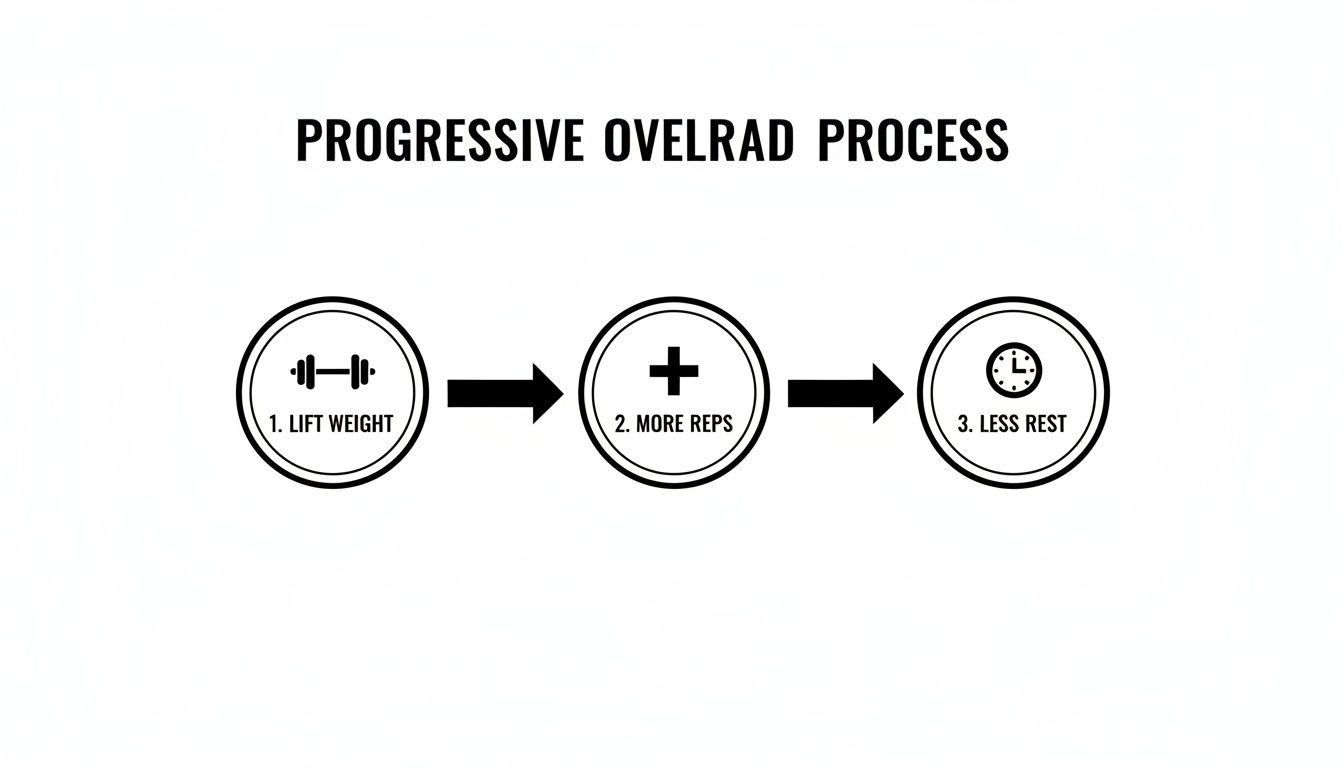
It’s a great reminder that progress isn't just about adding more plates to the bar. Banging out more reps or cutting your rest time are equally powerful tools for forcing your body to adapt.
Step 3 Structure Your Workouts
With your baseline and progression rule sorted, it’s time to organize your exercises into a plan that actually makes sense. A well-structured routine makes sure you're hitting different muscle groups effectively while giving them enough time to recover. For most beginners, a full-body routine done three times a week on non-consecutive days is a fantastic starting point.
Here’s a sample beginner plan that focuses on building foundational strength:
Workout A (Monday & Friday)
- Goblet Squats: 3 sets of 8-12 reps
- Push-Ups (or Incline Push-Ups): 3 sets to near failure
- Dumbbell Rows: 3 sets of 8-12 reps per arm
- Plank: 3 sets, hold for 30-60 seconds
Workout B (Wednesday)
- Romanian Deadlifts: 3 sets of 10-15 reps
- Dumbbell Overhead Press: 3 sets of 8-12 reps
- Lat Pulldowns (or Assisted Pull-Ups): 3 sets of 8-12 reps
- Leg Raises: 3 sets of 15-20 reps
This setup covers all the big movement patterns—squat, push, pull, hinge, and carry—giving you a balanced approach to getting stronger. For a deeper dive, check out our guide on how to create a workout plan for beginners.
Step 4 Integrate Periodization and Deloads
You can’t just push harder and harder forever. Your body is smart, but it's not a machine. It needs planned breaks and periods of lower intensity to recover, adapt, and sidestep burnout. This is where periodization and deload weeks become your secret weapons.
Periodization is just the fancy term for long-term planning, usually broken into training "blocks." A simple way to do this is to focus on one type of progression for 4-6 weeks (like adding weight) before switching your focus to another (like adding reps) to give your body a new challenge.
A deload week is a planned, temporary reduction in your training intensity, usually done every 4-8 weeks. During a deload, you might lift 50-60% of your usual weights or simply cut back on your number of sets. This gives your joints, nervous system, and muscles a much-needed break to fully recover. More often than not, you'll come back feeling stronger than before.
Think of it as a strategic pit stop in a long race. It gives you a chance to refuel so you can come back stronger, ensuring your progress is sustainable for the long haul.
Tracking Your Progress and Smashing Through Plateaus

The path to getting stronger is rarely a straight, upward line. Some weeks you’ll feel unstoppable, while others might feel like you’re stuck in neutral. This is where smart tracking and a solid strategy for breaking through plateaus become your most valuable training tools.
To make progressive overload actually work, you need to know exactly where you’ve been. Without tracking your workouts, you’re just guessing. A simple notebook or a fitness app can transform your efforts from random exercise into a calculated plan for getting better.
Key Metrics to Track for Real Progress
Effective tracking goes way beyond just jotting down the weight you lifted. If you want the full picture of your progress to make smart decisions, you need to monitor the variables that truly drive results.
Focus on logging these key data points for each exercise:
- Weight/Resistance Used: The most obvious one. This shows your direct strength gains over time.
- Reps Completed per Set: This tells you if you’re building endurance and getting closer to your progression goals, like the 2-for-2 rule.
- Sets Performed: Tracking your total sets helps you monitor your overall training volume.
- Rest Periods: Note your rest times, especially if you’re using shorter rest as a form of overload.
By recording these details, you can calculate your total training volume (Sets x Reps x Weight), which is one of the most accurate indicators of the work you're putting in. Seeing that number climb week after week is a powerful motivator. You can learn more about the best ways to keep a record in our guide on how to track fitness progress.
Identifying and Overcoming Training Plateaus
Sooner or later, every single lifter hits a wall. A plateau is when your progress stalls for several weeks despite consistent effort. It’s not just a single bad workout; it’s a sustained period where you just can’t add weight, reps, or improve your performance.
When this happens, don’t panic or try to mindlessly push harder. Instead, use it as a signal to make a strategic change. A plateau is simply your body telling you it has fully adapted to your current routine and needs a new kind of challenge to keep growing.
A true plateau isn't a sign of failure—it's a sign that you've successfully adapted to your current training stimulus. It’s an opportunity to get smarter with your programming.
Here are a few proven strategies to smash through a stubborn plateau:
- Change Your Progression Method: If you've been focused solely on adding weight, switch gears. Spend a few weeks trying to add reps, decrease your rest times, or slow down your tempo to increase time under tension.
- Vary Your Exercises: Swap out a stagnant exercise for a similar one. If your bench press has stalled, try an incline dumbbell press or a close-grip bench press for a few weeks to stimulate the muscles differently.
- Implement a Deload Week: Sometimes the best way forward is to take a strategic step back. A deload week, where you reduce your training volume and intensity by 40-50%, gives your nervous system and joints a much-needed chance to fully recover.
- Double-Down on Recovery: Progress is built during recovery, not in the gym. To consistently smash through plateaus and keep the gains coming, it’s critical to understand how to recover faster from workouts. Make sleep a priority, manage your stress, and make sure your nutrition is actually supporting your training goals.
Common Questions About Progressive Overload Training
Even with a solid plan, questions are bound to pop up. Let’s clear the air and tackle some of the most common sticking points people run into with progressive overload.
How Quickly Should I Progress Each Week?
A good rule of thumb is a 5-10% increase in weight or reps per week, but this is far from a hard-and-fast rule. Beginners often see progress jump much faster, while seasoned lifters might only manage an increase every few weeks.
The real key is consistent, gradual challenge without letting your form get sloppy. Always, always listen to your body—quality movement beats a rushed progression every time.
Can I Use Progressive Overload with Bodyweight Exercises?
Absolutely. You might not be able to slap another plate on the bar, but you can definitely apply the overload principle.
Think about increasing reps or sets, shortening your rest periods, or slowing down the tempo of each rep to increase time under tension. Moving on to a tougher exercise variation—like going from a standard squat to a pistol squat—is another fantastic way to keep the challenge going.
The core principle of demanding more from your body remains the same, with or without weights. It's about making the work harder over time, regardless of the tool you use.
What’s the Difference Between This and Just 'Working Out Hard'?
"Working out hard" is about the intensity you bring to a single session. That’s great, but it’s just one piece of the puzzle and lacks a long-term strategy.
Progressive overload, on the other hand, is a structured, systematic plan that guarantees your workouts get more challenging over time. A tough workout is awesome, but repeating that same tough workout week after week will eventually lead nowhere. Real progress is planned.
How Do I Know If I've Hit a Real Plateau?
A true plateau isn't just one off day or a bad workout. It's a sustained funk, usually lasting 3-4 weeks, where you just can't seem to add more weight, reps, or sets no matter how hard you try.
If your performance has been stuck in neutral for about a month, it's time to take a hard look at your program, your recovery, or maybe just shake things up with a new stimulus. For more ideas, check out our tips to prevent plateaus.
Ready to stop guessing and start progressing? The Zing Coach app takes the guesswork out of progressive overload by building an AI-powered plan that adapts to you. It tells you when to add weight, reps, or change exercises, ensuring you’re always challenged just enough to keep making gains safely. Download Zing Coach and start your personalized journey today!
Share this article


Authors