Learn how to improve mind muscle connection with science-backed techniques. Unlock faster muscle growth, break plateaus, and make every rep count.
Improving your mind-muscle connection isn't about just lifting a weight. It's about shifting your entire focus from simply moving the weight to consciously feeling the specific muscle you're training. This means you’ll likely need to lower the weight, slow down your reps, and focus intently on that muscle contracting and stretching through its full range of motion.
It’s a mental skill, and once you develop it, the effectiveness of every single exercise goes through the roof.
What Is the Mind Muscle Connection

Have you ever cranked out a set of lat pulldowns only to feel it more in your biceps than your back? Or finished a tough set of squats with your quads on fire but your glutes feeling like they barely showed up? It’s a common frustration, and it highlights the gap between just doing an exercise and truly executing it with purpose.
The mind-muscle connection (MMC) is the bridge that closes that gap.
At its core, MMC is a conscious, deliberate effort to channel your mental energy into the specific muscle you’re trying to work. Instead of just thinking, "lift this dumbbell," you’re thinking, "squeeze the bicep to curl this weight." This simple shift in internal focus strengthens the neuromuscular pathways—the communication lines between your brain and your muscles. Think of it as upgrading your body's internal wiring from dial-up to high-speed fiber.
The Science Behind the Squeeze
This isn't just bodybuilding "bro science"; it's a real physiological process. When you concentrate on a specific muscle, your brain sends more targeted electrical signals through its motor neurons. This process, known as enhanced motor unit recruitment, essentially wakes up a greater number of muscle fibers within that target muscle.
More activated fibers mean a higher quality contraction. A better contraction leads to more metabolic stress and muscle damage—the key ingredients for growth (hypertrophy).
Mastering this skill pays off in more ways than one. A strong mind-muscle connection helps you:
- Accelerate Muscle Growth: By ensuring the target muscle does the heavy lifting, you maximize the stimulus it gets from every single rep.
- Improve Lifting Form: When you focus on how a muscle is supposed to function, it naturally encourages better technique and reduces the temptation to use momentum.
- Reduce Injury Risk: Better form and control mean less unnecessary strain on joints, tendons, and ligaments that aren't meant to bear the load.
The mind-muscle connection is the difference between passively moving a weight from point A to point B and actively commanding a muscle to perform its function. It’s the key to making every rep count.
Turning Focus into Physical Gains
The physical impact of this mental focus is measurable. A 2018 resistance training study put this idea to the test. One group used an "internal focus"—concentrating on the working muscle—while the other used an "external focus."
The results were telling. The internal focus group saw the muscle thickness in their elbow flexors and quads increase by 12.4%. This was nearly double the 6.9% gains the other group saw over the same eight-week period. This data validates what experienced lifters have known for decades: how you lift matters just as much as what you lift.
This principle is a cornerstone of effective, science-based training. Understanding this connection is the first step toward transforming your workouts from simple physical effort into a precise, productive practice. To see how this concept is built into structured programs, you can explore the Zing Coach methodology, which prioritizes safe and effective muscle activation.
Getting this right isn't an overnight process, but it’s one of the most powerful tools you can add to your training arsenal for long-term progress.
Here’s a quick rundown of the most effective strategies to get you started.
Quick Guide to Improving Mind Muscle Connection
This table summarizes the most effective, science-backed strategies you can start using today to improve your mind-muscle connection and get more out of every workout.
| Strategy | Why It Works | How Zing Coach Helps |
|---|---|---|
| Lower the Weight | Using lighter loads allows you to focus on the feeling of the muscle contracting instead of just moving a heavy weight. | Personalized workout plans adjust weights to prioritize form and connection, especially in the early stages of a program. |
| Slow the Tempo | Increasing the time under tension forces you to control the movement, enhancing your ability to feel the muscle work through its full range of motion. | The app's avatar demos visually guide you through the correct exercise tempo, helping you internalize slower, more controlled movements. |
| Focus on One Muscle | Isolating a single muscle in your mind helps strengthen the neural pathways to that specific area, improving motor unit recruitment. | Exercise instructions and cues in the app specifically highlight the target muscle for each movement, keeping your focus where it needs to be. |
| Use Tactile Cues | Lightly touching the working muscle with your free hand provides direct sensory feedback, making the connection more tangible and easier to feel. | While the app can't touch you, visual cues from the avatar and clear audio instructions help you pinpoint where you should be feeling the contraction. |
By consistently applying these techniques, you'll start to build a stronger connection between your mind and your muscles. It's a skill that takes practice, but the payoff—in both results and injury prevention—is well worth the effort.
Priming Your Muscles with Proper Activation
Jumping straight into a heavy set without any prep work is a rookie mistake. It’s like trying to have a deep conversation the moment you wake up—it’s just not going to be very effective. Your muscles and nervous system need a gentle nudge to get on the same page. This is where muscle activation comes in, acting as the essential handshake between your brain and your body before the real work begins.
This isn't your standard five-minute jog on the treadmill. Activation is all about performing light, highly-focused movements to wake up the specific muscles you’re about to train. Think of it as deliberately priming your neural pathways for success, making it way easier to lock in that strong mind-muscle connection during your main lifts.
The Goal of Neuromuscular Activation
The main reason we do activation drills is to improve proprioception—your body’s awareness of its own position and movement. By performing simple, targeted exercises, you’re sending a clear signal to your brain, essentially saying, "Hey, we're about to use these glute fibers," or "Get the lats ready to fire."
This targeted warm-up makes sure the correct muscles are awake and ready to handle the load. When you do this right, you slash the risk of dominant muscles compensating for weaker or "sleepy" ones, which is a classic recipe for bad form and injury. To dig deeper into structuring this, check out our detailed guide on how to warm up before strength training.
Practical Activation Drills by Muscle Group
Think of these as rehearsal reps. The goal isn't to get tired; it's all about feeling the muscle work. Grab a light band or just use your body weight, and put all your focus on the sensation of the target muscle contracting.
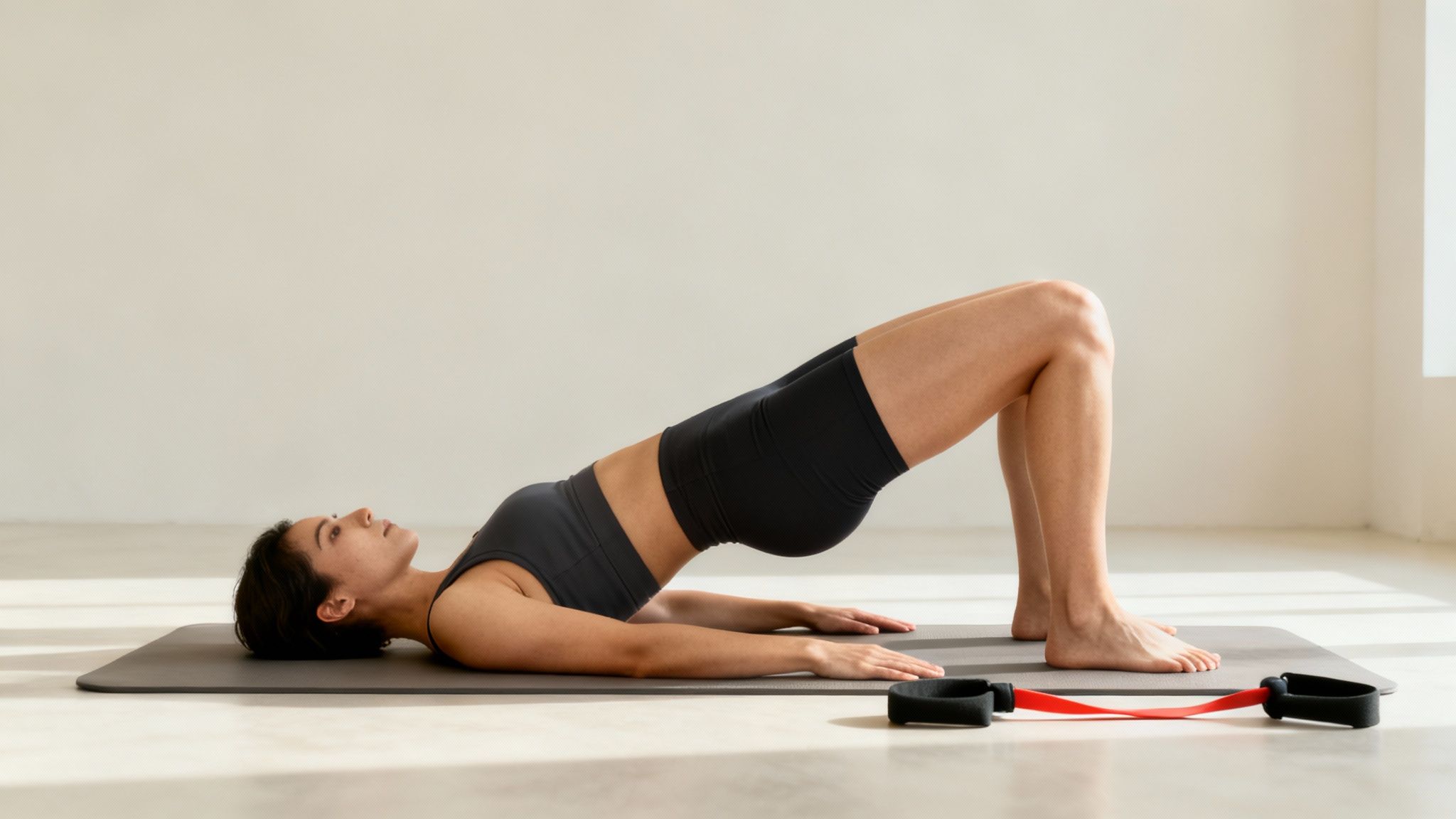
- For Glutes (Before Squats/Deadlifts): Glute bridges are a classic for a reason. Lie on your back, drive through your heels, and consciously squeeze your glutes at the top for a two-second hold. Don't just lift your hips; command your glutes to do the work.
- For Back (Before Rows/Pulldowns): Band pull-aparts are fantastic for this. Hold a resistance band out in front of you and pull it apart across your chest, focusing intently on squeezing your shoulder blades together. Feel those muscles in your upper back engage and hold that squeeze.
- For Chest (Before Pressing): A simple floor press with no weight or very light dumbbells works wonders. The goal is to feel your pectoral muscles contract to push your hands toward the ceiling. You can even place one hand on your chest to really feel the muscle fire up.
Key Takeaway: Your warm-up is more than just getting your blood flowing. It's a critical opportunity to practice your mind-muscle connection when the stakes are low, making it much easier to replicate when the weights get heavier.
The Power of Visualization and Mental Rehearsal
Activation isn't just physical. A seriously powerful technique is to mentally rehearse the movement before you even touch a weight. Close your eyes and visualize the muscle you're about to train. Picture the individual fibers shortening as they contract and lengthening as they stretch.
This mental practice strengthens the neural signals just as much as physical practice does. The science backs this up, too. Research has shown that a targeted instructional focus can significantly spike muscle activity. One push-up trial, for example, logged a 9% increase in pectoralis major EMG activity just from focused intention. This connection is strongest at moderate loads (up to 60% of your one-rep max), as really heavy weights tend to force an all-out effort that overrides this fine-tuned focus.
For anyone recovering from an injury or trying to re-establish proper muscle function, specialized care like physiotherapy at home can be a massive help in this muscle priming process. By adding these brief but intentional activation drills, you turn your warm-up from a boring chore into a powerful neuromuscular practice session.
Using Tempo and Lighter Loads to Feel the Burn
To really nail the mind-muscle connection, you have to give the muscle time to talk back. This usually means checking your ego at the door, swapping out heavy plates for lighter ones, and deliberately slowing things down. The goal isn't just to move a heavy weight from point A to B anymore; it's about controlling a manageable weight through every single inch of the movement.
This whole approach is built on tempo training, which is just a method for controlling the speed of each phase of a lift. By setting the pace for the lifting (concentric), pausing (isometric), and lowering (eccentric) parts of a rep, you kill momentum and force the target muscle to stay fired up from start to finish. It’s a huge shift from asking "how much can I lift?" to "how well can I lift?"—and the second question delivers far better results for muscle growth.
Deconstructing the Rep with Tempo
Tempo is usually written as a string of three or four numbers. Each number is the time in seconds for a specific phase of the lift. For instance, a 3-1-2 tempo on a bicep curl would break down like this:
- 3 (Eccentric): Take three full seconds to lower the dumbbell. This is the part where you're fighting gravity, which creates the good kind of muscle damage that sparks growth.
- 1 (Pause): Pause for one second at the bottom, where the muscle is fully stretched out. This kills the stretch reflex, so you can't just bounce the weight back up.
- 2 (Concentric): Take two seconds to curl the weight up. Your entire focus should be on squeezing the bicep to get the movement started.
This controlled pace demands a level of focus you just can't get when you're heaving weight around. It racks up more time under tension and lets you zero in on the exact feeling of the muscle working. For a perfect example of this in action, check out our guide on the slow-tempo incline dumbbell press.
Pro Tip: The eccentric (lowering) phase is where the magic really happens for building muscle and connection. Resisting gravity on the way down forces your muscle fibers to work overtime, which dramatically cranks up your ability to feel that muscle. Whatever you do, don't just let the weight drop.
Why Lighter Loads Are Your Best Friend
Using a lighter weight isn't a step back—it's a smart, strategic tool for making real progress. When the load is too heavy, your body just goes into survival mode. Its only goal is to complete the rep, so it recruits every muscle it can grab, including synergists and stabilizers. This is fine for building brute strength, but it's terrible for isolating a specific muscle.
Dropping the weight gives you the mental space to maintain perfect form and channel all your focus into the target muscle. You can actually think about squeezing, contracting, and feeling the burn without your form immediately falling apart.
And the science backs this up. Let's say you're doing a bench press but only feel it in your shoulders and triceps. A 2016 study showed that lifters who consciously focused on their pecs saw muscle activity there jump by a significant 9% compared to those who just lifted. This effect was strongest with lighter loads, specifically up to 60% of a one-rep max. By starting lighter and using cues like "squeeze your chest," you turn a general movement into a precision tool for muscle growth.
Pausing at Peak Contraction
Here's another powerful trick: add an isometric pause right at the point of peak contraction—that moment when the muscle is squeezed as tight as it can get. For a leg extension, that's when your leg is fully straight. On a cable row, it's when your hands are pulled right into your torso.
Holding this squeeze for a second or two does a few incredible things:
- It Ignites More Muscle Fibers: The extended squeeze forces your nervous system to call in backup, recruiting extra muscle fibers that are often just sitting dormant.
- It Starves the Muscle of Oxygen: This temporary oxygen shortage creates metabolic stress, which is a major trigger for hypertrophy (muscle growth).
- It Cements the Connection: That intense, focused squeeze is one of the clearest signals you can send from your brain to your muscle. The connection becomes impossible to ignore.
When you put it all together—slower tempos, lighter loads, and purposeful pauses—you create the perfect environment for your mind and muscles to finally start having a productive conversation.
Strategic Exercise Selection for Maximum Engagement
Not all exercises are created equal, especially when your goal is to master the mind-muscle connection. Think of your exercise selection as choosing the right tool for a specific job. While heavy compound movements like squats and deadlifts are champions for building overall strength, they can be like trying to listen to a whisper in a crowded room when you’re learning to feel a specific muscle.
To truly learn the language of your muscles, you need to quiet the noise. This is where isolation exercises shine. They put a single muscle group under a microscope, making it much easier to focus your mental energy and feel the contraction without other muscles jumping in to help.
Why Isolation Exercises Build a Better Connection
When you perform a complex movement like a bench press, your brain is focused on the big picture: pushing the bar up. Your chest, shoulders, and triceps all work together. But switch to a cable fly, and the movement pattern is far simpler—the primary mover is undeniably the chest. This simplicity is your greatest asset.
By removing the need to coordinate multiple large muscle groups, you free up mental bandwidth. You can dedicate all your focus to one thing and one thing only: making the target muscle contract and lengthen with perfect control.
This simple formula is incredibly powerful for rewiring how you lift.
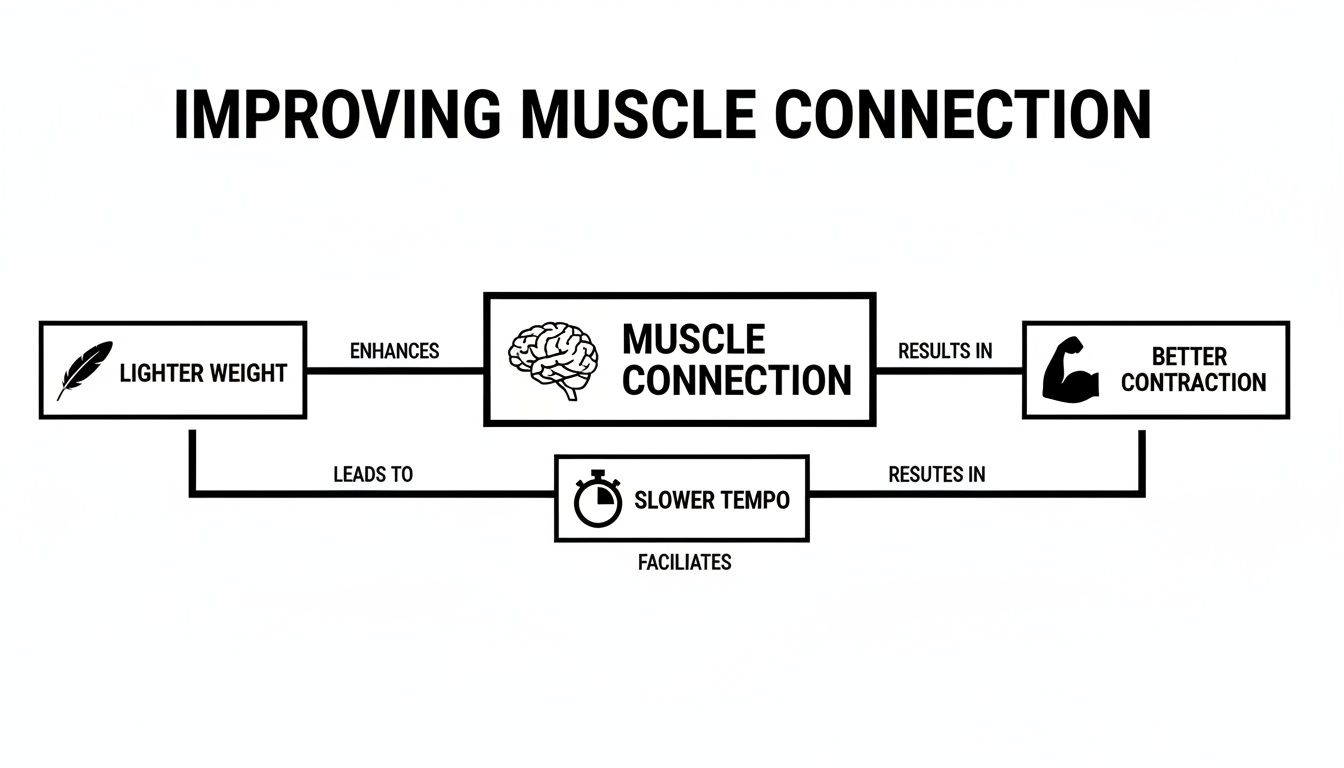
Each element builds on the last, creating the ideal environment for your brain and muscles to finally sync up.
Your Playbook for Muscle-Specific Engagement
Let's break down some go-to exercises for major muscle groups, along with specific cues to help you finally feel them fire. Remember to use a light weight and a slow, controlled tempo.
Chest (Pectorals)
- Go-to Exercise: Cable Fly or Pec-Deck Machine. These keep constant tension on the chest throughout the entire movement, unlike dumbbells.
- Pro Cue: Don't just think about bringing your hands together. Instead, imagine you are wrapping your arms around a giant tree and focus on squeezing your biceps toward each other. This subtle mental shift forces your pecs to do the work.
Back (Lats)
- Go-to Exercise: Straight-Arm Pulldown. This exercise takes your biceps almost completely out of the equation, forcing you to learn what lat activation feels like.
- Pro Cue: As you pull the bar down, think about driving your elbows down and back into your pockets. Keep your arms straight but not locked. The initiation of the movement should come from your back, not your arms.
Shoulders (Deltoids)
- Go-to Exercise: Lateral Raise (with light dumbbells or cables). This is the king of isolating the medial (side) head of the deltoid.
- Pro Cue: Imagine you have a glass of water on each fist that you can't spill. Lead with your elbows and think about pushing your hands out to the sides of the room, not just up. This prevents your traps from taking over.
Key Takeaway: The best exercises for building mind-muscle connection are often the ones that feel the most "boring" at first. They are simple, stable, and allow for a deep, focused contraction without requiring complex coordination.
A Deeper Dive into Specific Muscle Groups
Even smaller muscle groups that seem easy to connect with can benefit from a few specific cues. The right mental trigger can completely change the quality of your reps and the pump you get from them.
Below is a quick guide to some of my favorite isolation movements and the tips I use to really feel them working.
Exercise Modifications for Enhanced MMC
| Muscle Group | Go-To Isolation Exercise | Pro Tip for Feeling the Muscle |
|---|---|---|
| Biceps | Incline Dumbbell Curl | At the top, don't just lift the weight. Actively try to turn your pinky finger toward the ceiling to get a more intense peak contraction. |
| Triceps | Cable Pushdown (with rope) | At the bottom of the movement, spread the rope apart and squeeze for a full second. This fully engages all three heads of the triceps. |
| Glutes | Cable Pull-Through | Initiate the movement by squeezing your glutes to drive your hips forward. Don't think about pulling with your back or arms. |
By being more intentional with your exercise selection, you build a foundation of awareness and control that will eventually carry over to your heavier, more complex lifts.
Choosing the right number of exercises is also crucial for maintaining focus. Overwhelming a muscle with too many different movements can dilute your connection. To learn more, check out our guide on how many exercises per muscle group is optimal for growth.
How Technology Can Accelerate Your Connection
Building a solid mind-muscle connection is a skill, and like any skill, it takes patience and consistent practice to get right. The core principles haven't changed—slow down, use lighter weight, and focus like a laser on the muscle you're working. But let's be honest, the learning curve can be steep. This is where the right tools can completely change the game, turning a frustrating process into a clear, achievable goal.
Imagine having a coach in your pocket that does more than just count reps. Think of a system that actively teaches you how to feel each part of the movement. Modern fitness apps can slice through the guesswork that holds so many people back, giving you the structure and feedback needed to forge that link between your brain and your body way faster than going it alone.
Visual Cues and 3D Avatar Trainers
One of the biggest hurdles when you're starting out is simply not knowing what a proper contraction is supposed to look or feel like. Reading a description is one thing; seeing it is another. This is where clear, visual guidance becomes a game-changer.
Instead of trying to guess from a block of text, you can follow a 3D avatar that demonstrates every single movement with perfect form. Apps like Zing Coach take it a step further by highlighting the exact muscles you should be concentrating on, giving your mental energy a clear target. Seeing that target muscle light up on screen as the avatar moves creates a powerful mental anchor.
This visual feedback loop helps you:
- Pinpoint the Target Muscle: You instantly see which muscle the exercise is designed to hit.
- Understand the Movement: The avatar shows you the ideal tempo and full range of motion.
- Mimic Perfect Form: You have a constant reference point, which cuts down the risk of accidentally engaging the wrong muscles to cheat the weight up.
Adaptive Weight and Intensity Adjustments
Ego lifting is the sworn enemy of the mind-muscle connection. But how do you know if you're pushing too much weight or not enough? Technology can help by creating a training environment that keeps you in that sweet spot—where the focus is on feeling the muscle, not just moving a number.
An AI-powered system can intelligently adapt your prescribed weights, ensuring you’re always working in the optimal zone. It’s not about just adding more weight every week; it's about progressing at a pace that allows for high-quality, deliberate contractions. This kind of personalized adjustment keeps the focus squarely on form and sensation, stopping you from slipping back into using momentum when things get heavy.
The screenshot below shows how Zing Coach lays out your workout, emphasizing the visual guidance that's so crucial for building this connection.
This clean interface puts the focus right where it needs to be: on execution. The avatar demonstrates the exercise while highlighting the active muscle groups.
A truly smart training plan doesn't just make you lift more; it teaches you to lift better. Technology provides the real-time adjustments and visual cues that make this possible, ensuring every session is a step toward mastering your body's movements.
Real-Time Feedback and Progress Tracking
Without feedback, progress is just a guessing game. It's hard to know if what you're doing is actually working. The next wave of fitness apps is integrating computer vision to analyze your form as you do it, counting your reps and offering immediate pointers on your technique. Think of it as having a personal trainer watching over your shoulder, making sure you maintain the control and precision needed for a strong mind-muscle connection. For a deeper look at how this works, you can read more about upgrades to the Zing AI Coach.
Beyond individual reps, tracking your performance over time is a huge motivator. When you can see your strength metrics improving right alongside your ability to actually feel the target muscles working, it reinforces all that focused effort. This data-driven approach gives you concrete proof that your hard work is paying off, encouraging you to stay consistent and turn a conscious effort into an unconscious skill.
Common Questions About Mind–Muscle Connection
As you start putting all this into practice, you’re bound to have some questions. Building a better mind–muscle connection is a skill, and just like learning to squat or bench press, there are common hurdles and nuances to figure out. Let's tackle some of the most frequent questions to clear things up and keep you moving forward.
Do I Need a Mind–Muscle Connection for Every Single Exercise?
Not really, and this is a crucial distinction to make. The intense, internal focus we’ve been talking about is most powerful for hypertrophy-focused training—especially with isolation exercises and machine work. When your main goal is to grow a specific muscle, like your biceps or quads, this connection is your best friend.
But what about heavy, complex lifts like a one-rep max deadlift or a gut-busting squat? Your focus naturally shifts. Your brain’s priority becomes external: moving a massive load through space as safely and efficiently as possible. In those moments, you're coordinating tons of muscle groups at once. Trying to isolate just one can actually get in the way and hurt your performance.
- For Hypertrophy (Muscle Growth): Absolutely, make it a priority.
- For Max Strength/Power: Shift your focus to the overall movement and external cues, like "drive the floor away."
Can I Still Build Muscle Without Focusing on It?
Of course. People have been getting jacked for decades just by lifting heavy weights and applying progressive overload. That will always be the fundamental driver of muscle growth. You don't need a perfect mind–muscle connection to get bigger or stronger.
The real question is about making your time in the gym more efficient. By developing this connection, you make sure the target muscle is doing the maximum amount of work. This leads to a better stimulus from every single set and rep. It’s what turns a decent workout into a phenomenal one by making your effort count that much more.
Think of it this way: improving your mind–muscle connection isn't a requirement for muscle growth, but it's a powerful accelerator. It ensures your effort is directed exactly where you want it, maximizing the return on your investment in the gym.
What If I Still Can't Feel a Certain Muscle Working?
This is incredibly common, so don't get discouraged. It's especially true for muscles you can't easily see, like your lats or rear delts. If you've already tried dropping the weight, slowing down the tempo, and picking the right exercises but still feel nothing, it's time to troubleshoot.
Here are a few tricks I've seen work wonders:
- Use Tactile Cues: This is one of the most effective hacks. During a one-arm dumbbell row, for instance, use your free hand to gently poke or tap your lat. This physical feedback sends a direct signal to your brain, making the connection much more real.
- Do More Activation Drills: Spend extra time in your warm-up doing very light, high-rep drills for that muscle. Do band pull-aparts until you feel a burn in your upper back, or glute bridges until your glutes are screaming. This "wakes up" the muscle, making it easier to feel during your main lifts.
- Record Yourself: Sometimes, the problem is a small form error you're completely unaware of. You might be using more bicep than back in your rows without even realizing it. A quick video on your phone can instantly reveal if your form is off, preventing the target muscle from doing its job.
Honestly, patience is the key here. For some people, it can take weeks or even months of consistent, focused practice before a dormant muscle finally "clicks." Keep at it with light weight, and one day, you'll feel it.
Ready to stop guessing and start truly connecting with your muscles? The Zing Coach app uses 3D avatar trainers and clear visual cues to show you exactly which muscles to focus on. It takes the guesswork out of the equation and helps you progress faster.
Share this article


Authors