Discover an effective 3 day fitness plan for muscle gain and weight loss. Get expert-designed workouts, nutrition tips, and progress strategies.

Let's be real: finding a workout routine that actually gets you results without eating up all your free time can feel like a lost cause. That’s where the 3 day fitness plan comes in. It’s a game-changer for busy professionals, people just starting out, and frankly, anyone tired of the all-or-nothing fitness mentality. It's the perfect sweet spot between getting results and living your life.
Why a 3-Day Fitness Plan Is a Lifesaver for Busy People
The magic of a three-day-a-week workout is its incredible simplicity and staying power. Instead of grinding through a grueling five or six-day schedule that just leads to burnout, this approach weaves fitness into your life in a way you can actually handle. You end up focusing on quality over quantity, making every single session count.
This setup is so effective because it gives you real time to recover. Your muscles don't get stronger during the workout; that happens in the downtime between sessions. With a day or two of rest after you train, your body has the time it needs to repair tissue, restock its energy, and come back even stronger.
Consistency Is the Secret Sauce
The best workout plan on the planet is the one you actually stick with. A 3 day fitness plan makes it so much easier to get started and build a habit that lasts. When hitting the gym feels like a manageable part of your week instead of a daily chore, your motivation stays high. We dig deep into building this crucial habit in our guide on staying consistent with exercise.
That consistency is what really drives long-term results—whether you're looking to lose fat, build muscle, or just feel better overall. It's all about those small, repeated efforts that add up big time.
Sidestep Burnout and Overtraining
One of the most common mistakes is jumping into a crazy-intense daily routine. It's a fast track to physical and mental exhaustion. The classic signs of overtraining—feeling tired all the time, watching your performance tank, and dealing with nagging injuries—can completely derail your progress. A three-day schedule has a built-in safety net to stop that from happening.
The real beauty of a 3 day fitness plan is its balance. It pushes you just enough to spark change but gives you plenty of downtime to recover, adapt, and grow stronger without the risk of burning out.
This balanced approach is more popular than ever. Think about it: kicking off your fitness journey with a simple plan like Monday for strength, Wednesday for cardio, and Friday for a full-body session. This kind of efficiency is exactly what people are looking for. In fact, global health club memberships soared to 77 million in 2024, and gym visits jumped by 8% to 6.25 billion. This boom is being fueled by people seeking smart, effective routines that fit into their actual lives. You can read more about these fitness industry trends and see for yourself.
How to Structure Your Perfect 3 Day Workout Split
Figuring out the right structure for your 3-day fitness plan isn't about finding some secret, one-size-fits-all "best" option. It’s about finding what’s best for you. Your personal goals, how long you've been training, and even what you enjoy doing will all steer you toward the right choice.
Let's walk through the three most effective and time-tested splits to see which one clicks. Each one organizes your training week differently, hitting your muscles in a specific sequence to get the most out of your effort and recovery time.
This decision tree nails down why a three-day plan is so effective when life gets busy.
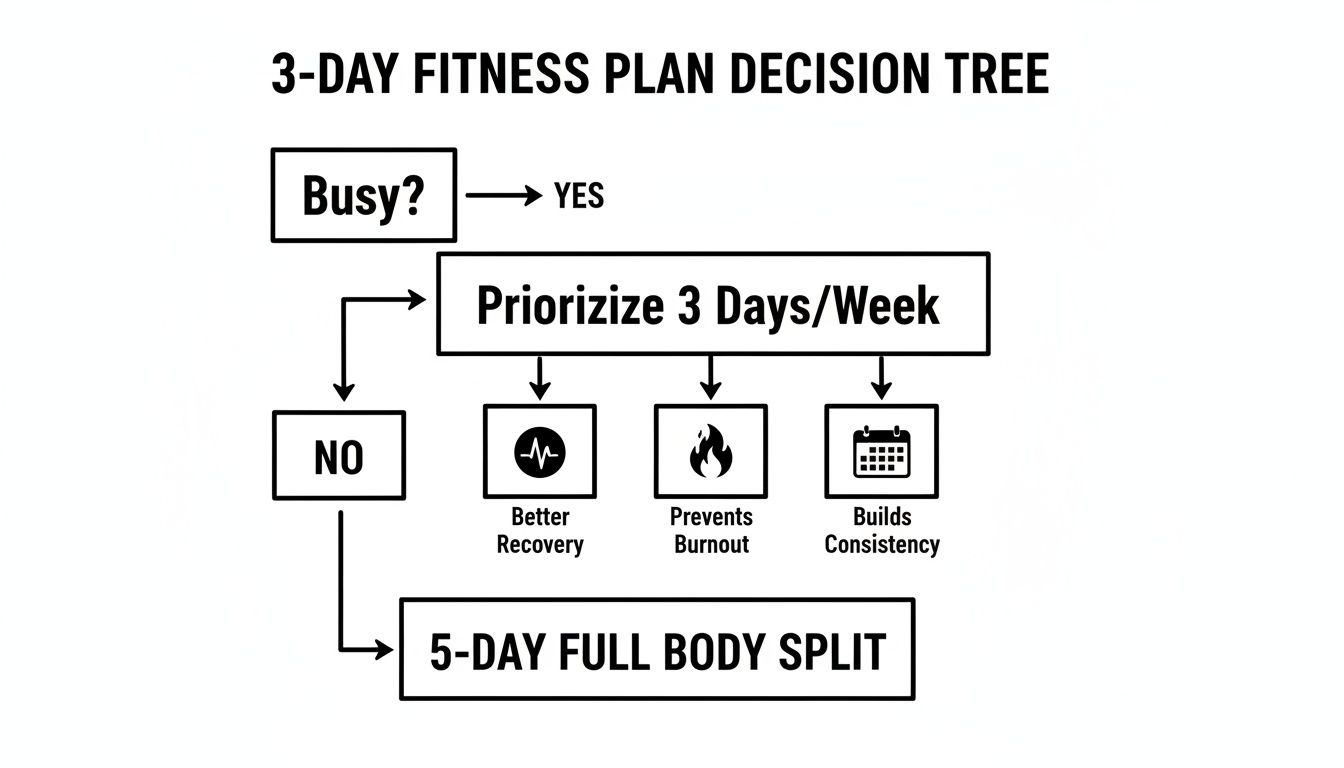
As you can see, those built-in recovery days are non-negotiable. They're what stop you from burning out and help you build the kind of consistency that leads to real, long-term results.
The Full Body Split
A full-body split is exactly what it sounds like: you train your entire body every time you hit the gym, three times a week. This approach is an absolute powerhouse for beginners or anyone whose main goal is building general strength and conditioning.
By hitting major muscle groups—think legs, back, and chest—three times per week, you're constantly giving your body a reason to adapt and grow. That frequent stimulation is fantastic for laying down a solid strength foundation and really mastering the fundamental lifts.
A typical full-body week usually plays out like this:
- Monday: Workout A (Full Body)
- Tuesday: Rest or Active Recovery
- Wednesday: Workout B (Full Body)
- Thursday: Rest or Active Recovery
- Friday: Workout C (Full Body)
- Saturday & Sunday: Rest
The Upper/Lower Split
Once you've got some solid training time under your belt, you'll probably want to start dedicating a little more attention to specific muscle groups. This is where the Upper/Lower split comes in. It’s the perfect next step.
You'll dedicate one session to your upper body, one to your lower body, and then round out the week with a full-body day. This setup lets you crank up the training volume for specific areas without killing your recovery. For instance, your upper body gets a full 48-72 hours of rest before you hit it again. It’s a brilliant intermediate strategy for building muscle.
A sample Upper/Lower week might be structured like this:
- Workout 1: Upper Body (Chest, Back, Shoulders, Arms)
- Workout 2: Lower Body (Quads, Hamstrings, Glutes, Calves)
- Workout 3: Full Body (Compound movements hitting everything)
The Push/Pull/Legs Split
The Push/Pull/Legs (PPL) split is a classic for good reason. It groups your workouts by movement pattern, which is an incredibly efficient way to train. For intermediate to advanced lifters focused on packing on muscle (hypertrophy), PPL is often the gold standard.
Here’s the breakdown:
- Push Day: You train all the "pushing" muscles of your upper body—primarily your chest, shoulders, and triceps.
- Pull Day: You switch focus to the "pulling" muscles, which means your back and biceps get all the attention.
- Legs Day: This one’s pretty self-explanatory. The entire session is dedicated to your lower body.
With PPL, you only train each muscle group directly once per week. This allows you to go all-out with higher intensity and volume during that one session, knowing it has a full week to recover. This can be a huge advantage for advanced lifters moving serious weight. Getting the volume right is crucial, and you can learn more about how many exercises per muscle group is optimal in our detailed guide.
The Push/Pull/Legs split is incredibly effective because it groups muscles that work together naturally. This synergy allows you to go harder on each specific day, creating a powerful stimulus for muscle growth.
Comparing Popular 3 Day Workout Splits
Still on the fence? This table breaks down the three splits to help you pinpoint which path is right for your 3-day fitness plan. It compares each one based on its primary goal, the experience level it suits best, and how a typical week looks.
| Workout Split | Primary Goal | Best For | Sample Schedule |
|---|---|---|---|
| Full Body | General Strength, Fat Loss | Beginners, Time-Crunched Individuals | Mon/Wed/Fri |
| Upper/Lower | Muscle Growth, Strength | Intermediates, Those wanting more focus | Tue/Thu/Sat |
| Push/Pull/Legs | Muscle Growth (Hypertrophy) | Intermediates & Advanced Lifters | Mon/Wed/Fri |
Ultimately, the best split is the one you can stick with consistently and that feels aligned with what you want to achieve. Don't be afraid to run with one for a few months and then switch things up to see how your body responds. Experimentation is part of the fun.
Alright, theory is great, but let's be honest—results come from putting in the reps. This is where the rubber meets the road. I’m going to lay out two straightforward, effective 3 day fitness plan templates you can start using today. One is designed for a fully-equipped gym, and the other is perfect for getting it done at home with just your bodyweight and maybe a chair.
No more guesswork. I've broken down the exercises, sets, and reps for you. All you have to do is show up and do the work.
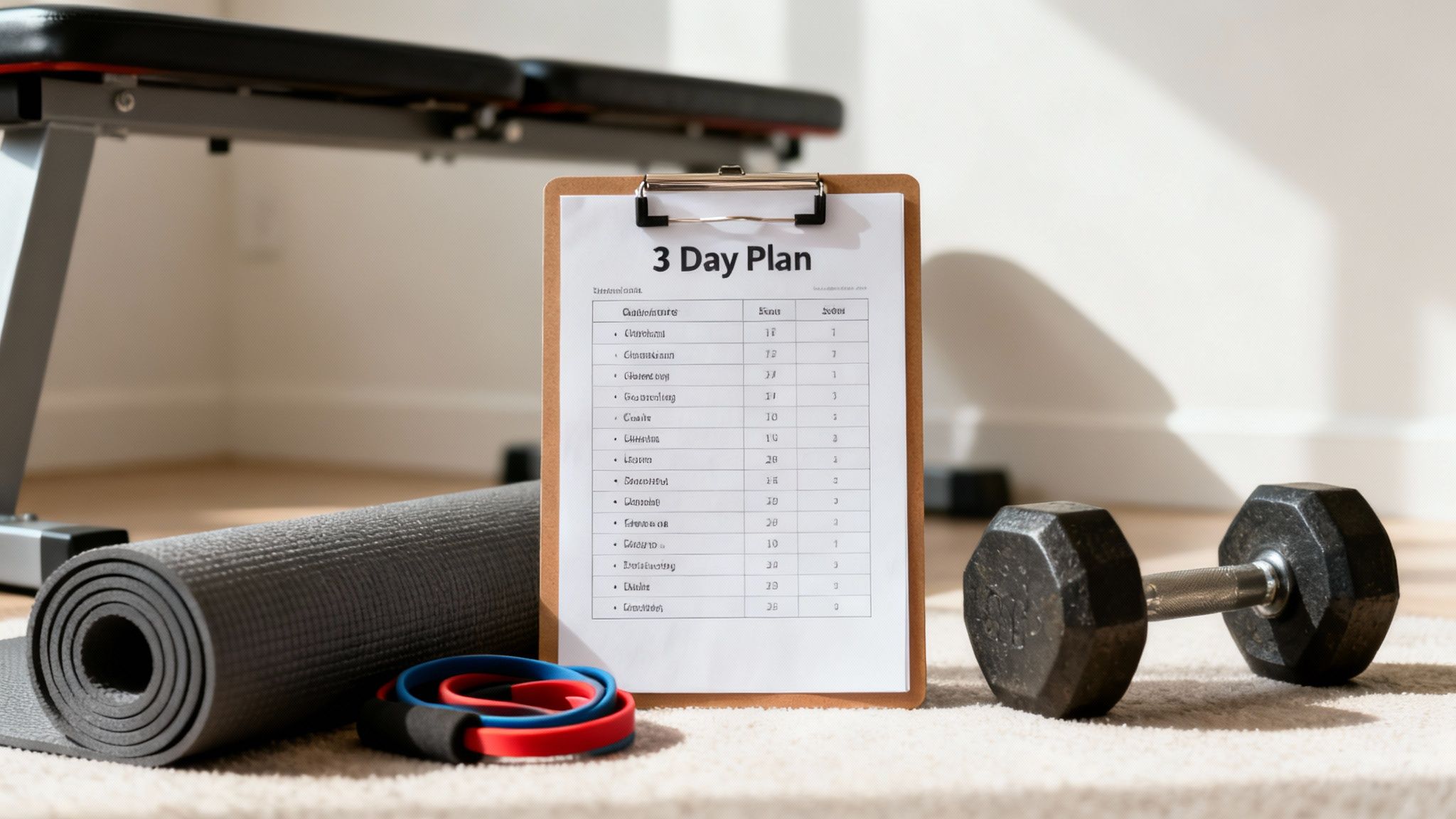
There's a huge demand for structured, guided routines like these. The global health and fitness club market was valued at a massive $121.19 billion in 2024, and it’s expected to balloon to $244.70 billion by 2032. Interestingly, personal training services—the kind of guidance that powers apps like Zing Coach—made up 47% of that market in 2024. People want effective plans that deliver, and that's exactly what you're getting here.
The Gym Based Full Body Plan
This plan is all about the big, foundational movements that give you the most bang for your buck. By focusing on these compound lifts, you'll trigger more muscle growth, torch more calories, and build real-world, functional strength. Just hit each workout once a week, making sure you have at least one rest day in between (think Monday, Wednesday, Friday).
Workout A
- Barbell Squats: 3 sets of 8-12 reps
- Dumbbell Bench Press: 3 sets of 8-12 reps
- Bent-Over Rows: 3 sets of 8-12 reps
- Overhead Press: 3 sets of 10-15 reps
- Plank: 3 sets, hold for 30-60 seconds
Workout B
- Deadlifts: 3 sets of 5-8 reps
- Pull-Ups (or Lat Pulldowns): 3 sets to failure (or 8-12 reps)
- Dumbbell Lunges: 3 sets of 10-12 reps per leg
- Dips (or Push-Ups): 3 sets to failure (or 10-15 reps)
- Leg Raises: 3 sets of 15-20 reps
Workout C
- Leg Press: 3 sets of 10-15 reps
- Incline Dumbbell Press: 3 sets of 10-12 reps
- Seated Cable Rows: 3 sets of 10-12 reps
- Dumbbell Lateral Raises: 3 sets of 12-15 reps
- Face Pulls: 3 sets of 15-20 reps
Quick Tip: Always spend 5-10 minutes warming up with some light cardio and dynamic stretches. And remember, quality over quantity—focus on controlled, clean form for every single rep.
The At Home Bodyweight Plan
No gym? No problem. This 3 day fitness plan proves you don't need fancy equipment to get a killer workout. All you need is your body and a bit of determination. We'll focus on mastering fundamental movements and using clever variations to keep things challenging as you get stronger. Just like the gym plan, spread these workouts across the week on non-consecutive days.
Workout A
- Bodyweight Squats: 3 sets of 15-20 reps
- Push-Ups: 3 sets to failure (focus on good form!)
- Glute Bridges: 3 sets of 15-20 reps
- Plank: 3 sets, hold for 45-60 seconds
- Jumping Jacks: 3 sets of 60 seconds
Workout B
- Reverse Lunges: 3 sets of 12-15 reps per leg
- Inverted Rows (using a sturdy table or chairs): 3 sets to failure
- Pike Push-Ups: 3 sets to failure
- Bird-Dog: 3 sets of 10-12 reps per side
- Burpees: 3 sets of 8-10 reps
Workout C
- Bulgarian Split Squats (use a couch or chair): 3 sets of 10-12 reps per leg
- Decline Push-Ups (feet elevated): 3 sets to failure
- Single-Leg Romanian Deadlifts (bodyweight): 3 sets of 12-15 reps per leg
- Mountain Climbers: 3 sets of 45 seconds
- Side Plank: 3 sets, hold for 30-45 seconds per side
Smart Workout Customization
The best workout plan is one that can bend without breaking. Sometimes the squat rack is taken, an old injury acts up, or an exercise just doesn't feel right. This is where smart substitutions are key. The trick is to swap in an exercise that hits the same main muscle group with a similar movement pattern.
Here are a few common scenarios and how to adapt:
- For Push-Ups: Too tough? Start with incline push-ups against a wall or bench, or drop to your knees. Too easy? Elevate your feet for decline push-ups or add a resistance band across your back.
- For Barbell Squats: No rack available? Dumbbell goblet squats are a fantastic substitute. If your knees are bothering you, try box squats (squatting down to a bench) to control your depth and ease the stress.
- For Pull-Ups: Can't do one yet? In the gym, the lat pulldown machine is your best friend. At home, inverted rows are the way to go.
This table gives you a quick cheat sheet for making effective swaps on the fly.
| If you can't do... | A good gym alternative is... | A good home alternative is... |
|---|---|---|
| Barbell Bench Press | Dumbbell Bench Press | Decline Push-Ups |
| Bent-Over Row | Seated Cable Row | Inverted Rows or Banded Rows |
| Deadlifts | Kettlebell Swings | Glute Bridges or Supermans |
| Overhead Press | Dumbbell Shoulder Press | Pike Push-Ups |
Making these simple adjustments keeps your 3 day fitness plan safe and on track, no matter what life throws at you. If you're ever fuzzy on the proper form for a movement, a good exercise library like the one on Zing Coach can be a lifesaver, offering clear videos and instructions to make sure you’re working the right muscles and staying injury-free.
Fueling Your Progress with Smart Nutrition and Recovery
What you do in the gym is only half the battle. Seriously. Your results from any 3 day fitness plan are truly built during the other 23 hours of the day—specifically through smart nutrition and quality recovery.
Think of your workouts as the spark. Your food and rest? That's the fuel that makes the fire grow. Training hard breaks your muscles down; food and sleep are what build them back up, stronger than before. Without them, you’re just spinning your wheels, feeling tired, and wondering why you aren't seeing the changes you're working so hard for.
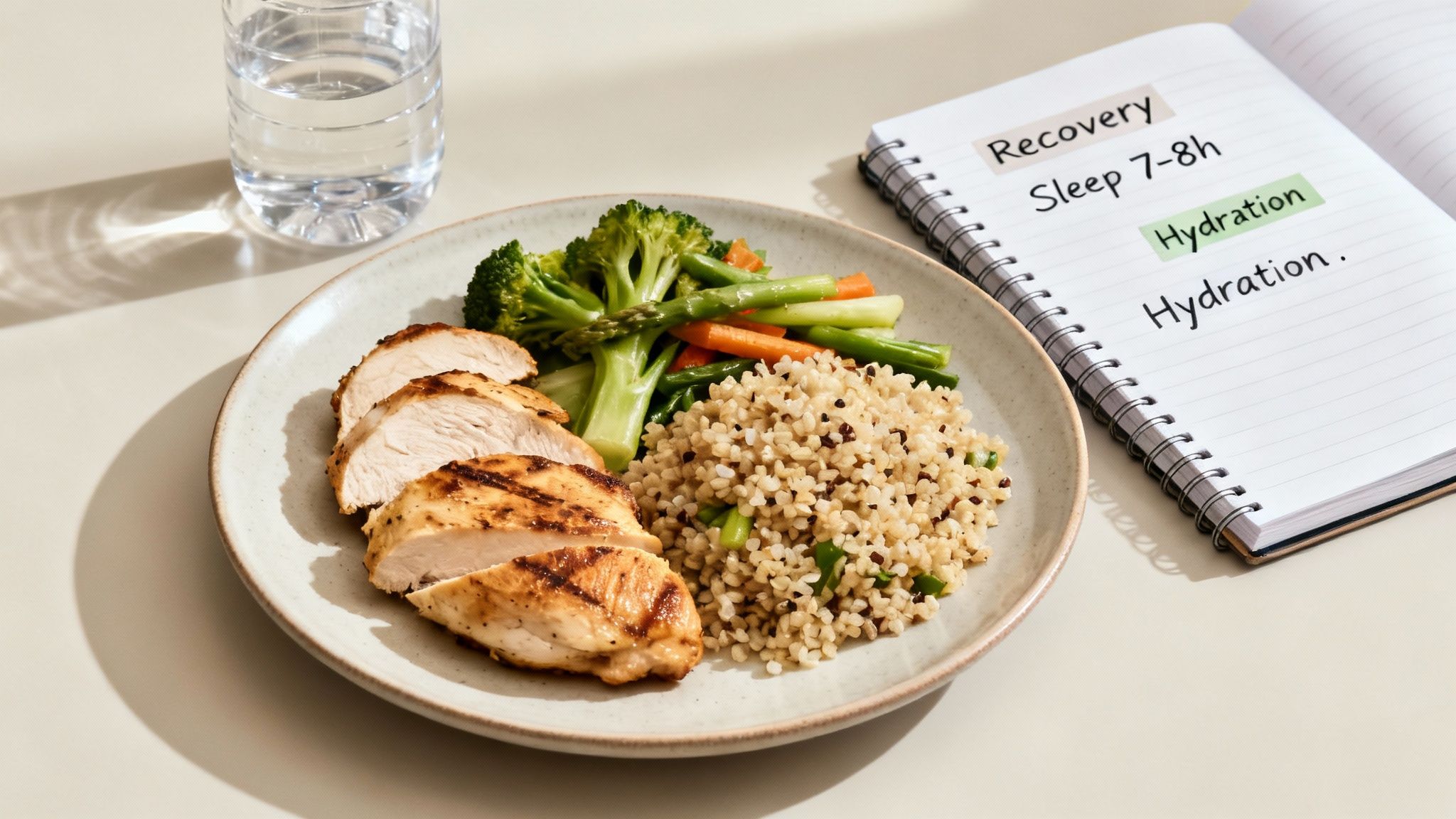
Nail Down Your Nutrition Fundamentals
Forget about complicated, restrictive diets. They rarely stick. Lasting success comes from understanding a few core principles and just being consistent. The two biggest levers you can pull are managing your calories and balancing your macronutrients—protein, carbs, and fats.
Calories are just energy. Your body needs a certain amount to get through the day. Want to lose weight? You’ll need a slight caloric deficit (burning more than you eat). Looking to build muscle? You'll need a slight caloric surplus (eating more than you burn). It's that straightforward.
Macronutrients, or "macros," are the building blocks of that energy. Each one has a specific job:
- Protein: Absolutely essential for repairing and building new muscle tissue after you train. Getting enough protein is non-negotiable for recovery and growth.
- Carbohydrates: This is your body's go-to energy source. Carbs fuel your workouts and then help replenish your energy stores so you're ready for the next one.
- Fats: Healthy fats are crucial for things like hormone production and absorbing certain nutrients. They're a vital part of the big picture.
Getting your nutrition right doesn’t have to feel like rocket science. Start by focusing on whole foods—lean proteins, tons of vegetables, fruits, and healthy fats. This one simple shift gives your body the high-quality nutrients it needs to support your training.
Learning how to count macros for beginners can be a real game-changer if you want to dial things in and align your diet precisely with your goals.
The Power of Smart Recovery
Recovery is where the magic actually happens. Your muscles don't get stronger during your workout; they get stronger when you rest and repair afterward. On a three-day schedule, you have four full days to recover, and making the most of them is the secret to real progress.
To truly maximize your 3-day fitness plan, you've got to implement effective strategies to speed up muscle recovery after each session. This ensures you walk into your next workout feeling strong, not run-down.
Here are the pillars of solid recovery:
- Sleep: This is your body's primetime for repair. You absolutely have to aim for 7-9 hours of quality sleep a night. Skimp on sleep, and you can mess with your hormones, slow muscle repair, and just kill your energy levels.
- Hydration: Water is involved in pretty much everything your body does, from transporting nutrients to helping your muscles function. Even slight dehydration can tank your performance and slam the brakes on recovery.
- Active Recovery: Your "off" days aren't "do nothing" days. Light activity like a brisk walk, some gentle stretching, or foam rolling can boost blood flow to your muscles. This helps clear out metabolic waste and ease soreness, setting you up perfectly for your next big workout.
Prioritize these simple but powerful habits, and you create an environment where your body can thrive. You won't just see better results—you'll feel more energized and resilient, both in and out of the gym.
Tracking Your Progress and Staying Motivated
A solid 3 day fitness plan is a fantastic roadmap, but let's be real: true, lasting success comes down to two things. You need to see that your hard work is actually paying off, and you need to find the drive to keep showing up.
Without those two key ingredients, even the most perfect routine can fizzle out. This is where smart progress tracking and a strong mental game become your most powerful allies.
The absolute bedrock of getting stronger is progressive overload. It’s a simple concept that just means you gradually increase the demand on your muscles over time. This is the fundamental principle that forces your body to adapt, rebuild, and grow stronger.
Making Consistent Gains
So, how do you actually apply progressive overload? The trick is to focus on improving just one thing at a time. That way, you know exactly what’s driving your progress.
Here are a few tried-and-true methods:
- Increase the Weight: Once you can comfortably nail all your reps and sets with perfect form, it's time to bump up the weight. Even a small jump, like 2.5-5 pounds, is progress.
- Add More Reps: Say your goal is 8-12 reps and you just hit 12 on all your sets. Awesome. Next time, aim for 13.
- Do More Sets: If your plan calls for 3 sets of an exercise, challenge yourself by adding a fourth set to increase the total workload on your muscles.
But here’s the thing: progress isn't just about the numbers you write in your workout log. It's crucial to track the changes that show up in your real life. Don't let the scale be your only measure of success—it can be seriously misleading.
Seeing the Bigger Picture
What I call "non-scale victories" are often way more motivating because they show you how fitness is genuinely improving your quality of life. They are tangible proof that your consistency is working.
Start noticing these positive shifts:
- How Your Clothes Fit: Are your jeans a bit looser? Are your shirt sleeves feeling a little snugger on your arms? That’s a classic sign of body recomposition.
- Your Energy Levels: Do you feel less drained during that afternoon slump? Is climbing a flight of stairs less of a chore? Improved energy is a direct payoff from getting fitter.
- Progress Photos: This is a game-changer. Snap a few quick photos from the front, side, and back every 4-6 weeks. Use the same lighting and pose, and you’ll start to see visual changes your eyes might otherwise miss day-to-day.
The most rewarding progress isn't just about lifting heavier weights. It's about feeling stronger, more energetic, and more confident in your day-to-day life. Celebrate these wins—they are the fuel that keeps the fire going.
Using Technology to Your Advantage
Modern fitness apps can take the grunt work out of tracking, giving you a clear, data-driven look at your journey. The Zing Coach app, for example, uses your initial fitness assessment to set a baseline. From there, it logs every workout, tracks your performance, and adjusts future sessions to make sure you're always being challenged. It completely removes the guesswork.
Want to dive deeper? We cover a bunch of different methods in our complete guide on how to track fitness progress.
In a world obsessed with quick results, the appeal of a 3-day fitness plan is soaring, especially when you pair it with smart AI personalization like you find in Zing Coach. Gym memberships in the U.S. hit 77 million in 2024, with total visits climbing 8% to 6.25 billion. This lines up with the 3-4% annual growth the fitness industry has seen, which is now picking up speed thanks to digital tools.
With 51% of exercisers saying they value AI personalization, features like streaks and real-time tips are helping people stick with it. That’s a huge deal, especially when you consider that 20% of the U.S. population with a gym membership is fighting to stay committed. It’s clear: a structured routine combined with engaging tech is a winning formula.
These tools also tap into some powerful psychological motivators. Features like workout streaks, completing challenges, and earning badges create a real sense of accomplishment. When you can see your consistency laid out in a streak, you're way more likely to show up for that next session just to keep it alive. This "gamified" approach turns your fitness plan from a chore into an engaging journey, helping you build the habits that last a lifetime.
Your Top Questions About the 3-Day Fitness Plan, Answered
Jumping into a new routine always brings up questions. That’s a good thing—it means you’re thinking critically about your training. Let's clear up some of the most common ones we get about a 3-day fitness plan so you can start with confidence.
How Long Should My Workouts Be?
One of the biggest myths in fitness is that more time in the gym automatically equals better results. That’s just not true. For a 3-day split, the sweet spot for each session is right around 45 to 60 minutes.
That’s plenty of time to get in a solid warm-up, hit your main lifts with real intensity, and cool down properly. This timeframe actually forces you to be more efficient. You cut out the fluff and focus on the exercises that truly drive progress. If you find your workouts are consistently dragging past the hour mark, you're likely resting too long between sets or adding too many junk-volume exercises.
What Kind of Results Can I Realistically Expect?
This is the big one, right? While your results will hinge on your specific goals, consistency, and (most importantly) your nutrition, you can absolutely expect to see noticeable changes within the first 8 to 12 weeks. Just remember, progress isn't always a straight line.
Here’s a realistic breakdown:
- For fat loss: If you’re pairing your workouts with a sensible diet, losing 0.5% to 1% of your body weight per week is a sustainable and healthy target.
- For muscle gain: Beginners who are eating enough protein and calories can realistically expect to put on about 0.25 to 0.5 pounds of muscle a week.
- For strength: This is where you’ll see the quickest feedback. You’ll find you can lift a bit more weight or squeeze out an extra rep almost weekly, especially at the beginning. That's your neuromuscular system getting smarter and more efficient.
Don’t just live and die by the scale, either. You'll start to feel stronger, have more energy, and notice your clothes fitting better. Those non-scale victories are often the best motivation to keep going.
Honestly, consistency is the whole game. Show up three times a week, put in the work, and fuel your body properly. If you nail that, the results have no choice but to follow.
Should I Do Cardio on My Off Days?
Yes, you definitely can—and probably should! The trick is to think of it as active recovery, not another grueling workout. Your four "off" days are when the real magic happens: muscle repair and growth. Hammering your body with intense cardio could get in the way of that.
The goal on these days is gentle movement. You want to increase blood flow to your muscles, which can help flush out waste products, reduce soreness, and speed up the recovery process.
Some great active recovery options include:
- A brisk 30-minute walk outside
- A light, easy-paced bike ride
- A gentle yoga or stretching session
- Spending some quality time with a foam roller
This kind of light activity supports your hard work in the gym without adding more stress. You'll come back to your next lifting session feeling refreshed and ready to go.
How Long Should I Stick With One Plan?
Give any 3-day fitness plan at least 8 to 12 weeks before you even think about switching things up. This is a non-negotiable timeframe. It gives your body enough time to actually adapt to the movements and for you to make real strength gains through progressive overload.
Program-hopping is one of the most common mistakes I see people make, and it’s a surefire way to stall your progress. You have to give a routine a fair shot to see if it works for you.
After that initial 8-12 week block, take stock. How are you feeling? Are you stronger? Are you closer to your goal? From there, you can decide if it's time to change your split (maybe moving from a Full Body plan to an Upper/Lower split) or simply swap out a few exercises to keep things fresh and challenge your muscles in a new way.
Ready to stop guessing and start seeing real results? The Zing Coach app removes all the guesswork by building a truly personalized 3-day fitness plan based on your goals, equipment, and fitness level. Let our AI adapt your workouts as you get stronger, track your progress automatically, and keep you motivated every step of the way.
Start your journey with a plan that’s built just for you at https://zing.coach.
Share this article


Authors