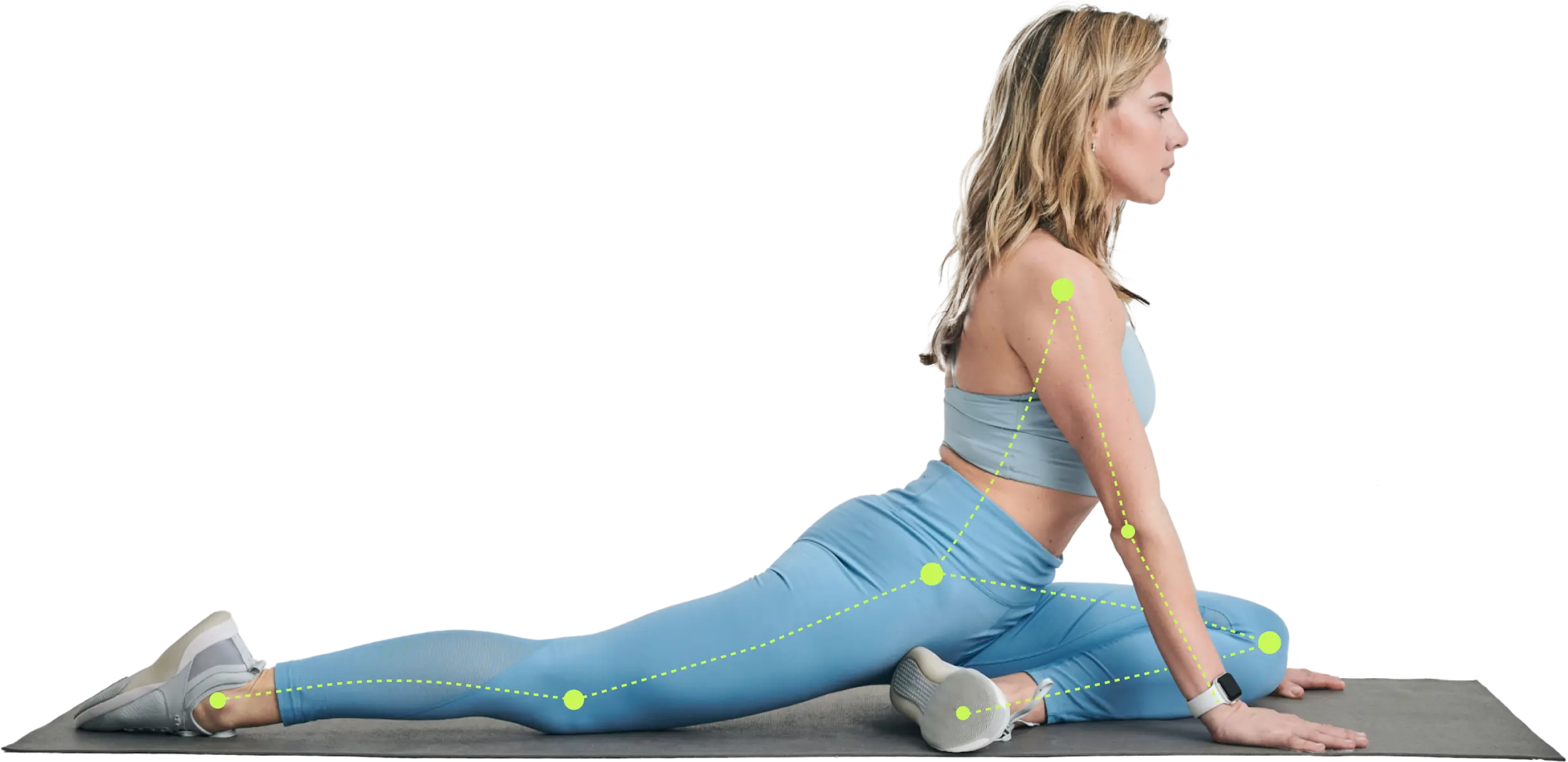
Discover safe and effective glute exercises for bad knees. Build strength, reduce pain, and protect your joints with this practical, knee-friendly guide.
If you've got bad knees, the best way to train your glutes is to pick exercises that light them up without putting direct pressure on the knee joint itself. Think movements like glute bridges, clamshells, and bird-dogs. These are fantastic starting points because they build that foundational strength in your hips and posterior chain, which in turn helps stabilize your knees from the top down.
Why Strong Glutes Are Your Knees' Best Friend
When knee pain flares up, the natural impulse is to zero in on the knee or the muscles right next to it, like your quads. But honestly, that approach can be a bit of a red herring and sometimes makes things worse. The real key to happy, healthy knees over the long haul often lies higher up the body—in your glutes.
Think of your glutes as the powerhouse and shock-absorption system for your entire lower body. When they're strong and firing on all cylinders, they control the alignment of your thigh bone (femur). This prevents it from rotating inward and causing that dreaded "knee cave" or valgus collapse, a major culprit behind pain and strain on the delicate structures inside your knee joint.
The Problem With Quad-Dominant Training
For years, the standard advice for knee pain was simple: strengthen your quads. While strong quads are definitely part of the equation, focusing only on them can create a serious muscle imbalance. This is especially true for people dealing with conditions like knee osteoarthritis, which is projected to affect a staggering 595 million people worldwide by 2025.
Research has shown that quad-heavy training can actually worsen symptoms in 40–50% of these cases because it neurologically shuts down the glutes. On the flip side, strong glutes can reduce the stress on your knees during everyday activities by 25–35%, acting like a natural, protective bungee cord.
Your glutes are designed to be the main drivers for big movements like climbing stairs, getting up from a chair, or just walking. When they're weak, other muscles—and more importantly, your joints—are forced to pick up the slack.
Shifting Focus for Lasting Relief
By simply shifting your focus from the front of your legs to the back, you start building a more balanced and supportive structure for your entire lower body. This is the core principle behind picking effective glute exercises when your knees are giving you trouble.
A quick look at the gluteal muscles shows just how vital they are for keeping your knees stable and pain-free.
Glute Muscles And Their Role In Knee Protection
This table breaks down the key players in your glutes and explains how strengthening each one directly helps take the pressure off your knees.
| Glute Muscle | Primary Function | How It Protects Your Knees |
|---|---|---|
| Gluteus Maximus | Hip extension (pushing hips forward) | Powers movements like squatting and climbing, preventing the quads from taking over and putting excess force through the kneecap. |
| Gluteus Medius | Hip abduction (moving leg out to the side), pelvic stability | The MVP of knee stability. It prevents your hip from dropping and your knee from caving inward when you walk, run, or land. |
| Gluteus Minimus | Assists with hip abduction and stabilization | Works alongside the gluteus medius to fine-tune hip control and maintain proper leg alignment, acting as a crucial supporting muscle. |
By targeting this whole complex, you ensure your hips, pelvis, and legs move in proper alignment, effectively offloading the knee joint.
An intelligent fitness app like Zing Coach can be a huge help here. It assesses your movement patterns and builds a personalized plan that develops this foundation safely from day one. You can explore a deeper dive into how to build glutes effectively with our detailed guide. This isn't just about dodging pain; it's about building a resilient, capable body that will support you for years to come.
Mastering The Foundational Knee-Friendly Exercises
Alright, let's build your arsenal of safe, effective movements. When you're dealing with cranky knees, the game plan is simple: pick glute exercises that fire up the hips without sending a bunch of force through the knee joint.
This means we're sidelining traditional squats and lunges for a bit. Instead, we'll focus on foundational, floor-based exercises that let you build strength without provoking pain. These moves are hand-picked because they zero in on the gluteus maximus and medius while your knees are in a stable, supported position.
The Classic Glute Bridge
The glute bridge is the cornerstone of any solid knee-friendly routine. It goes right after the gluteus maximus—the biggest muscle in your body—which is your powerhouse for hip extension. Nailing this movement is the first real step toward teaching your body to rely on its glutes instead of just its quads.
How to Do It:
- Lie on your back, knees bent, with your feet flat on the floor about hip-width apart. Your heels should be just close enough for your fingertips to graze them.
- Brace your core to keep your lower back neutral. You don't want it arched way up or mashed flat into the floor.
- Drive through your heels and squeeze your glutes hard to lift your hips off the floor. Aim for a straight line from your shoulders to your knees.
- Hold that peak contraction for a second. Really feel the glutes working.
- Slowly and with control, lower your hips back down to the start.
A classic mistake here is arching the lower back just to get more height. Forget height. Focus entirely on the quality of that glute squeeze—that's where the magic happens.
The Essential Clamshell
Next up is the clamshell. It might look unassuming, but this little move is incredibly powerful for targeting the gluteus medius. This is the muscle that gives you pelvic stability and, crucially, stops your knee from caving inward—a major culprit behind knee pain.
Strengthening this muscle can be a game-changer, especially during rehab. A clinical trial, for instance, showed that patients who added gluteus medius exercises after meniscus surgery improved their knee function scores by over 25% and saw pain levels plummet by 60-70% in just eight weeks.
How to Do It:
- Lie on your side with your knees bent at about a 45-degree angle, stacked one on top of the other.
- Prop your head on your bottom arm and place your top hand on the floor in front of you to keep your torso stable.
- Keeping your feet glued together, brace your core and lift your top knee toward the ceiling. The key is to do this without rocking your hips backward.
- The movement should be small and controlled, coming straight from your glutes, not your lower back.
- Lower your knee back down slowly.
This is exactly how you start correcting those muscular imbalances that lead to knee trouble in the first place.
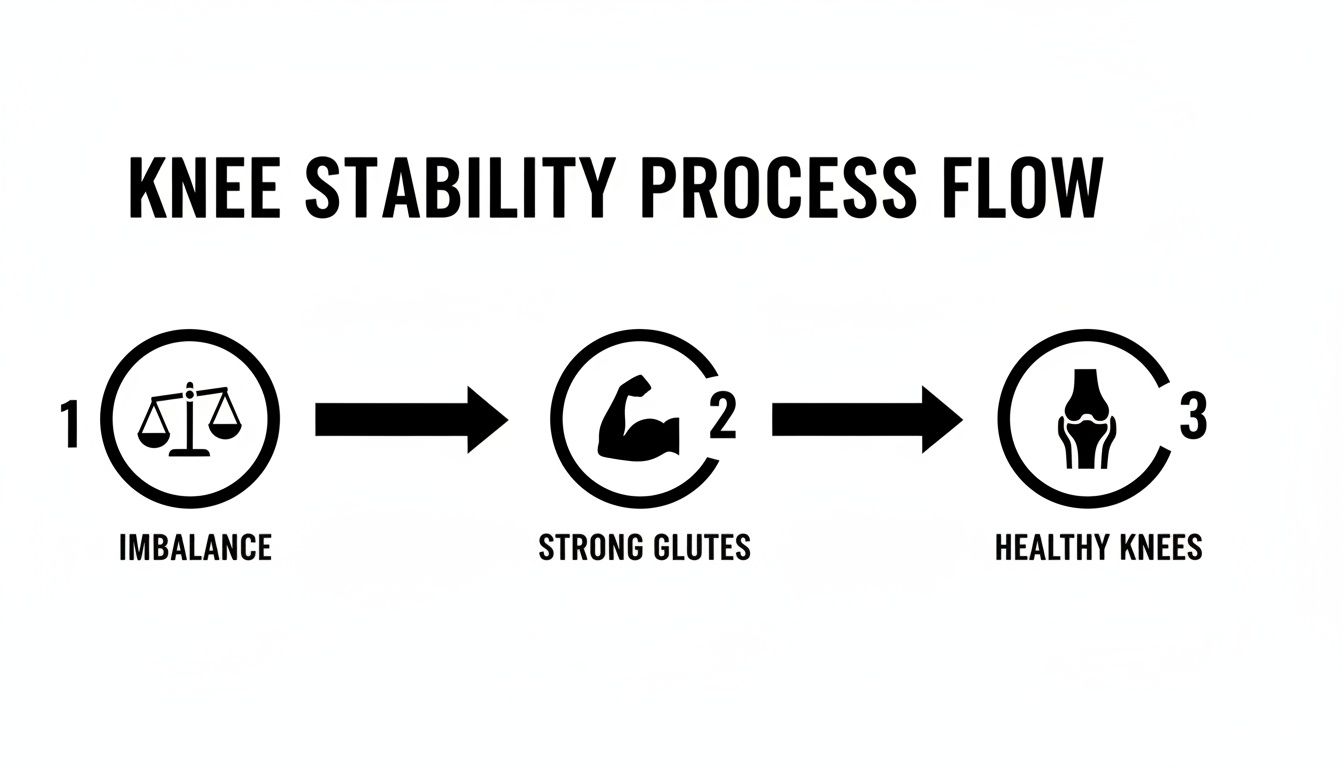
As you can see, weak glutes create an imbalance that puts the knee at risk. By strengthening them, you restore stability and protect the joint from unnecessary strain.
Side-Lying Leg Raise
The side-lying leg raise is another fantastic move for the gluteus medius. It challenges the muscle through a bigger range of motion than the clamshell, helping you build both pure strength and endurance.
Insider Tip: To really light up your glutes with this one, turn your top leg inward just slightly so your toes point down toward the floor. This tiny tweak helps take your hip flexors out of the equation and puts all the focus right where it belongs: on the glute medius.
Getting the form right on these foundational moves is non-negotiable. This is where an app like Zing Coach can be a huge help. Its avatar trainer gives you a crystal-clear visual guide, and the real-time form correction feature is like having a virtual PT watching over you to make sure every single rep is safe and effective. It's basically a spotter in your pocket.
For more ideas, you can also check out our extensive guide on other knee-friendly leg exercises.
How To Progress Your Workouts Without Harming Your Knees
Getting stronger is all about pushing your limits, but when you have sensitive joints, that line between a good challenge and a painful flare-up can feel incredibly thin. Smart progression is about making your muscles work harder without demanding more from your knees than they can handle. It all comes down to applying the principles of progressive overload in a way that’s friendly to your joints.
This doesn't always mean just piling on more weight. You can crank up the difficulty by adding reps, tacking on another set, or even just shortening your rest time. Each of these tweaks forces your glutes to adapt and get stronger over time.
Introducing Resistance Bands
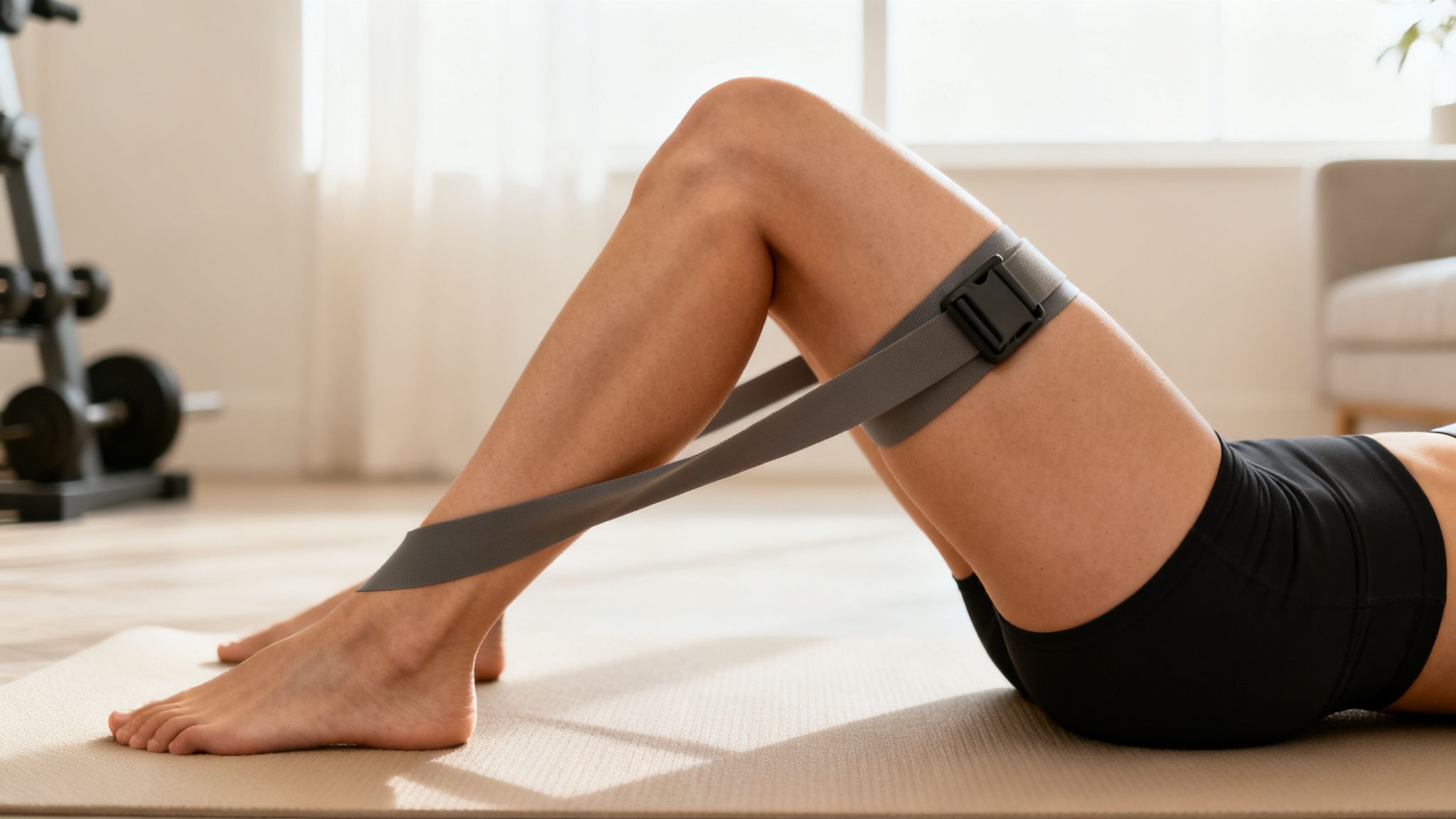
One of the best and safest ways to level up your glute work is with resistance bands. Seriously, just looping a band around your thighs during a glute bridge or clamshell can dramatically fire up your muscles without changing the joint angle or adding any harsh impact.
Start with a light band and be obsessive about your form. Once that starts to feel too easy, you can graduate to a heavier band. This gives you a really clear, measurable path to increasing the intensity of your routine.
Increasing Volume and Complexity
After you’ve nailed the basic moves with bands, you can start playing with other variables or even move on to more complex exercises.
- More Reps and Sets: If you're breezing through 3 sets of 15 reps, try aiming for 3 sets of 18, or just add a fourth set to your routine.
- Go Unilateral: This is a game-changer. Switch from a standard two-legged glute bridge to a single-leg version. Not only does this double the load on the working glute, but it also lights up your core and seriously challenges your pelvic stability.
As you progress, your form becomes even more critical. A 2025 study actually challenged the old-school idea that knee cave-in is always a sign of weak glutes. It found that subtle form changes can completely alter muscle outcomes—one group even saw a 4–5% decrease in glute size because of fatigue from specific form cues. You can learn more about these fascinating findings on muscle growth and form.
The whole point of progressive overload is to challenge the muscle, not the joint. If you feel any new or sharp pain in your knee, that's your body's signal to back off and check your form or intensity.
As you think about how to keep getting stronger without aggravating your knees, it's always smart to lean on expert advice, like these 5 Tips For Exercising Safely With Joint Issues.
Ultimately, taking the guesswork out of your progression is the surest way to get consistent, pain-free results. An adaptive app like Zing Coach analyzes your performance and fatigue levels to figure out the perfect moment to dial up the challenge. It takes all the principles we’ve talked about here and applies them directly to you, making sure you’re always moving forward safely. To dive deeper, check out our detailed guide on progressive overload training.
Your Weekly Plan For Building Stronger Glutes
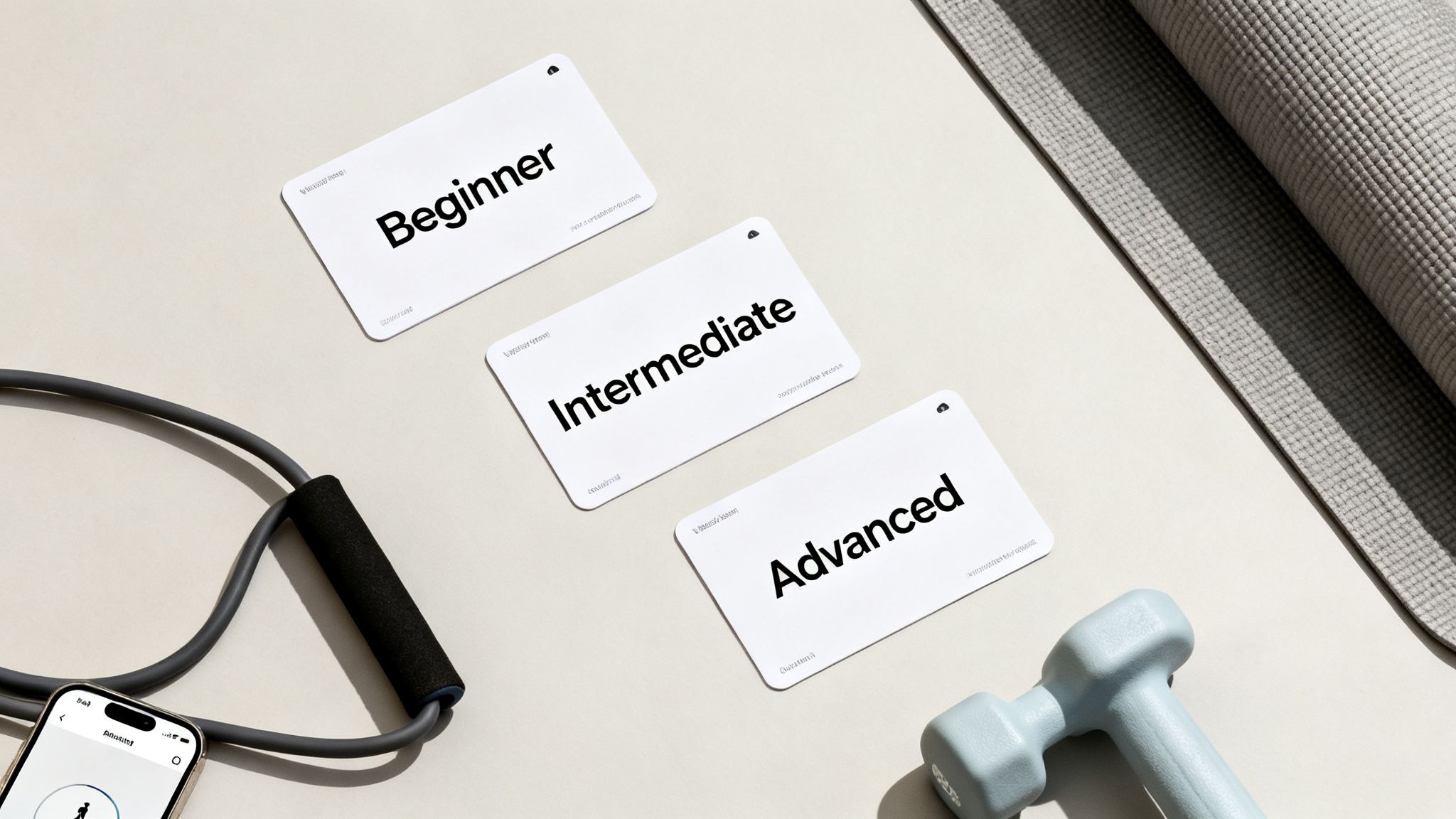
Knowing the right moves is one thing, but stringing them together into a consistent routine is where you’ll actually see—and feel—a real difference. To get you started, here are three sample workout templates designed for different fitness levels, each built around effective glute exercises for bad knees.
Think of these as a starting point, not a rigid prescription. The real goal is consistent, pain-free effort. Aim to hit your chosen workout 2–3 times per week on non-consecutive days. This gives your muscles the downtime they need to recover and grow stronger.
Beginner Bodyweight Routine
Just starting out or coming back from a layoff? This bodyweight-only plan is your perfect entry point. The entire focus is on mastering form and getting the right muscles to fire without any extra weight.
- Glute Bridges: 3 sets of 15 repetitions
- Clamshells: 3 sets of 15 repetitions (per side)
- Bird-Dog: 3 sets of 10 repetitions (per side, holding for a 2-second count)
- Side-Lying Leg Raises: 2 sets of 12 repetitions (per side)
Take a 60–90 second rest between sets. Your mantra here is slow and controlled. Really concentrate on feeling the squeeze in your glutes with every single rep.
Intermediate Resistance Band Workout
Ready to level up? Adding a resistance band is a simple way to increase the challenge and build more strength. For these moves, loop the band just above your knees.
- Banded Glute Bridges: 3 sets of 15 repetitions
- Banded Clamshells: 3 sets of 20 repetitions (per side)
- Banded Lateral Walks: 3 sets of 15 steps (per side)
- Fire Hydrants: 3 sets of 15 repetitions (per side)
Aim for about 60 seconds of rest between sets. That band forces your glutes to work harder to keep your knees from collapsing inward, which seriously amplifies the burn and the benefit.
Static templates are a fantastic start, but they can't adapt to your daily energy levels or how quickly you progress. This is where a bit of tech can make a massive difference in your long-term success and safety.
Advanced Glute Activation
This routine mixes in more complex movements and unilateral (single-leg) exercises. These are brilliant for challenging your stability and ironing out any strength imbalances between your left and right sides.
- Single-Leg Glute Bridges: 3 sets of 12 repetitions (per side)
- Banded Donkey Kicks: 3 sets of 15 repetitions (per side)
- Reverse Lunges: 3 sets of 10 repetitions (per side, focusing on driving up with your glute)
- Bodyweight Hip Thrusts: 3 sets of 15 repetitions
Keep your rest periods a bit shorter here, around 45–60 seconds.
Sample Weekly Glute Workout Schedule
To give you a clearer picture of how this fits into a week, here’s a sample schedule. The key is consistency and recovery, so make sure you have at least one full rest day between sessions.
| Day | Beginner Routine | Intermediate Routine | Advanced Routine |
|---|---|---|---|
| Monday | Workout A | Workout A | Workout A |
| Tuesday | Active Recovery (Walk, Stretch) | Active Recovery (Walk, Stretch) | Active Recovery (Walk, Stretch) |
| Wednesday | Workout B | Workout B | Workout B |
| Thursday | Rest | Rest | Rest |
| Friday | Optional: Workout A or C | Optional: Workout A or C | Optional: Workout A or C |
| Saturday | Active Recovery | Active Recovery | Active Recovery |
| Sunday | Rest | Rest | Rest |
No matter which routine you choose, remember that a truly optimized plan evolves with you. While these workouts provide a solid structure, an app like Zing Coach can take these principles and create a plan that’s truly yours. It adjusts your workouts based on your feedback, equipment, and how you're feeling, ensuring you’re always challenged just enough without pushing into the pain zone.
Knowing When To Push And When To Pull Back
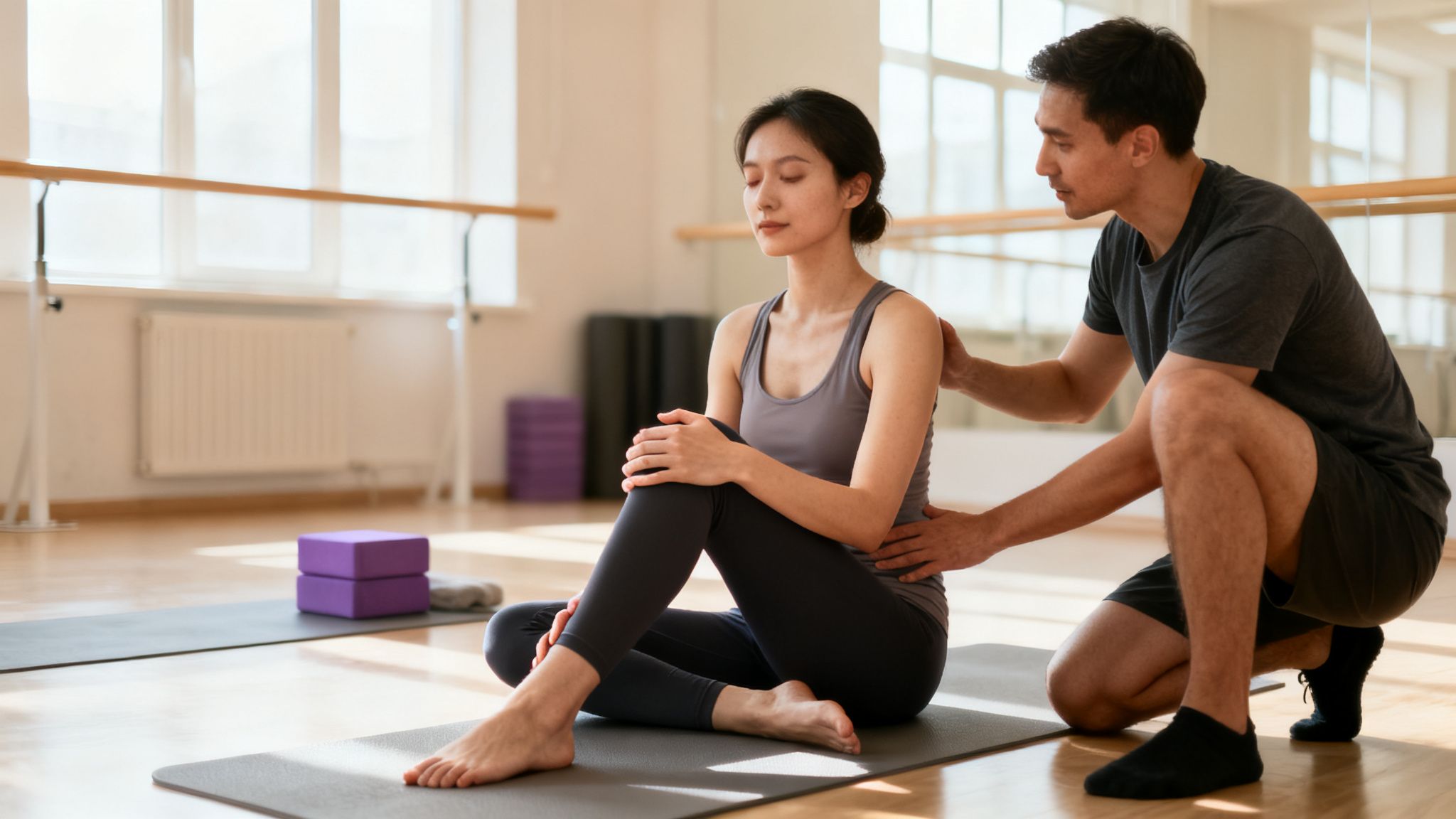
When you're training around sensitive joints, your most valuable skill isn't brute strength or endless endurance—it's body awareness. You have to learn the difference between the productive burn of muscle fatigue and the blaring warning signs of joint pain. Getting this right is the secret to making safe, lasting progress.
A huge part of any smart workout plan, especially when you have a pre-existing condition, is actively listening to your body. The dull, generalized ache of a muscle working hard? That's the good stuff. But pain that feels sharp, stabbing, or like it's buried deep inside the knee joint itself? That's a hard stop.
Red Flags To Watch For
Think of these as non-negotiable stop signs. If you feel any of them during an exercise, stop what you're doing immediately and reassess. Pushing through these signals is how a minor tweak turns into a major setback.
- Sharp, Pinching, or Grinding Pain: This is a classic sign that structures inside the joint are getting irritated.
- Pain That Increases with Reps: If each rep feels worse than the last, something about the movement is aggravating the joint.
- Swelling or Instability: Any noticeable puffiness around the knee or a feeling that the joint might "give out" is a serious red flag.
Remember, the whole point is to challenge your muscles, not your joints. A great workout should leave your glutes feeling tired, but your knees should feel stable and totally fine.
When To Consult A Professional
While these guidelines are great for navigating your day-to-day workouts, they are no substitute for professional medical advice. Trying to self-diagnose is a risky game, and what helps one person’s knee pain could make another’s worse. Getting a proper diagnosis from a doctor or physical therapist is always the best move.
Before you jump into any new exercise program—especially if you have a history of significant injury or chronic pain—talking to a clinician is the safest first step you can take. They can pinpoint the root cause of your pain and give you specific advice that’s actually built for your body.
An adaptive app like Zing Coach is designed around this safety-first approach with structured routines, but it always works from the principle that professional medical advice comes first. It also helps to learn how to know if you're overtraining so you don't push your body too far.
Common Questions About Glute Training With Bad Knees
Even when you know which exercises to do, starting a new routine when your knees are already giving you grief can feel a bit nerve-wracking. That’s totally normal. Let's clear the air and tackle some of the most common questions I hear from clients. Getting these sorted is the key to moving forward with confidence.
Can I Still Do Squats and Lunges?
This is probably the biggest question on everyone's mind. The short answer? Yes, but with some smart modifications. Traditional, deep squats and lunges can definitely cause trouble, but we aren't doing those. The goal is to tweak the mechanics to shift the stress away from the knee joint and onto your glutes, where it belongs.
For squats, think box squats. By squatting down to a bench or a chair, you’re forced to send your hips backward, which keeps your shins more vertical. This is a game-changer because it stops your knees from tracking too far forward—a classic trigger for knee pain.
When it comes to lunges, swap your forward lunges for reverse lunges. Stepping backward instead of forward dramatically reduces the stress on the patellar tendon. Just like with the box squat, focus on keeping that front shin vertical and use your glutes to power you back to the starting position.
How Long Until My Knees Feel Better?
This one is all about consistency. Most people start to feel a real difference—less discomfort, more stability—within 4 to 8 weeks of training their glutes two or three times a week. The first improvements actually come from your brain getting better at firing up those glute muscles, a process called neuromuscular control.
True strength gains and muscle growth, the kind that build long-term resilience, take a bit longer. You're typically looking at around 8 to 12 weeks for that. The key is to stick with it. Progress isn't always a straight line, but consistency is what builds bulletproof joints over time.
What Equipment Do I Really Need?
Honestly, you can get incredible results with just your body weight. Foundational moves like glute bridges and clamshells are powerful all on their own.
Once you start getting stronger, your best first investment is a set of resistance loop bands. They're cheap, easy to store, and perfect for adding a serious challenge to your glute work without adding any stressful impact on your knees.
What Else Supports Knee Health?
Building strong glutes is huge, but a holistic approach is always going to get you the best results. Don’t forget to support your joints from other angles.
- Nutrition: Focus on anti-inflammatory foods. Think fatty fish, berries, and leafy greens.
- Weight Management: This is critical. Every extra pound of body weight adds a significant amount of pressure to your knee joints during daily activities.
- Mobility: Always make time for a proper warm-up and cool-down. Pay special attention to stretching your hip flexors and hamstrings to maintain good pelvic alignment and reduce tension around the knee.
Tackling knee health from all sides is the smartest way to train. For more ideas on safe and effective movements, check out our library of other exercises for bad knees.
A structured, intelligent plan is the surest way to see these changes safely. Zing Coach eliminates the guesswork by creating a routine based on your specific needs, limitations, and goals. The AI cleverly adapts your workouts based on your feedback and whatever equipment you have, ensuring you're always progressing without ever pushing into the pain zone.
Share this article


Authors