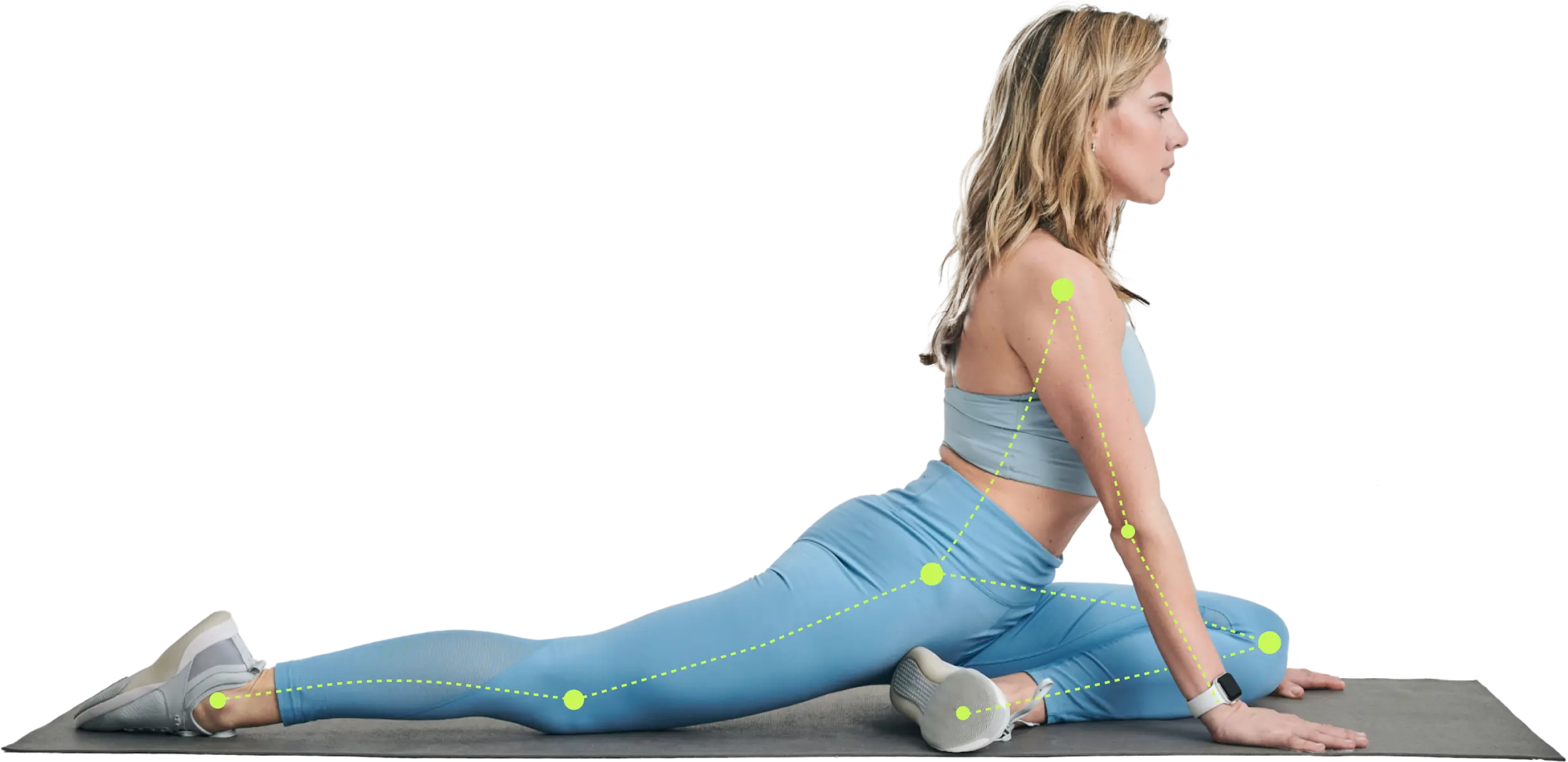
Discover the best exercises for bad knees with our guide. Learn safe, low-impact routines to strengthen joints, reduce pain, and regain mobility.
When your knee starts aching, the first impulse is often to just stop moving. But honestly, the best thing you can do is often the exact opposite. The right kind of low-impact exercises—think moves like straight leg raises, glute bridges, and hopping on a stationary bike—can actually strengthen the muscles that support your knee, boost your flexibility, and dial down the pain, all without making things worse.
Why the Right Exercise Is Your Best Medicine for Knee Pain
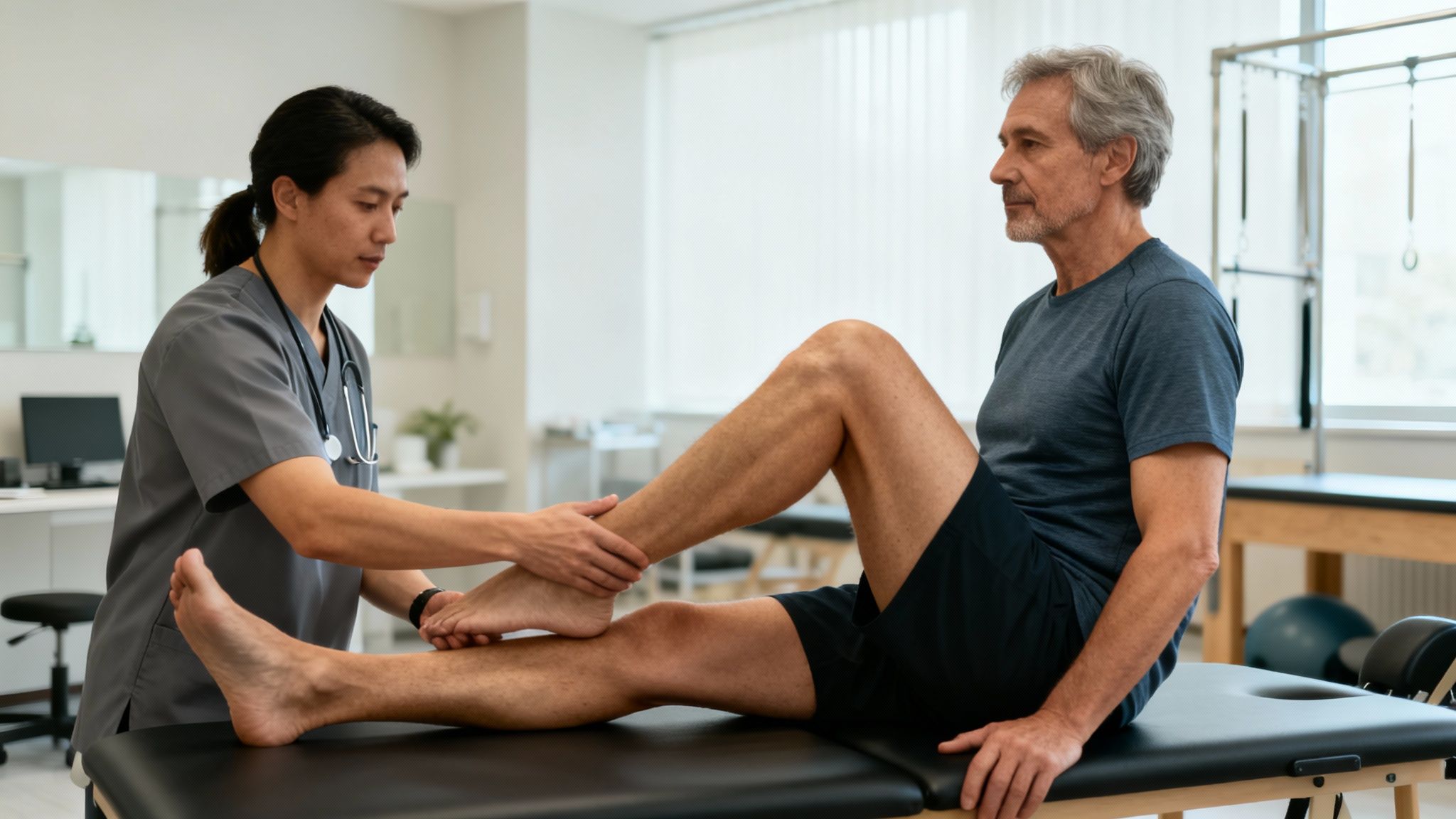
It’s a huge misconception that putting your feet up is the only fix for "bad knees." While you should absolutely back off from anything that causes sharp pain, becoming a couch potato can actually dig you into a deeper hole. Your knee joint is like a living hinge—it’s designed to move. Without that regular motion, the muscles around it get weak and the joint itself just gets stiffer.
Think of the muscles surrounding your knee—especially your quadriceps, hamstrings, and glutes—as your body’s own personal support crew. When these muscles are strong, they act like shock absorbers, soaking up the stress from everyday stuff like walking or taking the stairs. This takes a massive load off the knee joint itself, which can ease discomfort and prevent more wear and tear down the line.
Movement as Medicine
But it’s not just about building muscle. Targeted exercise also encourages your body to produce synovial fluid, which is basically a natural lubricant for your joints. It’s like the oil that keeps that hinge moving smoothly and without pain. When you don't move enough, this lubrication process slows way down, leading to more friction and stiffness.
This isn't just a nice theory; it's a physiological fact. Research actually points to our modern, sedentary lifestyles as a major reason knee problems are on the rise. The rate of knee osteoarthritis has more than doubled since pre-industrial times, and that’s even after accounting for factors like age and weight. Studies suggest that physical inactivity is a key culprit—our bodies are simply built for regular, joint-friendly activity.
A Smarter Approach to Fitness
Embracing exercises for bad knees doesn't mean you have to grind through agonizing workouts. It's all about being strategic and gentle, focusing on rebuilding strength and getting your function back. The real goal is to create a solid muscular framework that protects your joint, so you can get back to moving with confidence and way less pain.
This mindset is key, especially if you're feeling hesitant. If you're just dipping your toes back into fitness after some time off, figuring out how to start working out again safely is the most important first step. A controlled, mindful approach makes sure every move you make is helping you recover, turning exercise from something you fear into your most powerful tool for long-term relief.
The Golden Rules for Protecting Your Knees During Exercise
Before you jump into any new exercises, let's talk about a few core safety principles. Think of these as the fundamental rules of engagement for working out with sensitive knees. Sticking to them will ensure that every move you make is actually helping you build strength and reduce pain, not causing another setback.
The first and most important rule? Always start with a warm-up. Trying to work out with "cold" muscles is like trying to stretch a cold rubber band—it's stiff, rigid, and way more likely to snap. A solid warm-up gets blood flowing to your muscles and helps lubricate the joints, prepping them for the work ahead.
This doesn’t have to be some long, drawn-out affair. Just five to ten minutes of light, low-impact movement is all it takes to get your body ready.
- Gentle Marching: Simply march in place for a couple of minutes, lifting your knees gently.
- Arm Circles: Do some slow, controlled circles with your arms, both forwards and backward, to get the whole system awake.
- Dynamic Stretches: Focus on slow, flowing movements. For a safe and effective option, you can learn more about gentle knee rotations which are fantastic for improving joint mobility right before you begin.
Master Slow and Controlled Movements
When you’re dealing with knee pain, form is everything. The goal isn't to blast through reps or lift the heaviest weight you can. Instead, the focus should be on performing each and every exercise with slow, deliberate control. This kind of precision makes sure you're firing up the right supporting muscles—like your glutes and quads—instead of just dumping all that stress onto the knee joint itself.
Imagine you're moving through thick mud or water. There should be a smooth, consistent resistance from start to finish. This mindful approach builds strength far more safely and effectively than fast, jerky movements ever will.
Learn to Listen to Your Body
One of the most valuable skills you can develop is telling the difference between "good pain" and "bad pain." It’s one thing to feel the mild, satisfying burn of a muscle getting stronger. It’s something else entirely to feel a sharp, stabbing, or sudden pain right in the joint.
Your body is always giving you feedback. The productive fatigue in your quads after a set of wall sits is a sign of progress. A sharp pinch deep inside your knee when you bend it is a clear signal to stop and figure out what’s wrong.
To make this crystal clear, try using a simple mental checklist during your workouts—what I call the "Green Light vs. Red Light" system. It helps you confidently decide when to push forward and when to pull back, keeping you firmly in the safe zone.
Safe Exercise Signals: Green vs. Red Light Indicators
Here's a quick reference guide to help you translate what your body is telling you. Think of it as distinguishing between the feeling of productive effort and a warning sign of potential harm.
| Sensation Type | Green Light (Keep Going) | Red Light (Stop and Reassess) |
|---|---|---|
| Pain Character | Dull ache or burning sensation in a muscle. | Sharp, stabbing, or shooting pain in the joint. |
| Location | Felt in the belly of the muscle being worked (e.g., thigh, glutes). | Concentrated directly in, behind, or on the sides of the kneecap. |
| Timing | Occurs during the exercise and fades shortly after. | Begins suddenly, worsens with movement, or lingers long after stopping. |
| Swelling/Instability | No noticeable swelling or feeling of the knee "giving way." | Any new swelling, locking, clicking, or sense of instability. |
This simple chart is your go-to for making smart decisions on the fly. Listening to these signals is key to long-term success.
Finally, always wrap up your session with a cool-down. Just like you eased into the workout, you need to ease out of it. Five minutes of gentle stretching, with a focus on your quads and hamstrings, goes a long way in preventing that post-exercise stiffness and helps your muscles recover. This simple step is the final act of kindness you can show your hard-working knees.
Building Your Muscular Support System for Stronger Knees
Think of the muscles around your knee as a natural, living brace. When they’re strong and activated, they absorb shock, create stability, and take a ton of pressure off the joint itself. This is where we get practical, with step-by-step instructions to build that powerful support system using safe, no-impact exercises.
These movements are specifically designed to be gentle but effective. We’ll be focusing on the key muscles that act as your knee's personal bodyguards: the quadriceps, hamstrings, and glutes. By targeting these groups, you’re essentially creating a strong scaffold that helps control movement and cut down on painful friction inside the joint.
This protocol breaks down the core principles for keeping your knee exercises safe and effective, every single time.
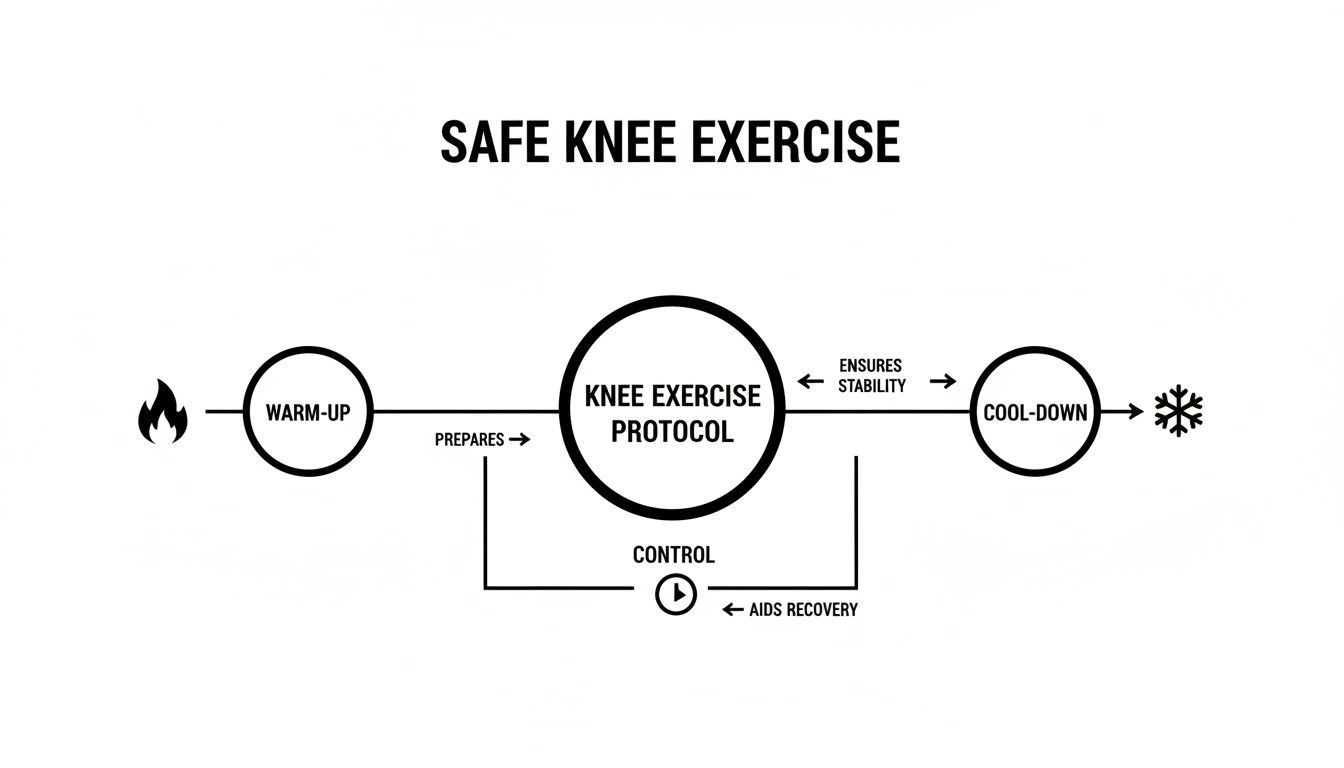
It all boils down to a simple but crucial three-part flow: warming up properly, maintaining slow and deliberate control during the exercise, and cooling down to kickstart recovery.
Straight Leg Raises
The straight leg raise is a fantastic foundational exercise. Why? Because it strengthens your quadriceps—the big muscles at the front of your thigh—without you having to bend your knee at all. This makes it a perfect, pain-free starting point for almost everyone.
- Get Set: Lie on your back on the floor or a firm bed. Bend one knee and plant your foot flat. Keep the other leg straight out in front of you.
- The Move: Squeeze the thigh muscle (quad) of your straight leg and slowly lift it up until it’s level with your other bent knee.
- Hold and Lower: Hold it there for 3–5 seconds, keeping that quad tight, then slowly lower it back down. Aim for 10–15 repetitions on each side.
- Make it easier: If lifting the leg is too much right now, just focus on tightening your quad without lifting. Hold that squeeze for 5 seconds, then release.
- Level it up: As you get stronger, add a light ankle weight (1–3 pounds) to increase the challenge.
Wall Sits
Wall sits are an incredible isometric exercise. That just means you build strength by holding a still position instead of moving. This is a brilliant way to fire up your quads, glutes, and hamstrings with very little stress on the knee joint itself.
- Get Set: Stand with your back flat against a wall. Your feet should be about shoulder-width apart and a foot or two away from the wall.
- The Move: Slowly slide your back down the wall until your knees are bent at about a 45-degree angle. Make sure your knees are tracking directly over your ankles, not drifting out in front of them.
- Hold it: Stay in this position for 20–30 seconds. Focus on keeping your core engaged and your weight pressed into your heels. Slide back up to the start.
- Make it easier: Don't slide down as far. Even a slight bend is enough to get those muscles working.
- Level it up: Gradually increase how long you hold the position or slide down into a deeper sit (but never go past a 90-degree angle).
Glute Bridges
Your glutes are absolute powerhouses for stabilizing your entire lower body—and that includes your knees. When your glutes are weak, it can cause your knees to cave inward, which is a common source of pain. Glute bridges hit them directly.
- Get Set: Lie on your back with your knees bent and your feet flat on the floor, about hip-width apart. Rest your arms by your sides.
- The Move: Squeeze your glutes and lift your hips off the floor until your body forms a straight line from your shoulders to your knees.
- Hold and Lower: Hold that squeeze at the top for 3 seconds, then slowly lower your hips back down. Aim for 10–15 repetitions.
- Make it easier: Don't lift your hips quite as high. The main goal here is to really feel your glutes doing the work.
- Level it up: Try the bridge with one leg extended straight out. This seriously ramps up the demand on the glute of your supporting leg.
Building a strong muscular support system is about more than just strength; you also have to maintain flexibility and range of motion. For more ideas, check out these essential mobility exercises for seniors.
Standing Hamstring Curls
The hamstrings run along the back of your thigh and are responsible for bending your knee. Keeping them strong helps create a balanced "push-pull" dynamic with your quads, which is key for a stable joint.
- Get Set: Stand up straight and hold onto a chair or wall for a bit of balance.
- The Move: Slowly bend one knee, bringing your heel up toward your butt. Focus on making the hamstring muscle do all the work in a smooth, controlled motion.
- Hold and Lower: Hold for 3–5 seconds at the top of the movement, then slowly lower your foot back to the ground. Go for 10–15 repetitions on each leg.
- Make it easier: If balancing is tricky, you can do this exercise lying on your stomach.
- Level it up: Add a light ankle weight for more resistance.
Key Insight: Consistency trumps intensity every time. Doing these simple exercises regularly is the real secret to building the muscular endurance that protects your knees for the long haul.
With 250 million people worldwide dealing with knee osteoarthritis, strengthening these key muscle groups isn't just about feeling better—it's a vital strategy for maintaining mobility. Knee-friendly routines that prioritize moves like seated leg lifts and wall sits have been shown to reduce the load on the joint by 15–25%. Better yet, studies show these simple programs have high adherence rates (around 70%), proving that consistent, targeted exercise can delay surgeries and dramatically improve quality of life.
The quadriceps, in particular, are the main shock absorbers for your knee. By focusing on them, you're building up your body's front line of defense. You can learn more about targeted quadriceps exercises to enhance your routine even further.
Low-Impact Cardio Workouts Your Knees Will Love
While strengthening exercises are busy building up that muscular support system around your knees, let's not forget their equally important counterpart: cardio. Good cardiovascular exercise helps you manage your weight—which means less daily load on your joints—and it improves circulation, which is fantastic for healing and overall health.
Of course, for anyone with cranky knees, the very thought of high-impact stuff like running can be cringe-inducing.
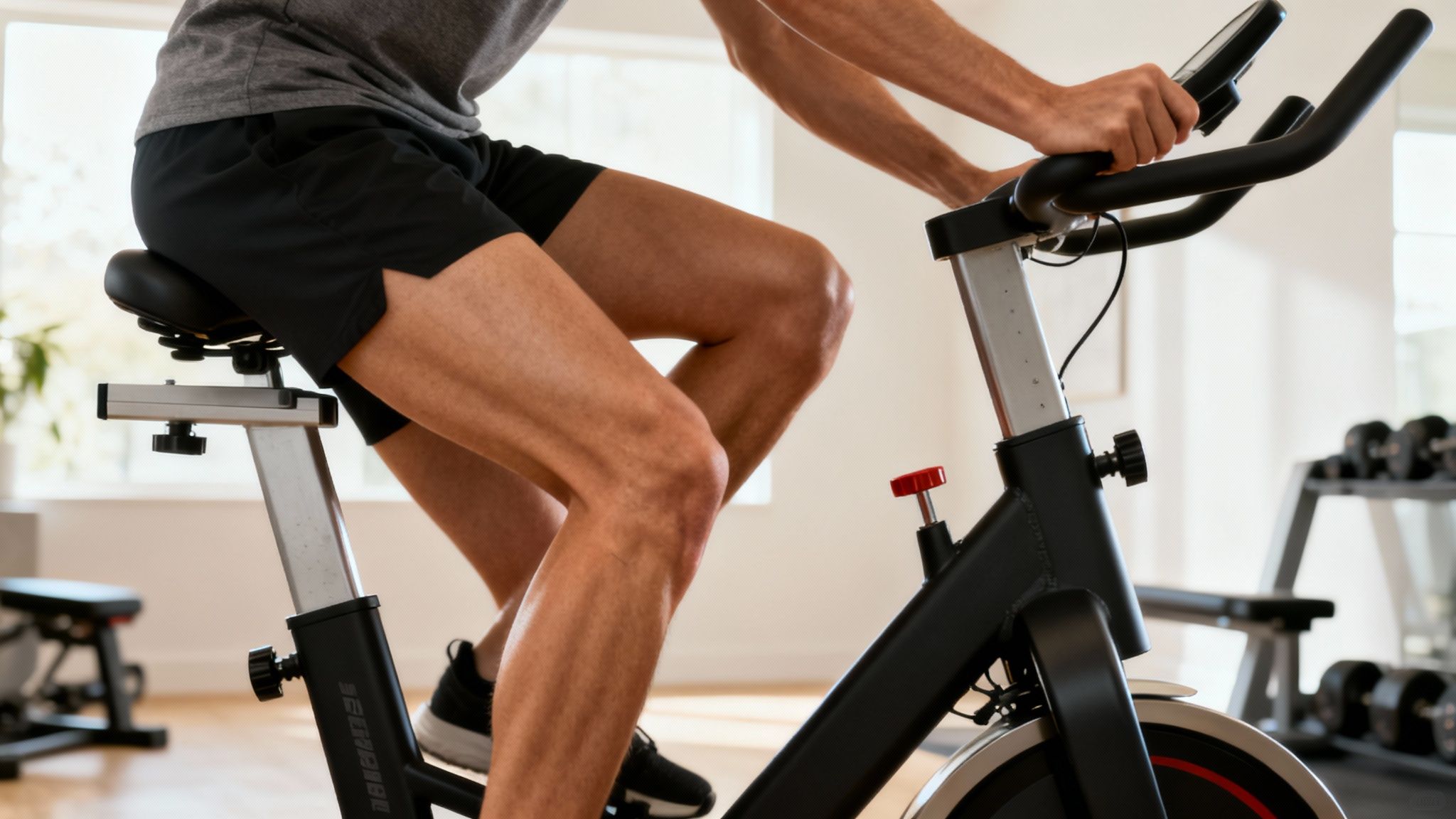
The good news? You absolutely do not have to pound the pavement to get your heart rate up. Low-impact cardio is your new best friend, giving you all the benefits without the jarring force that makes knees angry. These activities keep at least one foot on the ground (or pedal) at all times, creating a smooth, gliding motion that your joints will thank you for.
Swimming and Water Aerobics
Imagine exercising in an environment where the stress on your joints just… melts away. That’s pretty much what working out in the water feels like. The natural buoyancy of water supports your body weight, slashing the strain on your knees by as much as 90%.
This near-weightless setting is a game-changer, allowing for a much greater range of motion with far less pain. It’s an ideal starting point if you're dealing with significant discomfort.
- Swimming: Doing laps with strokes like the front crawl or backstroke provides an incredible full-body workout that is unbelievably gentle on the knees.
- Water Aerobics: These classes are a blast. You'll do movements like walking, jogging, or kicking against the water's resistance, which builds strength and cardiovascular endurance without any of the impact.
Stationary Cycling
The stationary bike is an absolute superstar in the world of knee-friendly cardio. It provides a rhythmic, non-weight-bearing workout that’s brilliant for strengthening your quads and hamstrings while also improving your joint mobility. There's no pounding here—just a smooth, circular motion.
Proper setup is everything, though. You need to adjust the seat height so your knee has a slight bend of about 10–15 degrees when your foot is at the very bottom of the pedal stroke. This sweet spot prevents you from overextending and puts minimal stress on the kneecap. For a deeper dive, a comprehensive guide to the stationary bike can help you nail your form and get the most out of every ride.
And if you want to take things outdoors, some people find that pain-free electric bike rides for knee pain are a fantastic option, offering an assisted-pedaling experience that lets you enjoy the fresh air.
A deep-dive analysis confirmed that moderate-intensity activity is the sweet spot for knee health, whereas going too hard can actually increase risk by 26%. This is exactly why activities like cycling and swimming—which fit perfectly within the WHO's recommendation of 150–300 minutes a week—are so often recommended.
The Elliptical Machine
The elliptical is another fantastic choice for a low-impact cardio session. The machine was literally designed to mimic the motion of running without the actual impact. Your feet stay planted on the pedals the whole time, creating a smooth, gliding path that’s way kinder to your knees than a treadmill.
Most ellipticals also come with moving handlebars, which is great because it lets you get your upper body in on the action for a more complete workout. This full-body engagement helps you burn more calories without having to crank up the speed or resistance to a level that might bother your knees.
When you're picking a machine, just remember that each has its own unique feel. A recumbent bike, for example, gives you back support and is often seen as the gentlest option of all. At the end of the day, the best machine is the one you actually enjoy using and can stick with consistently, without pain.
Your Weekly Plan for Consistent Knee Improvement
Knowing what exercises to do is one thing. Actually putting them into a consistent routine? That’s where the real change happens. A smart, well-structured plan is what turns good intentions into stronger, happier knees.
Think of this less like a strict prescription and more like a flexible template. The real goal is consistency, not crushing intensity. Showing up for shorter, doable workouts a few times a week will get you so much further than one monster session that leaves you limping for days. That’s how you build a habit that sticks.
The Anatomy of a Perfect Knee-Friendly Workout
Every single workout, whether it’s strength or cardio, needs to follow this simple three-part formula. This isn't just a friendly suggestion—it’s the golden rule for protecting your joints and getting the most out of your effort.
- Warm-Up (5-10 minutes): Don't even think about skipping this. A solid warm-up gets blood flowing to your muscles and lubricates the knee joint, basically telling it, "Hey, we're about to move." Think gentle marching in place, slow arm circles, and dynamic stretches like leg swings.
- Main Workout (20-30 minutes): This is the heart of your session. It might be your strengthening exercises (like those glute bridges and wall sits) or your low-impact cardio (hopping on a stationary bike or going for a swim).
- Cool-Down (5 minutes): This is how you gently transition your body back to rest. It’s your secret weapon against next-day stiffness and helps your muscles recover. Focus on gentle static stretches for your quads, hamstrings, and calves, holding each one for about 30 seconds.
Sample Weekly Workout Schedules
Here are a couple of sample plans to get you started—one for total beginners and another for when you’re ready to dial things up a notch. Notice how they mix different types of activity with crucial rest days. Rest is non-negotiable; it’s when your muscles actually repair and grow stronger.
Beginner Knee-Strengthening Plan
This plan is your perfect starting point, especially if you're new to this or coming back after a break. The whole idea is to build a solid foundation without putting your knees through the wringer.
| Day | Activity | Focus and Notes |
|---|---|---|
| Monday | Strength Training | Perform 2 sets of 10-12 reps of Straight Leg Raises, Glute Bridges, and Hamstring Curls. |
| Tuesday | Low-Impact Cardio | 20 minutes of stationary cycling or swimming at a comfortable, conversational pace. |
| Wednesday | Active Recovery | Gentle walking for 10-15 minutes or some light stretching. Motion is lotion for the joints! |
| Thursday | Strength Training | Repeat Monday's routine. If you feel good, try adding 1-2 more reps per set. |
| Friday | Low-Impact Cardio | 20-25 minutes on the elliptical or a brisk walk in the pool. |
| Saturday | Rest | Complete rest. Your body needs this to repair and get stronger. |
| Sunday | Active Recovery | Light activity like a short, leisurely walk or some gentle mobility work. |
Intermediate Knee-Strengthening Plan
Once the beginner plan starts to feel a bit too easy and you’re sailing through it without pain, it’s time to level up. With this schedule, we’ll bump up the volume and bring in a few new moves.
Key Insight: Progress isn't just about adding more weight. It can also mean holding a wall sit for longer, adding a few more reps to a set, or shortening your rest time. Your body is the ultimate guide—listen to it.
This plan builds on the strength you've already established.
- Monday & Thursday (Strength Days):
- Wall Sits: 3 sets, holding for 30-45 seconds.
- Glute Bridges: 3 sets of 15 reps.
- Straight Leg Raises: Add a light ankle weight (1-3 lbs) for 3 sets of 12 reps.
- Clamshells: 3 sets of 15 reps per side to really zero in on hip stability.
- Tuesday & Friday (Cardio Days):
- Push your cardio sessions to 30-40 minutes.
- Mix it up! Try some intervals on the stationary bike: 2 minutes of higher resistance followed by 3 minutes of easy pedaling.
- Wednesday, Saturday, & Sunday (Recovery Days):
- These days are all about active recovery or full-on rest. A longer walk, some quality time with a foam roller, or a dedicated stretching session are all fantastic options.
By giving your week this kind of structure, you create a rhythm your body can count on. It’s this balanced, steady approach that will turn these exercises into a powerful, lifelong strategy for staying active and keeping pain at bay.
Common Questions About Exercising with Bad Knees
Even with a solid game plan, it's totally normal to have a few lingering questions when you're working around knee pain. Let's clear up that uncertainty. This section tackles the most common questions we hear, so you can move forward with confidence.
Think of this as your quick-reference guide for those "what if" moments. Getting these key concerns sorted out will help you make smarter, safer decisions on your path to stronger, healthier knees.
Should I Rest or Exercise When My Knees Hurt?
This is the classic dilemma, and the answer isn't always a simple yes or no. You should absolutely rest if you're dealing with sharp, sudden pain or have obvious swelling. But for those chronic, dull aches from conditions like arthritis, the right kind of movement is often exactly what you need.
Inactivity can become a trap. When you stop moving, the muscles supporting your knee weaken, and the joint itself gets stiffer. This can actually make the pain cycle worse over time. The goal is gentle, controlled exercise, which gets blood flowing to the area and helps lubricate the joint.
The old saying "motion is lotion" is spot on when it comes to managing chronic knee discomfort. The golden rule is to always listen to your body—if a movement causes a sharp, "bad" pain, that's your cue to stop and rethink your approach.
What Exercises Should I Absolutely Avoid?
Protecting your knees really comes down to minimizing excessive stress and sudden, jarring impacts. As a general rule, you'll want to steer clear of high-impact activities that involve a lot of repetitive pounding, deep bending under a heavy load, or quick, twisting pivots.
Some common culprits to either avoid or modify include:
- High-Impact Running: The repetitive shock of pounding the pavement can be brutal on sensitive knee joints.
- Deep Squats and Lunges: Dropping way past a 90-degree angle in a squat or lunge can put a ton of pressure on the kneecap.
- High-Impact Aerobics: Think classes with a lot of jumping, hopping, or other jarring movements.
- Pivoting Sports: Activities like basketball or tennis that demand rapid changes in direction can put a lot of torque on the knee joint.
This isn't about eliminating every challenge. It's about focusing on controlled movements that you can perform within a pain-free range of motion.
How Long Until I See Improvement in My Knee Pain?
Patience and consistency are your two best friends on this journey. While some people might feel minor improvements in stability or a bit less stiffness within a few weeks, significant and lasting pain relief usually takes 6 to 8 weeks of sticking to a consistent routine.
Progress is gradual, not a giant leap. Instead of looking for a dramatic overnight change, learn to appreciate the small victories. Maybe you held a wall sit for ten seconds longer than last week, or you walked for an extra five minutes without any ache.
These small wins are real proof that you're getting stronger. Remember, sticking with your plan is the single most important factor for long-term success.
Can a Knee Brace Help During Exercise?
A knee brace can be a useful tool, but it’s important to see it for what it is: a support system, not a cure. A simple compression sleeve can offer a feeling of stability and warmth, which might boost your confidence and make movement feel more secure.
More heavy-duty, structured braces are usually for specific injuries and should always be recommended by a doctor or physical therapist. The crucial thing to remember is that a brace should never be a substitute for building up your own muscle strength.
Your ultimate goal is to turn your muscles—your quads, glutes, and hamstrings—into your body's own "natural brace." That's what creates true, lasting stability. For more on how cardio fits into the big picture, our guide on everything you need to know about cardio offers some great tips on choosing activities that support your joints.
Ready to stop guessing and start a plan that actually gets you? The Zing Coach app uses AI to build personalized workouts that adapt to your fitness level and goals, ensuring every exercise is safe and effective for your knees. Get a smart, adaptive plan that helps you build strength and confidence, one workout at a time. Discover your personalized plan at Zing Coach!
Share this article


Authors