Discover a realistic 30 minute workout plan designed for real results. Build strength and burn fat with efficient workouts for any fitness level.
Forget everything you’ve heard about needing to spend hours in the gym to get results. A solid 30 minute workout plan is more than enough to shed fat, build real strength, and seriously improve your conditioning. It all comes down to intensity and smart exercise selection, not just punching the clock.
Why 30 Minutes Is Enough to Get Real Results
Let's cut through the noise: you absolutely do not need to live in the gym to transform your body. This idea that longer workouts are automatically better is one of the biggest fitness myths out there, and frankly, it keeps a lot of people from ever getting started.
The truth is, a focused, high-intensity 30 minute workout can blow a longer, unfocused session out of the water. The secret isn't how much time you spend, but the quality of the effort you put into that time. When you really push yourself in a shorter window, you trigger some powerful physiological responses that drive real, lasting change.
The Power of Intensity Over Duration
Think of your workout like a conversation. A short, impactful statement is always more memorable than a long, rambling story, right? The same thing goes for exercise. By packing your effort into a condensed period, you force your body to adapt way more efficiently.
This isn't just bro-science; it's backed by a concept called Excess Post-exercise Oxygen Consumption (EPOC), better known as the "afterburn effect." High-intensity exercise basically creates a metabolic disruption that your body has to work hard to fix, meaning you keep burning calories at a higher rate for hours after you've finished your workout.
A 30-minute session that leaves you breathless can crank up your metabolism for up to 24-36 hours. Your body essentially becomes a more efficient fat-burning machine long after you’ve left the gym. That's metabolic efficiency at its best.
Hormonal Response and Muscle Growth
Another huge piece of the puzzle is focusing on compound movements—we’re talking squats, deadlifts, and overhead presses. These are the big, demanding exercises that work multiple muscle groups at once.
When you pack these moves into a 30-minute window, you do more than just build muscle; you trigger a massive hormonal response. This stimulates the release of crucial growth hormones like testosterone and human growth hormone (HGH). These are your body's natural tools for repairing and building lean muscle. You get all the hormonal benefits you need for a stronger physique without the prolonged stress of a 90-minute marathon session.
Mental and Physical Health Benefits
Beyond just looking better, the consistency that a 30-minute routine makes possible is a game-changer for your well-being. It’s a habit you can actually stick with, which gets rid of the friction that causes so many people to give up.
Hitting the benchmark of 150 minutes of moderate-intensity exercise a week—which is just five 30-minute sessions—is a well-established standard for good health. It dramatically cuts your risk of chronic diseases, boosts your self-esteem, and just plain makes you feel better. A massive review of 30 years of studies found that 89% showed a positive link between exercise and mental health, with effects comparable to therapy for treating depression. You can dive deeper into the connection between exercise and mental wellness on williamjames.edu.
The Building Blocks of an Effective 30-Minute Workout
A great workout isn’t just a random list of exercises thrown together; it's a smart, focused plan built to make every single second count. To get real results from a 30-minute workout plan, you need to know what makes it tick. Think of it like having the right ingredients and a solid recipe before you start cooking.
First up, the non-negotiables: your warm-up and cool-down. It's a classic mistake to skip these, but doing so is a fast track to injury and slow recovery. A good dynamic warm-up gets your body ready for action, while a cool-down eases you back to a resting state, jumpstarting the repair process.
In just half an hour, you're working toward some serious health wins.
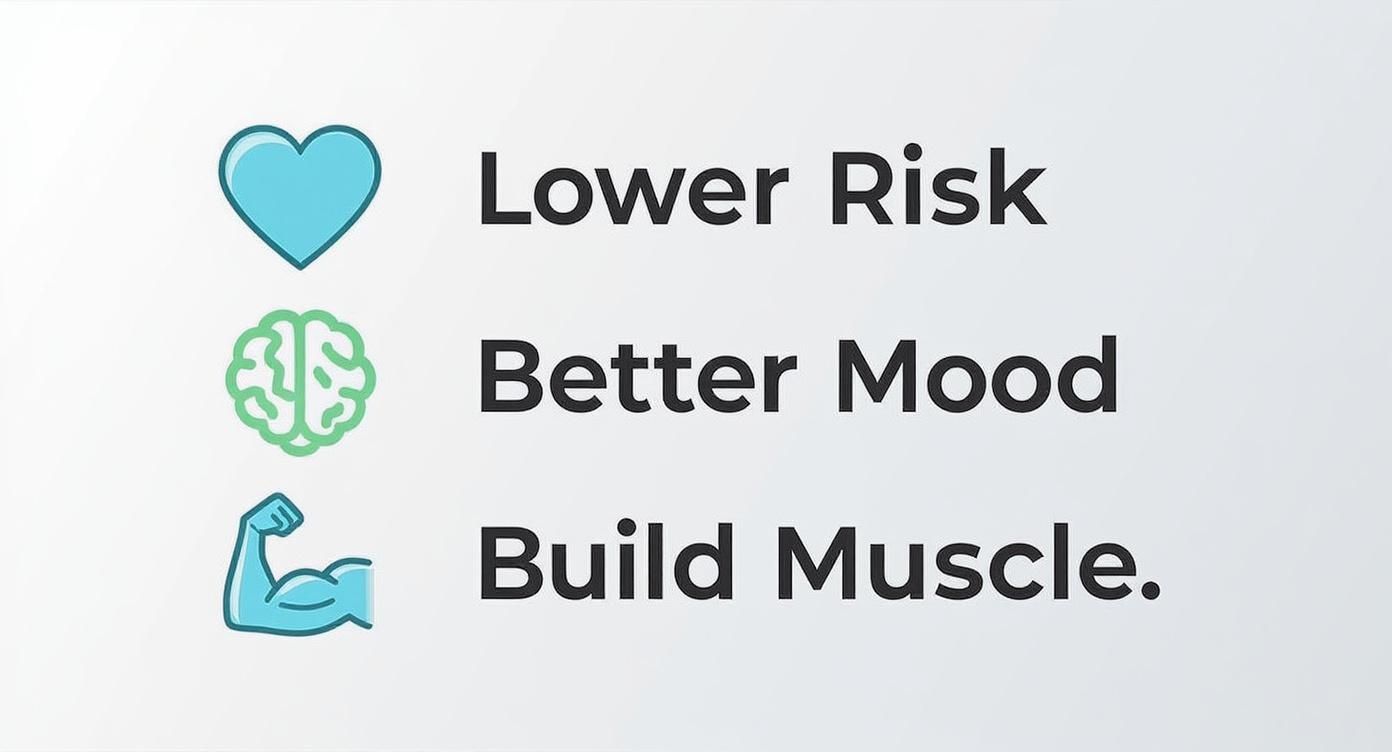
As you can see, these quick sessions are powerful tools for boosting everything from your heart health and mood to building lean muscle.
Choosing Your 30-Minute Workout Structure
With the clock ticking, how you structure your workout is everything. Different formats serve different goals, whether you’re trying to torch calories or build raw strength. The trick is to match the method to your mission.
A few structures work especially well for short, intense sessions:
- Circuits: You move from one exercise to the next with almost no rest. This is a brilliant strategy for conditioning and fat loss because it keeps your heart rate soaring. A classic circuit might hit a push, a pull, a squat, and a core move.
- Supersets: This means pairing two exercises back-to-back. You can target opposing muscle groups (like biceps and triceps) or hit the same muscle twice for a serious burn. Supersets are a fantastic, time-efficient way to crank up the volume and metabolic stress.
- AMRAP (As Many Rounds/Raps as Possible): You set a timer and crush as many rounds of a circuit as you can before time’s up. This format is a beast for building work capacity and mental grit, pushing you to hold onto your intensity.
Think of these structures as different gears on a bike. Circuits are your steady-state gear for endurance, supersets are for climbing hills (building strength), and AMRAPs are your all-out sprint to the finish line.
The table below breaks down these popular formats to help you pick the right one for you.
Choosing Your 30-Minute Workout Structure
| Workout Structure | Best For | Typical Format | Pros | Cons |
|---|---|---|---|---|
| Circuit Training | Conditioning, fat loss, full-body workouts | 4-8 exercises performed back-to-back with minimal rest. Repeat the circuit 2-4 times. | Highly time-efficient, keeps heart rate elevated, improves cardiovascular health. | Can be difficult to lift heavy; form may suffer from fatigue. |
| Supersets | Muscle growth (hypertrophy), increasing workout density | Two exercises performed back-to-back. Can be opposing muscles (e.g., bicep curl/tricep extension) or the same muscle. | Increases volume quickly, creates a big metabolic response, saves time. | Requires careful exercise pairing; can be taxing on the target muscles. |
| AMRAP | Work capacity, mental toughness, metabolic conditioning | A set number of exercises performed for as many rounds or reps as possible within a fixed time (e.g., 15 minutes). | Excellent for tracking progress, pushes intensity, builds endurance. | Pacing is key; high risk of form breakdown if you go too fast too soon. |
Ultimately, the best structure is the one that aligns with your specific goal and keeps you engaged. Don't be afraid to mix and match them to keep your workouts fresh and challenging.
Understanding Your Training Variables
Once you’ve picked a structure, the real magic comes from tweaking the training variables. Small adjustments to reps, sets, tempo, and rest periods can completely transform the effect of your workout. These are the dials you turn to fine-tune your progress.
For instance, someone chasing strength will stick to lower reps (like 5–8 reps) with heavier weight and take longer rests (60–90 seconds) to fully recover between sets. This approach is all about lifting maximal loads to trigger muscle fiber growth.
On the flip side, if your goal is endurance or fat loss, you’ll want higher reps (12–20 reps) with lighter weight and much shorter rest periods (30–45 seconds). This keeps the intensity high and puts your cardiovascular system to the test.
Knowing how to play with these variables is the key to creating a program that grows with you. It’s this kind of intelligent design that underpins an effective plan—a core principle of how we build personalized programs at Zing Coach. To see how we apply this science, check out our AI-powered coaching methodology.
By marrying a smart structure with the right variables, you can create an endless variety of effective and fun 30-minute sessions that deliver big results without taking over your day.
Your Go-To Full Body Strength Plan
This is where the rubber meets the road. Let's turn theory into a practical blueprint for building total-body strength and lean muscle, even when you're racing against the clock. The secret? Focusing on the big, impactful compound exercises—think squats, presses, and rows—that give you the most bang for your buck by hitting multiple muscle groups at once.
This 30 minute workout plan is all about efficiency. We're going to hit every major muscle group to kickstart growth and fire up your metabolism. It’s about prioritizing the movements that deliver the biggest return on your precious time.

The Core Workout Template
When time is short, structure is everything. This template gives you a balanced, full-body approach, making sure no muscle group gets left behind.
We’ll organize the session into pairs of exercises, known as supersets, to keep the intensity high and cut down on wasted time. The idea is simple: you perform a set of Exercise A, take a short rest, then hit a set of Exercise B, rest again, and repeat that cycle for all your sets.
Here’s what that looks like:
- Superset 1: Lower Body Push (e.g., Squats) & Upper Body Pull (e.g., Rows)
- Superset 2: Lower Body Hinge (e.g., Deadlifts) & Upper Body Push (e.g., Bench Press)
- Finisher: Core or Accessory Movement (e.g., Plank or Bicep Curls)
This method lets you work opposing muscle groups, allowing one area to recover while the other is working hard. It’s a classic, time-tested strategy for building strength efficiently.
Sets, Reps, and Rest Periods
For building both muscle and strength, the sweet spot is usually 3 sets of 8-12 repetitions for each exercise. This rep range is perfect for triggering hypertrophy (that’s the science-y term for muscle growth) while still letting you lift a weight that feels genuinely challenging.
Your rest periods need to be just as strategic:
- Rest for 60 seconds after each individual set within a superset.
- Rest for 90-120 seconds after you’ve finished all the sets for one superset, right before you move on to the next pair.
This gives you just enough time to catch your breath and mentally prepare for the next lift without letting your heart rate drop too much.
How to Select the Right Weight
Figuring out the right weight can feel intimidating, but it's crucial. You want to pick a weight where the last two reps of every set are tough to finish but still doable with good form. This is what we call an RPE (Rate of Perceived Exertion) of about 8 out of 10.
If you’re breezing through all 12 reps, the weight is too light. On the flip side, if you can't manage at least 8 solid reps, it’s too heavy. Don't be afraid to adjust the weight mid-workout to find that sweet spot. For more tips on this, our guide on strength training for weight loss dives deeper into optimizing your lifts.
Quick tip: The weight should challenge you, but never at the expense of your form. Quality always beats quantity. Lifting with your ego is the fastest way to get sidelined with an injury.
And don’t just take my word for it. The science backs this up. One 8-week study showed that just two 30-minute full-body strength sessions a week led to major gains in muscle size and strength. It proves that high intensity and progressive overload are what really move the needle.
Modifications for Every Fitness Level
This plan is built to grow with you. Whether you're just starting out or a seasoned lifter coming back, you can tweak it to meet you where you are.
For Beginners:
- Focus on Bodyweight: Before you add weight, you have to master the movement. Start with bodyweight squats, incline push-ups (using a bench or wall), and inverted rows.
- Go for Higher Reps: Aim for a 12-15 rep range. This helps build muscular endurance and lets you really lock in your form.
For Advanced Lifters:
- Increase the Weight: The most direct path to progress. Add more weight to the bar.
- Cut Rest Time: Drop your rest periods to 45 seconds to ramp up the metabolic demand of the workout.
- Add Intensity Techniques: Try things like pause reps (holding the hardest part of the lift for a second) or slow eccentrics (slowing down the lowering phase of the movement).
This adaptability is what makes it a sustainable 30 minute workout plan for the long haul. And of course, to get the best results from your hard work, make sure your nutrition is on point. Getting enough protein is key for muscle repair and growth; you can find some great ideas for high protein plant-based meals to support your efforts.
The High-Energy Fat Loss and Conditioning Plan
If your main goal is to torch calories, skyrocket your cardio fitness, and build some serious athletic endurance, this high-energy 30 minute workout plan is about to become your new best friend. It’s all built around high-intensity interval training (HIIT) and metabolic conditioning—two proven methods for getting maximum results in a short amount of time.
The whole approach hinges on strategic work-to-rest ratios. You’ll go all-out with intense bursts of exercise, followed by short, controlled recovery periods. This keeps your heart rate jacked up, sends your metabolism into overdrive, and kicks off that "afterburn effect" we mentioned earlier.

The Metabolic Conditioning Circuit
Metabolic conditioning, or MetCon for short, is all about pushing your body's energy systems to become more efficient. A well-designed circuit is the perfect way to put this into practice.
The idea is simple: complete as many rounds of a circuit as you can within a set time. This format is called an AMRAP (As Many Rounds As Possible), and it's fantastic for pushing both your physical and mental limits.
Sample 15-Minute AMRAP Circuit:
- 8 Kettlebell Swings: A true powerhouse move for building explosive hip strength and jacking up your heart rate.
- 10 Burpees: The classic love-to-hate exercise. It’s the ultimate full-body conditioner that leaves no muscle behind.
- 12 Goblet Squats: A great squat variation that hammers your legs while also firing up your core and upper body.
Just set a timer for 15 minutes and cycle through these three exercises with as little rest as you can manage. Your score is the total number of full rounds plus any extra reps you completed. What’s brilliant about this is that it’s self-regulating—as you get fitter, you’ll naturally squeeze in more work in the same timeframe.
This kind of training does more than just burn calories while you're moving. It jacks up your metabolic rate for hours afterward, essentially turning your body into a more efficient fat-burning machine 24/7.
Understanding Work-to-Rest Ratios
If the free-for-all AMRAP style isn't for you, a more structured interval approach works just as well. The magic is in balancing the work and rest periods. One of the most common and effective ratios I've seen is 2:1, where you work for twice as long as you rest.
A classic example is the Tabata protocol, but for a 30-minute session, a more sustainable version is 40 seconds of work followed by 20 seconds of rest.
You can apply this to pretty much any exercise. Pick four or five movements, run through them as a circuit, and stick to that 40/20 split for a set number of rounds. This keeps the intensity high but gives you just enough of a breather to gear up for the next push. For anyone putting in this kind of high-energy work, proper fueling is key. It's worth looking into the best supplements for endurance athletes to support both performance and recovery.
The Low-Impact Option: The 12-3-30 Workout
Look, not everyone can or should be doing high-impact stuff like burpees and box jumps. But that absolutely doesn't mean you can't get a killer conditioning session in. Enter the now-famous '12-3-30' treadmill routine—a surprisingly potent, joint-friendly tool for fat loss.
The formula couldn’t be simpler:
- Set the treadmill incline to 12%.
- Set the speed to 3 mph.
- Walk for 30 minutes.
It might sound too easy on paper, but that steep incline completely transforms a simple walk into a serious cardiovascular and lower-body challenge. It’s a fantastic way to build your aerobic base and burn a ton of calories without pounding your joints into dust. If you want to explore more ways to boost your cardio, our guide on everything you need to know about cardio has you covered.
Recent research has started to back up just how effective this is. One study analyzing the workout found that while it burns energy at a lower rate than running, it pulls a much higher percentage of those calories from fat—around 40.56%, to be exact. The science behind these unique metabolic patterns shows why it’s become such a go-to for people specifically targeting fat loss in their 30 minute workout plan.
Making Your Plan Work for the Long Haul
Having the perfect 30 minute workout plan on paper is one thing, but making it stick in the real world is another game entirely. The real marker of success isn't how you feel after week one—it's about building a genuine habit that delivers results months, and even years, from now.
That means learning how to adapt, how to push yourself intelligently, and how to stay in the game when your initial burst of motivation fades.
The secret to making gains that last is a principle called progressive overload. Simply put, to get stronger and fitter, you have to consistently make your workouts a little bit harder. But that doesn't just mean piling more plates on the bar. There are smarter ways to go about it.
Smart Ways to Progress Your Workouts
Progressive overload is more of an art than a science. When a workout starts to feel comfortable, that's your cue to turn up the dial. Instead of defaulting to heavier weights, try one of these strategies to keep your body adapting.
- Add Reps or Sets: If you managed 10 reps last week, shoot for 12 this week with the same weight. Once you can comfortably hit the top of your target rep range (like 12-15 reps), then you can think about going heavier.
- Cut Down Rest Time: Shaving just 10-15 seconds off your rest periods between sets is a simple trick that significantly ramps up the intensity and your conditioning without changing a single exercise.
- Master Your Form: Progress isn't always about more, more, more. Sometimes, it's about better. Slowing down the lowering phase of a lift (the eccentric) or adding a pause at the bottom of a squat forces your muscles to work harder through every inch of the movement.
- Increase Training Density: This just means doing more work in the same amount of time. If you finished a circuit in 15 minutes, challenge yourself to get it done in 14 minutes next time. Or see if you can squeeze in one more round before the clock runs out.
This steady, gradual increase in demand is what tells your body it needs to get stronger.
Listening to Your Body and Avoiding Burnout
Pushing yourself is crucial, but running yourself into the ground is just plain counterproductive. Burnout is the number one killer of consistency. That's why learning to read your body's signals is just as important as perfecting your squat form.
Some days, you'll walk into the gym feeling like you can take on the world. Go for it. But other days, stress, poor sleep, or just life will leave you feeling drained. On those days, true strength is having the wisdom to ease up.
Listening to your body isn’t a sign of weakness; it’s a sign of training intelligence. A planned deload week or a lighter session when you're feeling drained is an investment in your long-term consistency and health.
This doesn't mean you skip your workout. It just means you adjust. Swap out heavy deadlifts for some lighter kettlebell swings. Turn a high-intensity interval session into a brisk walk on an incline. Showing up and doing something will always be better than doing nothing because you felt too wiped to follow the plan perfectly.
Consistency beats perfection every single time. For more tips on making your routine stick, check out our guide on forming habits that stick.
How to Mix and Match for a Balanced Week
To get the most out of your 30-minute sessions, you want a good mix of strength and conditioning. A well-rounded week prevents burnout, reduces injury risk, and ensures you're building a truly capable body, not just one that looks good.
Here's what a sample week might look like, blending different workout types to keep things effective and interesting.
Sample Weekly 30-Minute Workout Schedule
| Day | Workout Focus | Example Session | Notes |
|---|---|---|---|
| Monday | Full-Body Strength | Session A (Squats, Push-ups) | Start the week strong with compound lifts. |
| Tuesday | Conditioning/HIIT | Session C (Intervals) | Get your heart rate up and boost your metabolism. |
| Wednesday | Active Recovery | Light cardio or mobility | A 30-minute walk, foam rolling, or stretching. |
| Thursday | Full-Body Strength | Session B (Deadlifts, Rows) | Focus on the posterior chain. |
| Friday | Conditioning/HIIT | Session D (Circuit) | Challenge your endurance with a different format. |
| Saturday | Active Recovery | Your choice | Play a sport, go for a hike, or do some yoga. |
| Sunday | Full Rest | - | Let your body recover and rebuild. |
This structure gives you two solid strength days and two conditioning days, with plenty of time for recovery in between. It's a sustainable rhythm that you can adapt based on how you feel and what your schedule allows.
Adapting Your Workout to Any Environment
Life happens. You might be on a business trip, the gym might be mobbed, or maybe you just can't get out of the house. A plan that falls apart the second you're away from your usual equipment isn't a good plan.
The key is to be flexible. Don't get fixated on a specific exercise; focus on the movement pattern you're trying to train.
- No Barbell? Dumbbells or kettlebells are perfect substitutes for squats, presses, and rows.
- No Dumbbells? Never underestimate resistance bands. They can provide a serious challenge for almost any exercise you can think of.
- No Equipment at All? Bodyweight is your gym. You can always get a killer workout with push-up variations, single-leg squats, glute bridges, and inverted rows using a sturdy table.
A push-up trains the same muscles as a bench press. A single-leg Romanian deadlift hits your hamstrings and glutes just like a barbell RDL. Knowing how to make these simple swaps means you never have an excuse to miss a session. This adaptability is what turns a workout plan into a lifelong fitness tool.
Common Questions About 30-Minute Workouts
Jumping into any new fitness routine is going to bring up some questions. It's only natural. When you're committing to a 30-minute workout plan, you want to be damn sure you're doing it right to get the results you're after.
Let's tackle some of the most common uncertainties I hear from clients. Getting these details right can be the difference between spinning your wheels and making real, measurable progress.
How Many Times a Week Should I Train?
For most people, the sweet spot is three to five 30-minute sessions per week. This hits that perfect balance of providing enough stimulus to actually see change—whether that's muscle growth or fat loss—while still giving your body the time it needs to recover.
Think of it like this:
- For fat loss and conditioning: Aim for four to five sessions. Keeping the frequency high helps maximize your weekly calorie burn and keeps your metabolism fired up.
- For strength and muscle gain: Three to four focused sessions are usually plenty. Remember, muscle is built during recovery, so giving your body that downtime is just as important as the lifting itself.
At the end of the day, consistency is king. It's way better to lock in three solid workouts every single week than to go hard with five one week and then burn out and do none the next.
What Should I Eat to Support My Goals?
You've heard it a million times, but it's true: you can't out-train a bad diet. Nutrition is the other half of the equation, providing the fuel for your workouts and the raw materials for recovery.
While everyone's needs are a bit different, a few principles are universal. Prioritize lean protein to repair and build muscle, get in some complex carbs for sustained energy, and don't forget healthy fats for hormone function.
Timing can also be a game-changer. A small, easily digestible snack with carbs and protein about an hour before your workout can give you that extra gear to push harder.
For fat loss, a moderate calorie deficit is the goal. But don't slash calories too aggressively—that's a surefire way to kill your energy levels and sabotage any muscle-building potential. A great way to see what's working is to track your body composition. You can learn more about how to measure body fat percentage to get a much clearer picture of your results beyond what the scale says.
Can You Really Build Muscle in 30 Minutes?
Absolutely, but there's a catch: you have to bring the intensity. Building muscle, or hypertrophy, isn't about how long you're in the gym. It's about the quality of the work you put in during that time.
To trigger muscle growth in a short session, you need to zero in on two things:
- Mechanical Tension: This just means lifting a weight that genuinely challenges you. You should be hitting that 8-15 rep range where the last couple of reps are a real struggle to complete with good form.
- Progressive Overload: You have to consistently give your body a reason to adapt. That means finding ways to make your workouts harder over time, whether it's by lifting heavier, doing more reps, or cutting down your rest periods.
A well-designed 30-minute strength session that pushes your muscles close to failure is far more effective for building muscle than coasting through an hour-long workout. It’s the effort, not the clock, that drives growth.
How Do I Know When to Take a Rest Day?
Learning to listen to your body is a skill every lifter needs to develop. You have to know the difference between being a little tired and being genuinely overworked. Pushing through fatigue is part of the game, but ignoring the signs of overtraining is a fast track to injury and burnout.
Your body sends pretty clear signals when it needs a break. Keep an eye out for:
- Persistent muscle soreness that doesn't go away after a day or two.
- A noticeable drop in your performance or strength.
- Trouble sleeping or feeling unusually irritable.
These are all your body's way of telling you it needs to recover. Remember, rest isn't a sign of weakness; it's a critical, strategic part of any effective 30-minute workout plan.
Ready to stop guessing and start training with a plan that adapts to you? The Zing Coach app uses AI to build personalized workouts based on your goals, equipment, and fitness level. Get real-time form correction, track your progress automatically, and let us handle the planning so you can focus on getting results. Download Zing Coach and start your personalized plan today!
Share this article


Authors