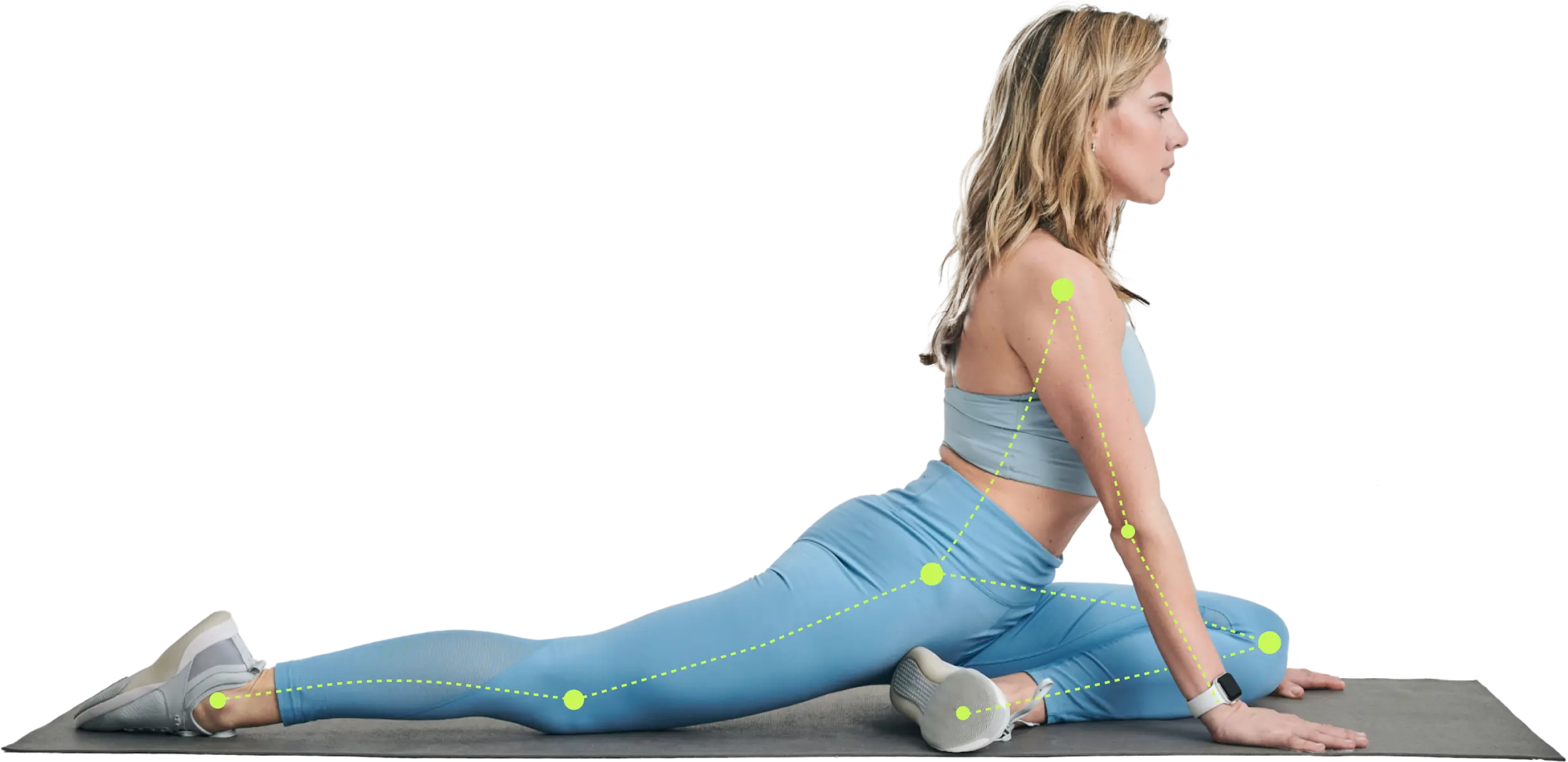
Learn how to warm up before strength training with proven routines. Boost performance, lift heavier, and prevent injuries with our expert guide.
Skipping your warm-up is like trying to drive a performance car in freezing weather without letting the engine warm up first—it’s clunky, inefficient, and you’re just asking for something to break. A proper warm-up primes your body for what’s to come, and that directly translates to better lifts and a much lower risk of injury. This isn't just about feeling loose; it's about unlocking your real strength potential from the very first rep.
Why Your Warm-Up Is a Performance Multiplier
Jumping straight into a heavy set is a huge missed opportunity. So many lifters treat the warm-up like a chore, something to rush through to "get to the good stuff." But in reality, a structured warm-up is the very foundation of a great session. Think of it as the bridge between being at rest and being ready to perform.
Imagine your muscles are like rubber bands. If they've been cold and inactive from sitting all day, suddenly asking them to stretch and contract under a heavy load is a recipe for disaster. A dedicated warm-up gradually increases your muscle temperature, which improves their elasticity and makes them far less susceptible to strains or tears.
The Science of a Solid Warm-Up
Beyond just making your muscles more pliable, a good warm-up ignites that all-important mind-muscle connection. It literally enhances nerve signaling, meaning your brain sends stronger, faster signals to your muscles. The result? More powerful contractions.
It also gets the synovial fluid moving in your joints. This is your body's natural lubricant, allowing your knees, hips, and shoulders to move smoothly and safely under load.
These benefits aren't just theoretical; they produce real, measurable results. In fact, a landmark analysis of 32 different studies confirmed that warming up improved performance in 79% of the criteria they looked at. The gains ranged from small but meaningful improvements to significant boosts of up to 20% in strength-based tasks.
The biggest mistake you can make is jumping straight to your heavy working sets. A warm-up isn't wasted time; it's an investment in the quality and safety of every lift that follows.
This preparation also extends beyond just your muscles and joints. Making sure you're wearing suitable gym clothes that don't restrict your movement is part of setting yourself up for success. It’s also the time to mentally lock in and decide on your session's structure, a key detail our guide on cardio before or after weights can help clarify.
Ultimately, a great warm-up sets the tone for a powerful, focused, and effective workout.
The Four Pillars of a Performance Warm Up
A good warm up is more than just a few lazy arm circles and a half-hearted quad stretch. It's a deliberate, systematic process designed to get your body ready to perform at its peak. Forget random movements; think of it as a four-part progression.
Each phase builds on the last, ensuring every system—from your heart to your joints to your nervous system—is primed and ready for the demands of a tough strength session. This is the difference between feeling stiff and clunky on your first set and feeling powerful from the very first rep.
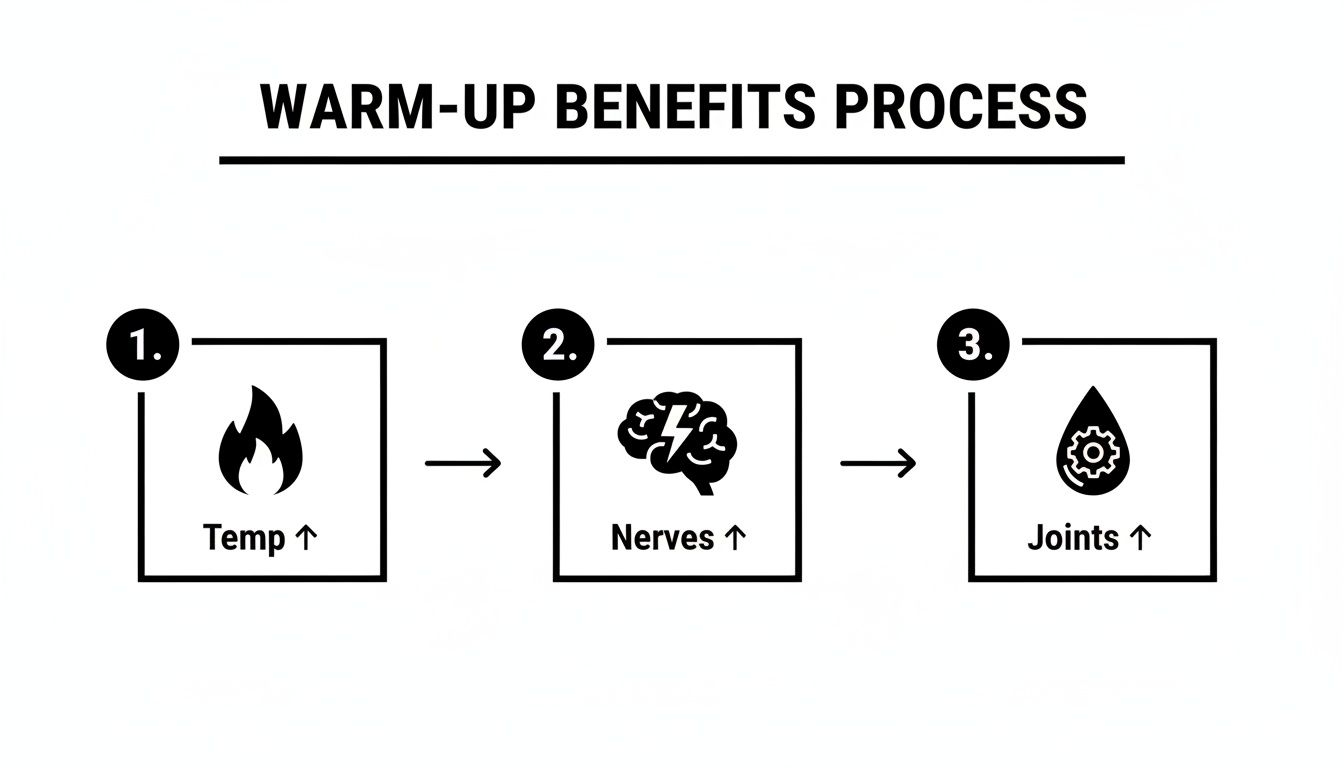
As you move through the process, you're systematically boosting muscle temperature, sharpening the signals from your brain to your muscles, and improving joint lubrication. The result? Safer, stronger lifts.
Here's a quick breakdown of the four essential phases that make up a truly effective warm-up.
The Four Pillars of a Performance Warm Up
| Phase | Purpose | Example Exercises |
|---|---|---|
| 1. General Pulse Raiser | Increase core temperature and blood flow to the muscles. | 3-5 minutes of light cardio like rowing, cycling, or jumping jacks. |
| 2. Dynamic Mobility | Actively move joints through their full range of motion. | Leg swings, arm circles, cat-cow, hip CARs (controlled articular rotations). |
| 3. Specific Activation | "Wake up" the key muscles for your main lifts. | Banded glute bridges, lateral band walks, bird-dogs, face pulls. |
| 4. Movement-Specific Priming | Rehearse the main lift with light weight to groove the pattern. | Empty barbell squats, light kettlebell swings, bodyweight push-ups. |
Let's dig into what each of these phases actually looks like in practice.
Phase 1: General Pulse Raiser
First things first, you need to get your blood flowing and raise your body temperature. This isn't a full-blown cardio session; it's just a gentle ramp-up. Spend just 3-5 minutes on any low-impact activity that gets your heart rate up slightly.
This initial step warms up your muscle tissue, making it more pliable and much less prone to injury. Think of it as taking the chill off a rubber band before you try to stretch it.
- Rowing Machine: A fantastic full-body option that gently engages your back, legs, and arms without impact.
- Stationary Bike: Perfect for getting the legs firing without stressing your joints.
- Jumping Jacks: A classic for a reason—it’s simple, effective, and you can do it anywhere.
Phase 2: Dynamic Mobility
With a little heat in the system, it's time to unlock your joints and improve your range of motion. This is where dynamic stretching comes in. Forget the old-school static stretching (holding a pose for 30+ seconds); we now know that can actually zap your power output before a lift.
Instead, your focus here should be on fluid, controlled movements that take your joints through their full, intended range. This process helps lubricate the joints with synovial fluid, getting them ready to handle heavy loads.
Coach's Tip: People often confuse flexibility with mobility. Flexibility is passive—how far a muscle can be stretched. Mobility is active—your ability to control a joint through its range of motion. For lifting, mobility is king.
Phase 3: Specific Activation
Now we need to wake up the specific muscles you’ll be relying on for your main lifts. This step is especially important for muscles that tend to get "sleepy" from sitting all day, like your glutes and the small stabilizers in your rotator cuffs.
This phase is all about creating a strong mind-muscle connection. By using light resistance from bands or just your bodyweight, you can fire up the exact stabilizers and prime movers you'll need for the workout ahead.
For example, on a heavy squat day, your activation work might include:
- Banded Glute Bridges: To get your glutes firing.
- Banded Lateral Walks: To activate the glute medius for better knee stability.
- Bird-Dogs: To engage your core and promote a stable spine under load.
Phase 4: Movement-Specific Priming
The final piece of the puzzle is to actually rehearse the exact movement pattern of your main lift for the day. This is where you grab an empty barbell or a very light weight and just groove the technique. It’s your chance to dial in your form and prime your central nervous system for the heavier sets to come.
These "ramp-up" sets are what bridge the gap between being generally warm and being specifically ready to lift heavy, safely. To see how these movements fit into a complete routine, explore our library of stretching workouts and find a flow that works for you.
Your Time-Based Warm Up Playbook
Look, life gets hectic. We've all been there—staring at the clock, realizing the biggest challenge isn't the workout itself, but just finding the time for it. But cutting your warm up short, or worse, skipping it entirely, is a classic mistake that tanks your performance and opens the door to injury.
The answer isn’t to ditch the warm up. It's to have a smart plan that flexes with the time you’ve got.
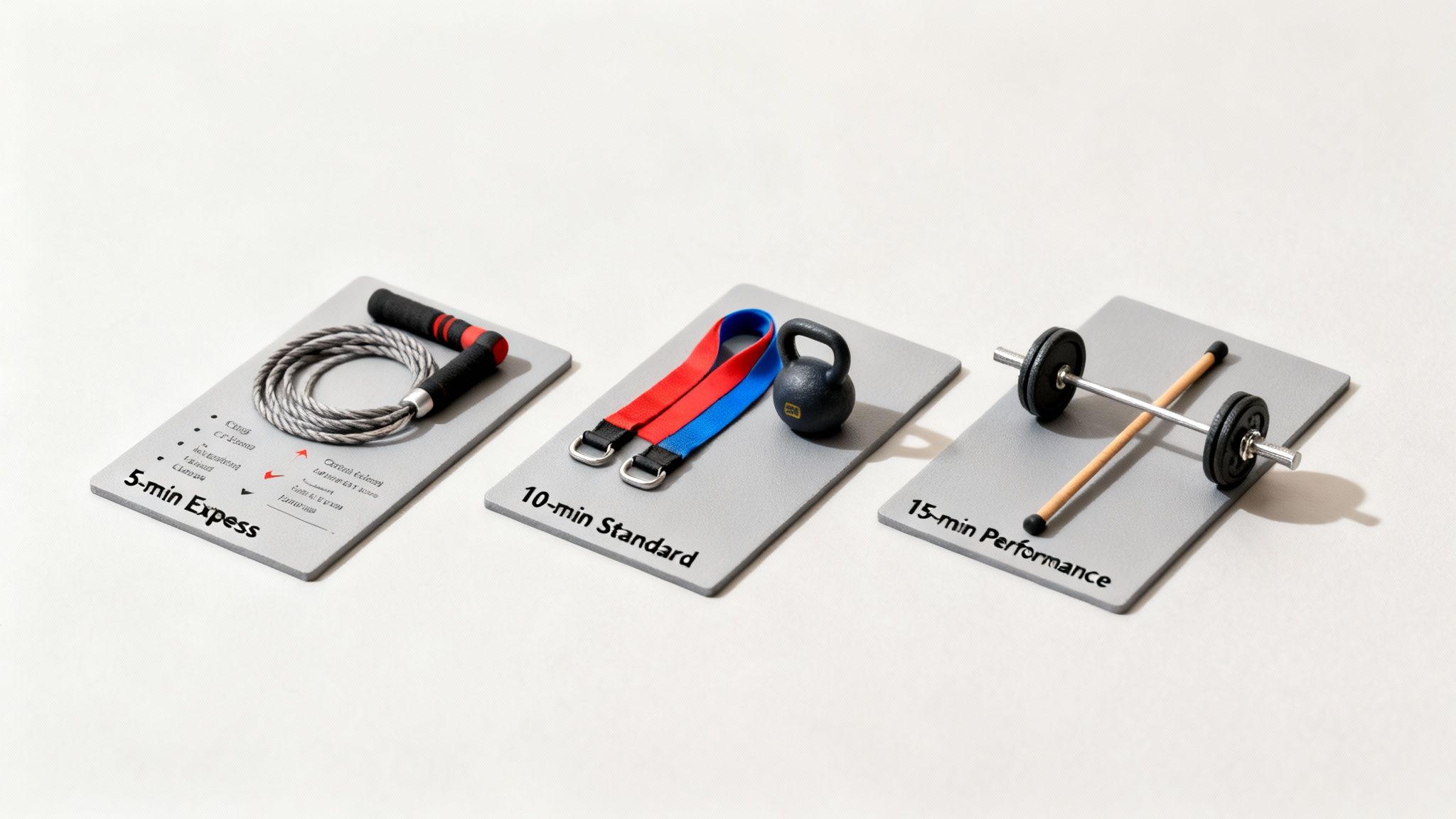
To make this dead simple, I’ve put together three grab-and-go routines based on how much time you can actually spare. These aren't just random exercises thrown together; they’re targeted protocols designed to give you the most bang for your buck, whether you have five minutes or fifteen.
The 5-Minute Express Warm Up
On those days when you're completely slammed, remember this: something is always better than nothing. This quick-and-dirty routine is all about hitting the absolute essentials to get you ready to lift safely.
Think of this as your "break glass in case of workout" emergency plan. It’s perfect for a lunch-break session or when you’ve hit the snooze button one too many times. The goal here is pure efficiency—get the blood flowing, mobilize key joints, and wake up your primary movers.
Here’s a simple, effective structure:
- Jumping Jacks: 60 seconds to get your heart rate up.
- Bodyweight Squats: 10 reps, focusing on full depth and control.
- Arm Circles: 30 seconds forward, 30 seconds backward.
- Leg Swings: 10 forward/backward and 10 side-to-side swings on each leg.
- Cat-Cow: 10 reps to get your spine moving.
- Bird-Dog: 5 reps per side to fire up your core and glutes.
The 10-Minute Standard Warm Up
This is my go-to warm up for probably 80% of my own training sessions. It strikes the perfect balance between thorough preparation and energy conservation. You cover all the bases—pulse-raising, mobility, activation, and priming—in a focused, efficient block of time.
This routine is comprehensive enough to get you prepped for heavy compound lifts but quick enough to fit into a standard one-hour workout. If you're serious about your training, this should be your default.
A well-structured 10-minute warm up is an investment that pays dividends in every single working set that follows. It's the difference between an average session and a great one.
Here’s how you can structure it for a full-body workout:
- Cardio: 3 minutes on a rower or stationary bike.
- Mobility Circuit (1 round):
- Spiderman Lunge with T-Rotation: 5 reps per side.
- Cat-Cow: 10 reps.
- Hip CARs (Controlled Articular Rotations): 5 slow circles per direction, each leg.
- Activation Circuit (2 rounds):
- Banded Glute Bridges: 15 reps.
- Banded Pull-Aparts: 15 reps.
- Plank: 30-second hold.
- Movement Priming: 1 set of 15-20 reps of your first exercise with just the empty bar or a very light weight.
You can learn more about how to perform some of these movements by checking out our guide on Jumping Jacks, which are a fantastic addition to any warm up.
The 15-Minute Performance Warm Up
When you’re about to chase a new personal record or tackle a beast of a workout, you can't afford to leave anything to chance. This extended warm up gives you the extra time you need to zero in on specific mobility restrictions, achieve deeper muscle activation, and really dial in your nervous system.
This is the protocol you pull out for max-effort days. It ensures your body and mind are perfectly synced and ready for peak performance, giving you the confidence you need to get under a heavy bar and own it.
- Cardio: 5 minutes of light, steady-state cardio.
- Foam Rolling: 2-3 minutes targeting any personal tight spots like your quads, lats, or thoracic spine.
- Mobility Circuit (2 rounds):
- 90/90 Hip Switches: 10 reps.
- Wall Slides: 12 reps to activate the scapular muscles.
- Deep Squat Hold: 30-60 seconds.
- Activation Circuit (2 rounds):
- Banded Lateral Walks: 10 steps each way.
- Single-Leg Glute Bridges: 10 reps per side.
- Face Pulls: 15 reps.
- Movement Priming: Perform two to three progressively heavier sets of your main lift, staying well below your working weight to groove the pattern.
Priming Your Body for Heavy Squats, Benches, and Deadlifts
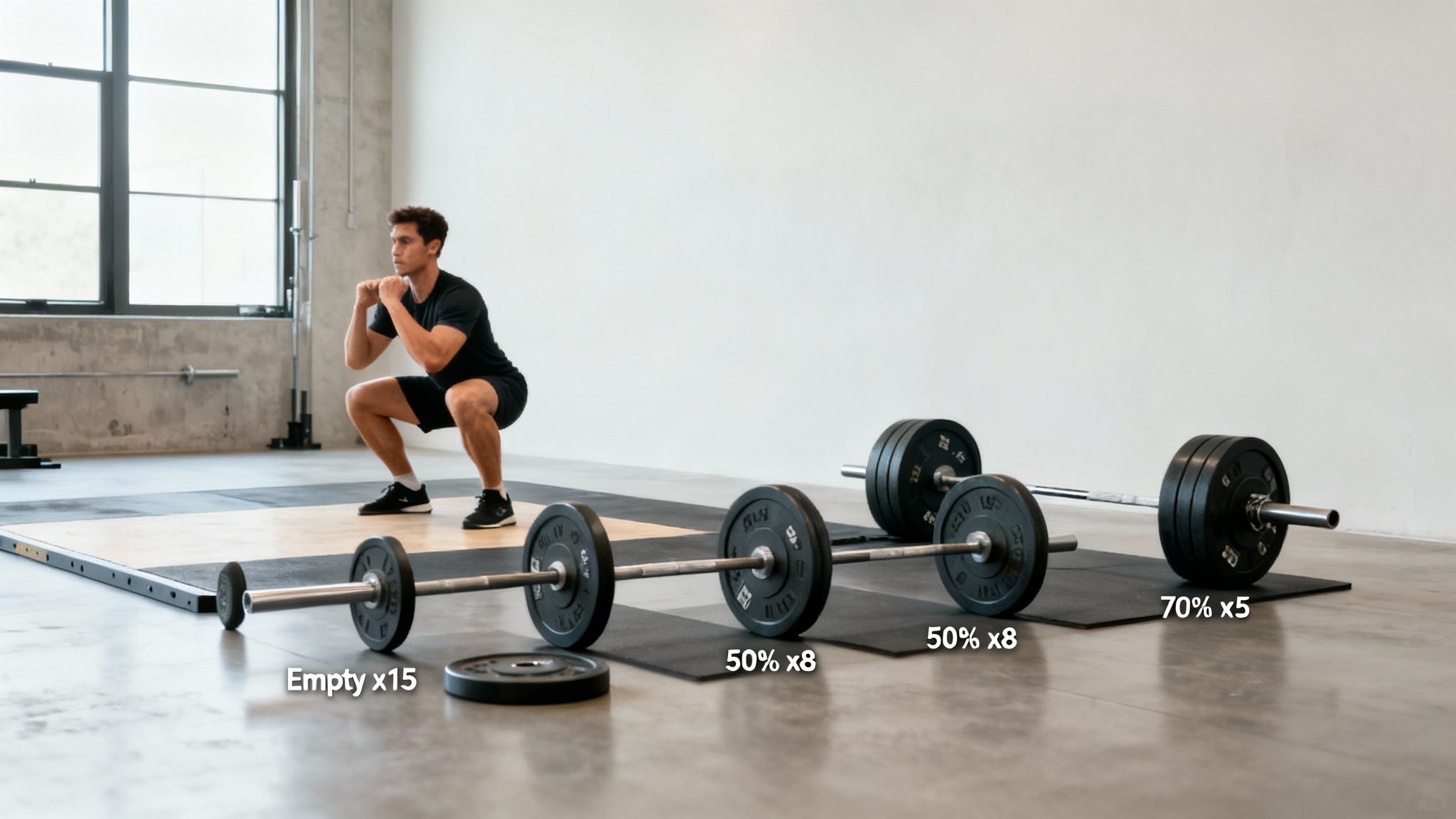
Once you've got your heart rate up and your joints are feeling loose, it's time for the most critical part of your warm-up: getting the barbell in your hands. This is where you shift from general readiness to being specifically primed for the heavy work ahead. These ramp-up sets are way more than just practice—they’re a direct line of communication to your central nervous system.
This whole process taps into a powerful physiological effect called Post-Activation Potentiation (PAP). In simple terms, lifting a moderately heavy weight "wakes up" your nervous system, teaching it to recruit more muscle fibers more efficiently. This brief boost can make your actual working sets feel lighter and more explosive.
The Power of Heavier Ramp-Up Sets
A classic mistake I see all the time is lifters doing way too many reps with light weight. This just builds up fatigue without ever waking up the high-threshold motor units you absolutely need for heavy lifting. The secret is to gradually increase the weight while dropping the reps. This excites the nervous system without tapping into your energy reserves.
Recent studies back this up, showing that heavier, specific warm-ups can give your performance a real kick. One protocol found that doing 5 reps at 80% of a 10-rep max led to the highest total training volume. It's all thanks to PAP, which can temporarily increase muscle twitch force by up to 20-30%. If you want to go down the rabbit hole, you can explore the science behind how heavier warm-ups improve performance in more detail.
Ramping up correctly is about potentiation, not exhaustion. The goal is to walk up to your first working set feeling strong, confident, and neurologically dialed in—not tired.
Sample Ramp-Up Protocol for a 225 lb Squat
Let's say your first working set of the day is 225 lbs (102 kg) for 5 reps. Just jumping straight into it would be a massive mistake. A smart ramp-up protocol teaches your body how to handle that load and locks in your technique. If you need a refresher on form, check out our guide on Barbell Back Squats.
Here’s exactly how I'd approach building up to that set:
- Set 1: Empty Bar (45 lbs) x 15 reps (Focus on tempo and full range of motion)
- Set 2: 95 lbs x 8 reps (Focus on crisp, controlled movement)
- Set 3: 135 lbs x 5 reps (The weight starts to feel more substantial)
- Set 4: 185 lbs x 3 reps (This is your key potentiation set)
- Set 5: 205 lbs x 1 rep (A final "primer" single to feel the intensity)
- Work Set: 225 lbs x 5 reps
This progressive loading scheme gets your muscles, joints, and nervous system ready for the specific demands of a heavy squat. Each set gets you one step closer to being performance-ready, so your body isn't shocked by the intensity of your first real set. By the time you get to 225 lbs, the weight feels expected and manageable.
Common Warm Up Mistakes You Might Be Making
It’s easy to go through the motions of a warm-up without actually getting much out of it. Just because you're moving doesn't mean you're preparing effectively. But spotting and fixing a few common slip-ups can completely change how you feel when you finally get under the bar for that first working set.
From what I’ve seen, most lifters make the same critical errors that sabotage their performance before they even begin. Knowing what to look for is the first step toward building a pre-lift routine that actually works.
Static Stretching Before Lifting
The old-school gym class advice of holding a stretch for 30-60 seconds before a workout is one of the biggest performance killers out there. Think of your muscles like rubber bands; long, static stretches tell them to relax and lengthen, which is the exact opposite of the tight, explosive state you need for strength training.
This type of stretching can temporarily dial down your muscle’s ability to produce force. Instead of holding poses, make the switch to dynamic stretches like leg swings, arm circles, and walking lunges. These movements actively prime your muscles for action without sacrificing power.
Too Much Pre-Workout Cardio
Sure, a few minutes of light cardio is a great way to raise your core temperature, but spending 15-20 minutes grinding it out on the treadmill or bike is just counterproductive. The goal here is to warm up, not wear yourself out. You're simply burning through the valuable energy stores your body needs to fuel your heavy lifts.
Keep your initial cardio short and sweet—just 3-5 minutes is all it takes to get your blood flowing. The rest of your energy should be saved for the weights, where it really matters. This little adjustment also helps keep excessive muscle soreness at bay. If you want to dive deeper, our guide to understanding DOMS can shed some light on recovery.
Your warm up should energize you, not fatigue you. If you feel tired before you even touch a weight, you've done too much.
Forgetting About Stabilizer Muscles
Another major mistake I see is focusing only on the big "mirror muscles" while totally ignoring the small but crucial stabilizers. Your rotator cuff, gluteus medius, and core muscles are the unsung heroes that protect your joints and help you maintain proper form under a heavy load.
Skipping activation work for these areas is like building a skyscraper on a shaky foundation. It's a recipe for disaster. Before every session, make sure to incorporate simple, targeted exercises to wake them up.
- For Upper Body Days: Banded pull-aparts and face pulls are non-negotiable for shoulder health.
- For Lower Body Days: A few sets of banded glute bridges and lateral walks will make sure your hips and knees are stable and ready to work.
Frequently Asked Questions About Warming Up
Even with the best plan, you're bound to have questions. How long is long enough? Can I just do the same thing every day? Nailing the details is what separates a so-so warm-up from one that actually supercharges your lifting.
Let's clear up a few of the most common questions I hear to help you perfect your pre-lift ritual.
Should I Do Static Stretching Before Lifting Weights
Save the long, deep stretches for after your workout. Holding a static stretch for 30-60 seconds can actually tell your muscles to relax and lengthen, which is the exact opposite of what you want before hitting the weights. Some studies even show it can temporarily zap your strength and power.
Instead, your pre-lift routine should be all about dynamic stretches. Think leg swings, arm circles, and walking lunges. These kinds of movements actively take your joints through their full range of motion, waking everything up without putting the brakes on your performance.
How Do I Know if I Am Warmed Up Enough
The goal is to feel locked in, both physically and mentally. This isn't just about going through the motions; you're actively looking for feedback from your body that says, "Okay, I'm ready."
You'll know you're good to go when you notice a few key signs:
- You've started to break a light sweat.
- Your heart rate is up a bit.
- Your joints feel fluid and move easily without any stickiness.
- Your last few warm-up sets with an empty bar feel light, fast, and snappy.
If you still feel stiff, slow, or your head's not in the game, that’s your body telling you it needs a few more minutes. Don't rush it. Spend that extra time on some targeted mobility or activation drills until you feel ready to own that first working set.
A great warm-up ends when you feel powerful and ready, not just when the clock runs out. Listen to what your body is telling you—it knows when it's primed for a great session.
Can My Warm Up Be the Same for Every Workout
Having a basic template is a great start, but the best warm-ups are always tailored to what you're training that day. The general parts—like getting your heart rate up and some full-body mobility—can stay pretty consistent. After all, that stuff benefits your entire body.
Where you need to get specific is with your activation and movement prep. If it's a heavy squat day, you've got to wake up your glutes, hamstrings, and core. On an upper-body day focused on bench pressing, the priority shifts to your rotator cuffs, lats, and triceps. This specific prep work makes sure the exact muscles you're about to hammer are firing on all cylinders, which leads to a much safer and stronger workout.
Tired of winging your warm-ups? The Zing Coach app takes out all the guesswork. It builds your entire session, including a warm-up perfectly matched to your workout, goals, and equipment. Stop wondering and start training smarter by visiting https://zing.coach today.
Share this article


Authors