Discover how to lose weight without gym with science-backed nutrition, practical home workouts, and smart progress tracking. Start your journey today.
Losing weight without a gym membership isn't just possible—it's often more sustainable. The whole process really boils down to two things: creating a consistent calorie deficit through smart eating and weaving accessible, equipment-free movement into your daily life. It’s less about heavy machinery and more about building smart habits you can stick with.
Your Gym-Free Weight Loss Journey Starts Here
Let's bust a huge fitness myth right now: you do not need a gym to see real, lasting weight loss. Sure, gyms have plenty of shiny equipment, but those tools are far from essential. The real engine behind a leaner, healthier you is a combination of sustainable dietary changes and a commitment to moving your body regularly, wherever you happen to be.
Think of this guide as your practical roadmap. We're going to skip the complicated stuff and show you exactly how to lose weight using what you've already got—your body, your home, and your own determination. This is all about creating a lifestyle that actually fits you, not forcing your life to revolve around a rigid gym schedule.
To pull this off, you don't need to overhaul everything at once. Success comes from focusing on a few key areas that deliver the biggest results. We can break these down into the core pillars of any effective at-home weight loss plan.
The Pillars of Gym-Free Weight Loss
Before diving into the specifics, let's get a bird's-eye view of what truly matters for gym-free weight loss. These pillars are the foundation upon which all your progress will be built. Mastering them is the key to creating a sustainable plan that delivers results without needing a single piece of gym equipment.
| Pillar | What It Means | Why It Matters for Gym-Free Success |
|---|---|---|
| Smart Nutrition | Understanding calorie balance and choosing foods that nourish your body and keep you full. | This is 80% of the battle. You can't out-exercise a bad diet, especially without high-intensity gym equipment to burn massive calories. |
| Consistent Movement | A mix of structured, at-home workouts and simply moving more throughout your day (e.g., walks, stairs). | Builds strength, boosts metabolism, and improves overall health without requiring a specific location or equipment. |
| Mindful Tracking | Paying attention to your progress beyond just the scale—like how your clothes fit, energy levels, and photos. | Keeps you motivated, helps you see non-scale victories, and allows for smart adjustments to your plan. |
By focusing on these three areas, you create a powerful, self-reinforcing system for weight loss that you can manage entirely from home.
The most powerful tool for weight loss isn't a dumbbell or a treadmill; it's your kitchen. Mastering what you eat is the single most effective strategy for changing your body composition.
Don't just take my word for it—the data is overwhelming. A landmark study from the National Weight Control Registry, which tracked over 10,000 people who successfully lost weight and kept it off, found that a whopping 90% of them relied primarily on dietary changes. You can dig into the findings on worldobesity.org.
This guide will show you how to combine that nutritional power with effective, accessible workouts you can do right in your living room. For a little inspiration on movements you can start with today, check out our guide on at-home exercises to stay fit without the gym.
Mastering Nutrition: The Real Engine of Weight Loss
Let's be upfront. While at-home workouts are fantastic, they aren't the biggest piece of the puzzle when it comes to weight loss. The undisputed champion, the thing that accounts for the vast majority of your success, is nutrition.
You simply cannot out-train a poor diet. It’s a hard truth, especially when you don't have access to the high-intensity equipment in a commercial gym.
The good news? You don't need a degree in dietetics or a miserable, restrictive eating plan to get this right. It all boils down to one fundamental principle: the calorie deficit. This is the non-negotiable foundation of fat loss. It just means you consistently eat fewer calories than your body burns each day.
Understanding Your Calorie Target
Before you can create a deficit, you need to know your starting point. Your body burns a certain number of calories just to stay alive—breathing, circulating blood, all the basics. This is your Basal Metabolic Rate (BMR). Factor in your daily activities, and you get your Total Daily Energy Expenditure (TDEE).
To lose weight sustainably, the sweet spot is eating 300–500 calories below your TDEE. This creates a deficit that encourages your body to tap into stored fat for fuel, but it's gentle enough to avoid triggering gnawing hunger or a metabolic slowdown.
Figuring out this number might seem complicated, but it's a crucial first step. You can get a solid estimate with an online TDEE calculator that uses your age, gender, height, weight, and activity level. For a detailed walkthrough, check out our guide on how to calculate daily calorie needs.
The Role of Macronutrients
Calories are king, but the quality of those calories makes a huge difference in how you feel—your energy levels, how full you are, and whether you hold onto muscle. This is where macronutrients (protein, carbs, and fats) come in.
- Protein is Your Best Friend: It's the most satiating macro, which is just a fancy way of saying it keeps you feeling full longer. A higher protein intake crushes cravings and helps prevent muscle loss while you're in a deficit.
- Carbohydrates Provide Energy: Don't be afraid of carbs! They're your body's preferred fuel source. The trick is to focus on complex carbs like vegetables, whole grains, and legumes that provide sustained energy and gut-friendly fiber.
- Fats Support Hormones: Healthy fats from foods like avocados, nuts, and olive oil are critical for hormone production and overall health. They are calorie-dense, though, so just be mindful of your portions.
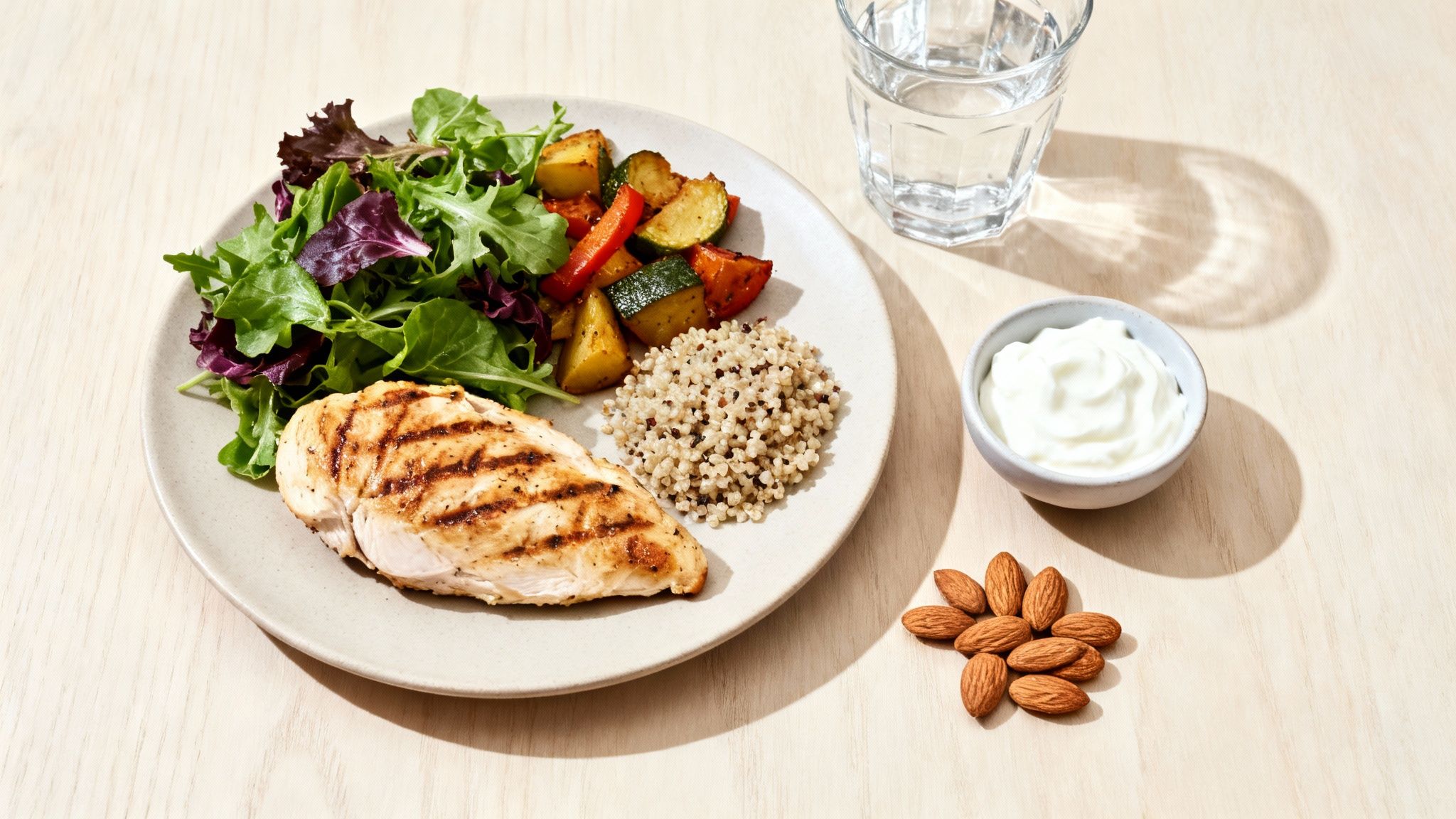
A simple, brilliant tool for building a satisfying meal is the "Plate Method." Imagine your plate divided: fill half with non-starchy veggies, a quarter with lean protein, and the final quarter with a complex carbohydrate. It’s an easy visual that works every time.
Practical Food Swaps for Easy Calorie Savings
Creating a calorie deficit doesn’t mean you have to eat sad, tiny portions of bland food. Often, the easiest wins come from making smarter, almost unnoticeable swaps that can save you hundreds of calories throughout the day.
Here are a few real-world examples:
- Swap a morning bagel with cream cheese (~450 calories) for two scrambled eggs with spinach (~200 calories). Savings: 250 calories.
- Choose a black coffee or Americano (~5 calories) instead of a large latte with whole milk and syrup (~300 calories). Savings: 295 calories.
- Use Greek yogurt (~100 calories per cup) instead of sour cream or mayonnaise (~400 calories per cup) for making dips and dressings. Savings: 300 calories.
These simple changes add up fast, making your calorie deficit feel almost effortless. It's all about working smarter, not harder.
Smarter Snacking to Crush Cravings
Snacks can be your best friend or your worst enemy. Used wisely, they're a powerful tool to manage hunger between meals and prevent you from getting ravenous. The key is picking snacks high in protein and/or fiber to keep you satisfied.
Snack Ideas That Work:
- An apple with a tablespoon of peanut butter
- A handful of almonds or walnuts
- Greek yogurt with a few berries
- Baby carrots with hummus
- A hard-boiled egg
The power of dietary change is well-documented. A landmark study from the Diabetes Prevention Program showed just how effective lifestyle changes can be. Participants who focused on diet and modest physical activity lost 5–7% of their body weight and cut their risk of developing diabetes by a staggering 58%—a result that blew medication out of the water.
Some people also find that when they eat matters as much as what they eat. If you're curious about a more structured approach to meal timing, you can learn more about methods like how to start intermittent fasting. Ultimately, the best nutritional strategy is the one you can stick with consistently.
Building Your At-Home Workout Arsenal
Forget the idea that an effective workout requires a room full of chrome and steel. Honestly, the most powerful piece of fitness equipment you'll ever own is your own body. Building strength and firing up your metabolism from your living room isn't just a backup plan—it’s incredibly effective when you do it right.
This is all about getting resourceful. A great workout stems from consistent effort, not pricey equipment. Once you figure out how to lose weight without a gym, you unlock a level of freedom and convenience that makes sticking with your goals so much easier.
The Power of Bodyweight Training
Bodyweight exercises are the absolute foundation of any solid at-home fitness plan. They’re accessible to everyone, endlessly versatile, and can be tweaked for any fitness level. More importantly, they teach you how to control your own body, building the kind of functional strength that makes a real difference in everyday life.
These are not just "easy" exercises; when you nail the form, they are incredibly challenging. The focus should always be on the quality of each movement, not just cranking out as many reps as possible.
Three core movements form the bedrock of a good bodyweight routine:
- Squats: This is the king of lower-body exercises, hitting your quads, hamstrings, and glutes all at once. Mastering the squat builds a strong foundation for pretty much every other leg movement you'll ever do.
- Push-Ups: The ultimate upper-body and core challenge. Whether you start on your knees or in a full plank, push-ups build strength in your chest, shoulders, and triceps while forcing your core to stay tight and stable.
- Planks: Don't let the stillness fool you. The plank is a full-body grind that builds serious core strength, which is crucial for good posture and preventing injuries down the road.
The secret to making bodyweight moves work long-term is progressive overload. It just means you have to keep finding ways to make them harder. You can do this by adding more reps, slowing them down for more time under tension, or graduating to tougher variations.
Level Up with Resistance Bands
Once you’ve got a good handle on bodyweight movements, resistance bands are the single best investment you can make for your home gym setup. They’re cheap, portable, and ridiculously versatile. They let you add resistance to moves that target muscles you just can't hit easily with bodyweight alone.
Think of them as your personal, portable cable machine. They provide constant tension through the entire exercise, which is fantastic for muscle growth. Suddenly, you can do things like bicep curls, shoulder presses, and lat pulldowns with just a simple set of bands. To really diversify your gym-free regimen, you should check out all the different ways you can go about how to use resistance bands for a full body workout.
Types of Resistance Bands:
- Loop Bands (or "Booty Bands"): Small, circular bands that are perfect for firing up your glutes and hips during squats, lunges, and bridges.
- Tube Bands with Handles: These mimic the feel of dumbbells and are great for upper-body classics like rows, chest presses, and curls.
- Large Loop Bands: These are long, heavy-duty bands that are awesome for assisting with pull-ups or adding some serious resistance to squats and deadlifts.
Get Creative with Household Items
You don't need to stop with bands. Your home is probably already filled with things you can use to add a little extra weight and challenge to your workouts. This is where you can have some fun and keep things interesting.
Before you even think about buying a dumbbell, just look around. You'll be surprised what you can find.
Household Items You Can Use for Resistance:
- Water Jugs or Milk Cartons: A gallon of water weighs about 8.3 pounds. Grab one in each hand for curls, overhead presses, or weighted lunges.
- A Loaded Backpack: Stuff a sturdy backpack with books, canned goods, or water bottles. Wear it for squats and lunges to add weight, or hug it to your chest for goblet squats.
- Sturdy Chair or Couch: The edge of a chair or your sofa is perfect for tricep dips, incline push-ups (hands on the seat), or decline push-ups (feet on the seat).
- Towels: On a smooth floor, a towel under your feet can become a slider for tough exercises like hamstring curls or mountain climbers.
By combining these three elements—bodyweight mastery, resistance bands, and a little household creativity—you can build a workout routine that’s just as effective as anything you could do in a gym. For more specific ideas, our guide on the best exercises for fat loss at home can help you put all these tools into action.
Creating Your Weekly No-Gym Fitness Plan
Knowing a bunch of exercises is one thing, but weaving them into a smart, consistent plan? That’s where the real results come from. Think of your weekly schedule as a blueprint for success. The goal is to build a rhythm that feels good and sustainable—not some grueling boot camp you’ll ditch in two weeks.
A balanced plan is your best defense against burnout and injury. You shouldn’t be crushing high-intensity circuits every single day. Instead, a smart approach mixes strength work, cardio, and active recovery. This keeps your body guessing and gives it the time it needs to repair and get stronger.
Your weekly plan should be a living document, not carved in stone. Life happens. If you need to swap a strength day for a cardio day, that’s fine. Consistency will always beat perfection.
Designing Your Workout Split
A great place to start is a simple three-to-four-day workout split. This gives you plenty of activity to spark fat loss and build muscle, plus enough downtime for your body to recover properly.
Here’s a practical, balanced approach you can tweak to fit your life:
- Two Strength Days: These are your core sessions for building and maintaining muscle. Muscle is metabolically active, meaning it torches calories even when you're just sitting around—a huge plus for weight loss.
- One to Two Cardio Days: The focus here is getting your heart rate up to boost cardiovascular health and burn calories. This doesn’t have to be punishing; a brisk walk absolutely counts.
- Active Recovery and Rest: These days are non-negotiable. Your muscles rebuild during rest, not during the workout. Active recovery, like light stretching or a casual stroll, can help ease soreness and speed things up.
This visual shows how you can level up your strength workouts over time using simple tools.
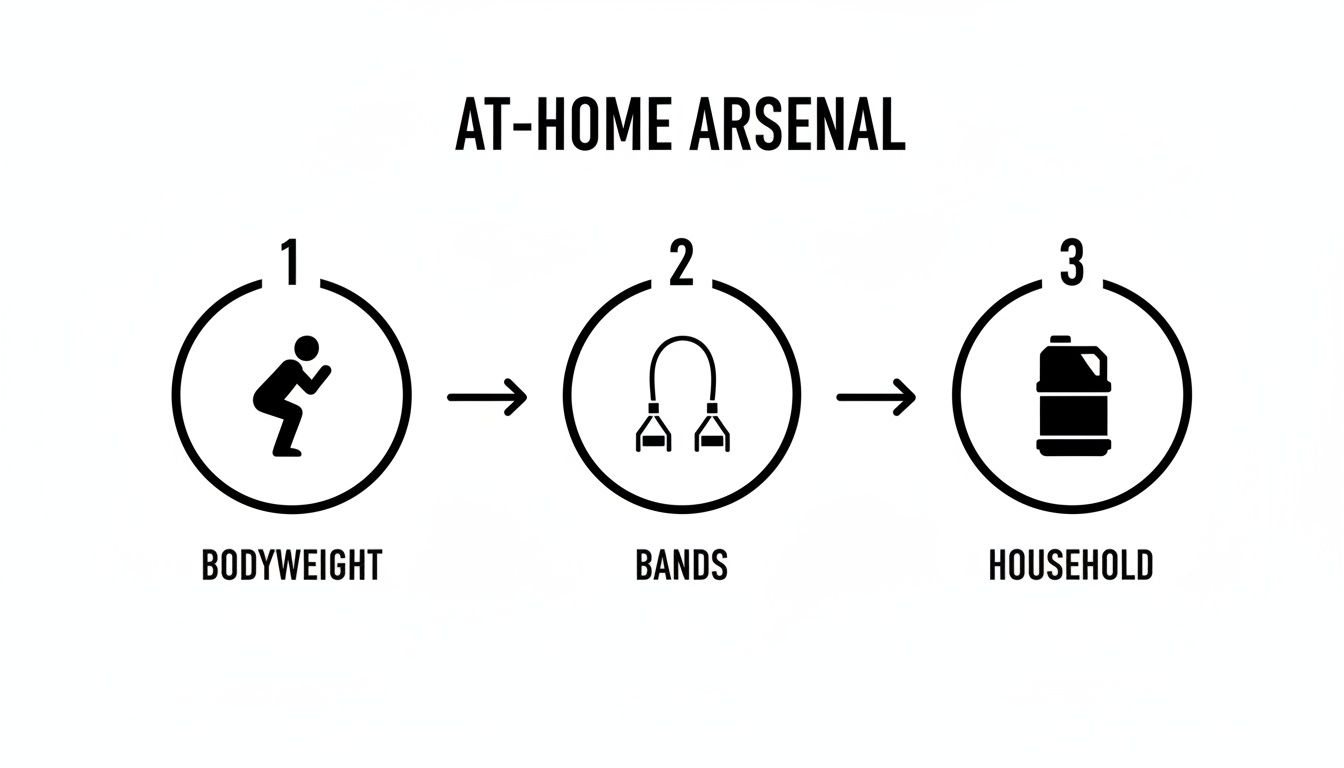
As you can see, you can start with just your body, add a challenge with resistance bands, and then get creative with common household items to keep making progress.
Sample Weekly No-Gym Workout Schedule
Use this template as your starting point, but don't be afraid to make it your own. Swap out exercises based on what you enjoy and what feels challenging. Remember, the best workout on the planet is the one you’ll actually stick with.
| Day | Focus | Example Activity (30-45 mins) | Progression Tip |
|---|---|---|---|
| Monday | Full-Body Strength | 3 rounds of: 15 Squats, 10 Push-Ups (on knees or toes), 12 Lunges per leg, 30-sec Plank. | Try to complete the circuit 30 seconds faster next week, or add 2 reps to each exercise. |
| Tuesday | Light Cardio & Core | 30-minute brisk walk or light jog outside. Finish with 3 rounds of: 15 Crunches, 15 Leg Raises. | Increase your walking pace or add a small hill to your route to boost intensity. |
| Wednesday | Active Recovery | 20-30 minutes of full-body stretching, foam rolling, or a gentle yoga flow (plenty of free videos online). | Hold each stretch for an extra 10 seconds to deepen the release and improve flexibility. |
| Thursday | Full-Body Strength | 3 rounds of: 12 Glute Bridges, 10 Tricep Dips (using a chair), 15 Resistance Band Rows, 30-sec Side Planks (each side). | Shorten your rest period between rounds by 15 seconds to increase the metabolic demand. |
| Friday | Moderate Cardio | 30 minutes of an activity you enjoy: dancing in your living room, cycling, or a home cardio circuit (Jumping Jacks, High Knees). | Increase the duration of your session by five minutes each week to build endurance. |
| Saturday | Active Recovery | A long, leisurely walk, light hiking, or playing an active game with family or friends. | Focus on movement as enjoyment, not a chore. This builds a positive relationship with activity. |
| Sunday | Full Rest | Rest is crucial. Let your body fully recover. Plan your meals and workouts for the upcoming week. | Listen to your body. If you feel tired and sore, a true rest day is more productive than forcing a workout. |
This schedule is just a guide. Feel free to move days around to fit your life. The key is to get the workouts in consistently.
The secret to long-term results is something called progressive overload. It’s a fancy term for a simple idea: you have to keep making your workouts more challenging as your body adapts. If you do the same thing forever, you'll stop seeing changes.
This doesn't mean you need to destroy yourself every session. It can be as simple as adding one more rep, holding a plank for five extra seconds, or grabbing a heavier resistance band. Small, consistent increases are what build a strong, lean body over time.
For a more guided approach, you might want to explore a comprehensive home workout plan for beginners that walks you through these progressions step-by-step.
Tracking Progress and Staying Motivated
Look, weight loss is so much more than a number on a scale. To really stick with this for the long haul—especially when you’re figuring out how to lose weight without a gym—you need to see and feel progress in multiple ways. Fixating only on pounds is a recipe for a motivational rollercoaster, since daily weight can jump around based on water, salt intake, and hormones.
A much smarter approach is to track a few different metrics that tell the full story of your transformation. This builds a more resilient mindset and helps you stay the course, even when the scale decides to be stubborn for a week.
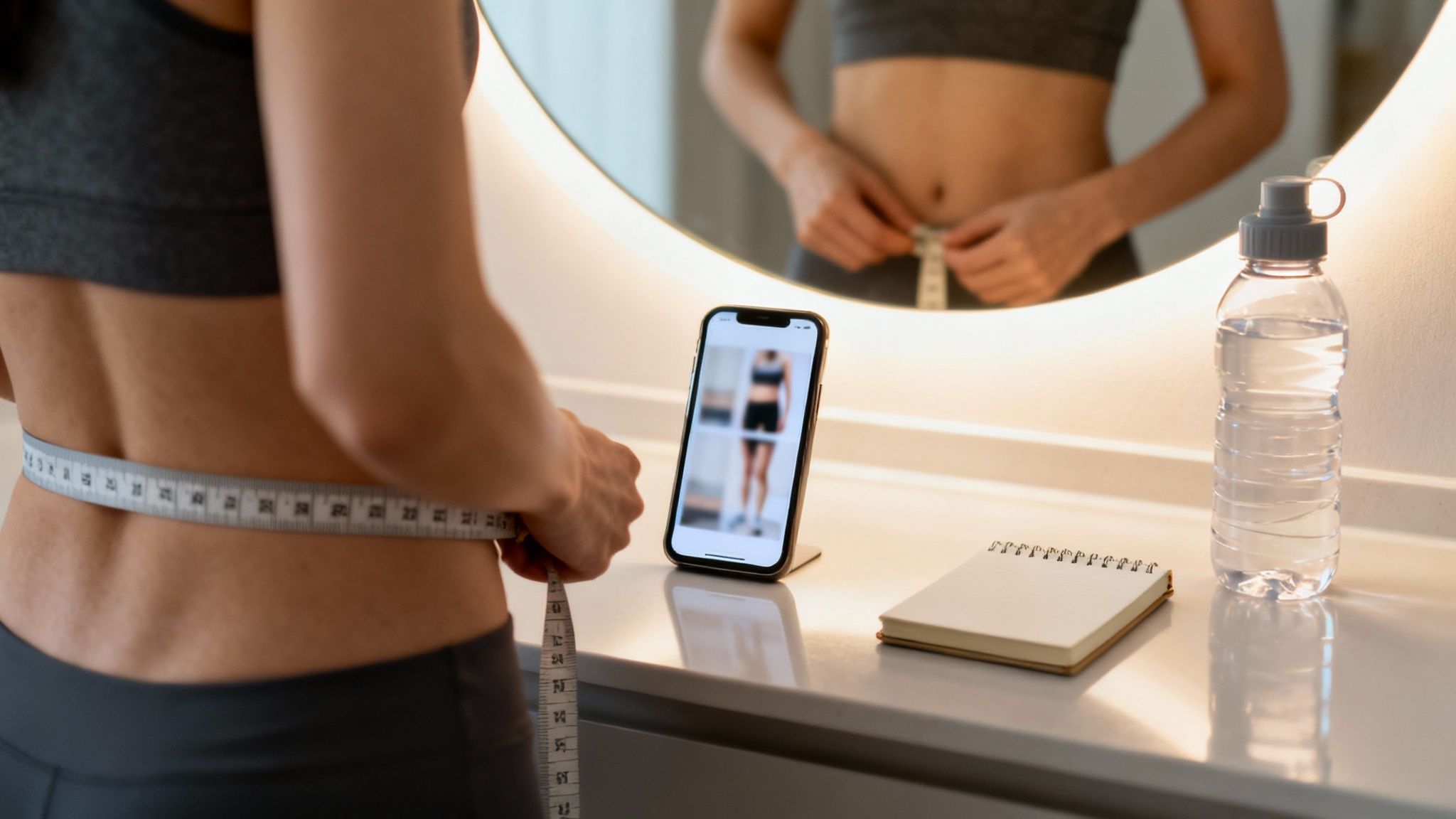
Look Beyond the Numbers on the Scale
The scale is just one tool, and frankly, it's not the most interesting one. Real progress shows up in your daily life in ways a digital number just can't capture. We call these non-scale victories, and trust me, they are the fuel that will keep your motivation burning bright.
Learning to spot these wins is a skill in itself. It trains your brain to look for the positive changes, creating a feedback loop that makes you want to keep going.
Here’s what you should actually be paying attention to:
- Body Measurements: Grab a flexible tape measure every two to four weeks. Jot down the circumference of your waist, hips, chest, and arms. It's totally possible to lose inches and reshape your body even if your weight stays the same, especially as you start building lean muscle.
- How Your Clothes Fit: This is one of the most satisfying signs of progress, period. Is that old pair of jeans feeling a little looser? Does your favorite shirt hang differently? These are tangible, undeniable proof that your body composition is changing for the better.
- Progress Photos: Snap a few quick photos from the front, side, and back every four weeks. Try to wear the same outfit and use the same lighting. When you feel discouraged, comparing your latest pictures to your starting point can be an incredibly powerful reminder of just how far you've come.
Don't underestimate the power of visual feedback. We see ourselves in the mirror every day, which makes it nearly impossible to notice slow, gradual changes. Photos provide the objective evidence that your hard work is absolutely paying off.
The Power of Tracking Your Habits
While outcomes like measurements are important, the real secret to building unstoppable momentum is tracking your daily actions—the habits themselves. Every time you check off a small, daily goal, you get a little hit of satisfaction that reinforces the behavior. This is how you build a new lifestyle, one small win at a time.
Focus on tracking the process, not just the result. This simple shift puts you back in the driver's seat. You can’t always control how many pounds you lose in a week, but you can 100% control whether you go for a walk or drink enough water.
Key Habits to Track Daily:
- Workout Consistency: Did you get your planned workout in today? A simple "yes" or "no" in a calendar or journal is all you need.
- Daily Step Count: Aim for a consistent daily step goal. A fitness tracker is great for this, but your smartphone's built-in health app works just fine.
- Water Intake: Mark off each glass or bottle of water you drink. Staying hydrated is non-negotiable for your metabolism and energy levels.
- Sleep Quality: Note how many hours you slept and how you felt when you woke up. Quality rest is a cornerstone of recovery and weight management.
This focus on daily actions is a core principle behind successful, sustainable fitness. If you want to dive deeper, you can learn more about how to track fitness progress with tools that make it simple and effective.
Progress is never a perfectly straight line. There will be ups, downs, and plateaus. By celebrating your non-scale victories and focusing on the consistency of your daily habits, you build the resilience to navigate those challenges and stay motivated for the entire journey.
Common Questions About Losing Weight at Home
Starting a weight loss journey from home is a huge step, but it's totally normal for a few questions to pop up. Can I really get the same results I'd get at a gym? Am I even doing this right? It's easy to get in your head about it.
Let's clear the air and tackle some of the most common hurdles people face. Getting some clarity here can be the difference between sticking with it and giving up.
Can I Really Build Muscle Without Weights?
This is probably the number one question I get. And the answer is a big, loud YES. Your muscles are pretty simple—they don't know if you're lifting a fancy dumbbell or just your own body. All they understand is resistance.
The magic happens through a principle called progressive overload. It sounds technical, but it just means you have to keep finding ways to make your exercises a little bit harder over time. That's what tells your muscles to adapt and grow stronger.
Here’s how you can do it:
- Add More Reps or Sets: If you did 10 squats last week, aim for 12 this week. Simple as that.
- Slow Things Down: Try taking a full three or four seconds to lower yourself into a squat. This "eccentric" phase creates way more muscle tension, which is fantastic for growth.
- Try Harder Versions: Once you’ve nailed regular push-ups, prop your feet up on a chair for decline push-ups. You'll feel the difference immediately.
Bodyweight training is incredible because it builds functional strength—the kind you actually use in your everyday life.
How Much Cardio Is Enough for Fat Loss?
So many people think they need to spend hours pounding the pavement to lose weight. While cardio is great for your heart and definitely helps burn calories, it's only one part of the equation. Your diet is what truly drives fat loss.
A great target for most people is 150 minutes of moderate-intensity cardio a week. That could look like five brisk 30-minute walks, a few 50-minute bike rides, or whatever combination gets your heart rate up.
The best kind of cardio isn't the one that burns the most calories in an hour; it's the one you'll actually do consistently. Find something you genuinely enjoy, whether it's dancing around your living room, hiking, or cycling. That way, it feels less like a chore.
Instead of obsessing over a specific number on your watch, just focus on the habit of moving your body regularly.
What If I Hit a Weight Loss Plateau?
First off, take a breath. Hitting a plateau is a completely normal part of the process. In fact, it happens to almost everyone. It just means your body, being the smart machine it is, has adapted to your new routine and calorie intake. When the scale won't budge for a few weeks, it’s not a failure—it's a signal that it's time to switch things up.
Here are a few things you can try to get things moving again:
- Revisit Your Calories: As you lose weight, your body doesn't need as much energy to function. Your daily calorie needs (your TDEE) go down. You might just need to make a small adjustment to your calorie target to get back into that deficit.
- Increase Your NEAT: This is a game-changer. NEAT stands for Non-Exercise Activity Thermogenesis, which is all the movement you do that isn't a formal workout. Think pacing on a phone call, taking the stairs, or even fidgeting. Making a conscious effort to just move more throughout your day adds up fast.
- Shake Up Your Workout: If you've been doing the exact same exercises for months, your body is probably bored. Try a new bodyweight move, add some resistance bands to an old favorite, or just change the order of your exercises. A new challenge is often all it takes.
A plateau isn't a stop sign. It's proof that you've made real progress, and now you're just ready for the next level.
Ready to stop guessing and start seeing results? Zing Coach uses AI to build a workout and nutrition plan that’s all about you. It adapts as you get stronger, helping you push past plateaus and hit your goals—no gym required. Get your personalized plan today
Share this article


Authors