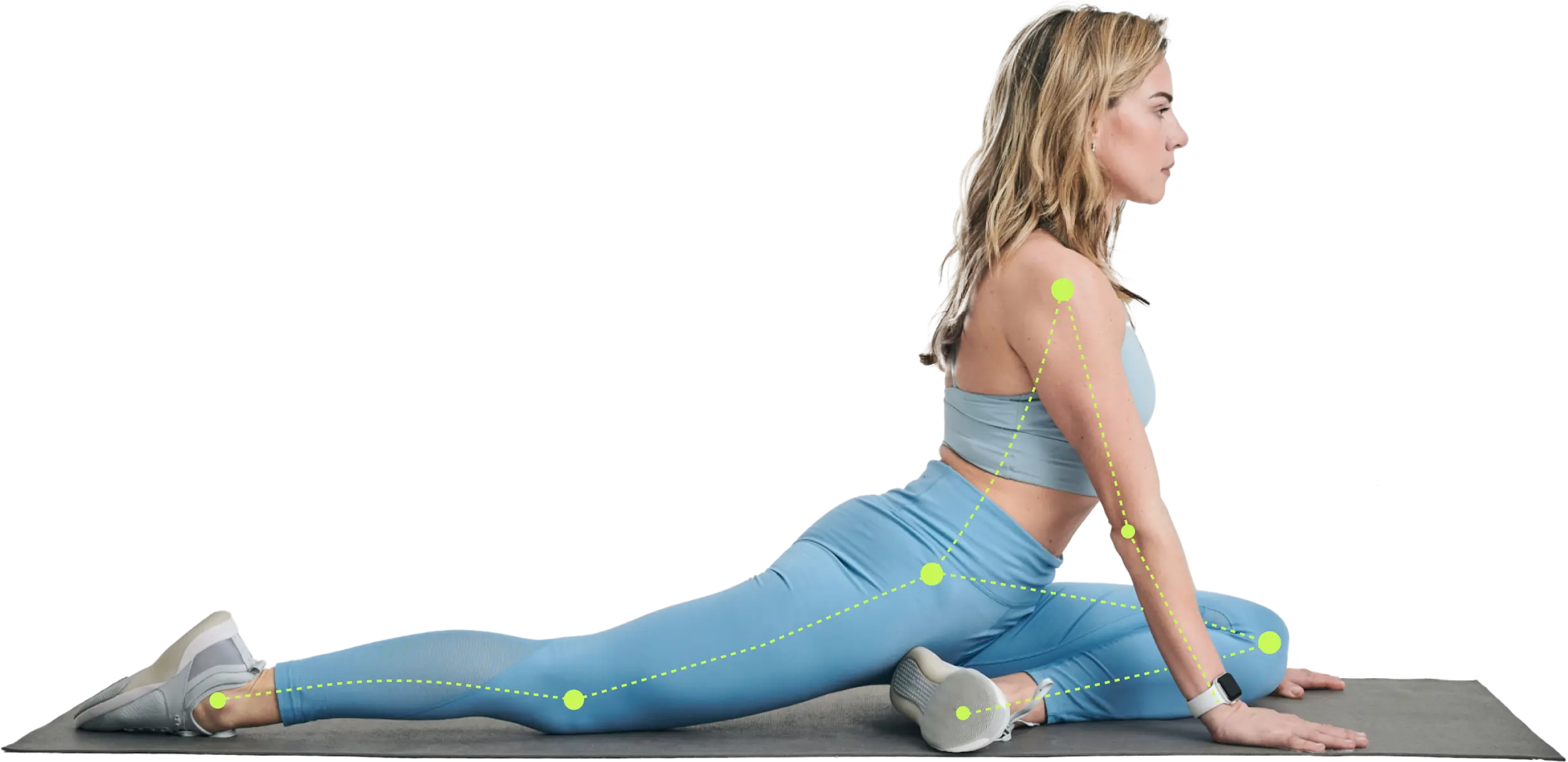
Start your fitness journey with a realistic home workout plan for beginners. This guide provides actionable steps, exercises, and schedules. No gym required.
Starting a home workout plan for beginners doesn't have to be complicated. Forget the all-or-nothing approach. A simple, effective start is just two or three 20-minute bodyweight workouts each week. That's it. This builds the habit without the burnout, using foundational movements like squats, push-ups, and planks to create a sustainable fitness routine right from your living room.
Starting Your Fitness Journey At Home
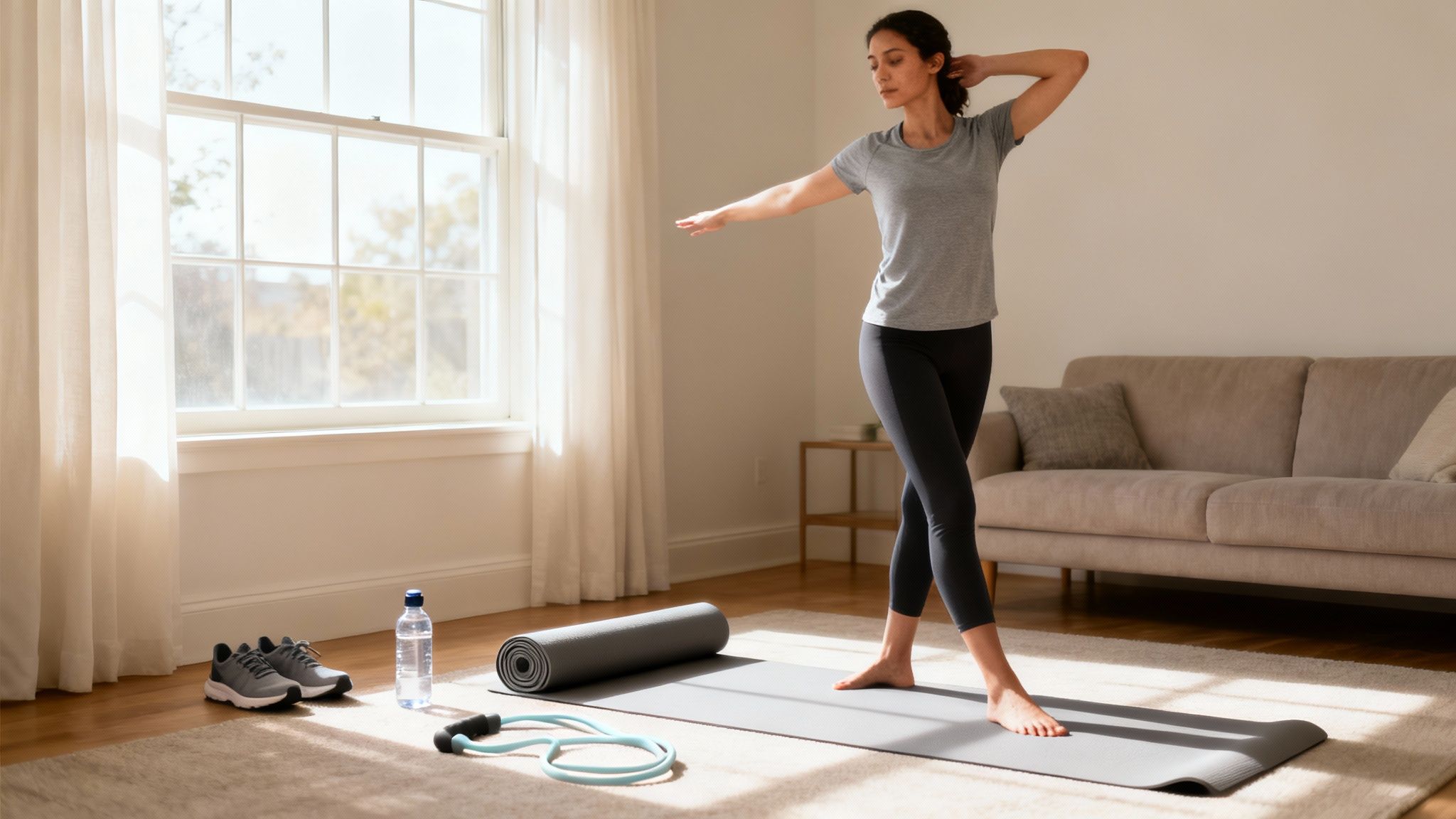
Feeling a little lost on where to begin with a workout routine? You're definitely not alone. The good news is that you don’t need expensive gear or huge chunks of time to build a plan that actually works. This guide is here to cut through the noise and give you a clear, realistic path forward.
Let's talk about the real-world perks of working out at home. Things like pure convenience and total privacy have made it a go-to for millions. The whole at-home fitness scene exploded during the 2020-2021 pandemic lockdowns, completely changing how we think about exercise and proving you don't need a gym membership to get results.
It's not just a trend; the online fitness market is on track to hit around $59 billion by 2027, a boom largely driven by beginners who find bodyweight exercises way more approachable and less intimidating.
To kick things off, let's get organized with a quick look at the building blocks of your new routine.
Your Beginner Fitness Foundation
| Component | Why It Matters | Quick Action |
|---|---|---|
| Goals | Gives you a "why" and keeps you motivated on tough days. | Write down one specific fitness goal you want to achieve in 8 weeks. |
| Schedule | Makes workouts non-negotiable and builds consistency. | Block out three 30-minute slots in your calendar for next week. |
| Space & Gear | Creates a dedicated, friction-free environment for exercise. | Clear a small, yoga-mat-sized space in your home. That's all you need to start. |
Getting these basics sorted out first makes everything that follows much, much easier.
Why Start at Home?
Honestly, the best part about a home workout plan is how easy it is to just start. There are no crowded weight rooms, no commuting, and no waiting for equipment. It just wipes out the most common excuses, letting you focus on building momentum.
Here’s why it works so well for beginners:
- Ultimate Convenience: You can squeeze in a 20-minute session whenever it fits your life—before work, on your lunch break, or after the kids are in bed.
- Total Privacy: Your living room is a judgment-free zone. You can learn new moves, build confidence, and even mess up a little without feeling like anyone's watching.
- Cost-Effective: You can get incredible results using just your own body weight, which can save you hundreds of dollars in gym fees every year.
Of course, feeling good in what you're wearing can give you a nice motivational boost. If you're looking for comfortable and functional activewear, a good guide on finding the best gym clothes for women can point you in the right direction.
The most effective workout plan is the one you actually stick with. Starting at home makes consistency easier by removing friction and fitting exercise seamlessly into your daily life.
This guide will walk you through a simple process: figuring out your current fitness level, setting goals that actually get you excited, and building a schedule you can stick to. If you’re coming back to fitness after taking some time off, you might find our guide on how to start working out again has some extra tips for easing back into it.
Let's get started.
Setting Goals That Actually Motivate You
Before you even think about your first push-up or bodyweight squat, we need to talk about your "why." A good home workout plan isn't just a list of exercises; it's a roadmap built around a clear destination. That destination is what keeps you lacing up your shoes on days when the couch is calling your name.
Think of it this way: without a meaningful goal, a workout plan is just a random collection of movements. Let's give it some purpose.
Establishing Your Starting Point
First things first, we need a simple, judgment-free check-in to see where you are right now. This isn't a test. It's just about grabbing some baseline numbers so you can build a realistic plan and, more importantly, see just how far you've come in a few weeks.
Try one or two of these simple benchmarks:
- Cardio Check: Time how long it takes you to walk one mile at a brisk, steady pace.
- Core Strength: See how long you can hold a solid plank (think straight line from head to heels).
- Upper Body Strength: Do as many push-ups as you can manage, even if they’re on your knees or against a wall. Good form is what counts here.
Jot these numbers down somewhere. Seriously. These are your "Day 1" stats, and they're pure gold. Watching them improve is one of the most powerful motivators you’ll ever find.
Moving Beyond Vague Ambitions
Okay, you've got your starting point. Now, where are you headed? "Get fit" or "be healthier" are nice thoughts, but they're terrible goals. They're fuzzy. They don’t give you anything concrete to aim for, which makes it impossible to know if you're actually getting anywhere.
This is where the SMART framework saves the day. It’s a classic for a reason—it works. It turns those fuzzy wishes into real, actionable targets.
- Specific: What, exactly, do you want to achieve?
- Measurable: How will you track it and know when you’ve hit the mark?
- Achievable: Is this goal realistic for you right now?
- Relevant: Why does this actually matter to you?
- Time-bound: What's the deadline?
This structure makes your goal feel tangible. For a deeper dive into this, our guide on how to set good goals has tons of extra detail.
Crafting Goals That Resonate
Let’s see this in action. We'll take a common vague goal and give it a SMART makeover.
Vague Goal: "I want to get stronger."
SMART Goal: "I will be able to complete 10 full, consecutive push-ups with good form in 8 weeks."
See the difference? It's specific (10 push-ups), measurable (you can count 'em), achievable (eight weeks is a solid timeframe for a beginner), relevant (directly builds upper body strength), and time-bound (8 weeks). You know exactly what you're working toward.
Here are a few more real-world examples to get your wheels turning:
- For Boosting Energy: "I will complete three 20-minute home workouts each week for the next month so I don't feel so drained by 3 p.m. at work."
- For Improving Heart Health: "I will build up to walking or jogging for 30 minutes straight, without stopping, within the next 6 weeks."
- For Functional Strength: "I want to carry all my groceries from the car in one trip. I'll focus on grip and core strength for the next 2 months to make it happen."
Your goal doesn't have to sound like you're training for the Olympics. It just has to mean something to you. Take a minute right now and write down one SMART goal that actually gets you a little excited. That's the foundation for everything that comes next.
Your Essential Bodyweight Exercise Toolkit
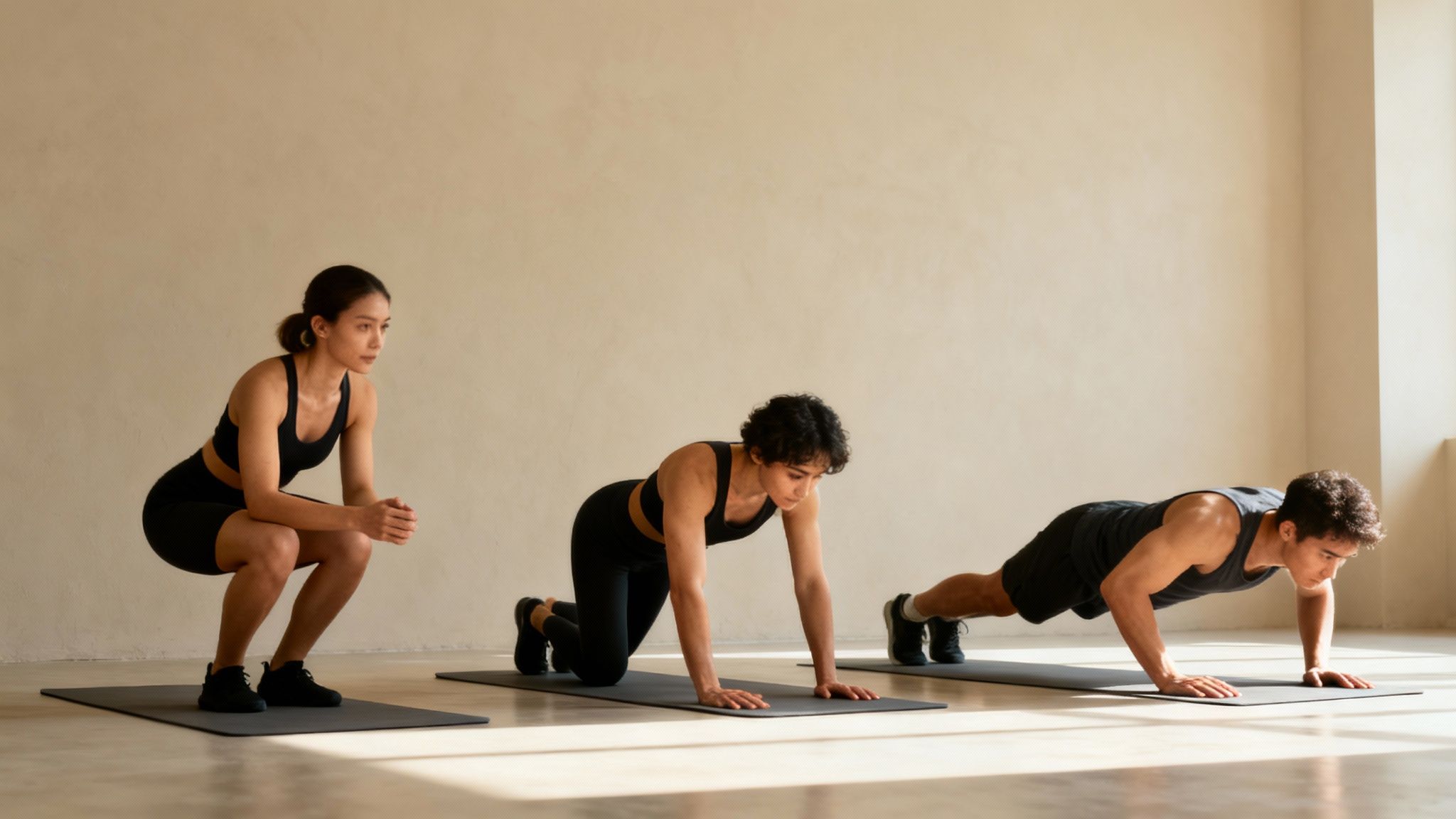
This is where the fun begins—building your personal library of go-to exercises. A solid home workout plan isn't about memorizing dozens of complicated moves. It's about getting really good at a handful of foundational patterns your body was designed to perform.
We’re going to focus on five core types of movement:
- Pushing: Moving something (or your own body) away from you.
- Pulling: Bringing something (or your own body) toward you.
- Squatting: Bending at your knees and hips, like you're about to sit in a chair.
- Hinging: Bending at your hips while keeping a nice, straight back.
- Bracing: Firing up your core muscles to keep everything stable.
By picking exercises from these categories, you guarantee yourself a balanced, full-body workout every time. We'll stick to compound movements—the ones that work multiple muscle groups at once—because they give you the biggest bang for your buck, especially when you're short on time.
A quick word of advice: quality over quantity is the golden rule. Doing eight perfect, controlled squats is infinitely better for building strength and preventing injury than blasting through twenty sloppy ones.
Choose Your Exercise Options
To make things simple, here’s a quick-glance table of foundational exercises broken down by movement pattern. You can start with just your bodyweight and, if you have them, add some simple pieces of equipment later on.
| Movement Pattern | Bodyweight Exercise | Minimal Equipment Option |
|---|---|---|
| Push | Incline or Knee Push-Up | Dumbbell Bench Press, Resistance Band Press |
| Squat | Bodyweight Squat (or Chair Squat) | Goblet Squat (with a dumbbell/kettlebell) |
| Hinge | Glute Bridge | Kettlebell Swing, Dumbbell Romanian Deadlift |
| Pull | Inverted Row (using a sturdy table) | Dumbbell Row, Resistance Band Row |
| Brace (Core) | Plank (on knees or toes) | Farmer's Walk (holding weights) |
This table is your starting menu. Pick one from each category to build a complete workout.
Pushing: The Foundational Strength Builder
Pushing movements are fantastic for developing your chest, shoulders, and triceps. The classic push-up reigns supreme here, but let's be real—the standard version is tough for most beginners. The trick is to start with a variation that lets you maintain flawless form.
Beginner-Friendly Push Variations:
- Wall Push-Up: This is your entry point. Stand facing a wall, about an arm's length away, and place your hands on it. Lean in, keeping your body straight like a board, and then push back out. It’s perfect for building that initial strength.
- Incline Push-Up: Next, find a sturdy elevated surface like a countertop or a strong table. The higher the surface, the easier it is. Perform a push-up here, focusing on that straight line from your head to your heels.
- Knee Push-Up: Once you feel solid on an incline, it's time to hit the floor. From your hands and knees, lower your chest toward the ground while keeping your back flat.
Your goal is to pick the variation you can do for 8-12 reps with good form. Once you can hit that range easily, you're ready to try the next, harder version.
Squatting: The Ultimate Lower-Body Exercise
Squats are absolutely non-negotiable for building a strong lower half. They hammer your quads, hamstrings, and glutes—some of the biggest muscles you have. Learning to squat properly doesn't just build muscle; it also improves mobility and protects your joints in everyday life.
Beginner-Friendly Squat Variations:
- Assisted Bodyweight Squat: Stand in front of a doorknob or a sturdy pole and hold on for balance. This little bit of assistance helps you learn the proper "sit back" motion without worrying about falling over.
- Chair Squat (Box Squat): Pop a chair behind you. Lower your hips back and down until you gently tap the seat, then stand back up without plopping down. This is the best way to drill the correct squat pattern.
- Bodyweight Squat: Once you've mastered the chair squat, take it away. Perform the exact same movement, keeping your weight in your heels and your chest held high.
Hinging and Bracing: Your Ticket to a Healthy Back
Hinging (bending at the hips) and bracing (tightening your core) are the dynamic duo for a strong, resilient midsection and a pain-free back. Think of hinging as how you’d safely pick up a heavy box.
Essential Hinge and Brace Exercises:
- Glute Bridge (Hinge): Lie on your back with your knees bent. Squeeze your glutes and lift your hips up until your body is in a straight line from your shoulders to your knees. This is one of the best ways to wake up your glutes.
- Plank (Brace): The plank is the undisputed champion of core stability. Start on your knees if you need to, and work up to a full plank on your toes. Your goal is to be a straight, rigid line—no sagging hips! Aim to hold for 15-30 seconds at first.
If you’re looking for a few more ideas, our guide on 8 at-home exercises to stay fit without the gym has some great options.
These basic movements are all you need to lay the groundwork for an effective home workout plan. Nail the form on these, and you'll build the strength and confidence to take on new challenges in no time.
Creating a Workout Schedule You Can Stick To
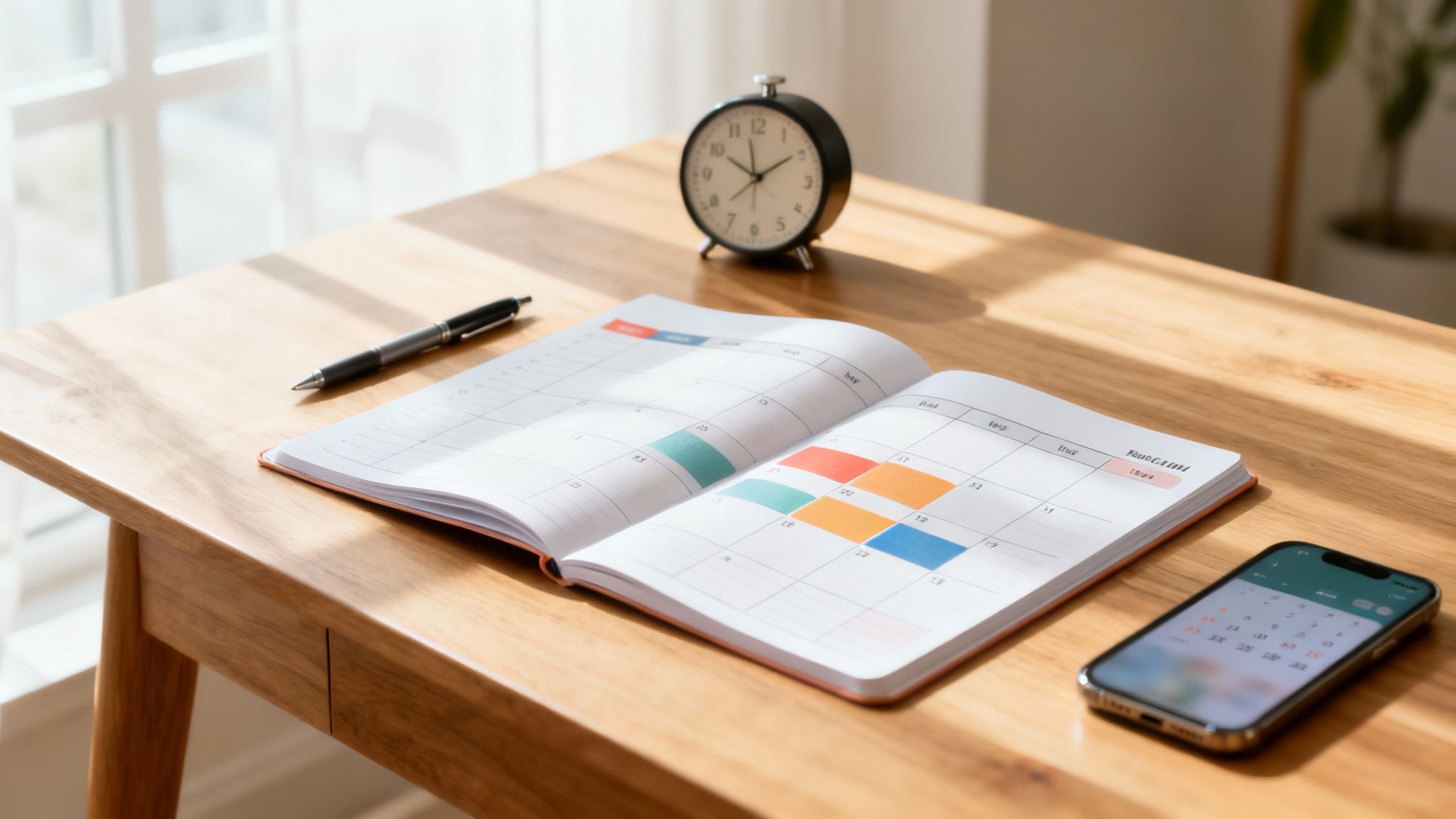
Alright, you’ve got your goals dialled in and a solid list of exercises. Now comes the part where the rubber meets the road: putting it all together into a weekly schedule that actually fits into your life. The best home workout plan for beginners is built on realism, not some punishing, all-or-nothing schedule that’ll burn you out in two weeks flat.
The secret? Start small. So small it feels almost too easy. This isn't about crushing yourself from day one; it's about building the unshakable habit of simply showing up.
Finding Your Weekly Rhythm
Forget what you see online about six-day splits and intense daily workouts. As a beginner, your only real goal is consistency. That's why I always recommend starting with just two or three workouts per week, lasting about 20-30 minutes each. This is how you build momentum without feeling totally overwhelmed.
A full-body routine is easily the most efficient way to start. It hits all your major muscle groups in one go, giving you the best bang for your buck time-wise. It also guarantees you get enough recovery time, which is when your muscles actually rebuild and get stronger.
Here are a few popular weekly structures that just plain work for beginners:
- The Monday-Wednesday-Friday Model: This is a classic for a reason. It gives you a full day of rest between each workout, letting your body recover completely before the next session.
- The Tuesday-Thursday-Saturday/Sunday Model: Perfect if your weeks tend to start out a bit hectic. This gives you a great mix of weekday and weekend sessions to stay on track.
- The Two-Day Starter: If three days feels like a stretch, just start with two. A Tuesday-Friday schedule, for example, is a fantastic way to ease into a routine and build confidence.
Your schedule is a tool, not a rulebook. If you miss a Monday workout, don't write off the whole week. Just do it on Tuesday and adjust. Flexibility is the real secret to long-term success.
Sample Four-Week Bodyweight Plan
This is a "plug-and-play" plan that requires zero equipment. It’s designed to build foundational strength and, just as importantly, confidence. Your only job is to focus on maintaining good form for every single rep.
Do this routine 2-3 times per week on non-consecutive days (so, never two days in a row).
The Workout:
- Warm-Up: 5 minutes of light cardio (marching in place, jumping jacks)
- Bodyweight Squats: 2 sets of 10-15 reps
- Incline or Knee Push-Ups: 2 sets of 8-12 reps
- Glute Bridges: 2 sets of 15 reps
- Plank: 2 sets, holding for 20-30 seconds
- Jumping Jacks: 2 sets of 30 seconds
- Cool-Down: 5 minutes of stretching
Take 60-90 seconds of rest between each set. For the first two weeks, just stick to two sets. In weeks three and four, if you're feeling good, add a third set to each exercise to up the challenge.
Sample Four-Week Minimal Equipment Plan
If you have a pair of dumbbells or some resistance bands, this plan will help you take the intensity up a notch. That bit of added resistance is fantastic for speeding up muscle development.
Perform this routine 2-3 times per week on non-consecutive days.
The Workout:
- Warm-Up: 5 minutes of light cardio (jogging in place, arm circles)
- Goblet Squats (with one dumbbell): 3 sets of 8-12 reps
- Dumbbell Rows: 3 sets of 10 reps per arm
- Dumbbell Floor Press: 3 sets of 10-12 reps
- Walking Lunges (bodyweight or holding dumbbells): 3 sets of 10 reps per leg
- Plank: 3 sets, holding for 30-45 seconds
- Cool-Down: 5 minutes of stretching
Rest for about 60 seconds between sets. Choose a weight that feels challenging by the last couple of reps but still allows you to maintain perfect form. If your form starts to break down, the weight is too heavy.
Weaving In Active Recovery
Rest days don't have to mean being glued to the couch. Active recovery is just low-intensity activity that helps your muscles recover faster by increasing blood flow. It can seriously reduce soreness and keep your body feeling good.
Think of it as a gentle nudge to your system, not another workout.
Simple Active Recovery Ideas:
- Go for a Walk: A brisk 20-30 minute walk is one of the best things you can do.
- Light Stretching or Yoga: Focus on gentle stretches, holding each for about 30 seconds. No need to push it.
- Foam Rolling: If you have a foam roller, it can be a great tool for massaging sore muscles.
Slotting one or two of these active recovery days into your week can make a huge difference in how you feel and perform. It’s a critical piece of any sustainable home workout plan for beginners, making sure you stay fresh and injury-free for the long haul.
Making Progress and Staying Motivated

Starting a new routine is a huge win, but the real magic happens when your plan grows with you. A static plan will eventually lead to a plateau where your body adapts and stops changing. To keep seeing results, you need to use a simple but powerful concept called progressive overload.
That might sound technical, but it just means making your workouts a little bit more challenging over time. It's the core principle that forces your muscles to keep adapting and getting stronger. Without it, you’re just going through the motions.
Simple Ways to Level Up Your Workouts
Progressive overload doesn't mean you have to suddenly start lifting heavy weights or doing hour-long workouts. For beginners, the changes can be small and gradual, which is exactly how you stay safe while consistently moving forward.
Here are a few practical ways to apply this to your home workout:
- Add One More Rep: If you did 10 squats last week, aim for 11 this week. That single extra rep is a clear sign of progress.
- Try a Harder Variation: Once you can comfortably do 15 knee push-ups, maybe it’s time to try a few full push-ups on your toes.
- Reduce Your Rest Time: Shaving just 15 seconds off your rest periods between sets can seriously crank up the workout's intensity.
- Increase the Sets: Been doing two sets of each exercise? Add a third to increase the total volume of your workout.
The goal isn't to do everything at once. Pick just one method of progression for an exercise at a time. This steady, incremental approach is the secret to building long-term strength and avoiding burnout.
Tracking Your Progress and Finding Your 'Why'
So, how do you know when it’s time to level up? By tracking your workouts. This doesn't need to be complicated at all. A simple notebook where you log the date, exercises, sets, and reps is all you need.
Seeing your numbers improve on paper provides undeniable proof that your hard work is paying off. It’s a massive motivational boost on days when you just don’t feel like exercising. If you prefer a digital approach, plenty of apps can help you log sessions and visualize your gains.
Wearable tech has also become a popular tool, hitting the top spot as the #1 global fitness trend. The market for these gadgets is expected to grow at 17.4% annually, with key features like heart rate monitoring (21.2% of use) giving beginners valuable insight into their effort and recovery.
Overcoming Roadblocks and Staying Consistent
Even with the best plan in the world, motivation can dip. You might get bored, or you might hit a temporary plateau where progress feels slow. This is completely normal—it happens to everyone.
To truly stick with it and keep moving forward, you have to build a strong mindset. It helps to look into practices for mastering mental toughness for peak performance.
When you feel stuck, try shaking things up:
- Switch Up Your Exercises: Swap your bodyweight squats for walking lunges for a couple of weeks to challenge your muscles in a new way.
- Change Your Scenery: If you always work out in the living room, try taking your routine to a local park on a nice day.
- Focus on "Non-Scale Victories": Celebrate being able to carry all the groceries in one trip or having more energy in the afternoon. These are real-world signs you’re getting stronger.
Remember, consistency will always beat perfection. Building the routine itself is the most important part of any home workout plan for beginners. For more tips on making your new routine second nature, check out our guide on forming habits that stick.
Your Home Workout Questions Answered
Even with the best plan in hand, questions are going to pop up. Honestly, that’s a good thing—it means you’re thinking critically about what you're doing. Let's tackle some of the most common ones I hear from people just starting out.
How Long Should a Beginner Workout at Home?
Forget those grueling, hour-long sessions you see on social media. Right now, the name of the game is consistency over duration. Your primary goal is to build a habit that feels good, not one that leaves you so wrecked you can't walk for three days.
Aim for 20-30 minute sessions, three times a week. That’s it. This is a sweet spot that gives your body enough of a challenge to adapt without feeling completely overwhelmed. Think of it as laying the foundation, brick by brick. Once you’ve stuck with that for four to six weeks, then you can think about bumping up to 45 minutes or maybe adding a fourth day.
Always listen to your body. Seriously. Taking an extra rest day when you feel rundown is a thousand times smarter than pushing through sharp pain and getting an injury that could sideline you for weeks.
What Is the Best Equipment for Home Workouts?
You can get a killer workout with zero equipment. Your own bodyweight is an incredible tool for building foundational strength with moves like squats, lunges, push-ups, and planks. These are the bread and butter of any solid fitness program for a reason.
If you get the itch to buy some gear down the line, you don't need to transform your living room into a commercial gym. A few versatile pieces will take you a long way.
- A Quality Exercise Mat: This is non-negotiable. It makes any floor work, from planks to core exercises, way more comfortable.
- A Set of Resistance Bands: These are fantastic. They add a new level of challenge to lower-body exercises and are perfect for "pulling" movements like rows, which are tough to do with just bodyweight.
- A Pair of Adjustable Dumbbells: This is more of an investment, but they save a ton of space and can grow with you as you get stronger, which is a huge plus.
My advice? Start with bodyweight, nail your form, and then think about adding equipment.
How Do I Know if My Form Is Correct?
This might be the single most important question you can ask. Good form is everything—it's the difference between getting stronger and getting injured.
First, find reliable video tutorials from certified trainers for every single exercise. Pay close attention to their cues and how they move. Here's a pro tip: record yourself with your phone while you do a few reps. Then, watch your video side-by-side with the tutorial. It's amazing what you'll spot in your own movement.
Beyond that, focus on how the exercise feels. You should feel a burn or a stretch in the muscle you're trying to work, not a sharp, pinching sensation in your joints. If something hurts in a "bad" way, stop immediately. Check your form again, and don't be afraid to try an easier version of the exercise.
How Long Until I See Workout Results?
Here’s the thing they don’t always tell you: you will feel the results long before you see them. Remembering this is crucial for staying motivated when you look in the mirror and feel like nothing’s changing.
Within the first 2-4 weeks, most people notice they have way more energy, are sleeping better, and just feel stronger in their day-to-day life. These are massive wins, so celebrate them!
Visible changes, like more muscle definition or a shift in your body shape, tend to show up after about 8-12 weeks of consistent effort and reasonably supportive nutrition. Patience is your best friend here. Trust the process.
And don't forget to track your non-visual progress! Being able to do one more push-up than last week or holding a plank for five extra seconds is real, measurable improvement. Muscle soreness is also a normal part of this journey. If you're curious about why you're aching after a good workout, it's worth understanding DOMS (Delayed Onset Muscle Soreness).
Ready to stop guessing and start training with a plan that adapts to you? The Zing Coach app uses AI to build a personalized home workout plan based on your goals, equipment, and fitness level. Get real-time form feedback and a schedule that grows with you. https://zing.coach
Share this article


Authors