Feeling intimidated by the gym? Learn how to overcome gym anxiety with practical, real-world strategies for preparation, mindset, and your first workouts.
First off, let’s get one thing straight: overcoming gym anxiety begins the moment you realize you're not the only one feeling it. The trick isn't to pretend the fear doesn't exist, but to reframe what the gym actually is. It’s not a stage where you’re the main act. Think of it more as a shared workshop, where everyone is busy tinkering with their own projects.
The real key? Start small. A simple, manageable plan is all you need to slowly build that feeling of comfort and familiarity.
Why Gym Anxiety Is Normal and How to Beat It
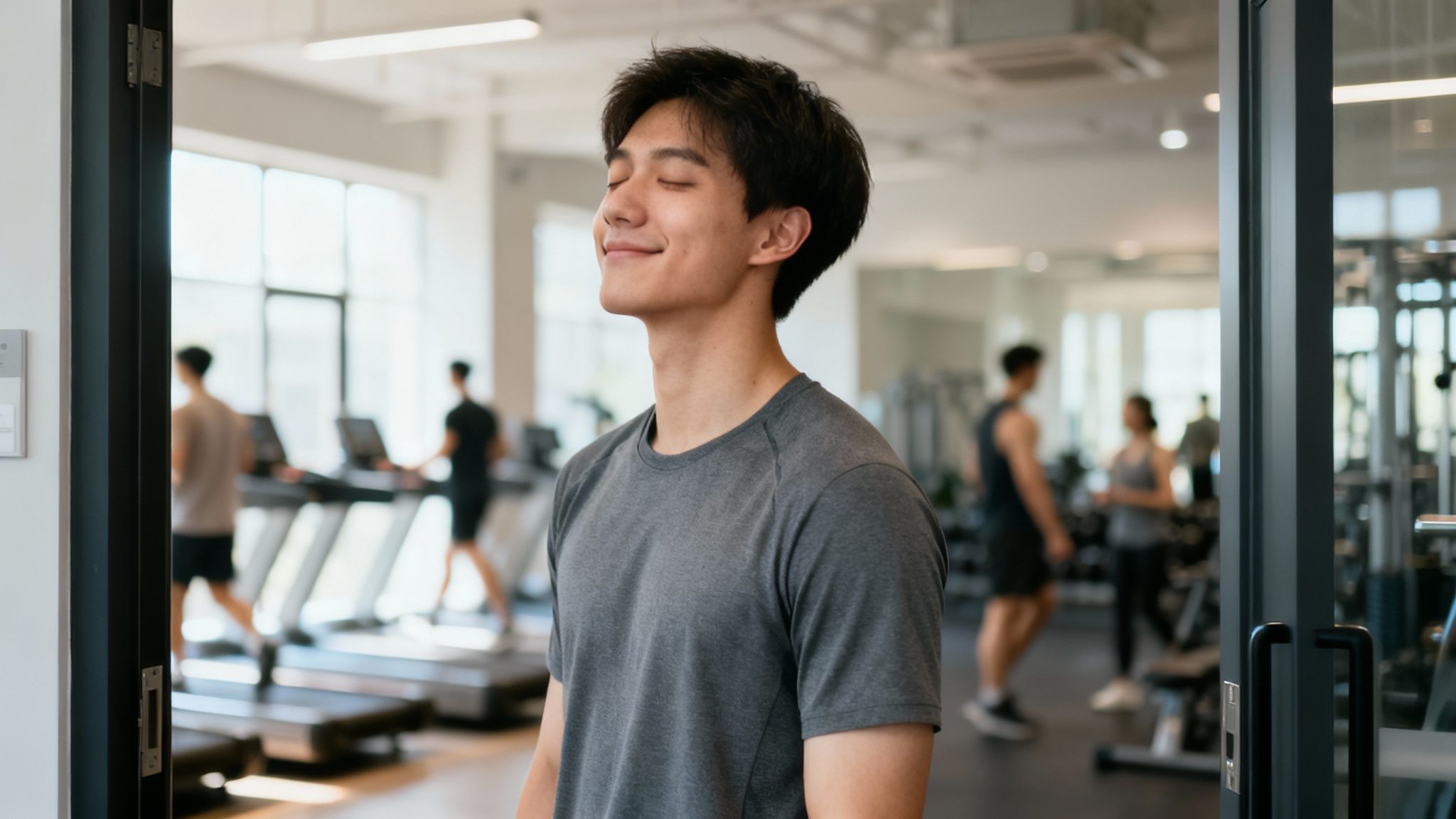
If you've ever felt that wave of self-consciousness hit you as you walk through the gym doors, you are in very good company. That feeling is often called "gymtimidation," and it's an incredibly common hurdle that stops countless people from even starting their fitness journey. It's a potent cocktail of social anxiety, self-doubt, and the raw fear of being judged.
This isn't just a feeling, either—it's a well-documented phenomenon. In fact, roughly 50% of Americans admit to feeling intimidated by the gym environment. Surveys consistently show that people steer clear of gyms because they’re worried about how they look, their current fitness level, or simply making a mistake. These fears feel very real, but they don't have to be the final word on your relationship with fitness.
Understanding the Root Causes of Gymtimidation
To really tackle gym anxiety, you have to know what you're up against. Pinpointing what triggers that feeling of dread is the first step. For most of us, it boils down to a few core concerns that are surprisingly universal.
Here are some of the usual suspects:
- Fear of Judgment: The nagging thought that everyone—especially the super-fit people—is watching and critiquing your every move.
- Equipment Uncertainty: Staring at a sea of complex machines and free weights, feeling completely lost and terrified of looking foolish or, worse, getting hurt.
- Social Comparison: It’s almost impossible not to compare your Day 1 to someone else’s Day 1,000. You see their strength and physique and feel like you'll never measure up.
- Feeling Out of Place: That powerful sense that you just don't belong in a space that seems dominated by experts.
Let's be honest, we've all been there. It's easy to get trapped in these thought loops. The table below breaks down these common triggers and gives you a practical way to flip the script.
Common Gym Anxiety Triggers and Practical Reframes
| Anxiety Trigger | Confidence-Building Reframe |
|---|---|
| "Everyone is watching me and judging my form." | "Most people are focused on their own workout. They're probably more worried about their next set than what I'm doing." |
| "I have no idea how to use this machine." | "Everyone starts somewhere. I can watch a quick tutorial, ask for help, or start with equipment I know. Learning is part of the process." |
| "I'm not as fit or strong as everyone else here." | "My journey is mine alone. I'm here to improve myself, not to compete with anyone else. This is my starting point, and that's okay." |
| "I look out of place and don't belong here." | "This space is for everyone trying to improve their health. By being here, I belong just as much as anyone else." |
Seeing these fears written down helps you recognize them not as facts, but as thoughts you have the power to change.
The most crucial mindset shift is this: everyone—even the most confident person lifting impossibly heavy weights—had a Day One. They were a beginner once, too.
Remember that most people are so deep in their own zone, listening to their music and focusing on their next rep, that they barely notice anyone else.
This simple change in perspective helps turn the gym from a performance stage into your personal workspace. Suddenly, your only competition is the person you were yesterday. Each visit, no matter how short or imperfect, is a win. You’re not just building physical strength; you're building the mental resilience to feel comfortable in your own skin, right where you are.
By focusing on your own progress and acknowledging these fears are normal, you can start forming habits that stick and transform the gym into a place that empowers you.
Building Your Confidence Before You Arrive
The best way to get a handle on gym anxiety starts hours before you even think about grabbing your keys. A little prep work can transform that feeling of walking into the unknown into a sense of control and purpose.
Think of it as building your own personal armor against self-doubt. You're not just wandering in; you have a mission.
Do a Digital Walkthrough First
This process starts with simple, deliberate actions. Packing your gym bag the night before is a small but surprisingly powerful ritual. Lay out your clothes, fill your water bottle, and check that your headphones are charged. It’s a tiny thing that removes last-minute stress and cements your intention to show up.
Before you ever visit in person, use the gym's website as your personal recon tool. Most places have photos or even a virtual tour online. Take a few minutes to explore the layout from your couch. Figure out where the locker rooms are, where the cardio machines live, and where they keep the free weights.
This “digital walkthrough” takes the mystery out of the building. When you finally arrive, the space will feel a little more familiar, which can dramatically cut down on that initial sensory overload that kicks anxiety into high gear. You’ll know exactly where to go, letting you move with confidence from the second you walk through the door.
Have a Clear and Simple Plan
Timing is another key piece of the puzzle. If your schedule allows, plan your first few visits during off-peak hours. We’re usually talking mid-mornings (around 9 AM to 11 AM) and early afternoons (1 PM to 4 PM).
A less crowded gym gives you the mental and physical space to get your bearings. You can figure out the equipment without feeling like you’re being watched or rushed.
Now for the most important part: walking into a gym without a plan is like going to the grocery store without a list. You just end up wandering aimlessly, feeling totally lost and overwhelmed. This is where having a workout ready to go becomes your secret weapon. Knowing exactly what you’re there to do erases the fear of looking like you don't belong.
A structured plan gives you:
- Purpose: You have a clear checklist, from your warm-up to your final stretch.
- Focus: It keeps your attention on your exercises, not on the people around you.
- Efficiency: You can move from one station to the next without second-guessing yourself.
Using an app like Zing Coach is a great way to handle this. It builds a workout for you based on your goals and what the gym has, complete with video demos for every single exercise. You literally walk in with your entire session on your phone, ready to hit "start."
Your only real goal for the first visit is to get comfortable. That's it. Follow your plan, get a feel for the place, and build a positive experience. Everything else is secondary.
This simple preparation shifts your entire mindset from, "What on earth am I going to do?" to "I know exactly what I'm here to do." That small change makes a massive difference in overcoming gym anxiety. By setting a clear plan and achievable goals, you're laying the groundwork for real success. For more on that, check out our guide on how to set good goals to make sure you start your fitness journey on the right foot.
Your Game Plan for the First Few Visits
Your first day at the gym isn’t about setting a personal record. Forget about trying some grueling, social-media-worthy workout.
The real goal is much simpler and way more important: build comfort and familiarity. Think of it as a reconnaissance mission. Success is measured by how comfortable you feel, not by how much you sweat. This approach is all about gradual exposure, a proven method for easing into a new environment without the pressure to perform.
This strategy is actually rooted in the proven principles of exposure therapy. By slowly and systematically getting used to the gym, you prove to your brain that the reality is far less intimidating than the scary scenarios you've built up. It's a powerful way to reclaim control.
A clear, step-by-step plan for your first few trips takes the guesswork out of the equation and gives you a real sense of purpose. This visual guide shows you exactly how to gear up for a successful visit.
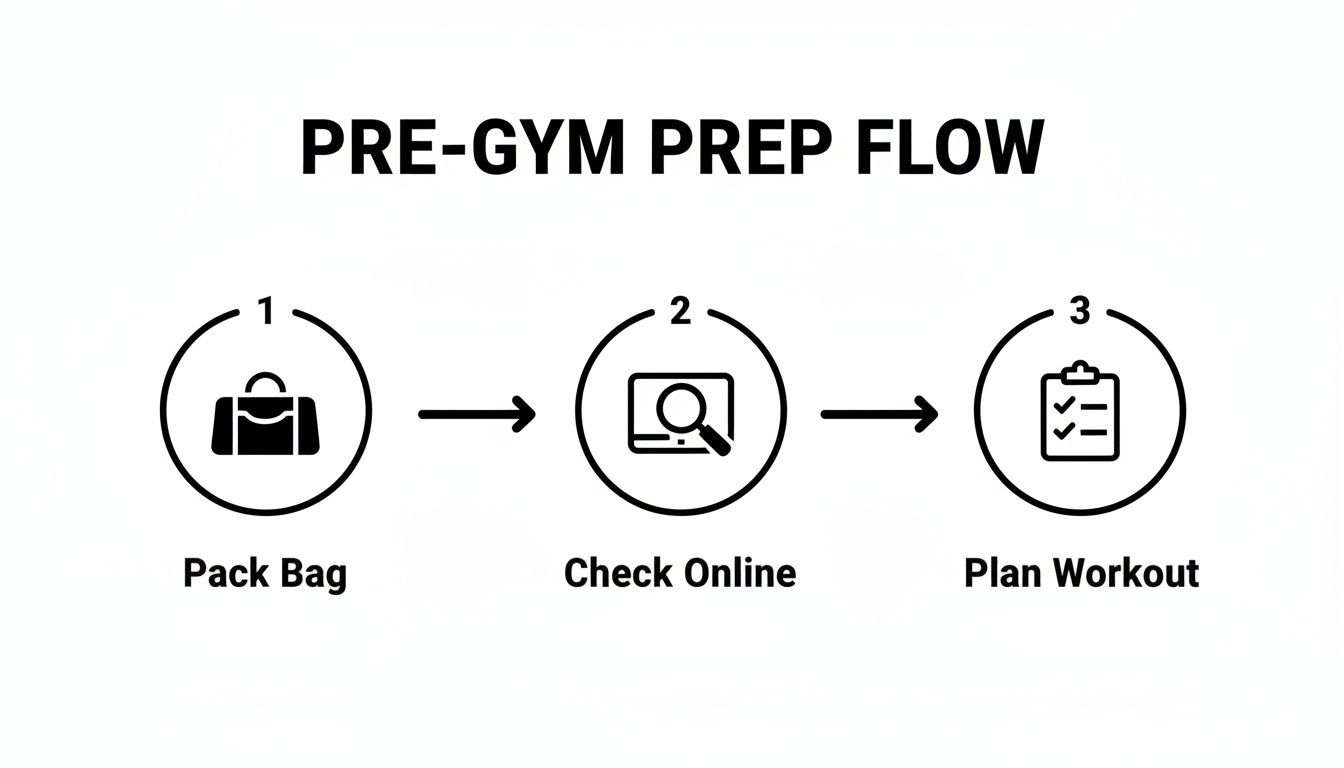
This little pre-gym ritual—packing your bag, scoping out the gym's layout online, and having a workout in mind—turns that feeling of uncertainty into a confident, actionable mission.
A Low-Pressure Plan For Your First Three Visits
Instead of just diving headfirst into the deep end, let's start by dipping a toe in. This plan is all about collecting small wins and creating a positive foundation to build on. Each visit has one single, manageable goal designed to build on the last one, turning what feels like an intimidating space into a familiar one.
If you're feeling a bit lost after taking a long break from fitness, our guide on how to start working out again can give you some extra structure.
The whole point here is consistency over intensity. Just proving to yourself that you can show up and feel okay is a massive victory. It’s the kind of win that builds momentum for the long haul.
The sample plan below is completely flexible. Feel free to tweak the times and activities to whatever feels right for you. The goal is to make it work for you.
Sample 3-Visit Confidence-Building Plan
This table lays out a simple, low-pressure plan for your first three gym sessions. The focus isn't on performance but on building comfort and familiarity with the space, equipment, and routine.
| Visit | Primary Goal | Suggested Duration | Key Action |
|---|---|---|---|
| Visit 1 | Observe and Acclimate | 15-20 Minutes | Walk on a treadmill or use a stationary bike in a low-traffic area. Your only job is to get a feel for the gym's energy and layout. |
| Visit 2 | Explore and Experiment | 20-25 Minutes | Do your cardio warm-up again, then pick one or two machines that look straightforward (e.g., leg press, chest press). Read the instructions and do a few light sets. |
| Visit 3 | Execute a Simple Routine | 25-30 Minutes | Complete a short, pre-planned workout. This could be your cardio warm-up followed by three different machines and a final stretch. The goal is to follow a full plan from start to finish. |
After just these three short trips, you will have hit several huge milestones. You've navigated the locker room, used multiple pieces of equipment, and successfully followed a full workout routine from beginning to end.
Each step systematically dismantles the sources of your gym anxiety, replacing fear with the quiet confidence that only comes from experience. This methodical approach ensures your fitness journey starts not with intimidation, but with empowerment.
Real-Time Techniques to Manage Anxiety Mid-Workout
Even with the best-laid plans, a sudden wave of anxiety can hit you right in the middle of the gym floor. Your heart might start pounding between sets, or you’ll suddenly feel like every single person is watching you.
When that happens, you need a toolkit of discreet, in-the-moment strategies to get back in the driver's seat. These aren’t complicated psychological drills; they're simple, physical actions you can take to ground yourself and quiet the noise in your head. The goal is to stop an anxiety spiral before it completely derails your workout.
Ground Yourself Between Sets
One of the quickest ways to pull yourself out of a sudden anxiety spike is to use a grounding technique. It yanks your focus away from racing thoughts and plants it firmly in your physical surroundings. The 5-4-3-2-1 method is a classic for a reason—it works, and you can do it anywhere.
While you're resting between exercises, discreetly run through this mental checklist:
- 5 things you can see: The specific knurling on the barbell, the bright color of a yoga mat, the digital numbers on a treadmill, a scuff mark on the floor, the texture of the wall. Get specific.
- 4 things you can feel: The solid grip of your hands on your water bottle, the fabric of your shirt on your skin, the firm ground under your feet, the cool metal of a dumbbell.
- 3 things you can hear: The distant clank of weights, the low hum of the air conditioning, the faint rhythm of someone else's music.
- 2 things you can smell: The scent of the gym's cleaning solution or the distinct smell of the rubber floor mats.
- 1 thing you can taste: The aftertaste of the water you just sipped.
This simple sensory scan forces your brain into the present moment, making it nearly impossible to stay stuck on anxious thoughts. Think of it as a private reset button you can press anytime you need it.
Master Your Breath to Calm Your Nerves
Anxiety often shows up physically as shallow, rapid breathing. This only amps up your body's stress response, creating a vicious cycle. The good news is you can break that cycle by consciously taking control of your breath.
Box breathing is a simple but incredibly powerful technique for slowing your heart rate and calming your entire nervous system. Just inhale for a count of four, hold for four, exhale for four, and hold again for four. Repeating this just a few times can make a huge difference.
The Takeaway: Your breath is a direct line to your nervous system. By controlling it, you send a clear signal to your brain that you are safe and in charge, effectively short-circuiting the physical symptoms of anxiety.
Another great way to find calm is through mindful stretching during your cool-down. For example, the Hero Pose has calming benefits that can help you recenter yourself. These practices create a personal bubble, allowing you to turn your focus inward and manage your anxiety in real-time.
Using Technology as Your Private Coach

Let's be honest: sometimes the hardest part of gym anxiety is feeling like you’re going it alone. A great antidote to that feeling can live right in your pocket. Modern fitness apps can feel like a private, non-judgmental coach, taking the sting out of the two biggest sources of "gymtimidation": not knowing what to do, and worrying you’ll do it wrong.
When you have a clear, structured plan on your phone, you're not wandering around hoping you look like you belong. You're there with a purpose. It helps turn an intimidating public space into your own private training ground.
Personalized Plans That Eliminate Guesswork
That paralyzing feeling of walking into a gym with no idea where to even start? AI-driven tools are designed to crush that exact problem. Apps like Zing Coach create a personalized plan before you even leave the house. You answer a few quick questions, and it builds workouts tailored to the equipment you have, the time you've got, and your current fitness level. Suddenly, that first session feels doable, not overwhelming.
The fear of getting hurt is another huge anxiety trigger, and it’s a valid one. In 2022 alone, exercise equipment injuries led to 445,642 emergency room visits. Many apps now tackle this by using your phone's camera for real-time form tracking, giving you feedback to help you move safely and correctly.
Your Own Digital Trainer and Progress Tracker
Beyond just giving you a workout, these apps have features built specifically to boost your confidence. An on-screen avatar can demonstrate every single movement, showing you exactly what proper form looks like and which muscles you should feel working. It's like having a personal trainer for each exercise, minus the social pressure of a real person watching you.
- Visual Guidance: Animated demonstrators take all the guesswork out of how to perform an exercise.
- Private Tracking: Your progress—reps, sets, weight lifted—is all tracked privately. You get to see your small wins add up without ever having to compare yourself to the person on the next bench.
- Motivational Nudges: Small things like workout streaks, challenges, and tips provide that little bit of positive reinforcement that keeps you coming back, all without any public spotlight.
By putting a structured, guided experience in your hands, technology effectively builds a personal "bubble" around you. Your focus shifts from the environment to the screen in front of you, making everyone else in the gym fade into the background.
This digital support system gives you the power to learn and grow at your own speed. You can see how the Zing AI Coach upgrades are designed to provide exactly this kind of guided, confidence-building experience. For more general mental support, you might also find that some of the best free anxiety apps can act as another private coach for your overall well-being.
Common Questions About Gym Anxiety
Even with a solid game plan, it's totally normal for specific worries to creep in when you're at the gym. Let's tackle some of the most common ones head-on. Think of this as your quick-reference guide for those moments when you need a little extra reassurance.
What if I'm Worried About My Form?
This is probably the #1 concern for anyone new to the gym, and for good reason—you want to be safe and effective. A fantastic place to start is with the weight machines.
Seriously, they're designed to guide you through the correct range of motion. Plus, they almost always have little diagrams on them showing you exactly what to do, which makes it pretty hard to get it wrong.
If you want an extra layer of confidence, a tool like the Zing Coach app can be a game-changer. It uses your phone's camera to give you real-time feedback on your technique. It’s like having a private, non-judgmental spotter right in your pocket. You can even practice the movements at home first to feel totally prepared before you even walk through the gym doors.
How Do I Handle Feeling Like People Are Watching Me?
Ah, the classic "spotlight effect." It’s that nagging feeling that every single person in the gym is staring at you, judging your every move. But here’s the truth: they’re not.
Most people are completely wrapped up in their own world—their music, their next set, their own insecurities. They are far too focused on themselves to pay much attention to you.
The key is to create your own personal bubble.
- Pop in your headphones. This is the universal sign for "I'm in the zone." A great playlist or a guided workout will help keep your focus where it belongs: on you.
- Have a plan. There's nothing worse than wandering around aimlessly. When you have a clear plan from an app, you move with purpose. It signals to yourself and everyone else that you're there to get stuff done.
The most freeing realization you can have in the gym is that nobody is thinking about you nearly as much as you are. Everyone is the main character of their own story; you’re just an extra in theirs, and vice versa.
I'm Not Seeing Results and It's Discouraging
This one hits hard. It can be incredibly frustrating when you're putting in the work but the mirror isn't reflecting the changes you'd hoped for. Visual changes can take weeks, or even months, to show up.
A much better way to stay motivated is to shift your focus to performance gains. These are the real, immediate signs that you're making progress.
Did you lift just a little more weight than last week? Squeeze out one extra rep? Last two more minutes on the treadmill? These are the small but powerful wins that prove you are getting stronger. Apps like Zing Coach are brilliant for this, as they track these little milestones for you, giving you that steady stream of positive feedback you need to stick with it for the long haul.
Ready to walk into the gym with a clear, personalized plan that builds confidence from day one? Let Zing Coach be your non-judgmental guide. Get a workout tailored to your goals and equipment, complete with form feedback to keep you safe and motivated.
Start your journey at https://zing.coach.
Share this article


Authors