Discover what is functional fitness training and how it builds practical strength for everyday life. Learn key exercises and benefits to get started.
Functional fitness training is all about preparing your body for the real world. Forget just isolating muscles to look good in the mirror; this is about building practical strength that helps you lift groceries, play with your kids, or just move through your day with more ease and way less risk of getting hurt.
What Is Functional Fitness Training, Really?

Let's use an analogy. Think of your body as a high-performance car. Traditional bodybuilding is like spending all your time polishing the chrome and admiring the sleek paint job—it definitely looks impressive.
Functional fitness, on the other hand, is about tuning the engine, upgrading the suspension, and making sure the brakes work perfectly. It’s all about what the vehicle can do, not just how it looks sitting in the driveway.
This style of training is built on exercises that copy the natural movements we make every day. Instead of sitting on a machine for a bicep curl, a functional workout might have you doing a farmer's carry. This single move strengthens your grip, core, and posture all at once—just like when you're lugging heavy bags through an airport.
To get a clearer picture of how functional fitness stacks up against more traditional approaches, let's break it down.
Functional Fitness At a Glance
This table offers a quick side-by-side comparison, highlighting the core differences in philosophy and application between functional fitness and traditional bodybuilding.
| Aspect | Functional Fitness Training | Traditional Bodybuilding |
|---|---|---|
| Primary Goal | Improve real-world performance and reduce injury risk. | Maximize muscle size and aesthetic symmetry. |
| Movements | Compound, multi-joint movements (squat, lunge, push, pull, carry). | Isolation exercises targeting individual muscles (bicep curls, leg extensions). |
| Equipment | Diverse: kettlebells, dumbbells, resistance bands, bodyweight. | Machine-heavy, barbells, and dumbbells for targeted muscle work. |
| Real-World Transfer | High. Strength directly applies to everyday activities. | Low to moderate. Builds muscle but doesn't always translate to functional strength. |
Ultimately, the choice depends on your "why." If your goal is to build a body that's as capable as it is strong, functional training is where it's at.
Training for the "Sport of Life"
The whole point is to get better at what we could call the "sport of life." It’s about building strength, coordination, and stability that you can actually use outside the gym. The goal isn't just to hit a new personal record on the deadlift, but to make lifting a heavy box off the floor feel completely effortless and safe.
Functional fitness revolves around compound movements—exercises that get multiple muscle groups and joints working together. This approach delivers some serious benefits:
- Improved Coordination: It trains your muscles to fire together as a single, efficient system.
- Greater Stability: It strengthens those tiny stabilizing muscles around your joints, which is a game-changer for balance and injury prevention.
- Enhanced Real-World Strength: You build the kind of strength that actually shows up when you need it most.
Functional fitness is more than a workout; it's a blueprint for preparing your body for whatever life throws at it. By focusing on how your body moves as an integrated unit, you build a foundation of strength that is both resilient and genuinely useful.
Its Rise in Popularity
The appeal here is its universal relevance. Whether you're an athlete chasing peak performance or a grandparent who just wants to keep up with the grandkids, the principles are the same.
This philosophy has caught on for a reason. It first gained traction in military and athletic programs back in the 1990s before exploding into the mainstream with the rise of CrossFit. Today, it’s one of the top fitness trends globally, which shows a massive shift toward practical, performance-driven exercise. You can see a perfect example of this in our guide to calisthenics exercises, which leverages bodyweight to build incredible functional strength.
As of 2023, functional fitness training was the #5 global fitness trend, sitting just behind wearables and traditional strength training. This highlights a clear demand for back-to-basics, effective training methods among the 64.2 million gym members in the US. It's a method that promises not just a better body, but a better-moving one.
Getting to Grips With Functional Movement
To really understand functional fitness training, you have to look past individual exercises and think about the fundamental ways we humans move. Forget about training isolated muscles like biceps or quads for a second. Functional training is all about actions: pushing, pulling, squatting, and carrying. These are the building blocks of everything you do, from hauling groceries to playing a pickup game of basketball.
This is a powerful way to train because it teaches your body to work as one integrated system. Your brain, nerves, and muscles learn to fire together in perfect sync, a process that improves your neuromuscular coordination. The better this connection gets, the more efficient, powerful, and stable you become, both in the gym and in your day-to-day life.
The Seven Pillars of Movement
Functional fitness is really built around seven foundational movement patterns. Think of them as the alphabet of physical skill. Once you learn them, you can combine them to handle just about any physical task you can imagine.
Push: This is all about moving an object away from your body, or your body away from an object. You do it when you push open a heavy door, get up off the floor, or shove a lawnmower across the yard. In the gym, we train this with classics like push-ups and overhead presses.
Pull: The natural opposite of a push. It’s the act of pulling something toward you or pulling yourself toward something else. Firing up a lawnmower, slinging a heavy backpack on, or doing a pull-up are all pull movements. We hit this pattern hard with rows and pull-ups.
Squat: This is simply lowering your hips from a standing position and then standing back up. You do this countless times a day when you sit in a chair or pick something light off the floor. The classic barbell back squat or a basic bodyweight squat directly trains this essential pattern.
When you focus on these patterns, you’re basically reverse-engineering your workouts to solve real-world physical problems.
Spotting the Patterns in Daily Life
Let's break down the last four patterns and see how they crop up when you're not even thinking about "exercise." Making these connections is the key to understanding why you’re doing a particular functional movement in your workout.
Lunge: Any time you take a big step—like dropping down to catch your phone before it hits the ground, kneeling to tie your shoe, or even just climbing a flight of stairs—you’re lunging. Training different kinds of lunges builds your balance and single-leg stability like nothing else.
Hinge: This is the crucial movement of bending at your hips while keeping your back straight. You use a proper hinge to safely pick up a heavy box from the floor, which saves your lower back from taking the strain. Exercises like deadlifts and kettlebell swings are pure hinge movements.
Rotate: Twisting motions, like turning to look over your shoulder while driving or swinging a golf club, are all about rotation. Core work like Russian twists or wood chops builds the strength you need for safe, powerful twisting.
Carry: It doesn't get more fundamental than this. Carrying objects—whether it’s groceries, a suitcase, or your kid—is a core human movement. Loaded carries, like the classic Farmer's Walk, build grip strength, core stability, and good posture all at the same time.
The point of functional fitness isn't just getting strong for the sake of it. It’s about making your gym strength useful, ensuring your body is ready for the messy, unpredictable physical demands of life.
Compound Moves and a Smarter Body
These seven patterns are best trained using compound exercises—movements that hit multiple joints and muscle groups all at once. A squat, for example, involves your hips, knees, and ankles while firing up your glutes, quads, hamstrings, and core.
This multi-joint approach is way more efficient than picking muscles apart with isolation exercises. More importantly, it forces your brain to act as a conductor, orchestrating a complex symphony of muscle contractions and improving that mind-muscle connection. To really get how movement applies in the real world, you can think of it like hands-on learning, where doing the thing is what makes the skill stick. Functional fitness is the physical version of that; it teaches your body skills through direct, practical application.
The result is a body that moves with more intelligence and coordination. The whole Zing Coach methodology is built on these principles, using AI to design workouts that strengthen these foundational patterns for the biggest real-world payoff. You can learn more about how Zing’s AI Coach creates these routines to help you move better every single day. It’s a smart approach that makes sure every workout gets you one step closer to being a more capable, resilient you.
Exploring the Key Benefits of Functional Fitness Training
Knowing the principles of functional fitness is one thing, but seeing how they pay off in the real world is where it gets exciting. This style of training isn't just about looking good in the gym; it's about building a body that works for you, making everyday life feel easier and safer.
The first thing you'll notice is a huge boost in usable strength. Because these exercises mimic the things you do every day, the strength you build is immediately practical. Suddenly, hoisting a heavy suitcase into an overhead bin or carrying all the groceries in one trip feels less like a struggle and more like something your body is simply built to do.
Enhanced Balance and Injury Prevention
Another game-changer is how much your balance and stability improve. Many functional movements challenge you to control your body on one leg or an unstable surface, which powerfully strengthens all the small stabilizer muscles around your joints.
This has a direct impact on preventing falls and injuries. Think about catching your balance on an icy sidewalk or steadying yourself after tripping over a toy—that quick, reflexive stabilization is a skill you sharpen with every lunge or single-leg deadlift. By training your body to be coordinated and resilient, you’re basically building a suit of armor against common sprains and strains.
Functional fitness is proactive healthcare. It doesn't just build muscle; it builds a more robust, injury-resistant body that is better prepared for the physical unpredictability of daily life.
By forcing multiple muscle groups to work together, functional workouts create a serious metabolic demand. This means you burn more calories in less time compared to isolated exercises, making it a super-efficient way to train if you have weight management goals. As a bonus, the focus on compound movements strengthens your entire core and back, which often leads to better posture and less lower back pain.
This graphic really drives home how central the core is to other fundamental movements like pushing, squatting, and carrying.
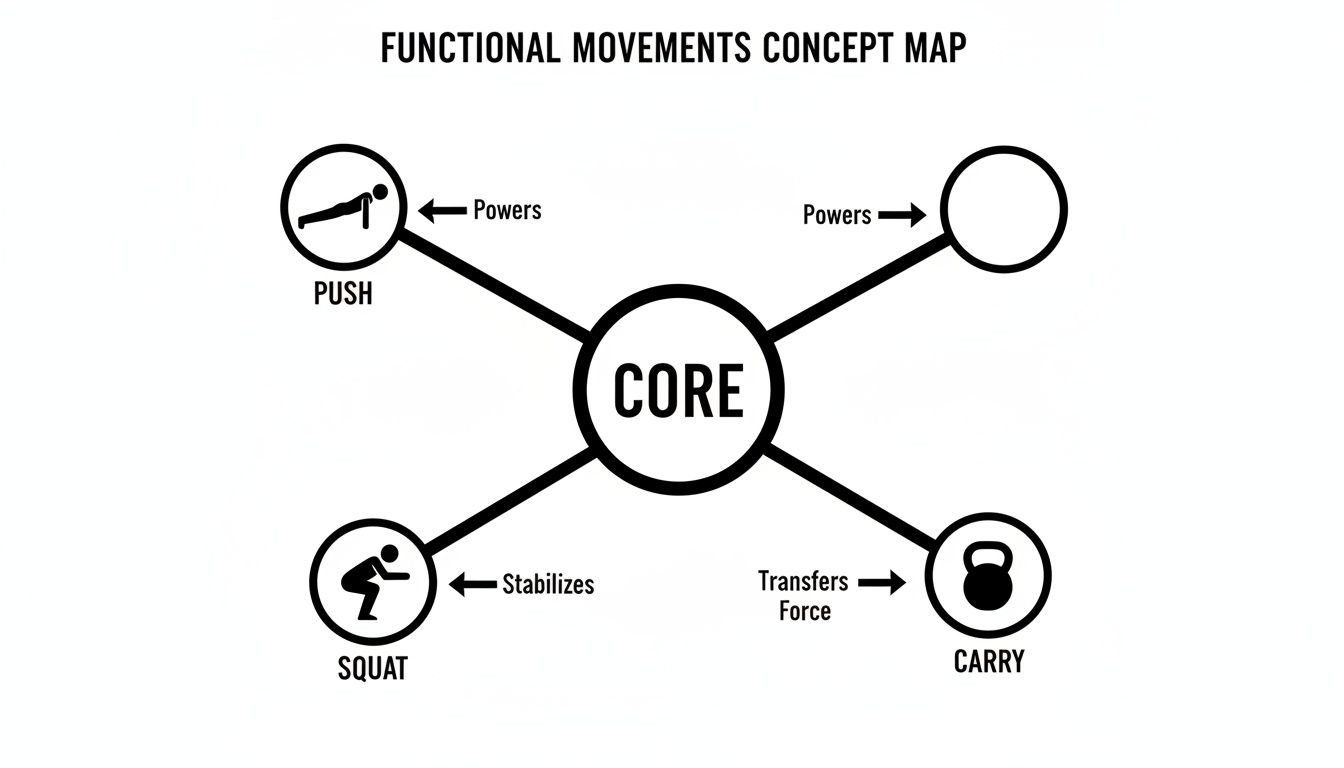
It’s a great visual reminder that a strong core is the foundation from which all other functional strength is built.
Better Mobility and Quality of Life
Beyond just strength and stability, functional fitness does wonders for your mobility—your ability to move your joints through their full range of motion without pain or restriction. Movements like deep squats don’t just build leg strength; they also promote flexibility and keep your joints healthy. This translates to more freedom to bend, twist, and reach, whether you're working in the garden or just getting out of bed in the morning.
This all-around approach delivers impressive results. Studies have shown that functional training leads to 20-30% better improvements in daily activities like climbing stairs or lifting objects compared to standard machine-based training. For Zing Coach users, this is taken a step further; adaptive plans can use computer vision to analyze form and adjust for recovery, a method shown to slash injury risk by up to 30% in certain functional programs. This makes it an incredibly effective strategy for anyone looking for real, long-term health benefits. You can see this trend reflected in the booming functional fitness equipment market.
Ultimately, the benefits are woven directly into your daily life. It’s the confidence to say "yes" to a last-minute hike, the ease of playing with your kids on the floor, and the simple freedom of moving through your world without pain holding you back.
Comparing Functional Fitness With Other Training Styles
With so many ways to work out, it's easy to get confused. Is functional fitness just a trendy new name for HIIT? Is it the same thing as CrossFit? While there can definitely be some overlap, the core philosophy behind functional fitness sets it apart from other popular methods.
Figuring out these differences is the key to picking the right approach for your own goals. It always comes down to the "why" behind your workout.
Functional Fitness vs. Traditional Strength Training
Traditional strength training, the kind most people associate with bodybuilding, is fantastic for building muscle size and zeroing in on specific muscle groups. Think of a bicep curl or a leg extension machine. The main goal here is hypertrophy—making a muscle bigger and stronger, often for aesthetic reasons.
Functional fitness, on the other hand, is all about integration. The goal isn't just to strengthen individual muscles, but to strengthen movement patterns. So, instead of a leg extension, you’d do a squat. A squat strengthens your quads, glutes, hamstrings, and core by teaching them how to fire together as a team.
The core difference is purpose. Traditional strength training builds muscles. Functional fitness builds movements. One prepares you for the stage; the other prepares you for life.
This is why a functional routine will almost always favor free weights, kettlebells, and bodyweight exercises over machines. They do a much better job of mimicking the instability and coordination you need to navigate the real world.
Functional Fitness vs. HIIT
This is where the lines can get a little blurry, because a functional workout can absolutely be a High-Intensity Interval Training (HIIT) session. HIIT isn’t about what you do, but how you do it. It’s defined by its structure: short, all-out bursts of work followed by brief recovery periods. Its primary mission is to torch calories and boost cardiovascular health in the shortest time possible.
You could easily build a HIIT workout using functional exercises like kettlebell swings and burpees. But you could also do a HIIT workout on a stationary bike, which has far less carryover to daily life.
The key is intent. A workout is functional because of the exercises chosen (they mimic real-life movements). A workout is HIIT because of the timing and intensity. You can combine them for a killer, efficient session, but their fundamental goals are different.
Functional Fitness vs. Sport-Specific Training
Sport-specific training is really just a highly specialized form of functional training. It's tailored to improve performance in a particular athletic activity. For instance, a basketball player might hammer out box jumps to boost their vertical leap, while a golfer might do rotational medicine ball throws to add power to their swing.
These are functional movements, no doubt, but they're laser-focused on getting better at one specific sport. General functional fitness is much broader. It aims to improve your ability to handle the "sport of life"—lugging groceries, moving furniture, and chasing your kids around the park.
Think of it like this:
- Sport-Specific Training: Prepares you for a specific game or event.
- General Functional Fitness: Prepares you for whatever life throws your way.
One builds specialized skills; the other builds a well-rounded foundation of physical capability.
How Functional Fitness Compares
To really see the differences at a glance, it helps to put these training styles side-by-side. Each has a distinct purpose and uses different tools to get the job done.
| Training Style | Primary Goal | Example Exercises |
|---|---|---|
| Functional Fitness | Improve real-world movement quality and reduce injury risk. | Goblet Squats, Farmer's Walks, Kettlebell Swings |
| Traditional Strength | Maximize muscle size and isolated strength. | Bicep Curls, Leg Extensions, Triceps Pushdowns |
| HIIT | Maximize calorie burn and cardiovascular conditioning. | Sprint intervals, Burpees, Jumping Jacks |
| Sport-Specific | Enhance performance in a particular sport. | Box Jumps (for basketball), Rotational Throws (for golf) |
While every style has its place, functional fitness acts as the perfect foundation for pretty much any other physical goal. Whether you're a bodybuilder looking to improve joint stability or an athlete wanting to build more resilient strength, weaving functional principles into your routine will make you better at what you do. Many smart programs, like a classic 3-day split workout routine, can be adapted to include functional movements, giving you the best of both worlds for a stronger, more capable body.
Starting Your First Functional Fitness Workouts
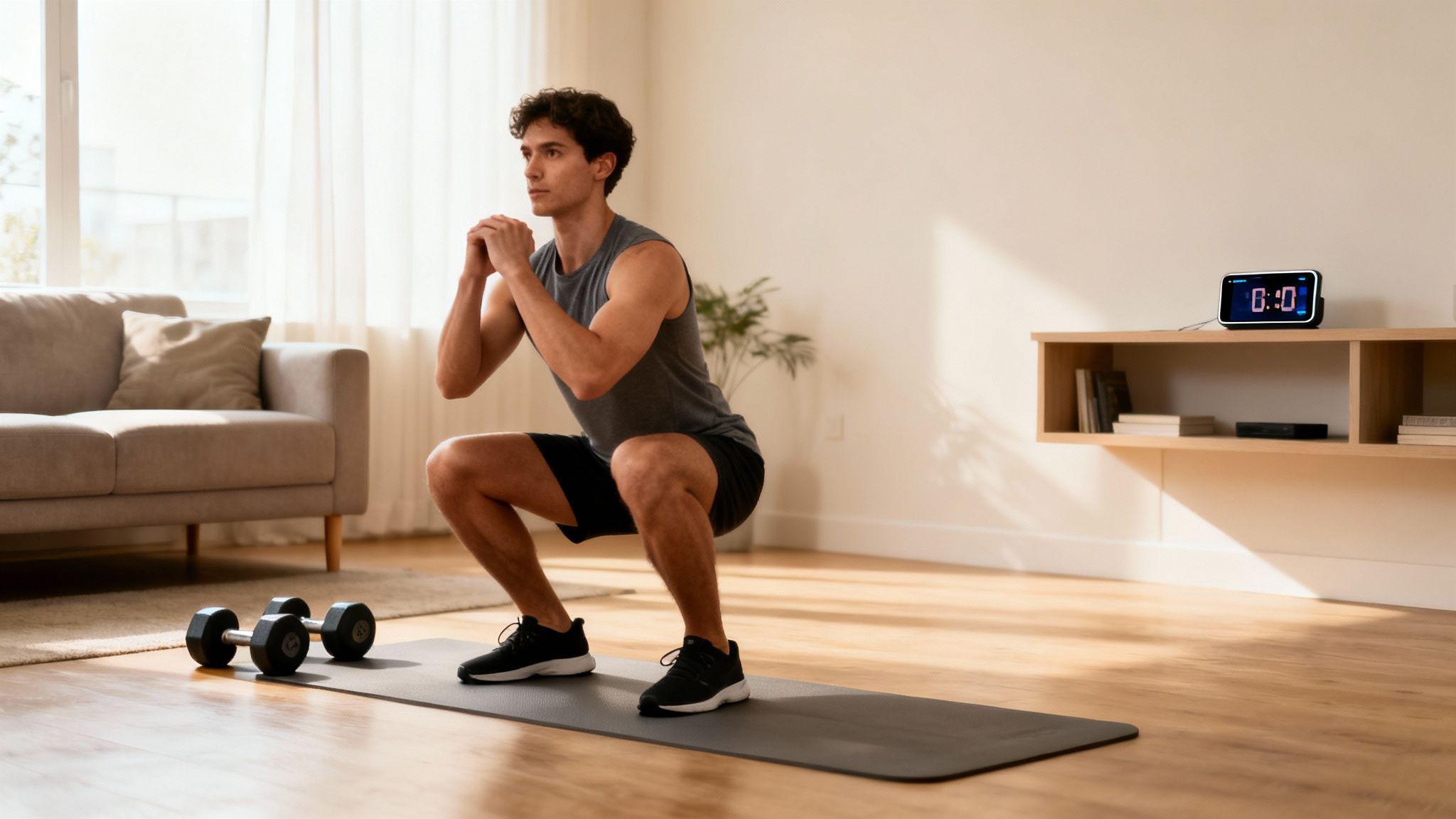
This is where the theory behind what is functional fitness training really comes to life. It’s time to get moving and feel the benefits for yourself. We’ve put together two beginner-friendly workouts to get you started: one using just your bodyweight and another that brings in a pair of dumbbells for a little extra resistance.
Each workout follows a simple, effective structure: a dynamic warm-up to prep your body for action, the main circuit to build strength and coordination, and a cool-down to kickstart the recovery process.
The At-Home Bodyweight Functional Workout
This routine requires zero equipment and can be done anywhere you have a bit of floor space. The key here is focusing on great form and controlling every single movement.
1. Dynamic Warm-Up (5 Minutes)
Let’s get your blood flowing and your joints ready to work.
- Leg Swings: 10 swings forward and backward on each leg.
- Arm Circles: 10 circles forward and 10 backward with each arm.
- Torso Twists: 20 twists, rotating gently from your core.
- Cat-Cow Stretch: 10 slow reps to wake up your spine.
2. Main Circuit (Complete 3 Rounds)
Perform each exercise for the number of reps listed, moving from one to the next with just a short pause. After you’ve finished all four exercises, take a 60-second rest before you start the next round.
- Bodyweight Squats (12 reps): Stand with your feet shoulder-width apart. Drop your hips back and down like you're sitting in a chair, keeping your chest up and your back straight.
- Push-Ups (8 reps): You can do these from your toes or drop to your knees. The goal is a straight line from your head to your heels (or knees) as you lower your chest toward the floor.
- Glute Bridges (15 reps): Lie on your back with your knees bent and feet flat. Squeeze your glutes to lift your hips up until your body makes a straight line from your shoulders to your knees.
- Plank (Hold for 30 seconds): Get on your forearms and toes, keeping your body perfectly straight. Squeeze your core and glutes tight.
3. Cool-Down (5 Minutes)
Hold each of these stretches for about 30 seconds to help with flexibility and recovery.
- Quad Stretch: Stand up and pull one heel toward your glute.
- Hamstring Stretch: Sit down with one leg straight out and gently reach for your toes.
- Chest Stretch: Clasp your hands behind your low back and gently pull your shoulders back to open up your chest.
The Minimal Equipment Dumbbell Functional Workout
If you’ve got a pair of dumbbells, this workout will add some resistance to really amplify your results. Pick a weight that feels challenging but still lets you complete all your reps with solid form.
The rise of home workouts has created a huge demand for versatile tools like dumbbells. The global functional fitness equipment market was valued at USD 10.2 billion in 2023 and is projected to hit an incredible USD 369.9 billion by 2033. This explosion shows a massive worldwide shift toward training that builds real-world strength with simple, accessible equipment. You can learn more about the explosive growth of the functional fitness market and what it means for everyday fitness.
1. Dynamic Warm-Up (5 Minutes)
- Jumping Jacks: 30 seconds.
- High Knees: 30 seconds.
- World's Greatest Stretch: 5 reps on each side.
- Inchworms: 5 reps, walking your hands out to a plank and back up.
2. Main Circuit (Complete 3 Rounds)
Move through each exercise with control. Rest for 60-90 seconds after you’ve completed the full circuit.
- Goblet Squats (10 reps): Hold one dumbbell vertically against your chest. Squat down, keeping your torso upright and proud.
- Dumbbell Rows (10 reps per side): Hinge forward at your hips, keeping your back flat. Pull one dumbbell up toward your chest, squeezing your shoulder blade.
- Walking Lunges (8 reps per leg): Step forward into a lunge, making sure your front knee stays right over your ankle. Holding dumbbells at your sides will make this tougher.
- Farmer's Walk (30 seconds): Grab a dumbbell in each hand and walk with a tall, strong posture. This is all about core stability and grip strength.
3. Cool-Down (5 Minutes)
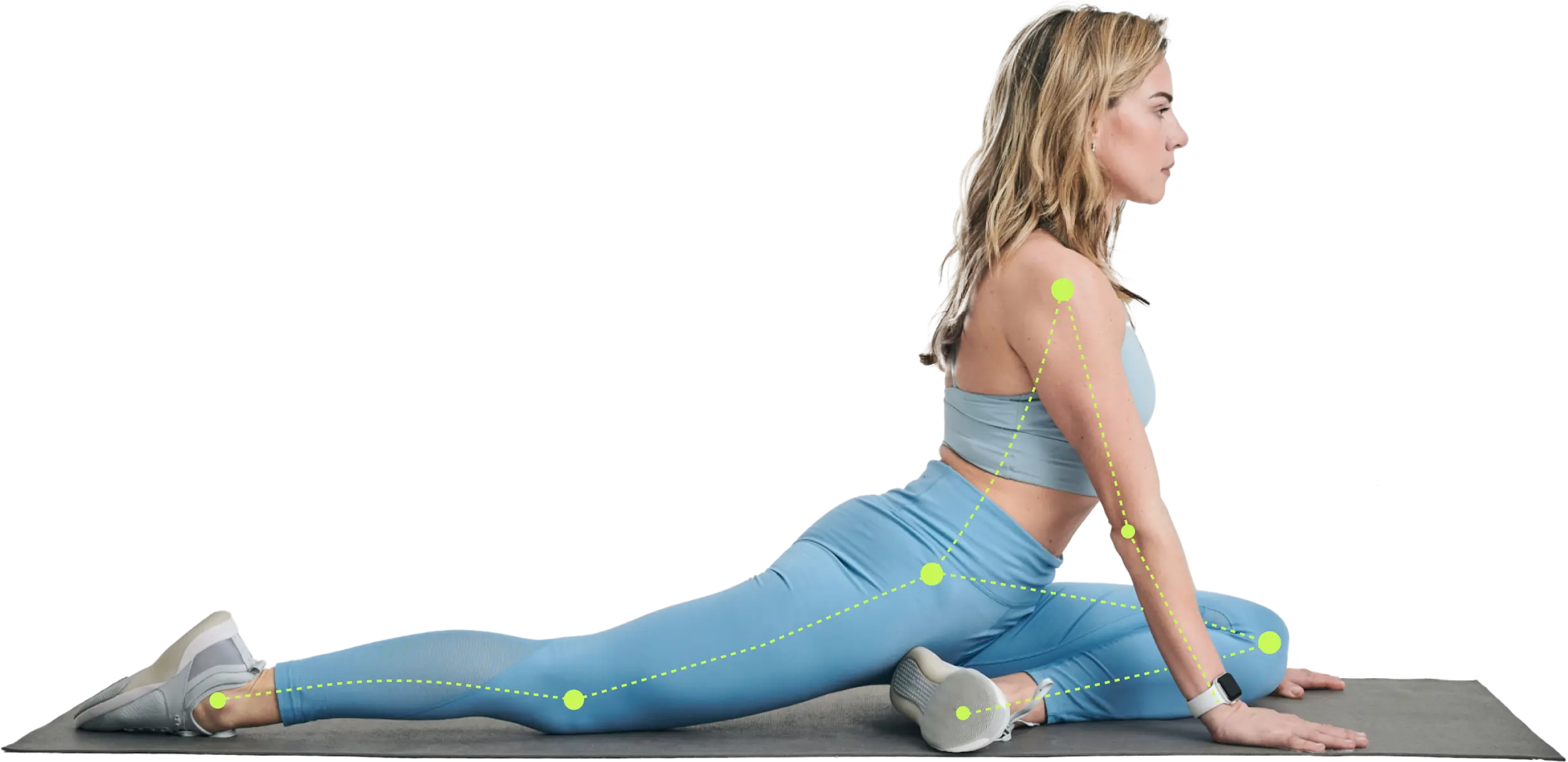
- Pigeon Pose: A fantastic deep stretch for your hips.
- Child's Pose: Gently stretches your back and shoulders.
- Triceps Stretch: Reach one arm overhead, bend the elbow, and use your other hand to gently pull it for a stretch.
How to Progress Your Workouts
Functional fitness is all about getting better over time. As soon as a workout starts feeling manageable, it’s time to dial up the challenge.
Your body adapts to the demands you place on it. To keep getting stronger and more capable, you must consistently give it a new reason to adapt. This is the core of progressive overload.
Here are a few simple ways to level up:
- Increase Reps: Try adding 2 reps to each exercise every week.
- Add a Round: Once you can nail 3 rounds without feeling completely gassed, go for a 4th.
- Decrease Rest Time: Shave 15 seconds off your rest period between rounds.
- Increase Weight: For the dumbbell workout, once you can easily hit all your sets and reps, it's time to grab the next heaviest pair.
For anyone just easing back into a routine, the most important thing is to start slow and listen to your body. Our guide on how to start working out again is packed with great advice for making a safe and effective comeback.
How Technology Can Optimize Your Functional Training
While functional fitness is built on timeless, natural movements, today's tech can seriously level up your training, making it safer, smarter, and way more personal. Let's be honest, we've all hit those same walls: Am I doing this right? When should I add more weight? How do I stay motivated when I'm not seeing results?
This is exactly where smart tools are changing the game.
The idea of a personal coach in your pocket isn’t science fiction anymore. AI-powered fitness apps have made it a reality. Think of them as a digital guide that takes the guesswork out of your workouts, giving you a clear, structured path to follow.
They offer a level of personalized attention that used to be reserved for expensive one-on-one coaching. By looking at your goals, current fitness level, and even the equipment you have on hand, these tools build workouts that are genuinely right for you.
Real-Time Form Correction
One of the biggest game-changers is computer vision. By using your phone’s camera, some advanced apps can literally watch and analyze your movements as you perform an exercise. It’s like having an expert trainer's eyes on every single rep you do.
If your squat isn't deep enough or your back starts to round during a deadlift, the app can give you instant feedback—either a sound or a visual cue—to help you fix it on the spot. This doesn't just make every rep count; it dramatically cuts down the risk of injury. You end up building strength on a solid, safe foundation.
Technology turns your smartphone from a passive workout log into an active coaching partner. It provides the immediate feedback you need to master your form, which is the absolute cornerstone of safe, effective functional training.
Intelligent Progression and Adaptation
Figuring out when to push yourself is a classic dilemma. More weight? More reps? Shorter rest? AI algorithms can answer these questions for you by learning from your performance.
When you log your sets, reps, and the weights you lift, a smart app starts to see patterns. It recognizes when you’re getting stronger and ready for the next challenge. It can automatically dial up the intensity of your workouts based on your actual progress, and can even account for things like your own feedback on how you're feeling.
This kind of smart adaptation makes sure you’re always challenged enough to keep improving, but not so much that you’re headed for burnout. The Zing AI Coach is a great example of this in action, constantly tweaking your plan to get you the best results. You can learn more about how Zing’s AI Coach upgrades your workouts as you go.
This data-first approach takes the emotion and guesswork out of the equation. What's left is a logical, progressive plan designed to help you build a more capable body, one smart workout at a time.
Your Functional Fitness Questions, Answered
Even when the concept clicks, it's natural to have a few lingering questions before diving in. Sometimes, getting straight answers is the final push you need to get started with confidence.
Let's clear up some of the most common questions that come up.
How Often Should I Do Functional Workouts?
When you're starting out, consistency beats intensity every time. For most people, aiming for two to four functional training sessions per week is the sweet spot. This gives your body enough time to recover and adapt between workouts—which, by the way, is when the real strength building happens.
This lines up perfectly with general physical activity guidelines, which suggest a couple of strength training days each week. Don't underestimate the power of showing up; even just two sessions a week will lead to noticeable gains in strength and how well you move.
Can I Build Muscle with Functional Fitness?
You absolutely can. While the main goal isn't bodybuilding-style muscle isolation, functional fitness is fantastic for building real-world muscle. Think about it: compound exercises like squats, deadlifts, and rows fire up multiple large muscle groups all at once, which is a powerful signal for growth.
Because these movements are so demanding, they help you build strong, dense, and capable muscles. You might not get the peaked biceps of a competitive bodybuilder, but you'll forge a powerful, athletic physique where every muscle knows how to work together as a single, coordinated team.
Is Functional Fitness Safe If I Have an Old Injury?
Actually, functional fitness can be one of the safest and smartest ways to train, especially if you're working around old injuries. The whole point is to focus on controlled, natural movement patterns. This strengthens the muscles and connective tissues that support your joints, boosting stability and cutting down the risk of re-injury.
That said, you have to approach it the right way:
- Start with a pro: It's always a good idea to work with a qualified coach or physical therapist who can tweak exercises for your specific situation.
- Form over everything: Never, ever sacrifice good technique just to lift more weight or squeeze out another rep.
- Listen to your body: Pay close attention to what you're feeling. Don't try to push through sharp or unusual pain.
What Kind of Results Can I Expect?
The results you get from functional fitness show up both inside the gym and, more importantly, outside of it. You can expect to feel stronger, have better balance, and notice a real boost in your overall energy levels. Suddenly, daily life just gets easier—lugging groceries, chasing your kids around the park, or doing yard work will feel less like a chore.
Aesthetically, you'll probably see a more toned, athletic build as you shed body fat and add lean muscle. For those who love data, advanced trackers can offer incredible insights into your progress; you can even learn more about how GPS tracking in sport can boost performance by monitoring your movement and output.
Ready to stop guessing and start building real-world strength with a plan that adapts to you? The Zing Coach app uses AI to create workouts tailored to your goals, equipment, and fitness level. Get real-time form feedback and intelligent progressions that make every session count. Download Zing Coach and start your personalized fitness journey today!
Share this article


Authors