How to break through weight loss plateau with proven nutrition, training, and recovery strategies to restart progress and see results again.
To break through a weight loss plateau, you need a strategic shift, not just more effort. This isn't about pushing harder with the same old plan. It's about getting smarter and adjusting to your body's new, more efficient state by taking a close look at your nutrition, workout intensity, and recovery.
Understanding Why Your Weight Loss Stalled
It's one of the most frustrating moments in any fitness journey: after weeks or even months of solid progress, the scale just stops moving. Let me be clear: this is not a sign that you've failed. It's a completely normal—and predictable—sign that your body is adapting to the changes you've made.
Think of it less as a roadblock and more as a crucial checkpoint. Your body is incredibly smart. As you lose weight, it gets lighter and simply requires fewer calories to function. This biological process, known as metabolic adaptation, is a deep-rooted survival mechanism. Your body is becoming more fuel-efficient, which means the calorie deficit that once delivered results is no longer cutting it.
What Is Really Happening to Your Body
It’s not just a case of a "slower metabolism." There are usually a few different factors at play when you hit that frustrating weight loss plateau:
- You're a smaller person now. Plain and simple, a lighter body burns fewer calories, both when you're resting and when you're working out. The diet and training plan that worked for you 15 pounds ago might now be your new maintenance level.
- You might have lost some muscle. If strength training isn't a priority, you can lose some muscle mass along with fat. Since muscle is more metabolically active, this can slightly dial down your daily calorie burn.
- "Calorie creep" is real. We've all been there. Small, untracked bites, licks, and sips add up faster than you'd think. That splash of creamer, a handful of nuts, a little taste while cooking—it can all quietly erase your calorie deficit.
- Your workouts have become routine. The human body is an adaptation machine. If your routine hasn't changed in months, it’s probably not challenging you enough to keep stimulating progress.
This decision tree gives you a great visual breakdown of the common culprits behind a stall, helping you figure out where to start digging.
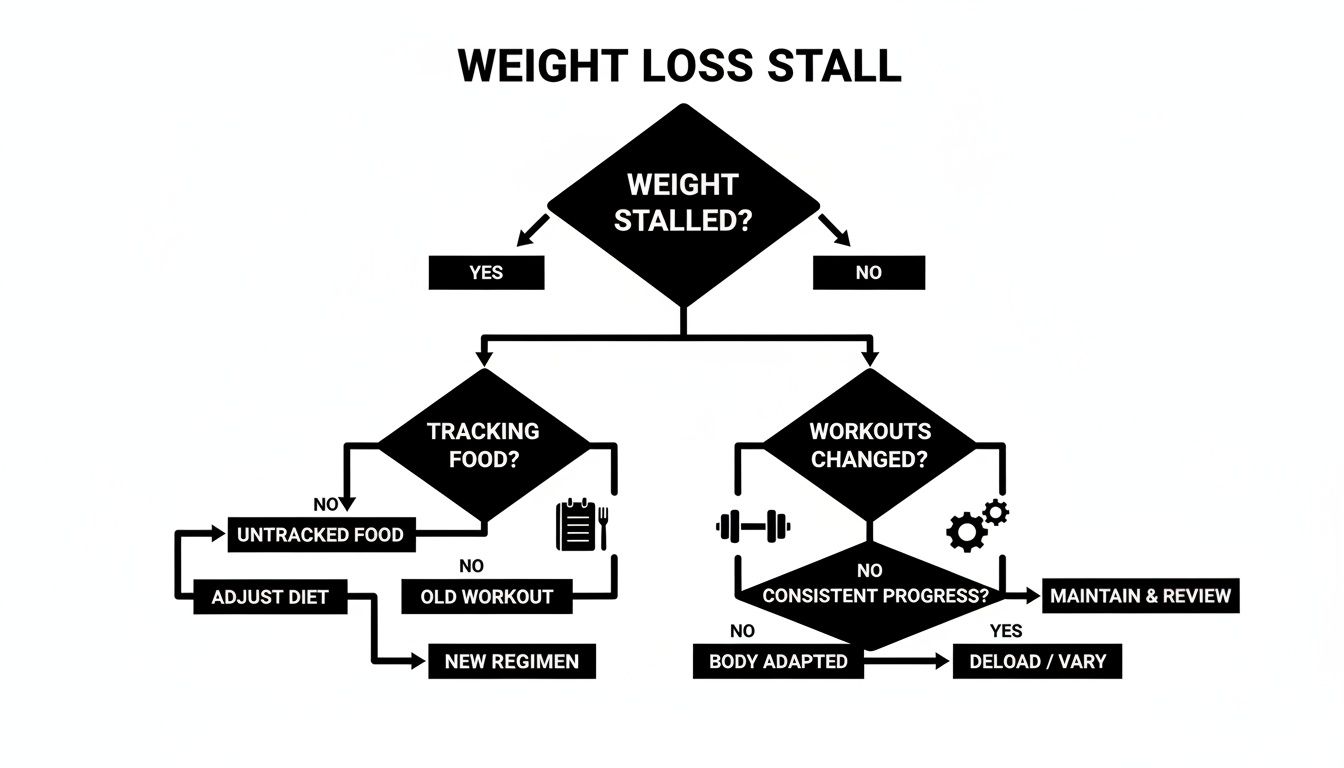
This visual helps break down the problem into actionable categories, guiding you to either re-evaluate your food log, adjust your workout, or address metabolic adaptation directly.
Before you overhaul your entire routine, it helps to quickly assess where the issue might be.
Quick Plateau Diagnosis Checklist
Use this table to quickly identify why your weight loss might have stalled before diving into the detailed solutions in this guide.
| Potential Cause | Key Question to Ask Yourself | Where to Find the Solution |
|---|---|---|
| Diet Inconsistencies | "Am I tracking everything I eat and drink, or have I gotten a bit relaxed?" | Section 2: Re-evaluating Your Nutrition |
| Workout Adaptation | "Has my training intensity and routine been the same for the last month or more?" | Section 3: Shaking Up Your Training |
| Metabolic Adaptation | "Have I been in a calorie deficit for more than 12 weeks without a break?" | Section 5: Using Diet Breaks & Refeeds |
| Recovery Issues | "Am I consistently getting less than 7 hours of quality sleep per night?" | Section 4: Prioritizing Recovery and Sleep |
This checklist should give you a solid starting point. Now let's dig into the details.
Plateaus Are the Rule, Not the Exception
Trust me, hitting a stall is an incredibly common part of the process. In fact, research often shows that people see the most significant weight loss around the six-month mark before progress naturally slows or stops altogether. This isn’t a failure; it’s a physiological reality for almost everyone.
A weight loss plateau isn't a wall; it's a signal. It tells you that your body has successfully adapted to your efforts and is now ready for a new, smarter strategy to continue making progress.
A key part of navigating this is continuously monitoring metabolic health markers, which gives you a clearer picture of what's happening under the hood.
Ultimately, reframing this experience is the first step. You haven't failed—you've succeeded to the point where your body needs a new challenge. Our guide on https://www.zing.coach/fitness-library/tips-to-prevent-plateaus offers more strategies for staying ahead of the curve. The next sections will give you the specific, actionable steps to create that challenge and break through for good.
Conducting a Precision Nutrition Audit
Before you even think about adding another workout or slashing your food intake, let's grab a magnifying glass, not a sledgehammer. Your nutrition is the most powerful lever you can pull, and more often than not, it's the small, unnoticed habits that are secretly holding the scale hostage. We need to play detective for a few days to get an honest look at what’s really going on.
This whole process kicks off by tackling a sneaky phenomenon I call “calorie creep.” It's the slow, subtle accumulation of untracked calories that can completely wipe out your deficit. That extra splash of creamer in your coffee, the handful of almonds you grab on a work call, the sauce you add to your chicken — they all add up. Individually, they seem totally harmless, but together they can easily pile on 100-300 calories a day without you ever noticing.
Getting an Honest Baseline
So, how do we uncover these hidden calories? Simple: commit to three to five days of meticulous tracking. And I mean meticulous. Don’t change a single thing about how you eat just yet. The goal here is brutal honesty, not perfection. You need a clear, unfiltered picture of your current intake before you can make any smart moves.
For these few days, track every single thing that passes your lips. A food scale is absolutely non-negotiable for this; "eyeballing" portion sizes is where most people go wrong.
- Weigh your solids. This means everything from the chicken breast and rice to the nuts and fruit in your afternoon snack.
- Measure your liquids. Grab those measuring spoons and cups for oils, dressings, and creamers. These are incredibly calorie-dense and easy to overdo.
- Log everything immediately. Don't try to remember it all at the end of the day. Use an app like Zing Coach to log your meals right as you eat them to keep things accurate.
This short-term audit isn't supposed to be your new lifestyle. Think of it as a diagnostic tool. After a few days, you'll have the hard data you need to see exactly where those extra calories are sneaking in.
Making Smart, Sustainable Adjustments
Once your audit is done, we can shift from diagnosis to action. The idea is to make small, intelligent changes that you can actually stick with, not drastic cuts that leave you feeling miserable and ready to quit.
Your first move should be to bump up your protein. Seriously, this is one of the most effective strategies for breaking through a plateau. Protein is incredibly satiating, meaning it keeps you feeling fuller for longer, which naturally helps you eat less overall. It also has a higher thermic effect of food (TEF), so your body actually burns more calories just digesting it compared to fats and carbs.
A good target to aim for is at least 0.7-1.0 grams of protein per pound of your goal body weight. This will do wonders for your hunger levels and help you hold onto that precious muscle while you're in a deficit.
Next, it's time for a small, controlled reduction in your daily calories. Look at your tracking data and find where you can easily trim 150-250 calories. This is a small enough drop that you likely won't feel a huge difference in hunger, but it's more than enough to get the fat loss ball rolling again.
- Example 1: Did your audit show you're using two tablespoons of olive oil to cook your veggies? Cut that back to one. Boom, you just saved over 100 calories.
- Example 2: Swapping that sugary flavored yogurt for plain Greek yogurt with a handful of your own berries can easily save another 80-100 calories and give you a nice protein boost.
See? These adjustments are about working smarter, not harder. They create a real deficit without making you feel deprived. As you implement these changes, remember that the scale isn't the only thing that matters. For a deeper look, check out our guide on how to measure body fat percentage; it covers other important metrics that give you a much fuller picture of your progress.
Of course, apps like Zing Coach can take a lot of the manual work out of this. It removes the guesswork by calculating your personalized calorie and macro targets based on your goals and activity, helping you make these adjustments seamlessly.
Reigniting Progress With Smart Training Adjustments

If you've double-checked your nutrition and everything is on point, it’s time to look at what’s happening in the gym. The workouts that kickstarted your results were effective because they were a new shock to your system. But our bodies are smart. They adapt.
What once felt challenging eventually becomes your new normal. When that happens, your old routine is great for maintaining where you are, but it won't be enough to push you forward. To get the scale moving again, you need to introduce a new stimulus—a reason for your body to change.
Applying Progressive Overload to Your Workouts
The absolute cornerstone of long-term progress is a principle called progressive overload. It sounds more complicated than it is. In short, it means you have to consistently make your workouts a little bit harder over time. This ongoing challenge forces your body to adapt by building more muscle and getting stronger, which helps keep your metabolism fired up.
If you're wondering how to break through a weight loss plateau, mastering this principle is non-negotiable. Walking into the gym and lifting the same weights for the same reps, week after week, is a direct path to stagnation.
Here are a few simple ways you can put progressive overload into practice:
- Increase the Weight: The most obvious method. If you squatted 100 pounds for 8 reps last week, aim for 105 pounds this week. That small jump is a powerful signal for your body to grow stronger.
- Add More Reps or Sets: Can't bump the weight up just yet? No big deal. Try to squeeze out an extra rep or two with the same weight. If you did 3 sets of 8, go for 3 sets of 9. Or, just add an entire fourth set to your main lifts.
- Decrease Your Rest Time: By simply cutting your rest periods, you increase the workout's intensity. Try shaving 15 seconds off your rest between sets. You'll keep your heart rate higher and make the whole session more demanding on your metabolism.
Building your routine around strength training is a game-changer for sustainable results. For a deeper dive, check out our complete guide to strength training for weight loss, which is packed with programs and exercise ideas.
The Untapped Power of NEAT
Your gym sessions are critical, but they're only a small slice of your day. The secret weapon for many people is something called Non-Exercise Activity Thermogenesis (NEAT). This is a fancy term for all the calories you burn from daily movements that aren't planned exercise.
We're talking about things like:
- Walking from your car into the office
- Choosing the stairs over the elevator
- Fidgeting while you sit at your desk
- Doing chores around the house
Here's the catch: as you diet down and lose weight, it's very common to subconsciously move less. Your body is trying to conserve energy. This dip in NEAT can quietly chip away at your total daily energy expenditure, easily causing a plateau.
The little movements really do add up. For some people, NEAT can account for hundreds of extra calories burned every single day. That's enough to create a meaningful calorie deficit without spending another minute in the gym.
The fix is to be more conscious about your daily activity. A simple step tracker can be your best friend here. If you're only hitting 5,000 steps a day, make it a goal to reach 7,000. Once you've made that a habit, aim for 8,000 or even 10,000.
Making Smart, Automated Adjustments
Juggling progressive overload and tracking your NEAT can feel like a part-time job. This is exactly where technology can step in to make your life easier. An app like Zing Coach is designed to handle this for you. It uses AI to analyze your performance and automatically tweak your plan.
For example, when the app sees that you’re consistently hitting your rep goals on an exercise, it will prompt you to increase the weight or add another set. This takes all the guesswork out of applying progressive overload. It ensures you're always being challenged just the right amount—enough to make progress, but not so much that you burn out.
Get Your Sleep and Recovery Dialed In

You can have the most perfect nutrition plan and a killer workout routine, but if you're skimping on recovery, you’re basically trying to drive a car with no gas. I’ve seen it time and time again: people wondering how to break through a weight loss plateau completely ignore the massive role sleep and stress play. It's the invisible pillar holding everything else up.
When you’re sleep-deprived or chronically stressed, your body goes into a state of hormonal chaos—the exact opposite of what you need for fat loss. This isn't just about feeling tired; it's a biochemical battle that makes progress feel next to impossible.
How a Lack of Recovery Messes With Your Hormones
Let's dig into the science here, because it really matters. A lack of quality sleep sends your body's key hormones into a nosedive, directly sabotaging your hard work.
- Cortisol Skyrockets: Often called the "stress hormone," cortisol goes through the roof. Chronically high cortisol encourages your body to store fat, especially around your midsection.
- Ghrelin Goes Up: This is your primary "hunger hormone." When you're running on empty, your body churns out more ghrelin, making you feel ravenous and sparking cravings for junk food.
- Leptin Goes Down: Leptin is the "I'm full" hormone that signals satiety to your brain. Poor sleep crushes leptin levels, which means you never quite feel satisfied, even after a big meal.
This hormonal cocktail is a recipe for disaster. You're stressed out, hungrier than normal, and your body can't even tell when it's full. It’s a physiological setup for overeating and stalled progress, and no amount of willpower can fight it.
Think of sleep as your body's nightly reset button for your metabolism and appetite hormones. Skimping on it is like trying to run complex software on a computer that never shuts down—eventually, it just starts glitching out.
Actionable Steps for Better Sleep
Fixing your sleep isn't something that just happens; you have to be proactive about it. If you're serious about breaking a plateau, optimizing your sleep is a non-negotiable. For a deeper dive, you can find more practical tips on how to improve sleep quality naturally to support your recovery.
Here are a few powerful habits you can start building tonight:
- Lock In a Schedule: Try to go to bed and wake up around the same time every day, even on weekends. This helps regulate your body's internal clock, or circadian rhythm.
- Create a "Power-Down" Hour: An hour before bed, kill the bright screens. The blue light from phones, tablets, and TVs messes with melatonin production, the hormone that signals sleep. Read a book, take a warm bath, or listen to some calming music instead.
- Optimize Your Bedroom: Your room should be a cave—dark, cool, and quiet. Blackout curtains, a white noise machine, or even just a good pair of earplugs can make a world of difference.
Don't Forget About Rest Days
Recovery is more than just sleep. Your muscles don't get stronger during your workout; they rebuild and get stronger in the hours and days afterward. Skipping rest days is a classic rookie mistake that leads straight to burnout, injury, and a plateau that just won't budge.
Rest days aren't "cheat" days. They are a strategic part of your training plan. Depending on how hard you’re training, aim for at least one to two full rest days each week.
Sometimes, you’re just plain sore from a tough session. If you want to know what’s really going on inside your muscles, our guide on understanding DOMS (Delayed Onset Muscle Soreness) can shed some light on it. On days you're not lifting heavy, think about active recovery. This just means light activity like a gentle walk, some stretching, or yoga, which can help boost blood flow and speed up the repair process without piling on more stress.
Using Strategic Diet Breaks to Reset Your System
Sometimes, the best way to get moving again is to hit the pause button. After weeks, or even months, of chipping away in a calorie deficit, your body and mind start to feel the strain. This is where a couple of smart strategies, diet breaks and refeeds, come into play. Think of them as a powerful reset button, not a detour from your goals.
It's really important to get this straight: these are not the same as a random "cheat day." A cheat day is usually a free-for-all that can leave you feeling guilty and bloated. Diet breaks and refeeds, on the other hand, are calculated, planned events designed to give you very specific physical and mental benefits.
Refeeds Versus Diet Breaks
While they both aim to give you a break, a refeed and a diet break are two different tools for two slightly different jobs. Knowing which one to use is key when you're staring down a frustrating plateau.
- A Refeed Day: This is a quick, sharp increase in calories, usually for just one or two days. The magic here is that the extra calories come almost entirely from carbohydrates. You’ll keep your protein consistent and your fat intake low.
- A Diet Break: This is a longer timeout, typically lasting one to two weeks, where you bring your calories all the way back up to your maintenance level. It's a full-blown vacation from being in a deficit, giving your body and mind a much more significant chance to recover.
So, which one do you choose? It really depends on how long you've been dieting and how wiped out you feel. A refeed can be a fantastic tool to use every week or two. A full diet break, however, is best saved for after a long, sustained dieting phase—think every 8-12 weeks.
The Science Behind Taking a Break
Taking a planned pause from your diet does a lot more than just lift your spirits. It triggers real physiological changes that can get the fat-loss engine firing again. The biggest player in this process is a hormone called leptin.
Leptin is basically your body's energy regulator. When you're in a deficit and losing body fat, your leptin levels drop. This drop sends a signal to your brain to slow down your metabolism and crank up your hunger—a survival mechanism to conserve energy.
A strategic spike in calories, especially from carbs, can give your leptin levels a temporary boost. This tells your brain, "Hey, we're not starving!" which can help nudge your metabolism back up and dial down the gnawing hunger that makes long-term dieting so tough.
But that's not all. A refeed or diet break also helps to:
- Replenish Muscle Glycogen: A long diet drains your muscles of their primary fuel. Topping off these glycogen stores means you'll have more power, strength, and intensity when you get back to your workouts.
- Reduce Psychological Fatigue: Let's be honest, dieting is mentally exhausting. A planned break can drastically improve your mood, squash cravings, and make it much easier to stick to the plan when you restart your deficit.
- Lower Cortisol Levels: Constant dieting is a form of stress, which can raise your cortisol levels. Taking a break helps bring this stress hormone down, which can also help you shed stubborn water weight and create a healthier hormonal balance for fat loss.
A diet break isn't a sign of weakness; it's an intelligent strategy. You're not quitting—you're refueling your body and mind for the next phase of your journey, making long-term success far more likely.
How to Implement a Diet Break Correctly
When it's time for a diet break, your goal is simple: eat at your new maintenance calories for one to two full weeks. Don't just guess what that number is. Use a reliable online calculator to estimate your maintenance level based on your current weight and activity.
During this time, keep your protein intake high to protect your muscle, but otherwise, enjoy the extra food and the renewed energy in the gym. You'll probably see the scale jump up a pound or two in the first few days—this is completely normal. It’s just water and glycogen, and it will disappear quickly once you go back into your deficit.
This approach is backed by solid research showing that weight loss is rarely a straight line down. For instance, a study from CSIRO showed that the most successful journeys involve periods of active loss followed by periods of maintenance. The key takeaway was that persistence through these different phases is what leads to success, because stalls and maintenance phases are just a normal part of the process. You can discover more about these findings on the CSIRO website.
Ultimately, these strategic pauses help you sidestep the common traps that cause people to give up. To learn more, check out our guide on nutrition misinformation and the misconceptions that can hold you back.
Answering Your Plateau Questions
Even with a solid plan, it's completely normal to have questions when the scale gets stubborn. Let's tackle some of the most common concerns I hear from clients, giving you clear answers to get you moving forward again.
How Long Does a Weight Loss Plateau Typically Last?
A true plateau isn't just a bad weigh-in day. I generally consider it a plateau when your weight has been stuck for at least two to four weeks, even though you’ve been consistent with your plan.
It's really important to separate this from a short-term stall. A few days or even a week of no change is often just normal body fluctuations. Things like a salty dinner, your digestion, or hormonal shifts (especially for women) can easily cause a temporary pause on the scale. But if you’ve been diligent for a month and nothing has budged, that's your cue to make a strategic change.
Should I Just Do More Cardio to Break a Plateau?
Piling on more cardio is the first instinct for many, but it's rarely the best long-term fix. In fact, adding hours of steady-state cardio can sometimes backfire by jacking up cortisol (your stress hormone) and making you hungrier.
A much smarter play is to prioritize strength training. Building and holding onto metabolically active muscle is your best defense against a sluggish metabolism. Focus on that, and then look to increase your daily Non-Exercise Activity Thermogenesis (NEAT)—basically, just moving more by aiming for more steps. If you really want to add dedicated cardio, think about one or two high-intensity interval training (HIIT) sessions a week instead of another long jog.
Over-relying on cardio can lead to burnout and muscle loss. The most resilient metabolisms are built with strength training as the foundation, not as an afterthought.
Could a Medical Condition Be Causing My Plateau?
Let’s be clear: the vast majority of plateaus are caused by the metabolic and lifestyle factors we've been talking about. However, in some rare situations, an underlying medical issue could be part of the puzzle. If you've been tracking everything meticulously, pushing yourself in the gym, and prioritizing recovery for over a month with zero change, it might be worth talking to your doctor.
Certain conditions can directly mess with your metabolism, making fat loss feel like an uphill battle.
- Hypothyroidism: An underactive thyroid can seriously slow down your metabolic rate.
- Polycystic Ovary Syndrome (PCOS): This condition often involves insulin resistance, which complicates weight management.
- Certain Medications: Some prescriptions, unfortunately, come with weight gain as a side effect.
A doctor can run the right tests to see if any of these are a factor and give you medical advice that works in tandem with your fitness goals.
Am I Gaining Muscle and Losing Fat at the Same Time?
This is called body recomposition, and it's a fantastic outcome, not a problem! It's a very real possibility, especially if you're somewhat new to lifting weights consistently. It means you're swapping fat for an equal amount of muscle, so the number on the scale doesn't move.
The scale is a blunt instrument; it can't tell the difference between a pound of fat and a pound of muscle. But you can. To figure out if this is what's happening, you have to look for other signs of progress.
- Take progress photos: Comparing pictures side-by-side can reveal incredible changes the scale completely misses.
- Measure your waist: Is your waistline shrinking even if your weight is stable? That's a massive win.
- Check how your clothes fit: If your jeans are getting looser, you are absolutely making progress.
These "non-scale victories" are often far better indicators of success than the scale alone. They prove you're building a stronger, leaner body, which is the ultimate goal.
Feeling stuck in a plateau is frustrating, but you don’t have to navigate it alone. Zing Coach eliminates the guesswork by building a personalized plan that adapts as you do. The AI automatically tweaks your workouts and nutrition targets based on your progress, so you're always getting the right challenge to keep breaking through barriers. Start your journey with a plan that evolves with you at https://zing.coach.
Share this article


Authors