Discover the best workout routine for weight loss and muscle gain. This guide provides a science-backed plan for building muscle while losing fat.
If you want to lose fat and gain muscle, the best approach is a smart one: prioritize strength training to build metabolically active muscle and back it up with strategic cardio to torch fat. This method is called body recomposition, and it’s about so much more than just watching the number on the scale go down. It's about fundamentally changing your physique by losing fat and gaining muscle at the same time.
The New Way to Think About Weight Loss and Muscle Gain
Forget the old-school debate of cardio versus weights. The most effective way to build a lean, strong body isn’t an either/or situation—it’s about intelligently combining them. The entire conversation has shifted from pure weight loss to what we in the fitness world call body recomposition.
This is a huge change in how people approach their fitness. We're finally realizing that the scale is often a terrible way to measure progress. A pound of muscle is way denser and more compact than a pound of fat. That means you can drop inches and look significantly leaner even if your weight stays the same or even creeps up a bit. This is exactly why progress photos and how your clothes fit are often far better indicators of success than a scale could ever be.
Body Recomposition At a Glance
To make this a bit clearer, here’s a quick breakdown of what a recomposition-focused routine looks like. It’s a multi-faceted approach where every component works together.
| Component | Primary Goal | Key Action |
|---|---|---|
| Resistance Training | Build lean muscle mass | Lift challenging weights 2–4 times per week. |
| Cardiovascular Exercise | Burn calories & improve heart health | Mix low-intensity and high-intensity sessions. |
| Nutrition | Fuel muscle growth & create a deficit | Eat a high-protein diet in a slight calorie deficit. |
| Recovery | Repair muscle & manage stress | Prioritize 7-9 hours of sleep and rest days. |
Ultimately, this table shows that recomposition isn't just about what you do in the gym; it's a holistic strategy for transforming your body.
Why Muscle Is Your Secret Weapon for Fat Loss
At the heart of this modern approach is one powerful truth: muscle is the engine of your metabolism. Unlike fat tissue, which just sits there, muscle is metabolically active. It’s constantly burning calories around the clock just to maintain itself—even when you’re binge-watching your favorite show.
Every pound of muscle you add essentially cranks up your body’s baseline calorie burn, also known as your resting metabolic rate (RMR). In fact, research shows that a solid resistance training program can boost your RMR by as much as 7%. You're effectively turning your body into a more efficient fat-burning machine, 24/7. This metabolic edge is the real key to sustainable fat loss without having to resort to extreme diets. To dive deeper, check out our detailed guide on the benefits of strength training for weight loss.
A Cultural Shift Towards Strength
This focus on building muscle isn't some niche trend anymore; it's a massive shift in mainstream fitness. A 2023 survey from Life Time uncovered a fascinating change in what people want: for the first time ever, building muscle (32%) actually beat out weight loss (30%) as the top fitness goal. This is a huge cultural pivot, showing that people are now valuing strength and function over just being smaller.
The ultimate goal is to build a strong, functional physique that not only looks good but also supports your long-term health. When you prioritize muscle gain, you set the stage for more effective and lasting fat loss, creating a positive feedback loop that just keeps accelerating your results.
This guide will give you the complete blueprint. We’ll combine proven resistance training protocols with smart, efficient cardio to create the best workout routine for losing fat and gaining muscle. Think of it less as a workout plan and more as a long-term strategy for transforming your body composition for good.
Building Your Foundation with Nutrition and Goals
Before you even touch a weight, let’s get one thing straight: the battle for a leaner, stronger body is won in the kitchen and in your mind. A killer workout routine is a powerful tool, but it's just one part of the equation. The real groundwork for losing fat while gaining muscle is laid with smart nutrition and crystal-clear goals.
This isn't about some miserable crash diet that leaves you starving and weak. It’s about eating strategically to fuel your workouts, your recovery, and your life. Think sustainable lifestyle change, not a quick fix you'll abandon in two weeks.
Fueling Your Transformation
First things first, we need to get your calories and protein dialed in. To achieve body recomposition, you have to walk a fine line: giving your muscles the fuel they need to grow while nudging your body to tap into stored fat for energy. The key is a moderate calorie deficit.
Calorie Deficit: Forget drastic cuts. You're aiming for a small, manageable deficit of about 300 to 500 calories below what you burn each day (your TDEE). This gentle approach ensures you have enough gas in the tank for intense training while still encouraging fat loss. Go too low, and you risk losing muscle and tanking your metabolism. If you're unsure where to start, you can learn how to calculate your daily calorie needs with our guide.
Protein Intake: This part is non-negotiable. Protein is what your body uses to repair and rebuild muscle tissue after you break it down in the gym. Your target should be 1.6 to 2.2 grams of protein per kilogram of body weight, every single day. Hitting this number is what separates people who lose fat from those who lose both fat and precious muscle.
This nutritional one-two punch is the heart of successful body recomposition, a strategy that's quickly becoming the gold standard for long-term results.
The Power of Smart Goal Setting
Let’s be honest: vague goals like "lose weight" or "get in shape" are basically a recipe for failure. They're wishy-washy and give you no real way to know if you're actually making progress. To really lock in and succeed, you need specific, measurable targets that go way beyond what the scale says.
This infographic nails the mental shift you need to make—from just chasing a lower number to actively building a stronger, leaner physique.
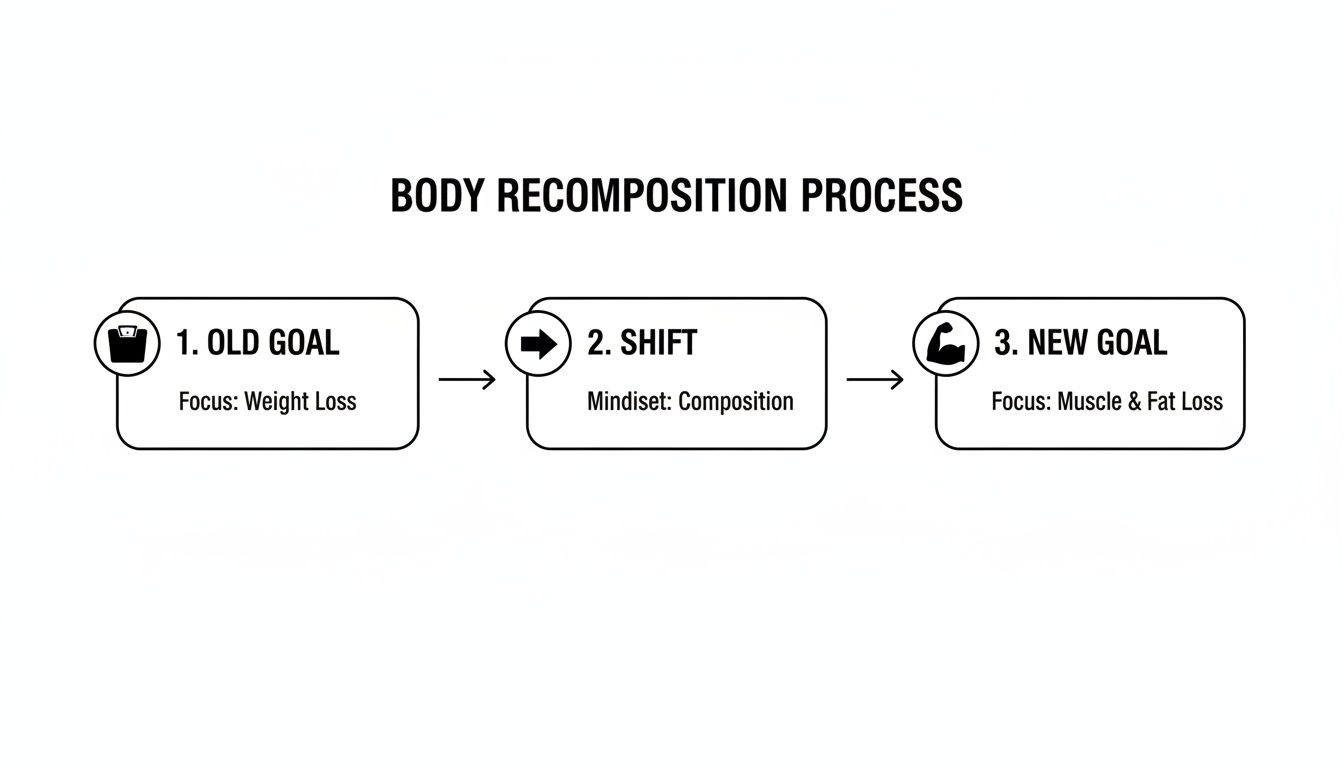
It's all about changing your focus from just weight to your actual body composition and performance in the gym.
So instead of a fuzzy goal, try something like this: "Over the next 12 weeks, I will drop my body fat by 5% and add 15 lbs to my deadlift." See the difference? A goal like that gives you a clear finish line and multiple ways to track success, keeping you fired up even on days the scale doesn’t cooperate.
A well-defined goal is your compass. It keeps you locked in during tough workouts and helps you make smarter choices in the kitchen, turning a vague wish into a concrete plan of attack.
This approach is more important than ever. Projections show that by 2035, a staggering 54% of adults could be affected by overweight and obesity, with associated healthcare costs hitting $4.32 trillion annually. Against that backdrop, body recomposition stands out. Studies have shown participants achieving a 9% reduction in body fat while gaining 4kg of muscle in just 16 weeks—a change that can boost metabolism by up to 15%. These results are almost always driven by a high-protein diet (around 30% of total calories) paired with a sensible energy deficit.
Designing Your Strength Training Program
This is where the real work—and the real transformation—begins. Your strength training program is the engine that will reshape your body, driving both fat loss and muscle gain. Forget about spending endless, mindless hours at the gym; this is about training with purpose.
The entire foundation of a successful strength plan is built on one simple concept: progressive overload. It sounds technical, but all it means is that to get stronger, you have to consistently ask your body to do more than it's used to. Your body is a brilliant adaptation machine, but it won't change unless you give it a reason.
Grasping the fundamentals of understanding progressive resistance training is the secret sauce. This gradual, consistent increase in demand is what separates those who get results from those who just go through the motions.

Prioritize Big Compound Movements
To get the most bang for your buck, your routine needs to be built around compound exercises. These are the multi-joint movements that recruit huge amounts of muscle in a single lift. Think of them as the heavy hitters of your workout.
They’re so effective because they stimulate more muscle fibers, which leads to greater strength gains and a bigger release of muscle-building hormones like testosterone. On top of that, they burn way more calories than isolation exercises (like bicep curls), making them perfect for our dual goal of shedding fat while building muscle.
Your primary focus should be on mastering these key movement patterns:
- Squat variations: Goblet squats, barbell back squats, front squats.
- Hinge variations: Romanian deadlifts, conventional deadlifts, kettlebell swings.
- Push variations: Push-ups, dumbbell bench press, overhead press.
- Pull variations: Pull-ups, bent-over rows, lat pulldowns.
These exercises form the backbone of any solid recomposition plan because they deliver maximum results in minimum time.
Choosing Your Weekly Workout Split
How you lay out your training week depends on your experience and, more importantly, how many days you can realistically commit. Consistency will always beat a "perfect" plan you can't stick to, so pick a split that fits your life.
For most beginners, three weekly sessions are all it takes to see incredible results. A full-body routine is the ideal starting point, as it hits every major muscle group in each workout. This high-frequency approach is fantastic for learning proper form and building a solid foundation. If you're new to lifting, our beginner strength training program offers a great structure to get you started.
As you get more advanced, you'll need more volume for each muscle group. That's when you can graduate to a training "split," where you divide your workouts to focus on different body parts on different days.
Here’s a quick look at how the two approaches stack up:
| Training Split | Best For | Typical Frequency | Example Schedule |
|---|---|---|---|
| Full Body | Beginners | 3 days/week | Mon: Full Body, Wed: Full Body, Fri: Full Body |
| Push/Pull/Legs | Intermediates | 3-6 days/week | Mon: Push, Tue: Pull, Wed: Legs, Fri: Full Body |
The key is simply to make sure each muscle group gets enough of a challenge to grow and enough time to recover before you hit it again.
The perfect workout plan is the one you actually do. Don't overcomplicate it. Pick a schedule, show up, and put in the work—that's 80% of the battle won right there.
Defining Your Sets, Reps, and Rest
Now for the nuts and bolts. For the goal of building muscle (a process called hypertrophy), the sweet spot is generally 3-4 sets of 6-12 repetitions per exercise.
This rep range is magic because it keeps the muscle under tension long enough to trigger growth while allowing you to use a weight that’s heavy enough to be a real challenge. You want to pick a weight where the last 1-2 reps of each set are tough, but you can still finish them with good form.
Don't neglect your rest periods; they're just as important as the work itself.
- For big compound lifts like squats and deadlifts, rest for 2-3 minutes. Your nervous system needs this time to recover so you can maintain intensity on the next set.
- For smaller, accessory lifts like rows or lunges, 60-90 seconds is plenty of time.
This entire structure is designed to maximize both metabolic stress and mechanical tension—the two primary drivers of muscle growth. Get these details right, and you'll ensure every single rep is moving you closer to a stronger, leaner physique.
Integrating Cardio Without Killing Your Gains
Cardio has a lingering, and frankly unfair, reputation as a "gain killer." This myth sends a shiver down the spine of anyone trying to build muscle. But when you use it the right way, cardio isn't a threat to your progress—it’s a powerful tool to speed up fat loss and boost your overall fitness.
The trick is to treat cardio like a scalpel, not a sledgehammer. In a recomposition plan, its main job is to bump up your total weekly calorie burn. This helps you stay in a consistent energy deficit without having to slash your food intake so drastically that your body doesn't have the fuel to build and repair muscle.
A smart cardio strategy is your best defense against the muscle breakdown that can happen with endless, poorly timed sessions.
HIIT vs. LISS: Which Cardio Is Best?
When we talk about cardio, you've really got two main options, and each has its own vibe. The right one for you comes down to your schedule, energy levels, and how well you recover from tough workouts.
High-Intensity Interval Training (HIIT): This is all about short, explosive bursts of effort followed by brief recovery. Think 30 seconds of all-out sprinting on a bike, then 60 seconds of easy pedaling, repeated for maybe 15-20 minutes. It's incredibly efficient and revs up your metabolism, helping you burn calories long after you've stopped.
Low-Intensity Steady State (LISS): This is your classic, traditional cardio. Picture a 30-45 minute brisk walk on the treadmill or a light jog outside, all done at a pace where you could still hold a conversation. It’s much less demanding on your body, making it easier to recover from and less likely to mess with your strength training.
Honestly, there's no single "best" choice here. A fantastic approach is to mix and match. You could do two LISS sessions during the week and one shorter HIIT session on a day when you’re feeling fresh. If you want to dig deeper, our guide on how to balance cardio and strength training has even more strategies.
The Underrated Power of NEAT
Beyond your planned gym sessions, one of the most powerful fat-loss tools is something you're doing all day long: Non-Exercise Activity Thermogenesis (NEAT). This is just a fancy term for the energy you burn from all the little movements that aren't formal exercise—walking to your car, taking the stairs, fidgeting, you name it.
Upping your NEAT is a total game-changer. It lets you burn a surprising number of extra calories without adding any more stress or recovery demands from the gym.
A gold-standard routine often pairs progressive overload circuits with a focus on NEAT, like hitting 10,000 steps per day. For beginners, this simple combo can lead to 2-3 lbs of fat loss per week while adding 1-2 lbs of muscle in a month.
This combined approach is catching on. A 2023 survey found that 81% of people trying to lose weight want to exercise more, with strength training leading the pack at 45% interest. It shows just how popular this method has become.
When to Schedule Your Cardio Sessions
Timing is everything. You have to schedule your cardio so it doesn't get in the way of your muscle-building goals. The golden rule is simple: don't let your cardio session sabotage the quality of your lifting session.
Here are a few smart ways to fit it in:
- On Separate Days: This is the ideal setup. Dedicate your "off days" from lifting exclusively to cardio. This ensures you’re 100% fresh for both.
- After You Lift: If you have to do both on the same day, always lift weights first. This way, you're using your prime energy stores for the most important task—getting stronger.
- Separated by Several Hours: Another great same-day option is to lift in the morning and do your cardio in the evening. This gives your body plenty of time to recover in between.
Whatever you do, avoid doing intense cardio before you lift weights. You'll walk into your main workout already tired, which will tank your strength, kill your ability to hit progressive overload, and ultimately hold back your muscle gains.
Sample Workout Blueprints You Can Start Today
Alright, let's move from theory to action. Knowing what to do is one thing, but having a concrete plan to follow is what gets you results. This is where the rubber meets the road.
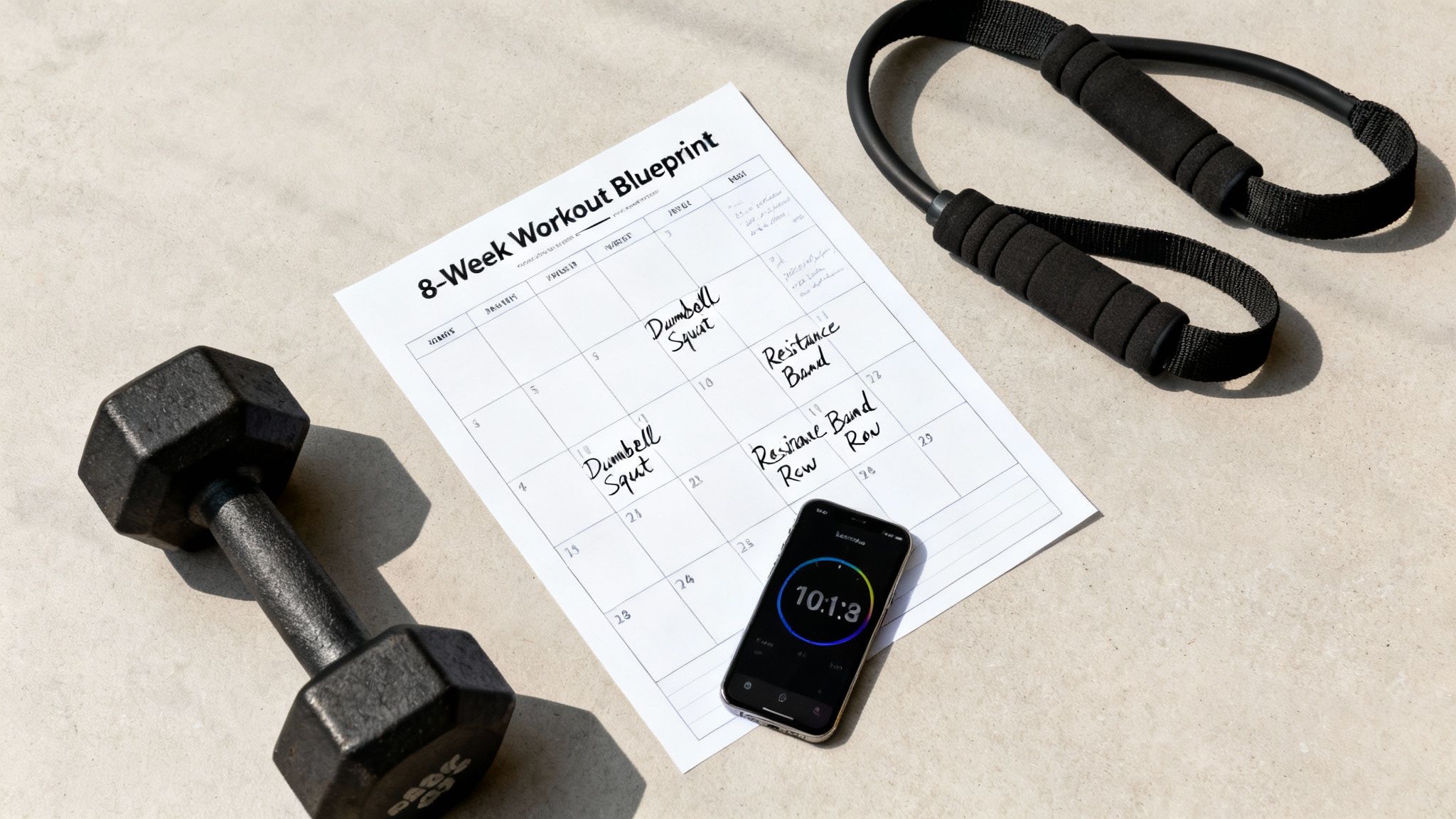
I’ve laid out two different 8-week programs below. These aren't just random lists of exercises; they're complete blueprints designed to get you losing fat and building muscle, whether you're at home or in the gym. Each plan details the exact movements, sets, reps, and rest periods, plus how to keep getting stronger week after week.
Beginner At-Home Foundation Plan
Just starting out or working with limited gear at home? This 3-day full-body routine is your perfect entry point. The goal here is simple: build a rock-solid foundation of strength and master the basic movement patterns.
You’ll hit every major muscle group in each session. This high frequency is fantastic for beginners because it accelerates those initial strength and muscle gains. You'll perform each workout once per week on non-consecutive days—think Monday, Wednesday, and Friday.
If you want to explore other ways to structure your week, our guide to a 3-day workout plan has some great alternatives.
Workout A
- Goblet Squats: 3 sets of 8-12 reps
- Push-Ups (on knees or toes): 3 sets to near-failure
- Dumbbell Rows: 3 sets of 10-15 reps per arm
- Glute Bridges: 3 sets of 15-20 reps
- Plank: 3 sets, hold for 30-60 seconds
Workout B
- Dumbbell Lunges: 3 sets of 10-12 reps per leg
- Dumbbell Overhead Press: 3 sets of 8-12 reps
- Band Pull-Aparts: 3 sets of 15-20 reps
- Romanian Deadlifts (with dumbbells): 3 sets of 12-15 reps
- Leg Raises: 3 sets of 15-20 reps
Workout C
- Bodyweight Squats: 3 sets of 15-20 reps
- Incline Push-Ups (hands on a chair or couch): 3 sets to near-failure
- Single-Arm Dumbbell Rows: 3 sets of 10-15 reps per arm
- Step-Ups: 3 sets of 12-15 reps per leg
- Side Plank: 3 sets, hold for 20-40 seconds per side
How to Progress: Your mission each week is to get stronger. Try adding just one more rep to each set. Once you can comfortably hit the top end of the rep range for all sets of an exercise, it's time to grab a slightly heavier weight for your next workout. That's progressive overload in action.
Intermediate Gym Recomposition Split
If you've got some experience under your belt and access to a gym, this 4-day upper/lower split will crank things up a notch. We’re splitting the body in half—dedicating entire sessions to either your upper or lower body.
This approach lets you hammer each muscle group with more total volume, which is a major key to unlocking new growth when you're past the beginner stage. It also gives your muscles more time to recover between sessions.
To help you visualize how these programs fit into a real week, here's a look at how you might structure your training days.
Beginner vs. Intermediate Weekly Workout Structure
| Day | Beginner (Home) | Intermediate (Gym) |
|---|---|---|
| Monday | Workout A | Day 1: Lower Body (Strength) |
| Tuesday | Rest / Active Recovery | Day 2: Upper Body (Push) |
| Wednesday | Workout B | Rest / Active Recovery |
| Thursday | Rest / Active Recovery | Day 3: Lower Body (Hypertrophy) |
| Friday | Workout C | Day 4: Upper Body (Pull) |
| Saturday | Rest / Active Recovery | Rest / Active Recovery |
| Sunday | Rest | Rest |
As you can see, the intermediate plan requires more dedicated days but allows for more focused work and recovery for each muscle group.
Here's the breakdown for the gym plan:
Day 1: Lower Body (Strength Focus)
- Barbell Back Squats: 4 sets of 5-8 reps
- Romanian Deadlifts: 3 sets of 8-10 reps
- Leg Press: 3 sets of 10-12 reps
- Seated Hamstring Curls: 3 sets of 12-15 reps
- Calf Raises: 4 sets of 15-20 reps
Day 2: Upper Body (Push Focus)
- Dumbbell Bench Press: 4 sets of 6-10 reps
- Seated Dumbbell Shoulder Press: 3 sets of 8-12 reps
- Incline Dumbbell Flys: 3 sets of 12-15 reps
- Triceps Pushdowns: 3 sets of 10-15 reps
- Lateral Raises: 3 sets of 15-20 reps
Day 3: Lower Body (Hypertrophy Focus)
- Barbell Hip Thrusts: 4 sets of 8-12 reps
- Bulgarian Split Squats: 3 sets of 10-15 reps per leg
- Leg Extensions: 3 sets of 15-20 reps
- Lying Leg Curls: 3 sets of 12-15 reps
- Abdominal Crunches (weighted): 3 sets of 15-20 reps
Day 4: Upper Body (Pull Focus)
- Pull-Ups (or Lat Pulldowns): 4 sets of 6-10 reps
- Bent-Over Barbell Rows: 3 sets of 8-12 reps
- Seated Cable Rows: 3 sets of 10-15 reps
- Face Pulls: 3 sets of 15-20 reps
- Dumbbell Bicep Curls: 3 sets of 10-15 reps
This kind of structured training gives your body the consistent, challenging stimulus it needs to burn fat and build lean muscle. Just remember to back it up with the nutrition principles we covered earlier—that's how you'll see the best results.
Your Body Recomposition Questions Answered
Starting a new fitness plan always brings up a ton of questions. As your body adapts and changes, it's totally normal to wonder if what you're experiencing is part of the process. Let's tackle some of the most common concerns people have when they're trying to lose fat and gain muscle at the same time.
How Long Does It Take to See Results From This Routine?
You'll probably feel stronger and have more energy within just a couple of weeks, which is a great motivator. But when it comes to seeing visible changes in the mirror, you'll need to give it 8-12 weeks of consistent effort.
One thing to remember is that progress isn't always linear, and the scale can be your worst enemy during body recomposition.
You're gaining dense, lean muscle while you lose body fat. This means your weight might not budge much at first, even as your clothes start fitting better and you look leaner. That's why taking progress photos and body measurements are far better ways to track your success. For a deeper look, our article explains how to measure muscle gain the right way.
Can I Do This Workout Routine Entirely at Home?
Absolutely. The magic of progressive overload works anywhere, not just in a fancy gym. The real key is finding ways to consistently challenge your muscles, wherever you are.
If you're working out at home, start by mastering bodyweight exercises. Once you've got the form down, you can make some small investments in gear that lets you scale up the difficulty.
- Adjustable Dumbbells: These are fantastic for saving space. More importantly, they allow you to easily increase the weight as you get stronger.
- Resistance Bands: A super versatile and affordable option for adding tension to exercises like squats, glute bridges, and rows.
No matter the location, the goal is always the same: make your workouts a little bit harder over time.
What Should I Do if I Hit a Weight Loss Plateau?
First off, don't panic. Plateaus are a completely normal—and expected—part of any fitness journey. Think of it as a sign that your body has successfully adapted to what you've been doing. Now it's time to switch things up.
When you hit that sticking point, it's time to play detective and look at these three areas:
- Nutrition: As you lose weight, your daily calorie needs actually go down. Take a moment to re-calculate your maintenance calories to make sure you’re still in that slight deficit.
- Training Intensity: Be honest with yourself. Are you truly pushing your limits? If your workouts start to feel comfortable, it's a clear signal to increase the weight, reps, or sets to spark new progress.
- Recovery: Chronic stress and not enough sleep can spike cortisol, a hormone that loves to hang on to body fat. Prioritizing rest isn't a luxury; it's a non-negotiable part of the equation.
How Important Is Recovery for Gaining Muscle and Losing Fat?
Recovery isn't just important—it's everything. It's the "off" time when all your hard work in the gym actually translates into results. You don't build muscle while you're lifting; you build it while you rest.
Think of it this way: your workouts are the stimulus for change, but sleep and rest are when the real magic of muscle repair and growth happens. Skimping on recovery is the fastest way to stall your progress and open the door to injuries.
Make 7-9 hours of quality sleep a priority every single night. For anyone serious about their results, learning how to effectively speed up muscle recovery is a game-changer. Listening to your body and taking planned rest days will get you to your goals much faster and safer than trying to train seven days a week.
Ready to stop guessing and start seeing real results? The Zing Coach app builds a truly personalized training plan based on your goals, schedule, and available equipment. With real-time form correction and adaptive workouts that get more challenging as you do, you'll have the perfect guide to losing fat and gaining muscle. Download Zing Coach and start your transformation today!
Share this article


Authors