Learn how to calculate daily calorie needs with our guide. We break down BMR and TDEE formulas to help you master your nutrition for any fitness goal.

To figure out how to calculate daily calorie needs, you first need to get a handle on two key ideas: your Basal Metabolic Rate (BMR) and your Total Daily Energy Expenditure (TDEE). These numbers give you a solid baseline for how many calories your body actually burns in a day, which you can then tweak to hit your goals, whether that's losing weight, building muscle, or just maintaining where you are.
Why Calorie Calculation Is Your Starting Point

Before we jump into the formulas, let's talk about why this matters. Think of your body like a car and calories as its fuel. You wouldn't just guess how much gas to put in for a road trip, right? In the same way, understanding your personal calorie needs is the bedrock of any successful fitness journey.
This number isn't just pulled out of thin air; it’s deeply rooted in your unique biology. It all starts with your Basal Metabolic Rate (BMR). This is the bare minimum energy your body needs just to stay alive—the calories burned to power essential functions like breathing, circulating blood, and producing cells while you're completely at rest.
From Resting to Active Energy Needs
Of course, most of us don't spend all day lying perfectly still. That’s where your Total Daily Energy Expenditure (TDEE) comes into play. TDEE takes your BMR and adds in all the calories you burn from daily activities—everything from walking to the office to crushing an intense workout. Your TDEE is the real, practical number that dictates whether you lose, maintain, or gain weight.
Once you know this number, you can connect it directly to your real-world goals:
- For fat loss: You'll aim for a slight, sustainable calorie deficit below your TDEE.
- For muscle gain: You'll need a modest calorie surplus above your TDEE to fuel new muscle growth.
- For weight maintenance: Your goal is to consistently eat at or very close to your TDEE.
And this isn't just about the number on the scale. Getting your calorie intake right affects your energy levels, your mood, and even how well you can focus. It’s the fuel that powers everything you do. To see how this all fits into the bigger picture of your physique, check out our guide on why body composition is important.
A calorie isn’t just a number on a food label. It’s a unit of energy that determines your body's ability to perform, recover, and change.
The good news is you don't need to be a math whiz to figure this out. This guide will walk you through the simple methods, and tools like the Zing Coach app can automate the whole process for you, giving you personalized targets that adapt as you make progress.
Getting to Grips With BMR and TDEE Formulas
If you really want to understand where your daily calorie number comes from, we have to roll up our sleeves and dig into the science behind it all. The classic approach is a two-step process: first, you figure out your Basal Metabolic Rate (BMR), and then you use that number to calculate your Total Daily Energy Expenditure (TDEE).
Think of it this way: your BMR is what your body burns just to stay alive—the cost of running the show behind the scenes. Your TDEE is the real-world number that accounts for everything else you do all day.
Start With Your BMR: The Harris-Benedict Equation
One of the oldest and most reliable tools for this is the Harris-Benedict equation. It’s been a cornerstone of nutritional science since 1919 and still powers many of the calorie calculators you see today, including smart apps like Zing Coach that offer personalized nutrition advice.
This formula gives you a solid estimate of your BMR—the calories your body needs at complete rest for basic functions like breathing and circulation. All you need are four inputs: your sex, weight, height, and age. If you're curious about the nitty-gritty, you can learn more about the research behind calorie calculation to see how these foundational formulas have held up over time.
The formula is slightly different for men and women, which helps account for general differences in body composition. Grab a calculator and let's find your number.
- For Men: BMR = 88.362 + (13.397 × weight in kg) + (4.799 × height in cm) - (5.677 × age in years)
- For Women: BMR = 447.593 + (9.247 × weight in kg) + (3.098 × height in cm) - (4.330 × age in years)
Let's run through a quick example. Say we have Alex, a 35-year-old woman who is 168 cm (about 5'6") tall and weighs 65 kg (about 143 lbs).
Using the women's formula, her BMR calculation would look like this:
BMR = 447.593 + (9.247 × 65) + (3.098 × 168) - (4.330 × 35)
BMR = 447.593 + 601.055 + 520.464 - 151.55
Alex's BMR ≈ 1,418 calories per day.
So, if Alex did absolutely nothing but rest for 24 hours, her body would still burn roughly 1,418 calories just to keep the lights on.
From BMR to TDEE: Factoring in Your Lifestyle
Now that we have that baseline, it's time to adjust for real life. This is where we turn the BMR into your TDEE by multiplying it by an activity factor. This step is absolutely crucial, and it's where a lot of people go wrong by accidentally overestimating just how active they are.
Honesty is your best policy here. A truly accurate TDEE depends on a realistic assessment of your daily movement. Use the table below to find the multiplier that best reflects your typical week.
Activity Level Multipliers for TDEE Calculation
Use this table to find the multiplier that best matches your daily activity level. Multiply your BMR by this number to estimate your TDEE.
| Activity Level | Description | Multiplier |
|---|---|---|
| Sedentary | Little to no exercise, desk job | 1.2 |
| Lightly Active | Light exercise or sports 1-3 days/week | 1.375 |
| Moderately Active | Moderate exercise or sports 3-5 days/week | 1.55 |
| Very Active | Hard exercise or sports 6-7 days a week | 1.725 |
| Extra Active | Very hard exercise, physical job, or training twice a day | 1.9 |
Remember Alex? She works a desk job, but she's consistent with her strength training, hitting the gym three times a week. That puts her squarely in the Lightly Active category.
So, to find her TDEE, we just do a little multiplication:
TDEE = 1,418 (BMR) × 1.375 (Activity Multiplier)
Alex's TDEE ≈ 1,950 calories per day.
This final figure, 1,950 calories, is Alex's maintenance number. It’s the estimated daily intake she needs to maintain her current weight with her current lifestyle.
Walking through this process yourself does more than just give you a number. It demystifies the calorie goals you see in fitness apps and gives you a solid, personalized starting point for whatever goal you’re chasing.
Quick Estimation With Body Weight Multipliers
If you're not in the mood to crunch all the numbers in the Harris-Benedict equation, there's a much faster way to get a solid estimate. It’s a shortcut trusted by countless coaches and nutrition pros: the body weight multiplier.
Think of it as a back-of-the-napkin calculation that gets you surprisingly close to the mark. The idea is simple—your energy needs are directly tied to your body weight and how much you move. This method boils it all down to a single multiplication.
Find Your Multiplier
First, you'll need your weight. This method works with either pounds or kilograms, so just grab whatever you're used to. Then, you'll pick a multiplier that matches your primary goal.
Here are the standard multipliers for maintaining your current weight, using kilograms (kg) as the unit:
- Sedentary or Lightly Active: Multiply your weight in kg by 26–30.
- Moderately Active: Multiply your weight in kg by 31–37.
- Very Active or Athlete: Multiply your weight in kg by 38–40.
This isn't just guesswork; this approach is grounded in real-world clinical practice. Healthcare professionals often begin with a range of 25–30 kcal per kg for healthy adults, which gives them an estimate that’s accurate up to 85–90% of the time. For more active folks, those numbers just get adjusted upwards to make sure there's enough fuel for performance and recovery. You can even see how these calculations are applied in clinical settings to get a better feel for it.
Putting It Into Practice
Let's see how this works with a real-world example. Imagine we have a moderately active person who weighs 75 kg (around 165 lbs) and just wants to figure out their maintenance calories.
They'd use the moderately active multiplier range, which is 31–37.
- Lower end: 75 kg × 31 = 2,325 calories
- Higher end: 75 kg × 37 = 2,775 calories
So, their daily maintenance target is somewhere between 2,325 and 2,775 calories. Where you land in that range really depends on what "moderately active" looks like for you day-to-day. Someone hitting an intense gym session will be at the higher end, while someone taking a long walk might be closer to the lower end.
It’s a powerful tool because it instinctively accounts for body composition—heavier individuals simply need more energy to function. If you want to get even more precise, you can learn how to measure body fat percentage, which offers a much deeper look at what your body is made of.
Ultimately, whether you're using detailed formulas or quick multipliers, the process follows the same fundamental steps.
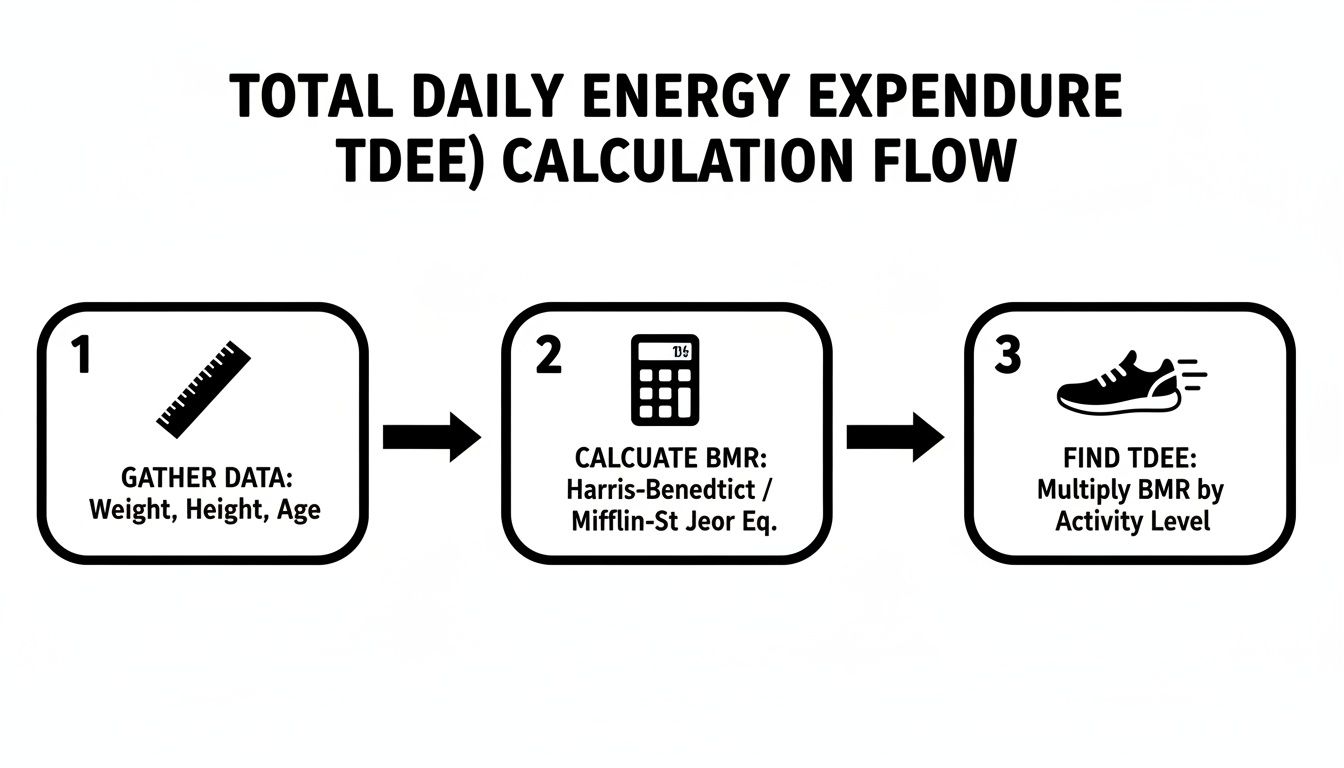
This breaks it down perfectly: you gather your stats, figure out your baseline metabolism (BMR), and then factor in your activity to find your total daily needs (TDEE).
Key Takeaway: Body weight multipliers are an excellent sanity check. If the TDEE you calculated with a more complex formula falls neatly within the range you get from this quick method, you can feel confident you’re on the right track.
Adjusting Calories for Your Specific Goals
Calculating your maintenance calories—your TDEE—is like finding your financial break-even point. It’s the number of calories you need to stay exactly where you are. But most of us have a specific destination in mind, whether that’s losing fat, building muscle, or a bit of both.
This is where the real work begins. You're moving from just knowing your numbers to actually using them. By strategically adjusting your daily calorie intake above or below your maintenance level, you can start steering your body in the right direction. It's a game of small, consistent changes, not drastic overhauls.
Creating a Sustainable Calorie Deficit for Weight Loss
To lose weight, you have to eat fewer calories than your body burns. This is called a calorie deficit. The key here is to create a safe and effective deficit. If you cut calories too aggressively, it can seriously backfire by causing muscle loss and stalling your metabolism.
A moderate deficit of 300 to 500 calories per day is a proven and sensible starting point. This gentle reduction encourages your body to tap into stored fat for energy without sending your hunger signals and energy levels through the floor. Realistically, this translates to a sustainable loss of about 0.5 to 1 pound per week.
So, if your TDEE is 2,000 calories, a healthy weight loss target would land you somewhere between 1,500 and 1,700 calories daily. Once you have your number, the next step is building a meal plan around it. For some great ideas on how to structure your meals, check out this guide on creating a healthy meal plan for weight loss that's both satisfying and effective.
Fueling Muscle Growth With a Calorie Surplus
Building new muscle tissue requires energy. Plain and simple. To repair and grow muscle after your workouts, you need to give your body more fuel than it needs just for maintenance. This is where a modest calorie surplus comes in.
Precision is the goal here. A slight surplus of 250 to 400 calories above your TDEE is generally all you need to support lean muscle gain while keeping fat storage to a minimum. Of course, this only works if you’re also following a solid workout routine. Pairing this calorie surplus with the right exercises is crucial, which is why it's worth exploring how strength training for weight loss and muscle building go hand-in-hand.
Listening to your body is just as important as counting calories. Adjust your intake based on your energy levels, workout performance, and how you feel day-to-day. Progress is rarely linear, so be patient.
Navigating Body Recomposition
But what if you want to do both at the same time—lose fat and build muscle? This goal, known as body recomposition, is a bit more nuanced. It usually means eating at or very close to your maintenance calories while making high protein intake and consistent resistance training your top priorities.
Progress is slower with recomposition, but it's a fantastic goal, especially for those new to lifting or coming back after a long break. The focus shifts from what the scale says to changes in your body measurements, how your clothes fit, and your strength gains in the gym.
Calorie Adjustments for Different Fitness Goals
To make this all crystal clear, here’s a quick summary of how to adjust your maintenance calories (TDEE) based on what you’re trying to achieve. Think of this as your cheat sheet for setting your daily targets.
| Goal | Recommended Daily Calorie Adjustment | Expected Weekly Outcome |
|---|---|---|
| Weight Loss | Subtract 300–500 calories from TDEE | 0.5–1 lb loss |
| Muscle Gain | Add 250–400 calories to TDEE | 0.25–0.5 lb gain |
| Recomposition | Eat at or slightly below TDEE | Slow fat loss & muscle gain |
Remember, these numbers are starting points. Your body is unique, so you may need to tweak these ranges based on your personal progress and how you feel.
Letting Modern Tools Automate Your Nutrition
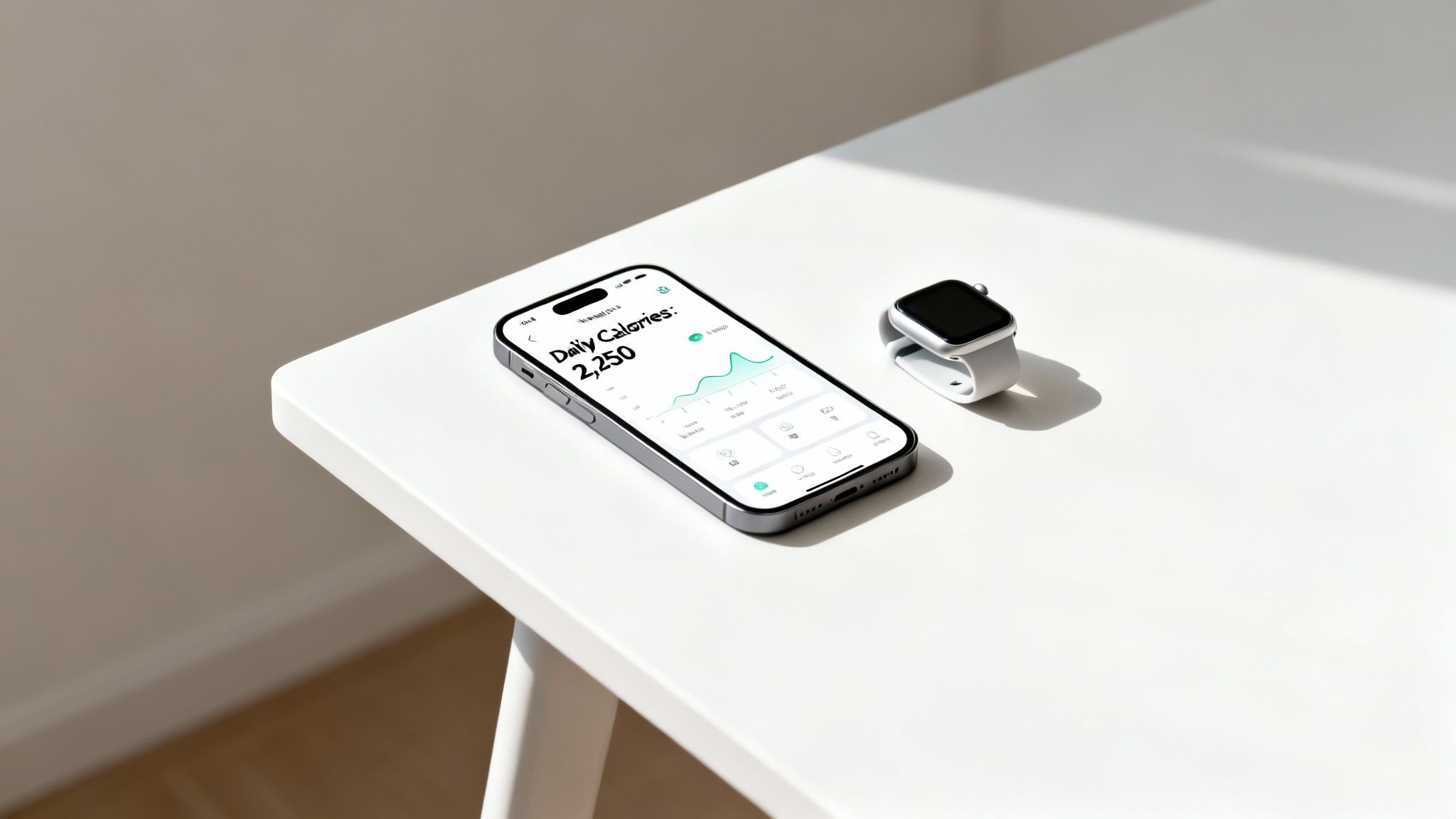
While learning the math behind your daily calorie needs is empowering, let’s be honest—it’s a lot of work. In the real world, modern tech can handle all the heavy lifting for you, and it often does a much better job. Fitness apps and smart tools make the whole process effortless, more accurate, and far more responsive to your body's changes.
Instead of plugging numbers into a static formula, these platforms create a living, breathing nutrition plan. Take the Zing Coach app, for example. It goes way beyond a simple calculation by pulling in data from multiple sources to build a genuinely personalized roadmap.
The Power of Integrated Data
What really sets today’s tools apart is their ability to pull together information from all corners of your life. This creates a much richer, more accurate picture of your actual energy burn than any single formula could ever hope to capture.
Apps like Zing connect directly with data sources you’re probably already using:
- Apple Health: Syncing your daily steps, active energy burn, and workout data gives a real-time, day-to-day look at how active you actually are. No more guessing.
- Body Scans: By tracking subtle shifts in body fat and lean mass over time, the app can make much more precise tweaks to your calorie and protein targets.
- Fitness Tests: Your initial and ongoing fitness assessments help calibrate the intensity of your workouts, making sure your nutrition plan is properly fueling your performance and recovery.
This multi-faceted approach completely removes the guesswork. You're no longer left wondering if you picked the right activity multiplier or second-guessing when it's time to recalculate everything. The system does it for you, adapting as your body and lifestyle evolve.
Using a smart tool is like upgrading from a static paper map to a live GPS. It doesn't just show you the destination; it reroutes you based on real-time traffic and conditions, always keeping you on the most efficient path to your goals.
Beyond the Initial Calculation
The real magic happens after day one. A quality nutrition tool doesn’t just "set it and forget it." Zing’s AI, for instance, is constantly learning from your progress and feedback. It fine-tunes your daily calorie and macro targets based on your workout performance, how tired you feel, and your progress toward your goal. This ensures your nutrition plan is always supporting your training, not holding it back.
The best apps use modern DRI-based calculators, which are widely considered the gold standard in nutrition science. They're built on data from thousands of global studies, allowing for incredibly precise, science-backed recommendations tailored to your unique stats. You can dive into the foundational science behind these DRI calculators to see just how deep the research goes. This constant adjustment and deep data integration are some of the key upgrades you'll find in the Zing AI coach.
Common Questions About Calorie Calculation
Once you start crunching the numbers for your daily calorie needs, a few practical questions almost always pop up. Think of this as the troubleshooting guide for your nutrition plan, designed to tackle the real-world details and help you feel more confident in your approach. Let's clear up some of the most common uncertainties.
How Often Should I Recalculate My Calorie Needs?
Your body isn't a static machine; your energy requirements change as your lifestyle and body composition evolve. A good rule of thumb is to take a fresh look at your TDEE every 4–6 weeks.
You should also plan to recalculate whenever you hit a significant milestone. This could be a 5–10% change in your body weight or a noticeable shift in your daily routine, like starting a more active job or changing how often you work out. This is where smart apps like Zing Coach really shine—they handle this for you automatically, continuously adjusting your targets based on your progress.
What Are Macronutrients and How Do I Calculate Them?
Macronutrients, or "macros," are the three main building blocks that make up your calories: protein, carbohydrates, and fats. Once you've figured out your total daily calorie goal, the next step is to split those calories among these three macros.
A balanced and popular starting point for many people is a 40/30/30 split:
- 40% of calories from carbohydrates
- 30% of calories from protein
- 30% of calories from fat
To turn these percentages into grams, just remember that protein and carbs each have 4 calories per gram, while fat packs 9 calories per gram. For someone aiming for 2,000 calories a day, this would break down to roughly 200g of carbs, 150g of protein, and about 67g of fat.
Your ideal macro split can definitely vary depending on what you're trying to achieve. An endurance athlete, for example, might need more carbs for fuel, while someone focused on building muscle might bump up their protein intake.
Why Am I Not Losing Weight in a Calorie Deficit?
Hitting a weight loss plateau despite being in a calorie deficit is one of the most common and frustrating experiences out there. If the scale isn't budging, there are several things to look at before you decide your plan has failed.
First, take an honest look at your tracking accuracy. It's incredibly easy to underestimate portion sizes or forget about the calories in drinks, sauces, and small snacks. Also, keep in mind that as you lose weight, your TDEE naturally goes down. What was once a "deficit" might now be your new maintenance level, which is a clear sign it's time to adjust your numbers.
Other factors can throw a wrench in the works, too, like water retention, hormonal shifts, and even muscle gain if you've recently started strength training. Misinformation can also lead you down the wrong path. Learning to spot and ignore bad advice is crucial for long-term success. You can get a head start by reading about common nutrition misconceptions that hold back your health.
Ready to skip the manual math and get a plan that adapts with you? The Zing Coach app uses your unique data to create a personalized nutrition and workout plan, making sure your targets always align with your goals. Try Zing Coach today.
Share this article


Authors