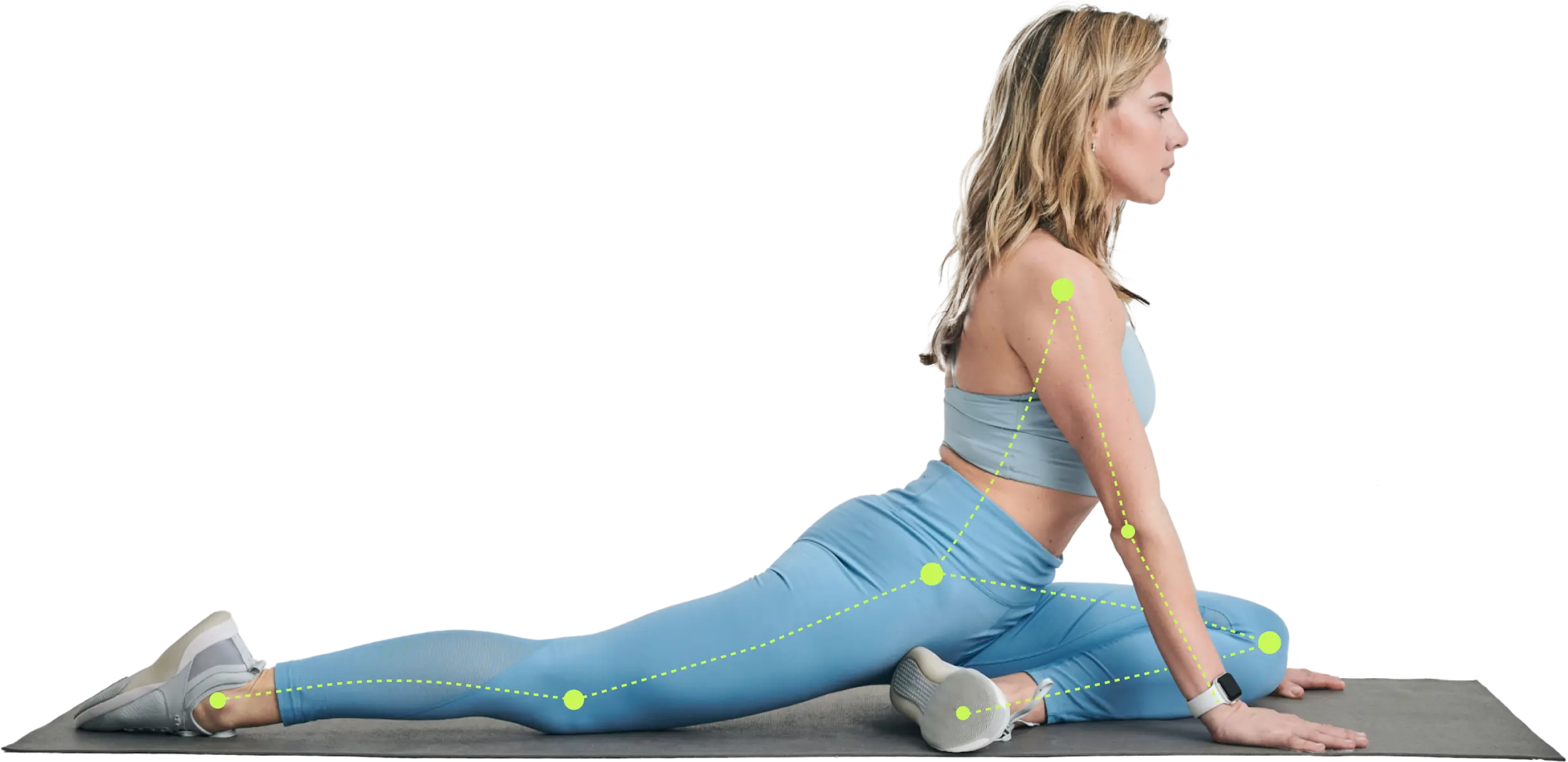
Discover the best exercises for fat loss at home. Our guide covers HIIT, burpees, and more with expert tips to help you build an effective workout plan.

Achieving your fat loss goals doesn't require an expensive gym membership or complex equipment. The key is knowing which movements deliver the biggest metabolic impact right from your living room. Traditional advice often focuses on either cardio or strength, but the most effective strategy combines both to maximize calorie burn and build lean muscle, which boosts your metabolism 24/7. This comprehensive guide moves beyond generic lists to provide actionable details on how and why each of the best exercises for fat loss at home actually works.
We will break down 10 of the most potent exercises, from high-intensity classics like Burpees and Mountain Climbers to foundational strength builders like Squats and Lunges. For each movement, you will find:
- Step-by-step instructions for proper form to maximize effectiveness and prevent injury.
- Progressions and modifications tailored to different fitness levels and available equipment.
- Specific programming guidance on sets, reps, and intervals for optimal results.
You will learn how to combine these exercises into powerful, efficient workouts you can complete in just 20 to 40 minutes. Beyond the individual movements, it is essential to have a well-rounded routine; to further diversify your at-home cardio, discover an additional 5 ways to get your cardio in without a gym membership. We'll also explore how an AI-powered tool like Zing Coach can eliminate guesswork by creating a personalized plan that adapts to your fitness level, equipment, and progress, ensuring every session is optimized for real, measurable fat loss. Let's get started.
1. High-Intensity Interval Training (HIIT)
High-Intensity Interval Training, or HIIT, is a powerful training method that stands out as one of the best exercises for fat loss at home due to its unmatched efficiency. It involves alternating between short, all-out bursts of intense exercise and brief periods of active recovery or complete rest. This approach pushes your heart rate into its anaerobic zone, maximizing calorie burn in a fraction of the time compared to steady-state cardio.
The real magic of HIIT lies in a phenomenon called Excess Post-Exercise Oxygen Consumption (EPOC), often known as the "afterburn effect." By pushing your body to its limits, you create a significant metabolic disturbance. Your body must then work hard for hours, even up to 24-36 hours post-workout, to restore itself to its normal state. This recovery process consumes extra oxygen and, consequently, burns additional calories long after you've finished exercising.
How to Implement HIIT at Home
You can apply HIIT principles to almost any bodyweight exercise, making it incredibly versatile for home workouts. The key is to maintain maximum effort during the work intervals.
- Structure: A common and effective protocol is the Tabata method: 20 seconds of intense work followed by 10 seconds of rest, repeated for 8 rounds (totaling 4 minutes per exercise).
- Example Exercises: Burpees, jump squats, high knees, mountain climbers, and sprinting in place are all excellent choices.
- Sample HIIT Circuit (20 minutes):
- Warm-up: 5 minutes of light cardio (jogging in place, jumping jacks).
- Circuit: Perform each exercise using the Tabata protocol (20 sec on, 10 sec off for 8 rounds) before moving to the next.
- Jump Squats
- Push-ups
- Mountain Climbers
- Burpees
- Cool-down: 5 minutes of stretching.
Key Insight: HIIT is not just about burning calories during the workout; it's about elevating your metabolic rate for the rest of the day. This makes it a highly effective strategy for fat loss, especially for those with busy schedules.
Actionable Tips for Success
To get the most out of your HIIT sessions safely, start smart. Begin with just 2-3 sessions per week on non-consecutive days to allow your body at least 48 hours to recover. Always prioritize a thorough 5-minute warm-up to prepare your muscles and prevent injury. While speed is important, never sacrifice proper form. If your form breaks down, slow down or modify the exercise. Using a timer or a dedicated HIIT app is crucial for staying on track with your intervals. If you're looking for more ways HIIT can help you reach your goals, discover how it can contribute to reducing abdominal fat in this comprehensive guide on ways to lose belly fat.
2. Burpees
The burpee is a legendary full-body exercise that earns its place as one of the best exercises for fat loss at home due to its sheer metabolic demand. It is an explosive, compound movement that seamlessly combines a squat, plank, push-up, and vertical jump into a single, fluid sequence. This high-intensity exercise engages nearly every major muscle group in your body, including your legs, glutes, core, chest, and arms, sending your heart rate soaring and torching calories with unmatched efficiency.
By demanding so much from your cardiovascular system and muscles simultaneously, burpees trigger a significant metabolic response. Much like HIIT, this intensity creates a powerful afterburn effect (EPOC), meaning your body continues to burn calories at an elevated rate long after you've completed your last rep. This makes burpees a profoundly effective tool for accelerating fat loss without needing any equipment.
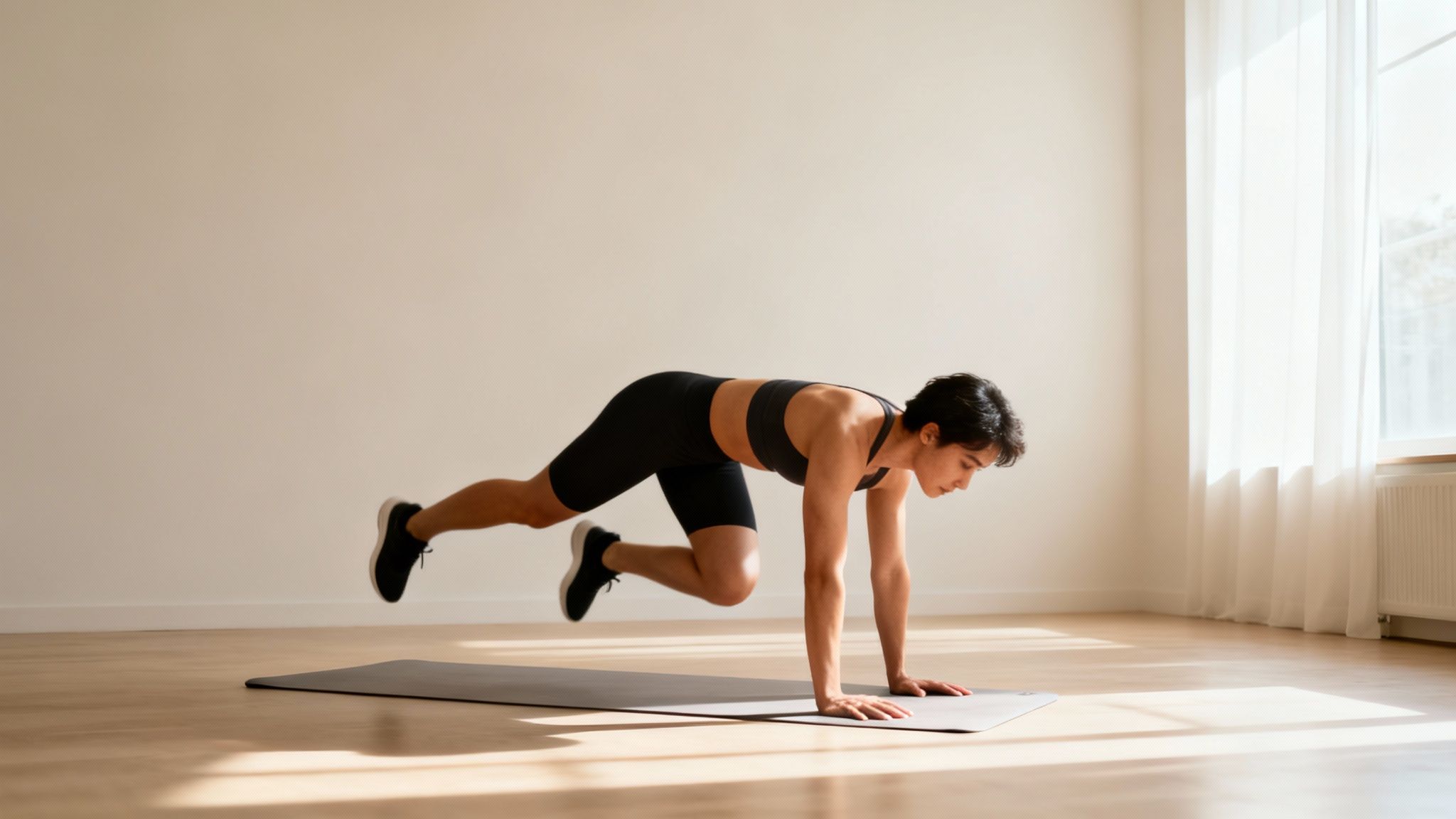
How to Implement Burpees at Home
The beauty of the burpee lies in its versatility; it can be performed anywhere and scaled to any fitness level. The key is to maintain a controlled but explosive pace throughout the movement.
- Structure: Burpees can be performed for reps or for time. A common approach is to do 3 sets of 10-15 repetitions with 60-90 seconds of rest in between.
- Example Variations:
- Standard Burpee: Squat down, kick your feet back to a plank, perform a push-up, jump your feet forward, and explode into a vertical jump.
- Modified (Beginner) Burpee: Instead of jumping back, step one foot back at a time into a plank. Skip the push-up, then step your feet forward to stand up.
- Advanced Burpee: Add a box jump at the end or hold dumbbells to increase the challenge.
- Sample Workout Idea: Set a timer and perform as many burpees as you can in 10 minutes, resting as needed. This is a great way to build conditioning and track progress.
Key Insight: The burpee is more than just an exercise; it's a full-body conditioning test. Its ability to build strength, endurance, and incinerate calories simultaneously makes it an indispensable movement for any home fat loss plan.
Actionable Tips for Success
To perform burpees safely and effectively, focus on technique. Always keep your core tight throughout the entire movement to protect your lower back. When you are in the plank and push-up position, ensure your hands are directly under your shoulders. Land softly on the balls of your feet after the jump to absorb the impact and protect your joints. For beginners, start with the modified version, stepping back instead of jumping, and gradually progress as you build strength and confidence.
3. Jump Rope
Jumping rope is a deceptively simple yet incredibly effective cardiovascular exercise that has earned its place as one of the best exercises for fat loss at home. This classic tool, favored by boxers and elite athletes for decades, engages your entire body, from your calves and quads to your core and shoulders. It is remarkably efficient at burning calories, with some studies suggesting it can burn over 10 calories per minute, rivaling high-impact activities like running.
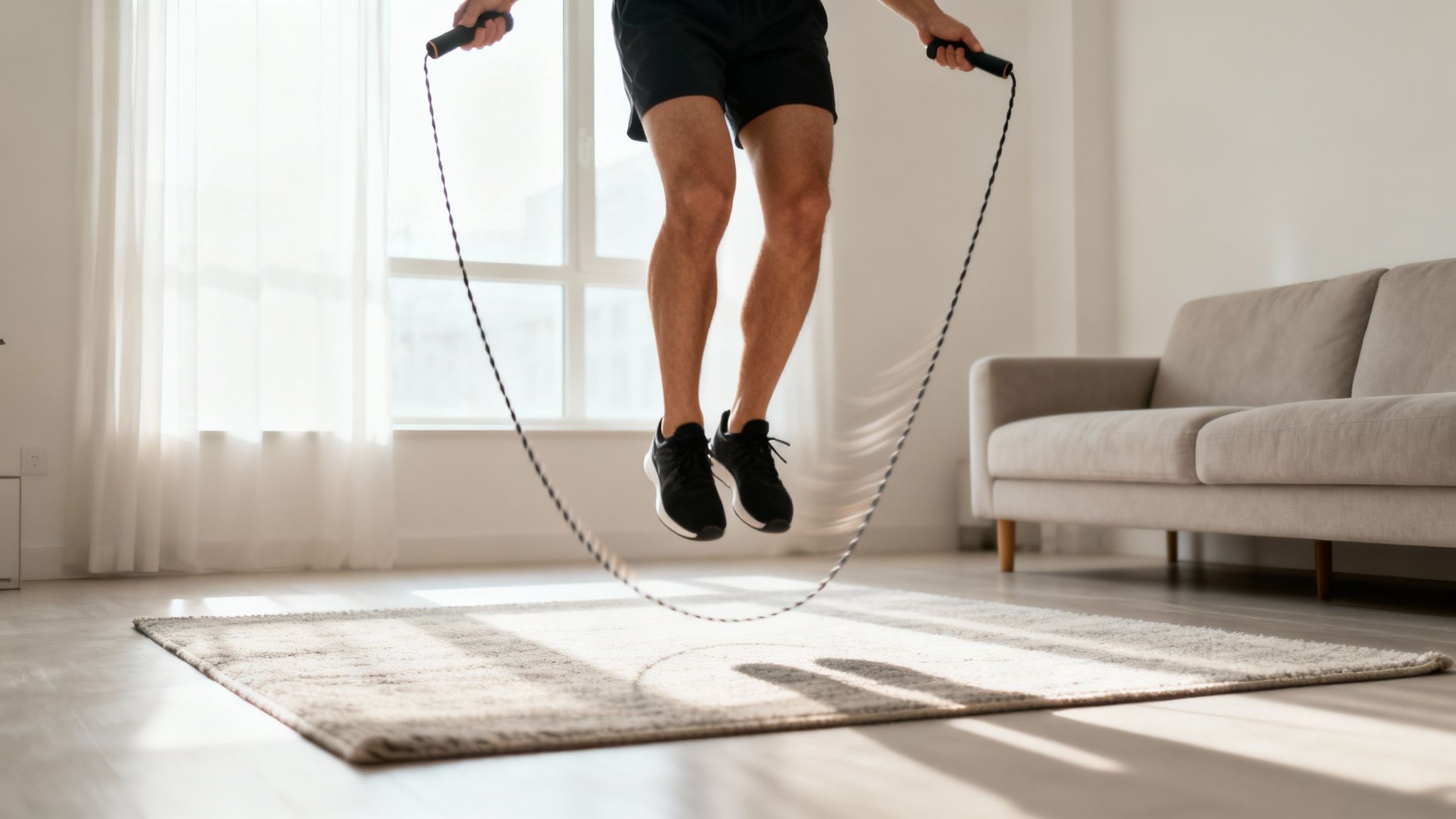
The benefit of jumping rope extends far beyond calorie expenditure. It significantly improves cardiovascular health, enhances coordination and agility, and increases bone density. Because it requires minimal space and equipment, it's an ideal choice for a home workout. You can easily incorporate it as a standalone cardio session, a warm-up, or part of a larger circuit to keep your heart rate elevated and maximize fat burn.
How to Implement Jump Rope at Home
The versatility of the jump rope allows for various training styles, catering to different fitness levels and goals. The key is to focus on proper form and gradually increase intensity.
- Structure: For fat loss, interval training is highly effective. Try a structure of 1 minute of intense jumping followed by 30 seconds of rest.
- Example Variations: Basic two-foot jumps, high-knees (driving knees up towards your chest), and double-unders (passing the rope under your feet twice per jump) are great ways to increase the challenge.
- Sample Jump Rope Workout (20 minutes):
- Warm-up: 5 minutes of light cardio and dynamic stretches.
- Circuit: Repeat the following 5-round circuit two times, with 1 minute of rest between circuits.
- Basic Jumps: 60 seconds
- Rest: 30 seconds
- High-Knees Jump Rope: 60 seconds
- Rest: 30 seconds
- Cool-down: 5 minutes of full-body stretching, focusing on calves and shoulders.
Key Insight: Jumping rope is a high-impact, full-body exercise that burns a significant number of calories in a short time. Its ability to improve coordination and cardiovascular endurance makes it a comprehensive tool for any fat loss journey.
Actionable Tips for Success
To get the most out of your jump rope workouts, focus on technique and consistency. Start with shorter sessions, perhaps 5-10 minutes, and gradually increase your duration as your stamina improves. Ensure your rope is the correct length; when you stand on the middle of the rope, the handles should reach your armpits. Always land on the balls of your feet with a slight bend in your knees to absorb the impact and protect your joints. Keep your elbows tucked in close to your body and use your wrists, not your entire arms, to turn the rope.
4. Mountain Climbers
Mountain climbers are a dynamic, full-body exercise that ranks among the best exercises for fat loss at home because they combine cardiovascular work with core strengthening. Performed from a plank position, this exercise mimics the motion of climbing, engaging your abs, obliques, shoulders, and legs simultaneously. This compound movement elevates your heart rate rapidly, turning your body into a calorie-burning machine without any need for equipment.
The effectiveness of mountain climbers comes from their high metabolic demand. By keeping your body in constant motion and supporting your own bodyweight, you challenge both your muscular endurance and your cardiovascular system. This dual-action approach not only burns a significant number of calories during the exercise but also contributes to an elevated metabolic rate post-workout, aiding in more efficient fat loss over time.
How to Implement Mountain Climbers at Home
The beauty of mountain climbers lies in their simplicity and adaptability. You can easily adjust the intensity by changing your speed or adding variations to target different muscles.
- Structure: For a cardio focus, perform them for timed intervals, such as 30-45 seconds of work followed by 15-20 seconds of rest. For strength, slow the movement down to focus on core control.
- Example Variations:
- Standard Mountain Climbers: The classic, fast-paced version.
- Cross-Body Climbers: Drive your right knee toward your left elbow, then switch. This adds an extra challenge for the obliques.
- Slow and Controlled Climbers: Focus on deliberately bringing each knee to your chest, holding for a second to maximize core engagement.
- Sample Finisher (5 minutes):
- Warm-up: Ensure you are already warmed up from a main workout.
- Circuit: Perform each variation for 45 seconds, followed by 15 seconds of rest.
- Standard Mountain Climbers
- Cross-Body Climbers
- Slow and Controlled Climbers
- Standard Mountain Climbers (final push)
- Cool-down: Finish with a child's pose and cobra stretch.
Key Insight: Mountain climbers are a highly efficient, no-equipment exercise that doubles as both a cardio blast and a core-strengthening powerhouse. Their versatility makes them a perfect addition to any fat loss workout.
Actionable Tips for Success
To maximize benefits and prevent injury, proper form is non-negotiable. Start by ensuring your hands are directly under your shoulders and your body forms a straight line from your head to your heels. Actively engage your core throughout the entire movement to protect your lower back and avoid letting your hips sag or rise too high. Breathe continuously; don't hold your breath. As you build strength and confidence, you can increase your speed or the duration of your intervals to keep challenging your body.
5. Jumping Jacks
Jumping jacks are a classic full-body cardio exercise that deserves a spot among the best exercises for fat loss at home. This simple yet effective movement involves jumping to a position with legs spread wide and hands touching overhead, then returning to a position with feet together and arms at the sides. It elevates your heart rate quickly, engaging multiple muscle groups simultaneously, including your glutes, quadriceps, and shoulders, to maximize calorie expenditure.
The primary benefit of jumping jacks is their accessibility and low barrier to entry. They require no equipment and minimal space, making them a perfect addition to any home workout routine. By forcing your heart and lungs to work harder to supply oxygen to your muscles, jumping jacks improve cardiovascular health and build endurance. This metabolic demand makes them an excellent tool for burning calories and contributing to a calorie deficit, which is essential for fat loss.
How to Implement Jumping Jacks at Home
Integrating jumping jacks is straightforward, whether as a standalone cardio burst or part of a larger circuit. The key is to maintain a brisk, consistent pace to keep your heart rate elevated.
- Structure: Can be performed for time (e.g., 30-60 seconds) or for repetitions (e.g., 3 sets of 50 reps).
- Example Uses:
- Warm-up: Perform 1-2 minutes of steady jumping jacks to increase blood flow and prepare your body for a workout.
- Cardio Interval: Incorporate 60 seconds of jumping jacks between strength exercises to keep your heart rate up and boost the overall calorie burn of your session.
- Finisher: End your workout with 3-5 minutes of continuous jumping jacks to fully exhaust your muscles and maximize the afterburn effect.
Key Insight: While often seen as just a warm-up, performing jumping jacks with intensity and for longer durations transforms them into a powerful fat-burning tool. Their simplicity allows you to focus purely on effort.
Actionable Tips for Success
To maximize the benefits of jumping jacks while staying safe, focus on proper technique and thoughtful integration. Start by landing softly on the balls of your feet to minimize impact on your joints, especially your knees and ankles. If the high-impact version is too challenging, you can easily modify it by stepping one leg out to the side at a time while still performing the arm motion. Maintain a steady, rhythmic breathing pattern to avoid getting winded too quickly. For enhanced fat loss results, combine jumping jacks with other bodyweight exercises like squats, push-ups, and planks to create a well-rounded and effective home workout.
6. Push-Ups
Push-ups are a fundamental compound exercise that earns its spot among the best exercises for fat loss at home by building powerful, metabolically active muscle. This classic bodyweight movement engages multiple muscle groups simultaneously, including the chest, shoulders, triceps, and core. By building lean muscle mass, push-ups help increase your resting metabolic rate, meaning your body burns more calories even when you are at rest.
Beyond muscle-building, performing push-ups at a consistent pace elevates your heart rate, contributing a cardiovascular element to your strength training. This combination of muscle engagement and cardiovascular work makes the push-up an efficient tool for burning calories and stimulating fat loss without requiring any equipment. Its versatility allows for numerous variations that can challenge any fitness level, ensuring continuous progress.
How to Implement Push-Ups at Home
The beauty of the push-up lies in its adaptability. You can easily adjust the difficulty to match your current strength level and progress over time by choosing more challenging variations.
- Structure: For strength and muscle growth, aim for a traditional set and repetition scheme. A great starting point is 3 sets of 8-15 repetitions.
- Example Variations:
- Incline Push-ups: Place hands on a sturdy, elevated surface like a bench or countertop to reduce the resistance.
- Diamond Push-ups: Form a diamond shape with your hands to place greater emphasis on the triceps.
- Explosive Push-ups: Push up with enough force for your hands to leave the ground, adding a power component.
- Push-up Burpees: Combine a push-up with a burpee for a full-body, high-intensity challenge.
Key Insight: Push-ups are more than just an upper-body exercise; they are a full-body movement that builds functional strength and boosts your metabolism, directly contributing to a leaner physique.
Actionable Tips for Success
Proper form is crucial to maximize benefits and prevent injury. Always keep your body in a straight line from your head to your heels, engaging your core and glutes to prevent your hips from sagging. Your hands should be positioned roughly shoulder-width apart, and you should lower your body until your elbows reach at least a 90-degree angle. If a standard push-up is too difficult, start with a modified version. You can begin by performing them on your knees to build foundational strength; explore the proper form for this variation in our guide to knee push-ups. As you get stronger, progress by increasing your reps or advancing to more difficult variations.
7. Running or Jogging
Running or jogging is a classic cardiovascular exercise that remains one of the most effective and accessible methods for fat loss at home. This steady-state cardio involves propelling yourself forward at a moderate to high intensity, which elevates your heart rate for a sustained period. This continuous effort forces your body to tap into fat stores for fuel, especially during longer sessions, making it an excellent calorie-burning activity.
The beauty of running is its simplicity and its profound impact on both cardiovascular health and metabolism. Unlike shorter, more intense workouts, running improves your body's aerobic efficiency, training it to use oxygen more effectively to generate energy. For home workouts, a treadmill eliminates weather-related excuses and allows for precise control over speed and incline, further increasing workout intensity and calorie expenditure without needing to go outside.
How to Implement Running at Home
Whether you're using a treadmill or have a safe outdoor route, structuring your runs can keep them effective and engaging. The key is to build a consistent routine that challenges your body.
- Structure: Aim for 3-4 sessions per week on non-consecutive days to allow for recovery. Start with shorter durations and gradually increase your time or distance.
- Example Workouts:
- Steady-State Jog: Maintain a comfortable, conversational pace for 30-45 minutes.
- Treadmill Incline Run: Set the treadmill to a moderate incline (2-4%) to increase intensity and target different muscle groups.
- Walk-Jog Intervals: Alternate between 2 minutes of jogging and 2 minutes of walking. This is an ideal starting point for beginners.
Key Insight: Consistency is more critical than intensity when using running for fat loss. A steady, regular running routine will burn more calories over the long term than sporadic, all-out efforts that can lead to burnout or injury.
Actionable Tips for Success
To build a safe and sustainable running habit, focus on smart preparation and gradual progression. Always invest in proper running shoes with good cushioning and support to protect your joints from impact. Start with a 5-minute warm-up of light jogging or brisk walking before every run. As you get fitter, prioritize increasing your running duration before you focus on increasing your speed. Finally, listen to your body; rest days are crucial for muscle repair and preventing overtraining injuries. Discover more about the benefits of cardiovascular exercise and how to incorporate it effectively in our guide on everything you need to know about cardio.
8. Squat Variations (Jump Squats, Goblet Squats)
Squat variations are a cornerstone of any effective fat loss program because they are a compound movement that engages the largest muscle groups in your body: the glutes, quadriceps, and hamstrings. Working these large muscles demands a significant amount of energy, which translates to a higher calorie burn both during and after your workout. By recruiting multiple muscle groups simultaneously, squats boost your metabolic rate more effectively than isolation exercises.
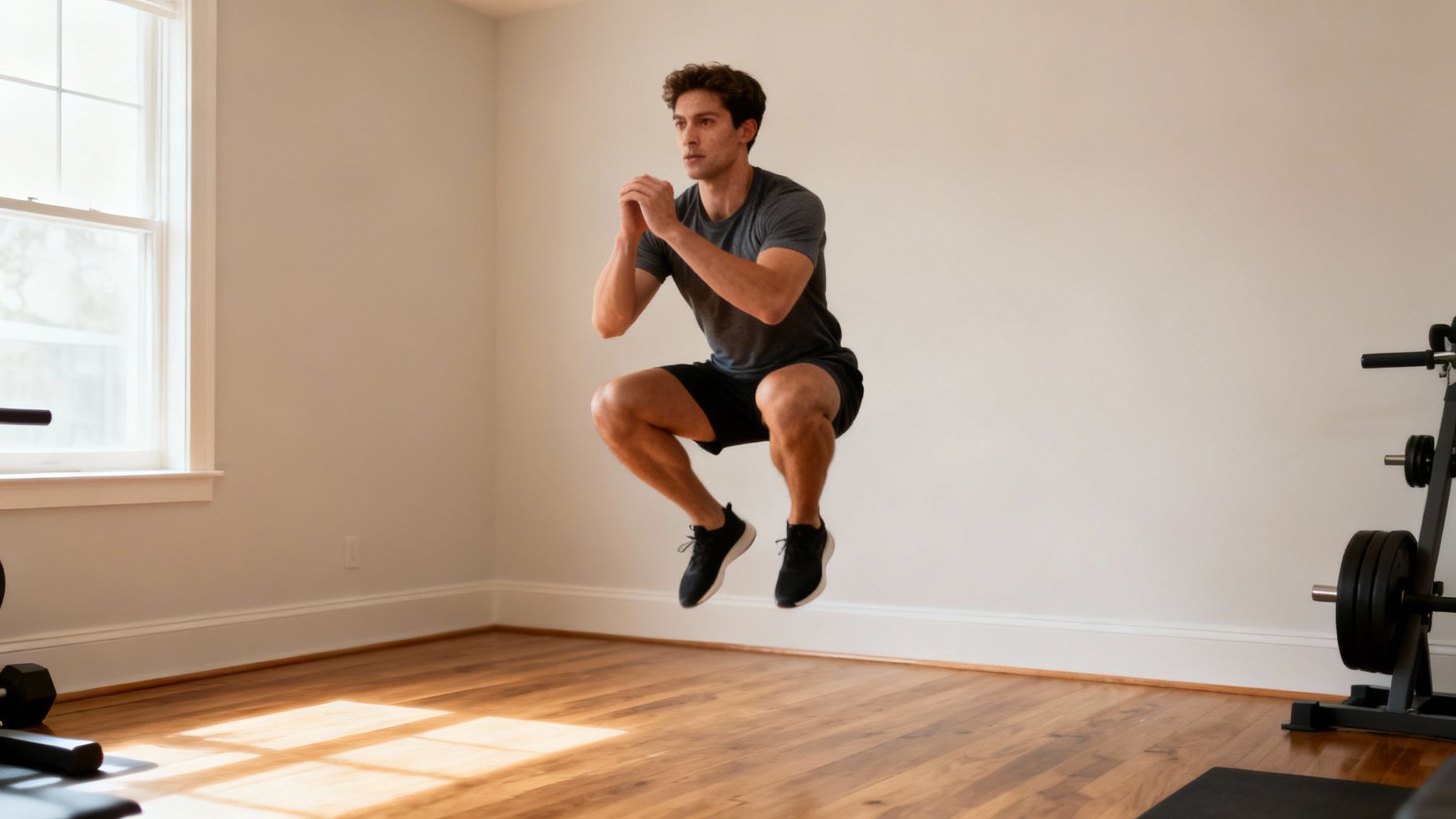
The versatility of squats makes them one of the best exercises for fat loss at home. You can modify them to match any fitness level and goal. Adding an explosive jump (jump squat) incorporates a cardiovascular element that spikes your heart rate and maximizes calorie expenditure, while holding a weight (goblet squat) builds lean muscle mass. This added muscle increases your resting metabolic rate, helping you burn more fat even when you're not exercising.
How to Implement Squats at Home
Integrating different squat variations keeps your workouts challenging and effective. Focus on mastering the basic bodyweight squat form first before progressing to more advanced versions.
- Structure: Aim for a set and rep scheme that aligns with your goals. For building muscle, use a lower rep range with added weight; for endurance and cardio, use a higher rep range or explosive movements.
- Example Variations: Bodyweight squats, jump squats, goblet squats (using a dumbbell, kettlebell, or even a heavy household object), and squat pulses are all fantastic home options.
- Sample Squat-Focused Workout (20 minutes):
- Warm-up: 5 minutes of dynamic stretching (leg swings, bodyweight squats).
- Workout: Perform 3-4 rounds of the following circuit, resting 60 seconds between rounds.
- Goblet Squats: 12-15 reps
- Jump Squats: 10-12 reps
- Bodyweight Squat Pulse: 30 seconds
- Cool-down: 5 minutes of static stretching for quads, hamstrings, and glutes.
Key Insight: Squats are a metabolic powerhouse. By engaging the body's largest muscles, they create a significant energy demand that accelerates fat loss and builds a stronger, more functional lower body.
Actionable Tips for Success
Proper form is crucial to prevent injury and maximize results. Always keep your chest up, back straight, and core engaged throughout the movement. Your weight should be distributed through your heels, not the balls of your feet, and ensure your knees track in line with your toes. When performing goblet squats, hold the weight securely against your chest. For jump squats, land softly with bent knees to absorb the impact. If you're ready for an advanced challenge, you can learn more about single-leg variations like the Pistol Squat.
9. Battle Ropes
Battle ropes are a formidable tool for fat loss, offering a unique blend of cardiovascular and strength training. This exercise involves powerfully whipping, slamming, or creating waves with heavy ropes, engaging nearly every muscle group from your core and back to your arms and legs. This full-body recruitment leads to a massive metabolic demand, making it one of the best exercises for fat loss at home if you have the space and equipment.
The effectiveness of battle ropes comes from their ability to sustain high-intensity effort over short intervals. This dynamic, explosive movement rapidly elevates your heart rate, torches a significant number of calories, and improves your anaerobic and aerobic capacity simultaneously. Unlike many traditional cardio exercises, battle ropes also build muscular endurance and power, contributing to a more athletic and functional physique.
How to Implement Battle Ropes at Home
To use battle ropes, you'll need a dedicated space and a secure anchor point. Once set up, focus on generating power from your entire body, not just your arms.
- Structure: A highly effective approach is to use HIIT-style intervals, such as 30 seconds of maximum effort followed by 30-60 seconds of rest.
- Example Exercises:
- Alternating Waves: Stand in an athletic stance, holding one rope in each hand. Alternately raise and lower each arm to create opposing waves.
- Double Waves: Keep both feet planted and move both arms up and down together, slamming the ropes to create large, powerful waves.
- Rope Slams: Lift both ropes overhead and forcefully slam them down onto the ground.
- Sample Battle Rope Circuit (15 minutes):
- Warm-up: 5 minutes of light cardio and dynamic stretching.
- Circuit: Perform each exercise for 30 seconds, followed by 30 seconds of rest. Repeat the entire circuit 3 times.
- Alternating Waves
- Double Waves
- Rope Slams
- Jumping Jacks (as active recovery)
- Cool-down: 5 minutes of full-body stretching.
Key Insight: Battle ropes provide a low-impact, high-intensity workout that builds power and torches fat without the joint stress associated with exercises like running or jumping. This makes them a great option for preserving joint health while maximizing results.
Actionable Tips for Success
Safety and proper form are paramount when using battle ropes. Start by securely fastening the ropes to a sturdy anchor point. Maintain an athletic stance throughout each movement with your feet shoulder-width apart, knees slightly bent, and your core tight to protect your lower back. If you are new to this exercise, begin with shorter work intervals of 15-20 seconds to master the form before increasing the duration. Focus on generating fluid motion from your hips and core, allowing your arms to follow through. As your endurance improves, you can progressively increase the work time or shorten your rest periods for a greater challenge.
10. Walking Lunges and Reverse Lunges
Walking and reverse lunges are foundational lower-body exercises that earn their spot among the best exercises for fat loss at home by targeting the largest muscle groups in your body: the glutes, quadriceps, and hamstrings. This single-leg movement challenges your balance and stability, forcing your core to engage deeply. By recruiting so much muscle mass, lunges significantly increase your metabolic demand, leading to greater calorie expenditure both during and after your workout.
Unlike bilateral exercises like squats, lunges work each leg independently, which helps correct muscle imbalances and enhance functional strength for everyday activities like climbing stairs or carrying groceries. Their versatility allows you to modify the intensity easily, either by adding weights, increasing your pace, or transitioning to more explosive variations. This scalability makes lunges an enduring and effective component of any fat loss program.
How to Implement Lunges at Home
Mastering the basic lunge form is crucial before adding intensity. The focus should be on controlled movement and proper knee alignment to maximize effectiveness and prevent injury.
- Structure: Aim for controlled sets and reps. A good starting point is 3 sets of 10-12 repetitions per leg.
- Example Variations:
- Walking Lunges: Step forward into a lunge, then push off your back foot to step directly into the next lunge with the opposite leg, moving across the room.
- Reverse Lunges: Step backward into a lunge. This variation is often considered safer for the knees as it keeps the front shin more vertical.
- Weighted Lunges: Hold dumbbells or kettlebells to increase resistance and calorie burn.
- Sample Lunge Workout (part of a lower-body day):
- Warm-up: 5 minutes of dynamic stretching (leg swings, hip circles).
- Circuit: Perform 3 rounds of the following.
- Reverse Lunges: 12 reps per leg
- Glute Bridges: 15 reps
- Walking Lunges: 10 reps per leg
- Cool-down: 5 minutes of static stretching for quads, hamstrings, and glutes.
Key Insight: Lunges are a powerful metabolic tool because they are a compound, unilateral exercise. Working one leg at a time demands more stabilization from your core and hips, activating more muscles and burning more calories than many bilateral movements.
Actionable Tips for Success
To perform lunges safely and effectively, pay close attention to your form. Always keep your torso upright and your core engaged to maintain balance and protect your spine. Ensure your front knee tracks in line with your foot and does not extend past your toes. Start with reverse lunges if you have sensitive knees, as they place less stress on the joint. Once you have mastered the bodyweight form, you can progress to weighted versions or more dynamic options. For an explosive challenge, you can learn how to properly perform plyometric jump lunges to further boost your heart rate and fat-burning potential.
Top 10 Home Fat-Loss Exercises Comparison
| Exercise | Implementation complexity | Resource requirements | Expected outcomes | Ideal use cases | Key advantages |
|---|---|---|---|---|---|
| High-Intensity Interval Training (HIIT) | Medium — interval planning and intensity control | Minimal — bodyweight or optional equipment | Very high calorie burn, metabolic afterburn, improved cardio | Time-efficient fat loss, metabolic conditioning | Highly time-efficient, scalable, strong afterburn |
| Burpees | Medium–High — complex full-body movement, good conditioning needed | None | Very high per-rep calorie burn; full-body strength and cardio | Short intense circuits, no-equipment sessions | Extremely efficient, full-body, portable |
| Jump Rope | Medium — requires coordination and rhythm | Low — jump rope and small clear space | High calorie burn, improved coordination and bone density | Cardio cross-training, portable workouts | Affordable, portable, very efficient cardio |
| Mountain Climbers | Low–Medium — plank form important | None | Moderate–high calorie burn, core strength, cardio | Core-focused circuits, HIIT components | Combines core and cardio, scalable, no equipment |
| Jumping Jacks | Low — basic movement, minimal skill | None | Low–moderate calorie burn; raises heart rate quickly | Warm-ups, beginners, circuit filler | Simple, accessible, easy to modify |
| Push-Ups | Medium — technique and baseline strength required | None (optional surfaces/variations) | Builds upper-body strength and lean muscle; modest calorie burn | Strength building, bodyweight programs | Progressive variations, builds lean mass, no equipment |
| Running or Jogging | Low — basic movement but requires endurance planning | Minimal — good shoes; treadmill optional | High calorie burn, strong cardiovascular improvements | Steady-state cardio, endurance training, outdoor workouts | Accessible, effective for sustained calorie burn, mood benefits |
| Squat Variations (Jump/Goblet) | Medium — form critical, some variations advanced | Minimal to moderate — bodyweight or dumbbells/kettlebells | High calorie burn, major leg/glute strength, metabolic boost | Lower-body strength, power development, fat loss | Engages largest muscles, scalable intensity and resistance |
| Battle Ropes | Medium — technique and anchor setup required | Moderate — ropes, anchor point, space | Very high calorie burn in short bouts; power and conditioning | Gym or home-gym intervals, metabolic conditioning | Non-impact on lower joints, intense metabolic work |
| Walking Lunges / Reverse Lunges | Medium — balance and controlled technique | None to low — optional dumbbells and space | Moderate–high calorie burn; single-leg strength and stability | Strength, balance training, rehabilitation (reverse lunges) | Functional unilateral strength, scalable with weights |
Build a Smarter Workout Plan Today
You now have a powerful arsenal of the best exercises for fat loss at home. From the explosive cardio of HIIT and burpees to the foundational strength of squats and push-ups, each movement offers a unique pathway to a leaner, stronger physique. But as we've explored, the secret to sustainable fat loss isn't just knowing what to do; it’s about knowing how to piece it all together into a cohesive, intelligent plan.
The true transformation begins when you move from simply performing exercises to building a structured, progressive routine. The most effective workouts are not random collections of movements but are designed with purpose, balancing intensity, recovery, and variety to keep your body adapting and your mind engaged.
From Individual Exercises to a Cohesive Fat-Loss Engine
Think of the exercises in this guide, like burpees, mountain climbers, and jump rope, as high-performance parts of an engine. On their own, they are powerful, but only when assembled correctly do they create unstoppable momentum. Your goal is to become the architect of your own fitness engine.
Here’s a summary of the core principles for building that engine:
- Compound Movements are King: Exercises like squats, lunges, and push-ups engage multiple muscle groups simultaneously. This not only builds functional strength but also maximizes calorie burn both during and after your workout. They are the non-negotiable foundation of any effective fat-loss plan.
- Intensity Drives Adaptation: High-Intensity Interval Training (HIIT) is not just a trend; it's a scientifically-backed method for elevating your metabolic rate. By strategically integrating short bursts of all-out effort with brief recovery periods, you can achieve superior results in less time.
- Consistency Outweighs Perfection: A 20-minute workout performed consistently three times a week will always yield better results than a perfect 60-minute session done sporadically. The goal is to build a sustainable habit that fits your life, not an unrealistic routine that leads to burnout.
Actionable Steps to Start Your Transformation
Knowledge without action is just potential. To turn the insights from this article into tangible results, you must create a plan. Start simple and build from there. For a holistic approach to fitness and fat loss, incorporating strength training is crucial. You can find helpful ideas on essential strength training exercises that complement the high-intensity cardio we've discussed.
Here’s your immediate action plan:
- Select Your "Core Four": Choose four exercises from our list that you feel most confident performing. Aim for a mix: one full-body explosive move (like burpees), one cardio-focused move (like jumping jacks), one lower-body strength move (like squats), and one upper-body/core move (like push-ups or mountain climbers).
- Define Your Structure: Use the HIIT protocol. Set a timer for 40 seconds of work followed by 20 seconds of rest. Perform your "Core Four" exercises back-to-back to complete one round.
- Set a Realistic Goal: Aim to complete 3-4 rounds of this circuit. This creates a powerful, effective workout that can be completed in under 20 minutes. Schedule this workout for three non-consecutive days this week.
Key Takeaway: The ultimate goal is not just to burn calories but to build a body that is more metabolically active at rest. By combining high-intensity cardio with foundational strength work, you are teaching your body to become a more efficient fat-burning machine 24/7.
Mastering these concepts shifts your perspective from "working out" to "training with a purpose." Every session becomes a deliberate step toward your goal, driven by a clear strategy rather than guesswork. This is the difference between exercising and achieving a transformation. You have the tools, the knowledge, and the strategy. Now is the time to build.
Ready to stop guessing and start training with a plan that evolves with you? Zing Coach uses AI to analyze your goals, abilities, and available equipment to build hyper-personalized workouts. Get real-time feedback and an adaptive plan that ensures you are always progressing safely and effectively toward your fat loss goals. Download Zing Coach today and let your smarter fitness journey begin.
Share this article


Authors