Unlock muscle growth with this definitive 4 day push pull workout routine. Get a full schedule, exercises, and progression tips for real results.
A 4-day push/pull workout routine is a classic, battle-tested training split for a reason: it just works. The setup is simple. You have "pushing" days dedicated to your chest, shoulders, and triceps, and "pulling" days for your back and biceps. This layout lets you hit every major upper-body muscle twice a week—a known sweet spot for building muscle and strength.
The whole plan is built around balancing intense work with smart recovery, which is the key to sticking with it long enough to see real results.
Why The 4-Day Push/Pull Split Actually Works
What makes the 4-day push/pull split so effective is its straightforward logic. Forget those overly complicated routines where you're not sure what you're supposed to be training. Here, you're either pushing weight away from your body or pulling it in. Every session has a clear purpose.
This approach naturally avoids the muscle overlap that can lead to overtraining in other splits. When you group muscles that work together—like the chest, shoulders, and triceps during a bench press—you can train them hard and to their full potential. After that push day, those muscles get a well-deserved break while you switch gears to your pulling muscles.
Maximizing Growth with Optimal Frequency
One of the biggest wins here is training frequency. Study after study confirms that hitting a muscle group twice a week is a game-changer for growth. A traditional "bro split" might only train a muscle once every seven days. This 4-day push/pull plan doubles that stimulus, which translates to more consistent gains over the long haul.
It’s the perfect middle ground for most people. You get enough volume to kickstart muscle protein synthesis multiple times a week without having to live in the gym on a demanding 5- or 6-day schedule. It’s an evidence-based method that respects the fact that you have a life outside of working out.
The 4-day push/pull split has become a go-to for recreational lifters because it aligns with a typical workweek while allowing for adequate rest. Studies on training frequency show that hitting a muscle group 2–4 times per week can increase muscle size by approximately 6.8%, compared to just 3.7% when trained once weekly. This makes the split highly effective for those who can't live in the gym but still want scientifically backed results.
Here is a common way to structure your week for optimal performance and recovery. This ensures no muscle group is overworked.
Example Weekly 4-Day Push Pull Schedule
| Day | Workout Focus |
|---|---|
| Monday | Push Day 1 (Strength Focus) |
| Tuesday | Pull Day 1 (Strength Focus) |
| Wednesday | Rest |
| Thursday | Push Day 2 (Hypertrophy Focus) |
| Friday | Pull Day 2 (Hypertrophy Focus) |
| Saturday | Rest |
| Sunday | Rest |
This schedule gives you a solid weekend to recover and come back strong for the following week.
Balancing Intensity and Recovery
Burnout is the number one reason people fall off their workout programs. The 4-day push/pull routine has recovery baked right in, giving each muscle group a solid 48-72 hours of rest before you hit it again. This schedule is designed to manage fatigue, cut down on soreness, and lower your risk of injury.
That balance is what makes the program so sustainable. You can go all-out in your sessions, knowing you have recovery days built in to repair and rebuild stronger muscle tissue. It's a system designed for long-term consistency, and that's the real secret to reaching your fitness goals. If you're wondering exactly how to structure your volume, our guide on how many exercises per muscle group breaks it down with clear, actionable advice.
The Complete 4-Day Push/Pull Workout Plan
Alright, let's get into the good stuff—the actual workouts. This is the blueprint for your entire training week, broken down day by day. We’re structuring this 4-day push/pull workout routine with a smart hybrid approach: two days are dedicated to building raw strength, and two are geared toward hypertrophy to pack on muscle size.
This method ensures you’re not just getting bigger but becoming functionally stronger, too. The strength days will have you working in lower rep ranges (5-8 reps) with heavier weight. Then, on hypertrophy days, we’ll switch gears to moderate weight for higher reps (10-15 reps) to chase that muscle pump and create the metabolic stress needed for growth.
Here’s a quick look at how the push, pull, and recovery cycle flows throughout the week.
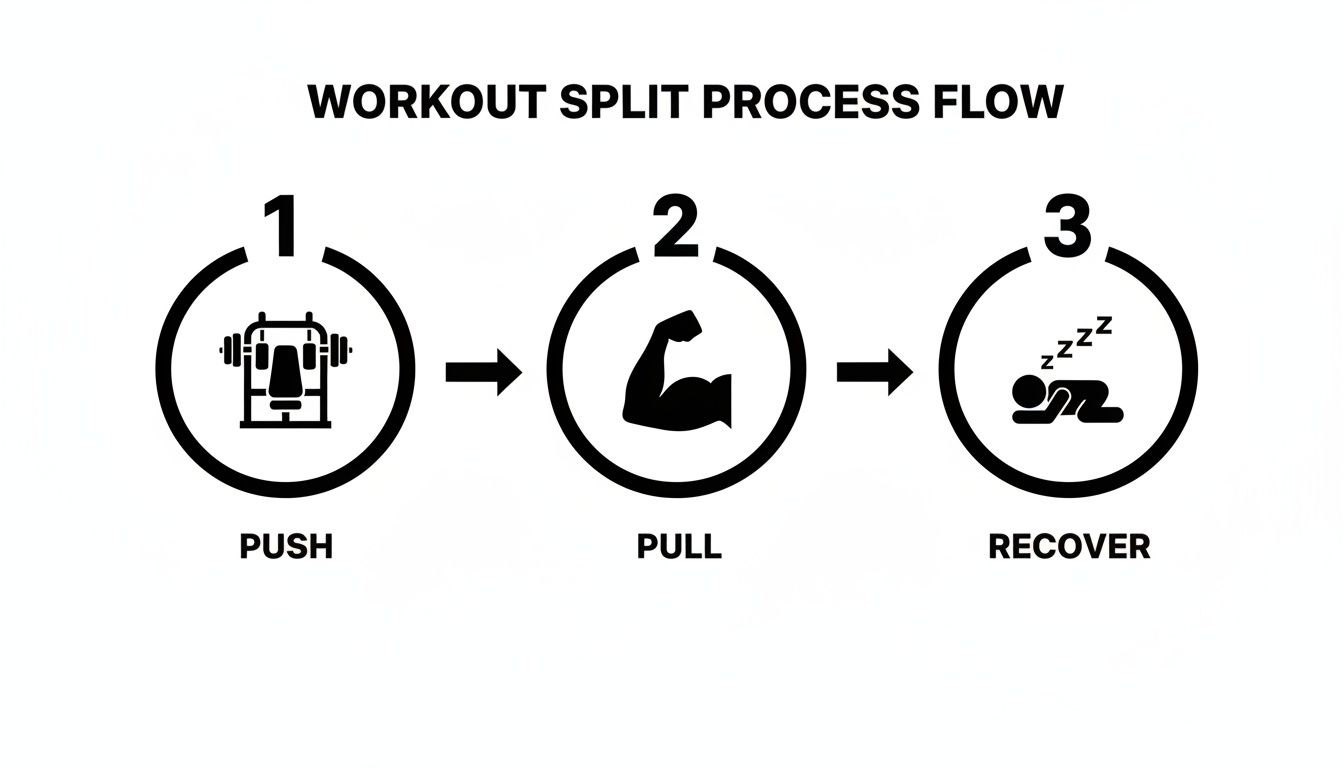
This simple workflow shows the beautiful balance of this routine. You alternate between pushing and pulling movements before giving your body the crucial time it needs to recover and come back stronger.
Workout 1: Push Day (Strength Focus)
We kick off the week by moving some serious weight. Today is all about building a powerful foundation for your chest, shoulders, and triceps with heavy compound lifts. Your job is to focus on intensity and control every single rep. Rest fully between your big lifts so you can bring maximum effort to each set.
| Exercise | Sets x Reps | Rest |
|---|---|---|
| Barbell Bench Press | 4 x 5-8 | 2–3 minutes |
| Seated Dumbbell Shoulder Press | 4 x 6-8 | 2 minutes |
| Incline Dumbbell Press | 3 x 6-8 | 90 seconds |
| Triceps Dips (Weighted) | 3 x 8-10 | 90 seconds |
| Lateral Raises | 3 x 8-10 | 60 seconds |
Don't rush your rest periods here, especially on the bench press. Taking that full 3 minutes isn't lazy; it’s strategic. Your central nervous system needs that time to recharge so you can attack the next set with the same force. This is where real strength is built.
Workout 2: Pull Day (Strength Focus)
Next up, we hit the opposing muscle groups with that same strength-focused intensity. This workout is designed to build a thick, powerful back and strong biceps using heavy, controlled pulling movements. Strict form is non-negotiable, especially on rows, to protect your lower back and make sure the right muscles are doing the work.
| Exercise | Sets x Reps | Rest |
|---|---|---|
| Barbell Rows | 4 x 5-8 | 2–3 minutes |
| Pull-Ups (Weighted) | 4 x 6-8 | 2 minutes |
| T-Bar Rows | 3 x 8-10 | 90 seconds |
| Barbell Curls | 3 x 8-10 | 90 seconds |
| Face Pulls | 3 x 10-12 | 60 seconds |
A little tip for your Barbell Rows: think about pulling the bar toward your belly button, not your chest. This small adjustment in the angle helps you engage your lats much more effectively, which is key for building that wide V-taper.
Pro Tip: If you can't bang out at least 6 clean bodyweight pull-ups, don’t sweat it. Use the assisted pull-up machine or loop a heavy resistance band around the bar. The goal is to stay in that target rep range, so just adjust the assistance as needed. You'll get stronger and need less help over time.
Workout 3: Push Day (Hypertrophy Focus)
After a much-needed rest day, we’re back to pushing movements, but today’s mission is different. We’re shifting the focus from pure strength to pure muscle growth. That means higher reps, shorter rest times, and techniques that pump as much blood into the muscles as possible.
| Exercise | Sets x Reps | Rest |
|---|---|---|
| Dumbbell Bench Press | 3 x 10-15 | 60–90 seconds |
| Arnold Press | 3 x 10-12 | 60 seconds |
| Cable Flyes | 3 x 12-15 | 60 seconds |
| Triceps Pushdowns | 3 x 12-15 | 45–60 seconds |
| Overhead Triceps Extension | 3 x 12-15 | 45–60 seconds |
On hypertrophy days, the "pump" is your best friend. That burning sensation you feel in the last few reps? That’s the good stuff. It signals you're creating the metabolic environment that tells your muscles to grow. Don’t stop when it burns; that’s your cue to push for one or two more.
Workout 4: Pull Day (Hypertrophy Focus)
We wrap up the training week with a hypertrophy-focused pull day. Just like the second push day, the goal here is all about volume and getting a massive pump. We'll use a mix of machines and free weights to hit the back and biceps from multiple angles, ensuring we leave no muscle fiber untouched.
| Exercise | Sets x Reps | Rest |
|---|---|---|
| Lat Pulldowns | 3 x 10-15 | 60–90 seconds |
| Seated Cable Rows | 3 x 10-15 | 60 seconds |
| Dumbbell Rows | 3 x 12-15 per side | 60 seconds |
| Dumbbell Hammer Curls | 3 x 12-15 | 45–60 seconds |
| Preacher Curls | 3 x 12-15 | 45–60 seconds |
Think of this routine as a complete framework. The exercises listed are absolute killers, but they aren't set in stone. If you're ever unsure about form or need to swap something out, browsing a comprehensive library of fitness exercises is a great way to find video guides and detailed instructions to keep your workouts both safe and effective.
And remember, always listen to your body. On these hypertrophy days, pick a weight where the last two reps of every set feel like a genuine struggle. It needs to be heavy enough to force failure in the target rep range, but not so heavy that your form breaks down. That blend of controlled chaos is the secret to building a truly impressive physique with a 4-day push/pull workout routine.
How to Make Consistent Progress and Avoid Plateaus
Having a killer 4-day push-pull workout routine is a fantastic start, but a plan is only as good as what you do with it over the long haul. The real magic behind lasting gains isn't some secret exercise—it's the consistent, intelligent application of progressive overload.
Put simply, this principle means you have to constantly ask your muscles to do a little more than they're used to. If you just lift the same weight for the same reps, week after week, your body has zero reason to adapt and grow stronger. It gets comfortable, and that's when you hit the dreaded plateau that drives so many people nuts.
Smart Ways to Apply Progressive Overload
Progressive overload is more art than science, and it’s about more than just slapping another plate on the bar. There are several clever ways to keep challenging your body and forcing it to adapt. The best part? You can mix and match these methods to keep things fresh and ensure you’re always moving forward.
- Increase Reps: Did you hit 10 reps on the dumbbell bench press last week? Your mission this week is to squeeze out 11 or 12 with the same weight.
- Increase Weight: Once you can comfortably nail the top end of your rep range (say, 15 reps on an exercise where the goal is 10-15), it's time. Add a little weight next session.
- Increase Sets: Can't add more weight or reps just yet? No problem. Add another working set to an exercise to bump up your total training volume.
- Decrease Rest Time: Trimming your rest periods between sets makes the workout more demanding and forces your body to become more efficient at handling the workload.
- Improve Form and Tempo: This is a big one. Slowing down the eccentric (the lowering part) of a lift or pausing at the point of peak contraction massively increases time under tension, which is a powerful trigger for muscle growth.
The real goal isn't just to move weight; it's to move it better and more effectively over time. True progress is measured in quality reps, not just how much is on the bar.
Tracking these small wins is where the real motivation comes from. To stay on top of it, think about using a gym journal to track progress. It takes all the guesswork out of the equation and tells you exactly what you need to beat from your last session.
The Power of the Deload Week
Going all-out, all the time sounds like the fastest way to get results, but from my experience, it's actually the fastest way to get injured or burn out. Your body—muscles, joints, and even your nervous system—accumulates fatigue. That’s where a strategic deload week comes in.
A deload is a planned period of lighter training that lets your body fully recover so you can come back even stronger. You don't just stop training. Instead, you might cut your working weights by 40-50% or simply do half the number of sets. This kind of active recovery helps shake off fatigue without killing your momentum.
I'd recommend planning a deload every 4-8 weeks. Pay attention to the signs, too—if you're feeling constantly sore, your energy is tanking, or your lifts have stalled for a couple of weeks, it's probably time. For more on this, we've got a whole guide with tips to prevent plateaus.
Nail Your Warm-Ups and Recovery to Maximize Gains
What you do before and after your lifts is every bit as important as the workout itself. Think of your 4-day push/pull workout routine as the main event, but your warm-up and recovery are the behind-the-scenes crew that make the show a success. Skimp on them, and you’re just asking for stalled progress and injuries.
Jumping straight into heavy lifts with cold muscles is a recipe for disaster. A solid warm-up does more than just get your blood flowing; it lubes up your joints, fires up your nervous system, and gets your head in the game. It’s all about priming your body for the specific work you're about to put in.

A Dynamic Warm-Up Blueprint
Forget plodding on the treadmill for 10 minutes. Your warm-up needs to be dynamic, which just means you’re actively moving through a full range of motion. This approach directly wakes up the muscles you’re about to hammer.
Before every single push or pull day, set aside 5-10 minutes for this sequence:
- Light Cardio (2-3 minutes): Kick things off with something simple like jogging in place, cycling, or jumping jacks. The goal is just to raise your core body temperature.
- Dynamic Stretching (3-5 minutes): Now, focus on movements that mimic your workout. For a push day, think arm circles and torso twists. For a pull day, cat-cow stretches and band pull-aparts are your best friends.
- Activation and Mobility (2-3 minutes): Wrap up by waking up key stabilizer muscles. Glute bridges are perfect for activating your hips, and scapular push-ups will get your shoulders ready to press.
If you want a more detailed playbook, check out our complete guide on how to warm up before strength training.
Unlocking Recovery Beyond Just Stretching
Your cool-down is where the real recovery process kicks off. While a few minutes of static stretching—holding a stretch for 20-30 seconds—is great for flexibility, true recovery is a 24/7 job. It’s what you do in the hours and days between your workouts that truly dictates your results.
Recovery isn't just about what you do for 10 minutes post-workout; it's a lifestyle. Sleep, nutrition, and hydration are the three pillars that support every single rep you perform in the gym.
Think of it as a complete system. Your body needs the right resources to repair the muscle damage you create during training.
- Sleep: This is non-negotiable. Aim for 7-9 hours of quality sleep a night. This is when your body releases the growth hormone essential for muscle repair.
- Nutrition: Make protein a priority. Getting enough protein provides the amino acids your body needs to rebuild muscle fibers stronger than before.
- Hydration: Water is crucial for transporting nutrients and keeping your muscles functioning. Even slight dehydration can tank your strength and endurance.
Getting a handle on your body's internal chemistry is a game-changer for maximizing your workouts. For a deeper dive, explore the crucial link between exercise and hormone health. When you dial in these elements, you ensure all the hard work from your 4-day push/pull workout routine translates into real, lasting gains.
How to Adapt the Routine for Any Fitness Level
A well-designed 4-day push-pull workout routine is a fantastic tool, but its real power is in its adaptability. This isn't some rigid, one-size-fits-all plan carved in stone. You can make this split work for you whether you're a complete beginner, training at home with minimal gear, or so swamped you can barely find time to breathe.
The trick is knowing which levers to pull. By adjusting variables like exercise choice, volume, and intensity, you can tailor this routine to your exact situation. Remember, the best workout plan is the one you can actually stick with—and that means it has to fit into your life, not the other way around.

Modifications for Beginners
If you're just starting out, your main goal isn't to hoist the heaviest weight possible. It’s to nail down perfect form and build a solid foundation. Trying to rush that process is just a fast track to injury and frustration.
Here’s how to scale things back the right way:
- Dial back the volume: Instead of aiming for four sets right away, start with 2-3 sets per exercise. This gives you plenty of practice with the movements without completely torching your muscles.
- Focus on lighter weight: Pick a weight that lets you complete every single rep with clean, controlled form. The last couple of reps should feel challenging, but not like an all-out battle.
- Keep the exercises simple: Swap out complex barbell movements for more stable alternatives. For example, use a Smith machine for your bench press or just opt for dumbbell presses, which are often much easier to control when you're learning.
For your first few weeks, your mission is simple: consistency and technique. Once you feel confident and your form is locked in, you can start to gradually increase the weight and intensity.
Limited Equipment and Home Workout Swaps
No gym membership? No sweat. You can run an incredibly effective push/pull split right from home with just a few pieces of gear. It all comes down to choosing exercises that still provide enough resistance to challenge your muscles.
Here are some smart substitutions for common gym exercises:
| Gym Exercise | At-Home Alternative |
|---|---|
| Barbell Bench Press | Dumbbell Bench Press, Push-Ups (various inclines) |
| Barbell Rows | Dumbbell Rows, Resistance Band Rows, Inverted Rows |
| Lat Pulldowns | Pull-Ups (with assistance band if needed), Band Pulldowns |
| Cable Flyes | Dumbbell Flyes, Resistance Band Flyes |
| Leg Press | Goblet Squats, Lunges, Bulgarian Split Squats |
Even with just a pair of adjustable dumbbells and some resistance bands, you can build a fantastic physique. If you're looking for more ideas, our guide on how to start strength training at home is packed with practical advice.
Time-Saving Tip for Busy Days
When you're in a time crunch, turn to supersets. Just pair a push exercise with a pull exercise (like push-ups and dumbbell rows) and perform them back-to-back with zero rest in between. This is a killer way to get a full workout done in under 30 minutes.
This routine's efficiency is one of its greatest strengths. Compared to other popular training templates, 4-day splits are consistently ranked as one of the most time-efficient ways to build strength. A 4-day push/pull routine is structured much like an upper/lower split, which can deliver about 85% of the gains of a 5-day plan while requiring 30% less time in the gym. This makes it a realistic choice for professionals who can commit 45–60 minutes four days a week. It hits that sweet spot—providing enough stimulus for growth while still allowing for plenty of recovery, unlike some high-frequency splits that demand over six hours per week.
Got Questions About the 4 Day Push Pull Routine?
Jumping into a new training split always brings up a few questions. That's a good thing. When it comes to the 4-day push/pull routine, a few of the same queries tend to pop up, and getting solid answers is key to building the confidence you need to really own the program.
Let's tackle the big ones right now. That way, you can clear your head and focus your energy on what actually matters—getting stronger in the gym.
Can I Change the Order of the Workout Days?
You absolutely can. The most important rule here is simple: avoid training the same movement pattern on back-to-back days. The classic Push-Pull-Rest-Push-Pull setup is popular for a reason—it builds this separation in automatically. But life isn't always that neat and tidy.
Feel free to shuffle the days to make it work for you. A Push-Rest-Pull-Rest-Push-Pull-Rest schedule, for example, is just as effective. The main thing is to give each muscle group at least 48 hours to recover before you hit it again. Listen to your body and lock in a structure you know you can stick with.
What Should I Do If I Miss a Workout?
First thing's first: don't sweat it. Life gets in the way sometimes, and one missed session isn't going to derail your progress. The worst thing you can do is try to overcompensate.
The best move is to just pick up where you left off. If you were supposed to hit a Pull workout on Tuesday but missed it, just do that Pull workout on Wednesday and shift everything back a day. This keeps your training volume balanced over the long haul. Resist the urge to cram two workouts into one day—consistency over time will always beat short-term perfection.
The most successful lifters aren't the ones who never miss a workout. They're the ones who get right back on track after a minor hiccup. One missed session is just a blip on the radar.
How Do I Add Cardio and Core Training?
Working cardio and core into your 4-day push/pull split is pretty straightforward with a little planning. You just want to make sure it's not draining the tank for your main lifts.
Here’s a smart way to fit it all in:
- Core Work: Add 10-15 minutes of core-specific exercises to the end of two of your lifting days. Things like planks, leg raises, and Russian twists are perfect.
- Cardio: Your rest days are the ideal spot for cardio. Aim for 20-30 minutes of moderate-intensity work like incline walking, cycling, or hitting the elliptical. It’s enough to keep your heart healthy without messing with your muscle recovery.
How Long Should I Stick With This Routine?
You'll want to give this program a real shot—I'm talking a solid 8-12 weeks—to see how your body responds. If you're seeing measurable progress, the routine is working. That means you're lifting more weight, getting more reps, or just feeling like your form is getting cleaner and stronger.
Don't fall into the trap of thinking you need to swap out exercises constantly for "variety." The whole "muscle confusion" thing is mostly a myth. What really drives results is progressive overload. The only time to think about changing an exercise is if you've hit a true strength plateau that's lasted for a few weeks. Even then, just switching to a similar variation is often all it takes to get things moving again.
Ready to stop guessing and start progressing? The Zing Coach app removes the guesswork by creating a truly personalized training plan that adapts to you. It tracks your progress, adjusts your workouts based on your performance, and provides real-time form feedback to ensure every rep counts. Start your journey with a plan that’s as serious about your goals as you are. Get your AI-powered fitness plan today at Zing Coach.
Share this article


Authors