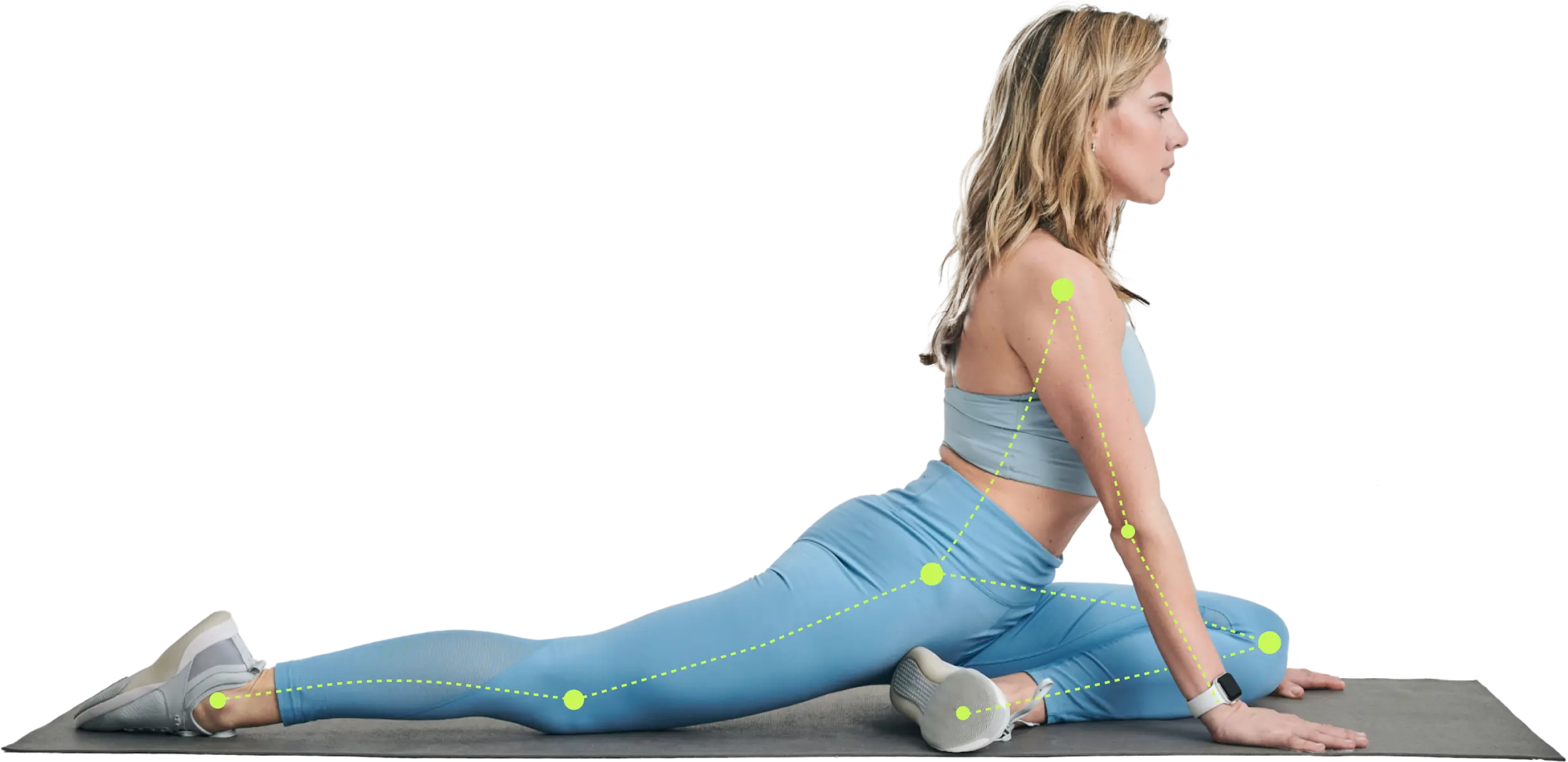
Learn how to start strength training at home: a beginner-friendly guide with essential exercises, a simple plan, and tips to stay motivated.
Getting started with strength training from your own home is way more straightforward than most people think. Seriously. The secret is to begin with bodyweight exercises. Just focus on showing up for two to three sessions a week, hitting all your major muscle groups. This approach costs you nothing and, more importantly, builds the kind of consistency that leads to real, lasting results.
Why Strength Training at Home Is Your Best First Move
Let’s be honest, the gym can be a lot. The rows of complicated machines, the unwritten rules of etiquette, and that nagging feeling that everyone is watching you can be enough to stop you before you even start. Ditching the crowded gym floor for your living room is one of the smartest moves you can make.
Training at home completely removes that social pressure. It gives you a private, judgment-free space to focus on what actually matters: learning the movements and listening to what your body is telling you.
This isn’t just a passing trend, either. The shift to home fitness is a massive movement. The home fitness equipment market was valued at USD 12.26 billion in 2024 and is expected to hit USD 19.79 billion by 2032. People are realizing that effective, life-changing fitness can happen right where they are. Even better, regular strength training is linked to a 23% reduction in all-cause mortality. Think of it as a powerful investment in your long-term health. You can learn more about the home fitness market's growth and see for yourself.
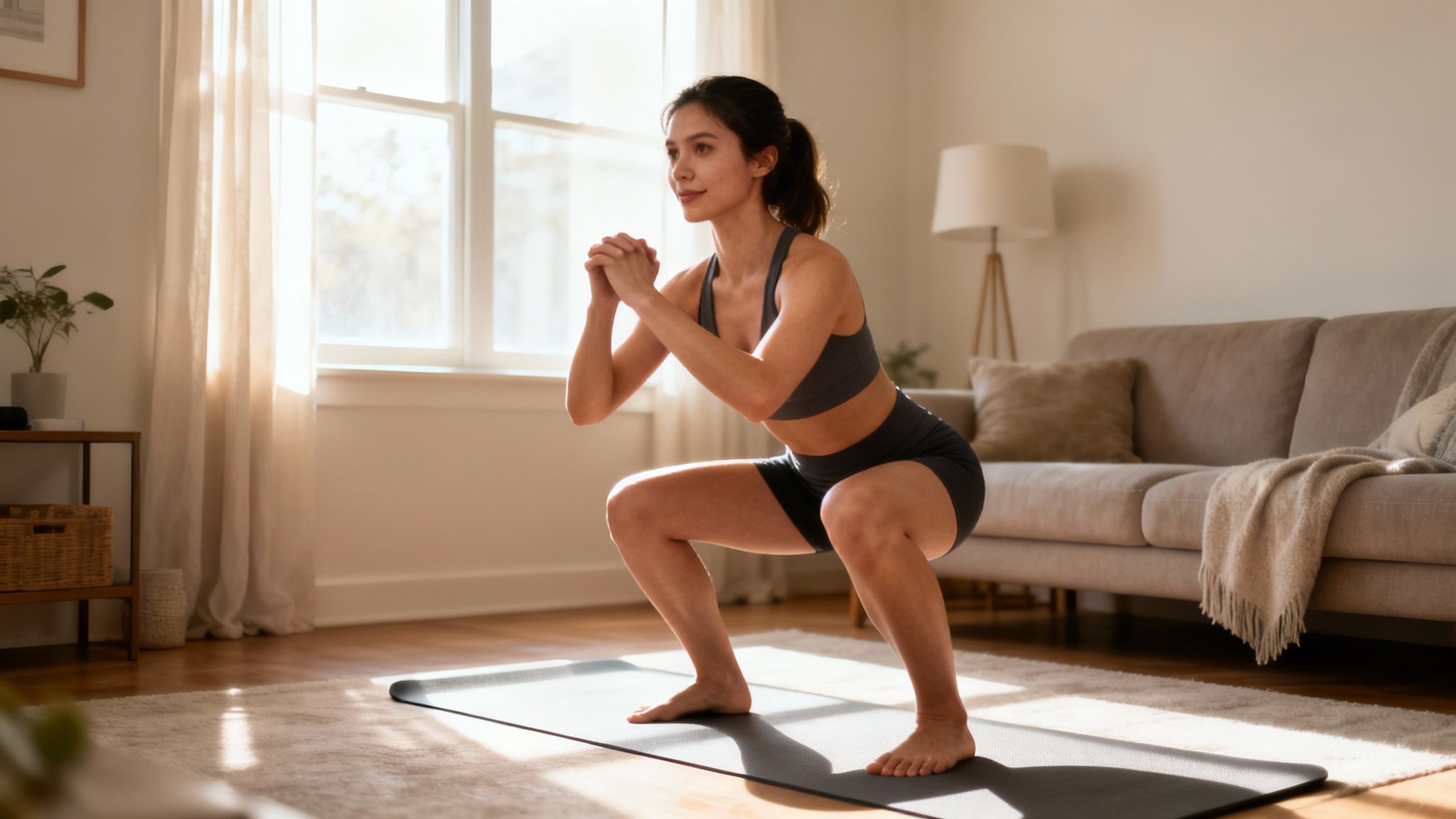
To help you visualize what a solid starting point looks like, here’s a quick blueprint. Think of this table as your cheat sheet for getting started safely and effectively right from day one.
Your At-Home Strength Training Blueprint
| Component | Beginner Recommendation | Why It Matters for You |
|---|---|---|
| Frequency | 2-3 full-body sessions per week on non-consecutive days. | Gives your muscles time to recover and grow stronger, preventing burnout. |
| Exercises | Start with bodyweight movements like squats, push-ups, lunges, and planks. | Builds a solid foundation of strength and coordination without any equipment. |
| Sets & Reps | Aim for 2-3 sets of 8-12 reps per exercise, focusing on good form. | This range is the sweet spot for building muscle and endurance as a beginner. |
| Progression | Once an exercise feels easy, increase reps, sets, or try a harder variation. | This is progressive overload in action—the key to getting stronger over time. |
| Recovery | Prioritize 7-9 hours of sleep and listen to your body’s signals. | Recovery is when the magic happens; it's when your muscles actually rebuild. |
This table lays out the core principles, but the real magic is in the tangible benefits you'll start to feel.
The Tangible Benefits of Starting at Home
Beyond simple convenience, starting your strength journey at home unlocks some powerful advantages. You’re not just building muscle; you're building a routine that actually fits your life.
Here's what you can look forward to:
- A Metabolism Boost: Building lean muscle increases your resting metabolic rate. That means your body burns more calories all day long, even when you're relaxing on the couch.
- Stronger Bones: Strength training puts just the right amount of stress on your bones, signaling your body to build them up denser and more resilient. This is huge for preventing osteoporosis down the road.
- Real-World Strength: You’ll quickly notice that everyday tasks—hauling groceries, lifting your kids, rearranging furniture—feel significantly easier. That’s functional strength, and it’s a game-changer.
The best workout plan is the one you actually stick with. By eliminating hurdles like travel time, gym fees, and self-consciousness, training at home makes consistency feel almost effortless.
Building a Foundation Without Overwhelm
Kicking things off with bodyweight exercises is the perfect entry point. Moves like squats, push-ups, lunges, and planks build a powerful base of strength, stability, and coordination using the one piece of gear you always have with you: your own body.
This approach lets you nail down proper form before you even think about adding weights, which dramatically cuts your risk of injury. As you get stronger, making things more challenging is simple and doesn't require a shopping trip. You can slow down the tempo, add more reps, or switch to a tougher variation. This concept, called progressive overload, is the secret sauce to getting stronger, and you can do it all from your own space, on your own schedule.
Building Your First Home Gym on a Budget
Creating your own workout space is one of the most empowering steps you can take, and thankfully, it doesn't require a second mortgage. You can forget the idea that you need a room full of chrome machines to get strong. When you’re figuring out how to start strength training at home, the goal should always be function over flash.
Believe it or not, the most powerful piece of equipment is one you already own: your body. Bodyweight training costs absolutely nothing and is the perfect way to master foundational movements like squats, push-ups, and planks. This isn't just some temporary placeholder; it's a legitimate training method that builds real-world strength and muscle.
Start with Smart Essentials
Once you’ve built a consistent routine with just your body weight, a few small, strategic investments can unlock hundreds of new movement possibilities. These items are affordable, versatile, and take up minimal space, making them perfect for just about any home.
You really don’t need much to get started. A couple of key pieces will dramatically expand your workout options and help you apply progressive overload—which is the secret sauce to getting stronger over time.
- Resistance Bands: These are arguably the most versatile and cost-effective tools you can buy. A set of loop bands adds resistance to squats and glute bridges, while tube bands with handles can mimic almost any cable machine exercise you can think of, like rows and chest presses.
- A Quality Mat: This is more than just for comfort during floor exercises like planks or core work. A good mat provides a stable, non-slip surface, which actually improves your form and safety. Think of it as your designated workout zone.
Don't underestimate the power of simple tools. I've had clients build impressive strength for months using nothing more than a set of resistance bands and their own determination.
Consider Your Next-Level Investments
As you get stronger and more confident, you might decide it’s time to level up your home gym. This is where you can make a slightly larger investment in equipment that will grow with you for years. The key is to pick items that are adjustable and multi-functional.
This is a great time to be building a home gym, too. The global weight training market is projected to hit USD 16.26 billion by 2035, with the at-home segment driving a huge chunk of that growth. This boom means there are more options and better tech for home users than ever before. You can discover more insights about the weight training market to see just how popular these setups have become.
Here are two excellent choices for a long-term investment:
- Adjustable Dumbbells: A full rack of dumbbells is impractical for most people, but a single pair of adjustable dumbbells is a total game-changer. They let you quickly change the weight, making them perfect for progressing in exercises like bicep curls, overhead presses, and lunges.
- A Versatile Kettlebell: A single kettlebell, maybe starting in the 15-35 lb range depending on your initial strength, is incredibly efficient. It’s ideal for dynamic, full-body movements like kettlebell swings, goblet squats, and Turkish get-ups that build power, cardio, and strength all at once.
These tools open up a massive variety of exercises. If you opt for dumbbells, for example, you can explore a whole library of movements to keep your workouts fresh and challenging. If you're looking for ideas, check out our guide on effective dumbbell exercises for every muscle group. This kind of variety is crucial for staying engaged and making continuous progress on your fitness journey.
Mastering the Foundational Home Exercises
Real, lasting strength isn't built with complicated machines or intimidating exercises. It comes from mastering a handful of foundational movements that work multiple muscle groups at once.
Confidence in your workout starts here. We're talking about the exercises that deliver the biggest bang for your buck, forming the bedrock of any solid at-home strength plan.
Let's break down the "big five" essential home exercises. I'll walk you through not just how to do each one, but why it’s so effective, common mistakes to watch out for, and how to tweak the difficulty to meet you exactly where you are today.
This infographic lays out a simple way to think about your equipment journey as you get stronger, starting with just your bodyweight and adding essential tools over time.
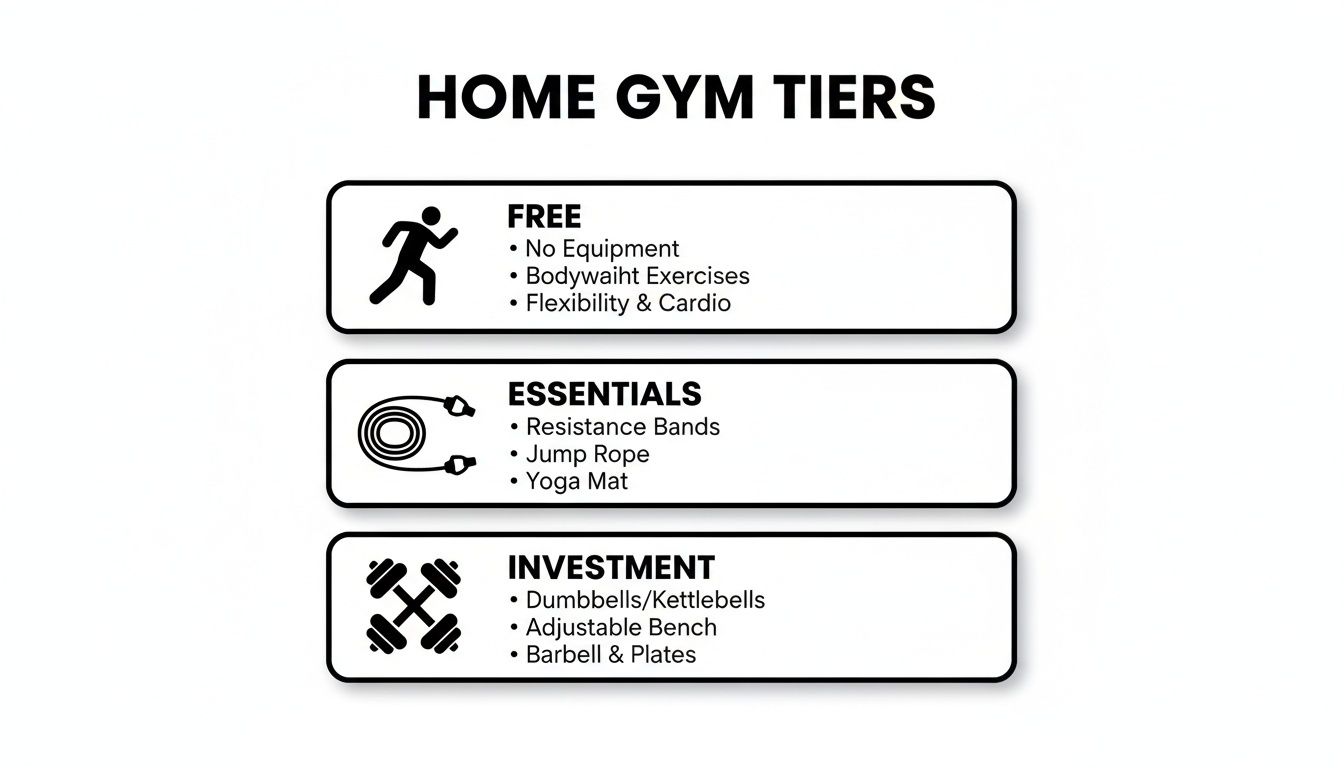
The key takeaway? You can start effectively with zero cost and strategically add pieces as your needs and strength evolve.
The Bodyweight Squat: Your Lower Body Powerhouse
The squat is arguably the most fundamental human movement. It builds powerful legs, glutes, and a strong core, which translates directly to real-world strength—think lifting heavy boxes or getting up from a low chair with ease.
- How to do it: Stand with feet shoulder-width apart, toes pointing slightly out. Keep your chest up, engage your core, and send your hips back and down like you're sitting in an invisible chair. Go until your thighs are parallel to the floor (or as low as you can comfortably go with a flat back), then drive through your heels to stand back up, squeezing your glutes at the top.
A common mistake is letting your knees cave inward. To fix this, imagine you're trying to spread the floor apart with your feet. This simple cue fires up your glutes and keeps your knees tracking safely over your toes.
- Make It Easier (Regression): Try a box squat. Place a sturdy chair behind you and squat down until you gently tap the surface, then stand back up. This builds confidence and helps you perfect the hip-hinge motion.
- Make It Harder (Progression): Slow it down. A 3-second descent, a 1-second pause at the bottom, and a 3-second ascent will seriously increase your time under tension—a key driver of muscle growth.
The Push-Up: The Ultimate Upper Body Press
The push-up is a true test of upper-body and core strength, hitting your chest, shoulders, and triceps in one go. Mastering it is a game-changer for building a strong, stable upper body.
The biggest form flaw I see is a sagging lower back, which is a dead giveaway of a disengaged core. Brace your midsection like you're about to take a punch and squeeze your glutes. This creates a rigid, plank-like line from your head to your heels.
- Make It Easier (Regression): Incline push-ups are your best friend. Place your hands on a raised surface like a countertop or sturdy table. The higher the incline, the more manageable the exercise becomes.
- Make It Harder (Progression): Flip it around with decline push-ups. Elevating your feet on a step or chair shifts more emphasis onto your shoulders and upper chest for a greater challenge.
The Lunge: Building Single-Leg Strength and Stability
Lunges are fantastic for ironing out strength imbalances and improving your stability, as they force each leg to work on its own. They target your quads, hamstrings, and glutes, all while your core works overtime to keep you from wobbling.
To nail your form, take a controlled step forward, lowering your hips until both knees are bent at roughly a 90-degree angle. Your front knee should stay stacked over your ankle, not drift past your toes. Then, push off your front foot to return to the start.
A crucial tip for balance is to avoid lunging on a "tightrope." Instead, imagine you are stepping forward on railroad tracks, keeping your feet hip-width apart throughout the movement.
- Make It Easier (Regression): Take the step out of it with static or split squats. Start in the lunge position and simply lower and raise your body. You can also hold onto a wall or chair for extra support.
- Make It Harder (Progression): Try reverse lunges. Stepping backward is often tougher on your balance and puts a little more emphasis on the glutes.
The Plank: The Core Strength Standard
The plank is an isometric exercise, which just means you’re holding a static position. It’s one of the best ways to build deep core strength, which is essential for protecting your spine and improving your posture.
For a perfect plank, stack your shoulders directly over your elbows, keep your back flat, and hold your hips in line with your shoulders—no sagging or piking up. Squeeze your core, quads, and glutes at the same time.
- Make It Easier (Regression): Drop to your knees. A knee plank shortens the lever, reducing the demand on your core while still helping you build that foundational endurance.
- Make It Harder (Progression): Lift one leg off the ground for a few seconds, then switch. This instability forces your core to work much harder to stop your hips from rotating.
For a deeper dive into more movements you can master, explore our guide on 8 at-home exercises to stay fit without the gym.
Your First At-Home Strength Training Plan
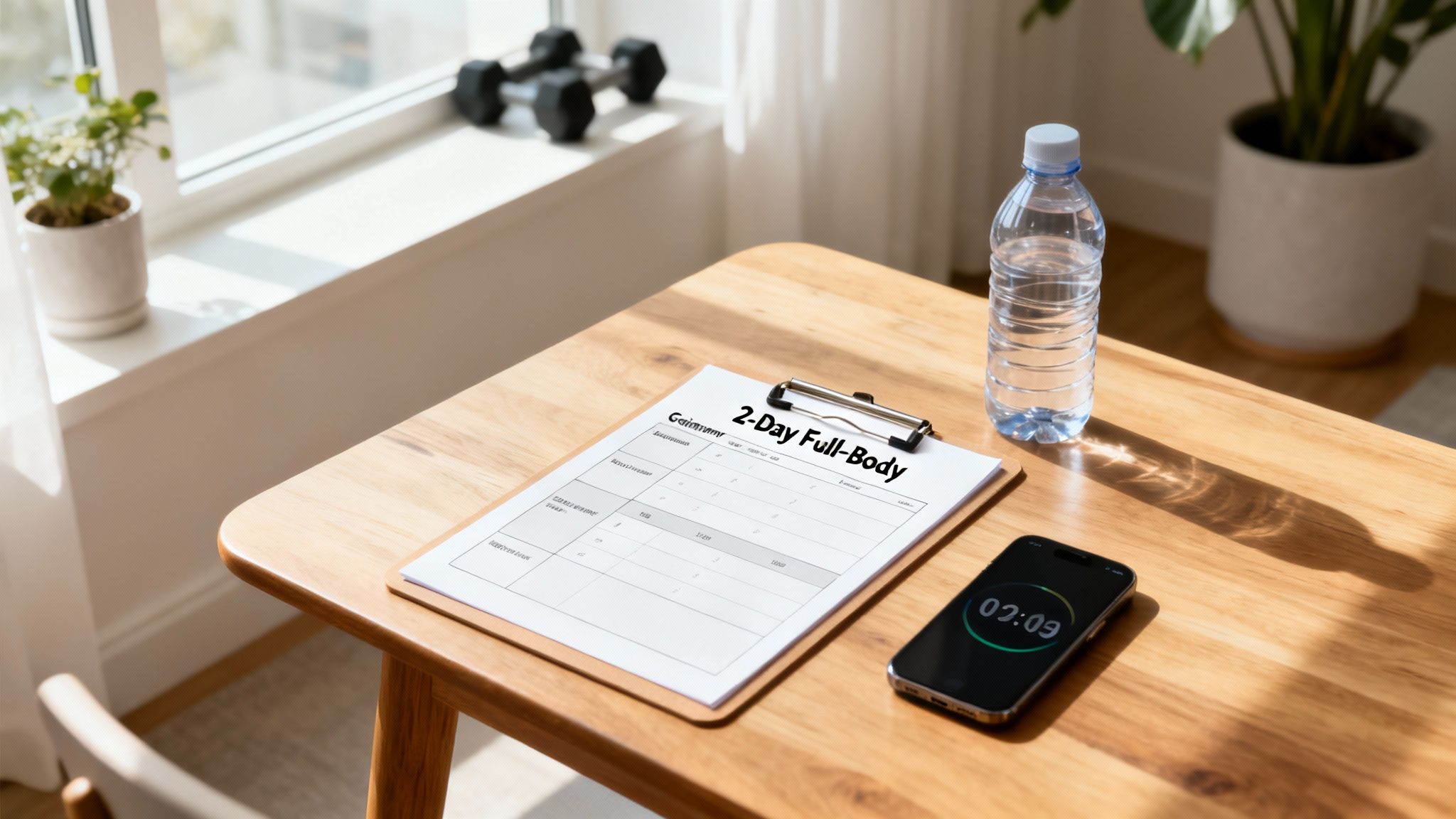
Okay, you’ve got the basic movements down. Now, let's pull them together into a smart, effective plan that actually gets you somewhere. A great workout isn’t just a random list of exercises you found online; it’s a structured routine designed to deliver results. This is where a lot of beginners get stuck, but honestly, it’s simpler than you think.
First, let's quickly break down the language you'll see in any workout plan: sets, reps, and rest.
- Reps (Repetitions): Think of this as one full movement. One complete squat, from top to bottom and back up, is one rep.
- Sets: This is just a group of reps. If you do 10 squats in a row and then take a break, you've completed one set of 10 reps.
- Rest: The downtime you take between sets. This isn't for checking your phone—it's crucial for letting your muscles recover just enough to hit the next set with good form.
When you're starting out, aim for 2–3 sets of 8–12 reps for each exercise. Give yourself about 60–90 seconds of rest between sets. This is the sweet spot for building both muscle and endurance without burning yourself out.
Your 2-Day Full-Body Starter Plan
A full-body routine is hands-down the most efficient way to train when you're new to this. You hit all your major muscle groups in every session, which builds balanced, functional strength and gives your body plenty of time to recover and grow stronger.
This two-day-a-week plan is perfect for building a habit that sticks. Just make sure to schedule it on non-consecutive days—like Monday and Thursday—to give your body at least 48 hours to recover.
| Exercise | Sets | Reps | Rest |
|---|---|---|---|
| Bodyweight Squats | 3 | 10-12 | 60 sec |
| Incline Push-ups | 3 | As Many As Possible (AMAP) | 60 sec |
| Glute Bridges | 3 | 12-15 | 60 sec |
| Resistance Band Rows | 3 | 10-12 per side | 60 sec |
| Plank | 3 | Hold for 30-45 sec | 60 sec |
And you're in good company with this approach. According to ACSM's latest survey, traditional strength training has rocketed to the #5 spot among 45 global fitness trends for 2025—a massive jump from #17 in 2024. For anyone wondering how to start strength training at home, this kind of plan is the perfect entry point. It's even linked to a 23% reduction in all-cause mortality as more people prioritize it over pure cardio. You can read the full survey on global fitness trends to see why it's gaining so much traction.
Your 3-Day Full-Body Progression Plan
Feeling good with two days a week and itching for more? Bumping it up to three days can seriously accelerate your progress by increasing your total weekly training volume. The structure stays the same, but we'll swap in a few new movements on that third day to keep your body guessing.
Once you’ve mastered this full-body approach, you can explore other routines. For example, our guide to the 3-day split workout is a great next step for structuring your training week differently.
- Day 1 & Day 3: Follow the 2-Day Full-Body Starter Plan.
- Day 2 (add this in the middle of your week):
- Reverse Lunges: 3 sets of 10 reps per leg
- Pike Push-ups: 3 sets of as many reps as possible
- Bird-Dog: 3 sets of 12 reps per side
- Side Plank: 3 sets of 30-second holds per side
The 20-Minute Power Session
Let's be real: life gets busy. On those days when you're slammed, it's tempting to just skip your workout. Don't. Use this quick and dirty 20-minute session to stay on track.
The secret here is to work in a circuit. You’ll move from one exercise to the next with almost no rest in between. Once you finish the last exercise, you'll take a short break and then dive right back in for another round.
- Jumping Jacks (60 seconds)
- Bodyweight Squats (15 reps)
- Push-ups (to your ability)
- Alternating Lunges (10 reps per leg)
- Plank (hold for 45 seconds)
How to do it: Perform each exercise in order, taking as little rest as you can manage. After the plank, rest for a solid 90 seconds. Repeat the entire circuit as many times as you can in 20 minutes.
Look, this isn't just about blindly following a plan. It's about understanding how to make fitness work for you. Consistency will always win out over intensity. Sticking with a 2-day plan every single week is far more effective than trying a 5-day plan and quitting after a month. Start with what feels manageable, and build from there.
Fueling Your Body for Strength and Recovery
The work you do in your living room is only half the battle. The real magic—where you actually get stronger—happens between your workouts. Solid recovery is what turns all that effort into real, noticeable results, and it all boils down to how you fuel your body.
Don’t worry, this doesn't have to be complicated. Forget counting every calorie or gram. When you're just starting your at-home strength journey, let's keep it simple and focus on three pillars: protein for repair, carbs for energy, and water for… well, everything else.
The Building Blocks of Muscle Repair
Every time you lift, you're creating tiny microscopic tears in your muscle fibers. That might sound bad, but it's exactly what you want. Protein is the key ingredient your body uses to patch up this damage, rebuilding those fibers bigger and stronger than before. That’s literally how muscle growth works.
Getting enough protein is non-negotiable. Think of it like this: your workout is the blueprint, but protein provides the raw materials to actually build the structure. You can get it from simple sources like chicken, fish, eggs, Greek yogurt, lentils, and tofu.
Look, your goal isn't to live on a diet of bland chicken and broccoli. Just make a conscious effort to include a solid protein source with each main meal. That’s it. This gives your body a steady supply of building blocks throughout the day.
If you struggle to hit your protein goals with whole foods, especially right after a workout when you might not feel like eating a full meal, supplements are a super convenient option. You can learn more about how to use protein shakes and supplements to give your recovery a boost.
Fueling and Refueling Your Workouts
Carbohydrates get a bad rap sometimes, but when it comes to strength training, they're your best friend. Carbs are your body's number one energy source. They give you the gas in the tank to push through your sets and reps with good, strong form.
Try having some complex carbs like oatmeal, brown rice, or even just a banana about 1-2 hours before you work out to top off your energy stores. Afterward, pairing carbs with your protein is a classic combo for a reason—it helps shuttle those repair nutrients into your muscles to kickstart recovery. To really get the most out of this, choosing the best protein after workout to maximize muscle recovery and growth is key, as it helps replenish everything you've just used up.
A simple post-workout meal could be something like:
- Scrambled eggs with a slice of whole-wheat toast.
- Greek yogurt with some berries and a sprinkle of granola.
- A glass of chocolate milk—seriously! It has a fantastic carb-to-protein ratio for recovery.
The Power of Sleep and Active Recovery
Nutrition is huge, but so is good old-fashioned rest. Your body does the vast majority of its repair work and hormone regulation while you're asleep. Making sure you get a consistent 7-9 hours of quality sleep every night is probably one of the most powerful things you can do for your results.
Finally, "rest days" don't always mean being a couch potato. Gentle movement, or what we call active recovery, can do wonders. Think a brisk walk, a light bike ride, or some stretching. This helps increase blood flow to your sore muscles, flushing out waste products and easing stiffness. Ultimately, learning to listen to your body is the most important skill you'll develop on this journey.
Your At-Home Strength Training Questions Answered
Starting any new fitness routine is going to bring up some questions. It's totally normal to wonder if you’re doing things right, what to expect, and how to handle the little bumps in the road. Let’s clear up some of the most common things people ask when they start strength training at home.
Having clear answers builds the confidence you need to actually stick with it. Think of this as your go-to guide for those first few weeks.
How Soon Will I See Results from At-Home Workouts?
This is the big one, isn't it? While everyone’s body is different, most beginners start to feel stronger and more capable within 4 to 8 weeks of consistent training. That means hitting your workouts two to three times per week without taking long breaks.
Those first gains you notice are mostly neurological. Your brain is just getting better at talking to your muscles, making them fire more efficiently. This is why you might suddenly be able to do more push-ups or hold a plank longer, even before you see big changes in the mirror. Visible muscle definition usually comes after this initial phase.
Pro Tip: Focus on performance wins first. Celebrate being able to do one more rep than last week or moving up to a tougher exercise variation. These are real, tangible signs of progress that keep you motivated long before the scale or mirror catches up.
Can I Lose Weight with Just Strength Training?
Absolutely. In fact, strength training is a secret weapon for sustainable weight loss. While a cardio session might burn more calories in the moment, strength training gives you a unique metabolic advantage.
When you build lean muscle, you increase your resting metabolic rate. This just means your body burns more calories all day long, even when you're just sitting on the couch. Over time, this helps you lose fat while building a stronger, more toned physique. For the best results, you'll want to pair your strength workouts with a balanced diet and try to stay active on your off days—even if it's just a brisk walk.
What Is the Difference Between Soreness and Injury?
Learning to tell the difference between normal muscle soreness and an actual injury is a critical skill for anyone who works out.
- Muscle Soreness (DOMS): This feels like a dull, general ache in the muscles you worked. It usually peaks 24 to 48 hours after your workout. The muscle might feel a bit tender, but the feeling is manageable and shouldn't stop you from going about your day.
- Injury Pain: This is often sharp, sudden, or focused on one specific spot, frequently near a joint. It might come with swelling, a popping sound, or an inability to move a limb through its full range of motion.
It’s completely normal to feel some discomfort after a tough session. To get a better handle on this, check out our detailed guide on understanding DOMS and how to manage it. But if the pain is sharp and just won't quit, that's a clear signal to stop, rest, and talk to a professional if it doesn’t get better.
Do I Need Protein Shakes to Get Started?
Nope, not at all. For someone just figuring out how to start strength training at home, supplements are way down the priority list. Your main focus should be on building a solid routine of consistent workouts and eating whole foods.
Protein shakes are convenient, but they aren't magic. You can easily get all the protein your body needs for muscle repair from foods like chicken, fish, eggs, tofu, lentils, and beans. Nail down your consistency in training, nutrition, and sleep first. Think of supplements as a potential small boost much later, not something you need to succeed right now.
Ready to stop guessing and start training with a plan that actually adapts to you? The Zing Coach app takes the uncertainty out of the equation by creating personalized workouts based on your goals, equipment, and fitness level. With AI-powered form correction and progress tracking, you get a coach in your pocket to guide you safely and effectively every step of the way. Get your personalized plan at https://zing.coach.
Share this article


Authors