Perfect your tricep kickback form with our guide. Get setup, cues, & avoid errors. AI feedback, like from Zing Coach, accelerates your progress.
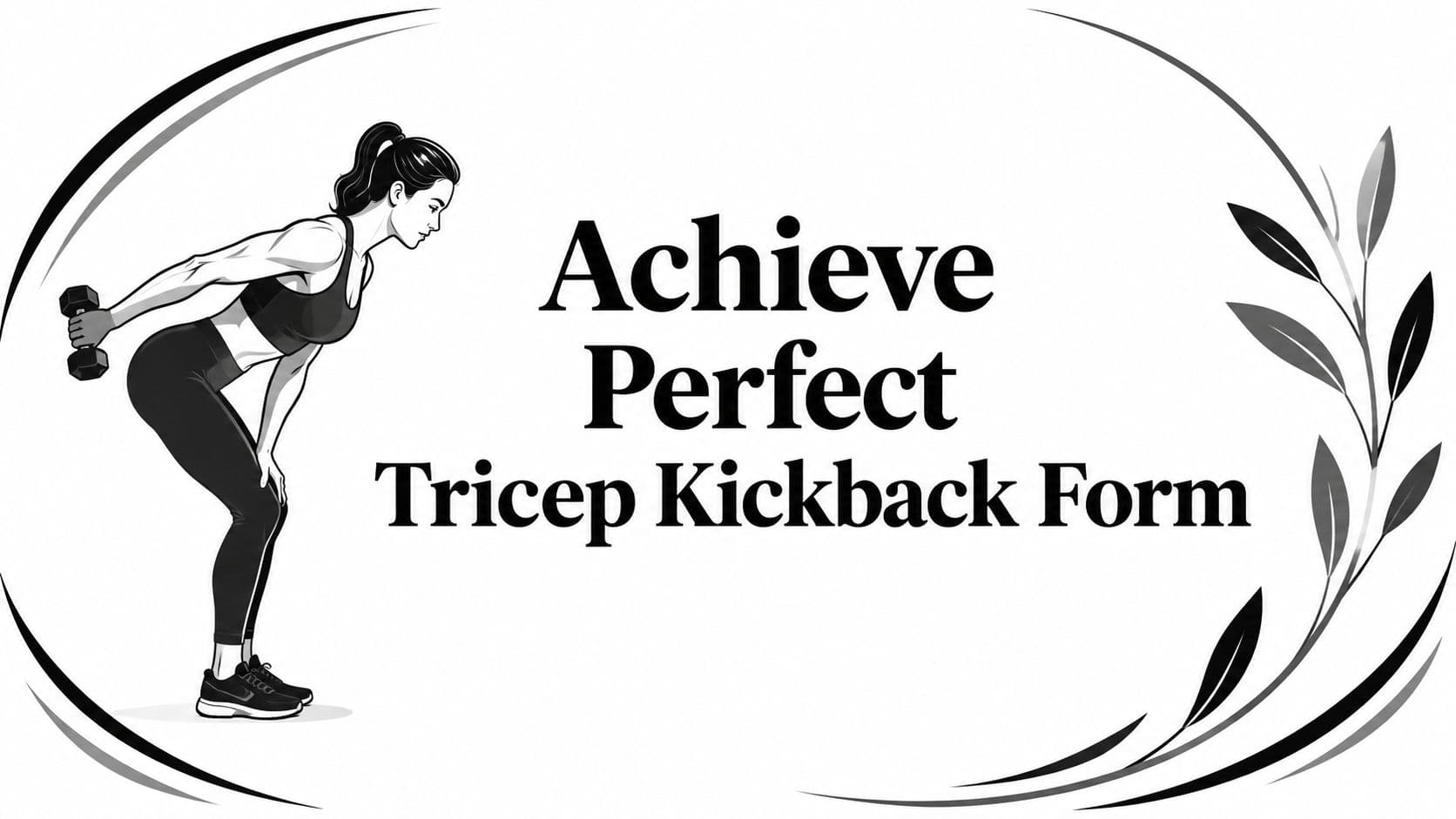
You're probably doing tricep kickbacks one of two ways right now. Either you're using light weights and wondering if the move is doing anything, or you're trying to push heavier dumbbells and feeling your shoulders, lower back, and momentum take over.
That's normal. The tricep kickback looks simple, but it's one of the most technical arm isolation exercises in the gym. Small setup errors change the rep completely. The difference between a clean kickback and a sloppy one is usually not effort. It's position.
What makes this exercise worth learning is also what makes it easy to mess up. It needs very little equipment, fits home and gym workouts, and can teach precise elbow extension better than many bigger lifts. But it only works if you treat it like a controlled skill, not a casual arm swing.
Why Your Tricep Kickback Form Matters
The tricep kickback is a precision exercise. It isn't built for ego lifting. It's built to make the triceps do the work while the rest of the body stays quiet.
That's why the exercise has stayed popular across home and gym training. It's easy to set up with minimal equipment, and major fitness platforms have standardized it as a staple accessory lift, commonly recommending 3 to 4 sets of 8 to 15 reps while emphasizing that only the elbow should move, with no swinging or momentum, as noted in Women's Health's kickback guide.
If your tricep kickback form is off, the movement stops being an isolation drill and turns into a loose rowing pattern with elbow flare. You still move the weight, but your triceps lose tension and nearby joints take on work they shouldn't.
Good form changes what the exercise does
A clean rep keeps tension where you want it. The elbow acts like a hinge. The upper arm stays in place. The forearm extends and returns under control.
A messy rep usually looks different in three ways:
- The torso rocks so momentum drives the weight.
- The shoulder shifts so the upper arm drifts instead of staying fixed.
- The lower back arches to help finish the rep.
Those changes matter because the kickback has a small margin for error. It doesn't hide bad mechanics well.
Practical rule: If you feel more “movement” than muscle, your setup or load is probably wrong.
This is also why beginners often get more from mastering one strict kickback than from rushing through several arm exercises. Controlled reps teach you how to separate elbow motion from shoulder motion. That skill carries into pushdowns, extensions, and pressing work.
For a broader view of where this move fits, Zing Coach's guide to triceps exercises is a useful reference point. The kickback belongs in that bigger triceps picture, but only if you can perform it with discipline.
Think execution, not just lifting
The back of the arm responds well to focused work. But this isn't a movement where “more weight” automatically means “better training.” The aim is simple. Put your body in a stable position, lock in the upper arm, and make the triceps straighten the elbow without help.
That mindset shift changes everything. You stop chasing a heavy dumbbell and start chasing a clean rep.
The Blueprint for a Perfect Kickback Setup
Most kickback problems start before the first rep. If your base is unstable, your body will search for a workaround. Usually that means swinging, shrugging, or twisting.
For a technically sound dumbbell kickback, coaching sources consistently anchor the movement around a fixed shoulder, a hip hinge, a neutral spine, and an upper arm held parallel to the body. Healthline also recommends starting with light 5 to 10 lb dumbbells to make strict execution easier in its tricep kickback form guide.

Build the stance first
Start by deciding how you'll support your body. A split stance works well if you're standing free. One foot goes forward, one back, and most of your balance comes from your legs and core. If you want more support, place one hand and one knee on a bench and work the opposite arm.
Then hinge from the hips. Don't just bend forward randomly. Push your hips back and let your chest angle toward the floor while your spine stays long. A useful cue is to think about showing your chest to the floor without collapsing through your back.
Your neck should follow the spine. Look slightly ahead of your hands or at the floor, not up into a mirror.
Set the arm before you move the weight
Once your torso is stable, bring the working upper arm close to your side. Lift the elbow until the upper arm is roughly in line with your torso. Then bend the elbow to about a right angle.
At this point, pause. Before you extend anything, ask yourself:
- Can I hold my torso still without wobbling?
- Is my core braced, or am I hanging off my lower back?
- Is my upper arm tucked close instead of drifting outward?
If the answer to any of those is no, fix that before the rep starts.
The kickback rewards setup discipline more than raw effort. The rep should feel almost predetermined once you're in position.
A simple setup checklist
Use this quick table before each set:
| Setup point | What to look for |
|---|---|
| Feet or bench support | Stable base, no balance fight |
| Hip hinge | Hips back, torso angled forward |
| Spine | Neutral, not rounded or overarched |
| Core | Braced enough to stop torso sway |
| Upper arm | Close to body and held still |
| Elbow | Bent and ready to extend |
A short warm-up helps here more than is commonly assumed. If your shoulders, trunk, and hips feel stiff, your body will borrow motion from the wrong places. A practical primer is this guide on how to warm up before strength training, especially if you're doing kickbacks after long hours at a desk.
Executing Each Rep with Precision
Once the setup is locked in, the rep itself should look almost boring. That's a good sign. Correct tricep kickback form is defined by an elbow-driven motion where the upper arm stays fixed and only the forearm moves from about a right angle to full extension. Tonal also places the exercise in moderate rep ranges, including 8 to 12 reps for strength endurance and 6 to 20 reps for muscle growth, in its triceps kickback resource.

The extension
Start from the bent-elbow position and drive your hand back, not up. That cue matters. Many lifters turn the kickback into a mini rear-delt raise by lifting the whole arm instead of extending at the elbow.
Exhale as you straighten the arm. The movement should be smooth, not snappy. Think about the forearm unfolding behind you while the shoulder stays quiet.
If you watch yourself from the side, the upper arm should barely move. If it bounces, drops, or swings, the triceps aren't owning the rep.
The squeeze at lockout
When the elbow reaches full extension, stop for a brief beat. Don't fling the weight to the top and immediately reverse it.
At the back of the rep, focus on a hard triceps contraction. The sensation should be local and clear, right along the back of the upper arm. You're not trying to hold the weight forever. You're proving you control it.
A strong lockout in a kickback feels clean and deliberate. If you need to jerk into it, the rep was lost earlier.
This is one reason the exercise can improve your mind-muscle connection. The finish position gives you a very obvious chance to feel whether the triceps are shortening or whether your body is faking the movement. If that's a weak point, this article on how to improve mind-muscle connection is worth applying to your arm work.
The controlled return
The lowering phase is where many lifters give away tension. Instead of dropping back to the start, return the forearm slowly until the elbow is bent again and the upper arm is still in place.
Inhale on the way down. Keep the torso frozen. Keep the shoulder from rolling forward. The return should feel like you're resisting gravity, not surrendering to it.
A useful self-test is simple: can you pause halfway down without changing your torso position? If not, you're moving too fast or using too much weight.
Here's a clear visual reference for the rhythm of the movement:
What to progress and what not to chase
Kickbacks do respond to progression, but not in the same way as big compound lifts. You can add load, reps, cleaner pauses, better control, or more consistent execution. The key is to progress without sacrificing the fixed-arm pattern that makes the exercise valuable in the first place.
If you want a practical breakdown of progressive overload for tricep kickbacks, that resource lays out useful ways to make the movement harder without turning it into a cheat rep contest.
A good rep should meet these standards:
- Stable body position throughout the set
- No shoulder takeover as the arm extends
- Clear lockout with triceps tension
- Deliberate eccentric instead of a drop
That's what precision looks like here. Not dramatic. Effective.
Sidestepping Common Form Breakdowns
Most kickback mistakes don't come from lack of effort. They come from compensation. Your body wants to finish the rep, so it finds the easiest path. ACE Fitness specifically warns against rocking the torso, letting the upper arm drift, and arching the low back, while recommending a braced core and fixed upper arm. It also notes that if you have to swing or shrug to finish the rep, the load is too heavy in its exercise library entry for triceps kickback.

When the weight swings
Symptom: The dumbbell moves fast, but the triceps don't feel loaded well.
Cause: You picked a weight that invites momentum, or you rushed the tempo.
Fix: Reduce the load and slow the rep down enough that the lockout is earned.
This is the most common error I see with kickbacks. People assume a bigger dumbbell means a better arm exercise. In practice, a sloppy heavy kickback often trains your ability to heave a weight, not your ability to isolate the triceps.
If the dumbbell needs a runway, it's too heavy.
When the elbow drops
Symptom: The arm starts in a solid position, then the elbow falls as fatigue builds.
Cause: You've lost upper-arm stability, so the shoulder starts helping.
Fix: Reset after each rep or shorten the set before technique breaks.
A dropped elbow changes the resistance profile and usually cuts tension where you want it most. One of the easiest fixes is to think about keeping your upper arm “parked” beside your torso while only the forearm moves.
When your lower back talks back
Symptom: You feel pressure in the low back during the set.
Cause: Your hinge is loose, your core isn't braced, or you're trying to force range with spinal extension.
Fix: Rebuild the setup. Soften the knees, hinge from the hips, brace your abs, and stop chasing a dramatic finish position.
This usually happens when lifters treat the kickback like a standing arm swing instead of a supported hinge. The triceps don't need a big backbend to contract. Your body is adding that because it doesn't have enough stability to stay organized.
When the range gets cut short
Symptom: Reps stop before full extension, or the return phase becomes tiny and rushed.
Cause: Fatigue, too much load, or poor awareness of where the rep starts and ends.
Fix: Use a slower cadence and think in checkpoints: bent elbow, full extension, controlled return.
A shortened range isn't always obvious in real time. Filming your sets is particularly useful. Many lifters think they're locking out cleanly until they watch the video and realize the last part of elbow extension never happened.
Here's a quick troubleshooting summary:
| Symptom | Likely cause | Direct fix |
|---|---|---|
| Swinging dumbbell | Load too heavy | Lighten weight and slow tempo |
| Elbow drifting | Shoulder taking over | Keep upper arm pinned close |
| Back rounding or arching | Poor hinge and brace | Reset stance and engage core |
| Half reps | Fatigue or rushed pacing | Control range and pause at key points |
The pattern is simple. If your body has to recruit extra motion to finish the rep, the exercise stopped being a kickback.
Variations and Smarter Programming
The dumbbell version gets most of the attention, but it's not your only option. The better question is which version fits your goal, your equipment, and your current skill level.
There's also a bigger programming issue that most tutorials skip. A kickback can be a good triceps exercise without being your best primary triceps builder. That distinction matters.
Dumbbell vs cable
A dumbbell kickback is simple, accessible, and effective if you control it well. It's great for home workouts and for lifters who want to practice strict elbow extension with minimal setup.
A low cable kickback often feels smoother because the resistance stays more consistent. Many lifters find it easier to keep tension on the triceps without cheating the top of the rep. The cable can also make it easier to notice if the shoulder starts drifting.
Use this comparison as a quick filter:
| Variation | Best for | Trade-off |
|---|---|---|
| Dumbbell kickback | Home training, simple setup, learning control | Easier to cheat with momentum |
| Cable kickback | Steadier resistance, cleaner tension | Needs machine access |
| Bench-supported single-arm kickback | Extra stability, beginners | Slower setup between sides |
Where kickbacks fit in a triceps plan
Kickbacks emphasize the shortened position of the triceps. That gives them a useful role, but it also limits what they should do in your program. As Peloton notes in its discussion of triceps training, movements that load muscles at longer lengths often produce greater hypertrophy, which means kickbacks may work better as a finisher than as a main mass-builder in a triceps kickbacks article discussing hypertrophy trade-offs.
That doesn't make the exercise weak. It makes it specific.
If your goal is fuller triceps development, use kickbacks alongside exercises with different resistance profiles. Overhead extensions, skull crushers, and pushdowns can cover qualities that kickbacks don't emphasize as strongly.
Kickbacks are excellent when you want focused contraction and clean isolation. They're less convincing as your only triceps movement.
Practical programming choices
Use kickbacks when:
- You want a finisher after pressing or heavier triceps work
- You're training at home and need a low-equipment accessory
- You're rebuilding technique and want to improve elbow control
- You respond well to feel-based isolation work near the end of a session
Move them down the priority list when:
- Your main goal is maximum triceps size
- You're fresh and able to handle bigger extension patterns first
- You keep cheating the movement no matter what load you pick
If you're unsure how to place them in a routine, think of kickbacks as a targeted accessory rather than the centerpiece. They pair well after compound pressing or after a longer-length triceps exercise. For progression across weeks, this guide to progressive overload training gives a practical framework for deciding when to add challenge and when to improve execution instead.
Using Tech to Analyze and Improve Your Form
Training alone creates one obvious problem. You can know the right cues and still miss what your body is doing.
Kickbacks expose that gap fast. The rep is small, and the mistakes are subtle. A drifting elbow, a shrug, a slight torso swing, or an arched lower back can change the exercise without feeling dramatic in the moment. Mirrors only help so much, and few will routinely film every set.

Objective feedback beats guesswork
App-based form analysis proves useful. Computer vision tools can help you spot whether your upper arm stays fixed, whether your torso shifts, and whether your reps stay consistent from the first to the last one.
That kind of feedback doesn't replace coaching principles. It applies them. Instead of relying only on “I think I felt my triceps,” you get a more objective check on whether the rep matched the standard.
One example is an AI-powered workout app that uses computer vision for movement tracking, rep counting, and technique feedback. For an exercise like the kickback, that type of tool is useful because the success of the rep depends on staying inside a narrow movement pattern.
What to look for when reviewing your reps
Whether you use an app or a simple phone recording, review these points:
- Upper arm position stayed close to the torso
- Elbow motion drove the rep
- Torso and spine stayed stable
- Lockout happened without a shrug
- Tempo stayed controlled as fatigue increased
That's the bridge between old-school coaching and newer tech. You still need the right cues. Technology just makes it easier to verify them when no trainer is standing next to you.
If you want guided practice instead of guessing through each set, Zing Coach can help you apply solid tricep kickback form with personalized workouts, rep tracking, and real-time feedback while you train on your own.
Share this article


Authors