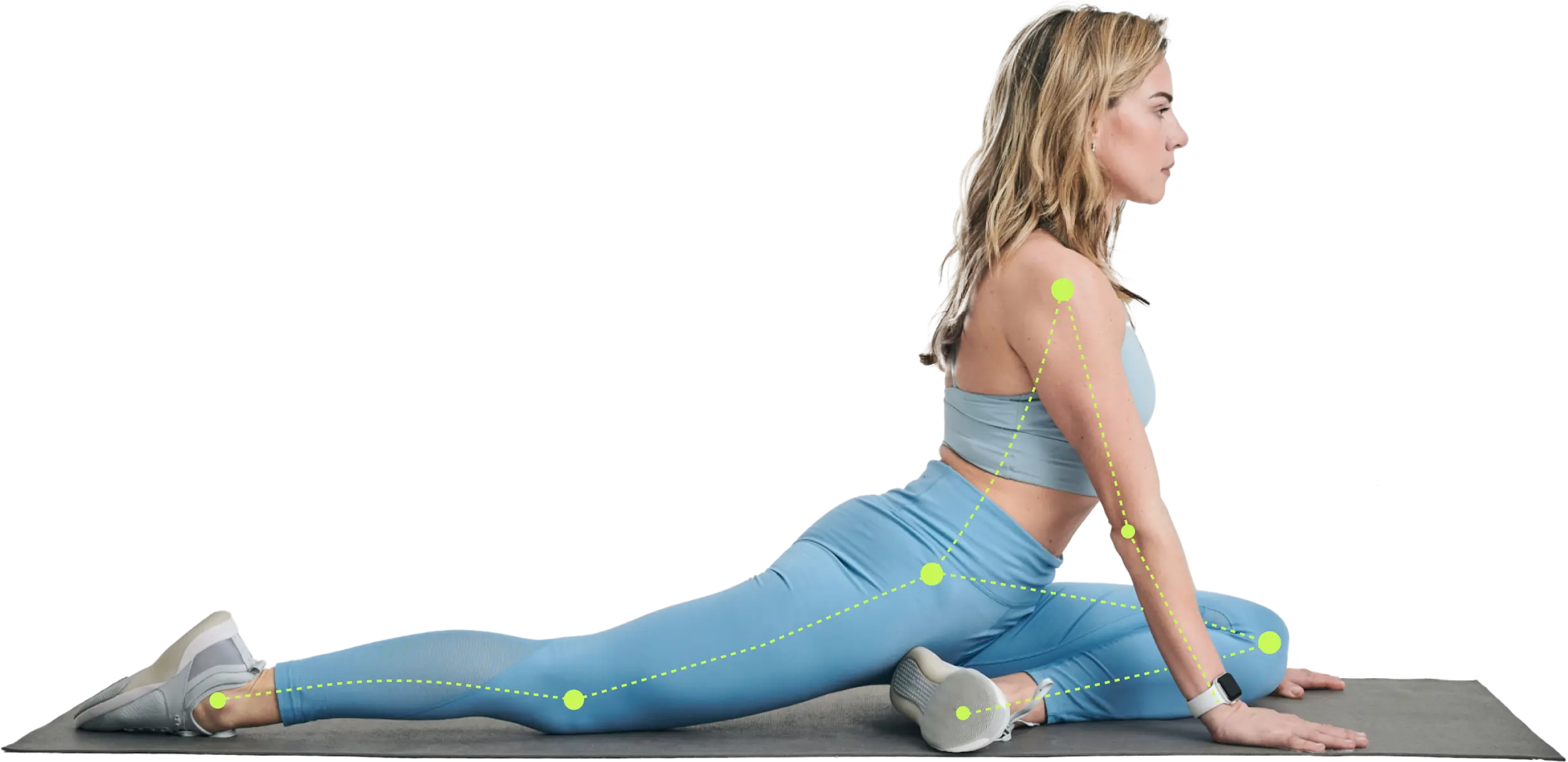
Discover low impact strength training exercises to build muscle without joint pain. Explore bodyweight, bands, and dumbbells for all levels.
The idea that strength training requires heavy weights, high-impact jumps, and post-workout joint pain is a common yet outdated misconception. In reality, building functional, sustainable strength is entirely possible without stressing your joints. This guide is dedicated to the most effective low impact strength training exercises designed to build muscle, improve stability, and boost your fitness safely.
We will explore eight distinct methods, from progressive bodyweight moves to water-based resistance, providing detailed instructions, common mistakes to avoid, and sample workout structures. The focus is on controlled, deliberate movements that challenge your muscles while keeping your knees, hips, and back protected. This approach is not only safer but also highly effective for creating lean muscle mass.
This comprehensive roundup will give you the tools to get strong while protecting your body for the long haul. Whether you're a beginner, managing a chronic condition, recovering from an injury, or simply seeking a smarter way to train, these techniques are adaptable to any fitness level. Beyond just preventing pain, this type of exercise is a cornerstone of overall wellness. To understand the broader health benefits, including how to build more muscle with strength training to speed up your metabolism, consult resources focused on age-appropriate fitness. Let's dive into the exercises that prove you don't need to pound your joints to achieve powerful results.
1. Resistance Band Training
Resistance bands are a cornerstone of effective low impact strength training exercises due to their unique properties. Unlike free weights, which provide consistent resistance from gravity, bands offer variable resistance. This means the tension increases as you stretch the band, challenging your muscles most at their strongest point in the range of motion while easing up at the most vulnerable starting point. This ascending tension protects joints from sudden, heavy loads, making it an ideal tool for beginners, individuals with joint sensitivity, or anyone recovering from an injury.
Initially popularized within physical therapy settings for rehabilitation, bands have become a mainstream fitness tool for their versatility and portability. They are perfect for building functional strength that translates directly to everyday activities.
Why It's a Top Low-Impact Choice
The primary benefit of resistance bands is their ability to build strength without the joint compression associated with heavy lifting. The elastic nature of the bands forces you to control the movement through both the concentric (lifting) and eccentric (lowering) phases, which enhances muscle activation and stability. This controlled tension is gentle on the knees, shoulders, and hips, allowing you to strengthen supporting muscles safely.
Actionable Tips for Getting Started
To incorporate resistance bands effectively, follow these guidelines:
- Master Form First: Always start with a lighter band (often yellow or red) to perfect your movement pattern. Good form is more important than high resistance.
- Secure Your Anchor: When performing exercises like rows or presses, ensure the band is anchored to a sturdy, immovable object that will not shift or break under tension.
- Control the Eccentric: Don't let the band snap back. Slowly control the return to the starting position. This negative phase is crucial for building strength and muscle control.
- Combine and Progress: As you get stronger, you can either move to a thicker band or combine multiple bands to create more challenging resistance.
Bands are highly adaptable and can be used for full-body workouts, targeting everything from glutes and legs to arms and core. For a comprehensive guide with specific movements, you can find a variety of power band exercises to build a complete routine.
2. Dumbbell Work (Controlled Movements)
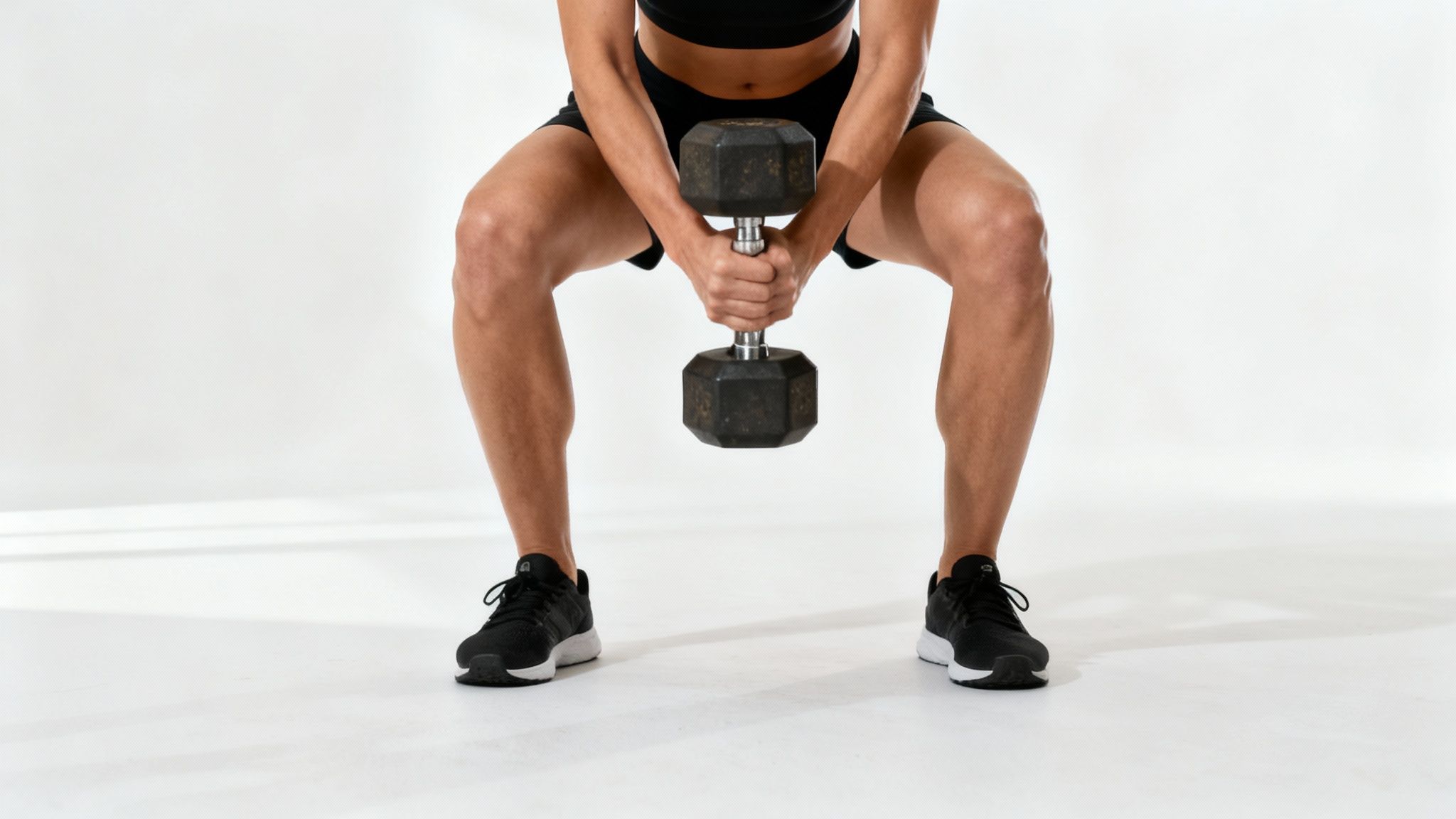
Controlled dumbbell exercises are a foundational element of low impact strength training exercises, emphasizing muscular control and precise form over lifting heavy weights. This method uses moderate loads to challenge muscles effectively without imposing the high stress on joints often associated with barbell training. Unlike barbells, dumbbells allow for a more natural range of motion and grip, reducing strain on the wrists, elbows, and shoulders.
This focus on deliberate, controlled movement maximizes muscle engagement, or time-under-tension, and allows for the correction of imbalances. The approach has been a staple for everyone from physical therapists helping patients regain strength to elite athletes performing accessory work to prevent injuries.
Why It's a Top Low-Impact Choice
The primary advantage of controlled dumbbell work is its ability to build foundational strength with minimal joint impact. By slowing down the tempo and focusing on the full range of motion, you eliminate momentum, which is often a source of injury. This forces the target muscles to do all the work, fostering greater stability and strength.
Furthermore, dumbbells facilitate unilateral (single-arm or single-leg) training. This is crucial for identifying and correcting strength imbalances between the left and right sides of your body, a common issue that can lead to compensation patterns and chronic pain. Strengthening each side independently builds a more resilient and balanced physique.
Actionable Tips for Getting Started
To incorporate controlled dumbbell movements safely and effectively, consider these guidelines:
- Prioritize Tempo: Focus on a slow, controlled tempo for each repetition, such as a 2-second lift, a 1-second pause, and a 3-second lower. This maximizes muscle engagement and minimizes joint stress.
- Start Lighter Than You Think: Select a weight that allows you to maintain perfect form and control throughout the entire set. Good form is non-negotiable for low-impact success.
- Focus on Unilateral Work: Incorporate exercises like single-arm dumbbell rows, presses, and split squats to challenge your core stability and address any strength discrepancies.
- Progress Gradually: Once you can complete all your reps with perfect control, increase the weight in small increments, such as 2.5 to 5 pounds. Avoid large jumps in weight that compromise form.
Dumbbells are incredibly versatile and can be used for both compound movements like goblet squats and isolation exercises like bicep curls. For a deeper dive into movements and routines, explore this extensive collection of dumbbell exercises to enhance your training.
3. Isometric Exercise (Static Holds)
Isometric exercises are a unique form of low impact strength training exercises where muscles are contracted without any movement at the joints. Instead of lifting and lowering a weight, you simply hold a challenging position. This static contraction creates significant muscular tension, building strength and endurance with zero impact, making it exceptionally safe for joints, tendons, and ligaments.
Initially a staple in physical therapy and rehabilitation settings to rebuild strength around injured joints, isometrics have gained widespread recognition in athletic training and functional fitness. From planks in core stability programs to wall sits for lower body endurance, these exercises build foundational strength and improve mind-muscle connection.
Why It's a Top Low-Impact Choice
The key advantage of isometric exercises is their ability to generate high levels of muscle force without dynamic movement, which completely eliminates stress on the joints. This static tension is not only safe but also highly effective for strengthening stabilizing muscles around the spine, hips, and shoulders. Holding a position forces your body to recruit muscle fibers to maintain stability, which is crucial for injury prevention and improving posture.
Actionable Tips for Getting Started
To integrate isometric holds into your routine safely and effectively, consider these guidelines:
- Focus on Time Under Tension: Start with shorter holds, aiming for 20-30 seconds, and focus on maintaining good form. As you get stronger, gradually increase the duration.
- Breathe Consistently: It's a common mistake to hold your breath during an isometric exercise. Maintain steady, controlled breathing throughout the entire hold to ensure your muscles receive adequate oxygen.
- Engage the Right Muscles: Concentrate on actively squeezing the target muscles. For example, during a plank, consciously brace your core, squeeze your glutes, and tighten your quads.
- Combine with Dynamic Moves: For a well-rounded workout, pair an isometric hold with a dynamic exercise. For instance, perform a wall sit immediately followed by a set of bodyweight squats to build both endurance and strength.
Isometric exercises are incredibly versatile and can be performed anywhere with minimal to no equipment. You can use them to strengthen weak points in a lift, such as holding the bottom position of a squat, or as standalone exercises. To see how this principle applies with weights, check out this guide to isometric dumbbell rows, which can help build a stronger back.
4. Water-Based Strength Training
Exercising in water is a powerful method for low impact strength training exercises because it leverages the unique physical properties of water. The natural buoyancy of water supports your body, reducing the impact on your joints by up to 90% depending on the depth. At the same time, the water provides consistent, 360-degree resistance against every movement, effectively challenging your muscles without the need for heavy weights. This combination makes it exceptionally joint-friendly and effective for building functional strength.

Originally a key component of physical rehabilitation and therapeutic programs, water-based training has gained widespread popularity among diverse populations. It is frequently recommended by organizations like the Arthritis Foundation and used by everyone from seniors seeking to improve mobility to professional athletes using pool sessions for active recovery.
Why It's a Top Low-Impact Choice
The primary advantage of water-based training is the near-elimination of joint-jarring impact. The hydrostatic pressure of the water also improves circulation and can help reduce swelling, while its cooling effect allows for more vigorous workouts without overheating. This supportive environment allows individuals with arthritis, previous injuries, or excess body weight to strengthen muscles and improve cardiovascular health with minimal discomfort or risk of re-injury. The resistance is also naturally variable; the faster you move, the harder the water pushes back.
Actionable Tips for Getting Started
To get the most out of your pool workouts, follow these practical guidelines:
- Start in Shallow Water: Begin in waist-to-chest deep water to build confidence and acclimate to the unique resistance. This allows you to keep your feet on the pool floor for stability.
- Use the Water's Resistance: Perform movements slowly and deliberately, focusing on a 2-3 second count in each direction to maximize muscle engagement against the water's drag.
- Incorporate Simple Equipment: Use tools like water noodles, kickboards, or webbed gloves to increase the surface area you are pushing against, which significantly increases resistance.
- Try Deep Water Running: For a zero-impact cardio and strength challenge, use a flotation belt to stay vertical in the deep end and run in place. This is excellent for building endurance without any stress on the knees or hips.
Water-based workouts are incredibly versatile, allowing for a full-body routine that enhances strength, balance, and cardiovascular fitness in a safe, supportive setting.
5. Bodyweight Training (Progressive Calisthenics)
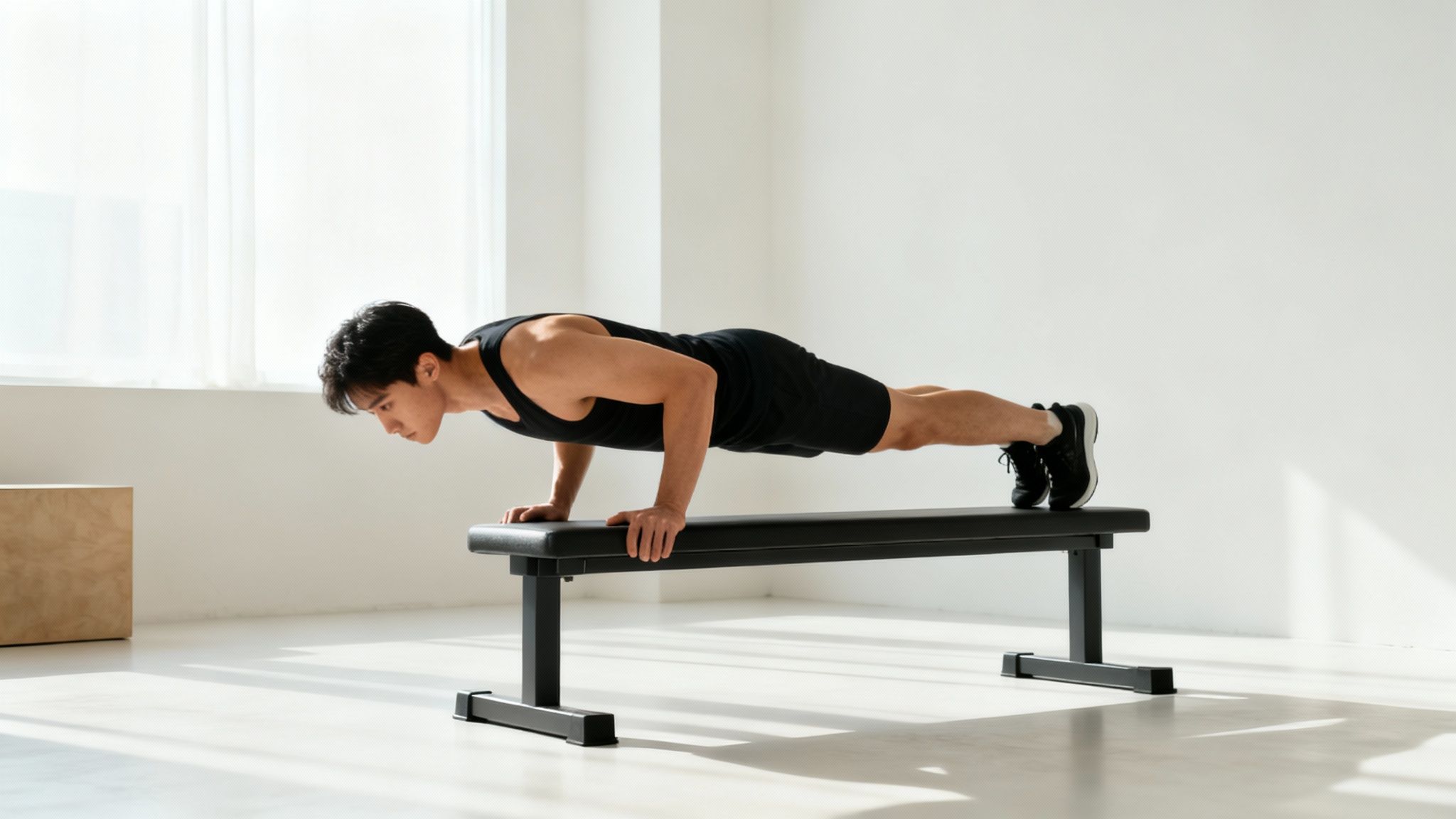
Bodyweight training, or progressive calisthenics, is a powerful form of low impact strength training exercises that leverages your own body weight as resistance. The "progressive" aspect is key; it’s a systematic method of increasing difficulty not by adding weight, but by manipulating leverage, angles, and range of motion. This approach develops true functional strength that translates to real-world movements, all without the need for equipment.
Popularized by military training programs and modern fitness communities like Parkour and MovNat, progressive calisthenics proves that you don't need a gym to build significant strength. The entire philosophy is built on mastering foundational movements and gradually making them more challenging, which ensures continuous progress while minimizing joint stress.
Why It's a Top Low-Impact Choice
Bodyweight training is inherently low-impact because you are always in control of the load, which is your own body. There are no external weights to drop or mismanage, reducing the risk of sudden strain on your joints. By focusing on controlled, full-range movements, you build stability in the muscles surrounding the joints, such as the rotator cuff in the shoulders or the stabilizing muscles around the knees and hips. This makes it an excellent choice for anyone with joint sensitivity or those new to strength training.
Actionable Tips for Getting Started
To begin your progressive calisthenics journey safely and effectively, use these strategies:
- Start with Regressions: Never jump into a difficult variation. Begin with an easier form, like performing push-ups against a wall or on your knees, before attempting a full push-up. Master the basics first.
- Focus on Leverage: Progress by changing your body's angle, not by adding speed. For example, elevate your feet during a push-up or glute bridge to increase the challenge.
- Control Every Rep: Perform each repetition with deliberate control through both the push/pull and the return phases. Aim for 3-4 sets of 6-12 high-quality reps.
- Combine and Conquer: Create efficient full-body workouts by combining movements into a circuit. For example, perform a set of squats, followed by push-ups, then rows (using a table or suspension trainer), and finish with planks.
Calisthenics is a scalable and highly effective discipline. To explore a wide range of movements and build a structured routine, you can learn more about this versatile calisthenics training method and its benefits.
6. Machine-Based Strength Training
Strength machines are a foundational component of many low impact strength training exercises, particularly for those prioritizing safety and guided movement. These machines operate on a fixed path, meaning the trajectory of the movement is predetermined. This design isolates specific muscle groups and removes the need for the user to stabilize the weight, drastically reducing the risk of improper form and subsequent injury. The controlled environment makes them exceptionally beginner-friendly and ideal for anyone building initial strength or returning to exercise after a break.
Originally pioneered by innovators like Arthur Jones of Nautilus, strength machines were designed to make resistance training more accessible and effective. Today, they are staples in commercial gyms, physical therapy clinics, and senior fitness centers, valued for their ability to provide a safe, predictable, and effective workout.
Why It's a Top Low-Impact Choice
The primary advantage of machine-based training is its unparalleled joint protection. Because the machine dictates the movement path, it prevents the uncontrolled, multidirectional stress that can aggravate sensitive joints like the knees, shoulders, and lower back. The fixed-path design ensures that the load is distributed evenly and correctly through the target muscle, minimizing compensatory movements that could lead to strain. This makes machines an excellent choice for individuals with joint limitations, those in post-surgical rehabilitation, or anyone who wants to build strength with maximum confidence and minimal risk.
Actionable Tips for Getting Started
To get the most out of machine-based strength training, follow these key principles:
- Adjust for Your Body: Before adding weight, always adjust the seat height, backrest, and handle positions to fit your specific body dimensions. Proper alignment is crucial for targeting the right muscles and preventing strain.
- Master the Movement: Start with a very light weight to learn the machine’s full, intended range of motion. Focus on a smooth, controlled tempo, avoiding any jerking or reliance on momentum.
- Control Both Phases: Pay equal attention to the concentric (pushing or pulling) and eccentric (returning) parts of the movement. A slow, controlled return phase is a powerful stimulus for muscle growth and is gentle on the joints.
- Progress Systematically: The greatest benefit of machines is the ease of progressive overload. Once you can comfortably complete your target reps and sets (e.g., 3 sets of 10-12 reps) with good form, increase the weight by the smallest available increment.
Machines are perfect for building a solid foundation of strength. For personalized workout plans that incorporate machines safely and effectively, you can explore the guided routines offered by the Zing Coach app to ensure you are progressing correctly.
7. Suspension Training (TRX-Style)
Suspension training is one of the most dynamic and scalable low impact strength training exercises, utilizing a system of straps, handles, and anchors to leverage your own body weight. With this method, you use gravity and your body angle to create resistance, allowing for hundreds of functional movements. The intensity is determined by a simple adjustment of your foot position; stepping closer to the anchor point increases the challenge, while stepping away decreases it. This makes it an incredibly adaptable tool for nearly any fitness level.
Originating from the U.S. Navy SEALs, who needed a way to maintain peak physical condition in tight spaces with minimal gear, suspension training has become a staple in physical therapy clinics, high-performance training centers, and home gyms worldwide. Its focus is on building a strong core, improving stability, and developing functional strength that supports everyday life and athletic performance.
Why It's a Top Low-Impact Choice
Suspension training is uniquely low-impact because you are always in control of the load. Unlike traditional weights where the load is fixed, you can instantly modify the resistance mid-set by simply changing your body's angle. This removes the jarring impact and joint compression associated with heavy lifting or plyometrics. Every movement requires constant core engagement to maintain stability, strengthening the deep muscles of your abdomen and back, which is crucial for protecting your spine and improving posture.
The "unstable" nature of the straps forces your stabilizer muscles to work overtime, enhancing joint health and proprioception (your body's awareness in space) without overloading the joints themselves.
Actionable Tips for Getting Started
To safely and effectively incorporate suspension training into your routine, keep these tips in mind:
- Maintain Core Tension: Before starting any exercise, brace your core as if you're about to take a punch. This "plank" position should be held throughout the entire movement to protect your spine.
- Start with a Higher Angle: Begin with your body in a more upright position (less of an angle to the floor) to master the form with lighter resistance. As you gain confidence and strength, you can increase the challenge by walking your feet forward to create a steeper angle.
- Focus on Slow, Controlled Movements: Avoid using momentum. Perform each repetition slowly, focusing on a 2-3 second count for both the concentric (pulling/pushing) and eccentric (lowering) phases. This maximizes muscle engagement and minimizes strain.
- Keep Straps Taut: There should be no slack in the straps at any point during an exercise. Constant tension ensures the target muscles are always engaged and the movement is stable and controlled.
8. Pilates and Core-Based Strength
Pilates is a sophisticated method of exercise that emphasizes controlled movements, precise breathing patterns, and deep core engagement to build functional strength from the inside out. Unlike traditional strength training that often isolates muscle groups, Pilates focuses on the body as an integrated system. It develops the deep stabilizing muscles of the core, hips, and back, creating a strong foundation that improves posture and enhances all other physical activities.
Developed by Joseph Pilates, this method has long been a secret weapon for dancers and physical therapists. Its focus on movement quality over quantity makes it one of the most effective low impact strength training exercises for building lean, resilient strength and addressing muscular imbalances.
Why It's a Top Low-Impact Choice
The primary advantage of Pilates is its focus on developing the "powerhouse" or core, which is the center of gravity and the source of all movement. By strengthening these deep muscles, you create a stable base that protects the spine and joints from strain during daily activities and other forms of exercise. The movements are fluid, deliberate, and performed with concentration, ensuring that momentum is not used. This controlled execution builds exceptional body awareness and strength without any jarring impact on the joints.
Actionable Tips for Getting Started
To begin integrating Pilates into your routine for core strength and stability, follow these key principles:
- Prioritize Controlled Breathing: Coordinate your breath with each movement, typically inhaling to prepare and exhaling through the most strenuous part of the exercise. This helps engage the deep core muscles.
- Focus on Quality, Not Quantity: Perform each movement with slow, deliberate control. A tempo of 2-3 seconds for both the exertion and return phases is ideal. Aim for 10-15 well-executed repetitions rather than rushing through more.
- Master Mat Work First: Begin with foundational mat exercises before considering equipment like the reformer. Mat Pilates teaches you how to control your body using only your own strength and focus.
- Engage Your Core First: Before initiating any limb movement, consciously draw your navel in toward your spine to activate your transverse abdominis. This ensures the work originates from your center.
Pilates is excellent as a standalone practice or as a supplement to other training, performed 2-3 times per week. For a deeper dive into movements that build this foundational strength, explore these effective core exercises to enhance your routine.
Low-Impact Strength Training — 8-Method Comparison
| Modality | Implementation complexity | Resource requirements | Expected outcomes | Ideal use cases | Key advantages |
|---|---|---|---|---|---|
| Resistance Band Training | Low — simple techniques, some anchoring knowledge | Low — bands and anchors; highly portable | Joint-friendly strength, muscle activation, moderate overload | Rehab, travel, home workouts, accessory training | Affordable, portable, scalable, low joint stress |
| Dumbbell Work (Controlled Movements) | Low–Medium — emphasis on tempo and form | Medium — dumbbells and space; adjustable sets preferred | Foundational strength, unilateral balance, hypertrophy potential | Home gyms, form-focused programs, rehab progression | Precise loading, corrects imbalances, stabilizer engagement |
| Isometric Exercise (Static Holds) | Very low — easy to learn holds and positions | Minimal — body or simple props (wall, band) | Strength at specific angles, improved stability and endurance | Rehab, time-efficient sessions, beginners, desk breaks | Zero impact, minimal equipment, time-efficient gains |
| Water-Based Strength Training | Low–Medium — pool-specific technique and safety | High — pool access; optional flotation aids | Low-impact strength + cardio, improved mobility and circulation | Arthritis management, obesity, post-injury rehab, seniors | Dramatically reduces joint load; hydrostatic benefits |
| Bodyweight Training (Progressive Calisthenics) | Low–Medium — requires progression knowledge | Minimal — no equipment; small space needed | Functional strength, body control, scalable up to a ceiling | Travelers, beginners, minimalist home training | Free, portable, builds movement skill and control |
| Machine-Based Strength Training | Very low — guided movements, minimal skill | High — gym machines and facility access | Safe muscle isolation, consistent load tracking, rehab-friendly | Beginners, post-surgical rehab, senior fitness, gyms | High safety, easy progression, low learning curve |
| Suspension Training (TRX-Style) | Medium — requires understanding of angles and positioning | Low — straps and secure anchor; minimal space | Functional strength, core and stabilizer development, scalable | Small-space training, travel, tactical and functional programs | Highly scalable, excellent core engagement, portable |
| Pilates and Core-Based Strength | Medium — technique and breathing emphasis | Low–Medium — mat or equipment (Reformer) for advanced work | Deep core stability, posture improvement, movement quality | Postural correction, rehabilitation, dancers, prenatal/postnatal | Low impact, strong mind‑body focus, corrects imbalances |
Your Next Steps to Building Joint-Friendly Strength
You have now explored a comprehensive toolkit of eight powerful methodologies for low-impact strength training. From the adaptable resistance of bands and suspension trainers to the controlled precision of dumbbell and machine work, the path to building a stronger, more resilient body without punishing your joints is clearer than ever. The central message to carry forward is that strength and joint preservation are not opposing forces; they are partners in creating a sustainable, long-term fitness foundation.
The true power of this knowledge lies not in choosing one "best" method, but in understanding how to blend them into a routine that fits your unique needs. You might find that starting your sessions with progressive bodyweight exercises serves as an effective warm-up, followed by machine-based work for targeted muscle groups, and finishing with Pilates-inspired movements to fortify your core. This multifaceted approach ensures you are building well-rounded, functional strength.
Key Takeaways for Sustainable Progress
Moving from theory to practice requires a focused mindset. As you begin to integrate these low impact strength training exercises into your life, keep these core principles at the forefront of your mind:
- Master Form First: Before you even think about increasing weight or repetitions, your absolute priority must be impeccable form. This is the cornerstone of injury prevention and ensures you are activating the correct muscles for maximum benefit.
- Listen to Your Body's Feedback: Your body is the ultimate guide. Differentiate between the productive discomfort of muscle fatigue and the sharp, warning signal of joint pain. Never push through pain; instead, regress the exercise or choose an alternative.
- Consistency Outweighs Intensity: A few well-executed, consistent workouts each week will yield far greater results than sporadic, high-intensity sessions that leave you sore and sidelined. Building strength is a marathon, not a sprint.
- Prioritize Recovery: Strength gains don't happen during the workout; they happen during the recovery period afterward. Adequate sleep, hydration, and nutrition are non-negotiable components of your training plan. To support your body's recovery and enhance muscle repair after your low-impact strength sessions, it's crucial to consider proper post-workout nutrition. For those following a plant-based diet, optimizing muscle recovery with vegan post-workout snacks can provide the essential protein and nutrients needed to rebuild muscle tissue effectively.
Putting It All Into Action
Your journey begins with a single, manageable step. Don't feel pressured to implement everything at once. Start by selecting two or three exercises from the list that appeal to you and are accessible with your current equipment. Commit to practicing them two to three times a week for the next month.
Focus on the quality of each repetition, feeling the target muscles contract and release. This mindful approach not only protects your joints but also deepens the mind-muscle connection, making your workouts more effective. As you build confidence and your form becomes second nature, you can then begin to explore progressions, add new exercises, or increase your training frequency. The journey to building pain-free strength is a deeply personal one, built on a foundation of smart choices, patience, and unwavering consistency. You now have the map; it's time to take the first step.
Ready to take the guesswork out of building your perfect low-impact routine? Zing Coach uses AI to design a personalized strength plan that adapts to your fitness level, protects your joints, and evolves with you as you get stronger. Start your journey to safe, effective, and sustainable fitness today by visiting Zing Coach.
Share this article


Authors