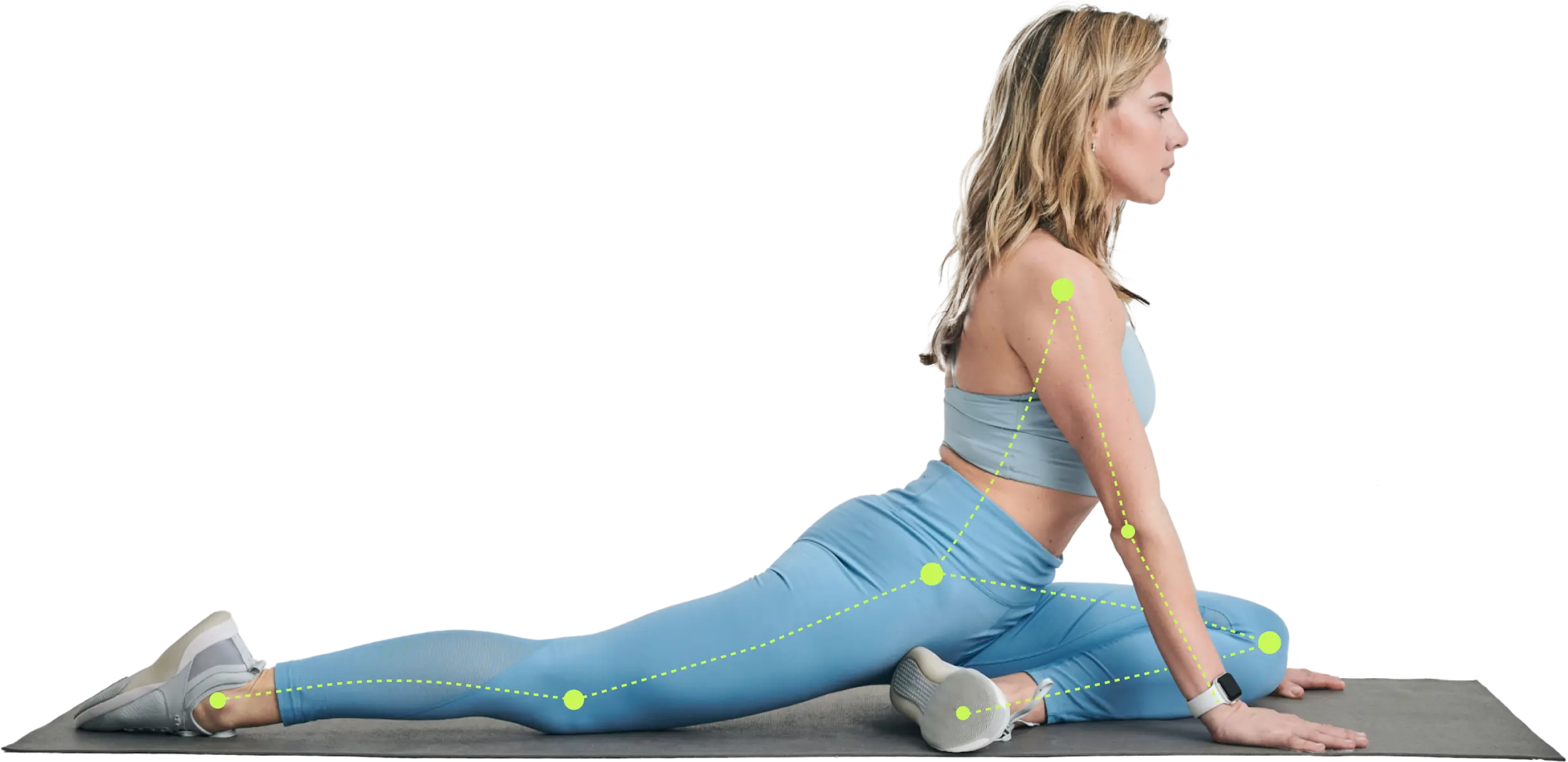
Discover 10 actionable home workout tips for any goal. Learn to optimize space, use equipment, and leverage AI for better results. Start your journey today!
The landscape of fitness has shifted, with more people than ever discovering the power and convenience of training at home. Yet, transitioning from a structured gym environment to your living room presents unique challenges. Staying motivated, ensuring proper form, and making continuous progress without a personal trainer by your side can feel like an uphill battle. This guide cuts through the noise, providing 10 essential home workout tips designed to create a sustainable, effective, and safe fitness routine right where you are.
We'll move beyond generic advice like "just be consistent" and dive straight into actionable strategies that yield real results. You'll learn how to establish a dedicated and motivating workout space, invest strategically in minimal equipment, and master the art of progressive overload using just your body weight. We will explore how to create a balanced schedule that prioritizes both high-intensity training and crucial recovery periods, ensuring you build strength without burning out.
This comprehensive list is your blueprint for success. It addresses the common pitfalls of at-home training by focusing on practical solutions, from maintaining perfect form to leveraging smart technology. For instance, we'll cover how to use AI-powered tools like Zing Coach to get a personalized plan, analyze your movements with computer vision, and adapt your workouts based on real-time feedback and body-scan calibration. Whether you are a beginner looking for guidance, a busy professional needing efficiency, or a seasoned athlete aiming to optimize performance, these tips provide the framework you need to not just work out at home, but to truly thrive in your fitness journey.
1. Establish a Dedicated Workout Space
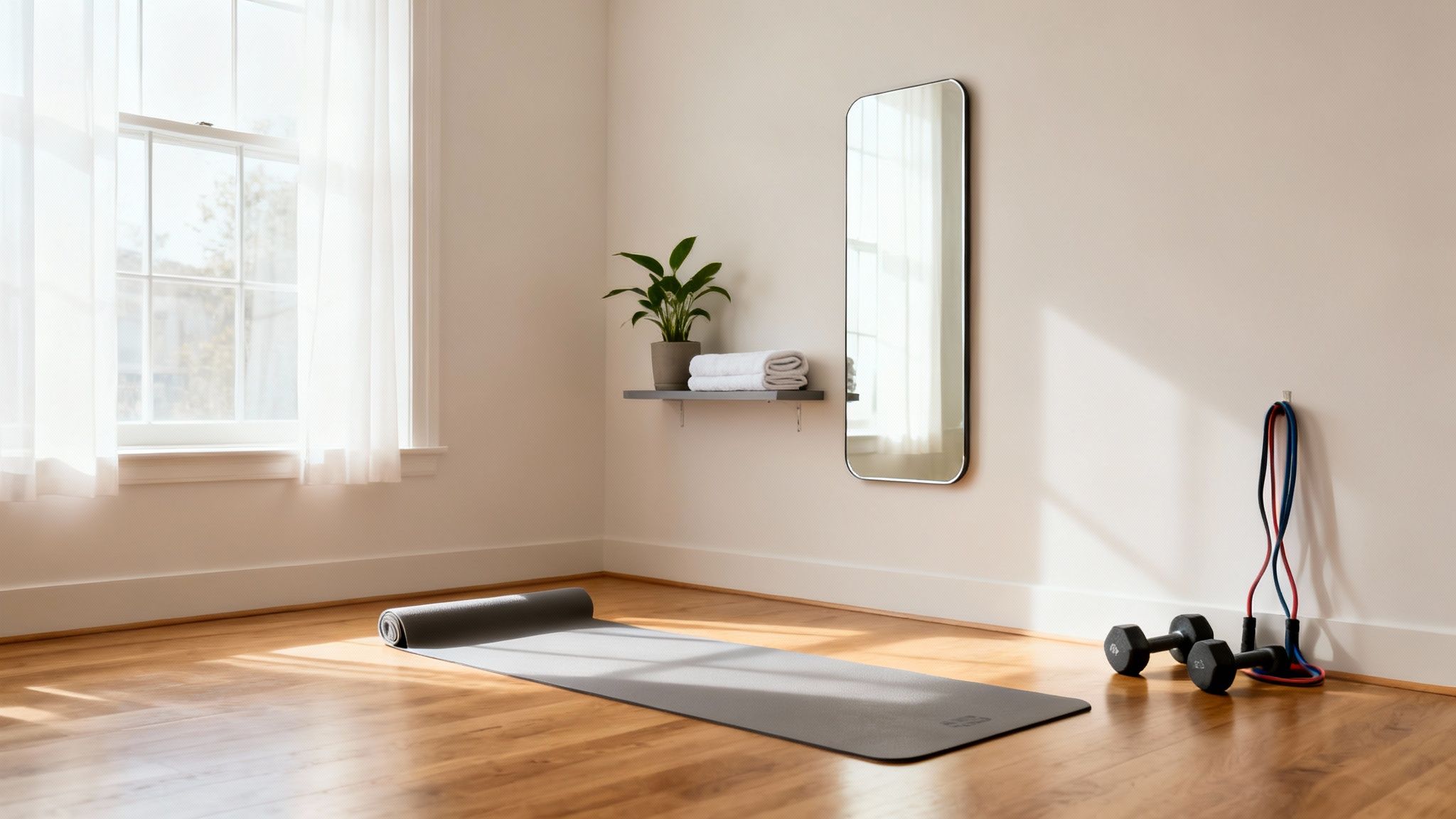
One of the most effective home workout tips for building consistency is to create a dedicated physical space for your fitness routine. This simple act creates a powerful psychological cue, signaling to your brain that it’s time to switch from a "home" mindset to a "workout" mindset. By removing the friction of deciding where to exercise each day, you eliminate a common barrier to starting.
This space doesn't need to be an entire room. It can be a small, uncluttered corner of your living room, bedroom, or even a garage. The key is consistency; using the same spot repeatedly reinforces the habit. Before you even begin, consider tips for maximizing your home's potential by learning how to organizing small spaces effectively. This can help you carve out a functional area you hadn't considered before.
Making Your Space Work for You
Once you've identified a potential spot, a few small adjustments can transform it into an inspiring and functional workout zone.
- Define the Area: A yoga mat is a perfect tool for visually and physically marking your territory. It contains your workout and protects your floors. You can discover a wide range of workouts using only this single piece of equipment with these effective yoga mat exercises.
- Keep it Ready: Ensure the space is clear of daily clutter like toys, laundry, or work papers before you plan to exercise. Store your equipment neatly nearby in a basket or on a small shelf so it's easily accessible.
- Enhance the Environment: If possible, choose a spot with good ventilation and natural light. Adding a small mirror can be incredibly helpful for monitoring your form and preventing injury, a key component of successful at-home fitness.
Zing Coach Tip: Your environment directly impacts your motivation. Use the Zing Coach app to start your workout, place your phone where the camera can see you, and let your dedicated space become the backdrop for real-time form correction from the AI. This turns any corner into a smart personal training studio.
2. Invest in Essential Equipment Strategically
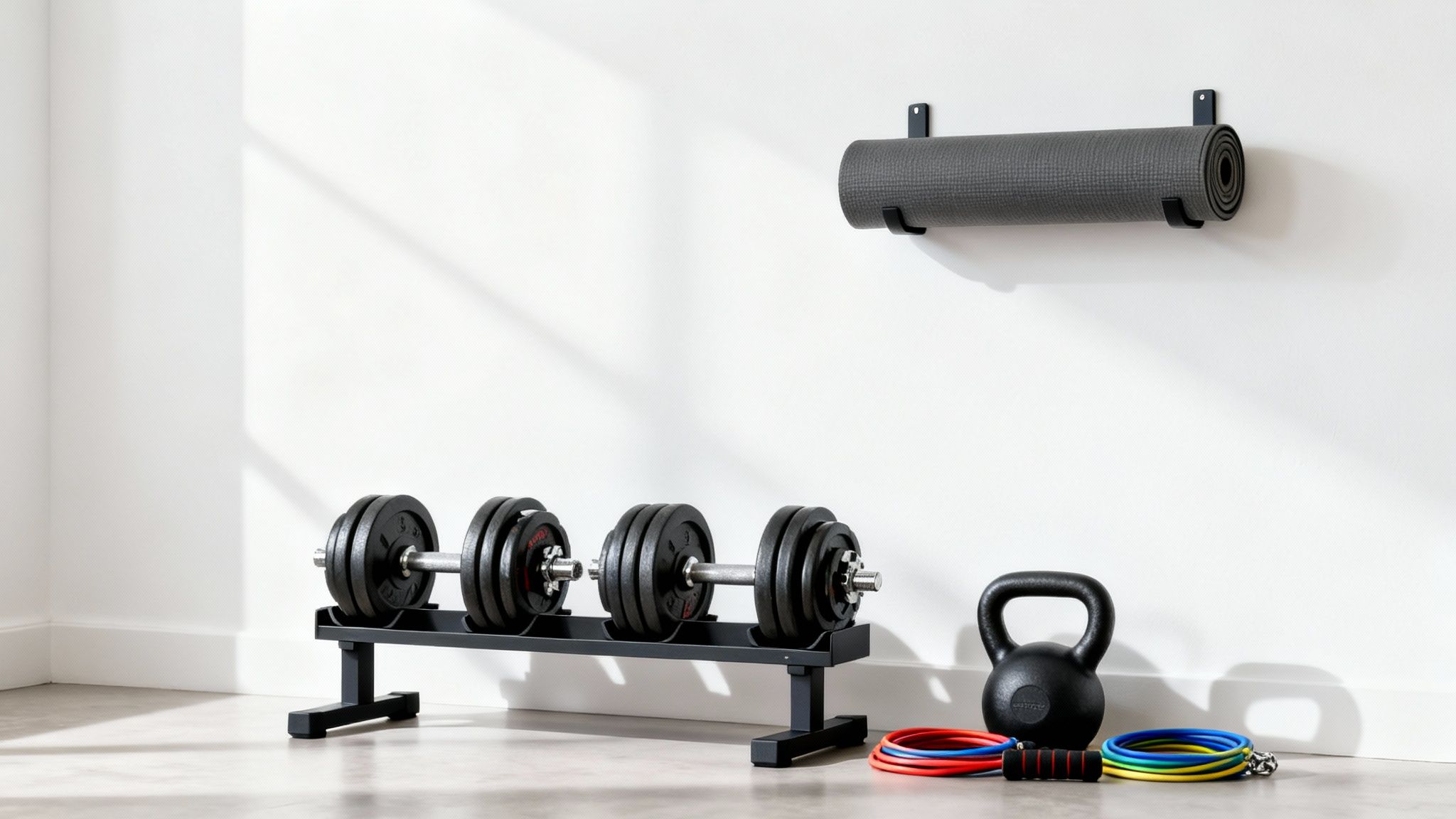
Building an effective home gym isn't about buying the biggest, most expensive machines. A more strategic approach involves investing in a few key pieces of versatile equipment that offer maximum bang for your buck and space. This method ensures you have the tools for a wide variety of exercises without cluttering your home or draining your wallet, a core principle of sustainable home workout tips.
Focusing on multi-functional items allows for progressive overload and exercise variety, two critical components for long-term fitness success. Instead of a single-use machine, a set of adjustable dumbbells or resistance bands can be used for hundreds of different movements targeting every muscle group.
Making Your Space Work for You
Once you're ready to purchase, prioritize items that align with your specific fitness goals and available space. This thoughtful approach ensures every piece of equipment serves a purpose.
- Start with the Basics: A set of resistance bands is an inexpensive, portable, and incredibly versatile starting point for strength training. Likewise, a quality yoga mat provides a comfortable, dedicated surface for everything from floor exercises to stretching.
- Prioritize Adjustability: To save space and allow for progression, consider adjustable equipment. Options like Bowflex SelectTech dumbbells replace an entire rack of weights with a single pair, making them ideal for small spaces. This allows you to perform a huge range of movements, which you can explore with these effective dumbbell exercises.
- Choose for Versatility: A kettlebell or a TRX suspension trainer can facilitate a full-body workout using compound movements. Research items based on the types of workouts you enjoy to ensure your investment gets used regularly.
Zing Coach Tip: You don't need a full gym to get a great workout. The Zing Coach app creates personalized routines using the equipment you have, whether it's a full set of dumbbells or just a single resistance band. Simply tell the app what's available, and it will build an effective workout tailored to your tools and goals.
3. Follow Structured Workout Programs
One of the most powerful home workout tips to eliminate decision fatigue and ensure consistent progress is to follow a structured program. Instead of randomly choosing exercises each day, a pre-designed plan provides a clear roadmap, guiding you on what to do, when to do it, and how to progress over time. This removes the guesswork and builds momentum, which is crucial for staying motivated.
A well-designed program, whether from a popular app like Nike Training Club or a classic like Couch to 5K, is built on the principle of progressive overload. It systematically increases the challenge to prevent plateaus and drive results. This structure is essential for anyone, from beginners needing guidance to advanced athletes looking to optimize their training.
Making a Program Work for You
Selecting the right program is the first step, but sticking to it and adapting it to your needs is what truly creates lasting change.
- Choose Wisely: Select a program that aligns with your current fitness level, goals, and available equipment. If you're new to strength training, a plan like StrongLifts 5x5 is excellent, while someone focused on cardio might prefer a running program. For a balanced approach, you can explore workout splits, such as this effective 3-day split workout plan.
- Track Everything: Accountability is key. Log your workouts, including the weights used, reps completed, and how you felt. This data helps you see your progress and tells you precisely when to increase the intensity.
- Trust the Process: Structured programs are designed with built-in recovery days and specific progression timelines. Avoid the temptation to skip rest days or add extra workouts, as this can lead to burnout or injury. Follow the plan as written for the best results.
Zing Coach Tip: The Zing Coach app takes structured programming to the next level. It doesn't just give you a static plan; it builds a dynamic program based on your initial fitness assessment and body scan. As you work out, the AI adjusts the volume and intensity in real-time, ensuring every session is perfectly tailored to drive your progress.
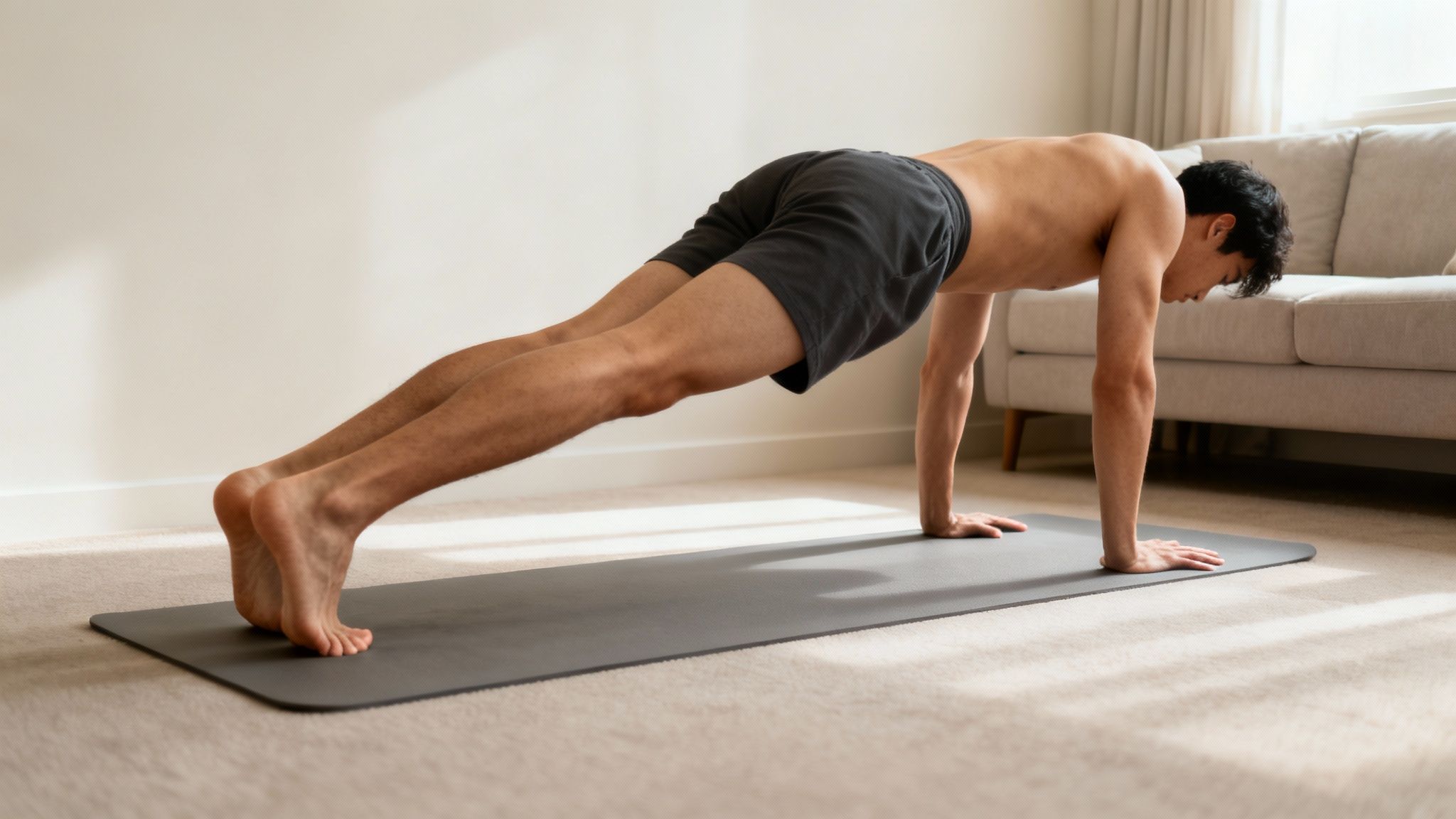
4. Utilize Bodyweight Exercises
One of the most accessible and effective home workout tips is to leverage the power of your own body for resistance. Bodyweight training requires zero equipment, making it a perfect starting point for beginners and a challenging tool for advanced athletes. It builds functional strength, improves core stability, and enhances body awareness by forcing you to control your own mass through space.
This method is incredibly versatile, allowing you to build muscle and endurance from anywhere. Exercises like squats, push-ups, planks, and lunges are foundational movements that target multiple muscle groups simultaneously. You can learn more about this training style by exploring the world of calisthenics, which is built entirely on mastering bodyweight movements.
Making Bodyweight Training Work for You
The key to successful bodyweight training is progressive overload, which means making the exercises more challenging over time. Here’s how to do it without adding weights.
- Master the Form First: Before increasing intensity, ensure your form is perfect. Focus on controlled, deliberate movements rather than speed. A slow, well-executed push-up is far more effective than ten fast, sloppy ones.
- Modify to Your Level: Use your environment to adjust difficulty. Perform push-ups against a wall or with your hands on a chair to make them easier. As you get stronger, progress to incline push-ups with your feet elevated to make them harder.
- Increase the Challenge: Progress by adding more repetitions or sets, reducing rest time between sets, or moving to more complex variations. For example, advance from a standard bodyweight squat to a pistol squat or a jump squat.
Zing Coach Tip: Bodyweight exercises demand precision. Use the Zing Coach app’s motion-tracking feature to get real-time feedback on your form for exercises like squats and lunges. The AI acts as your virtual spotter, ensuring you perform each rep safely and effectively to maximize results and minimize injury risk.
5. Use Online Fitness Videos and Apps
One of the most powerful home workout tips is to leverage the vast world of online fitness videos and apps. This approach brings expert guidance, structured routines, and endless variety directly into your living room, eliminating guesswork and boosting motivation. You get access to professional instructors and high-quality programming for a fraction of the cost of a gym membership or personal trainer.
The digital fitness landscape is rich with options, from live-streamed classes that create a sense of community to on-demand libraries you can access anytime. Platforms like Peloton Digital, Apple Fitness+, and YouTube channels such as Yoga with Adriene offer everything from high-intensity interval training (HIIT) to restorative yoga. This accessibility makes it easy to find a workout that fits your mood, schedule, and fitness level on any given day.
Making Your Space Work for You
To get the most out of your digital fitness experience, a few simple setup strategies can make a significant difference in your performance and safety.
- Set Up Your Screen: Position your tablet, TV, or phone at a safe viewing distance where you can see the instructor clearly without straining your neck. Ensure the device is stable and won't be knocked over during dynamic movements.
- Find Your Instructor: The right coach can make or break your motivation. Take advantage of free trial periods to explore different platforms and find instructors whose energy, cueing style, and personality resonate with you.
- Schedule It In: Treat your online workouts like non-negotiable appointments. Add them to your calendar to build a consistent routine and hold yourself accountable. Knowing how to choose the best home workout app can help you find a platform that aligns perfectly with your goals.
Zing Coach Tip: Go beyond just following along. The Zing Coach app uses your phone's camera to provide real-time, AI-powered feedback on your form, just like a personal trainer would. This ensures you're performing exercises like squats and lunges safely and effectively, maximizing results while minimizing the risk of injury.
6. Create a Consistent Schedule and Routine
Just like a dedicated space, a dedicated time slot is one of the most powerful home workout tips for long-term success. Establishing a consistent schedule transforms exercise from a sporadic activity into a non-negotiable appointment with yourself. This routine-building approach removes the daily decision-making fatigue of when to work out, making it much more likely that you'll follow through.
Consistency is the engine of progress. It allows your body to adapt, recover, and grow stronger over time, which is far more effective than occasional, high-intensity sessions. By scheduling your workouts, you signal to your brain and your household that this time is protected. Whether it's a quick 20-minute session before the kids wake up or a 45-minute strength routine during your lunch break, the regularity is what builds the habit.
Making Your Schedule Work for You
Finding the right time and sticking to it is personal, but a few universal strategies can help you lock in the habit and ensure you stay on track.
- Anchor it to an Existing Habit: Link your workout to something you already do every day, like right after your morning coffee or immediately after you sign off from work. This is called "habit stacking" and makes the new routine easier to remember.
- Start Realistically: Don't commit to seven days a week if you're just starting. Aim for a manageable frequency, like three days per week, and build from there. Success breeds motivation, so set yourself up for early wins.
- Use Digital Reminders: Treat your workout like a critical meeting. Put it on your digital calendar and set alarms. To help solidify your exercise regimen and ensure long-term adherence, consider utilizing tools that can reinforce your commitment. You can find a great overview of the best habit tracking apps to gamify your consistency.
Zing Coach Tip: The Zing Coach app helps you build a sustainable routine by creating a personalized plan based on your availability. When you set up your profile, you tell the AI how many days you can train and for how long. The app then generates a schedule, sends reminders, and adapts the workouts to ensure you're always progressing without burning out.
7. Incorporate High-Intensity Interval Training (HIIT)
For those looking to maximize results in minimal time, one of the most powerful home workout tips is to incorporate High-Intensity Interval Training (HIIT). This method involves short, all-out bursts of intense exercise alternated with brief recovery periods. The goal is to push your heart rate near its maximum capacity, which triggers significant metabolic and cardiovascular benefits that last long after the workout ends.
HIIT is incredibly time-efficient, making it perfect for busy schedules. A session can be as short as 10-20 minutes while delivering fitness gains comparable to much longer steady-state cardio sessions. This style of training, popularized by protocols like Tabata and programs like Insanity, is highly effective for fat loss and improving aerobic capacity without requiring any equipment.
Making HIIT Work for You
The key to successful HIIT is managing intensity and prioritizing safety. Here’s how to integrate it into your home routine effectively:
- Start with Manageable Intervals: Don’t jump straight into extreme protocols. Begin with a 1:2 work-to-rest ratio, such as 30 seconds of high-intensity effort followed by 60 seconds of rest. As your fitness improves, you can progress to a 1:1 or even a 2:1 ratio, like the classic Tabata format of 20 seconds on, 10 seconds off.
- Focus on Form First: The high-speed nature of HIIT can compromise form. Always prioritize correct technique over speed to prevent injury. Choose exercises you can perform safely at a high intensity, like burpees, high knees, or jump squats.
- Allow for Recovery: HIIT places significant stress on the body. It’s not meant to be done daily. Limit HIIT sessions to 2-3 times per week on non-consecutive days to allow your muscles and nervous system to recover fully.
Zing Coach Tip: Unsure how to structure a HIIT session? The Zing Coach app builds personalized interval workouts based on your fitness level and goals. It guides you through work and rest periods with clear timers and visual cues, ensuring you push yourself safely and effectively for maximum impact.
8. Maintain Proper Form and Technique
One of the most crucial home workout tips for long-term success is prioritizing correct exercise form over weight or repetitions. Proper technique ensures you are targeting the intended muscles, maximizing the effectiveness of each movement, and significantly reducing the risk of injury. Neglecting form not only leads to poor results but can also cause strains or more serious issues that derail your progress.
Mastering your movements is the foundation of a safe and effective fitness journey. It's far more beneficial to perform five perfect squats than 20 sloppy ones. This focus on quality over quantity builds a strong base, allowing you to progress safely and consistently without developing bad habits that are difficult to correct later.

How to Master Your Form at Home
You don't need a personal trainer standing next to you to refine your technique. With a few simple tools and a mindful approach, you can effectively monitor and improve your form.
- Use Visual Feedback: Position a mirror so you can watch yourself during exercises like squats or deadlifts. This provides immediate visual cues, helping you check for a neutral spine, ensure your knees are tracking correctly over your toes, and maintain overall body alignment.
- Record Yourself: Your phone is a powerful coaching tool. Record a set of an exercise from the side or front, then review the footage. Compare your movement to tutorials from certified trainers to spot areas for improvement you might otherwise miss.
- Focus on the Feeling: Pay attention to which muscles are working. This is called the mind-muscle connection. If you feel a deadlift primarily in your lower back instead of your glutes and hamstrings, it's a clear sign your form needs adjustment. Start with bodyweight or very light weights to master this connection.
Zing Coach Tip: Eliminate the guesswork entirely. The Zing Coach app uses your phone's camera and advanced computer vision to analyze your form in real-time. It provides instant feedback and rep-by-rep corrections, acting as a virtual personal trainer to ensure every movement is performed safely and effectively.
9. Implement Progressive Overload
To avoid hitting a frustrating fitness plateau, you must consistently challenge your body. This is the core principle of progressive overload, a fundamental concept for making long-term strength and muscle gains. It means gradually increasing the demands placed on your musculoskeletal system, forcing it to adapt and grow stronger over time. Without it, your body gets comfortable, and progress stalls.
This principle is one of the most crucial home workout tips for anyone serious about results. It’s the difference between just going through the motions and actively building a stronger, more capable body. You simply cannot expect different results from doing the exact same routine with the same intensity week after week. Applying this forces adaptation, which is the biological process behind all fitness improvements.
How to Apply Progressive Overload at Home
You don't need a gym full of heavy weights to apply this principle. You can progressively overload your muscles in several ways, making it perfect for a home environment.
- Increase Resistance: This is the most common method. If you're using dumbbells for squats, move from 15 lbs to 20 lbs. For bodyweight exercises, you can add a resistance band or wear a weighted vest.
- Increase Reps or Sets: If you successfully completed three sets of 10 push-ups last week, aim for three sets of 12 this week. Once you can comfortably perform more reps, it might be time to increase the resistance.
- Decrease Rest Time: Shortening the rest period between sets increases the metabolic stress on your muscles, making the workout more intense without changing weight or reps. Try shaving 15 seconds off your rest time.
- Increase Training Frequency: If you currently train your legs once per week, adding a second session is a form of progressive overload.
- Improve Exercise Complexity: Progress from a standard bodyweight squat to a more challenging pistol squat, or from a regular plank to a plank with an arm raise.
Zing Coach Tip: Tracking is the key to progressive overload, but it can be tedious. The Zing Coach app automatically logs your reps, sets, and weights, taking the guesswork out of progression. When the AI detects you're getting stronger, it will suggest increasing the load or reps in your next workout to ensure you’re always moving forward.
10. Balance Training with Adequate Recovery
One of the most overlooked yet critical home workout tips is recognizing that progress isn't made during your workout, but during the recovery period afterward. Intense exercise creates microscopic tears in your muscle fibers; it's during rest that your body repairs these fibers, making them stronger and more resilient. Without adequate recovery, you risk overtraining, injury, and burnout, which can completely derail your fitness journey.
Prioritizing recovery is what separates sustainable, long-term success from short-lived bursts of effort followed by exhaustion. A well-structured plan strategically includes rest days and active recovery to allow your body to adapt and grow. This isn't about being lazy; it's about training smart. For example, a common and effective split is alternating an upper body day with a lower body day, followed by a complete rest day or a light active recovery session like yoga.
Making Recovery Work for You
Integrating recovery into your routine is a non-negotiable part of a successful fitness plan. Here are actionable ways to ensure your body gets the rest it needs to rebuild and come back stronger.
- Schedule Rest Days: Intentionally block out at least one to two full rest days per week in your calendar. These are days with no structured, intense exercise.
- Embrace Active Recovery: On days after a tough workout, engage in light activities like a brisk walk, gentle stretching, or foam rolling. This low-intensity movement helps increase blood flow to your muscles, which can aid in reducing soreness and speeding up repair.
- Prioritize Sleep: Aim for 7-9 hours of quality sleep per night. Sleep is when your body releases growth hormone and performs most of its muscle repair and regeneration.
- Fuel Your Body: Proper nutrition is key to recovery. Ensure you're consuming enough protein to rebuild muscle tissue and staying well-hydrated throughout the day to support all bodily functions.
Zing Coach Tip: Your body's needs change daily. Zing Coach adapts to your feedback, adjusting workout intensity and volume based on your reported energy levels and muscle soreness. This ensures you're pushing hard enough to make progress but not so hard that you compromise recovery and risk injury.
10-Point Home Workout Tips Comparison
| Strategy | Implementation complexity | Resource requirements | Expected outcomes | Ideal use cases | Key advantages |
|---|---|---|---|---|---|
| Establish a Dedicated Workout Space | Low — simple setup and planning | Minimal space, mat, basic storage | Improved consistency and focus | Home exercisers needing routine | Reduces excuses, saves time, organized environment |
| Invest in Essential Equipment Strategically | Moderate — research and selective purchases | Low–medium cost, compact storage space | Greater exercise variety and progression | Home gyms wanting versatility without clutter | Enables progression, space-efficient, cost-effective |
| Follow Structured Workout Programs | Low–Moderate — follow plan and track | Varies by program (minimal to full gym) | Measurable progress and balanced training | Goal-oriented users seeking guidance | Removes guesswork, ensures progression and balance |
| Utilize Bodyweight Exercises | Low — easy to start, requires form attention | None to minimal (mat, optional bar) | Functional strength, endurance, portability | Travelers, beginners, limited budget/space | Free, portable, highly scalable |
| Use Online Fitness Videos and Apps | Low — select platform and follow classes | Internet, device, possible subscription | Expert guidance, variety, motivation | Remote learners and schedule-flexible users | Access to pros, wide variety, flexible timing |
| Create a Consistent Schedule and Routine | Moderate — habit building and discipline | Calendar, reminders, planning time | Higher adherence and sustainable results | Anyone aiming for long-term habit formation | Increases adherence, simplifies planning and recovery |
| Incorporate High-Intensity Interval Training (HIIT) | Moderate — intensity control and programming | Minimal equipment, short time commitment | Rapid cardio improvement, efficient fat loss | Busy people seeking fast results, conditioning | Maximum results in minimal time, metabolic boost |
| Maintain Proper Form and Technique | Moderate–High — requires learning and feedback | Instructional resources, mirror or coach | Reduced injury risk, improved effectiveness | Lifters, novices, injury-prone individuals | Maximizes results safely, prevents chronic issues |
| Implement Progressive Overload | Moderate — tracking and planned increases | Progressive equipment or exercise variations, logging tools | Continuous strength and performance gains | Those focused on strength and long-term growth | Ensures steady progress, prevents plateaus |
| Balance Training with Adequate Recovery | Moderate — planning rest, nutrition, sleep | Sleep, nutrition, active recovery tools | Sustainable gains, reduced injury and burnout | Regular trainers and high-frequency programs | Prevents overtraining, supports long-term progress |
Putting It All Together for Lasting Success
Embarking on a home fitness journey can feel like assembling a complex puzzle. You have all these pieces-scheduling, equipment, exercise selection, and recovery-but seeing the final picture requires a clear strategy. Throughout this guide, we've explored the essential home workout tips that transform a spare room into a powerful personal gym and a sporadic routine into a sustainable lifestyle. The ultimate goal isn't just to work out at home; it's to thrive, build momentum, and achieve lasting results without ever needing a commercial gym membership.
The true power of these strategies lies not in applying them in isolation, but in weaving them together into a cohesive, personalized system. Your dedicated workout space becomes the stage for your consistent schedule. Your strategic equipment choices unlock new ways to apply progressive overload. Your mastery of bodyweight exercises ensures you can always get a workout in, no matter where you are. Each tip supports and amplifies the others.
From Individual Tips to an Integrated System
Let's distill the core principles we've covered into an actionable framework. Think of this as your final checklist for building a robust and effective home fitness plan.
Foundation First: The non-negotiables are your space, schedule, and consistency. Without a designated area and a protected time slot, even the best program will fail. Treat your workouts like crucial appointments with yourself, because they are. This is the bedrock upon which all progress is built.
Intelligent Programming: Random workouts yield random results. The leap from simply exercising to actively training comes from structure. This means following a program, focusing on progressive overload, and maintaining impeccable form. This is where tools become invaluable, moving you from guesswork to a data-driven approach. An app that tracks your reps, suggests weight increases, and corrects your form in real-time is a game-changer.
Holistic Health: Your workout is only one part of the equation. True success and sustainability are impossible without prioritizing recovery and nutrition. Sleep, hydration, and balanced meals are not optional add-ons; they are the fuel and repair mechanisms that allow your body to adapt, grow stronger, and avoid burnout. Ignoring recovery is the fastest way to derail your home workout consistency.
The Real Secret to Long-Term Adherence
The most overlooked "secret" among all these home workout tips is the principle of reducing friction. Every barrier you remove between you and your workout increases your chances of success.
Key Insight: Your environment and your tools should make starting your workout easier than skipping it. A pre-planned workout on an app, a dedicated space with equipment ready to go, and a clear schedule eliminate the decision fatigue that so often leads to inaction.
This is the fundamental advantage of a well-organized home workout routine. There's no commute to the gym, no waiting for equipment, and no crowded locker rooms. By optimizing your personal environment and leveraging technology, you create a nearly frictionless path to achieving your fitness goals. You are no longer just relying on willpower; you are building a system that fosters consistency by design.
Ultimately, your home is your most accessible and powerful fitness tool. By applying these principles, you transform it from a place of rest into a hub of personal growth and strength. The journey begins with that first step: defining your space, scheduling your time, and committing to the process. With the right strategy and a commitment to smart, structured training, the results you seek are not just possible-they are inevitable.
Ready to eliminate the guesswork and build a truly personalized home fitness plan? Zing Coach uses AI to create workouts that adapt to your body, goals, and available equipment, while our computer vision technology provides real-time form feedback to keep you safe and effective. Start your journey with a plan that’s built just for you at Zing Coach.
Share this article


Authors