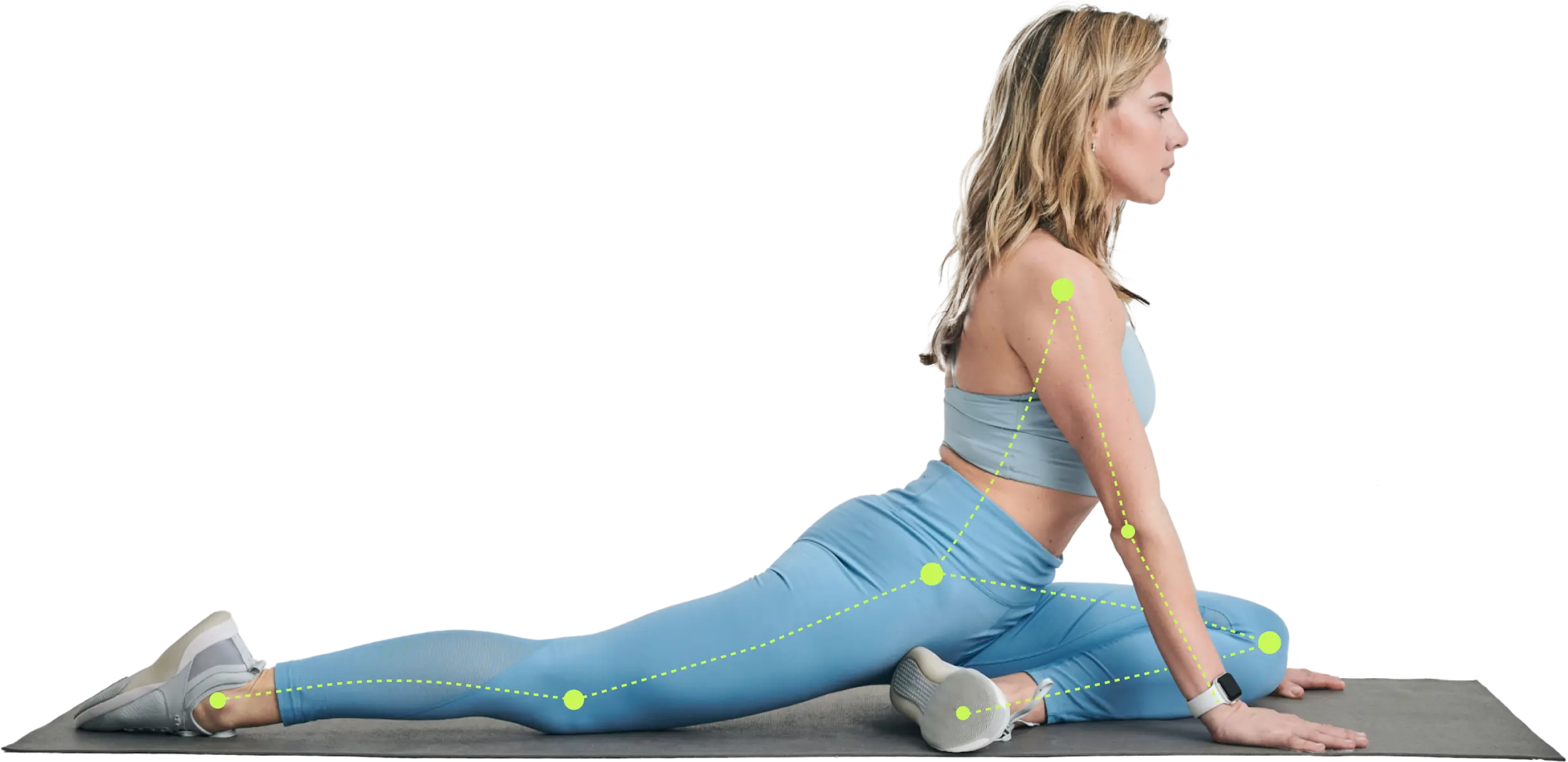
Tired of failed resolutions? Learn how to set fitness goals using proven methods that build momentum, keep you motivated, and deliver real, sustainable results.
Setting a real fitness goal is all about trading in vague wishes for a clear, actionable game plan. It’s the difference between saying, “I want to get fit,” and declaring, “I will strength train three times a week and run twice a week to lose 10 pounds in 12 weeks.”
This simple shift in thinking is what separates a fleeting New Year's resolution from a lasting lifestyle change.
Why Most Fitness Goals Fail and How Yours Can Succeed
Every January, a wave of ambitious fitness resolutions crashes ashore, but by February, most have receded back into the ocean of good intentions. Why? It's simple: most goals are just wishes in disguise.
Vague statements like "get in shape" or "be healthier" feel good to say, but they lack the teeth to drive real action. They're like a destination without a map—it’s easy to get lost or just give up when your initial burst of motivation fades.
Success starts the moment you replace that ambiguity with a solid strategy. This is where the SMART framework comes in. It's a ridiculously powerful tool for turning a fuzzy idea into a concrete objective you can actually work toward.

From Wishful Thinking to a Concrete Plan
The secret isn’t about finding some hidden reserve of willpower; it’s about building a system that makes showing up the easiest option. And the data backs this up.
One study with over 1,100 beginners found that those who combined goal setting with preparatory habits had 200% higher attendance rates than those who didn't. People with structured plans were also 88% more likely to still be active a year later. That tells you everything you need to know: a clear plan is the ultimate motivator.
The core idea is to build a goal so clear that the next steps are obvious. Instead of relying on fluctuating motivation, you rely on a well-defined plan that guides your daily actions.
The key to long-term success is creating routines you can stick with. It's one thing to set a goal, but building healthy habits that actually stick is what makes it happen.
Understanding how to create these routines is just as important as the goal itself. For more on this, check out our guide on forming habits that stick. When you focus on both the goal and the process, you build a foundation that won't crumble.
Laying Your Foundation with a Realistic Self-Assessment
You wouldn't try to build a skyscraper without understanding the ground it’s sitting on, right? The same logic applies when you set fitness goals. Diving headfirst into a demanding routine without knowing your starting point is a fast track to frustration and burnout.
An honest self-assessment isn’t about judging yourself. It’s about gathering the data you need to build a smart, sustainable plan that actually works for you. This isn’t about expensive tests or fancy equipment, either. It’s about creating a simple, real-world snapshot of where you are right now. This baseline is your starting line, giving you a tangible point from which to measure every victory, big or small.

Establish Your Physical Baseline
First things first, you need a few key metrics. Think of these as your personal fitness vitals. You don't need a gym for this—just a bit of space and a timer will do the trick.
- Cardiovascular Fitness: How’s your heart and lung health? A simple one-mile walk test is a great way to check. Time how long it takes you to walk one mile at a brisk, challenging pace. Write that number down—it’s your first benchmark.
- Muscular Strength: Let's test your raw strength with some foundational movements. See how many push-ups (from your toes or knees are both fine) and bodyweight squats you can do with good form before you have to stop.
- Flexibility: How's your range of motion feeling? A simple sit-and-reach test will give you a clue. Sit on the floor with your legs straight out and see how far you can reach toward your toes without straining your back.
These basic tests give you powerful data. Knowing where you stand today makes your future goals far more meaningful and measurable. For a more guided approach, you can learn about the Zing Coach Fitness Test feature, which walks you through an initial assessment to personalize your plan from day one.
Assess Your Lifestyle Honestly
Your fitness plan has to fit into your life, not the other way around. This is where you need to get brutally honest about your daily realities.
An honest appraisal of your lifestyle is the most critical step in setting achievable goals. It’s not about finding the “perfect” time; it’s about finding your time.
Think about these non-negotiable factors:
- Your Schedule: How many days a week can you realistically commit to a workout? Be specific. Are you a morning person or a night owl? Actually block out 30-45 minutes on your calendar like it’s a doctor's appointment.
- Your Budget: Do you have a gym membership, or are you working out at home? Your goals need to line up with the resources you actually have available.
- Your Enjoyment: Seriously, what activities do you genuinely like doing? If you hate running with a passion, setting a marathon goal will feel like a punishment. If you love to dance, a Zumba class might be the perfect fit.
Doing this foundational work sets the stage for everything that comes next. With a clear picture of your physical starting point and your real-world constraints, you’re ready to stop just wishing for results and start building a fitness plan that's personal, practical, and achievable.
Crafting Your Specific Fitness Goals with the SMART Method
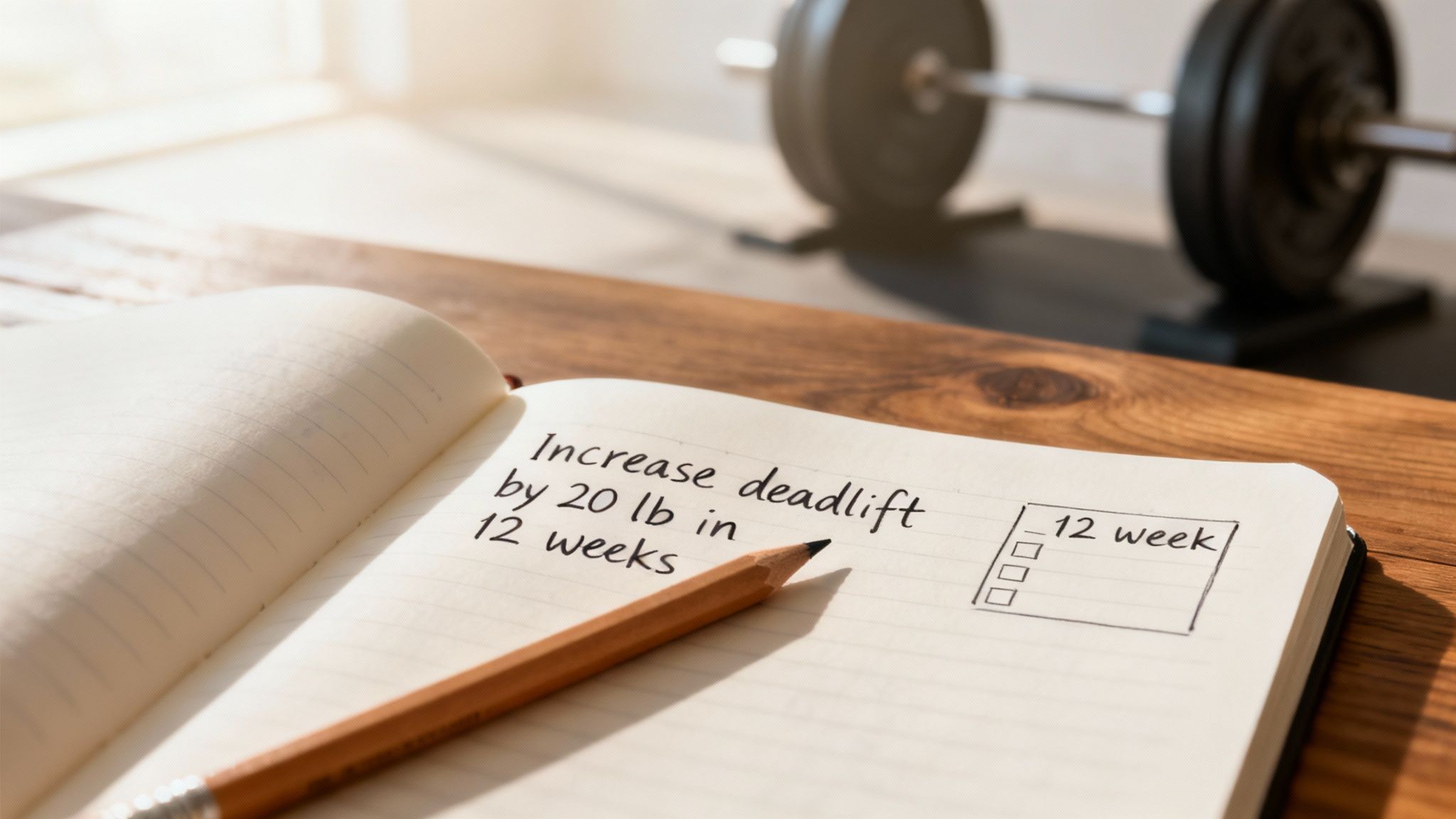
Okay, you've figured out your personal starting line. Now it's time to turn those big dreams into a clear, actionable roadmap. This is where the SMART method really shines. It's how you go from a vague wish like "I want to get stronger" to a concrete target like "I will increase my deadlift by 20 pounds in 12 weeks."
Using this framework takes the guesswork out of the equation and gives you a black-and-white definition of success. Think of each letter in the SMART acronym as a filter that refines your idea into something you can actually grab onto and work toward.
Making Your Goals Specific and Measurable
Specificity is your first—and most important—move. Without it, you have no way to measure if you're getting anywhere. "Getting in shape" is a nice thought, but it's not a goal. Let's sharpen that focus.
- Instead of: "I want to improve my cardio."
- Try: "I want to be able to run 5k without stopping to walk."
That simple shift gives you a clear target to aim for. Next, you need a way to track your journey. Measurable goals are what keep you honest and fired up because you can literally see the progress you're making.
Some solid metrics to track include:
- Time: Shaving 30 seconds off your one-mile run time.
- Weight/Reps: Bumping up your squat from 100 lbs to 120 lbs for five reps.
- Frequency: Nailing three strength workouts every single week.
- Body Composition: Dropping your body fat percentage by 2% in eight weeks.
When you pick the right metrics, you give yourself small wins to celebrate along the way. Trust me, that's crucial for staying in the game long-term.
Setting Achievable and Relevant Targets
A goal has to walk a fine line: it needs to be ambitious enough to get you excited but realistic enough that you can actually achieve it. Aiming to lose 30 pounds in a month isn't just unhealthy; it's a surefire recipe for burnout and disappointment. Look back at your baseline numbers and set a target that stretches you, but doesn't break you.
For instance, a realistic strength gain for a beginner might be adding 5-10 pounds to a major lift each month. A sustainable pace for weight loss is usually around 1-2 pounds per week.
A great fitness goal is one that connects directly to your "why." It should feel important and personal, not like something you should do, but something you genuinely want to achieve.
This brings us to relevance. Why does this particular goal matter to you? Does it line up with what you truly value?
- If you value energy: A goal to improve your sleep and nutrition is totally relevant.
- If you value independence: A goal to build strength for daily tasks makes perfect sense.
That personal connection is the fuel that will power you through the days when motivation dips. It’s the difference between a fleeting resolution and a real, lasting change. We actually dive a lot deeper into this in our guide on unlocking the secrets of New Year's resolution success.
Establishing a Time-Bound Plan
Finally, every goal needs a deadline. Putting a date on it creates a healthy sense of urgency and stops procrastination in its tracks. It gives you a clear finish line to sprint toward.
A great way to do this is to map out your journey in stages:
- Short-Term Goals (1-4 Weeks): These are your immediate action steps. For example: "Go to the gym three times a week for the next four weeks."
- Medium-Term Goals (2-6 Months): These are the bigger milestones on the horizon. For example: "Run a 10k race in three months."
- Long-Term Goals (1 Year+): This is your ultimate vision. For example: "Lose 50 pounds and maintain it for one year."
This tiered approach breaks a massive objective into smaller, much less intimidating chunks. Research backs this up, too. One study showed that beginners who combined goal setting with simple prep habits (like packing a gym bag the night before) had 65% more club visits and an 88% higher retention rate over 12 months. It all ties into a bigger picture where 74.7% of people are making their health a top priority.
Using Technology for Smart Tracking and Real Motivation
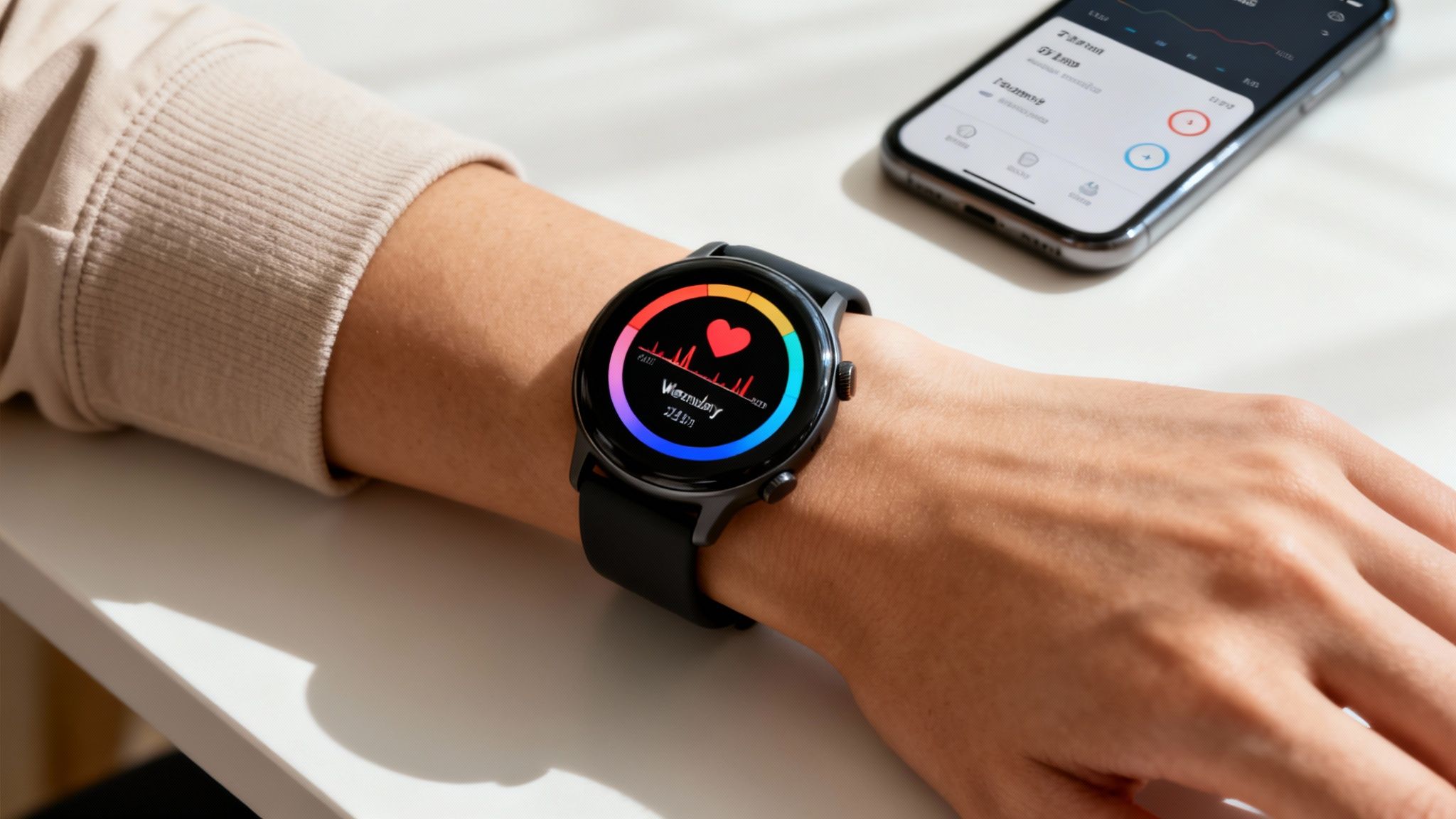
Let's be honest, flying blind on your fitness journey is a recipe for frustration. You're putting in the work, but are you getting the results? This is where technology—from the smartwatch on your wrist to a solid fitness app—stops being a gadget and starts being your coach. It's time to get past simply counting steps and start using real data to make every single workout count.
When you move from just passively tracking to actively analyzing your numbers, your fitness goals become dynamic. You can see what's working in real-time. This lets you make smart adjustments on the fly, knowing exactly when to push harder and when your body is telling you to back off and recover.
Go Beyond Basic Metrics
Sure, most wearables track steps and sleep, and that’s a good starting point. But if you really want to dial in your training, you need to dig a little deeper. Metrics like heart rate zones, for example, are absolute gold for making sure your effort level actually matches your goals.
- Heart Rate Zones: Training in specific zones is how you target different results. A chill Zone 2 workout is perfect for building endurance, while blasting through a high-intensity session in Zones 4 and 5 will fire up your metabolism.
- Heart Rate Variability (HRV): This one is a game-changer. HRV measures the tiny variations between your heartbeats, and it's a fantastic indicator of how ready your body is to train. A high HRV usually means you're well-rested and good to go, while a dip might be a sign to take a lighter, recovery-focused day.
- VO2 Max: Think of this as a benchmark for your cardiovascular fitness. It measures the maximum amount of oxygen your body can use during tough exercise. Watching this number improve over time is concrete proof that your hard work is paying off.
This data-driven approach isn't just theory; it has a huge impact on consistency. An analysis of millions of users found that 59% of those following structured plans trained for an average of 301 minutes a week—that's more than double the WHO's recommendation! A staggering 87% of them used heart rate data from wearables to guide those workouts.
Automate Your Progress with Smart Apps
Trying to interpret all this data yourself can feel like a full-time job. That's where a smart fitness app like Zing Coach comes in and does the heavy lifting for you. A good app doesn't just throw numbers at you; it tells you what they mean for your next workout.
Zing’s AI, for example, crunches the numbers from your performance and recovery data to automatically tweak the intensity of your next session. It's like having a personal programmer constantly updating your plan as you get stronger, which is the secret to busting through plateaus and staying motivated. If you're working out at home, finding an app with this kind of smart personalization is key. Our guide on how to choose the best home workout app for women has more great tips on what to look for.
Technology turns your goals from static targets into a living, breathing plan. It gives you the real-time feedback you need to stay engaged, adapt when things get tough, and celebrate every win along the way.
For anyone who loves to organize their wellness journey, other dedicated tools can help you track your progress and build consistent habits across the board. By pairing your fitness goals with smart tracking, you're not just guessing anymore. You're creating a powerful system that guides your effort and proves your hard work is delivering results.
Navigating Setbacks and Adjusting Your Goals with Confidence
Let's be real: the "perfect" fitness plan is a myth. In the real world, progress is messy and never a straight line. Life always finds a way to throw a wrench in the works—an unexpected project at work, a week where you feel totally drained, or a frustrating plateau that makes your goal feel miles away.This isn't a sign of failure. It's just... life. This stuff is a normal, expected part of any fitness journey that lasts longer than a few weeks. The trick isn't to avoid these bumps in the road, but to learn how to roll with them. It’s all about building resilience and learning to be flexible without completely ditching your ambitions.
Think of your fitness plan less like a rigid contract and more like a living, breathing document. It has to be able to bend so it doesn't break.
The Art of the Strategic Adjustment
When you hit a roadblock, the knee-jerk reaction is often one of two extremes: plow through at all costs or just quit. But the smartest move is almost always somewhere in the middle: adjust. Making small, intelligent tweaks to your routine is what keeps you in the game when things aren't perfect.
Here are a few ways I've seen this play out:
- Time Crunches: Can't make your usual 60-minute gym session? Don't just write the day off. Swap it for a fiery 20-minute bodyweight circuit at home. The real goal is keeping the habit alive, even if it's just a small dose.
- Motivation Dips: Feeling zero inspiration to lift weights? It happens. Go for a long walk, hop on a bike, or just do some stretching. Doing something is infinitely better for your momentum than doing nothing at all.
- Fatigue or Soreness: Listen to your body. If it’s screaming for a break, give it one. Instead of another tough workout, make it a dedicated recovery day with stretching, foam rolling, or some light yoga.
Sometimes, you might need a more significant break before jumping back in. If that’s the case, our guide on how to start working out again has some practical steps for easing back into things safely.
Remember this: consistency will beat intensity every single time. A "good enough" workout that you actually do is way more valuable than the "perfect" one you keep skipping.
Schedule Regular Goal Reviews
The most successful people I know in fitness operate on a simple cycle: act, then reflect. To make sure your goals stay relevant and within reach, you have to check in on them. A good rhythm is a quick weekly review and a more detailed assessment every 4-6 weeks.
During these check-ins, ask yourself a few honest questions:
- Am I on track? Take a look at your numbers. If you're hitting your targets, awesome. If not, it’s time to figure out why.
- Does this goal still matter to me? Priorities shift. A goal that felt super exciting six weeks ago might not light you up anymore. That's perfectly okay.
- Is this sustainable? Let's be real. Is your current routine pushing you toward burnout, or does it feel like something you can actually stick with long-term?
This simple process turns you from someone just following a plan into the driver of your own fitness journey. By embracing adjustments and regularly checking your map, you ensure that every step—even the detours—is bringing you closer to where you want to go.
Your Top Questions About Setting Fitness Goals, Answered
Even with a rock-solid plan, you're going to have questions as you get started. Think of goal-setting not as a one-time event, but as a skill you build over time. Let's tackle some of the most common questions that come up, so you can keep moving forward with confidence.
How Many Fitness Goals Should I Set at Once?
It’s so easy to get fired up and try to overhaul your entire life overnight. But trust me, focus is your best friend here. A good rule of thumb is to stick to 1-3 primary goals at a time. Any more than that, and you risk feeling pulled in too many directions.
A strategy I've seen work incredibly well is to have one main outcome goal that's supported by a couple of smaller, action-based process goals.
For instance:
- Outcome Goal: Lose 15 pounds in 3 months.
- Process Goal 1: Strength train 3 times per week.
- Process Goal 2: Eat 5 servings of vegetables daily.
This setup keeps you laser-focused. Once you nail these and they start feeling like second nature, then you can layer on new, more ambitious goals.
What's the Difference Between Outcome and Process Goals?
Getting this distinction is a game-changer for staying motivated. An outcome goal is the big prize you're after—the destination. Think "run a half-marathon" or "fit into my old jeans."
A process goal, on the other hand, is a specific action you can control to get there. To use the half-marathon example, a process goal would be "run 3 times a week, adding one mile to my long run each weekend." You have total control over lacing up your shoes and getting out the door, and that's incredibly empowering.
The most successful fitness plans are built on a smart mix of both. Your process goals are the daily and weekly steps that, when done consistently, make your big outcome goal feel almost inevitable.
My Motivation Is Fading After a Few Weeks. What Should I Do?
First off, welcome to the club! This happens to literally everyone. Motivation is fickle; it comes and goes. Discipline and solid habits are what will see you through the dips. When your motivation takes a nosedive, it’s time to play detective.
Start by reconnecting with your "why"—that core, personal reason you started this journey. Next, take a hard look at your goal. Is it too big? Too vague? Try breaking it down into smaller, weekly targets to give yourself more frequent wins. A little variety in your routine can also work wonders. Sometimes, just seeing visual proof of your progress—no matter how small—is the perfect fuel to get the fire going again.
How Often Should I Review and Adjust My Fitness Goals?
Your fitness plan shouldn't be carved in stone. Life happens. A good rhythm is to do a quick weekly check-in on your process goals (Did I get my workouts in?) and a more in-depth review of your main outcome goals every 4-6 weeks.
That timeframe is the sweet spot—long enough to see real progress but short enough to course-correct if something’s not clicking. If your schedule gets turned upside down, you hit a plateau, or you pick up an injury, those are all perfectly valid reasons to reassess sooner. Remember, flexibility is a superpower.
Ready to stop guessing and start achieving? The Zing Coach AI builds a fitness plan that adapts to your progress, equipment, and schedule. Get a personalized roadmap to your goals by visiting https://zing.coach and starting your journey today.
Share this article


Authors